
Sapio Sciences Review: Features, Pricing & Who It’s For (2026)
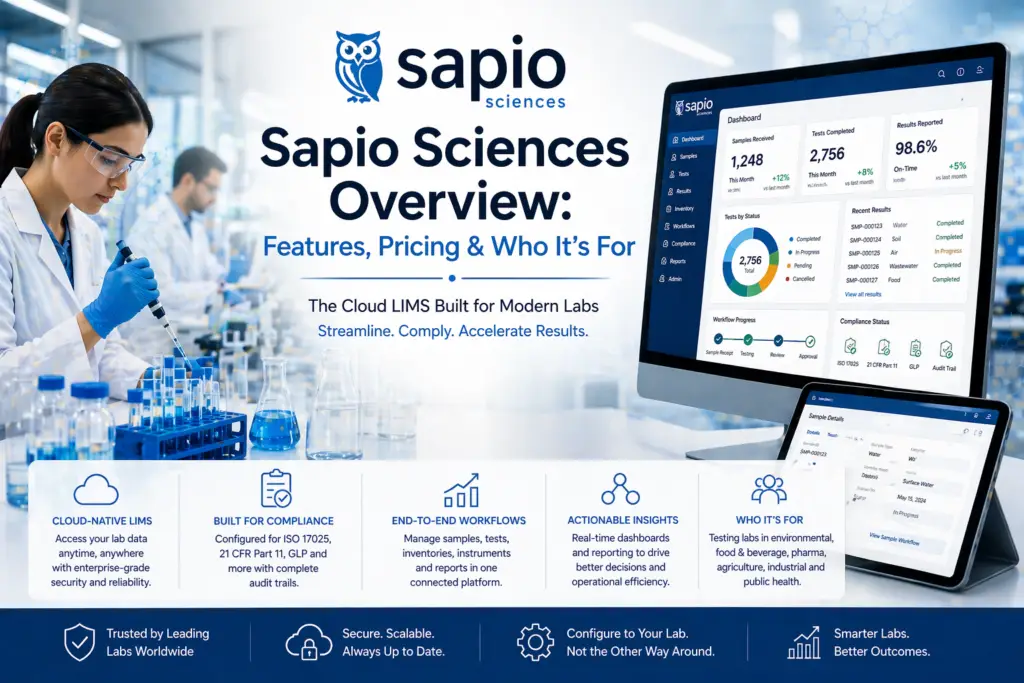
Sapio Sciences is a laboratory informatics platform founded in 2004 by Kevin Cramer in Baltimore, Maryland. The company’s origins are in genomics and machine learning — its first product, Exemplar Analytics, integrated over 50 algorithms for genetic data analysis. In 2007, Sapio entered the LIMS market with Exemplar LIMS, and in 2017 became, according to Wikipedia, the first company to integrate a full-featured, web-based Electronic Lab Notebook with a LIMS on a single unified platform. In December 2022, GHO Capital Partners — a London-based private equity firm specialising in global healthcare — took a majority stake in the company. The investment press release confirmed named customers at the time of investment as Bristol Myers Squibb, GSK, Johnson & Johnson, Charles River, and LabCorp. GHO’s stated rationale was to fund international expansion, particularly into Europe, and accelerate AI development. Today, Sapio describes itself as an “AI-native” lab informatics platform, positioning its LIMS, ELN (Sapio ELaiN), and Scientific Data Cloud as a unified system purpose-built for biopharma R&D, CROs, and clinical diagnostics. Its momentum in 2024–2025 has been notable: it secured the Wellcome Sanger Institute as a customer (December 2025), Schrödinger (January 2025), AstraZeneca spoke at its annual SapioCon conference (2025), and it integrated NVIDIA BioNeMo into its platform (March 2025). This article draws exclusively on Sapio’s official website, Wikipedia, GHO Capital’s press releases, Business Wire announcements, G2, Sourceforge, and independent analyst sources. Sapio Sciences has not reviewed, sponsored, or paid for this article. At a glance Field Details Vendor Sapio Sciences, Inc. Founded 2004 by Kevin Cramer Headquarters Baltimore, Maryland, USA. Offices in York PA, Fort Lauderdale FL, and London, UK. CEO & CTO Kevin Cramer (founder) Ownership Private equity backed. GHO Capital Partners took a majority stake in December 2022. Platform scope LIMS (Sapio LIMS®) + ELN (Sapio ELaiN™) + Scientific Data Cloud — all on one unified, no-code/low-code architecture Deployment Cloud-native SaaS. AWS-hosted. Confirmed no on-premise offering in current platform. Key industries Biopharma R&D, biotechnology, CRO, clinical and molecular diagnostics, biomanufacturing/GMP, NGS Named customers Bristol Myers Squibb, GSK, J&J, Charles River, LabCorp (GHO press release, 2022). Oxford Biomedica (2023). Schrödinger, LabConnect (2025). Wellcome Sanger Institute (December 2025). Compliance 21 CFR Part 11, EU Annex 11, GxP (full GxP validation awarded 2024). SOC 2 Type 2 (August 2024). HIPAA/HITECH (August 2024). HDS — Hébergeur de Données de Santé (January 2025). ISO 27001 not confirmed. ELN included Yes — Sapio ELaiN is a core product, not an add-on. Integrated with LIMS in a single platform. AI assistant ELaiN — first launched in 2023. Third-generation version integrates AWS Bedrock (November 2024), NVIDIA BioNeMo (March 2025), and a partner ecosystem including CCDC, Cadence Molecular Sciences/OpenEye, and Optibrium (January 2026). Pricing Not publicly listed. Quote-based. Multiple editions including a free Bronze entry tier (academic/small startup). Paid tiers require direct engagement. Languages English, French, German, Italian, Portuguese, Spanish (per Sourceforge listing) Support Phone, 24/7 live support, online. Training included with purchase (per Sourceforge). Annual SapioCon user conference. G2 Listed on G2 with multiple editions (LIMS, ELN, Scientific Data Cloud). Reviews are present but review count is modest compared to more marketing-mature LIMS vendors. What Sapio Sciences does Sapio’s platform is built around three integrated products that share a single cloud-native architecture and data foundation. The company’s core claim is that this unification eliminates the need to integrate separate LIMS, ELN, and SDMS systems from different vendors: Additional scientific tools built into the platform, per the Sapio website, include CRISPR design, genome browsing, vector modification, plasmid design, compound design, 3D plating, and flow cytometry data management. Electronic Batch Record (EBR) capabilities were released in October 2024. SapioCon 2025 context Sapio’s annual conference (SapioCon) in 2025 featured presentations from AstraZeneca, Johnson & Johnson, CureVac, Olink, Amazon AWS, and IQVIA. AstraZeneca’s Global Head of IT for Research, Amrik Mahal, presented on how AstraZeneca uses Sapio informatics to drive its digital transformation in drug discovery. This is referenced in Sapio’s resource library blog (“Making a Difference: Digital Transformation and LIMS in Pharma (AstraZeneca)”) but a formal press release confirming the customer relationship has not been published by Sapio as of April 2026. Compliance and regulatory support Sapio’s compliance posture has strengthened substantially in 2024–2025. All of the following are confirmed through official press releases, Wikipedia, and Business Wire announcements: Validation note Sapio’s full GxP validation (2024) means the platform has been formally validated for use in regulated environments. Sapio’s GMP LIMS is described on its website as “out-of-the-box support for batch management, QC testing, stability and environmental monitoring, and automatic COA generation.” Labs in regulated GMP manufacturing should request Sapio’s full validation package and documentation scope before purchase, as the degree of vendor-supplied vs. lab-supplied validation evidence varies by deployment context. Deployment and architecture Sapio is a cloud-native SaaS platform. The Wikipedia article and GHO Capital press release both confirm it operates as a SaaS business. The platform is built on AWS — AWS Bedrock integration was confirmed in November 2024, and AWS was a speaker at SapioCon 2025. No on-premise deployment option has been confirmed in publicly available documentation. The platform is described as no-code/low-code: workflow designers, rules engines, and UI design tools allow labs to configure the system without developer involvement. Where custom code is required, ELaiN can automatically generate Python configuration code from natural language prompts. The system supports hundreds of concurrent users and multi-site deployments, per the GHO Capital investment documentation. Integration is supported through APIs, webhooks, and direct instrument interfaces. The Wellcome Sanger Institute deployment (December 2025 press release) specifically calls out “advanced workflow automation and equipment integration” including the ability to connect to new, cutting-edge instruments — a practical validation of the platform’s integration capability at enterprise scale. Key milestones: 2022–2026 This timeline draws exclusively on Wikipedia, Business Wire, and Sapio’s own press releases: Pricing Sapio does not publish pricing publicly. All paid tiers require a direct quote. G2 lists five pricing editions; Sapio’s website and G2 confirm a free Bronze tier exists. Based on G2’s pricing page and independent analysis: Pricing
Benchling Overview: Features, Pricing & Who It’s For (2026)
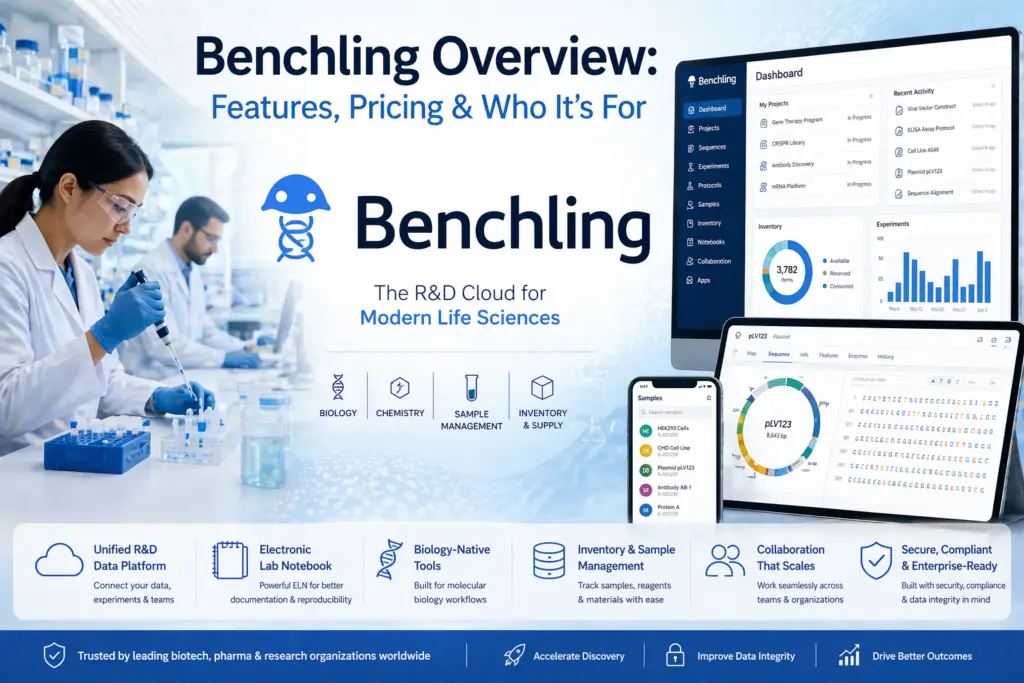
Benchling was founded in 2012 in San Francisco by Sajith Wickramasekara and Ashu Singhal, two MIT alumni who met while working in biology research labs. The company’s stated mission from the outset was to build software purpose-built for biology — not adapted from generic laboratory management tools. Today, according to its own press releases, Benchling serves more than 1,300 biotech companies worldwide, including more than half of the top 50 global biopharma companies, and more than 200,000 scientists rely on its platform. The company has raised a total of $418 million in funding across 11 rounds, per PitchBook. Its last published valuation was $6.1 billion following a Series F in November 2021 — a figure that has not been publicly updated since. Key investors include Altimeter Capital, Tiger Global, Benchmark, ICONIQ Capital, Lux Capital, Franklin Templeton, and Thrive Capital. Benchling sits at an important intersection in the lab software market: it is neither a traditional LIMS nor a pure ELN. The company describes itself as a unified R&D Cloud — a platform that brings electronic notebook, molecular biology tools, sample management, workflow orchestration, and AI into a single cloud-native system built specifically for life sciences research and development. This article is based exclusively on Benchling’s official documentation, press releases, AWS Marketplace listing, PitchBook, Sacra research, G2, and independent analysis from Clarkston Consulting. No payment or sponsorship from Benchling is involved. At a glance Field Details Vendor Benchling, Inc. Founded 2012 Headquarters San Francisco, California, USA Co-founders Sajith Wickramasekara (CEO) and Ashu Singhal (President) Employees ~797 (PitchBook, 2026) Funding raised $418 million across 11 rounds (PitchBook). Last published valuation: $6.1 billion (Series F, November 2021) Estimated ARR Sacra estimated $210 million annualised recurring revenue as of May 2024, up 27% year-on-year Users 200,000+ scientists across 1,300+ companies and 7,500 academic institutions (Benchling press releases, 2025) Deployment Cloud-only (SaaS). No on-premise option. Platform scope Notebook (ELN), Molecular Biology, Registry, Inventory, Requests, Workflows, Insights, Lab Automation, Benchling AI Key industries Biotech, biopharma, academic research, agricultural biotech, synthetic biology Named customers Merck, Moderna, Sanofi (1,500+ scientists, 30 teams — June 2024 press release) Compliance 21 CFR Part 11, EU Annex 11, GxP (via Validated Cloud), ISO/IEC 27001:2022, SOC 2 Type 2, GDPR, CCPA, NIST, C5 ELN included Yes — Notebook is one of seven integrated applications, not an add-on Pricing Not publicly listed. Quote-based enterprise contracts. Academic use: free. Startup pricing last published in 2020 at ~$20,000/year for 5 users. G2 rating 4.5 / 5 — Leader badge in LIMS and ELN categories. Most recent review: January 2025 (per QBench) Free tier Yes — free for academic scientists, including Benchling AI (launched October 2025) Recent acquisitions ReSync Bio and Sphinx Bio — both acquired August 2025 to accelerate AI roadmap What Benchling does Benchling describes its platform as the R&D Cloud — a unified, cloud-native system built around the specific needs of biology-driven research. Unlike traditional LIMS that were designed primarily for structured, repetitive QC workflows, Benchling’s architecture prioritises the flexibility and collaboration needs of early-stage and mid-stage biotech R&D. Its platform consists of seven integrated applications, all sharing a common data layer: The platform also exposes well-documented REST APIs, event-triggered integrations, and a built-in Data Warehouse, confirmed on both the Benchling website and its AWS Marketplace listing. New capabilities announced at Benchtalk 2025 include custom Python and R scripting running natively inside the platform. Important distinction Benchling is often described as a LIMS, but its architecture prioritises R&D flexibility over the structured QC workflows that define traditional LIMS. Independent consultancy Clarkston Consulting states clearly that Benchling “does not provide adequate support for quality control (QC) activities such as batch management, product specifications, and report generation” at commercial scale. Labs transitioning from early R&D to regulated manufacturing QC should evaluate whether Benchling’s Validated Cloud meets their full compliance requirements before committing. Deployment Benchling is a cloud-only platform — there is no on-premise option. All data is hosted in Benchling’s cloud infrastructure, which maintains ISO/IEC 27001:2022 certification (with extensions ISO/IEC 27017:2015 and 27018:2019) and SOC 2 Type 2 attestation, confirmed on Benchling’s Trust page. The platform uses AES 256-bit encryption at rest and TLS 1.2 or higher in transit, and operates a Zero Trust security policy. There are two tenant types: The AWS Marketplace listing confirms the platform is 21 CFR Part 11 compliant. Single Sign-On (SSO) with multi-factor authentication (MFA) is supported, and customers can configure access control via their own SSO provider. Compliance and regulatory support Benchling has published a whitepaper specifically addressing GxP computer systems validation considerations. Key compliance capabilities, verified across Benchling’s Trust page, Validated Cloud product page, and the GxP whitepaper: Validation note Validated Cloud tenants receive quarterly releases with Validation Plan and Impact Assessments from Benchling. The GxP whitepaper describes the split between what Benchling is responsible for and what the customer must complete to maintain a validated state. Clarkston Consulting notes that while this “reduces customers’ validation burden,” labs must still complete their own validation activities. The full validation responsibility is shared, not transferred to Benchling. Pricing Benchling does not publish current pricing. The last pricing information published on Benchling’s website was in 2020, when the professional plan was listed at around $20,000 per year for five users. That figure has not been officially updated. Sacra’s independent financial research (May 2024) estimates an average revenue per customer of approximately $175,000 as of May 2024, up from $125,000 in 2017–2018, reflecting expansion within existing accounts. With 1,200 commercial customers as of May 2024 and $210 million in estimated ARR, this average is consistent with mid-to-large enterprise contracts. Benchling offers a free plan for academic scientists, extended in October 2025 to include free access to Benchling AI. For commercial labs, pricing is available on request. Pricing note Independent sources consistently describe Benchling as one of the more expensive platforms in the biotech R&D space. One 2025 analysis (cited by IntuitionLabs, noting it was sponsored by a competitor) suggests per-user costs in the range of $5–$7k per user per year.