The promise of open-source laboratory software is compelling: no licence fees, full access to the source code, unlimited users, and the freedom to customise every workflow. In a market where enterprise LIMS and ELN contracts routinely run to six figures, it is no surprise that academic labs, startups, public health institutions, and budget-conscious industrial labs have invested seriously in open-source alternatives.
But the reality is more nuanced than the marketing. Open-source does not mean free — it means the software is free. Infrastructure, implementation, validation, maintenance, and support are not. For some labs, that trade-off is excellent value. For others, it is a costly detour.
This guide reviews the most capable open-source and free ELN and LIMS solutions available in 2026, and gives you a clear-eyed view of where they genuinely work — and where they fall short.
The leading open-source ELN platforms
eLabFTW is the most widely deployed open-source ELN in academic research. Published under the AGPLv3 licence and actively maintained by Deltablot, it covers experiment documentation, inventory management, team collaboration, audit trails, and multi-language support across 21 languages. Crucially, it supports the open .eln file format promoted by the ELN Consortium, protecting your data from lock-in. It requires a Linux server and comfort with Docker; institutions with IT support find it straightforward to deploy. Its FAIR data alignment and active global community make it a genuine first choice for academic and research labs.
| Solution | Type | License / model | Best for |
| eLabFTW | ELN | AGPLv3 — fully free, self-hosted | Academic & research labs of all sizes |
Chemotion ELN was developed at the Karlsruhe Institute of Technology specifically for chemistry research. Published in the Journal of Cheminformatics, it features molecular structure handling, reaction planning, integration with PubChem and SciFinder, and a research data repository (Chemotion Repository) for FAIR-compliant data publication. If your lab works in organic chemistry or chemical sciences, it is one of the few open-source tools built for that domain rather than adapted from a generic notebook.
| Solution | Type | License / model | Best for |
| Chemotion ELN | ELN | EUPL — free, self-hosted | Chemistry & chemical sciences labs |
SciNote occupies an interesting middle ground: its core is open source under Mozilla Public License, built in Ruby on Rails. Life science teams and academic groups can self-host the community edition at no cost. SciNote also offers a commercial SaaS tier with 21 CFR Part 11 compliance and GxP features — making it one of the few open-source-rooted tools that can scale into regulated environments with vendor support.
| Solution | Type | License / model | Best for |
| SciNote | ELN | Open core — free community / paid SaaS tier | Life science researchers; regulated labs via paid tier |
The leading open-source LIMS platforms
SENAITE is the most production-ready open-source LIMS available today. Originally forked from Bika LIMS — one of the earliest open LIMS, in active development since 2002 — SENAITE is a web-based system built on Plone/Python that targets testing and calibration laboratories. It supports ISO/IEC 17025 process controls, instrument connectivity with automatic result import, full audit trails with immutable snapshots, worksheets and workload planning, and a REST JSON API for BI integration. Deployed in diagnostic, environmental, and public health laboratories across multiple countries, it is a serious production system rather than a prototype.
| Solution | Type | License / model | Best for |
| SENAITE | LIMS | GPLv2 — free, self-hosted; commercial support available | Testing, calibration, environmental & diagnostic labs |
Bika LIMS, the ancestor of SENAITE, continues as an independent project with a global community. It retains the same Plone/Python architecture and ISO 17025-compatible audit trail, with a focus on giving labs full ownership and zero licence fees. For labs that want to self-configure and self-support, Bika provides an established, well-documented codebase.
| Solution | Type | License / model | Best for |
| Bika LIMS | LIMS | GPLv2 — free, self-hosted | Environmental, food & agricultural testing labs |
OpenELIS is a LIMS purpose-built for public health and clinical laboratory environments, particularly relevant for HIV/TB testing, diagnostics, and national health programmes. It is backed by a global foundation, actively maintained, and deployed across multiple countries in Africa, the Caribbean, and Asia. The 2025 release introduced flexible patient matching and real-time NPI registry integration. If your context is public health or clinical diagnostics, OpenELIS deserves attention over general-purpose alternatives.
| Solution | Type | License / model | Best for |
| OpenELIS | LIMS | Apache 2.0 — free, self-hosted; community-supported | Public health, clinical & diagnostic labs |
openBIS from ETH Zurich is a combined ELN-LIMS designed for research data management in academic settings. It supports FAIR principles and is used by projects affiliated with the German National Research Data Infrastructure (NFDI). It is more complex to configure than eLabFTW, but offers powerful data modelling capabilities across biology, physics, chemistry, and materials science — and was specifically designed for multi-disciplinary research consortia.
| Solution | Type | License / model | Best for |
| openBIS | ELN-LIMS | Apache 2.0 — free, self-hosted | Multi-disciplinary academic research, NFDI/FAIR initiatives |
Free tiers worth considering
Beyond fully open-source tools, several commercial platforms offer genuinely useful free tiers that may suit smaller or early-stage labs without requiring a full open-source infrastructure commitment.
| Free tier | Benchling offers a free plan for academic researchers with access to its ELN and molecular biology tools. Feature-gated (no enterprise compliance or advanced LIMS workflows), but widely used and well-regarded for ease of use in biotech and life sciences. |
| Free tier | LabArchives provides a free tier for individual researchers covering basic ELN functionality. Widely adopted in universities due to institutional agreements with many US and European institutions. |
| Free tier | SciNote offers a free plan for individual users and small teams with access to core experiment documentation, protocols, and basic inventory — sufficient for academic lab groups getting started with digital notebooks. |
The real advantages of open-source lab software
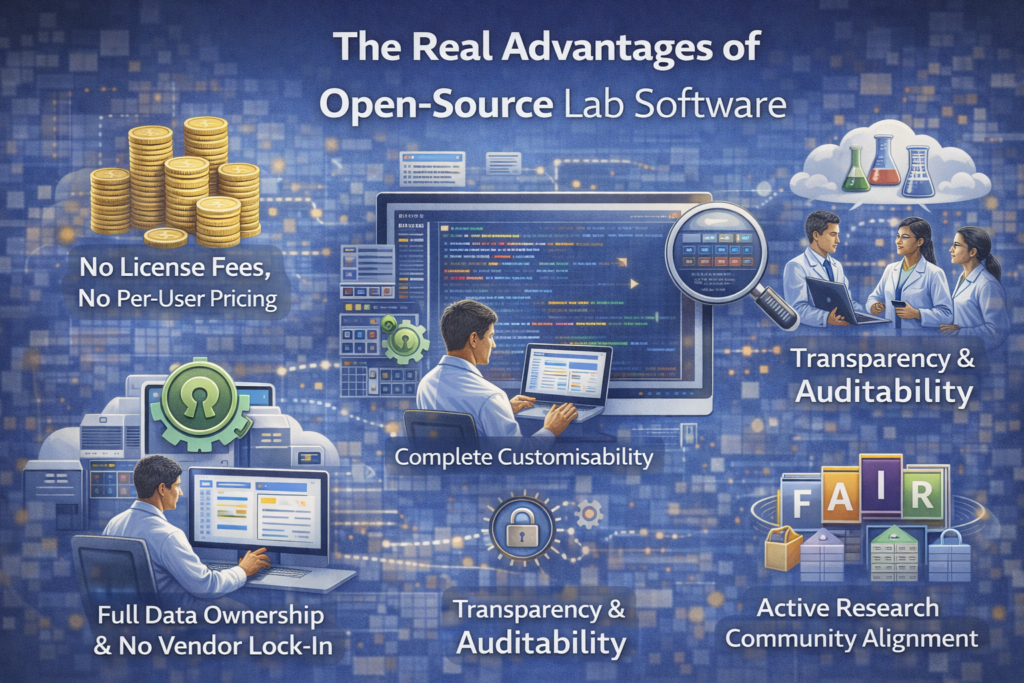
- No licence fees, no per-user pricing. The most immediate benefit: once deployed, the software itself costs nothing regardless of how many users you add. In labs with large team sizes or tight budgets, this is a significant structural advantage over SaaS pricing models that charge per seat.
- Full data ownership and no vendor lock-in. Your data lives on your own infrastructure in open, documented formats. There is no risk of a vendor acquisition, pricing change, or service discontinuation forcing an expensive migration. eLabFTW’s support for the open .eln format is a good example of this principle in practice.
- Complete customisability. Because the source code is available, labs with IT capability can modify any workflow, add integrations, or build domain-specific features that would require expensive professional services engagements with commercial vendors.
- Transparency and auditability of the code itself. Open-source software is subject to public scrutiny. Security vulnerabilities can be identified and patched by the community, and accreditation assessors can, in principle, inspect the source code supporting your compliance claims — something impossible with proprietary black-box systems.
- Active research community alignment. Tools like eLabFTW, Chemotion, and openBIS are developed by and for researchers. Feature development tends to track actual scientific workflows rather than commercial product roadmaps, which can result in better alignment with how labs actually work.
- FAIR data compliance. Many open-source ELNs explicitly support FAIR principles (Findable, Accessible, Interoperable, Reusable) and open data formats, aligning with funder mandates from DFG, NIH, and the European Research Council.
The real disadvantages — what the brochures omit
- Implementation is not free. Deploying a self-hosted system requires a Linux server, IT administration, Docker knowledge, and ongoing system maintenance. For labs without dedicated IT support, this is a significant hidden cost — often equivalent to one or more years of a mid-tier SaaS subscription.
- Validation burden falls entirely on the lab. Commercial LIMS vendors typically provide IQ/OQ documentation and validation packages. With open-source software, the lab must produce all validation evidence independently. Under the FDA’s Computer Software Assurance (CSA) framework and ISO 17025 Clause 6.4.7, this can be a substantial project requiring specialised consulting resources.
- No contractual SLA or guaranteed support. Community forums and GitHub issues are not the same as a contracted support agreement with response time guarantees. For regulated environments, the absence of vendor accountability is a genuine compliance risk that must be addressed through alternative means (commercial support contracts, internal expertise).
- Compliance features may require significant configuration. Many open-source LIMS and ELN tools are designed primarily for academic or research contexts. Satisfying 21 CFR Part 11, EU Annex 11, or ISO 17025 in a regulated production environment often requires substantial configuration, potentially custom development, and careful validation — significantly increasing total cost and timeline.
- Slower feature velocity in some projects. Community-driven development means feature requests depend on volunteer effort or sponsored development. If your lab needs a specific integration or workflow that is not on the community roadmap, your options are to build it yourself, commission it, or wait.
- Risk of project discontinuation. Smaller open-source projects can become inactive when their core maintainers move on. Before committing to a platform, review its GitHub commit history and community activity to assess long-term viability.
Licences and support models: what to check before you commit
“Open source” covers very different arrangements. Two questions matter more than the label: what the licence obliges you to do, and who will help when something breaks.
What the licence type means for a lab
- Copyleft licences (GPL, AGPL). You can use, modify and self-host the software freely. Obligations apply when you share it: under the GPL, if you distribute a modified version, you must release its source code under the same licence. The AGPL extends this to software offered over a network, so if you modify an AGPL application such as eLabFTW, users who interact with it over a network must be offered the modified source code. For a lab running the software without modifying it, these obligations rarely create work.
- Permissive licences (Apache 2.0, MIT). Fewer conditions: modified versions can stay private, provided licence and copyright notices are kept. openBIS and OpenELIS use Apache 2.0.
- Open core. A free community edition with some features, hosting or compliance capabilities reserved for a paid tier, as with SciNote. Check which edition the features you need belong to before planning a free deployment.
If your organization plans to modify the code or offer the system to partners or clients, ask your legal or IT team to review the licence before deployment. The full texts are published by the Free Software Foundation and the Apache Software Foundation.
Community support vs commercial support
- Community support means forums, documentation and issue trackers. It can be excellent for active projects, but there is no guaranteed response time, and fixes follow the project’s priorities rather than your deadline.
- Commercial support and hosting from the maintainers or certified partners adds service levels, managed updates and sometimes validation help. Deltablot, the company behind eLabFTW, offers managed hosting, and several open-source LIMS projects have paid implementers.
- Internal support is the default if you choose neither: your IT team or a technically skilled scientist becomes the support desk, including security updates and backups.
A practical rule: for research labs with in-house IT, community support is often enough. For operational or regulated environments, budget commercial support from the start and check the project’s health (release frequency, number of active maintainers, responsiveness to issues) as carefully as you would assess a commercial vendor. Our open-source LIMS guide covers this evaluation in more depth, and the eLabFTW overview shows how the self-hosted and managed options compare in practice.
Open source: who it works for, and who should look elsewhere
| Well suited | Academic and research institutions with IT support, public health programmes in resource-limited settings, startups in pre-regulatory phase, industrial labs doing non-regulated testing with price-sensitive procurement, and any lab that has developer resources and values data sovereignty above managed-service convenience. |
| Proceed with caution | Regulated pharmaceutical, biotech, or clinical diagnostics labs needing out-of-the-box 21 CFR Part 11 or GxP compliance. Multi-site enterprise deployments requiring contractual SLA and audit-ready validation packages. Labs with no IT staff and limited technical capacity. If compliance, validation, and support accountability are your top priorities, a commercial LIMS with a vendor-supplied validation package may represent a lower total cost of ownership despite higher licence fees. |
The bottom line
Open-source ELN and LIMS solutions have matured significantly. SENAITE is a credible ISO 17025-capable LIMS. eLabFTW is a genuinely excellent research ELN adopted by major European universities. Chemotion is built from the ground up for chemical sciences. These are not compromises — they are serious tools.
The question is never whether open-source software is good enough. The question is whether your organisation has the infrastructure, the IT capability, and the internal expertise to extract its full value — and whether the validation and compliance overhead you take on is worth the licence savings.
For labs that can answer yes to both: open-source offers real, lasting advantages. For those that cannot, a modern SaaS platform with a validation package may be the more prudent investment.
Want to compare commercial alternatives? See our Best LIMS Software 2026 guide and our Best ELN Software guide for independent, vendor-neutral reviews.
Sources & further reading
• eLabFTW — open-source ELN project
• Chemotion ELN — Journal of Cheminformatics (Tremouilhac et al., 2017)
• SciNote — open-source ELN on GitHub
• Bika LIMS — open-source LIMS community
• OpenELIS — public health LIMS
• openBIS — ELN-LIMS, ETH Zurich
• GO FAIR Initiative — FAIR principles
• FDA Computer Software Assurance (CSA) framework
• The ELN Consortium — open .eln file format
• IntuitionLabs — Guide to open-source LIMS (2026)• GNU AGPLv3 licence