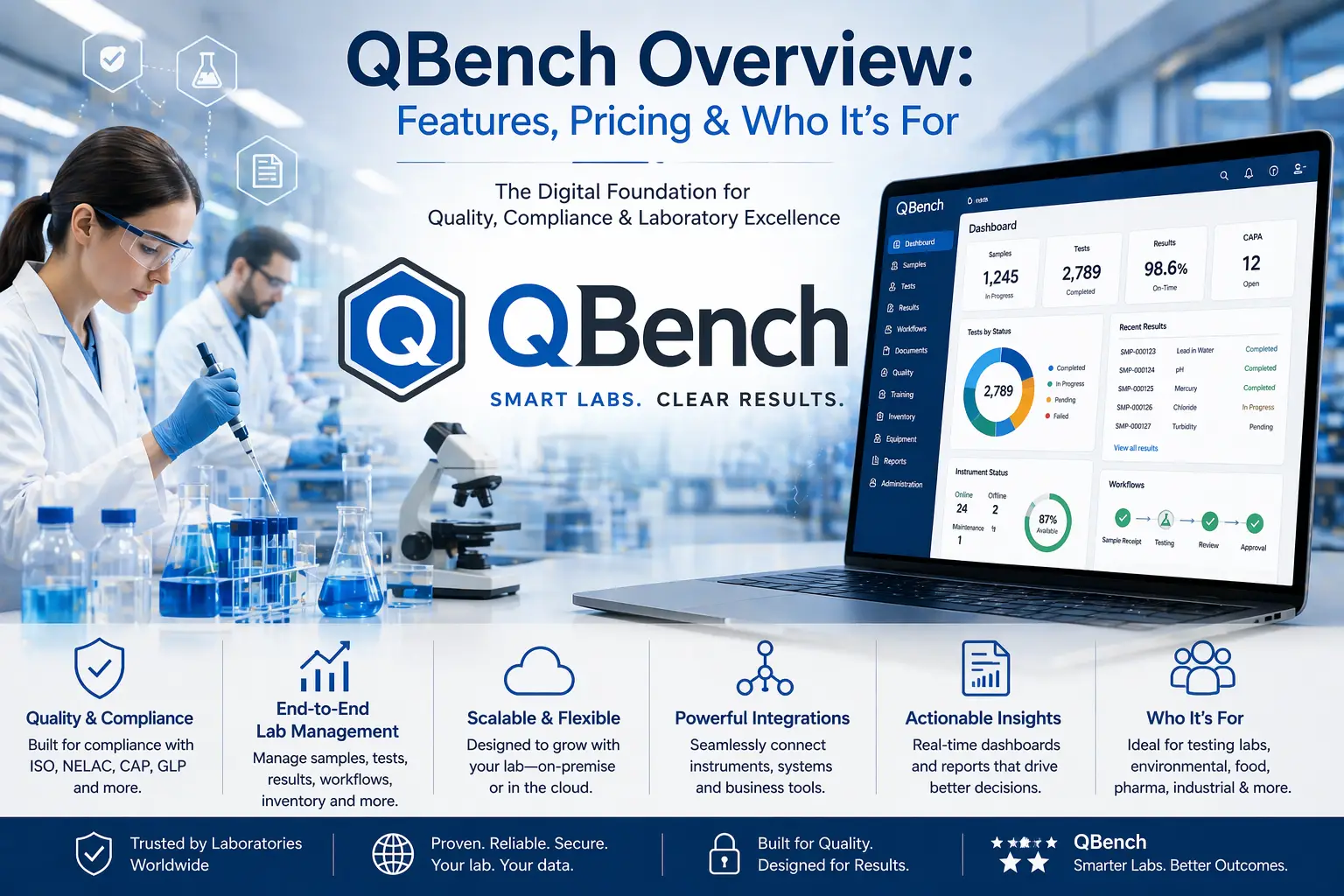
QBench is a cloud-based Laboratory Information Management System (LIMS) founded in 2016 and headquartered in Newark, Delaware. According to the company’s own blog and comparison pages, it was started by lab owners and software investors with over 30 years of combined laboratory experience — a founding context that explicitly shapes the product’s direction toward lab-manager usability rather than enterprise IT complexity.
The platform sits in the mid-market of the LIMS space: more fully featured and configurable than entry-level tools, more accessible and faster to implement than legacy enterprise platforms. It has built a notable track record on G2, holding the #1 position on G2’s Highest-Rated LIMS list and earning the Easiest to Use designation, with 133 verified reviews as of January 2026 and a 4.5/5 average rating.
QBench is privately owned — not venture-capital backed — by a group of families and software investors. The company states this gives it a long-term time horizon and the ability to prioritise customer outcomes over growth metrics. Approximately 85% of employees are based in North America as of 2025.
This article is based on QBench’s official website and pricing page, G2 and Capterra reviews, Software Advice, Crunchbase, CB Insights, and independent competitor analysis. QBench has not reviewed, sponsored, or paid for this article.
At a glance
| Field | Details |
| Vendor | QBench Inc. |
| Founded | 2016 |
| Headquarters | Newark, Delaware, USA |
| Ownership | Privately owned — family and software investors. Not VC-backed. |
| Employees | ~85% North America-based (QBench blog, 2025). Global team. |
| Deployment | Cloud-only (SaaS). Hosted on AWS. No on-premise option. |
| Platform scope | LIMS core + integrated QMS, Inventory Management, Customer Portal, Billing, REST API, Analytics/BI integrations |
| Key industries | Biotech & life sciences, food & beverage, environmental, agricultural, clinical & diagnostics, materials & manufacturing |
| Compliance | ISO 17025:2017, HIPAA, 21 CFR Part 11, CLIA, SOC 2 Type II (annual audit, no exceptions recorded) |
| ELN included | Not a core feature. Protocols (LES) are included. QBench positions itself as a LIMS-first platform. |
| Pricing | Publicly listed. Starts at $275/user/month (Foundation, billed annually, 5-user minimum). See pricing section below. |
| Implementation | Weeks, not months. Training: $5–$10K. Professional Services: varies by scope (per QBench pricing page). |
| Release cadence | Software updates every two weeks (per QBench’s own blog), enabling rapid feature delivery. |
| G2 rating | 4.5/5 — 133 reviews (January 2026). #1 Highest-Rated LIMS, #1 Easiest to Use, Momentum Leader (Winter 2026). 5 first-place rankings in G2 Spring 2026 report. |
| Free trial | No free trial. Demo available on request. |
What QBench does
QBench describes itself as a Lab Operating System — a positioning that signals its ambition to go beyond pure sample tracking and serve as the central operational hub for the entire testing workflow. The platform is built around a no-code configuration philosophy: labs can modify workflows, add custom fields, create automations, and build report templates without writing code or engaging vendor professional services for every change.
Core capabilities documented on qbench.com include:
- Sample and order management: End-to-end tracking from sample receipt through results reporting. Custom IDs, custom fields, and tagging on all core data types. Visual status tracking of orders, samples, and tests with filters and search.
- No-code workflow automation: An automation engine that allows labs to define triggers and actions to skip manual steps, speed up turnaround times, and enforce process consistency. Configurable without developer involvement.
- Batch tracking and electronic worksheets: Batch management with control charting, configurable worksheets using Excel-style formulas, and full audit trails per batch step.
- Report and Certificate of Analysis (CoA) generation: A point-and-click visual report template editor. Automated generation, approval, and bulk release of hundreds of reports. CoAs can be emailed directly to customers.
- Quality Management System (QMS, Advanced tier): Integrated QMS covering equipment management, issues and logs, CAPA management (Corrective and Preventive Actions), document control with version approval workflows, and training sets.
- Inventory management (Growth tier and above): Stock tracking with automated consumption, formulations, low-stock alerts, expired stock alerts, and cost-of-goods-sold (COGS) reporting.
- Customer Portal (Growth tier and above): Allows external customers to submit orders, track sample status, and access results without requiring a QBench user licence.
- Billing (Advanced tier): Quotations, invoice creation and emailing, dynamic price discounts and surcharges, customer-specific pricing, turnaround time discounts, and QuickBooks integration.
- REST API: Available from the Growth tier. Well-documented, open API for integration with instruments, ERPs, CRMs (HubSpot integration confirmed on qbench.com), NetSuite, Tableau, and QuickBooks Online. Direct instrument integration supported including analytical and liquid handling equipment.
- Analytics and BI: Built-in analytics for business KPIs. Tableau integration confirmed on the website for external BI.
QBench releases software updates every two weeks — a notably faster cadence than most LIMS vendors, which typically release quarterly or less frequently. The company publishes a customer feature request board where users can submit, vote on, and track feature ideas.
Deployment and security
QBench is a cloud-only SaaS platform hosted on AWS. There is no on-premise option. Data transmitted between the lab and QBench is encrypted using HTTPS. The platform undergoes an annual SOC 2 Type II audit — a press release published in 2023 confirmed the audit was completed with no exceptions, and the company commits to annual repetition.
Security and access controls documented on QBench’s compliance page include:
- Role-based access control — define roles and assign permissions at the user level
- SSO and MFA — available in the Enterprise tier only
- Full audit trail functionality for compliance documentation and inspection readiness
- Regular data backups
| SSO note | Single Sign-On (SSO) and Multi-Factor Authentication (MFA) are only included in the Enterprise tier, which requires a custom quote. Labs on lower tiers who require SSO for IT policy or regulated environment reasons should factor Enterprise pricing into their evaluation. This is confirmed in the CloudLIMS vs QBench competitive analysis published by CloudLIMS. |
Compliance and regulatory support
QBench’s compliance capabilities are documented on a dedicated security and compliance page at qbench.com. The platform supports:
- ISO 17025:2017: Explicitly confirmed on the QBench compliance page. QBench notes that the 2017 revision of the standard introduced a specific LIMS requirements section, which QBench’s documentation claims to meet.
- HIPAA: Confirmed. The compliance page states QBench keeps Protected Health Information (PHI) secure and provides controls for data integrity, availability, and confidentiality.
- 21 CFR Part 11 (FDA): Confirmed. Audit trail functionality and controls are described as supporting 21 CFR Part 11 requirements. QBench positions this for food & beverage, pharmaceutical, and medical device labs.
- CLIA: Confirmed on the platform’s homepage and Sourceforge listing.
- SOC 2 Type II: Annual audit conducted. 2023 audit completed with no exceptions per the QBench blog.
| Validation note | QBench offers access to third-party validation services through what it calls the QBench Vendor Alliance — connecting regulated customers with external vendors for validation. Unlike some enterprise LIMS providers, QBench does not supply IQ/OQ/PQ documentation directly; validation is the customer’s responsibility. Labs in 21 CFR Part 11 or GxP environments should confirm the scope of validation support before committing. This is noted in an independent comparison blog published by Thirdwave Analytics in January 2026. |
Pricing — one of the few LIMS vendors with published rates
QBench is unusual in the LIMS market for publishing its pricing publicly. All figures below are taken directly from qbench.com/pricing and QBench’s own blog posts. These are the only vendor-confirmed pricing figures available and should be verified at the time of purchase.
| Plan | Price / user / month | Min. users | Key additions vs tier below |
| Foundation | $275 / user / month | 5 users min. | Core LIMS: workflows, sample tracking, reports, no-code config, basic analytics |
| Growth | $325 / user / month | 5 users min. | Adds: Customer Portal, Inventory Management, Instrument Integration, REST API |
| Advanced | $425 / user / month | 5 users min. | Adds: QMS (CAPA, Doc Control, Training), Billing, Dropbox integration |
| Enterprise | Custom quote | Custom | Adds: SSO, MFA, dedicated support, custom SLAs |
Per QBench’s own hidden costs blog post, the Foundation plan starts at $16,500/year for a 5-user lab (billed annually). The company states volume discounts are available as labs grow, though specific volume discount thresholds are not published. Initial training is billed upfront at $5–$10K. Professional services for data migrations, third-party integrations, or custom work are billed separately as work is completed, and are delivered by Technical Account Managers who are described on the pricing page as former lab staff.
| Tier consideration | Labs requiring QMS functionality — including CAPA management and document control — must reach the Advanced tier at $425/user/month. For a 5-user lab, this is $25,500/year before training and professional services. Labs requiring SSO and MFA must reach the Enterprise tier with a custom quote. Regulated labs should map their compliance requirements against the tier structure carefully before using the Foundation price as a budget baseline. |
Who QBench is designed for
QBench’s About page states it serves “Fortune 100 companies to small businesses” across a wide range of lab industries. CB Insights and Crunchbase confirm the sectors it serves as: materials & manufacturing, food & beverage, biotech & life sciences, diagnostic & clinical, agriculture, and environmental.
In practice, QBench is most commonly chosen by:
- Small to mid-size testing labs that need to move off spreadsheets and paper-based systems quickly, without a 6–12 month implementation project
- Analytical testing labs, environmental labs, food safety labs, and agricultural labs where sample-to-report workflow is the primary use case
- Second-time LIMS buyers who have experienced the rigidity and vendor dependency of legacy enterprise systems and want configurable, self-serviceable software
- Labs in regulated environments (ISO 17025, HIPAA, 21 CFR Part 11) that need documented compliance without a full enterprise implementation
- Labs that want transparent, predictable per-user pricing rather than opaque enterprise quotes
It is less commonly the right fit for:
- Laboratories needing deep molecular biology or ELN capability for research workflows — Benchling or open-source ELNs are stronger options
- Multi-site global enterprise deployments requiring on-premise hosting or the breadth of a platform like LabVantage or LabWare
- Labs that require SSO and MFA without custom Enterprise pricing
What users say
The following themes are drawn from G2 (133 reviews, 4.5/5 — the largest independent review base of any LIMS in this series), Capterra, and Software Advice. QBench’s G2 profile is actively updated, including an October 2025 review update noting continued satisfaction.
Frequently praised
- Configurability and no-code flexibility: The single most consistent theme across G2. Reviewers describe being able to reshape workflows, rename fields, and build automations without IT involvement. One G2 reviewer states: “If you can imagine it, you can develop it on QBench.”
- Speed of implementation: Multiple reviewers contrast QBench’s weeks-based go-live timeline with prior LIMS experiences of 6–12 months. A food and beverage case study on CB Insights describes one lab going from kickoff to processing samples in approximately 40 days.
- Customer support quality: Support responsiveness is cited in nearly every positive review on both G2 and Capterra. G2’s generated review summary identifies “Customer Support” as a top-three positive theme by mention count. QBench’s Relationship Index ranking on G2 has consistently placed it at or near the top of the LIMS category.
- Automation engine: The no-code automation engine is highlighted by labs managing high-volume workflows, particularly for skipping repetitive manual steps and enforcing process consistency.
- Scalability: Several reviewers note starting with a basic configuration and growing the system over time. One Capterra reviewer describes beginning with a simple setup and iterating “as our processes have grown more complex.”
Frequently criticised
- Performance under load: The most consistently reported limitation. G2’s generated summary lists “Slow Performance” as the top negative theme by mention count (12 mentions). Users describe the UI slowing noticeably when loading pages with large datasets, many samples, or complex reports. One Software Advice reviewer notes this is “far from a work stop” but flags it explicitly.
- Feature depth vs enterprise platforms: Several G2 reviewers acknowledge that as a newer product, some features available in older, more mature platforms are missing. The team is noted as responsive to feature requests, and the two-week release cadence is cited as a mitigating factor.
- Learning curve on complex workflows: CB Insights’ independent summary notes some users describe workflows as not user-friendly at first and documentation as “sparse.” G2’s generated summary lists “Learning Curve” as a negative theme.
- QMS locked behind Advanced tier: Multiple independent comparison sources note that regulated labs needing quality management features cannot access them on the Foundation or Growth plans, creating an unexpectedly higher entry cost for compliance-critical use cases.
Quick verdict
| Best for | Small to mid-size testing labs in food & beverage, environmental, agricultural, biotech, and clinical/diagnostics sectors that want to get off spreadsheets and into a properly structured, cloud-based LIMS quickly — without a multi-month enterprise implementation. The published pricing, no-code configurability, fast onboarding, and consistently praised support team make QBench a strong default consideration for labs in the $16,500–$30,000/year budget range. The integrated QMS (Advanced tier) adds genuine value for labs pursuing ISO 17025 accreditation or FDA compliance without needing a separate quality management platform. |
| Consider alternatives if | Your lab requires on-premise deployment, deep molecular biology tools, or ELN capability — QBench does not offer these. If your primary need is research documentation rather than structured testing workflows, Benchling or open-source ELNs are better fits. For global multi-site enterprise deployments with complex integration requirements, LabVantage or LabWare offer greater depth. And if SSO and MFA are non-negotiable security requirements at a defined budget, map your need against the Enterprise tier pricing before proceeding. |
Further reading
- QBench official website
- QBench pricing page — official, publicly listed tiers
- QBench security and compliance page
- QBench on G2 — 133 verified reviews
- QBench on Capterra
- QBench G2 Spring 2026 rankings — QBench blog post
- QBench SOC 2 Type II audit announcement (2023)
- QBench hidden costs of a LIMS — pricing context blog
- labsoftwareguide.com: How to choose a LIMS — 10 questions to ask
- labsoftwareguide.com: LIMS pricing models explained
- labsoftwareguide.com: ISO 17025 and LIMS
| Editorial note | This article is based on: QBench’s official website, pricing page, compliance page, and blog posts (including the Spring 2026 G2 rankings post and the SOC 2 audit announcement); G2 (133 verified reviews); Capterra; Software Advice; Crunchbase; CB Insights; and independent competitor analyses from CloudLIMS and Thirdwave Analytics, cited where used. Pricing figures are taken directly from qbench.com/pricing and QBench’s own blog — these are among the few LIMS pricing figures in the market that are vendor-confirmed rather than estimated. QBench has not reviewed, sponsored, or paid for this article. Last verified: April 2026. |