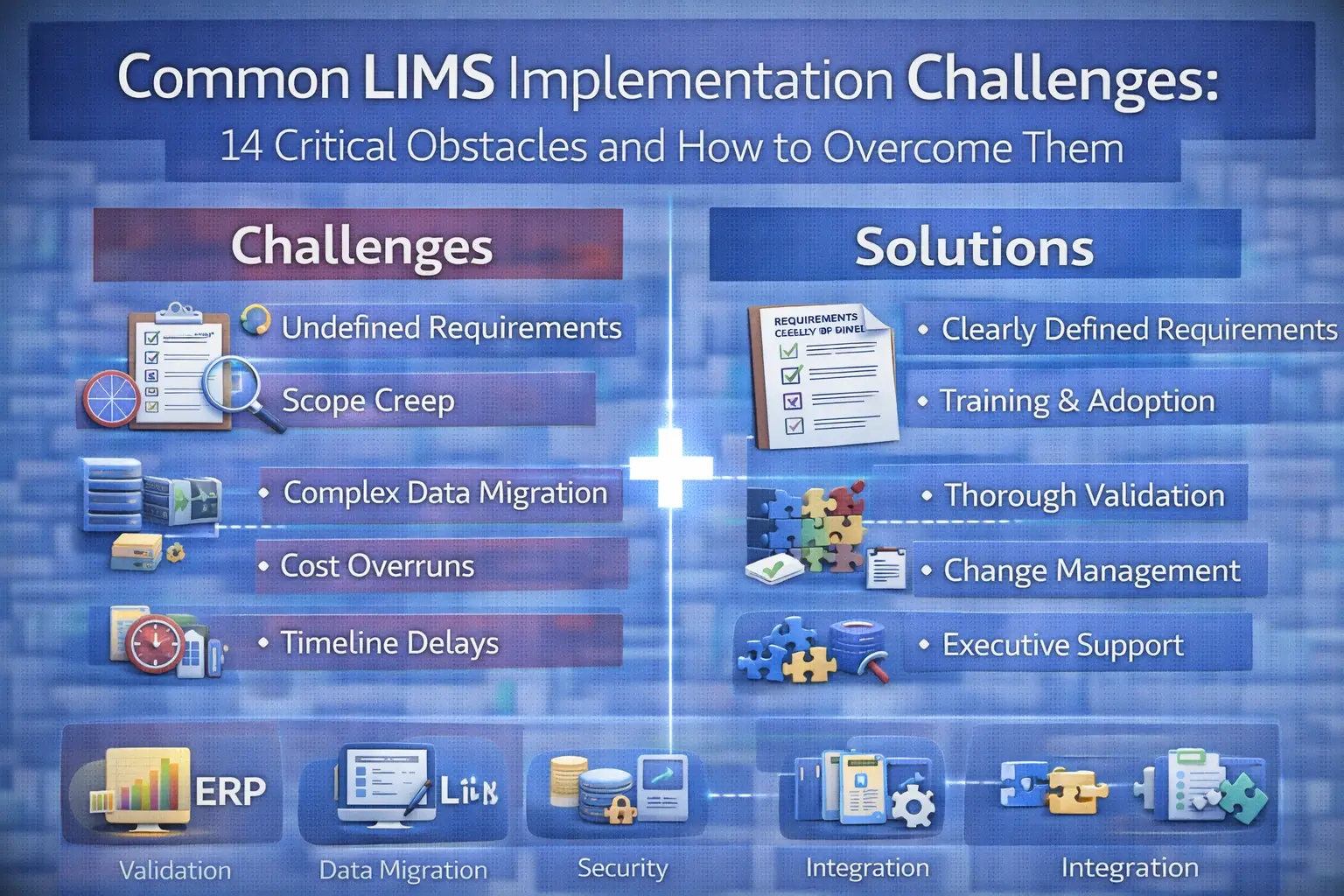
Implementing a Laboratory Information Management System (LIMS) is one of the most strategic decisions a laboratory can make. However, understanding Common LIMS Implementation Challenges is essential before starting the journey.
LIMS platforms impact sample tracking, workflow automation, compliance, reporting, and data integrity. But despite their long-term benefits, implementations are often complex, time-consuming, and resource-intensive.
The reality is simple: most LIMS projects fail not because of technology—but because of planning, governance, and execution issues.
Let’s explore the Common LIMS Implementation Challenges laboratories face and how to address them effectively.
Introduction to Common LIMS Implementation Challenges
A LIMS touches nearly every operational layer of a laboratory:
- Sample management
- Testing workflows
- Quality control
- Compliance documentation
- Reporting
- Instrument integration
In regulated industries overseen by agencies such as the U.S. Food and Drug Administration, LIMS implementations must also meet strict validation and data integrity requirements.
This combination of operational and regulatory complexity creates significant implementation risks.
Why LIMS Implementations Are Complex
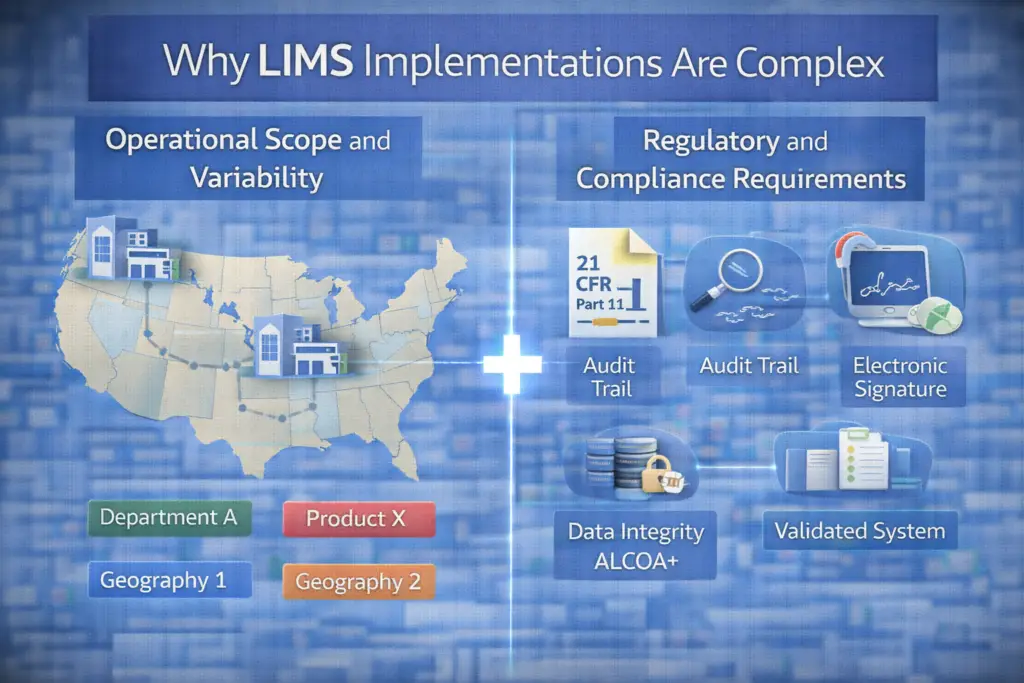
Operational Scope and Process Variability
Every laboratory operates differently.
Even within the same organization, workflows may vary by:
- Department
- Product line
- Geography
- Regulatory scope
Standardizing these processes before configuring LIMS is often difficult.
Regulatory and Compliance Requirements
Regulated laboratories must ensure:
- 21 CFR Part 11 compliance
- Audit trails
- Electronic signatures
- Data integrity (ALCOA+)
- Validated computerized systems
Validation alone can add months to project timelines.
Common LIMS Implementation Challenges Explained
1. Poorly Defined Requirements
One of the most frequent causes of failure is unclear requirements.
Without a detailed User Requirements Specification (URS), projects drift, features are misunderstood, and rework becomes inevitable.
Solution: Invest heavily in upfront requirement workshops.
2. Scope Creep
Stakeholders often add new requirements mid-project.
While improvements may seem beneficial, uncontrolled scope expansion leads to delays and budget overruns.
Solution: Implement strict change control governance.
3. Underestimating Data Migration Complexity
Migrating data from legacy systems, spreadsheets, or paper records can be extremely complex.
Challenges include:
- Data inconsistencies
- Missing metadata
- Format incompatibilities
- Duplicate records
Solution: Conduct a detailed data assessment before migration.
4. Integration with Existing Systems
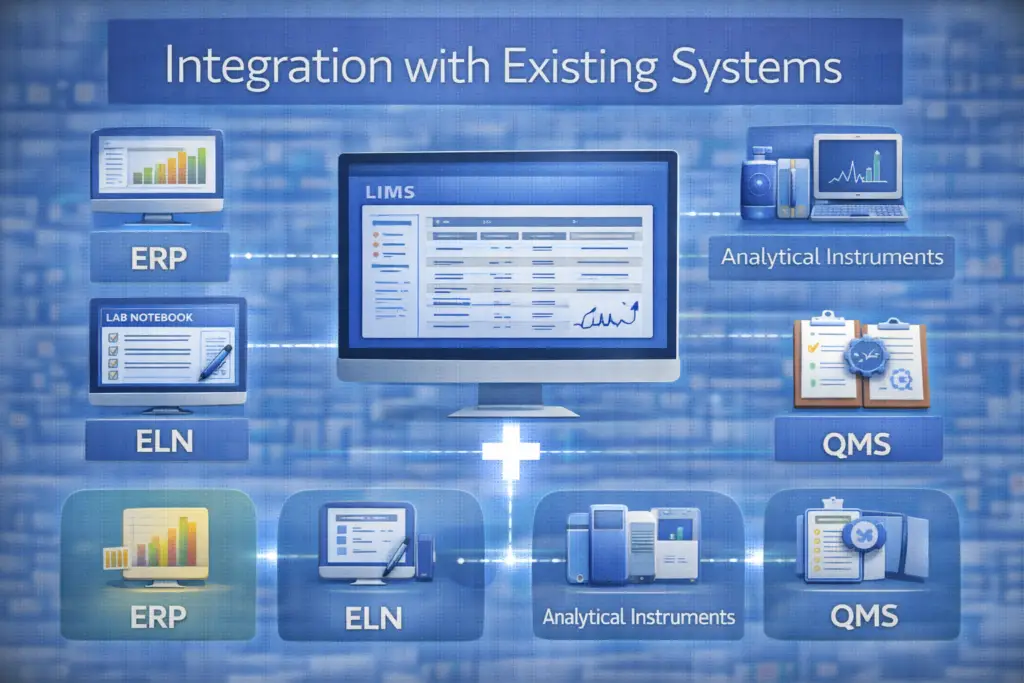
Modern labs require LIMS integration with:
- ERP systems
- ELNs
- Analytical instruments
- Quality Management Systems (QMS)
Integration failures can delay projects significantly.
Solution: Map integration architecture early.
5. User Resistance and Change Management
Users often resist change.
Common concerns include:
- Fear of automation
- Learning curve anxiety
- Disruption of established workflows
Without user buy-in, adoption suffers.
Solution: Implement structured change management and training programs.
6. Insufficient Executive Sponsorship
LIMS projects require leadership support.
Without executive sponsorship:
- Budgets shrink
- Decisions stall
- Resources become limited
Strong leadership ensures accountability.
7. Budget Overruns
Hidden costs often include:
- Customization
- Validation documentation
- IT infrastructure upgrades
- Training sessions
- Vendor consulting hours
Poor planning leads to unexpected financial strain.
8. Timeline Delays
Typical causes of delays include:
- Vendor scheduling conflicts
- Internal resource limitations
- Requirement changes
- Validation rework
Realistic timelines are essential.
9. Validation and Compliance Burden
In regulated environments, LIMS must undergo:
- Installation Qualification (IQ)
- Operational Qualification (OQ)
- Performance Qualification (PQ)
Validation documentation can become overwhelming.
10. Inadequate Testing (IQ/OQ/PQ)
Skipping rigorous testing increases long-term risk.
Incomplete test scripts lead to compliance gaps.
11. Vendor Dependency Risks
Over-reliance on vendor consultants can create:
- Knowledge gaps
- Future dependency
- Increased long-term costs
Internal capability building is critical.
Data Migration and Legacy System Risks
Legacy systems often contain:
- Unstructured data
- Inconsistent naming conventions
- Poorly maintained records
Migrating flawed data into a new LIMS multiplies problems.
Data cleansing should precede migration.
Regulatory and Validation Challenges
Organizations must align with:
- GMP
- GLP
- ISO standards
- FDA expectations
Failure to validate correctly can result in audit findings.
Validation is not optional—it is mandatory in regulated environments.
IT Infrastructure and Cybersecurity Issues
LIMS implementation requires:
- Secure servers
- Backup infrastructure
- Access controls
- Cybersecurity policies
Cloud-based systems reduce infrastructure burden but require vendor qualification.
Customization vs Configuration Dilemma
Heavy customization increases:
- Validation complexity
- Upgrade difficulty
- Maintenance costs
Configuration (using standard features) is usually safer.
Over-customization is one of the most underestimated Common LIMS Implementation Challenges.
Training and Adoption Barriers
Without proper training:
- Users revert to spreadsheets
- Shadow systems emerge
- Data integrity suffers
Continuous training programs are essential.
Post-Go-Live Challenges
Implementation does not end at go-live.
Post-deployment issues include:
- System performance tuning
- Ongoing validation updates
- Change control management
- User feedback integration
Maintenance planning is critical.
Best Practices for Successful LIMS Implementation
To overcome Common LIMS Implementation Challenges:
- Define clear requirements (URS).
- Conduct risk assessments.
- Establish executive sponsorship.
- Limit customization.
- Plan thorough validation.
- Invest in training.
- Control scope strictly.
- Clean data before migration.
- Engage cross-functional teams.
- Monitor post-go-live performance.
Successful implementation is about governance, not just software.
Frequently Asked Questions
1. How long does a LIMS implementation take?
Typically 6–18 months depending on complexity.
2. What is the biggest risk in LIMS implementation?
Poor requirement definition and scope creep.
3. Is validation mandatory?
Yes, in regulated environments.
4. Can cloud LIMS reduce implementation challenges?
It can reduce infrastructure burden but does not eliminate validation requirements.
5. Why do LIMS projects exceed budget?
Hidden costs and uncontrolled scope expansion.
6. What ensures long-term success?
Strong governance, training, and executive support.
Conclusion: Turning Implementation Challenges into Strategic Success
Understanding Common LIMS Implementation Challenges is the first step toward successful digital transformation.
LIMS implementation is not merely a software project—it is an organizational transformation initiative.
Labs that approach deployment strategically:
- Define clear requirements
- Prioritize validation
- Manage change effectively
- Maintain executive oversight
are far more likely to succeed.
When executed properly, LIMS becomes not just an operational tool—but a compliance asset, efficiency driver, and competitive advantage.
Preparation turns complexity into opportunity.