Selecting an Electronic Laboratory Notebook (ELN) is one of the most consequential software decisions a modern laboratory will make. Done right, it replaces fragmented paper notebooks and spreadsheets with a single, searchable, auditable system that accelerates research and satisfies regulators. Done poorly, it becomes an expensive burden that scientists work around rather than with.
The ELN market now includes over 96 active platforms, according to a 2024 review published in Nature Protocols. The range of options — from lightweight research tools to enterprise-grade compliant systems — makes comparison genuinely difficult. This guide cuts through the noise with ten critical questions to ask any ELN vendor before signing a contract.
These questions are designed for lab managers, quality directors, and IT teams working in pharma, biotech, CRO, academic, and industrial laboratory environments.
1. Does it meet your regulatory and compliance requirements?
Compliance is not a feature — it is a prerequisite. Before evaluating anything else, establish which regulatory frameworks govern your laboratory, then verify that every candidate ELN can satisfy them with documented evidence.
The most common compliance requirements for ELN selection include:
- 21 CFR Part 11: FDA’s rule for electronic records and signatures in regulated pharmaceutical and biotech environments. Requires audit trails, e-signatures, and access controls.
- EU Annex 11: The European equivalent for computerised systems used in GMP environments.
- ISO 17025: For testing and calibration laboratories seeking accreditation.
- ALCOA+ principles: Data must be Attributable, Legible, Contemporaneous, Original, Accurate, Complete, Consistent, Enduring, and Available.
Ask vendors for their validation documentation (IQ/OQ/PQ protocols), an audit trail demo, and references from similarly regulated customers. The FDA’s guidance on Part 11 scope and application is a useful starting point to understand what is actually required.
| Ask this | Show me your audit trail in action. Who can modify or delete an entry, and what record is created when they do? |
2. Cloud or on-premise — and what does that mean for your data?
The deployment model shapes security, maintenance burden, cost structure, and accessibility. Both options are legitimate; the right choice depends on your organisation’s IT policy and data sensitivity.
- Cloud (SaaS): Lower upfront cost, automatic updates, accessible from anywhere. Ideal for distributed or growing teams. Requires trust in the vendor’s security posture.
- On-premise: Data stays within your infrastructure. Preferred in highly classified defence, nuclear, or certain government-contracted environments. Higher IT overhead.
- Hybrid: Some vendors offer private cloud instances or air-gapped deployments that combine accessibility with data sovereignty.
For cloud ELNs, ask specifically: Where is data stored geographically? What certifications does the vendor hold (ISO 27001, SOC 2 Type II)? What happens to your data if you cancel the contract?
| Ask this | What is your data portability guarantee? In what format can we export everything if we choose to migrate? |
3. How does it integrate with your existing instruments and software?
An ELN that requires manual transcription of instrument data creates exactly the kind of human error it is supposed to eliminate. Strong integration capability is a non-negotiable requirement for most modern labs.
Ask about:
- Direct instrument connectivity (chromatography systems, spectrophotometers, plate readers, sequencers)
- API availability and documentation quality
- Integration with LIMS, ERP systems (SAP, Oracle), and inventory management software
- Support for standard data formats (JCAMP-DX, AnIML, SiLA 2, HL7 for clinical environments)
The SiLA 2 standard is worth referencing — it provides vendor-neutral instrument communication that reduces lock-in and simplifies future integration work.
| Ask this | Can you connect directly to [name your top 3 instruments]? Show me a live data import from an instrument, not a screenshot. |
4. How structured (or flexible) is the data entry model?
ELNs sit on a spectrum from free-form (like a digital Word document) to highly structured (templated forms with enforced fields). Where a platform sits on this spectrum has profound implications for data quality, searchability, and the effort required during implementation.
- Free-form ELNs: Low adoption friction, high flexibility. Risk: inconsistent data that is hard to query or analyse at scale.
- Structured/template-driven ELNs: Enforce consistency, enable advanced search and analytics. Risk: more upfront configuration effort and potential resistance from researchers.
For pharma and biotech environments pursuing FAIR data principles (Findable, Accessible, Interoperable, Reusable), structured data entry is typically essential.
| Ask this | How do you enforce data standards across a large team without blocking scientists from capturing unexpected observations? |
5. What does implementation and onboarding actually involve?
The total cost of an ELN is not the licence fee — it is the licence fee plus implementation time, data migration effort, training, and the productivity dip during the transition. Many labs dramatically underestimate this.
Request specifics on:
- Typical time from contract signature to go-live for a lab of your size
- Whether implementation is vendor-led, partner-led, or self-service
- Data migration tools and support (especially from paper notebooks or legacy systems)
- Training format: live sessions, video library, in-app guidance
- Post-go-live support: dedicated CSM, SLA response times, documentation quality
| Ask this | Give me a reference contact at a similar lab to ours who went live in the last 12 months. What was their actual timeline? |
6. How does it handle collaboration across teams and sites?
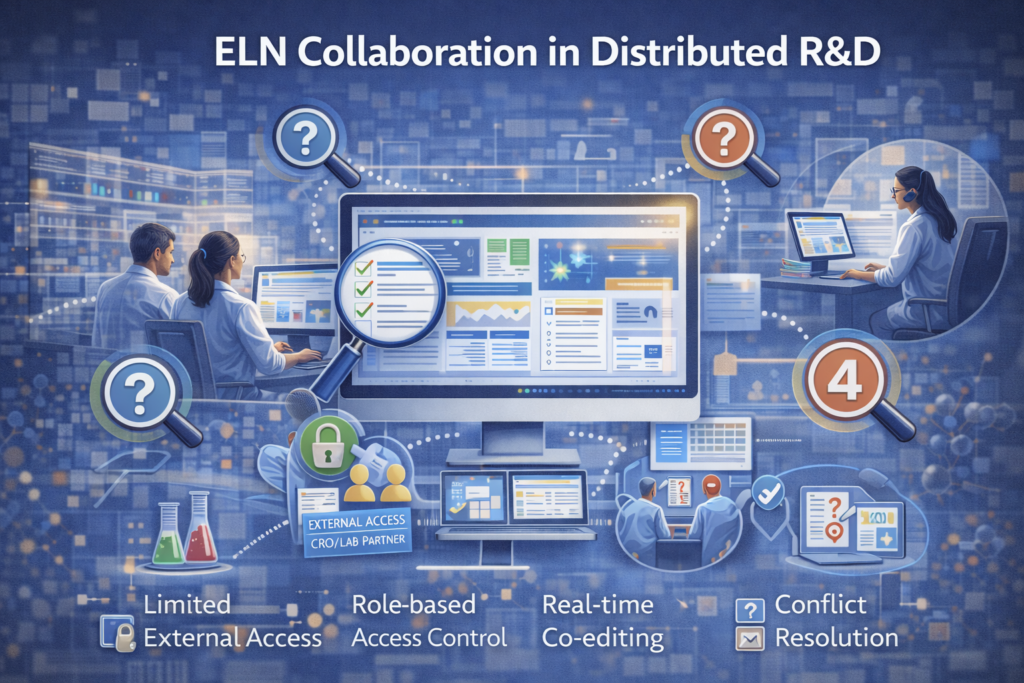
Modern R&D is distributed. CRO partnerships, multi-site organisations, remote working, and cross-functional teams require ELN collaboration features that go beyond simple shared access.
Key questions:
- Can external collaborators (CRO partners, contract labs) access specific projects without full system access?
- Is there granular role-based access control at the experiment, project, and notebook level?
- Does it support real-time co-editing or only sequential review workflows?
- How are conflicts handled when two people edit the same record?
| Ask this | How would a CRO partner access only the data relevant to them, without seeing proprietary IP from other projects? |
7. What is the real total cost of ownership over 3–5 years?
ELN pricing is rarely as simple as a per-user subscription. Hidden costs are common and can significantly alter the business case.
Typical cost components to map:
- Licence model: Per named user vs concurrent users vs site licence vs module-based pricing.
- Implementation fees: Configuration, data migration, validation support.
- Storage costs: Image-heavy labs (microscopy, genomics) can accumulate large data volumes quickly.
- API/integration fees: Some vendors charge extra for API access or specific integrations.
- Validation support: IQ/OQ/PQ documentation is sometimes a separate paid service.
- Annual price escalation clauses: Check what contractual protections exist against steep renewal increases.
| Ask this | Give us a fully itemised 5-year total cost estimate for our expected user count and data volume. Include everything. |
8. How does the vendor handle updates — and what is their validation approach?
In regulated environments, every software update is a potential validation event. A cloud ELN that pushes weekly updates without notice creates a compliance headache for labs that must document and approve system changes.
Questions to ask:
- How frequently is the software updated, and how much notice is given?
- Are updates optional or mandatory on a SaaS model?
- Does the vendor provide update release notes and a risk assessment to support your change control process?
- Is there a separate validation environment (staging) available so you can test updates before they go live?
The GAMP 5 framework from ISPE provides useful guidance on computerised systems validation that applies directly to ELN selection and ongoing management.
| Ask this | Do you provide a validation support package? What change control documentation do you supply with each update? |
9. What search and data retrieval capabilities does it offer?
An ELN is only as valuable as your ability to retrieve data from it. The promise of a searchable digital record fails completely if search is limited to keyword matching on titles.
Evaluate:
- Full-text search across all experiment content, including attached files and image metadata
- Structured query capability (e.g., find all experiments where reagent X was used at concentration Y)
- Chemical structure search (essential for chemistry labs — requires specific cheminformatics support)
- Cross-project and cross-notebook search with appropriate access controls
- API-based programmatic access for data science and automation workflows
If your lab is building towards AI-assisted analysis or machine learning on experimental data, check whether the ELN’s data model and API support downstream analytics pipelines — this is an area where early architecture decisions become hard to undo.
| Ask this | Show me how I would find every experiment in the last 2 years that used compound X and produced an IC50 below 10nM. |
10. What does the vendor’s long-term roadmap and financial stability look like?
An ELN is a 5–10 year commitment. The lab software market has seen consolidation, acquisitions, and product discontinuations. Choosing a vendor that is acquired or pivots their product strategy mid-contract is a painful and expensive disruption.
Due diligence should include:
- How long has the vendor been operating, and who are their investors or parent company?
- What is their customer retention rate (ideally >90%)?
- What is on the public product roadmap for the next 12–24 months?
- Have they made any recent acquisitions, or been acquired themselves?
- What data escrow or contract protections exist if the vendor ceases operations?
| Ask this | If your company were acquired tomorrow, what would our contractual protections be? What would change for us? |
Quick Reference: 10 Questions at a Glance
| # | Question area | What to look for |
| 1 | Regulatory compliance | 21 CFR Part 11, EU Annex 11, ISO 17025, ALCOA+ documentation |
| 2 | Deployment & data sovereignty | Cloud vs on-premise, data portability, exit clauses |
| 3 | Instrument & software integration | Direct connectivity, API docs, standard format support |
| 4 | Data structure & flexibility | Free-form vs template-driven, FAIR data alignment |
| 5 | Implementation & onboarding | Go-live timeline, migration support, training quality |
| 6 | Collaboration across teams | External access, RBAC, multi-site support |
| 7 | Total cost of ownership | 5-year model, storage, API, validation fees |
| 8 | Update & validation process | Change control docs, staging environment, release frequency |
| 9 | Search & data retrieval | Full-text, structured query, chemical structure, API access |
| 10 | Vendor stability & roadmap | Financial health, retention rate, product roadmap, exit terms |
The Bottom Line
No ELN will score perfectly on every dimension, and no vendor evaluation should rely on a demo alone. The goal of these ten questions is to shift the conversation from features to evidence — from marketing claims to documented proof.
Run a structured pilot with 10–15 real users, with real data, over at least 4–6 weeks before committing. Require vendors to respond to each question in writing. And involve your QA, IT, and scientific leads from the start — the ELN decision affects all of them.
Ready to compare specific platforms? See our Best LIMS Software in 2026 guide and our full ELN Software directory for independent, vendor-neutral reviews.
Sources & further reading
• Higgins et al., Nature Protocols — Electronic Laboratory Notebooks (2021)
• FDA: 21 CFR Part 11 Scope and Application Guidance
• GO FAIR Initiative: FAIR Principles
• ISPE: GAMP 5 Guide, 2nd Edition
• SiLA 2 Standard for lab instrument communication• ISO/IEC 27001: Information security management