Benchling was founded in 2012 in San Francisco by Sajith Wickramasekara and Ashu Singhal, two MIT alumni who met while working in biology research labs. The company’s stated mission from the outset was to build software purpose-built for biology — not adapted from generic laboratory management tools. Today, according to its own press releases, Benchling serves more than 1,300 biotech companies worldwide, including more than half of the top 50 global biopharma companies, and more than 200,000 scientists rely on its platform.
The company has raised a total of $418 million in funding across 11 rounds, per PitchBook. Its last published valuation was $6.1 billion following a Series F in November 2021 — a figure that has not been publicly updated since. Key investors include Altimeter Capital, Tiger Global, Benchmark, ICONIQ Capital, Lux Capital, Franklin Templeton, and Thrive Capital.
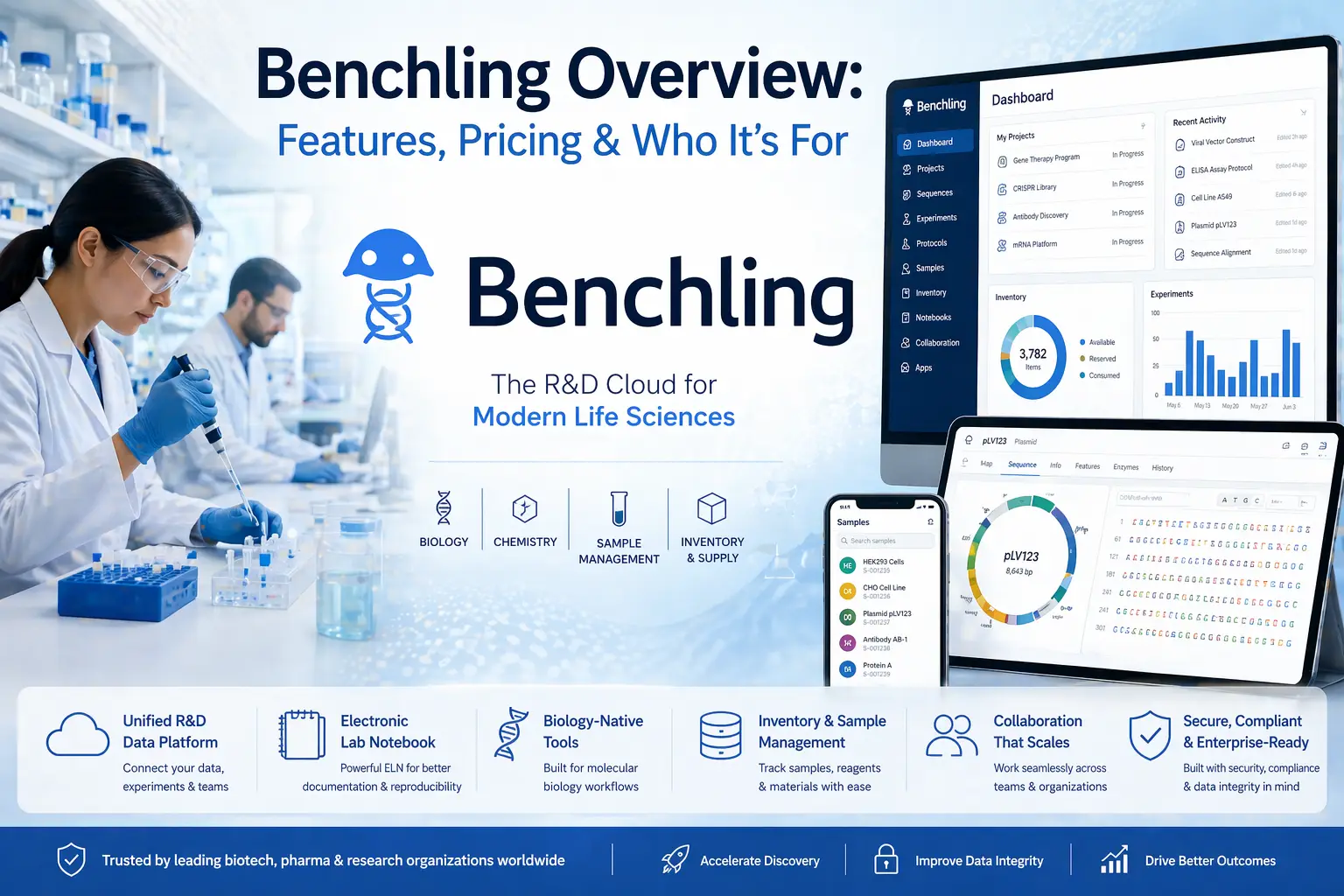
Benchling sits at an important intersection in the lab software market: it is neither a traditional LIMS nor a pure ELN. The company describes itself as a unified R&D Cloud — a platform that brings electronic notebook, molecular biology tools, sample management, workflow orchestration, and AI into a single cloud-native system built specifically for life sciences research and development.
This article is based exclusively on Benchling’s official documentation, press releases, AWS Marketplace listing, PitchBook, Sacra research, G2, and independent analysis from Clarkston Consulting. No payment or sponsorship from Benchling is involved.
At a glance
| Field | Details |
| Vendor | Benchling, Inc. |
| Founded | 2012 |
| Headquarters | San Francisco, California, USA |
| Co-founders | Sajith Wickramasekara (CEO) and Ashu Singhal (President) |
| Employees | ~797 (PitchBook, 2026) |
| Funding raised | $418 million across 11 rounds (PitchBook). Last published valuation: $6.1 billion (Series F, November 2021) |
| Estimated ARR | Sacra estimated $210 million annualised recurring revenue as of May 2024, up 27% year-on-year |
| Users | 200,000+ scientists across 1,300+ companies and 7,500 academic institutions (Benchling press releases, 2025) |
| Deployment | Cloud-only (SaaS). No on-premise option. |
| Platform scope | Notebook (ELN), Molecular Biology, Registry, Inventory, Requests, Workflows, Insights, Lab Automation, Benchling AI |
| Key industries | Biotech, biopharma, academic research, agricultural biotech, synthetic biology |
| Named customers | Merck, Moderna, Sanofi (1,500+ scientists, 30 teams — June 2024 press release) |
| Compliance | 21 CFR Part 11, EU Annex 11, GxP (via Validated Cloud), ISO/IEC 27001:2022, SOC 2 Type 2, GDPR, CCPA, NIST, C5 |
| ELN included | Yes — Notebook is one of seven integrated applications, not an add-on |
| Pricing | Not publicly listed. Quote-based enterprise contracts. Academic use: free. Startup pricing last published in 2020 at ~$20,000/year for 5 users. |
| G2 rating | 4.5 / 5 — Leader badge in LIMS and ELN categories. Most recent review: January 2025 (per QBench) |
| Free tier | Yes — free for academic scientists, including Benchling AI (launched October 2025) |
| Recent acquisitions | ReSync Bio and Sphinx Bio — both acquired August 2025 to accelerate AI roadmap |
What Benchling does
Benchling describes its platform as the R&D Cloud — a unified, cloud-native system built around the specific needs of biology-driven research. Unlike traditional LIMS that were designed primarily for structured, repetitive QC workflows, Benchling’s architecture prioritises the flexibility and collaboration needs of early-stage and mid-stage biotech R&D. Its platform consists of seven integrated applications, all sharing a common data layer:
- Notebook (ELN): A digital lab notebook for documenting experiments with rich media attachments, templated entries, and bi-directional links to samples and sequence data. Records are locked and non-editable upon electronic signature. An audit trail captures every edit with timestamps.
- Molecular Biology: A suite of tools for designing, analysing, and sharing DNA, RNA, protein, and oligonucleotide sequences. Includes CRISPR guide design, Gibson and Golden Gate cloning, primer design, multiple sequence alignment, and integrations with AlphaFold, Chai-1, and Boltz-2 for structural biology prediction (announced at Benchtalk, October 2025).
- Registry: A centralised database for registering and tracking biological entities — cell lines, plasmids, antibodies, small molecules — with version control and full traceability.
- Inventory: Sample and reagent tracking with configurable storage structures, location management, expiry dates, and lot numbers. Point-and-click configuration, no coding required.
- Workflows: Structured workflow orchestration for multi-step processes, supporting lab automation and instrument integration.
- Lab Automation: Integrates with robotic systems including liquid handlers. At Benchtalk 2025, Benchling announced “zero-click” lab integrations with HighRes Biosolutions’ workcells where experiments run and analyse themselves.
- Benchling AI: Launched October 2025, available to all customers with free access for academic scientists. Includes three agents — Deep Research, Compose, and Data Entry — plus integrations with AlphaFold, Chai-1, Boltz-2, NVIDIA NIM microservices (including OpenFold2), and a partnership with GXL (a Stanford spin-out) for domain-specific expert agents. A partnership with Anthropic allows scientists to query Benchling data through Claude, with permissions and audit logs carrying over automatically.
The platform also exposes well-documented REST APIs, event-triggered integrations, and a built-in Data Warehouse, confirmed on both the Benchling website and its AWS Marketplace listing. New capabilities announced at Benchtalk 2025 include custom Python and R scripting running natively inside the platform.
| Important distinction | Benchling is often described as a LIMS, but its architecture prioritises R&D flexibility over the structured QC workflows that define traditional LIMS. Independent consultancy Clarkston Consulting states clearly that Benchling “does not provide adequate support for quality control (QC) activities such as batch management, product specifications, and report generation” at commercial scale. Labs transitioning from early R&D to regulated manufacturing QC should evaluate whether Benchling’s Validated Cloud meets their full compliance requirements before committing. |
Deployment
Benchling is a cloud-only platform — there is no on-premise option. All data is hosted in Benchling’s cloud infrastructure, which maintains ISO/IEC 27001:2022 certification (with extensions ISO/IEC 27017:2015 and 27018:2019) and SOC 2 Type 2 attestation, confirmed on Benchling’s Trust page. The platform uses AES 256-bit encryption at rest and TLS 1.2 or higher in transit, and operates a Zero Trust security policy.
There are two tenant types:
- Standard tenants: Receive daily software updates. Suited to non-regulated research environments.
- Validated Cloud tenants: Receive controlled, quarterly release cycles. Each release comes with Validation Plan and Impact Assessments to support the lab’s change control process. Designed for GxP workflows. Customers get a dedicated tenant, separating GxP and non-GxP work. New England Biolabs is a named Validated Cloud customer, quoted on Benchling’s blog.
The AWS Marketplace listing confirms the platform is 21 CFR Part 11 compliant. Single Sign-On (SSO) with multi-factor authentication (MFA) is supported, and customers can configure access control via their own SSO provider.
Compliance and regulatory support
Benchling has published a whitepaper specifically addressing GxP computer systems validation considerations. Key compliance capabilities, verified across Benchling’s Trust page, Validated Cloud product page, and the GxP whitepaper:
- 21 CFR Part 11 (FDA): Supported. Electronic signatures require username and password. Once signed, entries are locked and non-editable. Audit trails capture all edits with timestamps. Benchling’s AWS Marketplace listing states explicitly: “21 CFR Part 11 compliant.”
- EU Annex 11: Supported. Confirmed on Benchling’s Validated Cloud product page and in the GxP whitepaper.
- GxP: Supported via the Validated Cloud tenant. Benchling provides validation documentation with each quarterly release to reduce the customer’s validation burden.
- ISO/IEC 27001:2022: Certified, with additional controls per ISO/IEC 27017:2015 (cloud security) and 27018:2019 (cloud privacy). Confirmed on Benchling’s Trust page.
- SOC 2 Type 2: Attested. Confirmed on Benchling’s Trust page.
- GDPR, CCPA: Both confirmed. Benchling aligns with the EU-US Data Privacy Framework (DPF) Programme.
| Validation note | Validated Cloud tenants receive quarterly releases with Validation Plan and Impact Assessments from Benchling. The GxP whitepaper describes the split between what Benchling is responsible for and what the customer must complete to maintain a validated state. Clarkston Consulting notes that while this “reduces customers’ validation burden,” labs must still complete their own validation activities. The full validation responsibility is shared, not transferred to Benchling. |
Pricing
Benchling does not publish current pricing. The last pricing information published on Benchling’s website was in 2020, when the professional plan was listed at around $20,000 per year for five users. That figure has not been officially updated.
Sacra’s independent financial research (May 2024) estimates an average revenue per customer of approximately $175,000 as of May 2024, up from $125,000 in 2017–2018, reflecting expansion within existing accounts. With 1,200 commercial customers as of May 2024 and $210 million in estimated ARR, this average is consistent with mid-to-large enterprise contracts.
Benchling offers a free plan for academic scientists, extended in October 2025 to include free access to Benchling AI. For commercial labs, pricing is available on request.
| Pricing note | Independent sources consistently describe Benchling as one of the more expensive platforms in the biotech R&D space. One 2025 analysis (cited by IntuitionLabs, noting it was sponsored by a competitor) suggests per-user costs in the range of $5–$7k per user per year. QBench’s independent comparison blog notes that “startup plans are reported to start around $15,000 per year,” with enterprise contracts scaling beyond that. These figures are not confirmed by Benchling and should be treated as estimates pending direct vendor engagement. |
Who Benchling is designed for
Benchling is purpose-built for biology-driven R&D organisations. Its customer base, as described in press releases and the AWS Marketplace listing, spans:
- Biotech startups and scale-ups conducting early-stage drug discovery, particularly those working with large molecules, CRISPR, CAR-T, cell and gene therapy, mRNA, and synthetic biology
- Mid-to-large biopharma organisations running research and translational teams across multiple sites — Sanofi’s deployment across 1,500+ scientists in 30 teams is the most detailed publicly documented example
- Academic institutions and government research labs — the free tier has driven adoption across more than 7,500 institutions globally
- Agricultural biotech and other biology-adjacent research disciplines
It is less commonly the right fit for:
- Laboratories with primary workflows in routine QC testing, batch release, or regulated manufacturing — where traditional LIMS platforms with stronger QC and batch management modules (such as LabWare or LabVantage) are better aligned
- Environmental, food, clinical diagnostics, or forensics labs whose primary use case is structured sample testing rather than experimental R&D
- Labs that require on-premise deployment for data sovereignty, security classification, or regulatory reasons
What users say
G2 lists Benchling as a Leader in both its LIMS and ELN categories, with a 4.5/5 rating. The following themes are drawn from G2 reviews and Clarkston Consulting’s independent analysis.
Frequently praised
- Biology-first design: Molecular biology tools are consistently cited as a core differentiator. G2 reviewers in biotech frequently describe using Benchling for sequence design and molecular cloning alongside their ELN, in a single interface. One reviewer states it “has made me a better scientist.”
- Ease of adoption and collaboration: Multiple reviewers highlight the platform’s collaborative features and the ease of sharing information across teams. Clarkston Consulting notes it “offers a secure system that requires minimal IT resources to implement.”
- Data centralisation: Users appreciate having experimental data, sample information, sequences, and protocols in one connected system. The AWS Marketplace listing quotes a customer: “Benchling gives transparency across the company. Scientists can quickly get all the details and all the data associated with any construct or experiment.”
- ELN quality: The Notebook application is frequently described as intuitive, with templated entries, protocol linking, and tagging.
- API and integration: The REST API and instrument integration capabilities are well-regarded by technically capable teams building custom workflows.
Frequently criticised
- Price relative to alternatives: Cost is the most consistently cited objection in competitor analyses and in forum discussions. Multiple independent sources describe Benchling as among the most expensive options in its category, with price increases when teams outgrow startup tiers.
- Learning curve for LIMS-specific use: G2 reviewers note that using Benchling for complex data and sample tracking is harder to navigate than the ELN. One reviewer states they “ended up scrapping use of it for that purpose” after difficulty building out sample tracking.
- Audit trail navigation: G2 reviews flag that audit trails, while present, can be difficult to navigate intuitively.
- QC workflow limitations: Clarkston Consulting’s independent analysis explicitly notes that Benchling “does not currently” provide adequate support for QC activities such as batch management, specifications, and report generation at regulated production scale.
- Data lock-in concern: Independent reviewers note that switching costs increase over time as teams build out deep integrations and customisations on the platform.
Quick verdict
| Best for | Biotech and biopharma R&D teams — from pre-seed startups to global biopharma — working on biology-intensive research involving large molecules, CRISPR, cell and gene therapy, mRNA, or synthetic biology. Benchling is the clearest choice when molecular biology tools, ELN, sample tracking, and AI-powered analysis need to live in a single biology-first platform with strong collaboration features. Academic teams benefit from the free tier. The Validated Cloud makes it a credible option for early-to-mid stage regulated environments. |
| Consider alternatives if | Your primary need is structured QC testing, batch management, or regulated manufacturing workflows. For those contexts, LabWare or LabVantage provide deeper out-of-the-box capability. If cost is a primary constraint, cloud LIMS alternatives such as QBench, CloudLIMS, or Scispot are worth evaluating. If your lab requires on-premise deployment, Benchling is not an option — no such offering exists. |
Further reading
- Benchling official website
- Benchling Trust & Security page
- Benchling Validated Cloud
- Benchling on G2 — verified user reviews
- Benchling on AWS Marketplace
- Benchling Sanofi partnership — press release, June 2024
- Benchling AI launch — press release, October 2025
- Benchling acquires ReSync Bio and Sphinx Bio — August 2025
- Benchling Benchtalk 2025 product announcements
- Sacra: Benchling revenue and financial analysis
- Clarkston Consulting: independent analysis of Benchling for R&D
- labsoftwareguide.com: How to choose an ELN
- labsoftwareguide.com: LIMS vs ELN — which does your lab need?
| Editorial note | This article is based on: Benchling’s official website, product pages, and press releases (2024–2025); the AWS Marketplace listing; PitchBook; Sacra’s financial analysis (May 2024); Contrary Research (September 2024); G2; Clarkston Consulting’s independent technical analysis; and IntuitionLabs’ GxP ELN comparison. No information has been included that could not be verified from at least one of these sources. Benchling has not reviewed, sponsored, or paid for this article. Last verified: April 2026. |