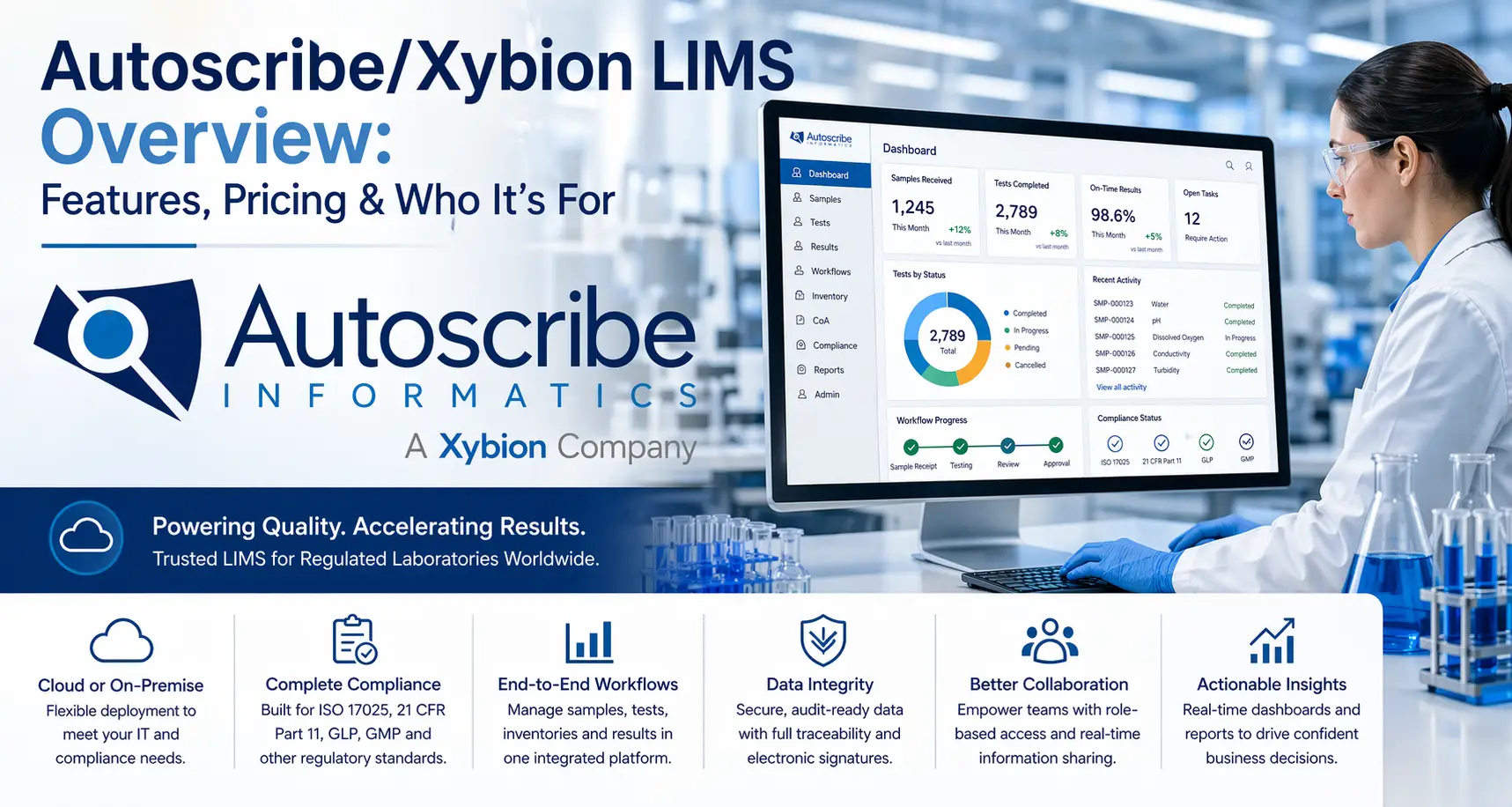
Autoscribe Informatics is a LIMS software company with one of the longest track records in the market. Its flagship product, Matrix Gemini LIMS, traces its roots to 1981 when Autoscribe Ltd was founded in the United Kingdom. A 40th anniversary press release published in 2021 confirms the founding year and describes some customers as having been with the product since the early 1990s.
The corporate structure around Autoscribe is more complex than its product history, and understanding it matters for buyers: the product and brand have passed through two acquisitions in quick succession. In November 2023, Xybion Digital Inc. (TSX.V: XYBN), a Princeton, New Jersey-based life sciences SaaS company, acquired Autoscribe Informatics for US$12.094 million closing payment, as announced in SEC-equivalent filings on the TSX Venture Exchange and confirmed by Yahoo Finance. Then, in July 2025, Instem — a UK-headquartered supplier of preclinical R&D platforms founded in 1969 — acquired Xybion Digital from Banerjee Group LLC, per a Business Wire press release dated 31 July 2025. The Instem press release confirms that Autoscribe’s LIMS business continues under the Autoscribe brand within Instem. As of April 2026, autoscribeinformatics.com remains an active website, the Autoscribe Informatics brand is in active use, and the product is marketed as “Autoscribe Informatics, a Xybion company” — though the parent is now Instem.
Matrix Gemini LIMS has 140+ customers as of the Xybion acquisition announcement (November 2023). The G2 profile has not been actively managed for over a year, per G2’s own notice, which is a visible signal of the transition period. Autoscribe participated in Pittcon 2025 (Boston, March 2025) and Lab Innovations 2024 (Birmingham, October 2024), confirming active commercial activity.
This article is based on Autoscribe Informatics’ official website, press releases, and case studies; TSX Venture Exchange filings; Yahoo Finance and Newsfile Corp acquisition announcements; the Instem Business Wire press release (July 2025); G2; Capterra; Sourceforge; the 40th anniversary press release (2021); the Matrix Gemini v6.0 announcement (2021); and Tracxn. Autoscribe Informatics has not reviewed, sponsored, or paid for this article.
Understanding the ownership chain — why it matters for buyers
Matrix Gemini LIMS is a 40+ year old product that has changed corporate hands twice since late 2023. Buyers evaluating a multi-year LIMS contract should understand this chain before committing. All dates and figures below are sourced from official press releases and public filings:
| Date | Event | Detail |
| 1981 | Founded | Autoscribe Ltd founded in the United Kingdom. The Matrix LIMS product begins development. |
| Early 1990s | First customers | Some customers confirmed by a 2021 press release to have been with Matrix LIMS since this period. |
| 2011 | US entity | Autoscribe Informatics formed as the US-facing entity, headquartered in Berkshire County (Tracxn). UK operations continue. |
| Nov 2023 | Acquired by Xybion | Xybion Digital Inc. (TSX.V: XYBN) acquires Autoscribe Informatics for US$12.094M closing payment plus deferred consideration. Autoscribe had revenue of US$6.18M and EBITDA of US$0.678M in FY ending March 2023 (TSX filing). Autoscribe operated 140+ customer deployments at acquisition. |
| 2024–2025 | A Xybion company | Autoscribe markets itself as “Autoscribe Informatics, a Xybion company.” Combined Xybion/Autoscribe customer base reaches 350+ across 35 countries (Xybion Q3 2024 filing). |
| Jul 2025 | Acquired by Instem | Instem acquires all shares of Xybion Digital from Banerjee Group LLC. Instem press release confirms Autoscribe™ brand continues within Instem. Xybion’s former CEO Dr Banerjee noted a “40X MOIC for Xybion shareholders.” Instem was founded in the UK in 1969 and focuses on preclinical R&D. |
| Apr 2026 | Current status | autoscribeinformatics.com is active. Product marketed as Autoscribe Informatics (brand now under Instem). G2 profile flagged as unmanaged for over a year. |
| Buyer note | Two acquisitions in under two years is relevant context for any lab evaluating a 5–10 year LIMS contract. The product has genuine 40+ year continuity and the Matrix Gemini codebase is unchanged. However, buyers should confirm: (1) which entity will hold and service the software licence post-Instem acquisition; (2) whether support, SLA, and upgrade commitments remain as previously contracted; and (3) the product roadmap under Instem’s ownership. These are standard due diligence questions that are more material here than for vendors with stable long-term ownership. |
At a glance
| Field | Details |
| Product | Matrix Gemini LIMS (flagship) + Matrix Gemini LIMS Express (small lab entry) + Matrix Tracker (asset/sample tracking) + Matrix Gemini Stability (stability studies) |
| Brand | Autoscribe Informatics — now an Instem company (as of July 2025) |
| Product origin | 1981 (Autoscribe Ltd, UK). Celebrating 40 years in business in 2021 per company press release. |
| Founder | John Boother, Chairman and Founder. Confirmed in multiple press releases and Tracxn. |
| Offices | United Kingdom (HQ), United States (near Boston), Australia (near Adelaide). Worldwide distributor network. |
| Customers | 140+ at time of Xybion acquisition (November 2023 press release). Combined Xybion/Autoscribe base: 350+ in 35 countries (Xybion Q3 2024 filing). |
| Revenue (Autoscribe pre-acquisition) | US$6.18M revenue, US$0.678M adjusted EBITDA for the fiscal year ending 31 March 2023 (TSX Venture Exchange filing, November 2023). |
| Deployment | On-premise (client-managed server), hosted/cloud (third-party server managed by Autoscribe or partner), or hybrid. Both desktop client (LAN) and web browser interfaces available within the same licence. Confirmed on autoscribeinformatics.com. |
| Licensing | Perpetual licence (one-off fee) or subscription (quarterly). Both confirmed on G2 pricing page (last updated October 2024). |
| ELN included | Built-in ELN module confirmed on Scientific Computing World listing. LES (Laboratory Execution System) and QMS also built in. |
| Key industries | Pharmaceutical, medical devices, food & beverage, water/environmental, veterinary, biobanking, mining/materials, contract laboratories |
| Named customers (from case studies) | Pixelle Specialty Solutions (paper manufacturing QA, US — customer since 2011, upgraded to v6.x in 2023). Swiss Precision Diagnostics/SPD (medical devices, Geneva — Clearblue maker). Nationwide Laboratories (UK veterinary pathology, 1,100+ tests). CIA Labs (contract lab, Missouri). Tungsten West (mining, UK). University of Iceland Laboratory of Pharmacology and Toxicology (forensic, 4,000–5,000 cases/year). Boston Scientific (named on medical device industry page). |
| Compliance | FDA 21 CFR Part 11, ISO 17025, GxP, GLP, GMP, cGxP. Confirmed on autoscribeinformatics.com, G2 listing, and product pages. |
| Pricing | Quote-based. Not publicly listed. G2 pricing page states: “available either on-premise or on-line, and may be licensed for a one-off fee or via subscription.” Capterra Canada lists paid version starting at £0.01/one-time (placeholder). |
| Free trial | Yes — confirmed by Sourceforge listing. |
| G2 profile status | Listed. Flagged as “not managed for over a year” per G2 notice. Reviews are present but limited. |
| Current owner | Instem plc (acquired July 2025). Previously Xybion Digital Inc. (TSX.V: XYBN). |
What Autoscribe Informatics does
Matrix Gemini LIMS is built around a singular architectural philosophy: genuine configurability without custom code. Every screen, workflow, field, and menu in the system can be modified using built-in graphical point-and-click tools, and — critically — those configuration changes are kept strictly separate from the underlying software. This means users can upgrade to new versions of Matrix Gemini without their customisations being overwritten, which Autoscribe’s press releases consistently describe as a key differentiator for long system lifetime and reduced cost of ownership.
The platform consists of several products sharing the same core code:
- Matrix Gemini LIMS (flagship): A full-featured LIMS scalable from single user to 500+ concurrent users at global multi-site deployments (per B2Saas listing). Features include sample and work registration, test allocation, sample receipt, sample preparation, result entry, limit checking (with automatic out-of-specification flagging), result validation, sample approval, CoA and report generation, and management dashboards. An enhanced calculation engine introduced in v6.0 (2021) supports complex derived results from raw analytical data. Multi-language user interface support confirmed in v6.0 release (Korean, English, Japanese cited). BarTender integration confirmed on Sourceforge.
- Built-in ELN, LES, and QMS: Confirmed by the Scientific Computing World listing and autoscribeinformatics.com as built into Matrix Gemini rather than separate licensed modules. This is a meaningful differentiator — most LIMS vendors charge separately for ELN and QMS add-ons.
- Matrix Gemini Stability: A stability management module for pharmaceutical and regulated industries. Supports FDA and ICH guidelines, protocol designer, batch and condition management, multi-point pull schedules, and result trend curves for shelf-life prediction. GLP 21CFR 58, 21CFR 210/211 compliance documented.
- Matrix Gemini LIMS Express: An off-the-shelf, ready-to-use LIMS for smaller laboratories or as an entry-level system in larger organisations. Pre-configured, minimal setup required. Includes security, audit trail, and 21 CFR Part 11 support. Can be expanded into full Matrix Gemini as needs grow.
- Matrix Tracker: A standalone product for tracking samples, reagents, consumables, waste, or assets using the Matrix graphical configuration tools. Can function as a lightweight alternative to a full LIMS.
- Matrix Gemini Field Analytics System: Extends the LIMS to field use, allowing offline data collection that syncs to the LIMS on reconnection. Confirmed on Scientific Computing World.
- Instrument and ERP integration: Autoscribe supports direct instrument interfacing (RS232, data protocols) and integration with chromatography data systems and ERP systems. Confirmed on autoscribeinformatics.com.
- CAPA management: Out-of-specification results can be linked to CAPA actions within the Medical Device LIMS configuration. Confirmed on the medical device LIMS industry page.
Industry-specific pre-configured “starter systems” are available on the G2 listing for: QC contract laboratories, pharmaceutical and regulated manufacturing (cGxP), and veterinary laboratories. The starter systems use the same core code as the full platform and can be expanded without migration.
Deployment options
Autoscribe’s deployment flexibility is a genuine differentiator from cloud-only LIMS vendors in this series. Three deployment models are confirmed on autoscribeinformatics.com and in Autoscribe’s own blog post “Is LIMS in the Cloud really the next step forward?”:
- On-premise (enterprise model): Software installed on the customer’s own server. Perpetual licence with one-off fee. Customer controls update timing, data is held behind corporate firewall. Highest data security. Higher upfront IT cost. Autoscribe’s blog post describes this as still “the most popular” model among their customer base.
- Hosted/cloud (shared server): Matrix Gemini hosted on third-party specialist servers managed by Autoscribe or a partner. Subscription pricing (typically quarterly). Lower upfront cost, less control over update timing. Customer still accesses the full Matrix Gemini feature set with built-in configuration tools.
- Hybrid (individual server): Hosted on a dedicated server, giving more control over maintenance schedules than shared hosting. Cost model sits between on-premise and shared.
The desktop client and web browser interfaces provide consistent access regardless of deployment model. Both are described as delivering the same user experience and configuration capabilities. This dual interface is confirmed on autoscribeinformatics.com: “If you are out of your lab today, use a browser; back in your lab tomorrow, use a client on your LAN – Matrix Gemini LIMS does not mind.”
| Deployment note | For highly regulated labs concerned about data sovereignty, on-premise deployment is available and appears to be the default for a segment of Autoscribe’s customer base. The blog post from Autoscribe explicitly acknowledges that “for data-sensitive industries such as medical diagnostics and pharmaceuticals where the potential cost of losing cloud-stored data may be immeasurable,” on-premise deployment may be the more appropriate choice. This makes Autoscribe one of the few LIMS vendors in this series that explicitly supports customers’ choice not to move to cloud. |
Compliance and regulatory support
Autoscribe’s compliance documentation is confirmed across multiple product pages, a dedicated 21 CFR Part 11 blog post, and the medical device LIMS page:
- FDA 21 CFR Part 11: Comprehensive support confirmed on autoscribeinformatics.com and the dedicated 21 CFR Part 11 compliance blog post. Features include: full audit trail with timestamps on all actions; encrypted database option; password-controlled access with auto-lock after inactivity; electronic signatures that are traceable to the individual with name, date, and reason; records of all changes including previous values and who made them.
- ISO 17025: Confirmed on the Matrix Gemini LIMS product page as a supported standard.
- GxP, GLP, GMP, cGxP: Confirmed across multiple product pages. The pharmaceutical LIMS and medical device LIMS pages both cite GxP compliance.
- ICH guidelines (stability studies): Confirmed in the Matrix Gemini Stability documentation.
- EU IVD Directive (medical devices): Confirmed in the Swiss Precision Diagnostics case study, where SPD is described as regulated under European IVD Directive 98/79/EC and certified to ISO 13485.
Autoscribe also develops the Medical Device LIMS product “according to our ISO9001 accredited quality system” (medical device LIMS page), and the product is “supported by comprehensive validation documentation providing a head start to validation activities” — meaning vendor-supplied documentation is available to support customers’ IQ/OQ/PQ process.
| Upgrade and validation note | One of Autoscribe’s most consistently stated architectural claims is that software and user configurations are kept strictly separate. This means upgrading the underlying software does not overwrite user-configured screens or workflows. For regulated labs that have gone through a validation exercise, this separation should reduce re-validation burden when upgrading versions — a meaningful practical advantage over systems where upgrades require full revalidation of custom code. Labs should request Autoscribe’s validation documentation and confirm the scope of change-control support before committing. |
Pricing
Autoscribe does not publish pricing publicly. The G2 pricing page (last updated October 2024) states: Matrix Gemini LIMS “is available either on-premise or on-line, and may be licensed for a one-off fee or via subscription. The choice is as broad as the types of customer we serve.” Capterra Canada lists a placeholder price of £0.01 one-time, which reflects the absence of a real published price rather than an actual cost.
The pricing model’s flexibility — perpetual licence vs. subscription, on-premise vs. cloud, single user vs. 500+ concurrent users, a standalone Express product for small labs vs. full Matrix Gemini with add-on modules — means pricing can vary substantially by lab size, deployment model, and module selection. Labs evaluating Autoscribe should request a detailed quote specifying: initial licence or subscription fee; annual support and maintenance costs (Autoscribe provides annual support and maintenance agreements per the Matrix Gemini product page); implementation and configuration services; any module-specific fees; and training costs.
| Pricing context | No public pricing signals exist for Matrix Gemini. Autoscribe’s pre-acquisition revenue of US$6.18M (FY March 2023) across 140+ customers implies an average customer contract value in the range of US$40,000–50,000 per year — though this figure blends customers of very different sizes and deployment types and should be treated as rough indicative context only, not as a pricing benchmark for any individual lab. |
Who Autoscribe is designed for
Based on the product’s case study library, industry pages, G2 listing, and Autoscribe’s own positioning statements, Matrix Gemini LIMS is best suited for:
- QC and analytical testing laboratories in pharmaceutical, food & beverage, water/environmental, medical device manufacturing, and contract testing that want a configurable LIMS without custom coding and prefer not to be cloud-only
- Laboratories that want on-premise deployment for data security or IT policy reasons — a meaningful differentiator from cloud-only competitors
- Labs seeking a system they can configure and maintain themselves without vendor involvement for every workflow change — the Swiss Precision Diagnostics case study describes their team as able to “quickly optimise screens to make their lives easier” without waiting for Autoscribe
- Organisations managing stability studies in pharmaceutical or food labs that need ICH-compliant protocol management and trend analysis built into the same platform
- Veterinary pathology labs — the Nationwide Laboratories case study and a dedicated veterinary LIMS page, plus VETXML standard support, indicate a meaningful veterinary customer base
- Small and growing labs that want to start with Matrix Express and expand into the full Matrix Gemini without a data migration exercise, using the same core product code
- Multi-site, multi-language global organisations — installations with 500+ concurrent users are documented (B2Saas), and v6.0 added per-user language preferences for multi-language deployments
Autoscribe is less commonly the right fit for:
- Labs that want a cloud-first, modern SaaS platform with the most recent UI design patterns, AI-powered automation, and rapid feature releases — Benchling, Sapio Sciences, or Scispot are better positioned
- Labs evaluating a vendor and needing maximum ownership stability as a decision criterion — two acquisitions in under two years warrants careful vendor diligence
- Labs that prioritise a large, active G2 review base as a proxy for vendor health: the G2 profile has not been actively managed for over a year
- Biotech R&D and discovery labs needing ELN-first workflows with molecular biology tools built in
What users say
G2 and Capterra both carry verified reviews for Matrix Gemini LIMS. The G2 profile notes it has not been actively managed for over a year — which limits the volume of reviews but does not affect the validity of existing ones. The following themes are drawn from G2 and Capterra directly, and from case studies published on autoscribeinformatics.com.
Frequently praised
- Configurability without coding: The defining and most consistent theme across both G2 and published case studies. A G2 reviewer describes the system as meeting “our every need” and praises the roadmap for future developments. The Pixelle case study describes implementing a configured system in just three months: “Autoscribe made a major effort to understand the needs of our laboratory, which helped enormously.”
- Long system lifetime and upgrade continuity: The separation of software and user configuration is cited by reviewers and case studies as enabling upgrades without disruption. Pixelle’s case study confirms they used Matrix Gemini from 2011 continuously, upgrading to v6.x in 2023 — over 12 years with the same platform.
- Audit trail and compliance automation: A G2 reviewer describes automatic audit trail generation as making “audits so much easier,” specifically noting the move away from paper systems. The University of Iceland forensic lab case study describes the team configuring the system themselves to meet unique forensic requirements.
- Ease of navigation: G2 reviewers note the system is easy to learn and navigate — one reviewer cites this as a primary positive. The Swiss Precision Diagnostics case study quotes the Clinical Laboratories Manager: “On top of this the ease of use has made it easier for the team to understand and adopt.”
- Responsiveness of the support team: Multiple case study quotes reference the quality of the Autoscribe team relationship. The autoscribeinformatics.com homepage quotes a customer: “The level of responsiveness from the Autoscribe team was just amazing.” The Pixelle case study describes “an extremely close, ongoing working relationship” established over 12+ years.
Considerations and limitations
- G2 profile not actively managed: G2’s own notice on the Autoscribe profile states it has not been managed for over a year. This is consistent with the ownership transition period and does not necessarily indicate product issues, but it means the vendor is not currently responding to G2 reviews or maintaining the listing.
- UI modernity: Third-party analyst write-ups (Labworks Best LIMS 2025 article) note that Matrix Gemini “isn’t exactly plug-and-play” and that “you’ll still need time to learn how to wield that flexibility effectively.” The dual desktop/web interface is practical but the overall product aesthetic reflects its legacy heritage.
- Pricing opacity: No public pricing is available, and the full Matrix Gemini cost will depend heavily on deployment model, user count, and modules selected. Labs cannot self-qualify on price without engaging Autoscribe directly.
- Ownership transition uncertainty: As noted above, two acquisitions in under two years is a procurement consideration. The G2 profile being unmanaged is a symptom of this transition period. Buyers should request explicit contractual commitments from the current Instem/Autoscribe team.
Quick verdict
| Best for | QC and analytical testing laboratories in pharmaceutical, food & beverage, medical device, water/environmental, and veterinary sectors that want a proven, 40+ year LIMS with genuine no-code configurability, a dual on-premise/cloud deployment option, and the ability to configure and maintain workflows without vendor involvement for every change. Matrix Gemini’s separation of software and configuration layers is a technically sound approach to long system lifetime and controlled upgrades — documented across multiple real customer cases spanning 10+ years. For labs that value proven longevity and on-premise data control over the latest SaaS UX, Autoscribe warrants serious evaluation. |
| Consider alternatives if | Ownership stability is a primary procurement criterion and two recent acquisitions (Xybion 2023, Instem 2025) are a concern for your organisation’s risk posture. Labs needing cloud-native, AI-powered, or biotech R&D-focused platforms will find better fits in Benchling, Sapio Sciences, or Scispot. For transparent published pricing at mid-market scale, QBench or CloudLIMS offer clearer budget signals. And for very large enterprise deployments with global IT teams and deep integration requirements, LabVantage or LabWare have deeper enterprise pedigrees. |
Further reading
- Autoscribe Informatics official website
- Matrix Gemini LIMS product page
- Matrix Gemini LIMS Express (small lab edition)
- Autoscribe case studies library
- Autoscribe on G2 — Matrix Gemini LIMS reviews
- Xybion acquires Autoscribe — TSX filing / Yahoo Finance, November 2023
- Autoscribe acquisition press release on autoscribeinformatics.com
- Instem acquires Xybion — Business Wire, July 2025
- Autoscribe 40 years in business — press release 2021
- Matrix Gemini v6.0 release announcement
- labsoftwareguide.com: ISO 17025 and LIMS
- labsoftwareguide.com: How to choose a LIMS
- labsoftwareguide.com: Best LIMS Software 2026
| Editorial note | This article is based on: Autoscribe Informatics’ official website, product pages, blog posts, case studies, and press releases; the Xybion Digital TSX Venture Exchange acquisition filing (November 2023, via Yahoo Finance and Newsfile Corp); the Instem Business Wire press release (July 2025); Autoscribe’s 40th anniversary press release (2021); the Matrix Gemini v6.0 release announcement (2021); G2 (noting the G2 profile is flagged as unmanaged for over a year); Capterra Canada; Sourceforge; B2Saas; Tracxn; Scientific Computing World; and the Labworks Best LIMS 2025 independent analysis. Revenue and financial figures are taken from the TSX Venture Exchange/Newsfile Corp filing, which is a regulated disclosure. Autoscribe Informatics has not reviewed, sponsored, or paid for this article. Last verified: April 2026. |