
Agilent SLIMS Overview: Features, Pricing & Who It’s For (2026)
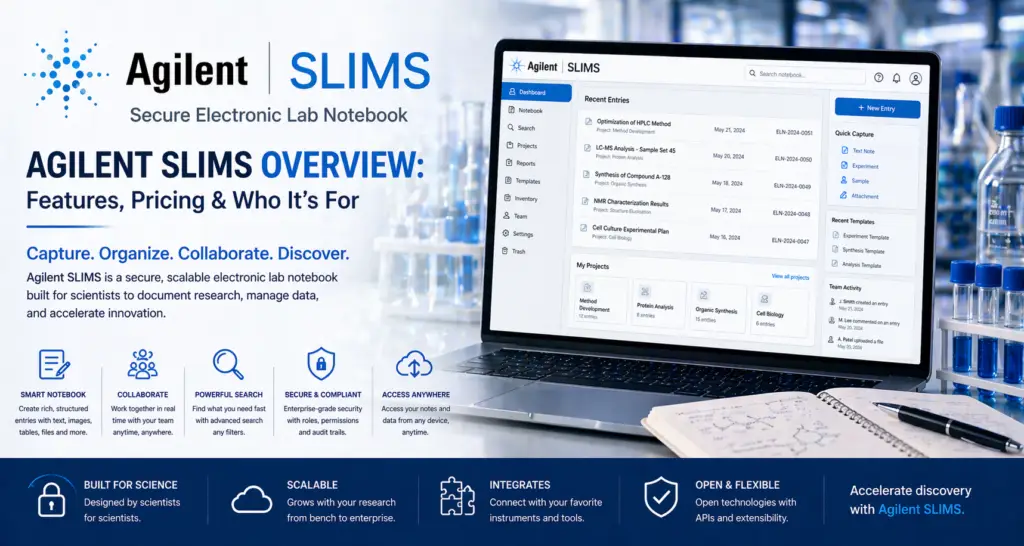
The single most important thing to know If your lab runs Agilent instruments, SLIMS has a native advantage no other LIMS in this series can match. SLIMS 7.2 introduced bidirectional, automated integration with Agilent MassHunter (LC/MS) and Agilent OpenLab CDS (chromatography). Worklists generate directly from your sample database and results return automatically — without manual transcription. If you operate Agilent LC-MS, HPLC, TapeStation, Bravo liquid handlers, or the Alissa genomics platform, SLIMS connects to your existing instrument ecosystem natively. If your lab does not use Agilent instruments, this differentiator does not apply, and other LIMS in this series — with stronger independent review bases and more transparent pricing — deserve equal or greater consideration. Agilent SLIMS is a Laboratory Execution System (LES) that combines LIMS, ELN, and workflow management in a single platform. It is one of the few LIMS products in this series owned by a publicly traded analytical instrument manufacturer — Agilent Technologies (NYSE: A), a global leader in life sciences, diagnostics, and applied chemical markets with revenues of approximately $6.8 billion. That parentage is both SLIMS’s greatest differentiator and a key factor in understanding who it is built for. SLIMS was created by Genohm, a company founded in Ghent, Belgium in 2002 (as a two-person bioinformatics shop) that re-established itself in 2011 as an EPFL spin-out at the Innovation Park in Lausanne, Switzerland. Genohm released SLIMS in 2010 and grew it across Europe, the Middle East, Asia Pacific, and the US before Agilent acquired the company in May 2018 (Business Wire, 2 May and 14 May 2018). At acquisition, Genohm had 40 employees and offices in Lausanne, Ghent, and Durham, North Carolina. The acquisition was framed by Agilent as adding LIMS and workflow management to its software portfolio — specifically to complement its OpenLab chromatography software suite. The current version is SLIMS 7.2, released in 2025, which introduced a modernised interface aligned with Agilent’s visual identity, a touchscreen Bench UI for protocol execution at the bench, and deeper integration with MassHunter and OpenLab CDS. SLIMS is deployed in more than 20 countries and supports nine languages: Chinese (Simplified), Dutch, English, French, German, Italian, Japanese, Korean, and Spanish. This article draws on agilent.com/slims, explore.agilent.com (SLIMS product pages), the Agilent Business Wire acquisition press releases (May 2018), the EPFL press release on the acquisition, G2, Capterra, GetApp, and a competitor-authored Scispot pricing analysis (September 2025). Agilent has not reviewed, sponsored, or paid for this article. At a glance Field Details Product Agilent SLIMS (Smart Laboratory Information Management System). Current version: 7.2. Product type Lab Execution System (LES): unified LIMS + ELN + workflow management in one platform. Origin Created by Genohm SA (founded 2002 Ghent, Belgium; re-established 2011 EPFL Innovation Park, Lausanne, Switzerland). SLIMS released 2010. Acquired by Agilent Technologies May 2018. Parent company Agilent Technologies, Inc. (NYSE: A). Global leader in life sciences, diagnostics, and applied chemical markets. ~$6.8B revenue (FY2024). 14,200+ employees worldwide. Deployment On-premise (customer’s own server), Agilent-hosted cloud, or customer’s preferred cloud provider. Browser-based — no client software needed on workstations. Tablet-accessible. Confirmed on agilent.com/slims and pharma product page. Verticals Pharmaceutical and biopharma QC, analytical chemistry, NGS (next-generation sequencing), biobanks/biorepositories, R&D research, PFAS testing, cannabis testing. Confirmed on agilent.com product pages. Languages Chinese (Simplified), Dutch, English, French, German, Italian, Japanese, Korean, Spanish. Confirmed on GetApp. API Yes — REST API available. Confirmed on GetApp and explore.agilent.com. SLIMS Store Pre-packaged configurations library: sample types, locations, metadata, automation snippets, sample sheets, workflow templates. Allows rapid deployment of pre-built content rather than starting from scratch. Compliance FDA 21 CFR Part 11, EU Annex 11, GAMP5, ISO/IEC 17025, EPA 40 CFR Part 160, ISO 20387:2018 (biobanks), ISBER Best Practices (biobanks), SPREC (biospecimen preanalytical variables), HIPAA, CLIA, ISO 13485, ISO 15189 (NGS). Confirmed on agilent.com product pages. ISO 27001 Agilent SLIMS ISO 27001 certificate available at agilent.com/quality/SLIMS_27001.pdf (confirmed on agilent.com). Key Agilent integrations OpenLab CDS (bidirectional, automated, versions 2.6+), MassHunter (bidirectional, LC/MS worklists + results, v7.2), Alissa Interpret (genomic variant analysis), TapeStation (DNA/RNA QC, automatic result transfer), Bravo liquid handler. Confirmed on agilent.com/slims/whats-new and pharma/NGS/biobank product pages. Non-Agilent integrations SAP (ERP), iLab (lab management), identity management systems, billing systems, EMR (electronic medical records via plugins), Illumina BaseSpace (NGS), sequencing instruments. API enables third-party connections. Global deployment 20+ countries (agilent.com biobanks page). First customers: EPFL research units (EPFL press release, 2018). Named customers doTERRA (essential oils company, saves 50+ hours/week by replacing paper workflows, explore.agilent.com). Anonymous: “SLIMS became crucial to our activities and is now the keystone of all our operations.” Anonymous pharma application note: biopharma QC lab for mAb release tests (agilent.com). No named pharmaceutical or biobank customers confirmed in press releases. Pricing Entirely quote-based. No published tiers. No free trial. Implementation requires paid professional deployment services. Contact Agilent directly. G2 / Capterra Both listed. G2 profile has limited features. Review count on both platforms is small compared to other LIMS in this series. G2 alternatives page lists reviews in the Pharmaceuticals industry category. Support options Email/Help Desk, FAQs/Forum, Phone Support, Knowledge Base (GetApp). Global SLIMS engineers for installation, validation, training, customisation confirmed on agilent.com. What Agilent SLIMS does — and what makes it a LES, not just a LIMS Most LIMS manage samples and results. SLIMS is positioned as a Lab Execution System (LES) — a term that reflects a scope beyond sample tracking. Agilent’s own definition on explore.agilent.com describes an LES as “a combination of LIMS functionality and ELN functionality” that converts “paper-based processes into fully automated and integrated digital workflows.” In practice, this means SLIMS is designed not just to record what happened, but to guide analysts through each step as they work — step-by-step protocol execution, instrument control, result retrieval, and review, all from a single system. The four core functional layers, all confirmed on agilent.com and explore.agilent.com: 1. Sample management (LIMS layer) Sample tracking through the full lifecycle: intake, storage, location management, status monitoring, lineage (parent-child relationships for derived samples, aliquots), chain-of-custody logging, and disposal. Every change is timestamped and attributed to the user
BIOVIA ONE Lab Review (Dassault Systèmes): Features, Pricing & Who It’s For (2026)
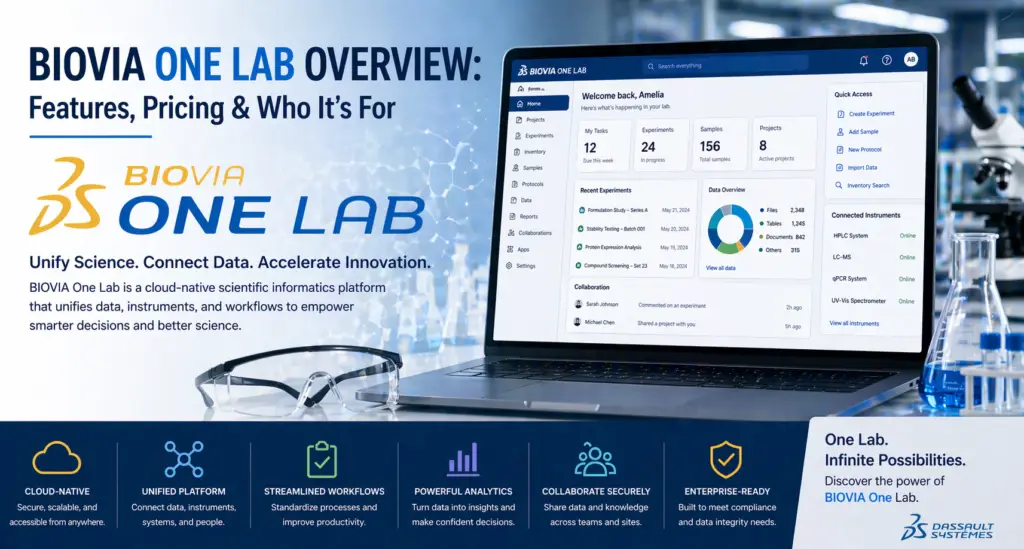
Read this first BIOVIA ONE Lab is not a mid-market LIMS. It is the lab informatics layer of a comprehensive scientific innovation platform that also covers molecular modelling, formulation design, manufacturing analytics, and regulatory quality management — all connected on a single RDF data model. Labs evaluating ONE Lab are not choosing between it and QBench or CloudLIMS. They are choosing between it and LabWare LIMS, Thermo Fisher SampleManager, or Veeva Vault for quality. The correct buyer profile is a large pharmaceutical, biopharma, CPG, or materials science organisation that needs end-to-end digital integration from molecule to market, not a 20-person contract testing laboratory that needs compliant sample tracking. If your lab fits the latter, other vendors in this series will deliver faster time to value at a fraction of the cost. BIOVIA ONE Lab is the laboratory informatics platform of BIOVIA, the scientific innovation brand of Dassault Systèmes. It combines Electronic Lab Notebook (ELN), LIMS, and Laboratory Execution System (LES) functions in a single, unified environment built on one data model — a design choice that separates it structurally from nearly every other LIMS in this series, where ELN, LIMS, and workflow modules are separate products integrated at the API layer. Dassault Systèmes (Euronext Paris: DSY.PA) is the 3DEXPERIENCE Company, founded in 1981 and best known for CATIA (aerospace engineering) and SOLIDWORKS (industrial design). Its BIOVIA brand was created in May 2014 when Dassault acquired Accelrys, Inc. for $750 million — a company that was itself a fusion of five scientific software firms including Molecular Simulations Inc. and Oxford Molecular. Accelrys brought a 20-year legacy of pharmaceutical and materials science software, including the predecessor products to what is now ONE Lab. BIOVIA is headquartered in San Diego, California, and operates as Dassault Systèmes’ scientific arm alongside the broader 3DEXPERIENCE platform used by 370,000+ companies globally. More than 2,000 companies across life sciences, chemistry, oil & gas, consumer packaged goods, and other industries use BIOVIA solutions (3ds.com). Named users of the BIOVIA portfolio include Pfizer, AstraZeneca, BASF, Shell, Unilever, and L’Oréal — though these references are to the BIOVIA platform broadly, not confirmed specifically to ONE Lab. The lab informatics layer (ONE Lab) is described as trusted by large pharmaceutical enterprises for standardising and accelerating testing in QA/QC labs (3ds.com/products/biovia/one-lab/les). This article draws on 3ds.com (ONE Lab, LIMS, LES, ELN, Equipment Management, and AI-ready lab product pages), discover.3ds.com, the Axendia independent analyst briefing on ONE Lab (April 2024), the BIOVIA GxP compliance blog post (3ds.com), Wikipedia (BIOVIA and Dassault Systèmes history), the Dassault Systèmes BIOVIA brand introduction press release (May 2014), the BIOVIA ONE Lab datasheet PDF, G2 (BIOVIA Notebook and CISPro reviews), and a Scispot competitor-authored pricing analysis (November 2025, attributed accordingly). BIOVIA/Dassault Systèmes has not reviewed, sponsored, or paid for this article. Understanding BIOVIA — the platform context every lab manager needs The most common mistake in evaluating BIOVIA ONE Lab is treating it as a standalone LIMS. It is not. ONE Lab is one component of the BIOVIA portfolio on the 3DEXPERIENCE platform, which also covers: All of these products share the same RDF-based data model on the 3DEXPERIENCE platform. This means experimental data captured in ONE Lab is immediately accessible to Pipeline Pilot for analytics, to Discovery Studio for modelling feedback, and to Quality Management for compliance records — without export, transformation, or integration middleware. This “digital thread from R&D to manufacturing” is the architectural proposition that distinguishes BIOVIA from every other vendor in this series. For lab managers at large pharmaceutical or CPG organisations already using Dassault Systèmes products (CATIA, SOLIDWORKS, Medidata for clinical trials), ONE Lab’s integration into that existing 3DEXPERIENCE infrastructure is a significant consideration. For lab managers at organisations with no existing Dassault footprint, the question is whether the breadth of the platform justifies the implementation complexity and cost relative to a purpose-built LIMS. Strategic context for LabOps directors The Axendia independent analyst briefing on ONE Lab (April 2024) quotes BIOVIA’s Director of Marketing Stephen Hayward: “Elements of ONE Lab can be deployed individually, together, or added over time as part of a company’s digital transformation journey.” This is the correct framing. Organisations do not need to deploy the entire BIOVIA portfolio to benefit from ONE Lab. A pharma QA/QC lab can deploy the LIMS and LES components alone. A biotech R&D group can start with the ELN. The RDF data model means each component’s data is immediately available to future components without migration. The strategic value multiplier, as Hayward describes it, is horizontal and vertical integration as additional components are added over time. At a glance Field Details Product BIOVIA ONE Lab — unified ELN + LIMS + LES on the 3DEXPERIENCE platform Parent company Dassault Systèmes (Euronext Paris: DSY.PA). Founded 1981. HQ: Vélizy-Villacoublay, France. BIOVIA HQ: San Diego, California, USA. BIOVIA history BIOVIA brand created May 2014 from acquisition of Accelrys, Inc. for $750M (Wikipedia). Accelrys was itself formed in 2001 from five scientific software companies including Molecular Simulations Inc. and Oxford Molecular. Scale (BIOVIA) 2,000+ companies use BIOVIA solutions across life sciences, chemistry, oil & gas, CPG, and other industries (3ds.com). Named customer references include Pfizer, AstraZeneca, BASF, Shell, Unilever, L’Oréal, Aboca. ONE Lab scope ELN + LIMS + LES + Equipment Management + Inventory Management in one platform with a single RDF data model. Removes artificial barriers between traditionally separate systems. ELN options Three ELNs, all integrated with ONE Lab: BIOVIA Scientific Notebook (cloud-native, knowledge graph architecture), BIOVIA Notebook (established IP-focused ELN), BIOVIA Workbook (research-focused). All available on cloud. Data model RDF (Resource Description Framework) / knowledge graph architecture. FAIR data (Findable, Accessible, Interoperable, Reusable) by design. 80% reduction in AI data preparation time reported (3ds.com — vendor-published). Deployment Cloud (BIOVIA ScienceCloud / 3DEXPERIENCE platform — global datacentres, sovereign data control), on-premise, or hybrid. Same code stream across all deployment options (easy migration). Quick Start programme for ELN with pre-packaged configurations. Compliance FDA 21 CFR Part 11, EU Annex 11, EPA, GxP (GLP, GMP, GCP). 3DEXPERIENCE platform is
Waters NuGenesis LMS / SDMS Overview: Features, Pricing & Who It’s For (2026)
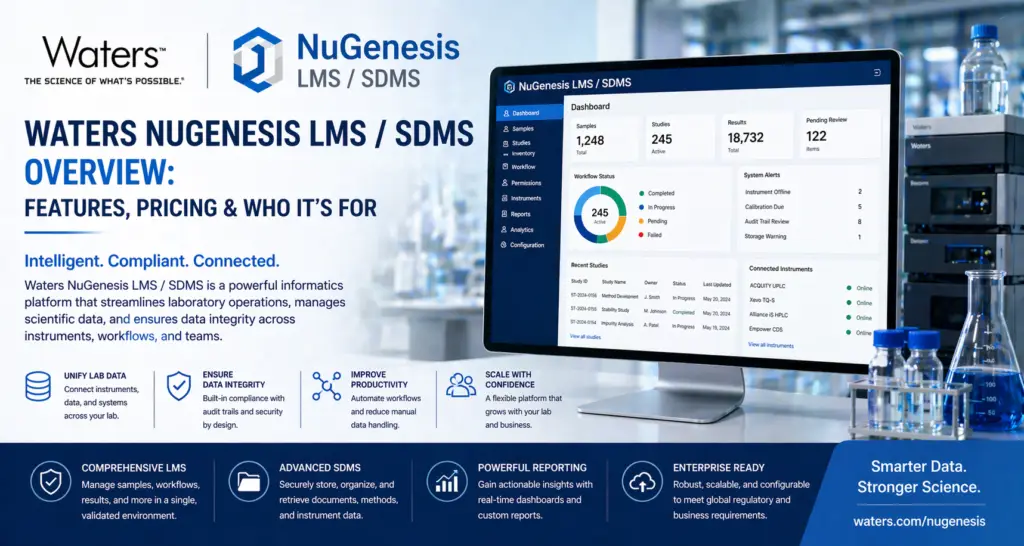
Read this first — NuGenesis is not a traditional LIMS Waters itself markets NuGenesis as “LIMS capabilities without the complexity” and as “a unique and powerful alternative to a traditional LIMS” (Waters video; European Pharmaceutical Review launch). If you are evaluating NuGenesis as your laboratory’s primary LIMS — the system that manages all your samples, tests, methods, and compliance workflows — you are likely evaluating the wrong product. NuGenesis is primarily an SDMS (Scientific Data Management System) and ELN platform that sits alongside a traditional LIMS, not in place of one. Its SDK explicitly integrates with external LIMS products (LabWare, Chemware). Its most powerful use case is as the compliance-ready data archive and ELN for labs already running Waters Empower chromatography data system. If your lab uses Empower heavily, NuGenesis is the natural next layer. If your lab does not use Empower and needs a primary LIMS, other vendors in this series serve that need more directly. Waters NuGenesis is a laboratory information management platform that combines a Scientific Data Management System (SDMS), an Electronic Lab Notebook (ELN), and a Sample Management layer into what Waters calls a Lab Management System (LMS). The platform is developed and supported by Waters Corporation (NYSE: WAT), a global leader in analytical instruments and software headquartered in Milford, Massachusetts. Waters was founded in 1958 by James Logan Waters and is known for Empower chromatography data system, MassLynx mass spectrometry software, ACQUITY UPLC and HPLC systems, and the NuGenesis LMS. FY2024 revenue: $2,958 million. Approximately 7,600 employees operating in 35 countries (Waters FY2024 press release). NuGenesis SDMS has been adopted by “hundrends of companies around the world” (waters.com/nugenesis-sdms). The Sumble technology adoption platform identifies 153 organisations currently using NuGenesis (Sumble, April 2026). The platform is available in Japan via Waters Informatics Strategic Partner B-EN-G (Business Engineering Corporation), which publishes implementation templates and a dedicated September 2025 article on NuGenesis for the Japanese biopharma market — confirming active commercial presence in Asia. Named customers include BIOVECTRA, a biotech CDMO serving the pharma industry, which is featured in a waters.com webinar series on ongoing NuGenesis LMS implementation success. This article draws on waters.com (all NuGenesis product pages), the NuGenesis 9.3 What’s New white paper (Waters, January 2024), the Waters 21 CFR Part 11 white paper for NuGenesis SDMS, the Waters Application Programming Interfaces page, the Waters Knowledge Base (AWS deployment article), European Pharmaceutical Review (NuGenesis LMS launch announcement), SelectScience (NuGenesis SDMS product listing and case study), Sumble (technology adoption data), B-EN-G (Waters Informatics Strategic Partner, Japan), Wikipedia (Waters Corporation), Waters FY2024 financial results press release, IntuitionLabs LIMS vs SDMS guide, and a Scispot competitor-authored pricing analysis (November 2025, attributed). Waters Corporation has not reviewed, sponsored, or paid for this article. Understanding Waters — and why NuGenesis exists Waters Corporation has been a dominant force in analytical chemistry instrumentation for over 65 years, particularly in HPLC and UPLC separations and mass spectrometry. Its Empower Chromatography Data System is one of the most widely deployed CDS platforms in pharmaceutical QC globally, with deep regulatory acceptance. The challenge Empower creates is also what NuGenesis solves: Empower generates massive volumes of instrument data — chromatograms, spectra, processing methods, raw files, printouts — that must be securely archived, searchable, auditable, and accessible for years under 21 CFR Part 11 and EU Annex 11 requirements. NuGenesis SDMS was built specifically to address this problem: automatically capture, index, and archive all data flowing out of Empower (and other instruments) into a compliant, searchable central repository without manual intervention. The NuGenesis LMS layer then adds ELN-style documentation, sample submission, results review, and stability testing workflow on top of that repository. This origin is why NuGenesis is most accurately evaluated as “the informatics complement to Empower” rather than as a standalone LIMS. A lab running Empower as its CDS, with no SDMS, has uncontrolled data files sitting on instrument PCs, difficult to back up, audit, or search. NuGenesis SDMS solves that immediately. A lab with no Empower deployment evaluating a primary LIMS would typically look at STARLIMS, LabWare, or Thermo Fisher SampleManager rather than NuGenesis. The Empower + NuGenesis stack The most common NuGenesis deployment pattern, confirmed by the IntuitionLabs LIMS/SDMS guide and the Astrix global biopharma case study, is: Thermo Fisher SampleManager (or another LIMS) manages samples and test results. Waters Empower 3 controls HPLC and UPLC instruments and processes chromatographic data. Waters NuGenesis SDMS automatically archives all Empower data files, raw chromatograms, and printouts into a searchable, 21 CFR Part 11-compliant central repository. In this stack, NuGenesis is not replacing the LIMS — it is adding the SDMS layer that the LIMS cannot provide on its own. At a glance Field Details Product Waters NuGenesis Software — comprising NuGenesis SDMS, NuGenesis LMS (ELN + Sample Management), NuGenesis Sample Management, NuGenesis Stability, and NuGenesis Dashboards. Current version 9.3 (NuGenesis 9.3 What’s New white paper, Waters, January 2024). Supports Empower 3.8 and Windows Server 2016 / 2019. Parent company Waters Corporation (NYSE: WAT). Founded 1958, Milford, Massachusetts, USA. FY2024 revenue: $2,958M. ~7,600 employees. 35 countries. Primary competitors: Agilent Technologies, Thermo Fisher Scientific, Revvity, Danaher (Wikipedia). What it actually is A Scientific Data Management System (SDMS) + ELN + Sample Management platform. NOT a traditional LIMS. Waters markets it explicitly as “LIMS capabilities without the complexity.” External LIMS (LabWare, Chemware) can connect via the NuGenesis SDK. Best understood as the data management and ELN complement to Waters Empower CDS. Primary market Pharmaceutical and biopharma analytical labs, QC labs, R&D, and CDMOs that use Waters Empower as their chromatography data system and need compliant data archiving, scientific search, ELN workflow, sample management, and stability management without deploying a full enterprise LIMS. Adoption “Hundreds of companies around the world” (waters.com SDMS page). 153 organisations confirmed on Sumble (April 2026). Named customer: BIOVECTRA (biotech CDMO, pharma). Waters Informatics Strategic Partner active in Japan: B-EN-G (September 2025 publication). Deployment On-premise (Windows Server). Cloud on AWS is NOT officially supported as of NuGenesis 9.4 per Waters Knowledge Base (WKB305387). The NuGenesis
Revvity Signals Notebook ELN Review: Features, Pricing & Who It’s For (2026)
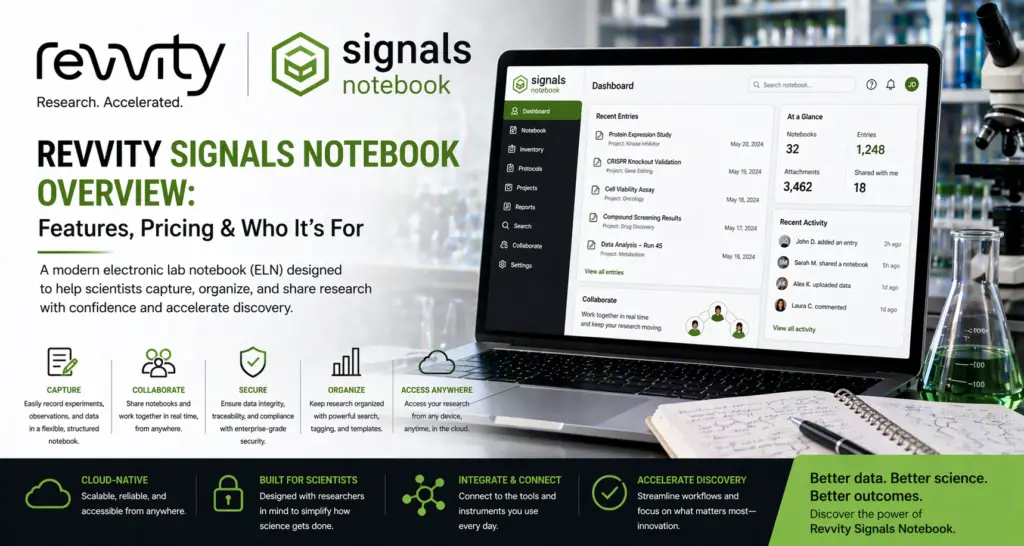
The defining differentiator for chemists Signals Notebook is the only cloud-native ELN with native, embedded ChemDraw. ChemDraw has been the industry-standard chemical drawing tool since 1985. If your lab includes synthetic chemists who draw structures, calculate stoichiometry, or search by chemical substructure and similarity, Signals Notebook’s native ChemDraw integration is the single most important capability no other ELN in this series can match on equal terms. For labs where biology is the primary discipline and chemical structure handling is not central, this advantage is reduced, and other ELNs may provide equivalent or better value. Signals Notebook is the flagship ELN of Revvity Signals Software, the informatics division of Revvity, Inc. (NYSE: RVTY). It is the most widely adopted ELN in this review series by any measurable scale: 1 million scientists at 4,000 organisations use it (AWS Marketplace). Named customers include Eli Lilly, Roche Diagnostics, AstraZeneca, Merck KGaA, Lundbeck, Givaudan, and FrieslandCampina. Stanford University and the NIH intramural research programme both run it. Revvity Signals Software employs approximately 720 people and serves those 1 million users worldwide (revvitysignals.com/company/about-us). Understanding Signals Notebook requires understanding where it comes from. Revvity’s informatics lineage begins with CambridgeSoft, the company that developed ChemDraw in 1985. CambridgeSoft was sold to PerkinElmer in 2011 (Wikipedia), and its lab notebook product — then called E-Notebook — was developed as an enterprise ELN for decades. In 2022, PerkinElmer split into two independent public companies: the life sciences and diagnostics businesses became Revvity, Inc. (NYSE: RVTY); the applied and enterprise businesses kept the PerkinElmer name and went private. Revvity’s software division became Revvity Signals Software, and Signals Notebook is the cloud-native successor to E-Notebook — rebuilt from scratch on a microservice architecture rather than ported to the cloud (white paper, revvitysignals.com). This article draws on revvitysignals.com (product pages, About Us, case studies, white papers, NEXUS Europe 2025 recap, FAQ pages), the Signals Notebook August 2024 data sheet, the ‘5 Benefits of Signals Notebook’ white paper (January 2025), the Eli Lilly case study (May 2025), AWS Marketplace (product listing and verified reviews), NIH Office of Intramural Research ELN policy (confirmed as active Signals Notebook deployment), Stanford University Science Library (confirmed active licence), G2 (Revvity Signals seller page: 4.4/5, 42 reviews), PeerSpot, ChemDraw Wikipedia article, Wikipedia (Revvity). Revvity Signals has not reviewed, sponsored, or paid for this article. Company and heritage — why the ChemDraw lineage matters Revvity is not a startup building a new ELN. It is the scientific informatics arm of a company with 65+ years of history in life sciences and analytical chemistry, with direct lineage to the most trusted chemical drawing tool in existence. This heritage is operationally relevant: Signals Notebook’s native ChemDraw integration is not a partnership or an API connection — ChemDraw is developed by the same organisation, on the same platform, and updated in lockstep with Signals Notebook. The informatics product line progression is: CambridgeSoft E-Notebook (1990s–2011) → PerkinElmer E-Notebook (2011–2022) → Revvity Signals Notebook (2022–present). Signals Notebook was built cloud-native from the ground up — not a cloud-hosted version of legacy on-premise software. The original E-Notebook product has been sunset. Signals Notebook Standard is the current active product; the Individual Edition reached End of Life on March 1, 2025 (Revvity Signals support portal), with data migration paths to Standard provided. Revvity Signals Software also maintains an exclusive partnership with Spotfire (the TIBCO/Cloud Software Group data analytics platform), embedding it within the Signals platform for scientific data visualisation. This Spotfire relationship provides advanced analytics capability directly connected to ELN data — a combination that is otherwise unavailable in a single vendor stack from any other ELN in this series. On the Revvity corporate context Revvity (NYSE: RVTY) is a publicly traded company with initial revenues of approximately $3 billion (Wikipedia) and approximately 11,000 employees. Revvity Signals Software is one division within Revvity. Lab managers signing multi-year ELN contracts benefit from the vendor stability that public company status provides — financial disclosures, public accountability, and institutional investment discipline. The risk of unexpected acquisition or discontinuation is lower than for small private ELN vendors. The offsetting consideration is that Revvity is a large organisation: product decisions reflect enterprise-wide priorities, not just the ELN user community. At a glance Field Details Product Signals Notebook — cloud-native ELN and scientific collaboration platform Parent company Revvity Signals Software, division of Revvity, Inc. (NYSE: RVTY). HQ: Waltham, Massachusetts, USA. ~11,000 employees (Revvity). ~720 employees (Revvity Signals Software). Origins: CambridgeSoft → PerkinElmer Informatics → Revvity Signals. Scale 1 million scientists at 4,000 organisations worldwide (AWS Marketplace product listing, April 2026). Product type ELN (Electronic Lab Notebook) and scientific collaboration platform. Primary purpose: experiment documentation, data capture, collaboration, IP protection, and regulatory compliance in R&D environments. Architecture Cloud-native SaaS built on AWS. Microservice architecture — each component operates independently; self-healing and resilient. No on-premise version available. Release cadence 10 releases per year (confirmed on product page and FAQ). Updates deployed automatically — no customer IT action required. Free trial Yes — available on revvitysignals.com. No credit card required for trial. ChemDraw Native, embedded integration. The only cloud ELN with ChemDraw. Automates stoichiometry calculations, supports SMILES, CAS Number search, structure/substructure/similarity search. Full access to PubChem safety data sheets. Spotfire Exclusive partnership for scientific data analytics and visualisation. Embedded within the Signals platform for advanced data analysis connected directly to ELN data. Signals DLX Digital Lab Exchange (powered by Scitara): automated instrument data capture, parsing, and organisation directly into Signals Notebook. Eliminates manual transcription from analytical instruments. Signals One Higher-tier offering adding AI-enhanced workflows, structured data handling, structure-activity relationship (SAR) analysis, and deeper data intelligence on top of Signals Notebook foundations. Signals Inventa Enterprise data analytics and management layer for the Signals platform. Signals VitroVivo In vitro/in vivo biological data management module within the Signals platform. Inventory Chemical and sample inventory management built directly within Signals Notebook. Barcode scanning, location tracking, automatic low-stock alerts, material traceability. Compliance 21 CFR Part 11 (audit trails, e-signatures, version control, page locking), GxP-ready, IP protection (sign/close/witness workflows). SOC 2
Mosaic by Cenevo Overview: Features, Pricing & Who It’s For (2026)
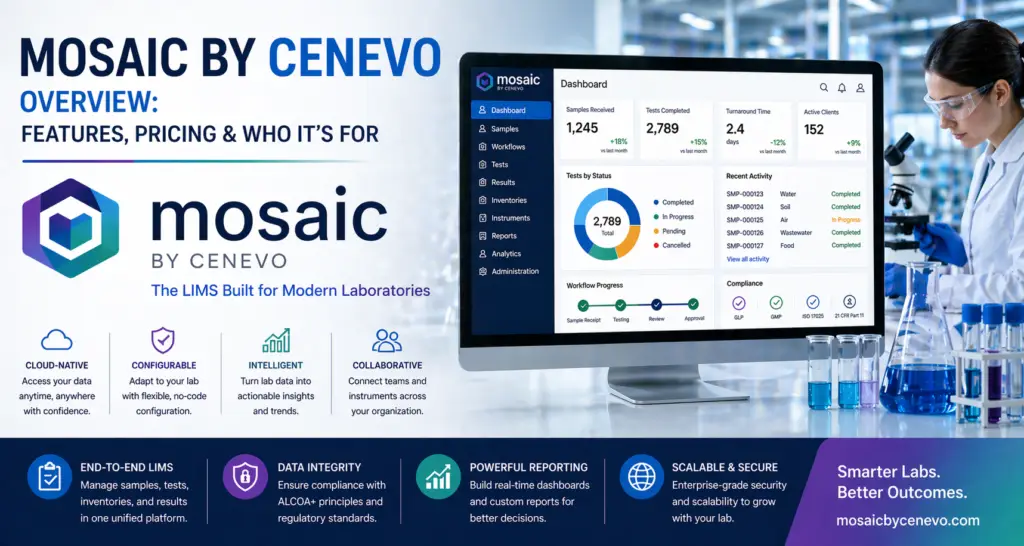
Read this first Mosaic is not a traditional LIMS. If you are searching for a system to manage test workflows, results entry, CoA generation, or QC analytical testing, Mosaic is not what you need. Mosaic is a specialist sample management platform — one of the most established in the life sciences industry — that tracks the physical lifecycle of samples (compounds, biologicals, reagents, biospecimens) from registration through storage, request, fulfilment, dispensing, and disposal. Think of it as the system that answers “where is my sample, in what container, at what location, at what concentration, with what history?” — not the system that records results. Labs that need both often run Mosaic alongside a traditional LIMS or ELN; within Cenevo’s portfolio, that ELN/LIMS is Labguru. Mosaic is the flagship product of Cenevo, a London-headquartered life science software company formed in July 2025 when Titian Software (the creator of Mosaic) and Labguru merged under the Cenevo brand. The product itself has a 25-year track record: Titian Software was founded in 1999 by Edmund Wilson and Richard Fry, and the first Mosaic system went into production in 2003 (titian.co.uk IT information page). As of April 2026, Mosaic operates in R&D environments in 13 of the world’s top 20 biopharma companies, has more than 60 installations worldwide, over 10,000 users, and manages over one billion samples (titian.co.uk IT information page). That scale and longevity are the most important facts a lab manager evaluating Mosaic needs to understand. This is not a startup product. It is a deeply established, specialist system that has been continuously refined over two decades to solve one specific problem: the accurate, automated, audit-compliant management of physical sample lifecycles at scale. Its customer base — which includes Evotec (nearly 20 years), Charles River Laboratories (renewed 3-year agreement 2023), Tyra Biosciences, Sygnature Discovery, Compounds Australia, and unnamed Japanese pharma and global biopharma companies — reflects a consistent focus on pharma, biopharma, biobank, and CRO environments where sample fidelity is mission-critical. This article draws on titian.co.uk, cenevo.com, Business Wire press releases (Battery Ventures investment June 2022; Mosaic 9.0 launch September 2023; Charles River 3-year agreement 2023; Compounds Australia November 2024), the Cenevo 2025 Year in Review (December 2025), the Cenevo Product Advisory Council 2025 write-up, SelectScience, Tracxn, and industry sources. Mosaic/Cenevo has not reviewed, sponsored, or paid for this article. Corporate history and the Cenevo context Understanding Mosaic’s ownership chain is important for any lab manager making a multi-year commitment: Date Event Detail 1999 Titian Software founded Founded in London, UK by Edmund Wilson and Richard Fry (Tracxn). Focused exclusively on sample management software for life science laboratories. 2003 Mosaic first deployment First Mosaic system goes into production (titian.co.uk IT information). A 20+ year continuous product evolution begins. 2003–2022 Organic growth Titian grows as a bootstrapped, founder-led specialist. Builds customer base in pharma, biopharma, and CRO environments. Establishes Mosaic as a recognised category leader for compound management. Expands to US and Asia offices. Jun 2022 Battery Ventures majority investment Battery Ventures (Boston-based global technology investment firm) makes a significant majority investment in Titian Software Ltd. Terms undisclosed (Business Wire, 22 June 2022). Edmund Wilson retains a meaningful ownership stake and remains closely involved. Justin Rosner (Battery) joins Titian’s board. Investment purpose: support organic growth and future acquisitions. Sep 2023 Mosaic 9.0 / Charles River Mosaic 9.0 released, adding real-time multi-site inventory synchronisation and global sample logistics. Charles River Laboratories and Titian announce a renewed and expanded 3-year partnership agreement (Business Wire, September 2023). Apr 2024 Labguru joins Battery portfolio Battery Ventures acquires Labguru (BioData Inc.) from Holtzbrinck Digital. Labguru joins the same Battery portfolio as Titian Software. Edmund Wilson appointed as Labguru’s Founder and Chief Product Officer in press materials. Jan 2025 Keith Hale named Group CEO Keith Hale appointed Group CEO of Titian Software (titian.co.uk press page, January 2025). Edmund Wilson transitions to Chief Product Officer role. Jul 2025 Cenevo rebrand Titian Software and Labguru rebrand as Cenevo (PRNewswire, 30 July 2025). Mosaic and Labguru continue as distinct products. Combined entity: 950+ customers, 45,000+ scientists, 200+ staff, offices in UK, US, Israel, and Poland. Nov 2024 Compounds Australia Compounds Australia (Griffith University, Queensland) selects Mosaic to manage their 1.5 million+ sample compound collection across 50 member organisations worldwide (Cenevo press release, 19 November 2024). 2025 150+ integrations, 120 new customers Cenevo 2025 Year in Review confirms: 150+ off-the-shelf automations and integrations, 120+ new customers, 300+ existing customers deepened partnerships, 140+ customer projects delivered. Battery Ventures and PE context for lab managers Battery Ventures is a well-regarded technology investment firm with a long track record (founded 1983) and specific expertise in life science informatics. Their investment in Titian in June 2022 was described as supporting organic growth and potential acquisitions — which the Labguru acquisition in 2024 confirmed. The Cenevo rebrand brings two complementary products (Mosaic sample management + Labguru ELN/LIMS) under one corporate roof. Labs buying Mosaic are buying into a PE-backed business with an active acquisition strategy. The Cenevo 2025 Year in Review commits explicitly to continued investment in Mosaic: “we will continue to invest in Mosaic to maintain and extend” its position. Buyers should clarify in contract negotiations what specific product and support commitments they can lock in for their contract term. At a glance Field Details Product Mosaic Sample Management Platform (by Cenevo, formerly Titian Software) Parent company Cenevo (formed July 2025 from merger of Titian Software and Labguru). HQ: London, UK. Mosaic founded 1999 (Titian Software Ltd, London). First production: 2003. Continuous product evolution for 25+ years. Founders Edmund Wilson and Richard Fry (Tracxn). Edmund Wilson = Co-Founder & CPO at Cenevo. CEO: Keith Hale (appointed January 2025). Ownership Battery Ventures (majority investment June 2022, terms undisclosed). Scale (Mosaic) 13 of the world’s top 20 biopharma companies. 60+ installations worldwide. 10,000+ users. 1 billion+ samples managed. (titian.co.uk IT information page) Cenevo combined 950+ customer organisations. 45,000+ scientist users. 200+ staff. Offices in UK, US, Israel, Poland. Product scope Specialist sample management platform: physical inventory tracking, sample lifecycle
LabLynx ELab LIMS Overview: Features, Pricing & Who It’s For (2026)
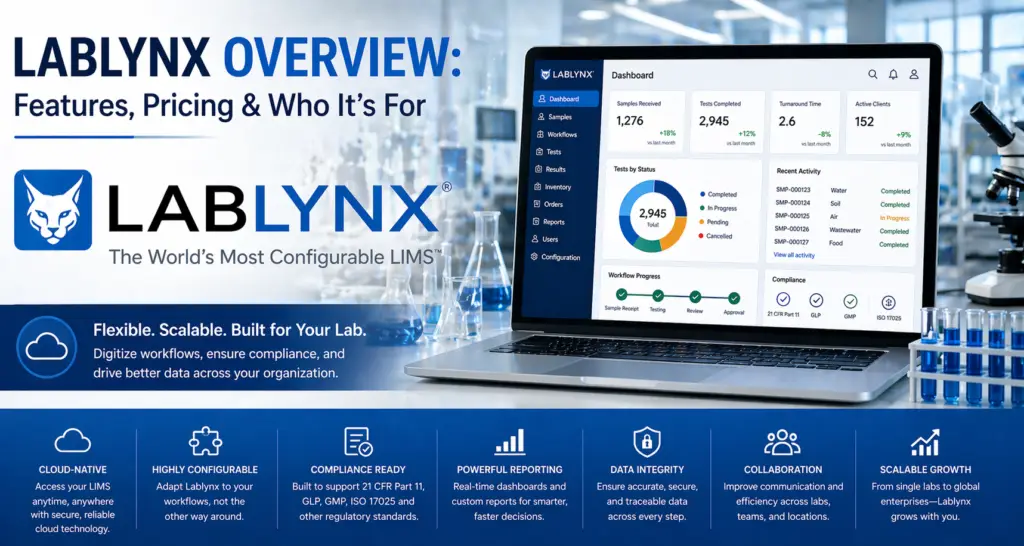
LabLynx is one of the longest-running LIMS companies in the United States, with a history that stretches back to 1992 and a product claim that is independently verifiable: it was among the first companies to demonstrate a browser-based LIMS, doing so at Pittcon in 1997 — at a time when most LIMS products still required client-side installation. That heritage is real and relevant. LabLynx has been building, hosting, and supporting web-based laboratory information management systems for nearly three decades. The company is privately owned, bootstrapped, and small. CEO and founder John H. Jones incorporated LabLynx, Inc. in July 2000 after separating it from its parent company Atlanta Systems Consultants, Inc. As of April 2026, LabLynx has approximately 14 employees (RocketReach) and is headquartered in the Atlanta, Georgia area. Crunchbase describes it as bootstrapped. Tracxn lists it as unfunded. This is not a venture-backed scale-up; it is an owner-operated specialist software company that has served laboratory clients continuously for over 25 years. Buying context matters here. LabLynx sits in a different market segment from the enterprise LIMS vendors in this series (STARLIMS, LabWare, Sapio Sciences) and from the well-funded mid-market cloud platforms (QBench, Scispot, Benchling). It is a small, bootstrapped, specialist provider with a long track record and a configurable platform. Labs that fit its target profile can get a capable, compliant, cloud-hosted LIMS at lower cost and with faster deployment than enterprise alternatives. Labs that need the deepest feature sets, the largest support organisation, or a vendor with hundreds of named case studies published externally will need to weigh those factors. This article draws on lablynx.com, Wikipedia, LIMSWiki, the LabLynxPress wiki, Tracxn, Crunchbase, Datanyze, RocketReach, Bloomberg Businessweek, John Jones’ LinkedIn profile, G2 (2 reviews, 4.8/5 — verified April 2026), Capterra, Sourceforge, IntuitionLabs LIMS guide (2025), and competitor analyses from Scispot (November 2025, January 2026). LabLynx has not reviewed, sponsored, or paid for this article. Company history — from ASC to LabLynx LabLynx’s origins predate the company itself. In 1992, Atlanta Systems Consultants, Inc. (ASC) was formed as a diversified IT consulting firm. Within ASC, a division began developing a LIMS product specifically designed to run in a web browser — an unusual approach for the mid-1990s, when LIMS software was almost universally delivered as thick client software requiring installation on each workstation. Date Milestone Detail 1992 ASC formed Atlanta Systems Consultants, Inc. (ASC) incorporated in Georgia. Begins development of a browser-based LIMS product under the LabLynx division name. 1997 Pittcon debut ASC demonstrates its Internet Explorer-based LabLynx LIMS at Pittcon — among the first browser-based LIMS products shown publicly (Wikipedia, LIMSWiki). Returns to Pittcon in 1998. Late 1990s US Customs contract LabLynx wins a major LIMS-based contract with the U.S. Customs Service shortly after its Pittcon appearances (Wikipedia). Jul 2000 LabLynx, Inc. incorporated LabLynx division separates from ASC to become its own incorporated entity. CEO and founder: John H. Jones (Tracxn, LinkedIn). Incorporated per Georgia Secretary of State (LIMSWiki). ASC ceases to exist in 2005. 2001 ASP model / ELab The browser-based product becomes ELab, distributed under an application service provider (ASP) model — a precursor to modern SaaS (Wikipedia, LIMSWiki). 2004 openLIMS released LabLynx releases openLIMS, a browser-based tool allowing consultants and end-users to build custom LIMS solutions without vendor involvement (Wikipedia). 2006 Laboratory Informatics Institute LabLynx founds the Laboratory Informatics Institute on 19 June 2006 — an open trade association for the lab informatics industry. Also publishes LIMSfinder (industry magazine) and LIMSbook (buyer’s guide) (Wikipedia). 2011 Health IT initiative LabLynx participates in a U.S. ONC-backed laboratory results interface (LRI) pilot to standardise transmission of lab data to electronic health records (Wikipedia). 2015 HealthCloudPOL Releases HealthCloudPOL, a cloud-based LIS for physician office laboratories (Wikipedia). 2019 CannaQA LIMS Releases CannaQA LIMS specifically for cannabis testing labs. Renamed “ELab LIMS for Cannabis Testing” by 2022 (Wikipedia). 2020 CovidLIMS In April 2020, LabLynx adapts ELab LIMS to manage COVID-19 testing workflows — described as the first dedicated COVID-19 LIMS (PRNewswire, 9 April 2020). 2026 Current status lablynx.com active. ELab LIMS is the flagship product. Platform rebranded as the LabLynx Next Generation Informatics Platform, combining LIMS Suite, ELN Suite, and Lab Automation Suite. ~14 employees. HQ: Atlanta/Smyrna, Georgia. Company scale context With approximately 14 employees, LabLynx is the smallest company reviewed in this series. For buyers, this means: a highly personalised sales and support relationship; faster response times for custom configurations (a consistent theme in independent analyses); and a product roadmap that is not driven by institutional investors. It also means a smaller support organisation, a narrower published case study library, and a G2 review base (2 verified reviews as of April 2026) that is too small to draw statistically meaningful conclusions. Buyers should conduct thorough reference checks with existing LabLynx customers in their industry and deployment size. At a glance Field Details Legal name LabLynx, Inc. Incorporated July 2000, Georgia, USA (Georgia Secretary of State, per LIMSWiki) CEO and founder John H. Jones (LinkedIn, Tracxn). Founder of LabLynx, Inc. and the Laboratory Informatics Institute. HQ Atlanta/Smyrna, Georgia, USA. Address listed by Datanyze: 2400 Lake Park Dr SE, Ste 435, Smyrna, Georgia 30080. Employees ~14 (RocketReach). Crunchbase confirms bootstrapped (no external funding). Ownership Privately owned and funded. Bootstrapped per Crunchbase. No external investors listed on Tracxn or Crunchbase. CEO John Jones is founder and owner. Flagship product ELab LIMS (also marketed as the LabLynx LIMS Suite). Browser-based, cloud-hosted or self-hosted. Platform suite LIMS Suite + ELN Suite + Lab Automation Suite = LabLynx Next Generation Informatics Platform. Modular: LIMS, LIS, LES, ELN, SDMS, Lab Portal, Reporting & Analytics, AI/IoT Automation, Document & Quality Management, and industry-specific modules. Deployment Cloud-hosted (SaaS, LabLynx-managed) or self-hosted (client-managed). Both confirmed on LIMSWiki and lablynx.com. Browser-based: no client installation required on workstations. Industries served Clinical/healthcare, environmental, forensics and medical examiner, agriculture, food & beverage, manufacturing, cannabis testing, pharmaceutical/biotech, construction & engineering. Confirmed across lablynx.com industry pages and Wikipedia. Notable history Contract with U.S. Customs Service (late 1990s, Wikipedia). First dedicated COVID-19 LIMS (April 2020, PRNewswire). Founded the
CloudLIMS Review: Features, Pricing & Who It’s For (2026)
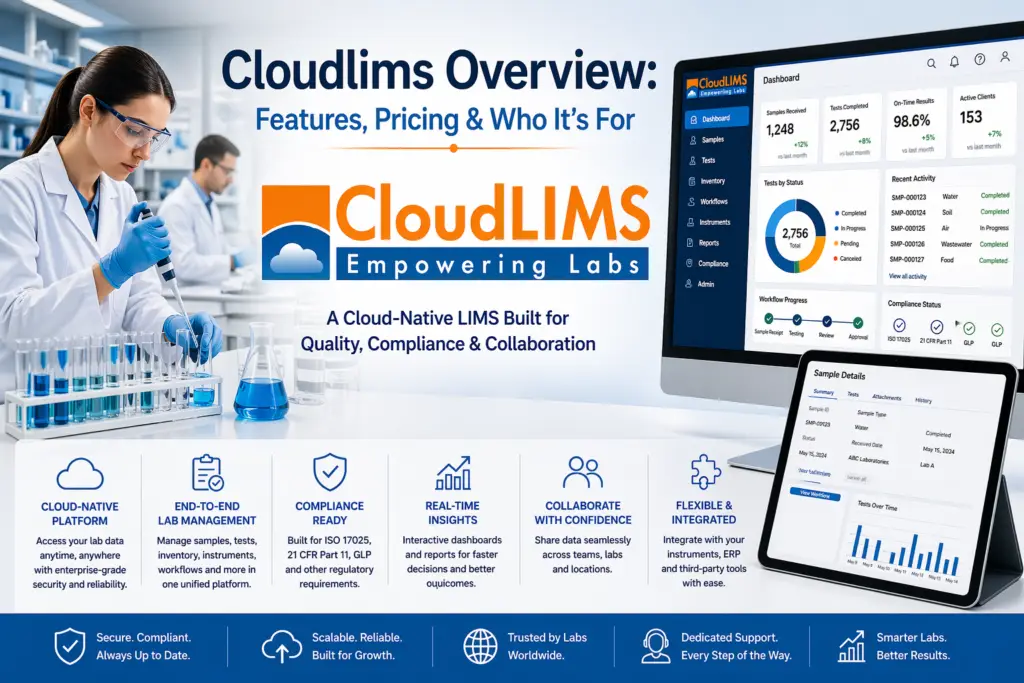
CloudLIMS is a web-based, cloud-only Laboratory Information Management System (LIMS) founded in 2013 and headquartered in Wilmington, Delaware. According to its own About Us page, the company is an ISO 9001:2015 certified informatics company, and PR.com and LinkedIn both confirm its founding year and location. It is a privately held, bootstrapped company — Tracxn and Crunchbase both confirm no external funding has been raised. CloudLIMS operates with a team of 11–50 employees (LinkedIn, ZoomInfo) and serves customers in over 100 countries — a figure stated on the company’s homepage and corroborated in third-party review write-ups. The platform is structured around the premise of zero upfront cost: all listed prices are subscription-only, and complementary services including technical support, instrument integration, legacy data migration, workflow configuration, one CoA template, product upgrades, and automatic backups are bundled into the subscription rather than billed separately. CloudLIMS occupies a well-defined position in the mid-market: it targets testing labs, biobanks, and clinical labs that need a fully web-based, compliance-ready LIMS with volume-scaled pricing — without the enterprise implementation burden of platforms like LabWare or LabVantage. Its most direct market comparison is QBench, with meaningful differences in pricing model, feature bundling, and industry verticals served. This article is based exclusively on CloudLIMS’s official website and pricing page (fetched directly in April 2026), G2, Capterra, GetApp, Software Advice, Sourceforge, LinkedIn, ZoomInfo, Datanyze, PitchBook, Tracxn, and published press releases on cloudlims.com, PR.com, and Biobanking.com. CloudLIMS has not reviewed, sponsored, or paid for this article. At a glance Field Details Vendor CloudLIMS.com LLC Founded 2013 Headquarters Wilmington, Delaware, USA (4023 Kennett Pike #50373). Development team in India (ZoomInfo, LeadIQ). CEO Arun Apte (named in SOC 2 Type 1 press release, February 2022, cloudlims.com) Ownership Privately held, bootstrapped. No external funding raised (Tracxn, Crunchbase). Employees 11–50 (LinkedIn). ~29–40 across data sources (LeadIQ: 29 as of July 2024; PitchBook: 40; ZoomInfo: 11–50). Certifications ISO 9001:2015 certified (confirmed on About Us page and multiple press releases). SOC 2 Type 2 compliant (announced cloudlims.com, 2023; confirmed PR.com September 2025). Deployment Cloud-only SaaS. Fully browser-based. No installation required. No on-premise option. Platform scope LIMS core + QMS support + Client Portal + Billing/Invoicing + Instrument Integration + Document Management + Staff Training Module + CAPA Module + Inventory Management ELN included No. CloudLIMS is a LIMS-first platform. No ELN component. Key industries Biobanking/biorepository, clinical diagnostics, clinical research, analytical testing, cannabis, environmental, food & beverage, veterinary, oil & gas, materials testing, water, mining, genomics, psychedelics Global reach Customers in 100+ countries (cloudlims.com homepage). Attends ISBER annually, including ISBER 2025 Argentina Regional Meeting (September 2025). Named customers University of Sheffield Biorepository (jointly presented ISBER 2017 poster). Fidelis Research (biospecimen collection sites in Bulgaria, Romania, Croatia, Serbia, Turkey; named on cloudlims.com homepage). LTL (Rhode Island cannabis lab; G2/Capterra review by director Cesar Marquez). Free tier FreeLIMS — a separate free product with basic features. No credit card required. Available at freelims.com. Limitations noted by G2 reviewers include restricted database access and absence of API. Pricing Publicly listed, volume-scaled per-user model. Starts at $285/user/month for 5 users (3rd party labs, billed annually). Full pricing table below. G2 profile Listed on G2. G2-generated review summary identifies Customer Support (8 mentions), Functionality (6), Ease of Use (6), and Customization (5) as top positive themes. Customization Difficulty (4) and Steep Learning Curve (3) are top negatives. Most recent verified reviews: August 2025. What CloudLIMS does CloudLIMS is a sample-centric LIMS built for labs that run structured, repeatable testing workflows. It is not an ELN or a research notebook. Its architecture is organised around tracking the full lifecycle of samples — from accessioning through storage, testing, reporting, and disposal — with supporting modules for compliance, billing, and quality management. All features documented below are confirmed on cloudlims.com, the G2 listing, or GetApp: Pricing — publicly listed, volume-scaled CloudLIMS publishes its full pricing on cloudlims.com/lims-software-pricing. All figures below were fetched directly from that page in April 2026 and are billed annually. Unlike most LIMS vendors in this series, CloudLIMS publishes complete pricing publicly — making it one of only two vendors in this series (alongside QBench) where buyers can budget accurately before entering a sales conversation. CloudLIMS pricing is split into three segments based on lab type, each with volume-based per-user rates: 3rd party analytical testing labs, veterinary labs, commercial & 3rd party biobanks (min. 5 users) User band Price/user/month (annual) Lab type 5 users $285/user/month 3rd party analytical testing, veterinary, commercial biobank 10 users $200/user/month 3rd party analytical testing, veterinary, commercial biobank 25 users $100/user/month 3rd party analytical testing, veterinary, commercial biobank 50 users $66/user/month 3rd party analytical testing, veterinary, commercial biobank 100 users $42/user/month 3rd party analytical testing, veterinary, commercial biobank In-house analytical testing labs & in-house biobanks (min. 3 users) User band Price/user/month (annual) Lab type 3 users $310/user/month In-house analytical testing, in-house biobank 5 users $285/user/month In-house analytical testing, in-house biobank 10 users $200/user/month In-house analytical testing, in-house biobank 25 users $100/user/month In-house analytical testing, in-house biobank 50 users $66/user/month In-house analytical testing, in-house biobank 100 users $42/user/month In-house analytical testing, in-house biobank Cannabis & clinical diagnostics (3rd party) (min. 4 users) User band Price/user/month (annual) Lab type 4 users $270/user/month Cannabis testing, clinical diagnostics (3rd party) 5 users $285/user/month Cannabis testing, clinical diagnostics (3rd party) 10 users $200/user/month Cannabis testing, clinical diagnostics (3rd party) 25 users $100/user/month Cannabis testing, clinical diagnostics (3rd party) 50 users $66/user/month Cannabis testing, clinical diagnostics (3rd party) What’s included in all paid plans Per cloudlims.com and confirmed by Capterra, every paid subscription includes at no additional charge: unlimited technical support, instrument integration, workflow configuration, one CoA/report template, automatic product upgrades, legacy data migration, and automatic data backups (twice daily per ISBER 2025 press release). There are no separate implementation fees listed — a meaningful structural advantage over competitors such as QBench, which charges $5–10K for training separately. Standard vs Enterprise editions CloudLIMS offers two feature tiers within the subscription. Standard includes sample management, storage, data import/export, barcode scanning, audit trail, HIPAA compliance, validated
Genemod LIMS & ELN Overview: Features, Pricing & Who It’s For (2026)
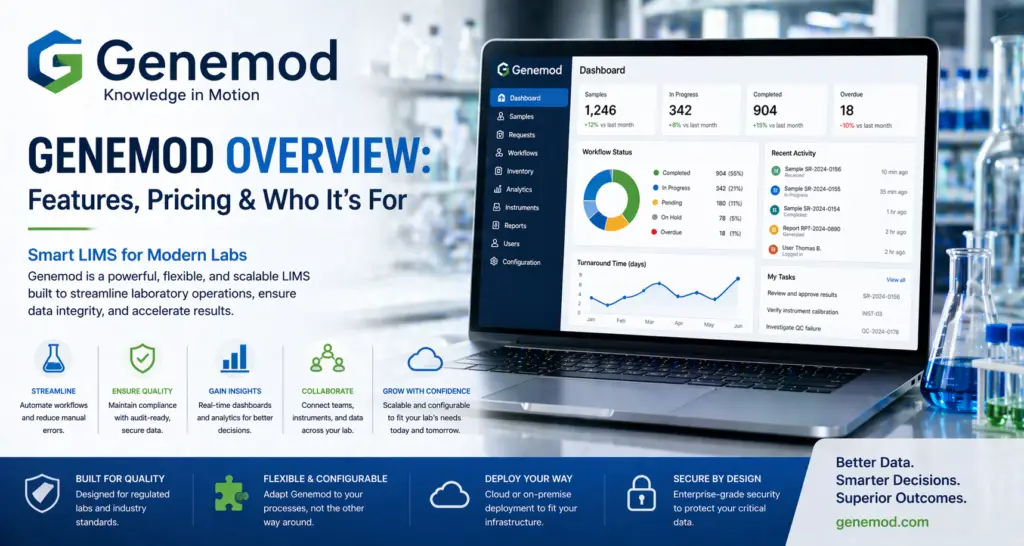
Who Genemod competes with Genemod is not competing with STARLIMS, BIOVIA, or Waters NuGenesis. It competes with Benchling, Labguru, and Scispot — cloud-native, modern LIMS/ELN platforms aimed at life science R&D labs transitioning away from paper notebooks and Excel. If your lab is a small-to-mid biotech, an academic research group, or an early-stage biopharma team that needs an affordable, easy-to-deploy unified LIMS and ELN, Genemod is in the right comparison set. If your lab is a regulated QC or manufacturing environment requiring a fully validated enterprise LIMS, the enterprise products in this series are more appropriate. Genemod is a Seattle-area software company that builds a unified LIMS and ELN platform for life science research labs. Founded in 2017 or 2018 (Tracxn and PitchBook report slightly different dates) by Jacob Lee (CEO) and Jin Choe (CTO), the company has raised $7.22 million across three funding rounds, with a $4.5 million Seed round closing in May 2023 led by Defy and LDV Partners (Tracxn). Other investors include Canaan, Cercano Management, Dolby Family Ventures, and Looking Glass Capital (PitchBook, 8 investors total). The company participated in SLAS 2024, one of the primary lab automation and screening conferences in the industry. Genemod’s core pitch is consolidation: replace the fragmented mix of Excel spreadsheets, Google Docs, physical freezer logs, and paper notebooks that most small and mid-size labs still operate on, and do it in a single cloud-native platform at a price point below the enterprise LIMS market. The platform manages 10 million+ records (genemod.net homepage). Its most praised feature — confirmed across every independent review source — is the visual freezer management system, which replicates the physical layout of a lab’s freezers on-screen. This article draws on genemod.net (all product, pricing, solutions, and FAQ pages), Tracxn, PitchBook, Crunchbase, G2, Capterra, Sourceforge, the Labsistant competitor pricing page (March 2026 verification, attributed as competitor-authored), and the Genemod pricing FAQ. Genemod has not reviewed, sponsored, or paid for this article. Company and funding context Understanding Genemod’s stage and scale is the most important context for a lab manager making a purchasing decision. This is a seed-stage startup, not a mature software company with decades of development behind it. Tracxn lists approximately 2 employees as of December 2024 (this appears to undercount; PitchBook lists 13 total employees, which is more consistent with an active multi-product software company). The company has raised $7.22M in total funding — meaningful for a seed stage, but modest relative to Benchling ($900M+) or even Scispot ($2.8M ARR on smaller funding). For lab managers, the practical implications of Genemod’s stage are: Vendor risk context for lab managers Genemod requires annual contract commitments (confirmed on FAQ). Before signing, ask specifically: what happens to your data if Genemod ceases operations or pivots; what data export formats are available and how complete they are; and what the transition plan would be to another system. These questions are standard due diligence for any startup LIMS vendor and are not a criticism of Genemod specifically — but they are more important here than for enterprise vendors. At a glance Field Details Founded 2017 or 2018 (Tracxn and PitchBook report different dates). Co-founders: Jacob Lee (CEO) and Jin Choe (CTO). HQ Seattle / Edmonds, Washington, USA (PitchBook: Edmonds, WA; SoftwareSuggest: Seattle). Employees ~13 (PitchBook). Tracxn lists 2, which appears to undercount. Funding $7.22M total over 3 rounds. Latest: $4.5M Seed, May 4, 2023, led by Defy and LDV Partners (Tracxn). Other investors: Canaan, Cercano Management, Dolby Family Ventures, Looking Glass Capital (PitchBook: 8 investors total). Platform Unified LIMS + ELN cloud-native SaaS. Single platform covering inventory (virtual freezers), consumables, order management, equipment scheduling, ELN, protocols, and audit trails. Scale 10M+ records managed (genemod.net homepage). Architecture Cloud-native SaaS hosted on AWS. Annual contracts required. No on-premise option confirmed. Compliance 21 CFR Part 11 compliance supported (FAQ). AWS infrastructure carries ISO 27001, SOC 1, SOC 2 — these are AWS’s own certifications for the infrastructure; Genemod’s own product-level SOC 2 certification is not separately confirmed in public sources. Audit trails and version control built in. AI features AI Agent LIMS (genemod.net/products/ai-lims): AI-powered workflow support, automated spreadsheet column matching, AI-driven recommendations. Described as “in-platform workflow support for every task.” API Open API framework confirmed (research.com, genemod.net FAQ). Languages English (Sourceforge). Pricing Starts at approximately $199/month (Sourceforge; Labsistant competitor page, March 2026 verification). 4 tiers, annual contracts required. 14-day free trial available. Academia plan for .edu emails (discounted, up to 10 users). No permanent free tier. Multi-year discounts available. Industries Biopharma R&D, industrial biotech, biorepository, clinical research, biomanufacturing, contract services, chemistry, diagnostics (genemod.net solutions pages). G2 profile Active, claimed by Genemod. Limited features plan. Verified reviews published. Top G2 praise themes: inventory management, ease of use, user interface, lab management, lab automation. Capterra Listed with non-incentivized verified reviews. Consistent praise for visual freezer management and responsive support. Notable events Participated in SLAS 2024 (Society for Laboratory Automation and Screening). (genemod.net/events/slas2024) What Genemod does — platform by module Genemod’s platform is organised around six functional areas, all available within a single cloud environment. The strength of each area is not uniform: inventory management is mature and heavily validated by user reviews; the ELN is newer and improving; the AI layer is early-stage. 1. Virtual freezer management and inventory (the core differentiator) This is Genemod’s most differentiated and most consistently praised feature. The virtual freezer replicates the physical layout of a lab’s actual freezers — rack by rack, shelf by shelf, box by box — in a visual on-screen interface. Scientists drag samples into their correct positions digitally, and the system maintains a real-world mirror of what is stored where. A Capterra reviewer who came from -80°C freezer management describes it as: “This software is useful for users who prefer better visualizations of real-life environment. Very easy to manage sample data.” Beyond freezers, the inventory module covers: reagent management with customisable item types (presets for common reagent categories, fully custom types for unusual materials); consumable management organised by category and location; advanced search with filters,
SciCord Overview: Features, Pricing & Who It’s For (2026)
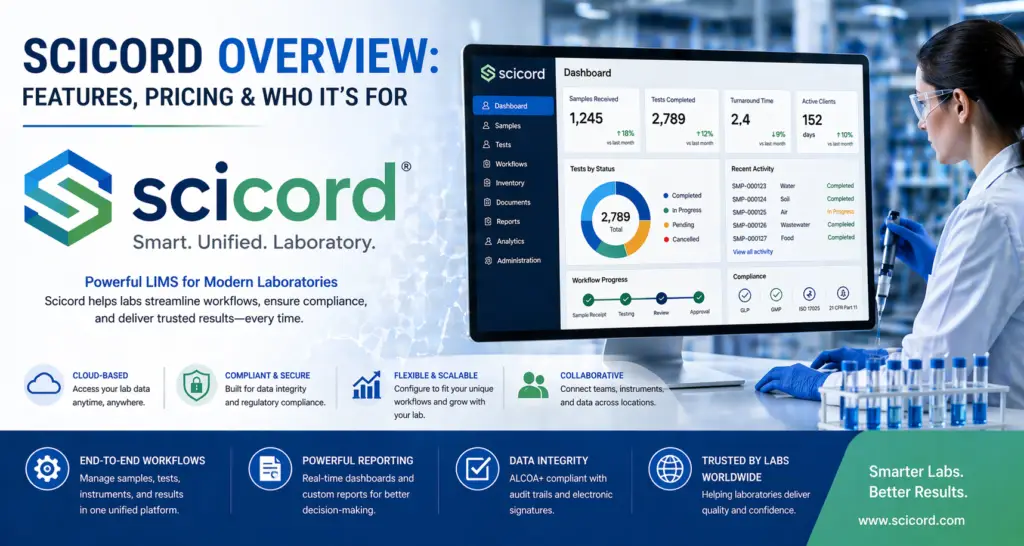
SciCord is a cloud-based LIMS and ELN platform built specifically for pharmaceutical and biopharma laboratories. It is narrower in scope than most vendors in this series: it does not target environmental labs, clinical diagnostics, food & beverage testing, or academic research. Its design choices — a spreadsheet-paradigm no-code engine, integrated ELN and LIMS in one codebase, GxP compliance from the ground up — are all oriented at one buyer profile: regulated analytical, development, QC, and manufacturing labs in pharma and biopharma that are transitioning from paper-based or spreadsheet-based processes and need FDA 21 CFR Part 11 compliance without a long enterprise implementation. That focus is both SciCord’s greatest strength and its most important constraint. If your lab fits that profile, SciCord offers a rare combination: a unified ELN/LIMS platform deployable in as few as 30 days, at a price point that independent reviewers describe as far below what comparable feature sets cost elsewhere, with verified FDA audit performance documented across multiple named customers. If your lab sits outside pharma/biopharma — or if you need a public-facing API, a large support organisation, or a substantial peer review base — other vendors in this series will be a better fit. This article draws on scicord.com, SciCord’s published case studies (Pearl Therapeutics/AstraZeneca, Aurobindo, Singota Solutions, Formulated Solutions, Tenaz), the SciCord Gartner Market Guide announcement, LinkedIn, ZoomInfo, LeadIQ, RocketReach, G2, GetApp, and Sourceforge. SciCord has not reviewed, sponsored, or paid for this article. At a glance Field Details Legal name SciCord LLC Founded 2014 (ZoomInfo). Bootstrapped; no external funding confirmed (Crunchbase). CEO & Founder David Strauss (confirmed on LinkedIn company description). Co-founders: Paolo Matrascia and others (LeadIQ, RocketReach). HQ Raleigh, North Carolina, USA. Website address: 8601 Six Forks Road, Suite 400, Raleigh, NC 27615. Other sources list Cary, NC (suburb of Raleigh). Employees Approximately 9–11 as of early 2026 (RocketReach: 9; LeadIQ: ~11). Staff across North America and Europe. Ownership Privately owned and bootstrapped. No funding rounds on Crunchbase. Primary market Pharmaceutical and biopharma. Core verticals: R&D, Analytical Drug Development, QA, QC, Manufacturing, Stability. LinkedIn and scicord.com confirm this explicitly. Oil & gas and CDMO customers also documented in case studies. Platform SciCord Informatics Platform. Unified ELN + LIMS + LES + SDMS + eBR (electronic batch record) in one codebase. No separate module purchases required. Architecture Cloud SaaS hosted on Microsoft Azure. Also includes a SciCord Smart Client — a desktop application for instrument connectivity via RS232 or IP, which does not require granting external server access to the customer network. Key differentiator Spreadsheet paradigm: the entire platform is built around an Excel-like interface and engine. This is a no-code configuration approach where templates are built using spreadsheet formulas and layouts, not custom programming. Deployment Cloud-only SaaS (Azure). No on-premise option confirmed. Deployment in as few as 30 days per scicord.com and comparison page. Languages English and Italian (Sourceforge). Employees across North America and Europe confirmed by LeadIQ. Compliance FDA 21 CFR Part 11, GxP (GLP, GMP), ISO 17025, ALCOA+ data integrity principles. Azure cloud: GDPR, ISO 27001, HIPAA, FedRAMP, SOC 1 and SOC 2. Validation IQ/OQ packages and PQ drafting services provided. Validated solution integration confirmed in Pearl Therapeutics case study. Validation documentation available to accelerate customer’s own validation activities. API No API available (GetApp, confirmed April 2026). Integrations via web services (LIMS, SAP, ESM, Metrology), file transfer, and database access. Integrations Microsoft Excel, JMP Statistical Software, Microsoft Power BI, Spotfire, Microsoft Entra ID (confirmed on Sourceforge). Instrument connectivity via RS232/IP through Smart Client. SAP integration via web services. Pricing Not publicly listed. Quote-based. ROI calculator available on scicord.com. Sourceforge reviewer describes cost as significantly lower than alternatives with comparable features. Gartner Named a Representative Vendor in the 2025 Gartner Market Guide for LIMS (16 April 2025) and the 2025 Gartner Market Guide for ELN (5 May 2025). First time named in the LIMS guide (previously ELN only). G2 profile Listed on G2; profile has limited features and no published pricing (G2 page confirmed). Review count is very small. Alternatives page lists SciNote, CrelioHealth, SciSure, Labguru, and STARLIMS as top alternatives. Free trial / demo Demo available. Free trial not confirmed. The spreadsheet paradigm — what it means for lab managers The central architectural decision that defines SciCord — and the one lab managers most need to understand before evaluating it — is the spreadsheet paradigm. Rather than building a traditional LIMS with form-based screens and a separate ELN, SciCord built its entire platform around an Excel-like interface. Templates are created using spreadsheet-style layouts and formulas. Scientists work in an environment that looks and behaves like a structured spreadsheet. Configuration is done by building or modifying templates, not by writing code or by hiring a developer. For lab managers, this choice has concrete practical consequences: Lab manager note The spreadsheet paradigm is SciCord’s core strength, but it is also a design constraint. Labs that need complex workflow routing, multi-step analytical testing with highly structured result hierarchies, or deep clinical diagnostics functionality may find the spreadsheet model limiting at scale. Before committing, run SciCord through your most complex assay workflows in a demo environment to validate that the template engine covers your specific data structures. Platform capabilities SciCord’s platform integrates five functions in a single codebase, confirmed on scicord.com/scicord-analytical-lab/: ELN (Electronic Lab Notebook) The ELN layer handles experiment documentation, protocol management, and review/approval workflows. The spreadsheet-style entry supports both structured data capture and free-form documentation. Review and approval cycles are built in, with a minimum 30% increase in reviewer turnaround efficiency cited consistently across the platform and case studies. Electronic signatures are 21 CFR Part 11 compliant. Data entry is validated in real time — out-of-specification flags, SOP adherence checks, and expired reagent restrictions are built into templates. LIMS (Laboratory Information Management System) Sample management covers registration with barcode identification, receipt date, sampling date, and batch number. Chain-of-custody tracking and audit trails for all actions are maintained. Sample and reagent inventory is tracked. Instrument interfacing (RS232 or IP) is handled via the
Scispot Review: Features, Pricing & Who It’s For (2026)
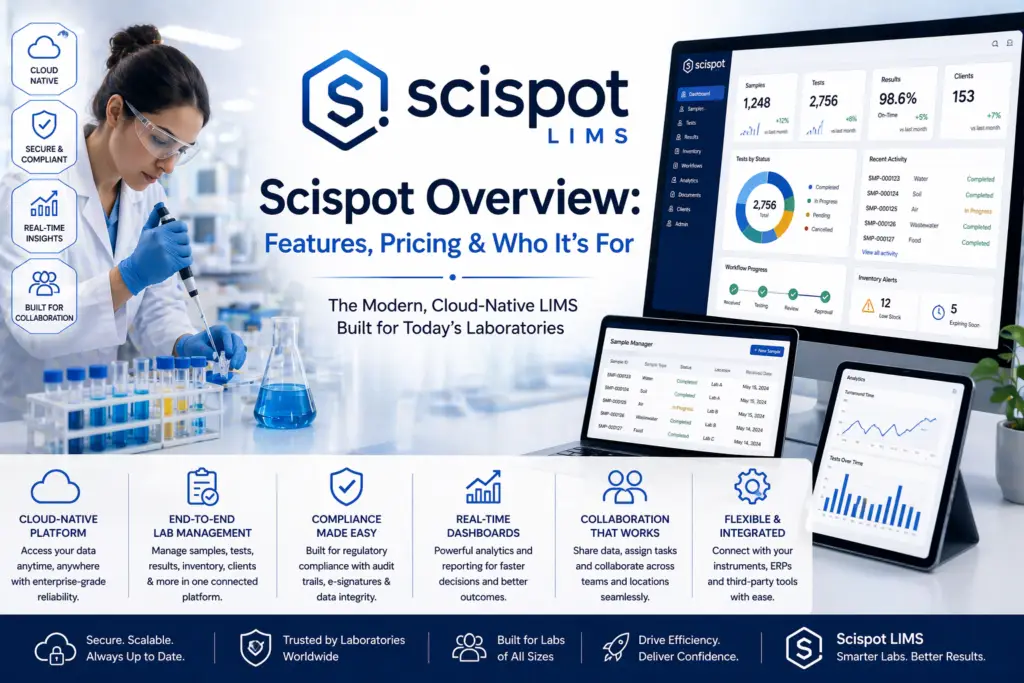
Scispot is a cloud-based laboratory informatics platform founded in 2020 by Guru Singh and Satya Singh in Kitchener, Ontario, Canada. The company’s founding insight, as described by co-founder Satya Singh in a GeekWire interview (May 2024), was that “80% of biotech data never gets analyzed” due to paper-based processes, unique file formats, and lack of platform integration in labs. Guru Singh’s previous experience included scaling life science startups including Scientist.com, Science Exchange, and LabTwin. Satya Singh was a data platform executive at Expedia. Within weeks of launching in 2020, Scispot was accepted into Y Combinator’s Summer 2021 batch — confirmed on Scispot’s own blog and the Y Combinator company directory. The company has also completed programmes at Creative Destruction Lab (CDL) in Seattle. According to PitchBook, total funding raised is $606,000 from 11 investors including Communitech, Ontario Genomics, the Federal Economic Development Agency for Southern Ontario, Alliance of Angels, and Creative Destruction Lab. PitchBook lists 23 total employees as of its most recent data point. Scispot positions itself not as a traditional LIMS but as a “Lab Operating System” (LabOS) — a no-code, unified platform integrating ELN, LIMS, and SDMS capabilities in a single system, with a strong emphasis on data integration via its proprietary GLUE engine and AI-powered automation via its Scibot assistant. This article draws exclusively on Scispot’s official website and pricing page, Y Combinator’s company directory, PitchBook, Tracxn, Crunchbase, GeekWire, the Indee Labs press release, G2, Software Advice, and GetApp. Scispot has not reviewed, sponsored, or paid for this article. At a glance Field Details Vendor Scispot Inc. (operating as Scispot.io) Founded 2020 Headquarters Kitchener, Ontario, Canada Co-founders Guru Singh (CEO) and Satya Singh (CPO/COO) Accelerators Y Combinator Summer 2021 batch; Creative Destruction Lab (CDL) Seattle Investors Communitech, Ontario Genomics, FEDAS, Alliance of Angels, Creative Destruction Lab, Pack Ventures (total 11 investors per PitchBook) Funding raised $606,000 (PitchBook). Revenue reported at $2.8M ARR in October 2024 (Latka/GetLatka). Employees 23 (PitchBook). 18 reported by GetLatka. YC directory states 16. Deployment Cloud-only SaaS. Hosted on AWS (AWS GovCloud optionally for government labs). Single-tenant deployments available for high-security requirements. Platform scope LabOS: alt-ELN (Labspaces) + alt-LIMS (Labsheets) + alt-SDMS (Lakehouse) + GLUE integration engine + Scibot AI assistant + Labflows workflow automation Key industries Biotech R&D, CROs, molecular diagnostics, clinical labs, biobanking, pathology, government labs, cell and gene therapy Named customers Arrakis Therapeutics (quoted on website). Indee Labs (press release, May 2023). Persist AI (press release, July 2023). CAN Health Network (June 2025). Compliance 21 CFR Part 11, SOC 2, HIPAA, GDPR, GLP, ISO 17025, CLIA, CAP, ISO 15189 — all documented on scispot.com. Compliance confirmed in Indee Labs press release (HIPAA, SOC 2, CFR Part 11). ELN included Yes — Labspaces (alt-ELN) is part of the core platform AI assistant Scibot — NLP-powered search, workflow recommendations, AI analytics dashboards Pricing Quote-based. Tiered: Essential, Growth, Enterprise. GLUE priced separately by connectivity and data throughput. No publicly listed per-user prices. Free trial Not confirmed. Demo available. G2 rating Listed. Reviews present but count is modest. Most recent activity confirmed through 2024-2025 based on Software Advice profile. What Scispot does Scispot describes its platform as a Lab Operating System (LabOS) — a positioning that explicitly distinguishes it from traditional LIMS. Rather than adopting the established LIMS, ELN, and SDMS categories, Scispot uses the prefix “alt-” (alt-LIMS, alt-ELN, alt-SDMS) to signal a different architectural philosophy: a unified, API-first, data-science-ready platform built for biotech teams that want to eliminate the integration overhead of running separate best-of-breed tools. The platform consists of several interconnected components, all documented on scispot.com: A notable architectural choice: Scispot’s pricing page confirms the platform can be used as individual components (alt-LIMS alone, GLUE alone) or as the full LabOS bundle, providing modular entry points for labs that do not need the full suite from day one. Company context: startup scale in an enterprise market Scispot occupies an unusual position in the LIMS market. It competes for deals against platforms backed by private equity (Sapio Sciences, GHO Capital), decades of customer deployments (LabWare since 1987, LabVantage since 1981), and significant venture capital (Benchling, $418M). Scispot’s total disclosed funding is $606,000 — orders of magnitude smaller than its most prominent competitors. This context matters for buyers evaluating the platform’s long-term viability, support capacity, and enterprise readiness. PitchBook lists 23 employees; GetLatka estimated 18 in 2024; the YC directory listed 16. Revenue was reported by GetLatka at $2.8M ARR in October 2024, up from $1.7M in 2023 — indicating real and growing commercial traction, though at a scale consistent with a startup rather than an established mid-market vendor. Scale note Scispot’s team size and funding position are relevant to procurement decisions in regulated environments. Labs should evaluate: Can Scispot support a multi-site implementation? What contractual SLAs are available? What happens to data and contracts if the company’s growth trajectory changes? These are standard enterprise diligence questions that apply more acutely to a startup-scale vendor than to incumbents. Scispot’s G2 reviewers consistently praise the support team’s responsiveness — delivered partly via Slack channels — which is a model that scales differently from a traditional enterprise support organisation. Deployment and compliance Scispot is cloud-only, hosted on AWS. For government labs with higher security requirements, Scispot’s government LIMS page documents support for AWS GovCloud (US) deployment and single-tenant instances. Standard deployments are multi-tenant. Compliance documentation on scispot.com and confirmed in the Indee Labs press release (May 2023) covers: Scispot’s pricing page references a “GxP validation package for regulated deployments” as an add-on to the Growth tier. IQ/OQ/PQ validation templates and documentation are referenced on the pricing page as available within that package. Validation note Scispot’s pricing page documents IQ/OQ/PQ validation templates and “inspection prep with a dedicated team” as part of a GxP validation package. Unlike some enterprise LIMS vendors, Scispot does not appear to offer a fully pre-validated system equivalent to LabVantage Pharma’s 90-day pre-validated deployment. Labs in heavily regulated GMP environments should clarify the scope and status of validation documentation before committing. Pricing