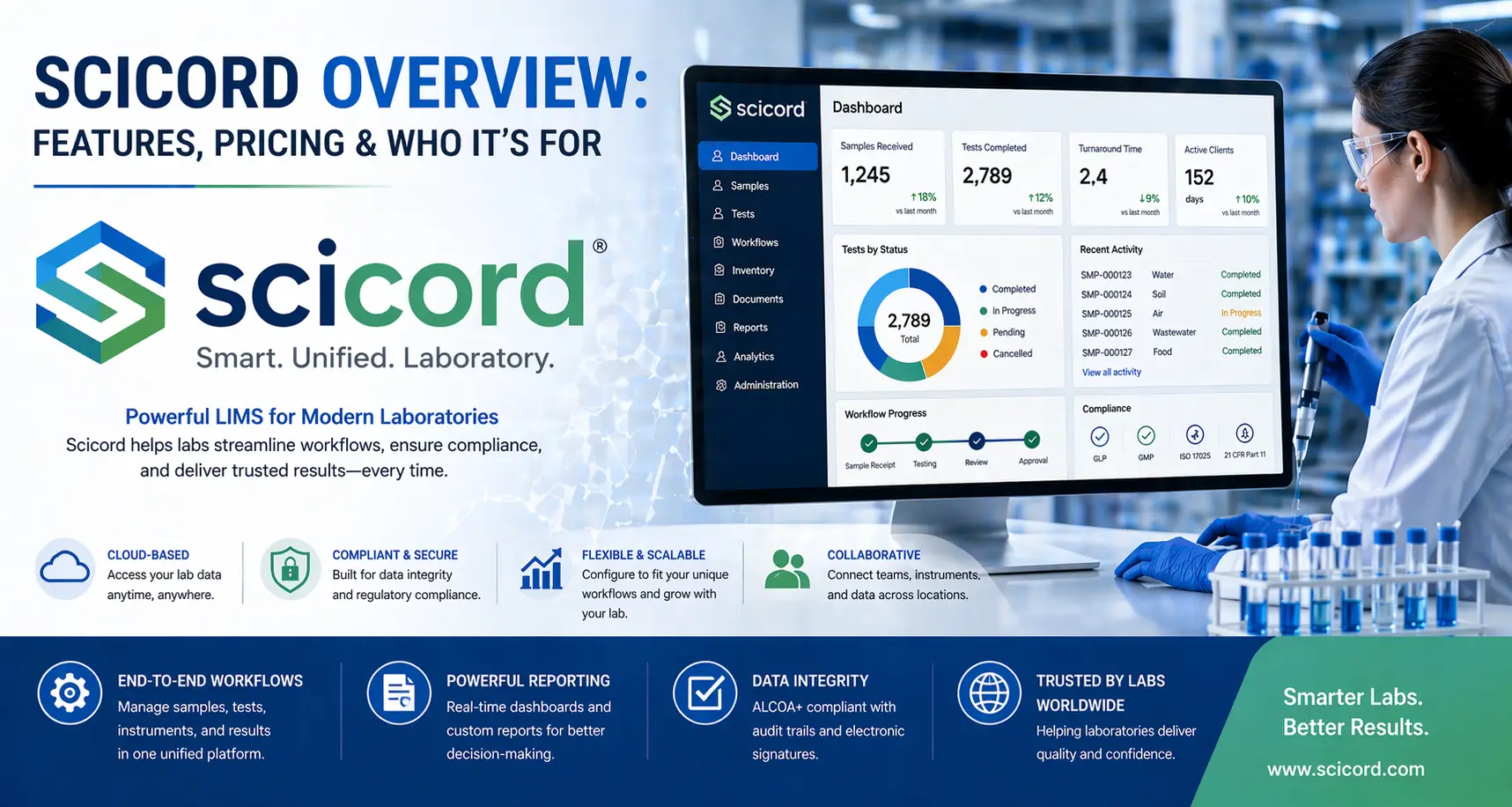
SciCord is a cloud-based LIMS and ELN platform built specifically for pharmaceutical and biopharma laboratories. It is narrower in scope than most vendors in this series: it does not target environmental labs, clinical diagnostics, food & beverage testing, or academic research. Its design choices — a spreadsheet-paradigm no-code engine, integrated ELN and LIMS in one codebase, GxP compliance from the ground up — are all oriented at one buyer profile: regulated analytical, development, QC, and manufacturing labs in pharma and biopharma that are transitioning from paper-based or spreadsheet-based processes and need FDA 21 CFR Part 11 compliance without a long enterprise implementation.
That focus is both SciCord’s greatest strength and its most important constraint. If your lab fits that profile, SciCord offers a rare combination: a unified ELN/LIMS platform deployable in as few as 30 days, at a price point that independent reviewers describe as far below what comparable feature sets cost elsewhere, with verified FDA audit performance documented across multiple named customers. If your lab sits outside pharma/biopharma — or if you need a public-facing API, a large support organisation, or a substantial peer review base — other vendors in this series will be a better fit.
This article draws on scicord.com, SciCord’s published case studies (Pearl Therapeutics/AstraZeneca, Aurobindo, Singota Solutions, Formulated Solutions, Tenaz), the SciCord Gartner Market Guide announcement, LinkedIn, ZoomInfo, LeadIQ, RocketReach, G2, GetApp, and Sourceforge. SciCord has not reviewed, sponsored, or paid for this article.
At a glance
| Field | Details |
| Legal name | SciCord LLC |
| Founded | 2014 (ZoomInfo). Bootstrapped; no external funding confirmed (Crunchbase). |
| CEO & Founder | David Strauss (confirmed on LinkedIn company description). Co-founders: Paolo Matrascia and others (LeadIQ, RocketReach). |
| HQ | Raleigh, North Carolina, USA. Website address: 8601 Six Forks Road, Suite 400, Raleigh, NC 27615. Other sources list Cary, NC (suburb of Raleigh). |
| Employees | Approximately 9–11 as of early 2026 (RocketReach: 9; LeadIQ: ~11). Staff across North America and Europe. |
| Ownership | Privately owned and bootstrapped. No funding rounds on Crunchbase. |
| Primary market | Pharmaceutical and biopharma. Core verticals: R&D, Analytical Drug Development, QA, QC, Manufacturing, Stability. LinkedIn and scicord.com confirm this explicitly. Oil & gas and CDMO customers also documented in case studies. |
| Platform | SciCord Informatics Platform. Unified ELN + LIMS + LES + SDMS + eBR (electronic batch record) in one codebase. No separate module purchases required. |
| Architecture | Cloud SaaS hosted on Microsoft Azure. Also includes a SciCord Smart Client — a desktop application for instrument connectivity via RS232 or IP, which does not require granting external server access to the customer network. |
| Key differentiator | Spreadsheet paradigm: the entire platform is built around an Excel-like interface and engine. This is a no-code configuration approach where templates are built using spreadsheet formulas and layouts, not custom programming. |
| Deployment | Cloud-only SaaS (Azure). No on-premise option confirmed. Deployment in as few as 30 days per scicord.com and comparison page. |
| Languages | English and Italian (Sourceforge). Employees across North America and Europe confirmed by LeadIQ. |
| Compliance | FDA 21 CFR Part 11, GxP (GLP, GMP), ISO 17025, ALCOA+ data integrity principles. Azure cloud: GDPR, ISO 27001, HIPAA, FedRAMP, SOC 1 and SOC 2. |
| Validation | IQ/OQ packages and PQ drafting services provided. Validated solution integration confirmed in Pearl Therapeutics case study. Validation documentation available to accelerate customer’s own validation activities. |
| API | No API available (GetApp, confirmed April 2026). Integrations via web services (LIMS, SAP, ESM, Metrology), file transfer, and database access. |
| Integrations | Microsoft Excel, JMP Statistical Software, Microsoft Power BI, Spotfire, Microsoft Entra ID (confirmed on Sourceforge). Instrument connectivity via RS232/IP through Smart Client. SAP integration via web services. |
| Pricing | Not publicly listed. Quote-based. ROI calculator available on scicord.com. Sourceforge reviewer describes cost as significantly lower than alternatives with comparable features. |
| Gartner | Named a Representative Vendor in the 2025 Gartner Market Guide for LIMS (16 April 2025) and the 2025 Gartner Market Guide for ELN (5 May 2025). First time named in the LIMS guide (previously ELN only). |
| G2 profile | Listed on G2; profile has limited features and no published pricing (G2 page confirmed). Review count is very small. Alternatives page lists SciNote, CrelioHealth, SciSure, Labguru, and STARLIMS as top alternatives. |
| Free trial / demo | Demo available. Free trial not confirmed. |
The spreadsheet paradigm — what it means for lab managers
The central architectural decision that defines SciCord — and the one lab managers most need to understand before evaluating it — is the spreadsheet paradigm. Rather than building a traditional LIMS with form-based screens and a separate ELN, SciCord built its entire platform around an Excel-like interface. Templates are created using spreadsheet-style layouts and formulas. Scientists work in an environment that looks and behaves like a structured spreadsheet. Configuration is done by building or modifying templates, not by writing code or by hiring a developer.
For lab managers, this choice has concrete practical consequences:
- Faster adoption: Scientists who already work in Excel can use SciCord templates without significant retraining. The SciCord compare page quotes a customer: “it’s far easier to use while working in the lab than our paper based notebook system.” The platform description on scicord.com states that “scientists can keep their favorite spreadsheets, promoting user acceptance and minimising training.”
- Migration from spreadsheets: Labs transitioning from uncontrolled Excel workflows to a compliant system can often import their existing spreadsheet templates directly into SciCord rather than rebuilding them from scratch. The Tenaz case study (2025, oil & gas) documents a migration of tens of thousands of samples and nearly 100,000 test results from a legacy system into SciCord.
- No-code configuration: Workflow changes, new templates, and new assay designs can be implemented by a trained lab user or administrator without developer involvement. This is a meaningful operational advantage for labs that cannot afford long vendor-managed implementation cycles.
- Rapid deployment: SciCord’s comparison page states deployment is possible in as few as 30 days. The Singota Solutions case study describes hitting a hard compliance deadline with no disruption. This contrasts with enterprise LIMS implementations that routinely take 6–18 months.
- Validated formula engine: Spreadsheet formulas in SciCord templates can be pre-defined, locked, and validated. Once validated, calculations cannot be altered by end users, addressing a core 21 CFR Part 11 requirement for data integrity. Out-of-specification conditions trigger automatic alerts. This bridges a gap that pure ELN tools leave open.
| Lab manager note | The spreadsheet paradigm is SciCord’s core strength, but it is also a design constraint. Labs that need complex workflow routing, multi-step analytical testing with highly structured result hierarchies, or deep clinical diagnostics functionality may find the spreadsheet model limiting at scale. Before committing, run SciCord through your most complex assay workflows in a demo environment to validate that the template engine covers your specific data structures. |
Platform capabilities
SciCord’s platform integrates five functions in a single codebase, confirmed on scicord.com/scicord-analytical-lab/:
ELN (Electronic Lab Notebook)
The ELN layer handles experiment documentation, protocol management, and review/approval workflows. The spreadsheet-style entry supports both structured data capture and free-form documentation. Review and approval cycles are built in, with a minimum 30% increase in reviewer turnaround efficiency cited consistently across the platform and case studies. Electronic signatures are 21 CFR Part 11 compliant. Data entry is validated in real time — out-of-specification flags, SOP adherence checks, and expired reagent restrictions are built into templates.
LIMS (Laboratory Information Management System)
Sample management covers registration with barcode identification, receipt date, sampling date, and batch number. Chain-of-custody tracking and audit trails for all actions are maintained. Sample and reagent inventory is tracked. Instrument interfacing (RS232 or IP) is handled via the Smart Client, which runs locally on the lab PC and pushes instrument data directly into SciCord experiments without requiring firewall access to SciCord servers. Batch processing and lot tracking are supported.
LES, SDMS, and eBR
Process execution (LES) provides step-by-step guided lab execution with mandatory verification at each step. SDMS captures and centralises instrument files and supporting documents. Electronic batch records (eBR) support GMP manufacturing documentation. These three components extend SciCord’s coverage from early R&D through clinical manufacturing, making it possible to use one platform across the full pharmaceutical development lifecycle.
SciMart data analytics layer
All data entered in SciCord is automatically processed into SciMart, described on scicord.com as “a read-only data mart that allows access to critical insights in a quick and effective way.” SciMart enables real-time analytics without requiring users to work in the transactional LIMS system. Confirmed integrations for analytics output: Microsoft Power BI, JMP Statistical Software, and Spotfire. This is a meaningful differentiator for QC managers who need batch trending and visualisation alongside daily lab operations.
Compliance and validation
Compliance is positioned as foundational rather than an add-on feature in SciCord. The platform’s architecture implements the ALCOA+ data integrity principles — Attributable, Legible, Contemporaneous, Original, Accurate, Complete, Consistent, Enduring, Available — at the system level:
- Audit trails: Timestamped, tamper-proof records of all user actions, changes, and approvals. Independent of the user’s computer clock (scicord.com).
- Electronic signatures: 21 CFR Part 11 compliant, with attribution, reason for signature, date, and timestamp. Required at configurable review and approval milestones.
- Validated calculation engine: Formulas in validated templates are locked and cannot be altered by end users. Calculations are traceable and re-executable.
- IQ/OQ packages and PQ support: Validation documentation packages provided, with PQ drafting services available. Reduces the regulatory burden on the customer’s own validation team.
- Azure cloud compliance posture: The hosting infrastructure (Microsoft Azure) carries GDPR, ISO 27001, HIPAA, FedRAMP, SOC 1, and SOC 2 certifications. Confirmed on scicord.com/how-scicord-informatics-works/.
The most significant independent compliance validation for SciCord is the Aurobindo case study. Aurobindo — a multinational pharma manufacturer with 1,560+ scientists and operations in 15 locations across 5 countries — implemented SciCord in 2016 for their generic inhaled formulations group. The case study documents: two FDA audits with zero findings, zero concerns about the system; a 30%+ increase in reviewer efficiency; and FDA approval of a generic inhalation suspension (bioequivalent to Pulmicort) following SciCord implementation. Two FDA audits with no findings across a real pharma manufacturing environment is a verifiable compliance signal that goes beyond vendor-authored marketing claims.
Named customers and verified outcomes
SciCord publishes five case studies on scicord.com with named customers and quantified results. All figures below are from SciCord’s own published case studies and are attributed accordingly as vendor-published. Independent third-party corroboration is noted where available.
| Customer | Type | Verified result |
| Pearl Therapeutics / AstraZeneca (US) | Pharma R&D, inhaled formulations | 30%+ improvement in review process efficiency. Validated integration across all operational functions. Managed operations across two US sites. AstraZeneca acquired Pearl in 2013; the case study names Shyamala Ivatury (Senior Director, IPD, PT&D, Pearl/AstraZeneca) as the contact. (SciCord case study, scicord.com) |
| Aurobindo (India, 15 locations, 5 countries) | Generic pharmaceutical manufacturer, inhaled formulations | Two FDA audits with zero findings/concerns. Obtained US FDA approval for generic inhalation suspension (Pulmicort bioequivalent). 30%+ increase in reviewer efficiency. Implemented 2016. (SciCord case study, scicord.com) |
| Singota Solutions (US CDMO) | CDMO, aseptic manufacturing and clinical supply chain | 120 hours saved monthly (manual workload reduction). 77% reduction in daily equipment check time (from 6.5 hours weekly to 1.5 hours). 80% decrease in deviations. Met hard compliance deadline with zero disruption. (SciCord case study, scicord.com) |
| Formulated Solutions (US) | Pharmaceutical contract manufacturer | $360,000 per year in cost reduction. Harmonisation of data across systems. (SciCord case study, scicord.com) |
| Tenaz (Dutch North Sea oil & gas) | Offshore drilling, acquired NAM joint venture 2025 | Migration of decades of legacy data: tens of thousands of samples and nearly 100,000 test results. Harmonisation of dissimilar legacy formats. Full administrative control retained by Tenaz team. (SciCord case study, scicord.com) |
| Editorial note on case study claims | All five case studies are published by SciCord on scicord.com. Efficiency percentages (30%, 77%, 80%) and cost savings ($360,000/year; $120 hours/month) are vendor-reported and not independently audited. The AstraZeneca/Pearl and Aurobindo cases include named individuals and verifiable regulatory events (FDA approval, FDA audits), which provides meaningful corroboration beyond vendor self-reporting. Lab managers should request reference calls with existing customers in their specific industry vertical during evaluation. |
Pricing
SciCord does not publish pricing publicly. G2 explicitly states pricing details are not currently available on their profile. An ROI calculator is available on scicord.com to generate a preliminary estimate based on organisation type and use case, but it does not disclose per-user rates.
Two independent signals help frame expectations. First, a Sourceforge reviewer (described as a Sr. Scientist/LIMS Admin) states: “Cost — We’re still amazed at what we get for what we pay.” A homepage quote from another customer states: “Other solutions in this price range had a fraction of the features, and those with the features cost 3x–10x more.” These are vendor-published quotes, but they are consistent with SciCord’s market position as a small bootstrapped company competing against enterprise platforms on value.
Second, the absence of an API (confirmed on GetApp) suggests SciCord’s pricing model does not include developer integration infrastructure, which keeps costs lower but also means integration projects with existing enterprise systems require alternative approaches (web services, file transfer, database access).
| Pricing approach for lab managers | Use the SciCord ROI calculator as a starting point, then request a direct quote specifying: number of users; modules needed (ELN only vs. full ELN+LIMS+LES+eBR); validation package requirements; and ongoing support tier. Ask specifically about the total cost including implementation services and annual subscription renewal, not just the first-year licence. Given the no-code architecture, implementation costs should be materially lower than enterprise LIMS implementations, but confirm this in writing before signing. |
Who SciCord is designed for
SciCord’s case studies, LinkedIn description, and platform positioning converge on a very specific buyer profile. As a lab manager, this section is the most important in the article for your decision:
- Pharmaceutical analytical labs, QC labs, and development organisations that are currently running on paper notebooks, uncontrolled Excel spreadsheets, or disconnected paper-based QC logs, and need to transition to a compliant electronic system without a 6–18 month enterprise implementation. SciCord’s spreadsheet paradigm makes this transition far less disruptive than starting from scratch in a form-based LIMS.
- Labs needing 21 CFR Part 11 compliance with validated calculation engines. If your primary regulatory requirement is an FDA-compliant audit trail with locked, validated formulas and electronic signatures, and you want this integrated with sample management rather than bolted on, SciCord is purpose-built for exactly this.
- Pharma organisations spanning early R&D through manufacturing that want one platform covering ELN, LIMS, LES, and eBR rather than four separate niche vendors. The Aurobindo case study confirms this works in production across two FDA audits.
- CDMOs and contract labs in pharma/biopharma facing compliance deadlines who need rapid deployment. The Singota case study documents meeting a hard compliance deadline with no disruption.
- Labs with significant Excel-based institutional knowledge that would face massive retraining burden with a traditional LIMS. SciCord’s spreadsheet interface preserves that institutional knowledge in compliant, validated form.
- Small to mid-size pharma and biopharma organisations that cannot justify the total cost of enterprise LIMS platforms (STARLIMS, LabWare, Sapio Sciences) but need equivalent compliance depth. Multiple independent reviewers confirm the price/feature ratio is highly competitive.
SciCord is not the right choice for:
- Labs outside pharma/biopharma — environmental, clinical diagnostics, food & beverage, academic research, forensics. SciCord’s compliance framework and platform design are built around GxP and pharma workflows; other vendors in this series (QBench, CloudLIMS, LabLynx) serve those verticals far more specifically.
- Labs that require a public API for custom integrations with existing enterprise systems. GetApp confirms no API is currently available, which is a hard constraint for any organisation with a complex technology ecosystem.
- Labs that prioritise peer review volume as a vendor health signal. SciCord’s G2 profile has limited features and a very small review count. Due diligence here relies on direct customer references rather than public review platforms.
- Biotech R&D and discovery labs that need molecular biology tools, sequence management, or AI-native experiment design — Benchling or Sapio Sciences are better positioned for those workflows.
What users say
SciCord’s public review footprint is small. G2 has a limited-feature profile with no published pricing and a low review count. Sourceforge lists the product with a small number of verified reviews. The most substantive independent user voices come from Sourceforge and vendor-published case study quotes.
From Sourceforge verified reviews
- Sr. Scientist / LIMS Admin: “Cost — We’re still amazed at what we get for what we pay.” Describes the interface as “unique and more intuitive to users than other ELN platforms.” Support and service rated as excellent. “I would highly recommend this program to any laboratory looking for an ELN with customisable templates and the ability to analyse laboratory metrics and data.”
- The only explicitly named negative across public reviews: minor issues encountered and subsequently resolved by the SciCord team.
From vendor-published case study quotes (all attributed to SciCord’s own publications)
- Aurobindo: “We have been audited by FDA twice and they had no concerns about the system nor any findings.”
- Undisclosed customer (scicord.com homepage): “This is by far the best value in science software (or anything else in science, really) that we’ve ever experienced. Other solutions in this price range had a fraction of the features, and those with the features cost 3x–10x more.”
- Undisclosed customer (head-to-head comparison): “In a head to head competition, SciCord was 3x more efficient at documenting a typical work process than [competition]. A complete Assay work process required 60 minutes in [competition], while only 20 minutes in SciCord.”
- Undisclosed customer (global collaboration): “I am so pleased at how many things we can manage efficiently through our deployment. Was just online with my colleagues on the other side of the planet reviewing lab experiments, sharing data, approving methods, and signing reports.”
| Review context for lab managers | The public review base for SciCord is too small to draw statistical conclusions. This does not mean the product is poor — the Aurobindo and Pearl/AstraZeneca case studies provide meaningful independent validation of the platform’s compliance performance. However, as a lab manager making a multi-year purchasing decision, you should require at least two to three direct reference calls with existing SciCord customers in your industry vertical and of similar regulatory complexity before committing. Ask specifically: how long did implementation take; how many FDA or equivalent regulatory audits have you passed; and has anything material changed in your workflow or pricing since go-live? |
Quick verdict
| Best for | Pharmaceutical and biopharma labs — analytical development, QC, manufacturing, CDMOs — transitioning from paper or uncontrolled Excel to a 21 CFR Part 11 compliant ELN/LIMS platform. SciCord’s spreadsheet paradigm dramatically reduces adoption friction for labs with strong Excel-based workflows. Its unified ELN+LIMS+LES+eBR codebase eliminates the vendor sprawl that plagues many pharma development organisations. Two FDA audits with zero findings at Aurobindo, plus FDA approval of a regulated drug product, validate the platform’s compliance posture in a real manufacturing environment. The 2025 Gartner Market Guide inclusion in both LIMS and ELN categories confirms independent analyst recognition. For a bootstrapped, ~10-person company, the breadth and regulatory depth of this platform is exceptional. |
| Consider alternatives if | You need a public API for enterprise system integration — this is a confirmed gap. For broader industry coverage beyond pharma (environmental, clinical, food & beverage), QBench, CloudLIMS, or LabLynx cover those verticals with purpose-built configurations. For biotech R&D with molecular biology, genomics, or AI-native workflows, Benchling or Sapio Sciences are better fits. If your lab requires a large vendor support organisation, a deep external review base, or on-premise deployment, STARLIMS or LabWare are more appropriate. And if you need the ELN/LIMS decision validated by a large peer review base before purchasing, SciCord’s thin public review footprint means you’ll need to do that validation through direct customer references rather than G2. |
Further reading
- SciCord official website
- SciCord platform overview (analytical lab)
- SciCord case studies library
- Pearl Therapeutics / AstraZeneca case study
- Aurobindo FDA compliance case study
- Singota Solutions QC optimisation case study
- Tenaz legacy data migration case study
- SciCord ROI Calculator
- SciCord Gartner Market Guide inclusion (2025)
- SciCord on Sourceforge — user reviews
- SciCord on G2
- labsoftwareguide.com: Best LIMS Software 2026
- labsoftwareguide.com: How to choose a LIMS
- labsoftwareguide.com: ISO 17025 and LIMS
| Editorial note | This article draws on: scicord.com (product pages, case studies, comparison page, Gartner announcement, ALCOA model page, ELN page, LIMS page, analytical lab page, how-it-works page); LinkedIn (SciCord LLC company description, CEO David Strauss quote); ZoomInfo (founded 2014); RocketReach (employee count 9, co-founder Paolo Matrascia); LeadIQ (employee count ~11, three co-founders, European presence); Crunchbase (bootstrapped, Raleigh NC); GetApp (no API confirmed); Sourceforge (languages English and Italian; Sr. Scientist/LIMS Admin review); G2 (profile confirmed as limited-feature, no pricing published). Gartner Market Guide citations are from SciCord’s own announcement — Gartner does not endorse vendors and Market Guide inclusion does not constitute a ranking. Efficiency and cost figures in case studies are vendor-published; Aurobindo FDA audit details and AstraZeneca/Pearl named individuals provide independent corroboration. Competitor-authored content was not used for this article. SciCord has not reviewed, sponsored, or paid for this article. Last verified: April 2026. |