| Two things to know upfront | 1. The software is completely free. eLabFTW is open-source (AGPLv3 licence). There is no per-seat charge, no paywalled feature tier, and no vendor lock-in. Every feature is available at no cost. 2. Running it requires a sysadmin. eLabFTW is server software. You cannot install it on a laptop and start using it the next day. It runs on a Linux server, deployed via Docker, and requires a systems administrator to install, configure, and maintain it. If your institution lacks this capacity, Deltablot — the company that backs the project — offers managed hosting. Both paths are covered in this article. |
eLabFTW is the most widely deployed open-source electronic laboratory notebook in the world. It was created by Nicolas CARPi, a research engineer at the Institut Curie in Paris, who built it to solve a problem he faced in his own lab: no suitable ELN existed that was free, flexible, and respectful of researchers’ data sovereignty. He released eLabFTW as an open-source project and developed it as a side project for years before its adoption reached a scale that led him to create Deltablot, the company that provides commercial hosting and support, in April 2019 (deltablot.com/about).
As of April 2026, eLabFTW has thousands of instances running worldwide — the project stopped maintaining a list of institutions because there are too many (doc.elabftw.net/faq). In France, it is the official recommended ELN of the CNRS (Centre National de la Recherche Scientifique), the largest fundamental science agency in Europe, following a competitive selection and deployment process with Deltablot and partner company Easter Eggs. In Germany, it is described in the official documentation as “ubiquitous” at universities and private companies. Community meetings run bi-monthly with participants from institutions across Europe, Asia, and North America.
No other ELN in this series — and none in the commercial market — comes close to eLabFTW’s breadth of institutional adoption in academic research. That breadth has a structural reason: when software is free, institutions that could never justify a per-seat licence budget can deploy it. Thousands of research groups at universities, institutes, startups, and public research organisations that could not afford proprietary ELNs have chosen eLabFTW specifically because the barrier to adoption is a server and a sysadmin, not a budget line.
This article draws on elabftw.net, deltablot.com, doc.elabftw.net (official documentation), the GitHub repository (elabftw/elabftw), the Deltablot blog, Nicolas CARPi’s startup.info interview (September 2023), his LinkedIn activity, the eLabFTW community meeting summaries, and G2. eLabFTW and Deltablot have not reviewed, sponsored, or paid for this article.
Understanding the open-source model — what it means practically
eLabFTW is licensed under the AGPLv3 licence. This means: the source code is publicly available on GitHub; you can download, inspect, modify, and deploy it for free; there are no hidden features unlocked by payment; and any modifications you distribute must also be made open-source. The development roadmap and issue tracker are entirely public on GitHub — there is no private backlog, no behind-closed-doors feature development.
For lab managers, this has three practical implications that are fundamentally different from every other vendor in this series:
- No vendor lock-in: Your data is stored in open formats. You can export your experiments at any time in multiple formats including the .eln standard (based on RO-Crate), JSON, PDF, and CSV. The .eln format is actively promoted through the ELN Consortium — a group of ELN vendors committed to interoperability — of which eLabFTW is a founding member. If you ever need to switch ELN systems, your data can move with you.
- No commercial risk of shutdown or acquisition: The software exists independently of Deltablot. If Deltablot ceased to exist, the community would continue developing eLabFTW. This is a meaningful distinction from proprietary ELNs where a vendor acquisition (as happened with Labfolder, acquired by SciSure; or eLabNext, merged into SciSure) changes pricing, support, and roadmap without user input.
- Community-driven development: New features are requested publicly on GitHub, discussed openly, and developed by Nicolas CARPi, Deltablot developers, and community contributors. Several major European universities and French institutions contribute funding directly — listed as sponsors on the GitHub repository. This includes the Department for the Development of Innovative Digital Use at the French National Research Institute for Sustainable Development, the Atelier de la donnée ADOC Lorraine, and others.
| The IT dependency | Open-source does not mean easy to set up. The official elabftw.net homepage states plainly: “eLabFTW should be installed on a server. This means it is not a software that you can download and install on your computer. It must be installed, configured and maintained by a Systems Administrator. If you’re not familiar with containerized services (Podman/Docker/K8s) and GNU/Linux server administration, we recommend our managed hosted solution.” For lab managers at institutions with central IT infrastructure or a technical research data manager, this barrier is modest. For lab managers at small groups without IT support, the Deltablot PRO Hosting service is the practical path to adoption. |
At a glance
| Field | Details |
| Software | eLabFTW — free, open-source electronic laboratory notebook (AGPLv3 licence) |
| Backing company | Deltablot (Paris, France). Founded April 2019 by Nicolas CARPi. |
| Creator | Nicolas CARPi, research engineer (Institut Curie). Creator, lead developer, and CEO of Deltablot. |
| Current version | 5.5 (deltablot.com blog, 2026). Active development with frequent releases. |
| Primary scope | ELN (Electronic Lab Notebook). Also includes a resource/inventory database. Not a full LIMS. |
| Deployment | Self-hosted (Docker on Linux server, managed by sysadmin) or Deltablot PRO Hosting (managed SaaS). |
| Software cost | Zero. 100% free. All features included. No paywalled tiers. |
| Hosting/support cost | Free for self-hosted. Deltablot PRO Hosting: quote-based (four tiers confirmed, no published prices). PRO Support for self-hosters: quote-based. |
| Adoption | Thousands of instances worldwide (doc.elabftw.net/faq). CNRS (France) official recommended ELN. Ubiquitous in German universities (official documentation). Named institution supporters: University of Freiburg, Georg-August-University Göttingen, French National Research Institute for Sustainable Development (GitHub sponsors). |
| Languages | 21+ languages (elabftw.net). Active translations contributed by community. |
| Key features | Experiment documentation, protocol templates, resource/inventory database, file attachments, tags and search, electronic signing, trusted timestamping (RFC 3161), blockchain timestamping (Bloxberg), API, team collaboration, SAML/LDAP SSO, 2FA, audit trail, FAIR data export. |
| Compliance | GMP compliance guidance document available (doc.elabftw.net). Trusted timestamping supports regulatory recordkeeping. 21 CFR Part 11: partial — audit trail, electronic signatures, and timestamping are confirmed; full reauthentication at signing (required by §11.200(a)(1)) was an open feature request as of July 2025 (GitHub issue #5782). Regulated labs should validate their specific requirements before deployment. |
| API | Full REST API. Official Python client (elabapi-python). Community clients: Perl, LabView, Matlab, R. API workshop available on GitHub. |
| Data sovereignty | Data stays on your server (self-hosted) or in Deltablot-managed infrastructure. No telemetry, no tracking cookies (confirmed by Nicolas CARPi, startup.info interview). GDPR-compliant. SecNumCloud option (EU-certified French cloud) available for maximum sovereignty. |
| ELN Consortium | Member. Promotes the open .eln interoperability format (RO-Crate-based). |
| G2 profile | Listed with verified reviews. G2 reviews describe eLabFTW as easy to use, feature-rich, and good for experiment collaboration. Review count is limited compared to commercial ELNs. |
| Community | Bi-monthly community meetings. RDM (Research Data Manager) Club with monthly meetings. Template sharing hub in development (pre-alpha as of January 2026). Active GitHub with many contributors. |
What eLabFTW does — and what it does not
Understanding eLabFTW’s scope is the most important step in deciding whether it is the right tool for your lab.
What eLabFTW is: an ELN with an inventory database
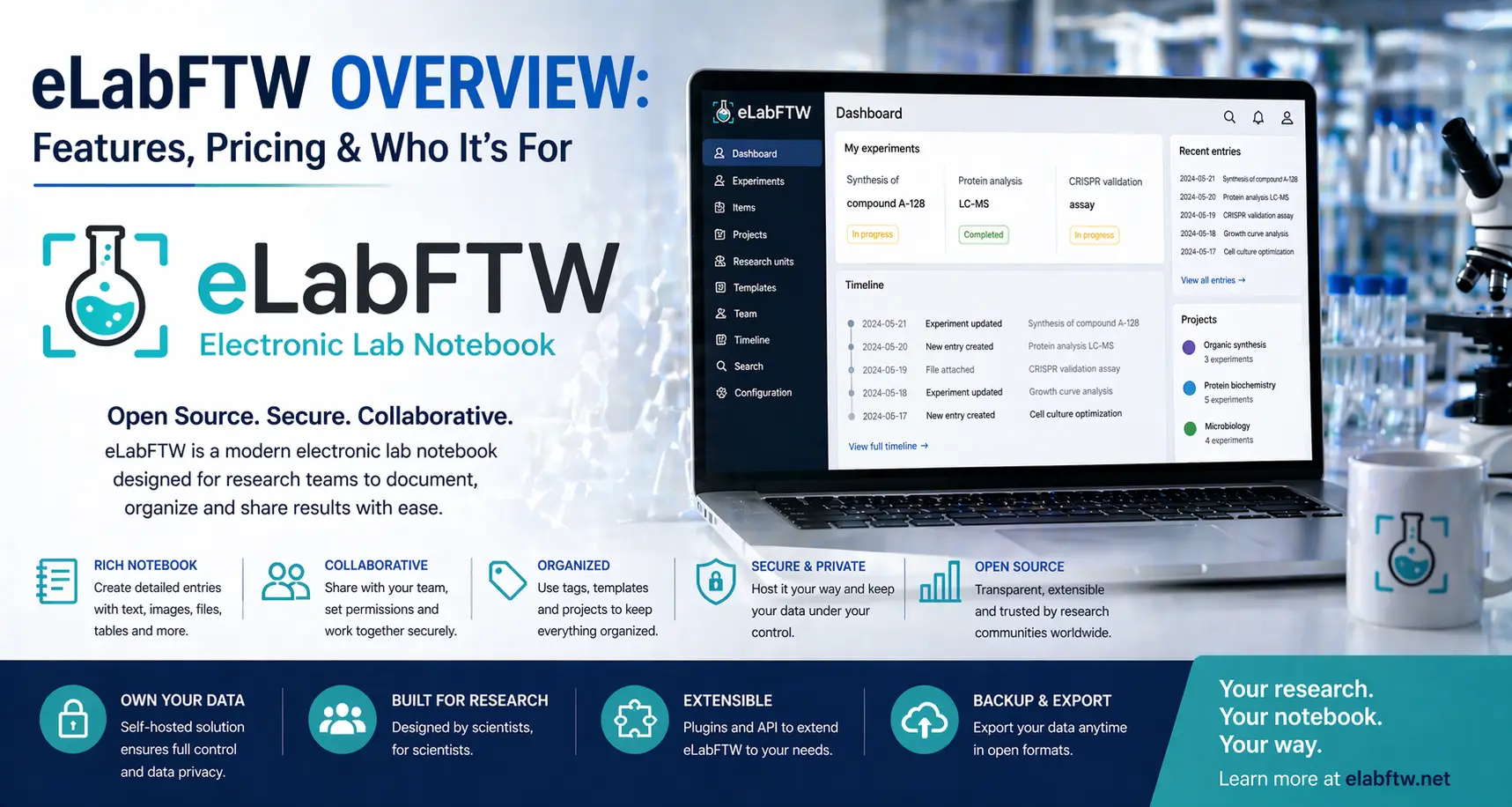
eLabFTW’s primary function is experiment documentation. Scientists create experiment records with text, attachments, drawings, metadata, and protocol references. They can tag, search, link, and export experiments. The system supports protocol templates, structured metadata fields, and collaborative editing across team members. Multiple teams can be hosted on a single installation, making it suitable for institutional deployment at the university or institute level.
The resource database allows any type of object to be stored and tracked: antibodies, plasmids, cell lines, equipment, reagents, boxes, organisms — defined by the lab. This is not a full sample management system in the way Mosaic (Cenevo) is; it is a flexible inventory catalogue that links to experiments. A chemical inventory plugin (chem-plugin) was added to the GitHub organisation and is confirmed in a January 2025 French community (CLE) LinkedIn post as adding chemical products management. For labs that need structured sample lifecycle management with automation integrations and complex fulfilment workflows, Mosaic is the appropriate tool.
Key features confirmed on elabftw.net and doc.elabftw.net:
- Experiment records: Rich text editor, file attachments (images, PDFs, data files), drawing canvas, metadata fields, tags, hyperlinks between experiments, version history (revisions), protocol templates.
- Electronic signing: Sign experiments electronically. Signs are attributed to a specific user and timestamped. Required fields (e.g. witness signature) can be configured.
- Trusted timestamping: One-click RFC 3161 timestamping creates a cryptographic proof of the experiment’s content at a specific time. Also supports Bloxberg blockchain timestamping. Both are confirmed in the user guide (doc.elabftw.net). This is the feature most relevant to intellectual property protection and research integrity requirements.
- Team collaboration: Multiple teams on one installation. Granular permissions (team, group, user). Share experiments across teams. Real-time visibility into team members’ work for group leaders.
- FAIR data export: Export in .eln format (RO-Crate standard), JSON, PDF, CSV, ZIP. Import from RSpace and Labfolder (Python migration scripts provided on GitHub). Data is never trapped in a proprietary format.
- SSO and 2FA: SAML2 single sign-on (institutional identity providers), LDAP integration, two-factor authentication. Confirmed in documentation. Relevant for institutions with central identity management.
- REST API: Full API with official Python client (elabapi-python). Community-contributed clients for Perl, LabView, Matlab. API workshop on GitHub. This enables instrument data upload, automation, and integration with other systems.
- Search and tagging: Full-text search, tag-based filtering, and a flexible query builder across experiments and resources.
What eLabFTW is not
Being clear about scope is the most useful service this article can provide for lab managers comparing options:
- eLabFTW is not a LIMS. It does not manage structured analytical testing workflows, QC-grade results entry with OOS flagging, batch management, CoA generation, or instrument data management at the level of STARLIMS, LabWare, QBench, or even Labguru’s LIMS component.
- It is not a pharmaceutical-grade, vendor-validated platform. The GMP compliance document (doc.elabftw.net) states: “when properly configured and maintained, eLabFTW provides the necessary functionality to support GMP compliance.” The key phrase is “when properly configured and maintained” — the responsibility for validated configuration lies with the deploying institution, not with a vendor-provided IQ/OQ/PQ package as in SciCord or STARLIMS.
- Full FDA 21 CFR Part 11 compliance at the electronic signature level is not fully confirmed as of April 2026. The audit trail, electronic signatures, and timestamping are implemented; a reauthentication prompt at the moment of signing (required by §11.200(a)(1)) was an open feature request on GitHub as of July 2025. Labs in regulated environments must perform their own gap assessment before relying on eLabFTW for Part 11 compliance.
- It is not a managed SaaS you can sign up for and have running in an hour. Even Deltablot PRO Hosting requires coordinating domain setup, SSO configuration, and onboarding.
| The right framing for lab managers | eLabFTW is the right ELN for labs that need: a capable, actively maintained ELN with no software cost; data sovereignty (your data stays on your server); freedom from vendor lock-in; and community-backed continuous development. It is not the right tool for labs that need: a vendor-validated, fully certified regulated environment (choose SciCord, STARLIMS, or Sapio Sciences instead); a full LIMS with structured QC workflows (choose QBench, CloudLIMS, or STARLIMS); or a no-IT-required SaaS setup (choose Labguru or SciSure instead). |
Deployment options — self-hosted vs. Deltablot PRO Hosting
There are two paths to running eLabFTW. Both are real options; the right one depends on your institution’s IT capacity and data sovereignty requirements.
Path 1: Self-hosted (free)
You download eLabFTW, deploy it via Docker on a Linux server, and your sysadmin manages it. The minimum server specification is modest: 512 MB RAM (1 GB recommended), 300 MB disk space, any GNU/Linux server running Docker. Larger deployments (hundreds of daily users) need more resources: at least 2 GB RAM, a multi-core processor above 2 GHz, and an SSD (doc.elabftw.net/faq). The official documentation provides a complete installation guide. Updates are delivered as Docker images.
This path is the right choice for: universities and research institutes with central IT that already manages server infrastructure; large institutions deploying eLabFTW at scale (CNRS, German universities); and organisations with strict data sovereignty requirements where data must remain on-premises.
Path 2: Deltablot PRO Hosting (paid)
Deltablot manages the server, updates, backups, monitoring, and security. You focus on science. The deltablot.com hosting page confirms four tiers:
- Small: Limited to 32 users. Described as ideal for start-ups and small companies.
- Standard: For labs that need more users. Described as the standard managed offering.
- Large: For large institutions. Described as “all included.”
- SecNumCloud: Hosted in a SecNumCloud-qualified French cloud provider (3DS Outscale), giving EU-certified, highest-sovereignty hosting. Available for European institutions with strict regulatory or national security requirements.
Geographic hosting confirmed on deltablot.com: Europe (Paris, Scaleway or 3DS Outscale), USA/Canada (New York, San Francisco, Toronto via DigitalOcean), Asia (Japan, Korea, India, Singapore via Vultr), Australia (Melbourne via Vultr), South/Central America (Chile, Brazil, Mexico via Vultr). The Japan deployment comes with a dedicated official partner: MORPH, which provides Japanese-language support and deployment services (deltablot.com hosting page).
Pricing for PRO Hosting is not published. Contact Deltablot directly. French academic institutions can access eLabFTW via a central purchasing framework (“centrale d’achat”), confirmed on the deltablot.com hosting page as available for INRAE, CEA, INSERM, universities, and others.
| PRO Support (third option) | For institutions that self-host but want expert backup: Deltablot offers PRO Support — advanced expertise and priority assistance for sysadmins managing their own installation. This is described on deltablot.com as “ideal if you manage your own on-premise hosting.” It contributes to eLabFTW’s long-term sustainability. Full PRO Support agreement terms are published on deltablot.com/pro-support-agreement/. |
Institutional adoption and named users
eLabFTW’s adoption pattern is fundamentally different from any commercial ELN in this series. There are no case studies with quantified ROI metrics because the adoption driver is not sales — it is word-of-mouth within the research community. The FAQ says bluntly: “We do not maintain a list of institutions using it anymore. There are just too many.”
What is verifiable from public sources:
- CNRS (France): The Centre National de la Recherche Scientifique — the largest fundamental science agency in Europe — selected eLabFTW as its recommended ELN for all CNRS laboratories. Deltablot and partner Easter Eggs were selected to deploy it. Nicolas CARPi announced this on LinkedIn (2023), and it is confirmed across multiple sources including the CNRS ELN portal. The CNRS has approximately 33,000 permanent researchers and engineers across more than 1,100 research units.
- Germany: Described as “ubiquitous” in German universities and private companies in the official documentation. Named institutions with confirmed eLabFTW community involvement: RWTH Aachen University, Goethe University Frankfurt, University of Münster, Friedrich-Alexander-University Erlangen-Nuremberg, Karlsruhe Institute of Technology (KIT). Hüseyin Uzun (Goethe University Frankfurt) provides German-language YouTube tutorials for eLabFTW.
- France: Named institutions as GitHub sponsors or community participants: Institut Curie (Nicolas CARPi’s employer), French National Research Institute for Sustainable Development, Atelier de la donnée ADOC Lorraine (funded by the French national open science fund). Université de Lorraine deployed eLabFTW institution-wide.
- École Polytechnique: Garrett Curley, Laboratoire de Physique des Plasmas at École Polytechnique, is quoted on elabftw.net: “The most adapted ELN software for academic research groups. A true alternative to paper notebooks, that is simple and intuitive to use.”
- Universität Münster: Adienne Karsten (Forschungsdatenmanagement at Universität Münster) quoted on elabftw.net: “Intuitive to use, great UI, great community, open source and generically usable.”
- KIT: Florian Strauß (Karlsruhe Institute of Technology) quoted on elabftw.net: “Great tool for doing and teaching good RDM practices.”
- Japan: Official Japanese partner MORPH confirmed on deltablot.com hosting page.
- Asia and rest of world: Interface translated into 21+ languages including many Asian languages. Community meeting participants from institutions worldwide.
Compliance — what is confirmed and what is not
This section matters more for eLabFTW than for any other vendor in this series, because open-source software places compliance responsibility differently than commercial platforms with vendor-provided validation packages.
What is confirmed
- Audit trail: Comprehensive audit trail for all actions, confirmed in the GMP compliance document and user guide. Records who made changes, what was changed, and when.
- Electronic signatures: Electronic signing of experiments with user attribution and timestamp. Confirmation of signing is cryptographically anchored to the document.
- Trusted timestamping (RFC 3161): One-click timestamp creates a cryptographic, legally-recognised proof of experiment content at a specific date and time. Compliant with eIDAS European regulation (910/2014). Confirmed in user guide.
- Blockchain timestamping: Bloxberg consortium blockchain timestamping available as an alternative. Confirmed in user guide.
- GMP compliance: Official GMP compliance document at doc.elabftw.net details how eLabFTW can support GMP environments. Key caveat from the document: “for full compliance, users must align eLabFTW usage with their internal SOPs and regulatory guidelines.”
- GDPR: No telemetry, no tracking cookies, no personal data collection for marketing (confirmed by Nicolas CARPi, startup.info interview 2023). Data resides on the institution’s server or in Deltablot’s hosted infrastructure.
- Encryption in transit: TLS 1.3, rated A+ by Qualys (deltablot.com/compliance/). Data encrypted using state-of-the-art algorithms.
- Deltablot certifications: Cyber Essentials certification (UK cybersecurity standard). Confirmed on deltablot.com.
What requires lab manager attention
- 21 CFR Part 11 electronic signature re-authentication: FDA 21 CFR Part 11 §11.200(a)(1) requires that the first signing is executed using all electronic signature components, including a credential check at the moment of signing. As of July 2025, a GitHub issue (#5782) explicitly requested this reauthentication prompt as a missing feature. Nicolas CARPi has been responsive on compliance GitHub discussions, but this specific feature was not confirmed as shipped as of that date. Labs in FDA-regulated environments must verify the current implementation status directly before relying on eLabFTW for Part 11 compliance.
- No vendor-provided IQ/OQ/PQ: Commercial platforms like SciCord and STARLIMS provide validation documentation packages. With eLabFTW, your institution writes its own validation protocols against the software’s capabilities. This is standard practice in academic and many industrial open-source deployments — but it requires internal resource.
- GxP in manufacturing: The GMP guidance document is useful but advisory. For manufacturing environments with GMP mandates, the validation burden and responsibility lie with the deploying institution and its QA team.
Cost model — free software, optional paid services
eLabFTW has the simplest cost structure of any vendor in this series: the software costs nothing. No per-seat fee, no feature tier, no module cost. The AGPLv3 licence guarantees this permanently — a future commercial entity cannot retroactively close eLabFTW’s source code.
What does cost money:
- Deltablot PRO Hosting: The managed SaaS hosting service. Four tiers (Small up to 32 users, Standard, Large, SecNumCloud). No prices published — contact Deltablot. French academic institutions can access through the centrale d’achat national purchasing framework.
- Deltablot PRO Support: For institutions that self-host and want expert priority support. Pricing not published; contact Deltablot.
- Deltablot onboarding webinar: A 90-minute paid webinar to get your lab up to speed with eLabFTW. Covers platform configuration tailored to your workflows.
- Custom development: Deltablot accepts custom feature requests that align with the project’s vision, developed as open-source code available to all users. Pricing by project.
- Server cost (self-hosted): If self-hosting, your institution pays for server infrastructure. The minimum is modest — a small Linux server or cloud VM. At scale (hundreds of users), institutional server infrastructure is appropriate and typically already exists.
The total cost of a self-hosted eLabFTW deployment at a university with existing Linux server infrastructure and a competent sysadmin can be effectively zero for the software, plus IT time for installation and maintenance. This is structurally different from any other ELN in this series.
Who eLabFTW is designed for
eLabFTW’s design choices — open-source, self-hosted, no-cost software, FAIR data, community-driven — define its ideal user profile very clearly:
- Academic research groups and university laboratories that need a capable, maintained ELN but cannot justify per-seat commercial licensing costs. For a research group of 15 scientists, eLabFTW at zero software cost versus a commercial ELN at €50–100/user/year is a meaningful difference at grant funding scale.
- Universities and research institutes deploying ELN infrastructure centrally for multiple groups. A single eLabFTW installation can host hundreds of teams. CNRS’s institutional deployment is the exemplar: one managed platform serving thousands of researchers across hundreds of laboratories.
- Research data managers (RDMs) supporting open science mandates. eLabFTW’s FAIR export, .eln interoperability format, timestamping, and data sovereignty align directly with European open science policy. The RDM Club is specifically built for this audience.
- Institutions with data sovereignty requirements. Self-hosted eLabFTW keeps all data on the institution’s own servers, with no data ever sent to a commercial third party unless Deltablot hosting is chosen. The SecNumCloud option provides French state-certified sovereignty for the most sensitive research.
- Startups and small companies that need an ELN immediately without a procurement budget. The Small PRO Hosting tier (up to 32 users) provides a managed option for early-stage companies. Self-hosting is available for free.
- IT-savvy teams at any size of organisation that value open-source principles, community participation, and freedom from vendor lock-in as organisational values, not just budget considerations.
eLabFTW is not the right choice for:
- Labs in FDA-regulated environments that need a fully vendor-validated, 21 CFR Part 11 certified platform with IQ/OQ/PQ documentation provided by the vendor. SciCord, STARLIMS, or Sapio Sciences serve this need with validated packages.
- Labs that need a full LIMS — structured QC testing, batch management, CoA generation, instrument data management — rather than an ELN with inventory. QBench, CloudLIMS, or STARLIMS are better positioned.
- Labs without any IT support that need a turnkey, no-configuration SaaS they can access five minutes after signing up. Labguru or SciSure offer that experience. Note: Deltablot PRO Hosting reduces (but does not eliminate) the IT setup burden.
- Industrial QC labs in manufacturing environments where the QA team requires a vendor to hold regulatory responsibility for the system’s validation status.
What users say
eLabFTW’s user signals come from four sources: institutional testimonials on elabftw.net, the active GitHub issue tracker and community meetings, G2 reviews, and the scale of adoption itself.
Named user testimonials (elabftw.net)
- Florian Strauß (KIT): “Great tool for doing and teaching good RDM practices.”
- Adienne Karsten (Universität Münster, Forschungsdatenmanagement): “Well maintained interdisciplinary ELN with a lively community. Intuitive to use, great UI, great community, open source and generically usable.”
- Garrett Curley (École Polytechnique, Laboratoire de Physique des Plasmas): “The most adapted ELN software for academic research groups. A true alternative to paper notebooks, that is simple and intuitive to use.”
- Anonymous (elabftw.net): “As an open-source tool, eLabFTW allows full customization without expensive licenses. It’s great for labs that need flexibility and control over their data.”
G2 verified reviews
G2 reviews for eLabFTW describe: ease of use and organisation, helpfulness for experiment sharing and collaboration across teams, and access control features. One reviewer describes it as “feature-rich, easy to use and maintain.” G2 review counts are limited compared to commercial ELNs, which is consistent with eLabFTW’s academic/open-source positioning (researchers less commonly leave commercial software reviews).
Community signals
The most meaningful adoption signal for an open-source project is sustained community engagement — and eLabFTW’s is strong. Bi-monthly community meetings with recorded presentations from universities across Europe. A Research Data Manager (RDM) Club with monthly meetings. An active GitHub issue tracker with transparent public development. A template sharing hub launched in testing in mid-2025. Multiple community-contributed API clients (Python, Perl, Matlab, LabView, R). This level of active, distributed community engagement is rare and meaningful: it means the software is being actively used, actively improved, and actively discussed by real researchers.
Quick verdict
| Best for | Academic research groups, universities, research institutes, and research data managers who need a capable, actively maintained ELN with no software licensing cost, full data sovereignty, FAIR data export, and freedom from vendor lock-in. eLabFTW’s institutional adoption — CNRS-wide across France, ubiquitous in German universities, thousands of instances worldwide — is the most compelling adoption signal in this series. No commercial ELN approaches this breadth in the academic sector. For research groups at institutions with Linux server infrastructure and IT support, eLabFTW is the default answer to the question “what ELN should we use?” — unless a specific regulated-environment or full-LIMS requirement rules it out. |
| Consider alternatives if | You are in a FDA-regulated environment that requires a fully vendor-validated, 21 CFR Part 11 certified platform with IQ/OQ/PQ documentation: consider SciCord or STARLIMS. If you need a full LIMS rather than an ELN: consider QBench, CloudLIMS, or Labguru. If your lab has no IT capacity for server management and Deltablot PRO Hosting budget is not available: consider Labguru, SciSure, or Benchling as no-IT-required cloud ELNs. If open-source principles are not a priority and a fully managed, polished commercial SaaS is preferred, most other vendors in this series offer that experience. |
Further reading
- eLabFTW official website
- eLabFTW documentation (user guide, FAQ, GMP compliance)
- eLabFTW on GitHub (source code, issue tracker, releases)
- Deltablot: PRO Hosting and PRO Support
- Deltablot: About (company and founder history)
- Deltablot: Regulatory compliance page
- eLabFTW community meetings and RDM Club (Deltablot blog)
- Live demo of eLabFTW
- labsoftwareguide.com: ELN vs LIMS — which does your lab need?
- labsoftwareguide.com: Best ELN Software 2026
| Editorial note | This article draws on: elabftw.net (homepage, feature descriptions, testimonials); doc.elabftw.net (user guide, FAQ, GMP compliance document); deltablot.com (About, PRO Hosting page, compliance page, blog posts/community meeting summaries); the GitHub repository elabftw/elabftw (README, issue tracker including GitHub issue #5782 re: 21 CFR Part 11 reauthentication, community client list, sponsors/backers); Nicolas CARPi’s startup.info interview (September 2023); Nicolas CARPi’s LinkedIn activity (CNRS deployment announcement); Deltablot LinkedIn company page; G2 (eLabFTW profile and reviews); Sourceforge mirror listing; and the French CLE (Cahier de Laboratoire Électronique) LinkedIn post cited for chemical inventory feature. The 21 CFR Part 11 reauthentication gap is sourced from GitHub issue #5782 (July 2025) and is presented as the status as of that date; lab managers should verify the current implementation status directly with Deltablot or on GitHub. eLabFTW and Deltablot have not reviewed, sponsored, or paid for this article. Last verified: April 2026. |