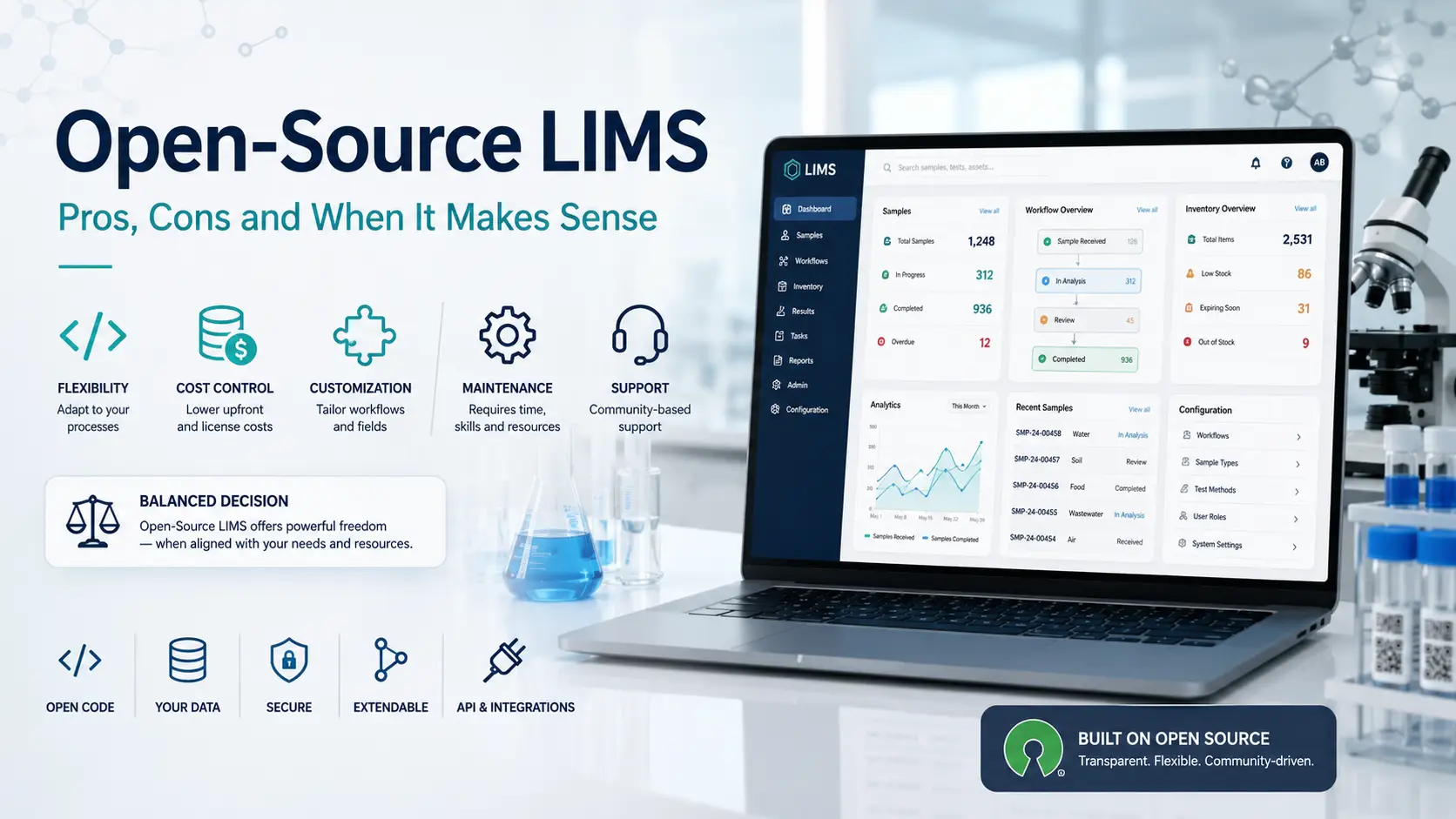
Quick verdict: Open-source LIMS is free to license, not free to run. For labs with technical capability, data-sovereignty requirements, or an allergy to vendor lock-in, it can be an excellent — occasionally superior — choice. For labs in regulated environments without in-house IT, the validation and support burden shifts entirely onto you, and the true cost frequently exceeds a commercial subscription. This guide is about the decision, not the catalogue: how to work out honestly whether open source fits your lab, before you invest six months finding out the hard way.
The question this article answers
Most open-source LIMS content is a list: here are the projects, here are their licences, here are their features. That’s useful once you’ve decided to go open source. It’s much less useful for the harder question that comes first — should you?
That question deserves a direct answer, because the failure mode is expensive. A lab that adopts open source without the capability to sustain it doesn’t discover the problem on day one; it discovers it eight months later, mid-audit or mid-outage, when nobody can fix the thing. Conversely, a lab that dismisses open source reflexively may pay a commercial subscription indefinitely for capability it could have owned outright.
So this guide works through the genuine advantages, the costs that don’t appear on any invoice, and a decision framework for telling which side of the line your lab sits on. If you want the landscape of specific tools alongside notebooks, our companion guide to open-source ELN and LIMS covers the projects themselves, and our eLabFTW overview examines one of the most polished options in depth.
What “open source” actually means for a LIMS
Before weighing pros and cons, it’s worth being precise, because the term is used loosely.
An open-source LIMS is distributed under a licence that grants you the right to inspect, modify, and redistribute the source code. In practice, the licence matters: eLabFTW is AGPLv3, Senaite is GPL, LabKey Server is Apache 2.0, and each carries different obligations if you modify and distribute the software. For most labs simply using the system internally, these distinctions rarely bite — but if you plan to modify heavily or offer the system to third parties, read the licence properly.
What open source does not mean is “free software with no strings.” It means the licence costs nothing and the code is yours to control. Everything else — hosting, deployment, configuration, upgrades, backups, security, support, and validation — is a cost you assume rather than one you outsource. That single reframing is the most important thing a prospective adopter can internalize.
The genuine advantages
No licence fees — and no per-seat escalation
The obvious benefit, and a real one. Commercial LIMS pricing commonly scales with users, and labs frequently encounter sharp cost jumps when crossing tier thresholds. Open source removes that dynamic entirely: adding your tenth or fiftieth user costs nothing in licensing. For a growing lab on a fixed budget — academic groups, public-health programmes, early-stage ventures — this is not a marginal saving but a structural one. Our LIMS pricing models explainer covers how commercial pricing typically behaves by comparison.
Genuine data sovereignty
Your data lives on infrastructure you control. For academic labs concerned with long-term archival, institutions subject to data-residency rules or GDPR obligations, and any organization uneasy about where a vendor stores its records, this is often the decisive argument. It is also, notably, an argument that money cannot buy from a SaaS vendor — no amount of subscription spend gives you the control that self-hosting does by default.
No vendor lock-in, and no exit problem
One of the sharpest criticisms of commercial platforms is that leaving them is hard: proprietary formats and limited export options can turn a multi-year contract into a trap. Open source inverts this. The code is available for audit, and every workflow, configuration, and integration you build is owned outright by your organization, accumulating as institutional capability rather than as spend that stops the moment you stop paying.
Transparency and adaptability
The source code is inspectable, which matters for security-conscious labs and for anyone who needs to know exactly how a calculation or workflow behaves. It also means the system can be adapted to genuinely local needs — a significant advantage for labs whose workflows don’t match what commercial vendors have standardized around, and a recurring theme in why public-health and resource-constrained laboratories adopt open source.
A maturing ecosystem
The dismissive framing of open-source LIMS as hobbyist software is outdated. The 2026 ecosystem includes actively developed projects delivering regular releases — Senaite, eLabFTW, OpenELIS and others — that increasingly rival commercial offerings in features and usability, serving microbial, genomics, clinical, and general research labs. Senaite has continued shipping substantive releases with analytical improvements such as limit-of-quantification support and refined uncertainty handling. Several projects also support LIMS fundamentals seriously: Senaite leverages the Plone framework’s security model with role-based access control and LDAP authentication, and both Senaite and LabKey provide audit logging and fine-grained permissions.
The costs that don’t appear on the invoice
Here is where honest guidance matters most, because these are the factors that determine whether an open-source adoption succeeds.
You are the support desk
This is the most consequential trade-off. When a critical bug or compliance issue arises, you cannot call a help desk at 2am — you rely on community assistance, internal capability, or a contracted implementer. Community support can be excellent, but it operates on the community’s timeline, not your production emergency’s. Labs must decide up front whether to accept that risk, and for many operational environments, commercial support for the open-source system becomes close to a necessity rather than an option. Notably, paid support and certified implementers do exist for major projects such as Senaite and Bika — which is a sensible middle path, but one that reintroduces cost.
Validation is entirely your burden
For any lab in a regulated environment, this is usually the deciding factor. Commercial LIMS vendors typically supply validation packages, documented change logs, and audit-oriented documentation designed to support inspection. Open-source LIMS generally lack out-of-the-box validation guidance, which means the lab must create and maintain its own validation documentation — for every change in the codebase. The transparency of open code helps, but the burden of demonstrating 21 CFR Part 11 compliance — electronic signatures, audit trails, access controls — rests entirely on you, and demands rigorous change control and thorough testing.
This is not to say open source cannot be compliant. Senaite has undergone community gap analysis for Part 11, guiding implementation of time-stamped audit logs and signature manifestations for approvals. But “capable of being made compliant” and “arriving compliant with a validation package” are very different propositions when an inspector is in the building. Labs pursuing accreditation should read our ISO 17025 guide alongside this one, and regulated pharmaceutical operations should see our LIMS for pharmaceutical QC guide for what inspection-readiness actually requires.
Deployment and maintenance are ongoing work
Self-hosting means someone owns the server, the database, the backups, the security patches, the version upgrades, and the disaster recovery plan. In a lab with capable IT, this is routine. In a lab without, it becomes an unassigned responsibility that quietly degrades — until the backup nobody tested turns out not to work.
Feature gaps in specialized areas
Open-source LIMS often originated as narrow or research-focused tools, and not all projects match the breadth of mature commercial systems. Specialized requirements — advanced chromatography integration, commodities billing, internationalization — may be missing or less polished. If your workflow depends on a specific capability, verify it exists rather than assuming parity.
Project vitality risk
Open source thrives on active community. Before adopting, assess project vitality honestly: release history, commit activity, the size and responsiveness of the community, and whether commercial implementers exist. A vibrant project is a safer long-term bet than a technically elegant one with three contributors and no release in eighteen months.
The total-cost reality
The most useful way to frame the decision is that open source converts a predictable external cost into an internal one. You stop paying licence fees; you start paying in staff time, technical capability, and assumed risk.
Whether that trade is favourable depends almost entirely on whether you already have the capability. A lab with a competent IT function, or a research group with technically fluent members, is converting cash into work it can absorb — often a genuinely good deal, and one that builds durable institutional capability. A lab without that capability is converting cash into work nobody is assigned to do, which is how open-source deployments fail.
Two honest observations follow. First, “free” open source plus a contracted implementer plus internal validation effort can easily cost more than a modest commercial subscription — so run the comparison properly rather than assuming zero. Second, the calculation shifts with scale: the more users you add, the better open source looks, because your costs stay flat while commercial licensing climbs.
When open source makes sense — and when it doesn’t
Strong fit
Academic and research groups. Budget constraints are real, technical capability is often available among staff or students, regulatory burden is typically light, and data-sovereignty concerns around long-term archival are common. This is open source’s home ground.
Public-health and resource-constrained laboratories. The combination of licence-cost sensitivity and the need to adapt software to local workflows is precisely what several open-source LIMS projects were built to serve.
Labs with data-residency or sovereignty requirements. If institutional rules, GDPR obligations, or national policy require data to stay on controlled infrastructure, self-hosting answers the requirement directly.
Organizations with genuine IT capability. If you already run servers competently, the maintenance burden is marginal rather than prohibitive, and the licence savings are close to pure gain.
Labs with unusual workflows. When commercial systems would require expensive customization to match how you actually work, owning the code can be cheaper and more sustainable than paying for professional services.
Poor fit
Regulated labs without validation resources. If you operate under GxP or need FDA-facing compliance and you have no one to write and maintain validation documentation, the burden will find you at the worst possible moment. This is the single most common reason regulated labs should choose commercial.
Labs with no IT function and no appetite for one. If nobody will own the server, don’t adopt something that requires one. Our best LIMS for small laboratories guide covers the cloud options that fit this situation better.
Operations that cannot tolerate downtime risk. If a LIMS outage halts revenue-generating testing, the absence of a contractual support SLA is a business risk, not just an inconvenience.
Labs needing specialized capability that projects don’t cover. Verify before committing; don’t plan to build it yourself unless you genuinely can.
How to evaluate an open-source LIMS properly
If you’re leaning toward open source, evaluate it like the operational commitment it is.
Start by auditing your own capability honestly — not aspirationally. Name the person who will own deployment, upgrades, backups, and troubleshooting. If you cannot name them, that is your answer.
Then assess project vitality: recent releases, active development, community responsiveness, and whether certified implementers or paid-support options exist. The existence of a commercial support ecosystem is a strong positive signal, both for the project’s health and for your fallback options.
Next, map compliance requirements against reality. List what your regulators or accreditors actually require, then verify feature-by-feature what the project provides natively and what you would have to build, document, and validate yourself.
Finally, model total cost over three years, including staff time, any contracted support, hosting, and validation effort — and compare it against commercial quotes for the same period. Do this before you fall in love with the idea. Sometimes open source wins decisively; sometimes the comparison is closer than expected, and knowing which situation you’re in is the entire point of the exercise.
The honest bottom line
Open-source LIMS in 2026 is a mature, credible option that deserves serious evaluation rather than reflexive dismissal — the leading projects are actively developed, increasingly capable, and offer control and cost characteristics that no commercial vendor can match. But “free” describes the licence, not the system. The costs are real; they’re simply denominated in capability and time rather than in subscription fees.
The labs that succeed with open source are the ones that went in clear-eyed about that trade and had the capability to absorb it. The labs that regret it are almost always the ones that heard “free” and stopped reading. Work out which you are before you commit, and open source becomes a genuinely strong option rather than an expensive lesson.
Where to go next
For the landscape of specific projects, see our honest guide to open-source ELN and LIMS and our eLabFTW overview. If you’re still framing the wider decision, start with our LIMS software pillar or the pricing models explainer. Labs weighing whether they need a LIMS, an ELN, or both will find our ELN buyer’s questions a useful next step.
This guide is updated as projects and licensing evolve. Licence terms, compliance capabilities, and project activity should always be verified directly with each project before adoption. LabSoftwareGuide is an independent editorial resource and is not affiliated with the projects or vendors mentioned above.
Sources
- IntuitionLabs — Open-Source LIMS 2026: Life Sciences Comparison Guide: https://intuitionlabs.ai/articles/open-source-lims-comparison-guide-2026
- IntuitionLabs — A Guide to Open-Source Laboratory Information Systems (LIMS): https://intuitionlabs.ai/articles/open-source-lims-guide
- IntuitionLabs — Understanding Open-Source LIMS: Core Functionalities: https://intuitionlabs.ai/articles/open-source-lims-functionalities
- SENAITE — Open Source LIMS (project site): https://www.senaite.com/
- Naralabs — Bika Health: Open Source LIMS for Health Care Laboratories: https://naralabs.com/en/blog/bika-health-an-open-surce-laboratory-information-management-system-lims-for-health-care-laboratories
- ClearLine LIMS — Open-Source vs Proprietary LIMS: An Honest Comparison: https://clearlinelims.com/blog/open-source-vs-proprietary-lims-comparison/
- 37degrees — Electronic Lab Notebooks in 2026: The Modern Scientist’s Guide: https://www.37degrees.io/resources/eln-landscape-2026/