As laboratories accelerate digital transformation, many organizations explore alternatives to expensive proprietary platforms. One option that often attracts attention is Open-Source ELN Software: Pros and Cons.
At first glance, open-source Electronic Laboratory Notebooks (ELNs) seem highly attractive: no licensing fees, full customization, and community-driven innovation. But beneath the surface, there are important trade-offs.
Understanding Open-Source ELN Software: Pros and Cons is critical before making a strategic technology decision that impacts compliance, data integrity, and intellectual property.
Let’s break it down clearly and objectively.
Introduction to Open-Source ELN Software: Pros and Cons
Open-source solutions have transformed many industries. From operating systems to databases, open-source technology has proven powerful and innovative.
Organizations like Linux Foundation have demonstrated how open collaboration can drive global adoption.
But laboratory environments are different.
Regulated laboratories must consider:
- Compliance requirements
- Data integrity
- Validation documentation
- Audit readiness
- Long-term vendor stability
Open-source ELNs can offer flexibility—but they also introduce responsibility.
What Is Open-Source ELN Software?
Definition and Core Characteristics
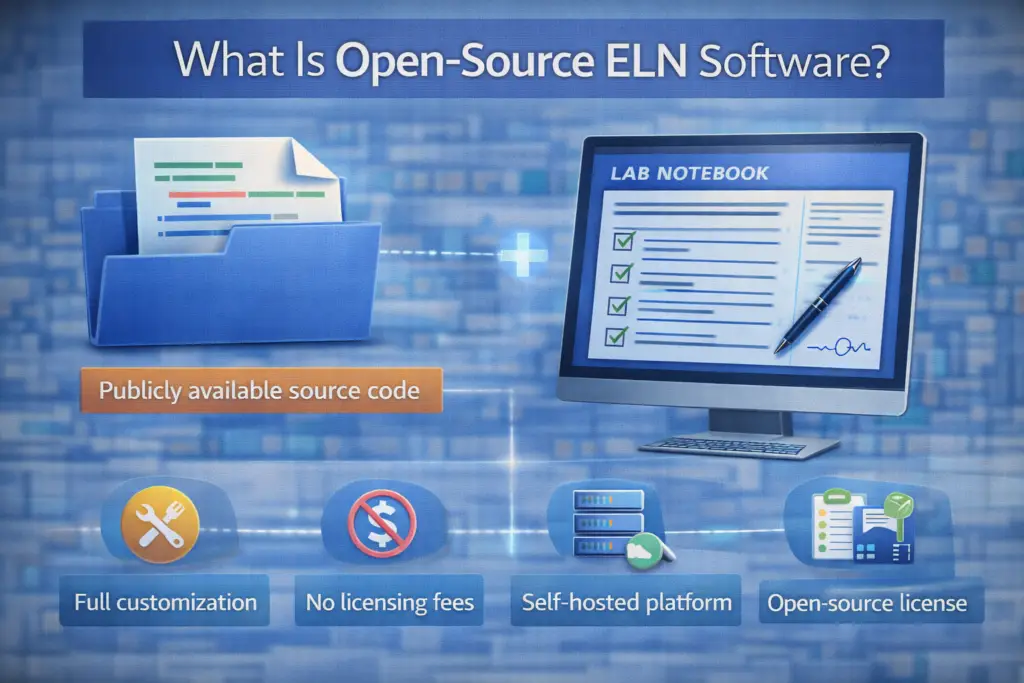
Open-source ELN software is a digital laboratory notebook platform whose source code is publicly available. This allows organizations to:
- Access and modify the code
- Customize features
- Self-host the platform
- Avoid traditional license fees
The software is typically distributed under open-source licenses such as GPL, MIT, or Apache.
How Open-Source Licensing Works
Open-source licenses define:
- Usage rights
- Redistribution permissions
- Modification allowances
- Liability limitations
Unlike commercial ELNs, open-source projects may not provide formal warranties or guaranteed support.
This distinction matters significantly in regulated environments.
Why Laboratories Consider Open-Source ELNs
Laboratories often explore open-source ELNs for several reasons:
- Budget constraints
- Desire for full customization
- Avoiding vendor lock-in
- Academic research flexibility
- Internal IT expertise availability
For startups or academic institutions, eliminating licensing fees can be appealing.
However, free software does not mean zero cost.
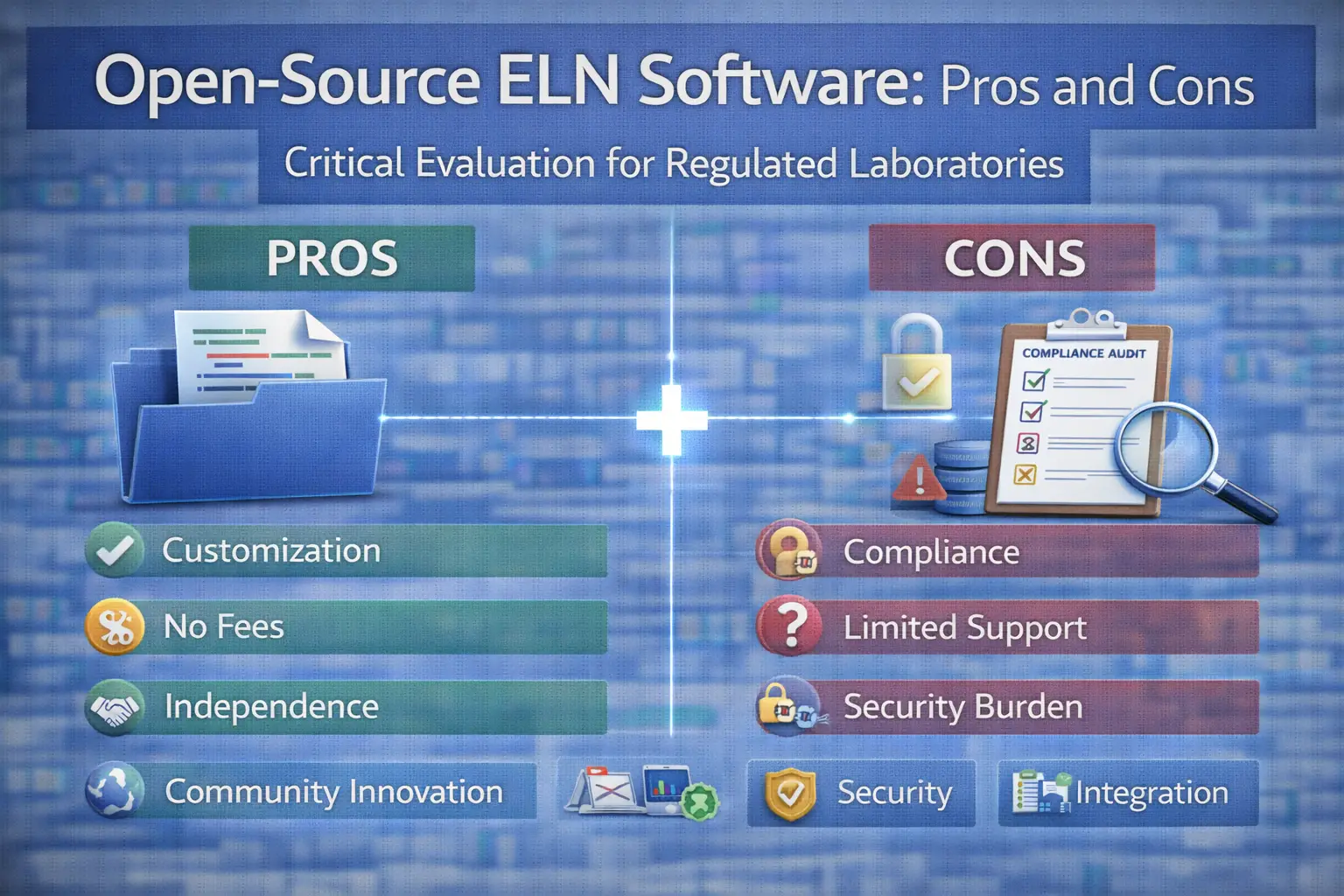
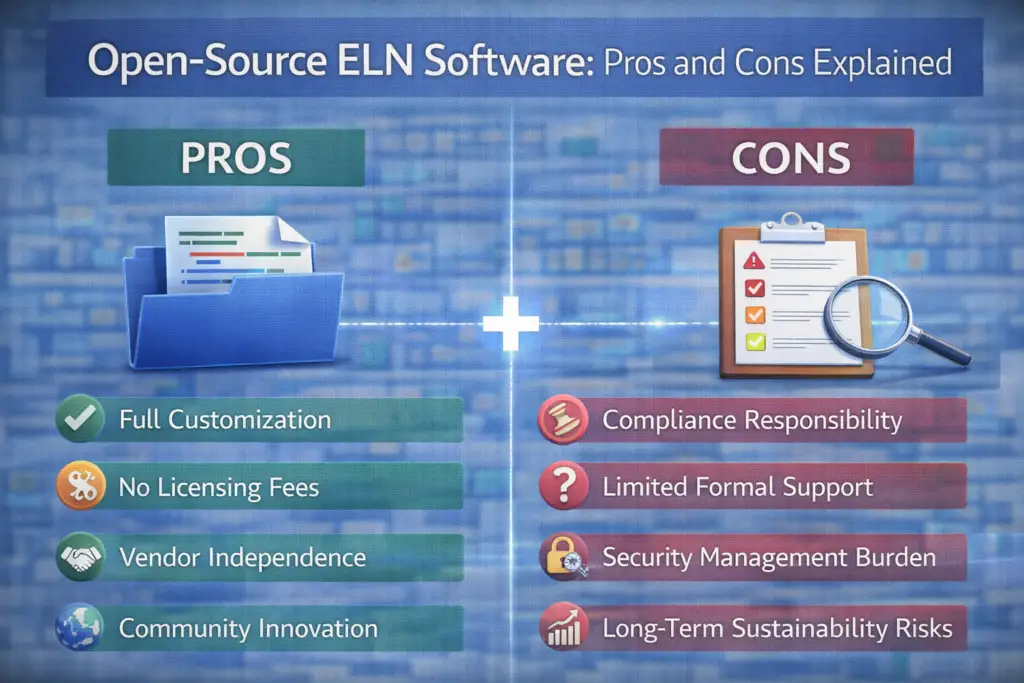
Open-Source ELN Software: Pros and Cons Explained
Major Advantages of Open-Source ELN
1. No Licensing Fees
Open-source ELNs typically eliminate recurring software licensing costs.
2. Full Customization
Access to source code allows labs to tailor features precisely to workflow needs.
3. Transparency
Code transparency enables full visibility into system logic.
4. Vendor Independence
Labs avoid being tied to a single commercial provider.
5. Community Innovation
Global developer communities may continuously improve features.
These advantages are particularly attractive for research-focused labs.
Key Disadvantages and Limitations
1. Compliance Responsibility
Regulated labs must validate the system independently. Agencies such as the U.S. Food and Drug Administration require validated computerized systems.
Open-source vendors rarely provide validation documentation.
2. Limited Formal Support
Community forums cannot replace guaranteed SLAs.
3. Security Management Burden
Internal teams must manage:
- Security patches
- Server hardening
- Backup procedures
- Access controls
4. Long-Term Sustainability Risks
Open-source projects may lose community support.
5. Hidden Infrastructure Costs
Hosting, maintenance, and IT staffing can outweigh licensing savings.
Open-source shifts responsibility from vendor to laboratory.
Cost Considerations: Free vs Total Cost of Ownership
The biggest misconception about open-source ELNs is cost.
While licensing may be free, total cost includes:
- Server infrastructure
- IT personnel
- Custom development
- Validation documentation
- Security management
- Training
In many cases, total cost of ownership (TCO) rivals or exceeds commercial ELN subscriptions.
Cost must be evaluated holistically.
Customization and Flexibility
Open-source ELNs provide unmatched customization potential.
Labs can:
- Modify workflows
- Add integrations
- Build custom dashboards
- Tailor user interfaces
However, deep customization increases:
- Validation complexity
- Maintenance burden
- Upgrade challenges
Customization freedom comes with lifecycle responsibility.
Security and Data Protection Implications
Security depends entirely on internal governance.
Open-source ELNs require:
- Secure hosting environment
- Regular vulnerability assessments
- Patch management procedures
- Cybersecurity expertise
Commercial vendors often invest heavily in cybersecurity certifications.
Open-source environments rely on internal capabilities.
Regulatory Compliance and Validation Challenges
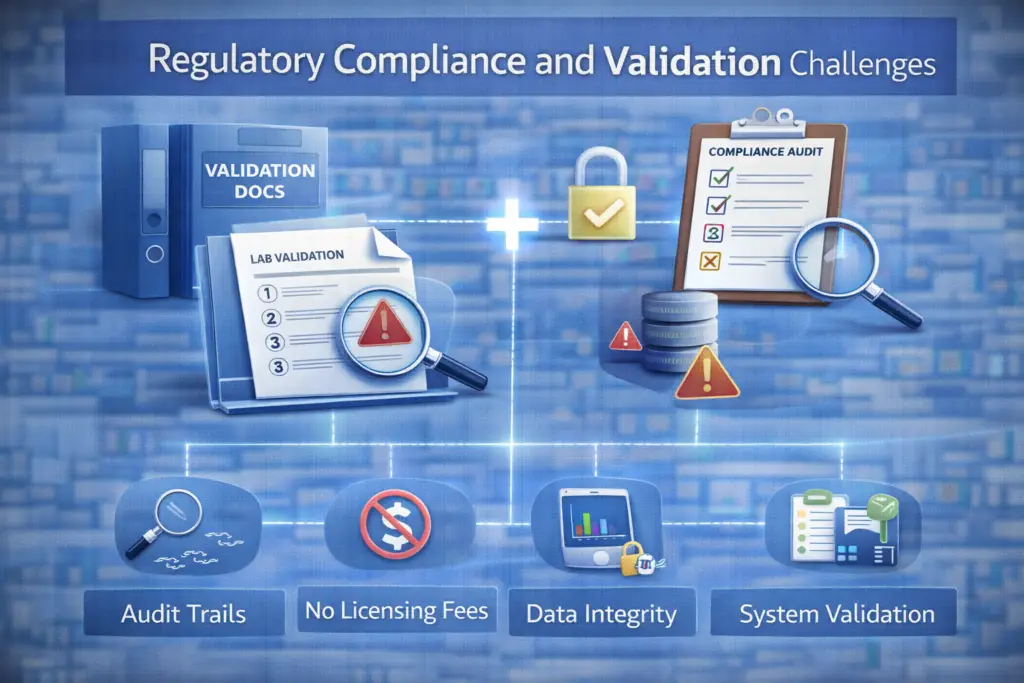
Regulated labs must ensure:
- Audit trails
- Electronic signatures
- Access control
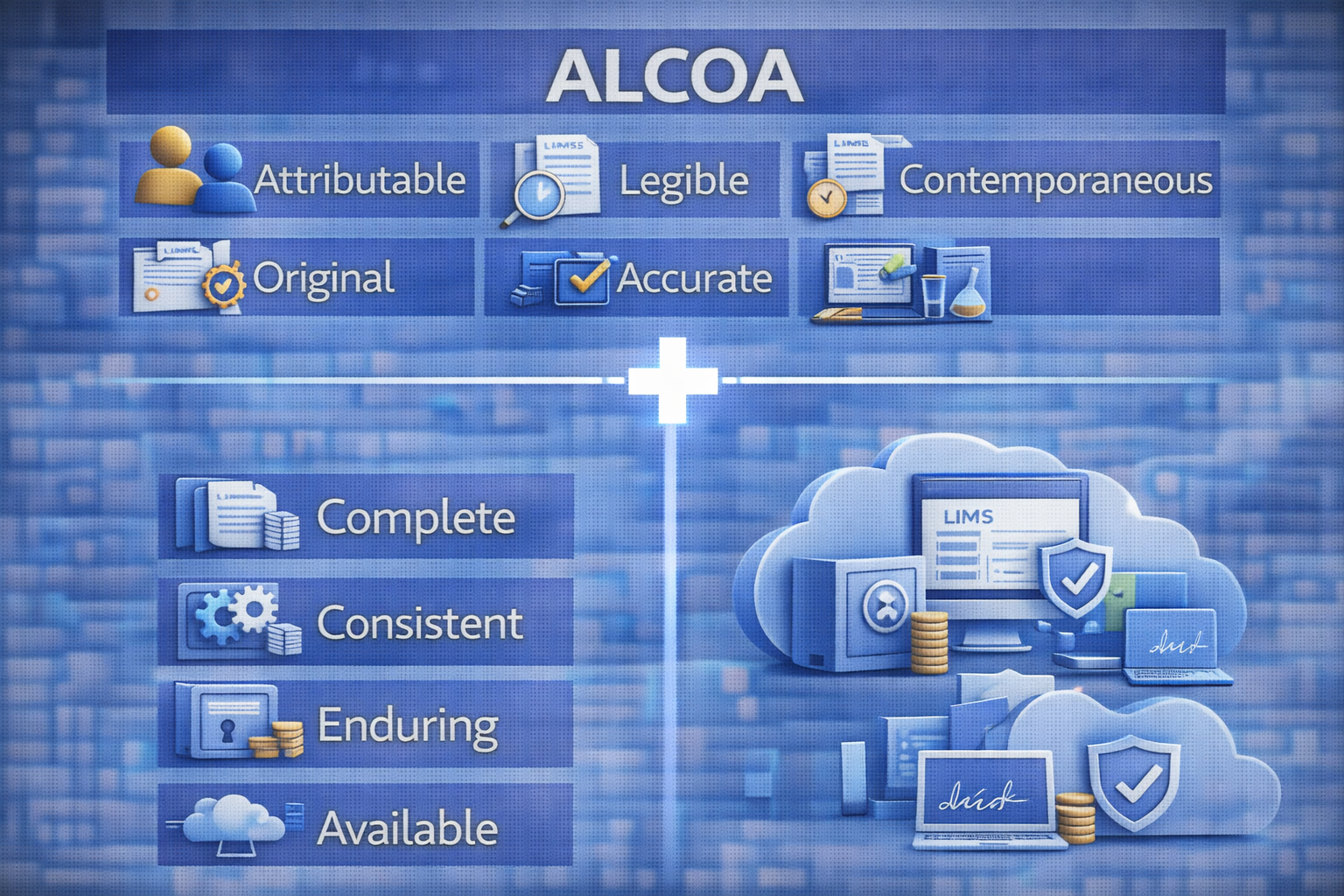
- Data integrity (ALCOA+ principles)
- System validation
Open-source projects may provide functionality—but rarely provide:
- Validation packages
- Risk assessments
- Compliance documentation templates
Validation burden rests entirely on the lab.
For GMP, GLP, or ISO environments, this can be a major obstacle.
Community Support vs Commercial Support
Community support typically includes:
- Online forums
- GitHub discussions
- Volunteer contributors
Commercial support offers:
- Dedicated help desks
- Service level agreements (SLAs)
- Response time guarantees
- Regulatory expertise
In mission-critical environments, guaranteed support often outweighs cost savings.
Scalability and Long-Term Sustainability
Open-source ELNs can scale technically.
But sustainability depends on:
- Active developer community
- Ongoing updates
- Security patch frequency
- Funding models
Abandoned projects can create long-term risk.
Labs must evaluate project maturity and roadmap stability.
Integration with LIMS and Other Systems
Modern laboratories require integration with:
- LIMS platforms
- ERP systems
- Analytical instruments
- Data warehouses
Open-source ELNs may require custom API development.
Commercial ELNs often provide pre-built connectors.
Integration complexity increases validation scope.
When Open-Source ELN Is the Right Choice
Open-source ELNs may be suitable for:
- Academic research labs
- Early-stage biotech startups
- Non-regulated environments
- Organizations with strong internal IT teams
- Labs prioritizing customization over compliance support
In low-regulatory contexts, open-source can be effective.
When Commercial ELN May Be Safer
Commercial ELNs are generally safer for:
- GMP-regulated environments
- Clinical laboratories
- Pharmaceutical manufacturing
- ISO-certified facilities
- Organizations requiring audit readiness
Compliance infrastructure is often built into commercial solutions.
Frequently Asked Questions
1. Is open-source ELN software truly free?
Licensing may be free, but infrastructure and support costs remain.
2. Can open-source ELN meet FDA requirements?
Yes, but validation responsibility lies entirely with the laboratory.
3. Is open-source less secure?
Not inherently. Security depends on implementation quality.
4. Who provides support for open-source ELNs?
Usually community contributors unless a commercial partner offers support.
5. Can open-source ELN integrate with LIMS?
Yes, but often requires custom development.
6. What is the biggest risk of open-source ELN?
Long-term sustainability and compliance burden.
Conclusion: Should Your Lab Choose Open-Source ELN Software?
When evaluating Open-Source ELN Software: Pros and Cons, the answer is not simple.
Open-source offers:
- Flexibility
- Transparency
- Customization
- Vendor independence
But it also demands:
- Strong IT governance
- Validation expertise
- Security management
- Long-term maintenance planning
For research-focused, non-regulated labs, open-source ELNs can be powerful tools.
For highly regulated environments, commercial ELNs often provide safer, compliance-ready infrastructure.
Ultimately, the right choice depends on your laboratory’s regulatory scope, IT maturity, risk tolerance, and long-term digital strategy.
Technology decisions in laboratory environments are never purely technical—they are strategic.
Choose accordingly.