Quick verdict: For most labs, a cloud (SaaS) ELN is the practical default: faster to deploy, no servers to run, updates included, and accepted by regulators when the lab keeps proper oversight of the provider. On-premise still makes sense in specific cases: strict data residency or network isolation requirements, heavy integration with local instruments and systems, an IT team already running validated infrastructure, or a need to control exactly when the software changes. The decision should rest on those constraints and on a five-year cost comparison that includes internal IT effort, not on a general belief that one option is more secure.
What the two models mean in practice
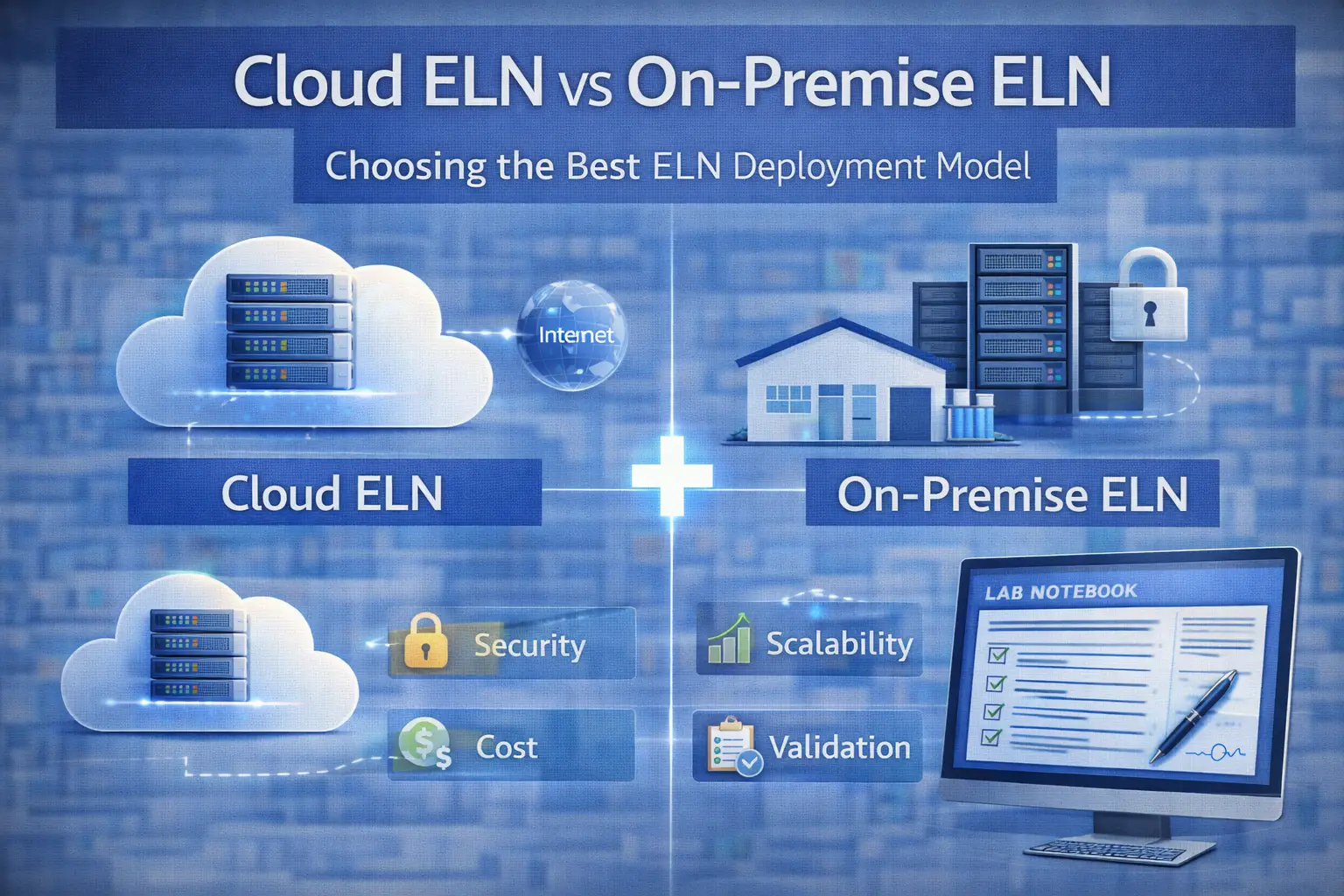
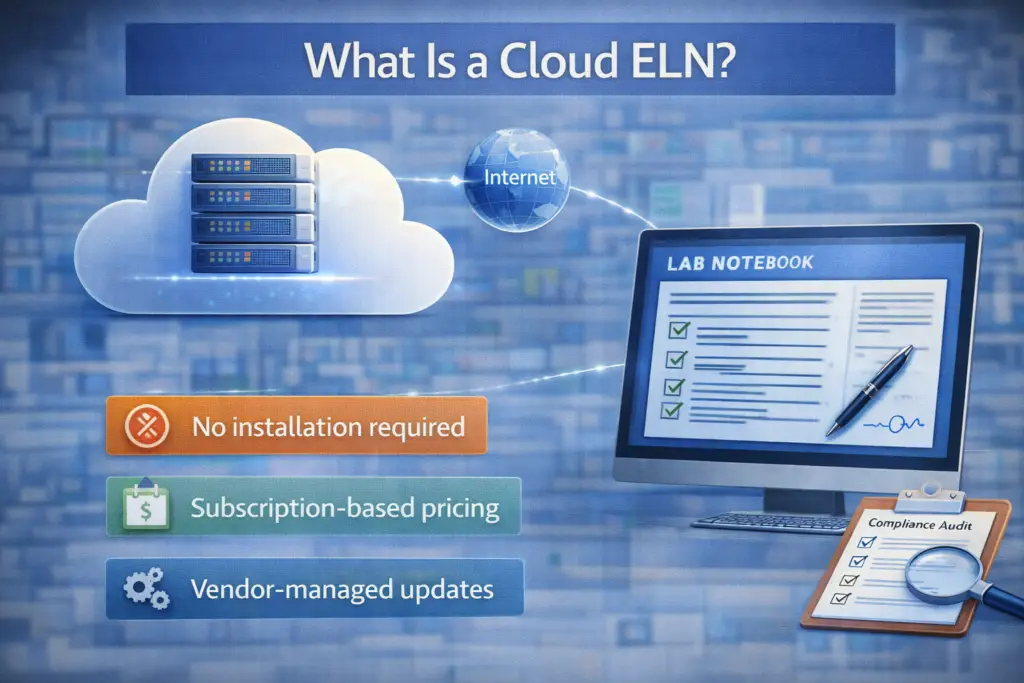
Cloud ELN (SaaS). The vendor hosts the application, usually on a major cloud platform, and runs infrastructure, security patching, backups and upgrades. You access it through a browser and pay a subscription. Most instances are multi-tenant: your data is logically separated from other customers on shared infrastructure. Some vendors offer a single-tenant or private cloud option at a higher price.
On-premise ELN. You install the software on servers you control, in your own data centre or in a cloud account managed by your IT team. You buy a licence (or a subscription for self-hosted software), and your team handles servers, databases, backups, security, and the timing of upgrades. Open-source ELNs such as eLabFTW are often self-hosted this way.
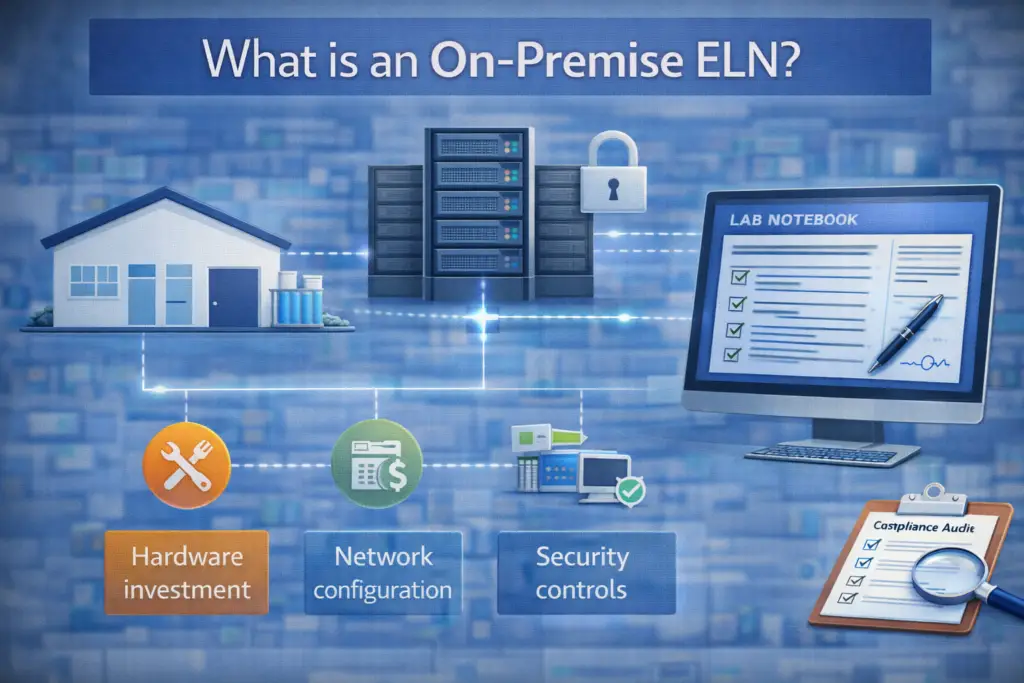
The boundary is less sharp than the labels suggest. A “self-hosted” ELN running in your own cloud subscription gives you on-premise control with cloud infrastructure, and a vendor-managed single-tenant instance sits in between.
Side-by-side comparison
| Cloud (SaaS) ELN | On-premise ELN | |
|---|---|---|
| Deployment speed | Fast: no infrastructure to build | Slower: servers, database, network and security setup |
| Who runs infrastructure | Vendor | Your IT team |
| Upgrades | Vendor schedule, frequent releases | Your schedule, less frequent, often larger projects |
| Cost profile | Recurring subscription (operating expense) | Upfront licence and hardware (capital expense), then maintenance and IT staff |
| Remote access and collaboration | Built in | Requires VPN or exposed services, set up by IT |
| Instrument and local system integration | Needs connectors or gateways to reach the lab network | Direct access on the local network |
| Data location | Vendor’s hosting regions; check contract | Wherever you host it |
| Validation focus | Supplier assessment, release impact assessment | Infrastructure qualification, upgrade revalidation |
| Exit | Depends on export terms in the contract | Data already in your environment |
Security: where the real differences are
A common assumption is that data is safer on servers inside the building. In practice, security depends on who runs the controls and how well.
A reputable SaaS provider typically offers encryption in transit and at rest, a dedicated security team, continuous patching, and independent attestations such as ISO/IEC 27001 certification or SOC 2 reports. Many labs could not match that level internally. The risks move elsewhere: account security (strong authentication, single sign-on, removal of leavers), the provider’s own practices, and the terms that govern access to your data.
On-premise gives you full control, which is an advantage only if your organization patches, monitors, backs up and tests recovery with the same discipline. A server that misses security updates for months, or a backup that has never been restored, is a larger risk than most cloud configurations.
What to ask a cloud ELN vendor: current certifications or audit reports and their scope, hosting regions, encryption approach, backup frequency and tested recovery times, incident notification commitments, and support for single sign-on and multi-factor authentication.
Compliance and validation
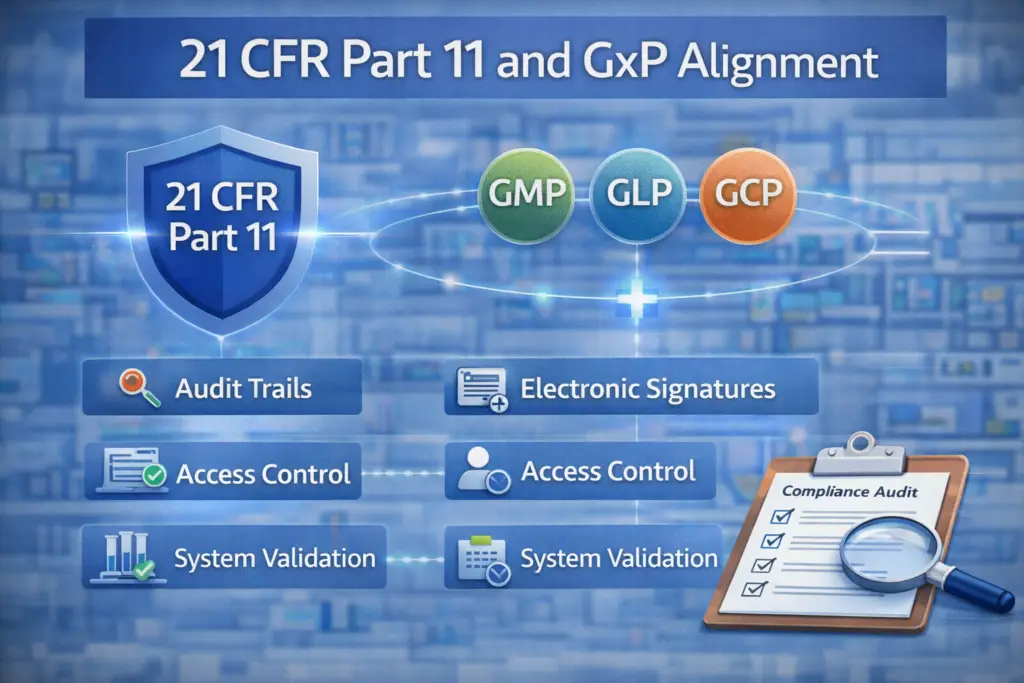
Regulators do not require on-premise systems. What they require is that the lab stays in control of its regulated records, whatever the hosting model.
- GLP: the OECD’s 2023 advisory document on GLP and cloud computing states that test facility management keeps responsibility for GLP compliance when services are outsourced, and expects service agreements covering responsibilities, data location, security, change control, business continuity and retrieval of all data and metadata at exit.
- GxP more broadly: ISPE’s GAMP 5 Second Edition includes guidance on assessing cloud and service providers, and the MHRA’s GxP data integrity guidance expects oversight of IT and cloud providers.
- Records and signatures: FDA 21 CFR Part 11 controls (audit trails, access control, electronic signatures) apply the same way in both models.
The validation work shifts rather than disappears:
- Cloud: less infrastructure qualification, more supplier assessment, and a process to assess each vendor release before or soon after it reaches production. Ask whether you get release notes in advance and a validation or sandbox environment.
- On-premise: you qualify the infrastructure yourself, and each major upgrade becomes a project with its own testing and documentation. Many on-premise labs delay upgrades for this reason and end up running outdated versions.
Our ELN compliance and data integrity guide covers the controls in detail, and the LIMS validation guide describes the risk-based lifecycle that applies to both system types.
Cost: compare five years, not year one
Cloud ELN pricing is usually per user per month; our ELN pricing benchmark documents current published plans. On-premise pricing combines a licence or self-hosted subscription with costs that rarely appear in a vendor quote: servers or cloud infrastructure, database licences, backup and disaster recovery, security tooling, and IT staff time for maintenance and upgrades.
A fair comparison uses the same scope for both options over five years:
- users per year, including growth;
- licence or subscription, maintenance and support;
- implementation, integrations and data migration;
- infrastructure and IT effort (on-premise), or premium hosting options (cloud);
- validation, including the effort per release or upgrade.
Our ELN pricing guide walks through the total cost of ownership calculation.
Collaboration and integration
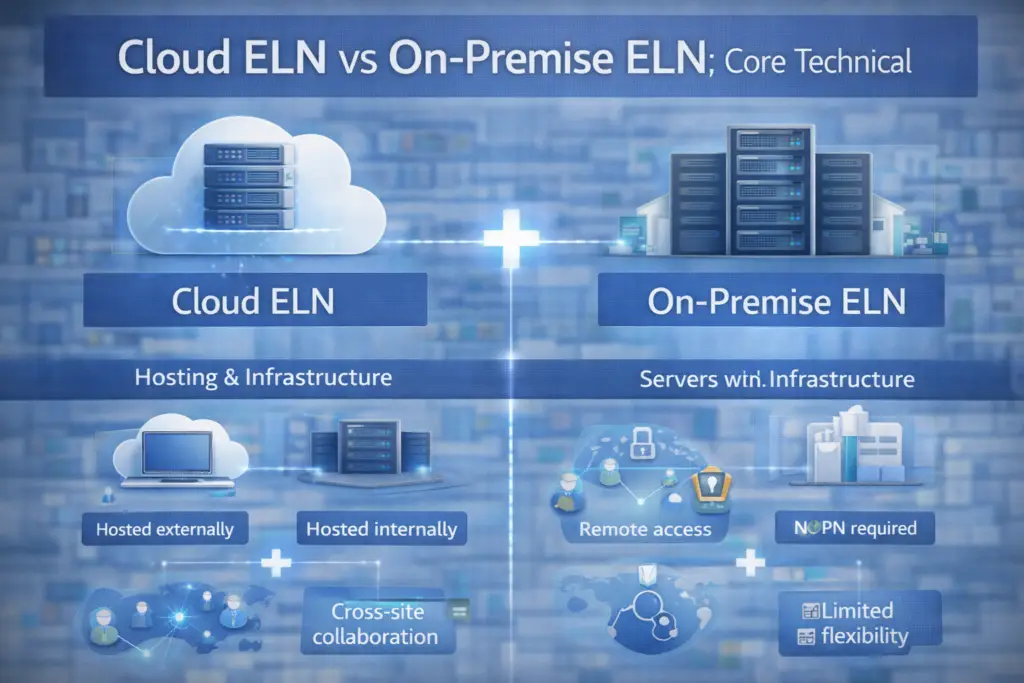
Cloud ELNs make collaboration across sites, home working and external partners straightforward, because access only requires a browser and an account. On-premise systems can offer the same, but IT has to expose the application securely.
Integration works the other way. Instruments, network drives and local systems sit on the lab network, which an on-premise ELN can reach directly. A cloud ELN needs an agent, gateway or middleware to collect instrument files and push them to the cloud. Before choosing cloud, list the instruments and systems you need to connect and ask each vendor how they are integrated today, in production, at a comparable lab.
Which model fits your lab?
Cloud is usually the better fit if:
- you have limited IT capacity for running validated servers;
- teams work across sites, remotely or with external partners;
- you want to start quickly and scale users progressively;
- your regulatory context allows outsourced hosting with proper supplier oversight.
On-premise is usually the better fit if:
- policy, contracts or national rules require data to stay in a specific environment or network;
- the ELN must integrate closely with many local instruments and systems;
- your IT team already runs validated infrastructure and can maintain it;
- you need full control over the timing of software changes.
Consider a middle option (self-hosted in your own cloud account, or a vendor-managed single-tenant instance) when you need control over data location or change timing without running physical servers.
Frequently asked questions
Can a cloud ELN be used for FDA-regulated or GLP work?
Yes. The lab must assess the provider, define responsibilities in the contract, validate the system for its intended use, and retain the ability to retrieve complete records.
Is on-premise more secure than cloud?
Not by default. Security depends on the controls in place and how consistently they are operated. Many SaaS providers maintain controls that small internal IT teams cannot.
Which option is cheaper?
Cloud usually costs less in the first years. Over a longer period on-premise can compete, but only when infrastructure, IT staff and upgrade projects are counted.
Can we move from on-premise to cloud later?
Usually, but plan it as a data migration project: check export formats, metadata and audit trail transfer, and revalidation effort before committing.
What should the cloud contract include?
Service levels, data location, security and incident notification, backup and recovery, change and release communication, audit rights, and complete data export at the end of the contract.
The bottom line
The cloud versus on-premise question is mainly about control and capacity. If your lab can accept outsourced hosting and oversee the provider properly, a cloud ELN removes most of the infrastructure burden. If data location, local integration or change control has to stay fully in your hands, and your IT team can run the system well, on-premise remains a sound choice. Decide on those constraints, then confirm with a five-year cost comparison.
This article is independent editorial content. No vendor paid for inclusion. Read how we review lab software.
Sources
- OECD, Advisory Document on GLP and Cloud Computing, Supplement 1 to Document No. 17 (2023): https://www.bfr.bund.de/cm/349/no-17-supplement-1-advisory-document-on-glp-cloud-computing.pdf
- ISPE Pharmaceutical Engineering, What You Need to Know About GAMP® 5 Guide, 2nd Edition: https://ispe.org/pharmaceutical-engineering/january-february-2023/what-you-need-know-about-gampr-5-guide-2nd-edition
- MHRA, GXP Data Integrity Guidance and Definitions, Revision 1 (March 2018): https://assets.publishing.service.gov.uk/media/5aa2b9ede5274a3e391e37f3/MHRA_GxP_data_integrity_guide_March_edited_Final.pdf
- U.S. eCFR, 21 CFR Part 11, Electronic Records; Electronic Signatures: https://www.ecfr.gov/current/title-21/chapter-I/subchapter-A/part-11
- Lab Software Guide, ELN Pricing Benchmark 2026: https://labsoftwareguide.com/eln-pricing-benchmark-2026-what-labs-actually-pay/