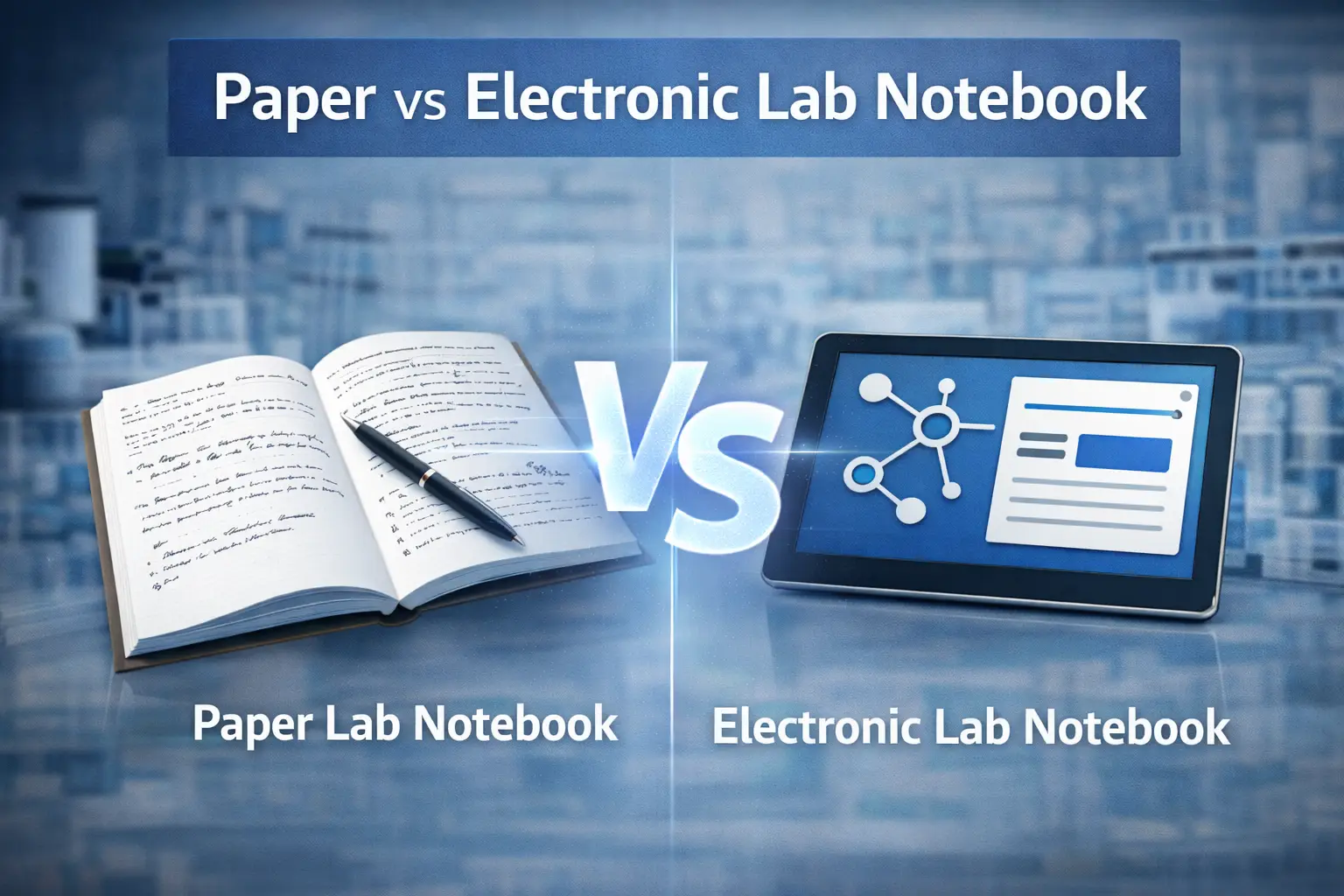
Laboratories around the world are facing a critical decision: Paper vs Electronic Lab Notebook. For decades, scientists relied on handwritten notebooks to document experiments, record observations, and protect intellectual property. But today, the digital transformation of laboratories is reshaping how research is conducted.
The debate around Paper vs Electronic Lab Notebook is no longer just about preference—it’s about efficiency, compliance, scalability, and competitive advantage.
If your goal is to modernize laboratory operations and future-proof research processes, understanding this comparison is essential.
Let’s explore it in depth.
Introduction to Paper vs Electronic Lab Notebook
The traditional lab notebook has been a symbol of scientific discovery for centuries. From handwritten chemical formulas to carefully taped chromatograms, paper notebooks have captured groundbreaking innovations.
However, science has evolved. Data volumes have exploded. Regulations have tightened. Teams are more global than ever.
This shift has brought Electronic Lab Notebooks (ELNs) into the spotlight.
So when we compare Paper vs Electronic Lab Notebook, we are really comparing tradition versus transformation.
What Is a Traditional Paper Lab Notebook?
A paper lab notebook is a bound notebook used to document experiments, procedures, observations, and results in handwritten format.
How Paper Notebooks Have Served Science for Centuries
Historically, paper notebooks have:
- Provided a legal record of discoveries
- Documented research progress
- Served as intellectual property evidence
- Allowed scientists to record observations in real time
Famous researchers across history relied on handwritten records to protect discoveries and establish patents.
Common Practices in Paper-Based Documentation
Typical paper notebook practices include:
- Writing in ink only
- Crossing out errors (never erasing)
- Signing and dating entries
- Having supervisors witness entries
- Storing notebooks in physical archives
While these practices ensure traceability, they are entirely manual—and prone to human error.
What Is an Electronic Lab Notebook (ELN)?
An Electronic Lab Notebook (ELN) is a digital platform designed to replace paper-based scientific documentation.
Organizations like Gartner classify ELNs as a key component of laboratory digital transformation.
Definition and Core Concept
An ELN is:
- A secure digital repository for experimental records
- Searchable and structured
- Time-stamped and audit-ready
- Accessible remotely
- Integrated with laboratory systems
It replicates the function of paper but enhances it with automation and connectivity.
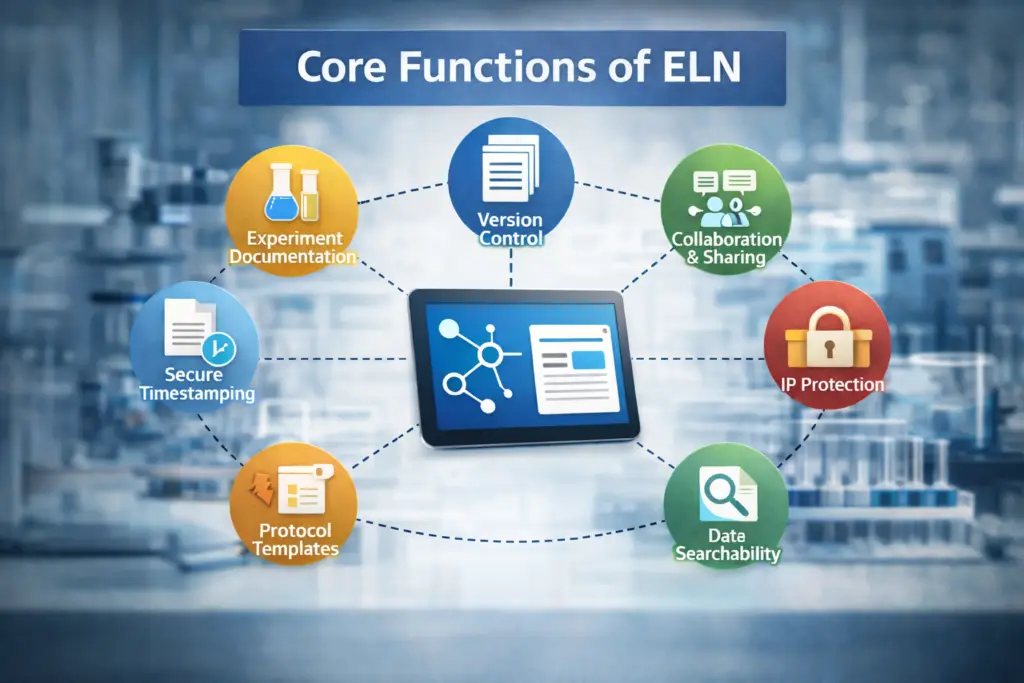
Key Functional Capabilities
Modern ELNs offer:
- Digital experiment templates
- Version control
- Electronic signatures
- Real-time collaboration
- Secure audit trails
- Data integration with instruments
- Advanced search functions
- IP protection features
In short, an ELN turns documentation into structured, usable data.
Paper vs Electronic Lab Notebook: What’s the Fundamental Difference?
At its core, the debate over Paper vs Electronic Lab Notebook centers on how data is stored, accessed, and protected.
Static Records vs Dynamic Data
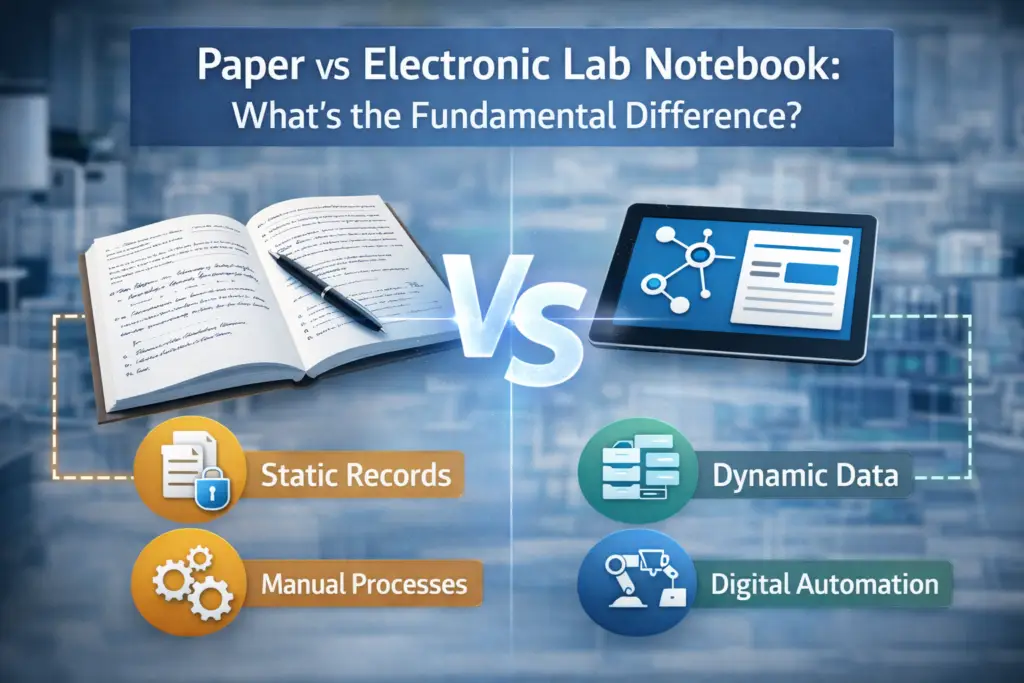
Paper notebooks are static.
Once written, information cannot be easily modified, reorganized, or searched. Retrieving past experiments requires manual flipping through pages.
ELNs are dynamic.
They allow:
- Instant keyword search
- Data filtering
- Cross-referencing
- Automated backups
Information becomes living, accessible data—not just ink on paper.
Manual Processes vs Digital Automation
Paper requires:
- Manual signatures
- Physical storage
- Manual duplication
- Physical sharing
ELNs automate:
- Time-stamping
- Audit logs
- Sharing permissions
- Version tracking
Automation reduces administrative burden significantly.
Data Integrity and Compliance Considerations
In regulated environments, documentation isn’t optional—it’s mandatory.
Audit Trails and Regulatory Requirements
Agencies such as the U.S. Food and Drug Administration require clear, traceable documentation.
Paper notebooks can meet compliance standards—but only with strict oversight.
ELNs provide built-in:
- Audit trails
- Electronic signatures
- Access control logs
- Time-stamped modifications
Compliance becomes systematic rather than procedural.
21 CFR Part 11 and GMP Alignment
ELNs are often designed to align with:
- 21 CFR Part 11
- GMP requirements
- ISO standards
Paper systems must rely entirely on procedural discipline.
Efficiency and Productivity Comparison
Time Spent Searching and Rewriting
With paper:
- Searching takes hours
- Data re-entry is common
- Reports require manual compilation
With ELN:
- Search takes seconds
- Templates speed up documentation
- Reports can be generated automatically
Time saved directly impacts productivity.
Workflow Optimization
ELNs standardize processes.
They ensure:
- Consistent protocol usage
- Reduced duplication
- Faster onboarding for new scientists
Paper systems often vary by individual user.
Collaboration and Knowledge Sharing
Modern research is collaborative.
Paper notebooks:
- Cannot be shared remotely
- Risk being misplaced
- Limit transparency
ELNs:
- Enable remote collaboration
- Allow permission-based access
- Facilitate cross-team projects
- Support global research teams
In a world of distributed labs, digital collaboration is essential.
Risk Management and Data Security
Paper notebooks can be:
- Lost
- Damaged
- Stolen
- Destroyed by fire or flood
ELNs offer:
- Encrypted storage
- Cloud backups
- Disaster recovery systems
- Access controls
Data security improves dramatically.
Intellectual Property Protection
IP protection depends on clear, verifiable documentation.
ELNs:
- Provide timestamp verification
- Offer digital signature validation
- Maintain immutable audit trails
Paper documentation can be challenged more easily in disputes.
For innovation-driven biotech companies, this is critical.
Scalability for Growing Labs
As labs grow:
Paper systems become chaotic.
Storage rooms fill up. Retrieval slows down. Audits become complex.
ELNs scale effortlessly:
- Unlimited digital storage
- Structured data organization
- Seamless expansion across teams
Growth demands digital infrastructure.
Cost Analysis: Short-Term vs Long-Term
Paper seems cheap initially.
But hidden costs include:
- Storage space
- Administrative time
- Compliance risk
- Data retrieval delays
ELNs require upfront investment but deliver long-term ROI through:
- Increased productivity
- Reduced compliance risk
- Faster reporting
- Improved data utilization
Over time, digital wins.
Real-World Use Cases in Modern Labs
Industries rapidly adopting ELNs include:
- Biotechnology
- Pharmaceutical R&D
- Academic research
- Contract research organizations
The shift is not theoretical—it’s operational.
Migration: Transitioning from Paper to ELN
Transition steps include:
- Needs assessment
- Vendor selection
- Validation planning
- Data migration
- Staff training
- Change management
Successful migration requires strategy—not just software installation.
Frequently Asked Questions
1. Is paper legally valid for lab documentation?
Yes, but compliance relies heavily on manual discipline.
2. Are ELNs secure?
Modern ELNs use encryption, access control, and secure cloud hosting.
3. Is ELN implementation difficult?
With proper planning, deployment can take weeks to months.
4. Do ELNs replace LIMS?
No. ELNs focus on documentation, while LIMS manage samples and operations.
5. Can small labs afford ELNs?
Cloud-based subscription models make ELNs accessible for smaller labs.
6. What is the biggest advantage of ELN?
Searchability, compliance automation, and collaboration.
Conclusion: Why the Future Is Electronic
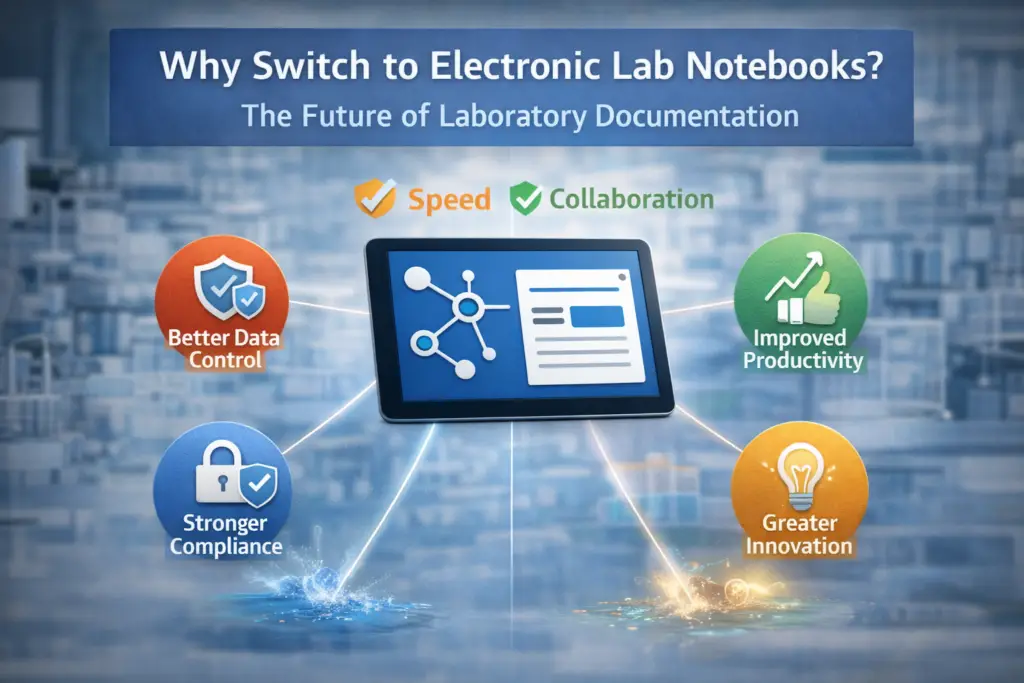
When evaluating Paper vs Electronic Lab Notebook, the conclusion is clear.
Paper represents tradition.
Electronic represents transformation.
In today’s data-driven scientific environment, speed, compliance, collaboration, and scalability are no longer optional—they are essential.
Labs that adopt Electronic Lab Notebooks gain:
- Better control over data
- Stronger compliance posture
- Improved productivity
- Greater innovation potential
The future of laboratory documentation is not bound by paper—it is powered by digital intelligence.
And smart labs are already making the switch.