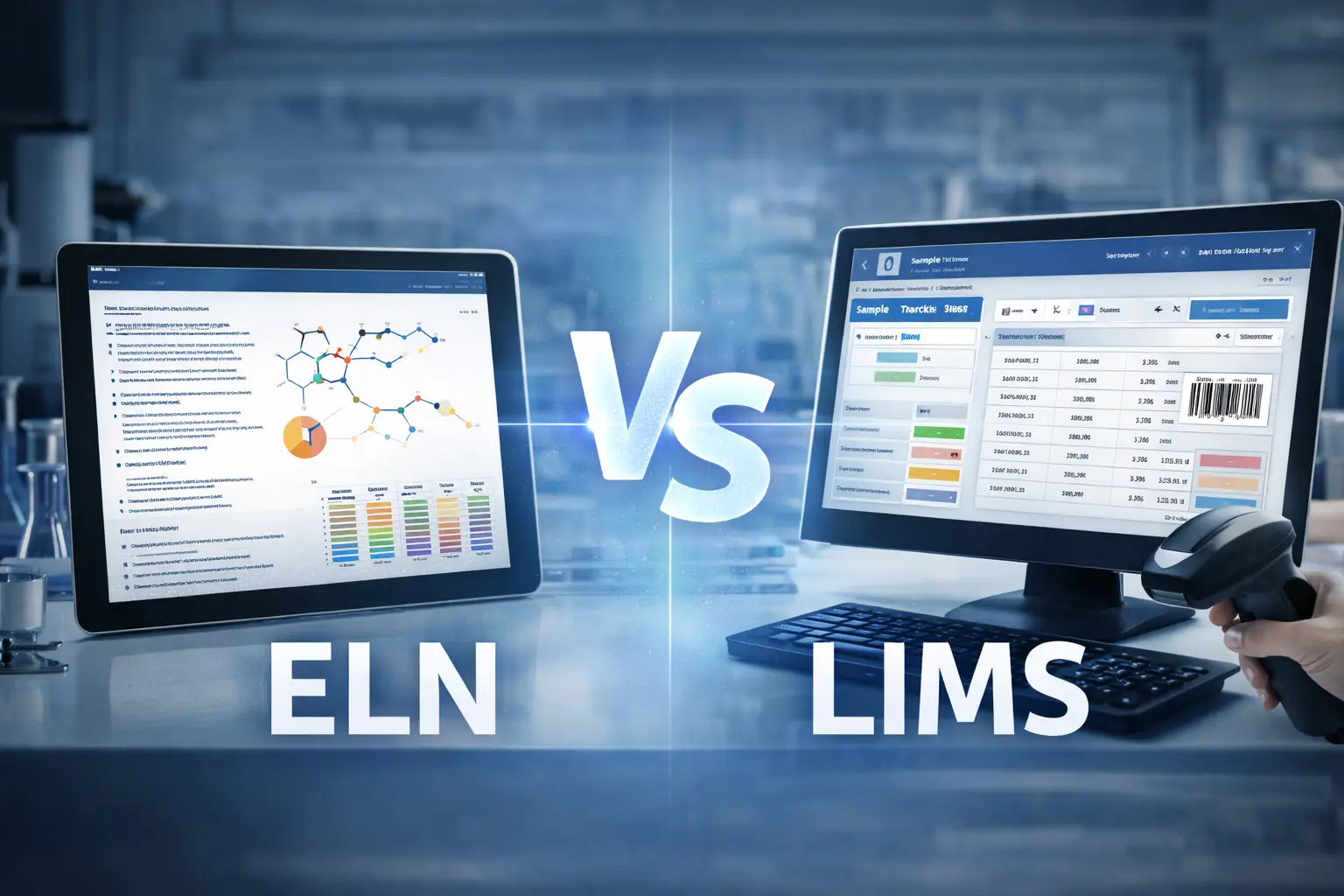
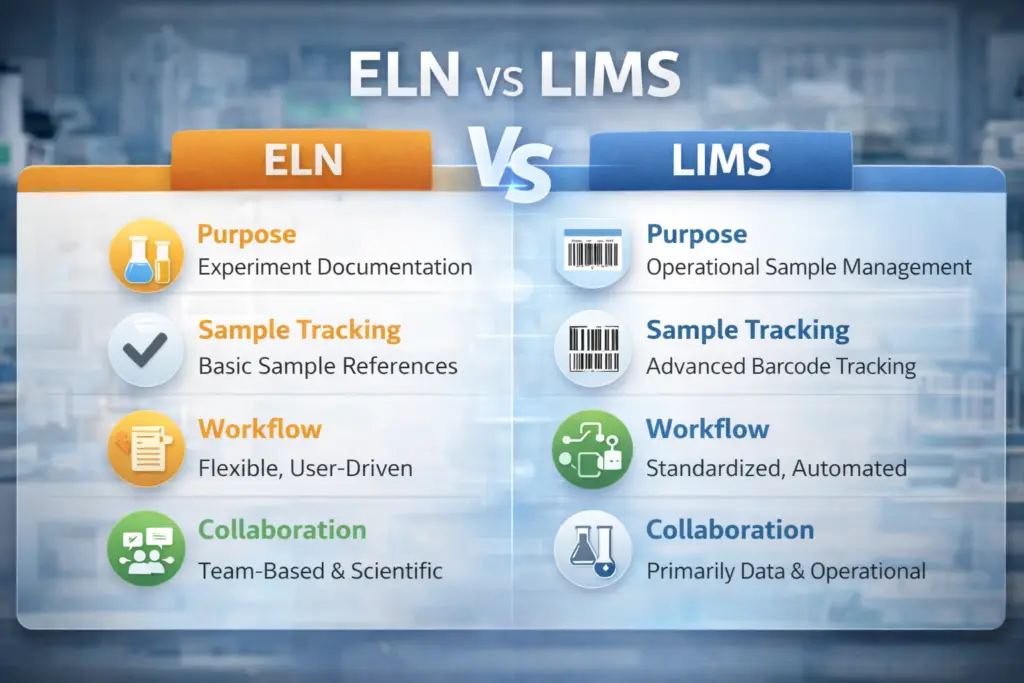
Quick verdict: A LIMS manages samples and the work done on them; an ELN manages experiments and the reasoning behind them. If your lab’s core output is a tested result delivered against a specification (QC, clinical, environmental or contract testing), you need a LIMS. If your core output is knowledge, such as a validated hypothesis, a new construct or a patent filing, you need an ELN. Many R&D organizations eventually need both, and a growing group of vendors now sell them as one platform. That convergence is useful, but it can hide the questions you should ask before buying.
Why the distinction still matters
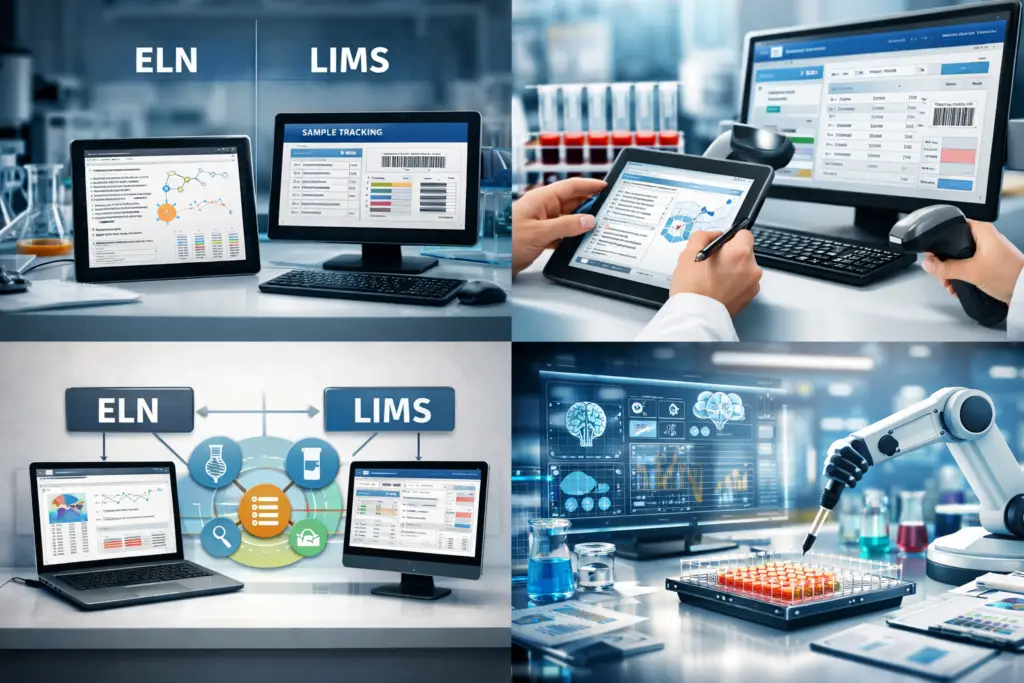
Vendors increasingly describe themselves as “ELN + LIMS” or “unified lab platforms”, and several of the products we review do cover both. The difference still matters, for a practical reason: the two systems are built around different units of work.
A LIMS is organized around the sample. Registration, tests, results, approvals and reports all hang off a sample record moving through a defined workflow. An ELN is organized around the experiment. The aim, protocol, observations, raw data and conclusions all hang off a notebook entry authored by a scientist.
When a hybrid platform is strong on one model and thin on the other, you will feel it within weeks of go-live. Knowing which model your lab actually runs on is the first and most important step in any evaluation. ASTM’s reference guide for laboratory informatics (E1578-18) treats LIMS and ELN as distinct system types alongside LES, LIS, SDMS and CDS, for the same reason.
What a LIMS does
A Laboratory Information Management System manages the operational life of samples in a lab. Its job is to ensure that every sample is accounted for, tested according to the right method, and reported correctly.
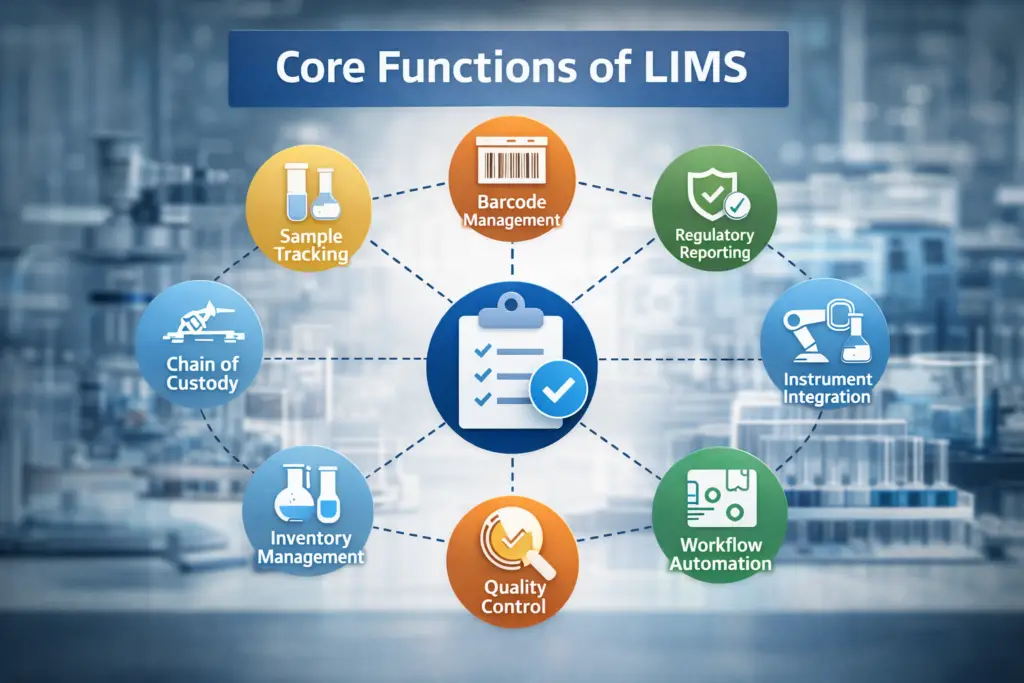
Typical LIMS capabilities:
- Sample registration, barcoding and chain of custody
- Test assignment, worklists and workflow enforcement
- Specifications, limits and out-of-specification flagging
- Result entry, review and approval
- Instrument and equipment management, calibration records
- Stability studies, batch release and certificates of analysis (in QC contexts)
- Regulatory and client reporting
Where LIMS dominates: pharmaceutical and biotech QC, contract testing, environmental and food testing, and clinical labs (which often use a LIS for patient-facing diagnostics; see our clinical and diagnostic LIMS guide).
The defining trait of a good LIMS is enforced structure: a technician cannot skip a step, enter a result outside the permitted sequence, or release a batch without the required approvals. That rigidity makes it valuable in regulated testing, and it frustrates research scientists who try to use it as a notebook.
What an ELN does
An Electronic Lab Notebook replaces the paper notebook, but its real value lies in making experimental work searchable, shareable and defensible.
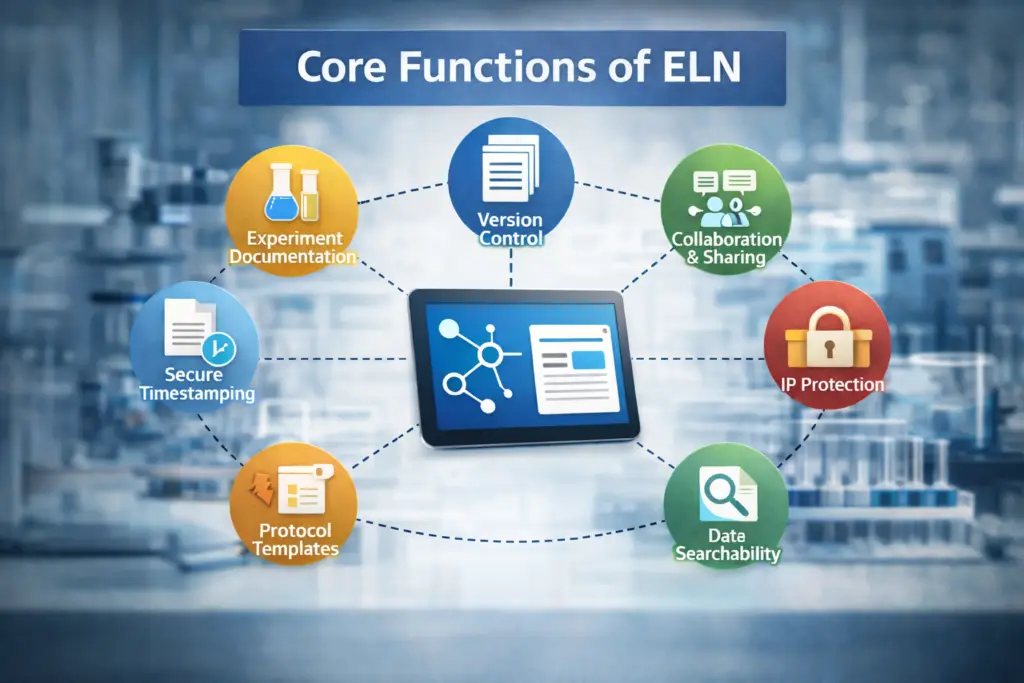
Typical ELN capabilities:
- Experiment entries with protocols, observations, results and conclusions
- Templates for recurring experiment types
- Attachments and embedded data (instrument files, images, spreadsheets)
- Domain tools: chemical structure drawing, sequence and plasmid editing
- Collaboration, sharing and witnessing/sign-off
- Time-stamped records and version history
- Full-text search across the lab’s experimental history
Where ELN dominates: discovery research, academic labs, process development and early-stage R&D, where the workflow changes from one experiment to the next.
The defining trait of a good ELN is structured flexibility: enough structure that data is findable and comparable later, without forcing scientists into a fixed sequence that does not match how research works. For the academic end of the market, see our comparison of the best ELNs for academic and research labs; for chemistry-heavy teams, our drug discovery ELN guide.
ELN vs LIMS at a glance
| LIMS | ELN | |
|---|---|---|
| Unit of work | Sample | Experiment |
| Core question it answers | “What happened to this sample, and is the result valid?” | “What did we do, why, and what did we learn?” |
| Workflow | Predefined, enforced | Flexible, author-driven |
| Typical users | Technicians, analysts, QA reviewers | Research scientists, principal investigators |
| Typical data | Structured results against specifications | Mixed: text, images, files, structured tables |
| Primary compliance driver | GxP, ISO/IEC 17025, 21 CFR Part 11 | IP protection, reproducibility, and GxP when used in regulated development |
| Implementation | Months, configuration-heavy | Weeks to months, lighter configuration |
| Pricing pattern | Opaque, often quote-based | More transparent, frequent free/academic tiers |
Compliance: both can be compliant, for different reasons
It is a common misconception that LIMS is “the compliant one” and ELN is “the flexible one”. Both system types can meet regulatory requirements; what differs is why compliance matters to the typical user.
In a LIMS, compliance is the product. In GMP QC or accredited testing, results feed release decisions and client reports, so the system is expected to be validated and to meet the controls described in FDA’s 21 CFR Part 11: validation, access control, secure computer-generated time-stamped audit trails, operational and authority checks (§11.10), signature manifestations showing the signer’s name, date/time and meaning (§11.50), and signatures linked to their records (§11.70).
In an ELN, compliance historically centered on intellectual property. Notebook records support inventorship and priority questions. The United States moved to a first-inventor-to-file system under the America Invents Act on 16 March 2013, which reduced the role of notebooks without eliminating it: records still matter for derivation proceedings, prior user rights and proving inventorship. Some IP practitioners also caution that electronic records can face more scrutiny in litigation than paper notebooks, so audit trails, time-stamping and signature controls in the ELN matter. When an ELN is used in regulated development (for example GLP studies or process development feeding a GMP filing), the same Part 11 and data integrity expectations apply as for a LIMS.
Two practical consequences for buyers:
- Ask what is validated, not whether the vendor is “compliant”. A vendor can provide a validation package and Part 11-ready features; validating the configured system for your intended use remains your responsibility, typically following a risk-based approach such as ISPE’s GAMP 5 (Second Edition).
- Check how the system supports data integrity principles. Our guides to ALCOA+ and to the EU GMP Annex 11 revision cover what inspectors now expect from computerised systems, whichever type you choose.
Cost and implementation: the gap is real
The two markets price very differently.
- ELN: our ELN pricing benchmark found entry-level commercial plans starting around $12–30 per user per month, with open-source options such as eLabFTW costing nothing to licence, and frequent academic/commercial price splits.
- LIMS: our LIMS pricing benchmark found cloud subscriptions clustering between roughly $40 and $300 per user per month, and perpetual on-premise licences starting around $20,000–$50,000 before maintenance.
Implementation follows the same pattern. A LIMS must be configured around your sample types, tests, specifications, instruments and reports; our LIMS implementation timeline guide documents projects ranging from about 6 weeks to 12 months or more. An ELN can often be rolled out to a research team much faster, because it imposes less structure up front. A regulated ELN deployment with validation, however, brings timelines closer to those of a LIMS.
The trade-off: the cheaper, faster ELN is not a budget LIMS. Labs that try to run sample-driven testing in an ELN usually end up rebuilding chain of custody and approvals in templates and spreadsheets, which is where many LIMS projects start.
Hybrid ELN-LIMS platforms: what they solve and what to check
A growing share of the market sells ELN and LIMS capabilities in a single platform. Among the products we have reviewed:
- R&D-first platforms adding LIMS capabilities: Benchling, Labguru, Genemod, SciSure (which also adds EHS).
- LIMS-first or unified platforms covering ELN use cases: Sapio Sciences, Scispot, SciCord (focused on pharma and biopharma), Agilent SLIMS.
- Data-centric platforms combining SDMS, ELN and lab management: Waters NuGenesis.
What a hybrid solves: one data model from experiment to sample, no integration to build and maintain between two systems, a single vendor to validate and a single user experience.
What to check before choosing one:
- Which side came first. Most hybrids started as either an ELN or a LIMS. Test the side that is not their origin with your own workflows, not the demo script.
- Depth of the LIMS side. Look for specifications, stability studies, instrument calibration, batch release and chain of custody if you run regulated testing. These are often where R&D-first platforms are thinnest.
- Flexibility of the ELN side. Ask scientists to document a real, messy experiment during the trial. LIMS-first platforms often feel rigid here.
- Lock-in. One platform means one exit. Check data export formats and contract terms before signing; our comparison of Benchling and Genemod shows how much two “unified” platforms can differ.
Which one does your lab need?
Choose a LIMS if most of these apply:
- You receive, register and test samples against defined methods and specifications
- Results go to a customer, a regulator or a batch release decision
- You operate under GMP, ISO/IEC 17025, CLIA or similar accreditation
- Throughput and turnaround time are key performance measures
Choose an ELN if most of these apply:
- Your work changes from one experiment to the next
- The main output is knowledge, data for publication, or an IP position
- Scientists need to collaborate on and search past experiments
- You are in discovery, academic or early development work
Consider both, or a hybrid, if:
- Research hands samples to an internal testing or QC group
- You are a growing biotech moving from discovery toward regulated development
- Your team spends time re-keying data between notebooks and sample tracking
Still unsure? Our two buyer checklists, how to choose a LIMS and how to choose an ELN list the questions to put to every vendor. If you are still on Excel, start with spreadsheets vs LIMS.
Frequently asked questions
Can an ELN replace a LIMS?
For a small research lab tracking a modest number of samples, sometimes. For regulated or high-volume testing, no: ELNs generally lack enforced workflows, specifications and release approvals. Some hybrid platforms cover both, but test the LIMS side carefully.
Can a LIMS replace an ELN?
Rarely well. A LIMS can store results, but it is not designed to capture the reasoning, iterations and unstructured observations of research work.
Is a LIMS always more expensive than an ELN?
Usually, both in licence and implementation cost. Open-source and free academic ELN tiers widen the gap, while simple cloud LIMS for small testing labs narrow it.
Do I need 21 CFR Part 11 compliance for an ELN?
Only if the ELN holds records required by FDA regulations, for example in GLP, GMP or clinical contexts. A purely academic research ELN is typically driven by IP, reproducibility and funder data policies instead.
Should a startup biotech buy an ELN or a LIMS first?
Most discovery-stage biotechs start with an ELN, then add LIMS capabilities as sample volumes grow and regulated work approaches. Choosing a platform that can extend in that direction avoids a disruptive migration later. See our LIMS for biotech guide.
The bottom line
The ELN vs LIMS question is less about software categories than about how your lab creates value. Sample-driven labs need the enforced structure of a LIMS; experiment-driven labs need the flexibility of an ELN. Hybrid platforms are a genuine option for organizations that do both, provided you test the side the vendor did not start with. Whatever you choose, judge vendors on your own workflows and data, not on the label on their website.
This article is independent editorial content. No vendor paid for inclusion or placement. Read how we review lab software.
Sources
- U.S. eCFR, 21 CFR Part 11, Electronic Records; Electronic Signatures: https://www.ecfr.gov/current/title-21/chapter-I/subchapter-A/part-11
- U.S. FDA, Part 11, Electronic Records; Electronic Signatures, Scope and Application (guidance): https://www.fda.gov/regulatory-information/search-fda-guidance-documents/part-11-electronic-records-electronic-signatures-scope-and-application
- U.S. FDA, Data Integrity and Compliance With Drug CGMP: Questions and Answers (guidance): https://www.fda.gov/regulatory-information/search-fda-guidance-documents/data-integrity-and-compliance-drug-cgmp-questions-and-answers
- ASTM International, E1578-18, Standard Guide for Laboratory Informatics: https://store.astm.org/e1578-18.html
- ISPE, GAMP® 5: A Risk-Based Approach to Compliant GxP Computerized Systems (Second Edition): https://ispe.org/publications/guidance-documents/gamp-5-guide-2nd-edition
- USPTO, America Invents Act (AIA) Frequently Asked Questions: https://www.uspto.gov/patents/laws/america-invents-act-aia/america-invents-act-aia-frequently-asked
- Palovich, T. U., Electronic Notebooks in the Post-America Invents Act World, ACS Medicinal Chemistry Letters (2014): https://pmc.ncbi.nlm.nih.gov/articles/PMC4265811/
- Finnegan, Don’t Throw Away Lab Notebooks: Record-Keeping Under AIA: https://www.finnegan.com/en/insights/articles/don-t-throw-away-lab-notebooks-record-keeping-under-aia.html
- Lab Software Guide, ELN Pricing Benchmark 2026; LIMS Pricing Benchmark 2026; LIMS Implementation Timeline (linked above)