Quick verdict: Validating a LIMS means producing documented evidence that your configured system, as your lab uses it, does what it is supposed to do and protects the integrity of your data. It is required wherever the LIMS holds regulated records: GMP, GLP, clinical or ISO/IEC 17025-accredited testing. The vendor can make it much easier, but cannot do it for you. The modern expectation is not more paperwork: regulators and industry guidance (GAMP 5 Second Edition, FDA’s Computer Software Assurance guidance) push towards risk-based effort: deep testing where errors would affect product quality, patient safety or reported results, and lighter assurance everywhere else.
What LIMS validation is, and what it is not
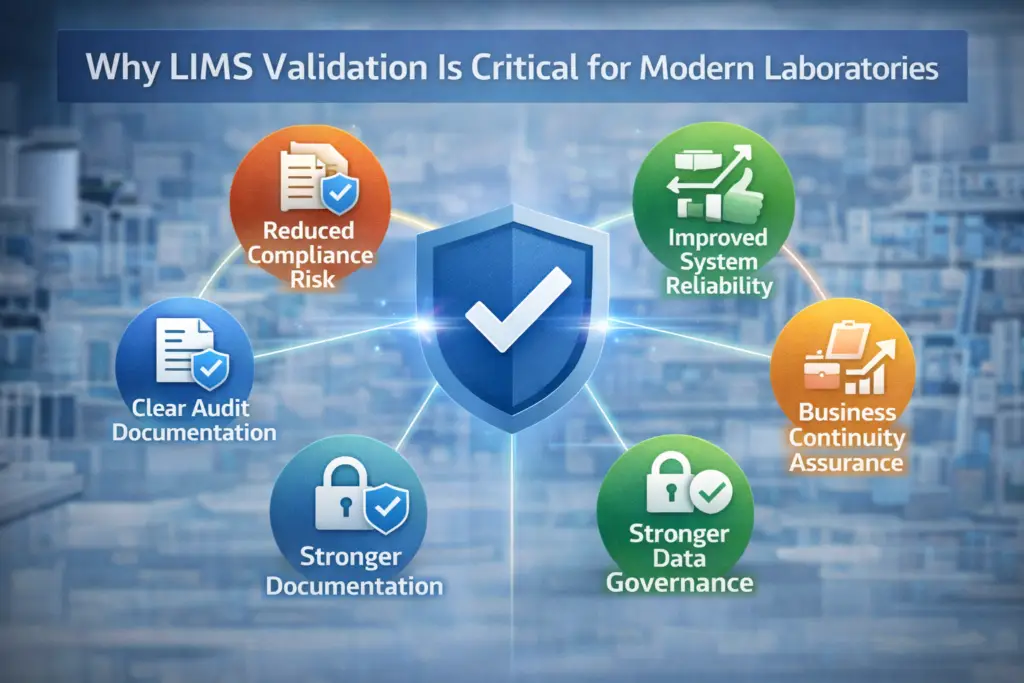
Validation answers one question: is this system fit for its intended use in this lab? Three consequences follow, and they are where most misunderstandings start.
- A “validated LIMS” does not exist off the shelf. Vendors sell validatable products, often with validation packages and test evidence. Validation applies to the system as configured, integrated and operated by you. A LIMS validated at another company is not validated at yours.
- Validation is not a one-off project. It starts with requirements, continues through testing and release, and lasts for the life of the system through change control and periodic review.
- Validation is not only testing. Supplier assessment, risk assessment, data migration checks, procedures, training and audit trail review are all part of the evidence an inspector or assessor will expect.
Terminology varies: pharma traditionally says computerized system validation (CSV), device manufacturers increasingly say computer software assurance (CSA), and ISO/IEC 17025 simply requires the system to be “validated for functionality”. The underlying idea is the same.
Which rules require it
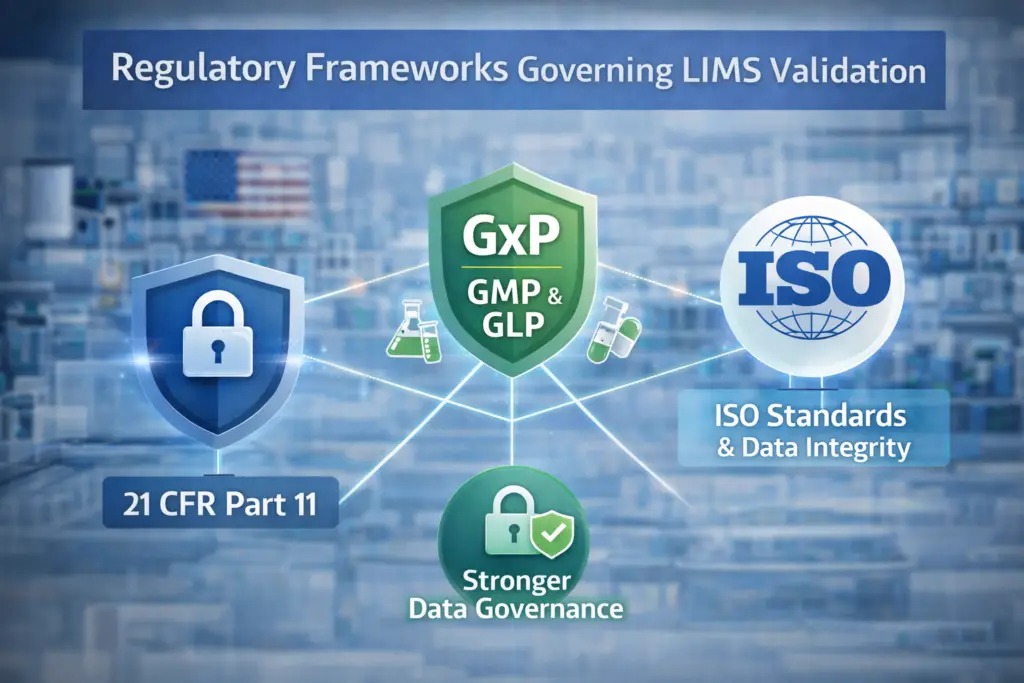
| Framework | Applies to | What it requires of a LIMS |
|---|---|---|
| FDA 21 CFR Part 11 | Electronic records required by FDA regulations | §11.10(a): validation of systems to ensure accuracy, reliability, consistent intended performance and the ability to discern invalid or altered records; plus audit trails, access and authority checks |
| FDA Data Integrity Q&A (2018) | Drug CGMP | Expects validated systems, controlled access and review of audit trails for critical data |
| EU GMP Annex 11 (revision drafted July 2025) | EU GMP manufacturers | Treats computerised systems as GMP-controlled assets: risk-based validation, supplier contracts, audit trail review, periodic review, cybersecurity |
| MHRA GxP Data Integrity Guidance (2018) | UK GxP organizations | Systems validated for intended purpose; oversight of IT and cloud service providers |
| ISO/IEC 17025:2017, clause 7.11 | Accredited testing and calibration labs | Information management systems “validated for functionality”; configuration changes authorized and validated before use; external providers checked |
| FDA CSA guidance (final Sept 2025, revised Feb 2026) | Medical device production and quality management system software | Risk-based assurance proportionate to process risk; less scripted testing for lower-risk functions |
Two nuances worth stating plainly:
- CSA is formally a device guidance. It applies to software used in medical device production and quality systems. Pharmaceutical and biotech QC labs are not bound by it, but its risk-based logic is consistent with GAMP 5 Second Edition, and many GxP organizations now apply the same thinking.
- The revised Annex 11 was still a draft when this guide was updated. The direction is clear even before the final text; see our Annex 11 revision tracker for the current status and changes.
For the underlying record-keeping rules, see our guides to 21 CFR Part 11, ALCOA+ and ISO 17025 and LIMS.
The risk-based approach in practice
The most widely used framework is ISPE’s GAMP 5, whose Second Edition (2022) puts critical thinking at the centre: subject-matter experts decide where assurance effort is needed, instead of applying the same depth of testing everywhere.
Start by classifying what you are validating. GAMP 5 describes software categories, now used as one input among others in the risk assessment:
- Category 3, non-configured products: used as supplied.
- Category 4, configured products: most commercial LIMS fall here. Workflows, specifications, user roles and reports are configured, not coded.
- Category 5, custom applications: bespoke code. Many LIMS deployments include Category 5 elements (custom scripts, calculations, interfaces or report templates), and these deserve the most scrutiny.
Then assess risk function by function. For each requirement, ask what happens if it fails: could a wrong result be reported, a batch released, a sample misidentified, or a record altered without trace? High-impact functions such as result calculations, specification checks, approvals and e-signatures, audit trails, instrument interfaces and certificate of analysis generation get detailed, documented testing. Low-impact functions such as cosmetic screens or convenience features can rely on vendor testing and lighter verification.
Leverage the supplier. Both GAMP 5 and CSA encourage using supplier documentation and test evidence rather than repeating work, provided you have assessed the supplier’s quality system. That assessment is itself part of your validation file.
The validation lifecycle, step by step
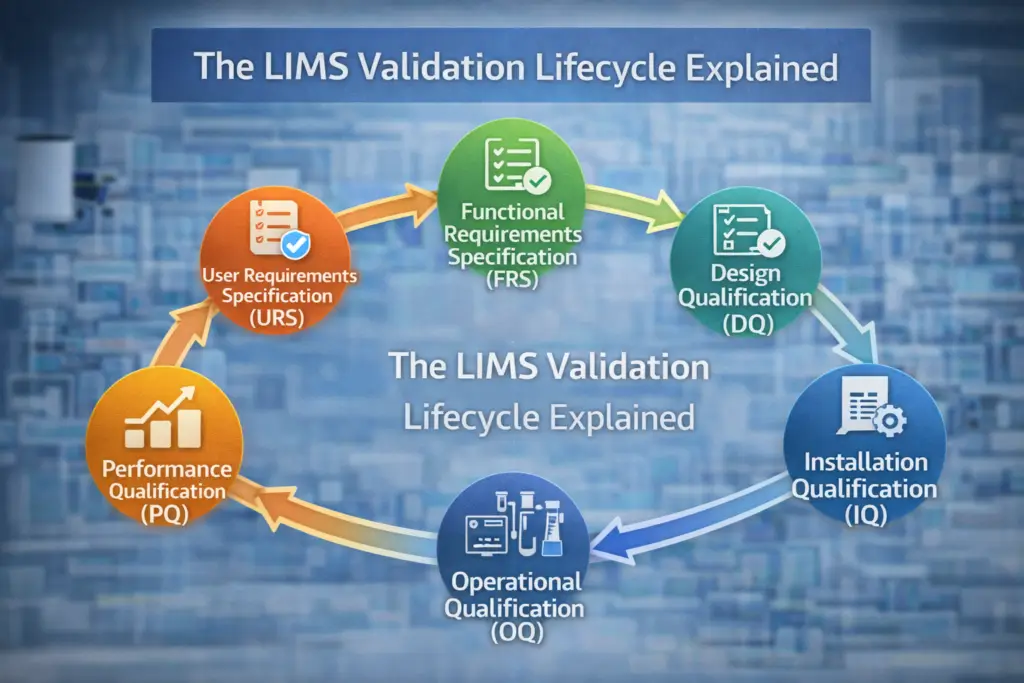
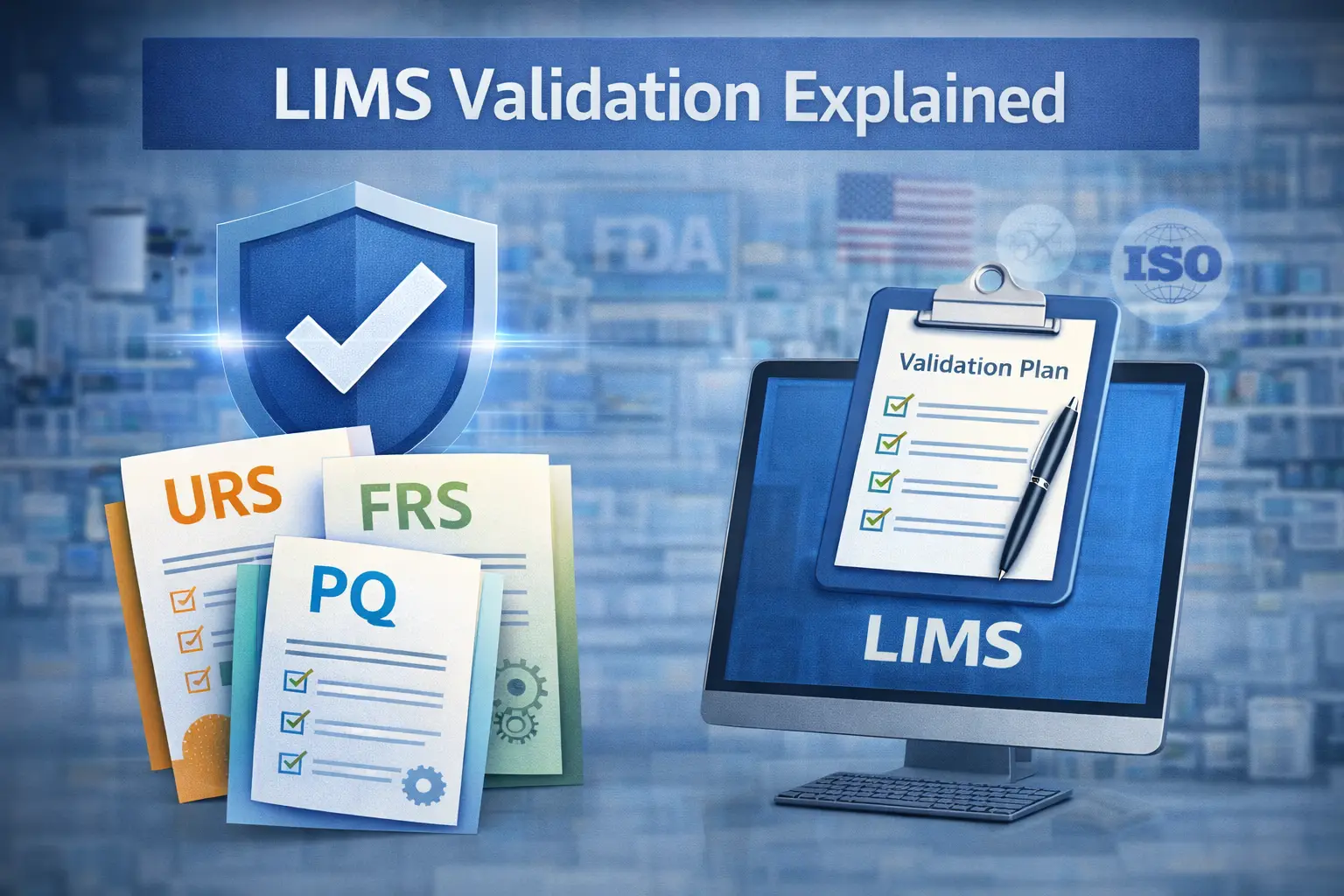
- Validation plan. Scope, system boundaries, roles and responsibilities, deliverables, acceptance criteria and the risk-based strategy you will follow.
- User requirements specification (URS). What the lab needs: sample types and workflows, specifications, calculations, reports, integrations, security, data retention. Each requirement should be testable and ranked by criticality.
- Supplier assessment. Questionnaire or audit of the vendor’s development, testing, release and support processes. For SaaS, include hosting, backup, security and change notification.
- Risk assessment. Function-level risk ranking that decides how much testing each requirement gets.
- Configuration and design specifications. What was configured and how. This is the reference for testing and for future change control.
- Testing. Installation checks, then functional and user acceptance testing. Detailed scripted tests for high-risk functions; unscripted or exploratory testing where risk is low. Test with realistic data and real users.
- Data migration verification. If you migrate legacy data, verify completeness and accuracy with a documented, risk-based sampling approach. This step is frequently underestimated (see how to migrate to a new LIMS).
- Traceability matrix. Links every requirement to its risk level and to the test evidence that covers it.
- Validation summary report and release. Deviations, their resolution, and formal approval to use the system.
- Operation. Procedures and training, change control for every update or configuration change, audit trail review, and periodic review to confirm the system is still in a validated state.
Classic IQ/OQ/PQ terminology still appears in many validation plans and remains acceptable; what matters is that the evidence is proportionate to risk and traceable to requirements.
Cloud and SaaS LIMS: what changes
A cloud LIMS does not remove validation, it redistributes responsibility.
- The vendor controls infrastructure and releases. Your supplier assessment and quality agreement must cover hosting, security, backups, disaster recovery and data location.
- Updates arrive on the vendor’s schedule. Agree on release notes, advance notice and a test or sandbox environment so you can assess each release under change control, focusing regression testing on your high-risk functions.
- Contracts become compliance documents. ISO/IEC 17025 requires labs to check that external system providers meet applicable requirements, and the draft Annex 11 revision specifies elements that supplier agreements should contain.
- Exit matters. Validation includes being able to retrieve complete, readable records, including audit trails and metadata, if you leave the vendor.
If you are still choosing a deployment model, our LIMS pricing benchmark and how to choose a LIMS checklist cover the commercial side.
Common mistakes (and how to avoid them)
- Validating the demo, not your configuration. Test the workflows, calculations and reports your lab will actually use.
- Testing everything to the same depth. Over-documenting low-risk screens consumes the time that should go into calculations, interfaces and approvals.
- Ignoring the edges. Custom reports, instrument interfaces and data exports are where errors hide, and they are often Category 5 elements.
- Treating migration as an IT task. Migrated results are regulated records; their accuracy needs documented verification.
- No trigger for revalidation. Define in advance which changes require impact assessment and testing, especially for SaaS releases.
- Audit trails that nobody reviews. Recording changes is not enough; regulators expect risk-based review of audit trails for critical data.
- Relying entirely on the vendor package. It is a valuable input, not your validation.
What to ask vendors about validation
- What validation package do you provide, and what test evidence does it include?
- Can we audit your development and quality processes, and on what terms?
- How do you notify customers of releases, and do we get a validation or sandbox environment?
- Which of our planned configurations would count as custom code or scripting?
- How are audit trails, e-signatures and user roles configured and exported?
- How do we retrieve complete records, with audit trails, if we terminate the contract?
Validation effort is a large part of implementation time: our LIMS implementation timeline guide shows how regulated projects extend schedules, and our pharmaceutical QC LIMS guide compares how much validation support vendors offer.
Frequently asked questions
Is LIMS validation required for every lab?
It is required when the LIMS holds records subject to GxP regulations or supports ISO/IEC 17025-accredited results. A non-regulated research lab has no legal obligation, although verifying calculations and data transfers remains good practice.
Can the vendor validate the LIMS for us?
The vendor can provide documentation, test evidence and services that reduce your effort. Responsibility for validating the system for your intended use stays with your organization.
Is a cloud LIMS easier to validate?
It removes infrastructure qualification from your scope, but adds supplier oversight and the need to assess frequent vendor releases.
Does CSA replace CSV for pharma labs?
Not formally. FDA’s CSA guidance covers medical device production and quality system software. Its risk-based principles align with GAMP 5 Second Edition, which pharma and biotech organizations widely use.
How often should a validated LIMS be reviewed?
There is no universal interval. Set a risk-based periodic review frequency in your procedures (higher for systems with critical GMP data) and assess every change under change control in between.
The bottom line
LIMS validation is a risk-based discipline that proves your configured system works for its intended use and keeps proving it as the system changes. Put your effort where errors would matter, use your supplier’s evidence where you have assessed it, and treat change control, audit trail review and periodic review as part of running the system, rather than as paperwork after go-live.
This article is independent editorial content and does not replace regulatory advice for your specific context. No vendor paid for inclusion. Read how we review lab software.
Sources
- U.S. eCFR, 21 CFR Part 11, Electronic Records; Electronic Signatures: https://www.ecfr.gov/current/title-21/chapter-I/subchapter-A/part-11
- U.S. FDA, Data Integrity and Compliance With Drug CGMP: Questions and Answers (guidance, 2018): https://www.fda.gov/regulatory-information/search-fda-guidance-documents/data-integrity-and-compliance-drug-cgmp-questions-and-answers
- U.S. FDA, Computer Software Assurance for Production and Quality Management System Software (final guidance, February 2026): https://www.fda.gov/regulatory-information/search-fda-guidance-documents/computer-software-assurance-production-and-quality-management-system-software
- Federal Register, Computer Software Assurance for Production and Quality System Software; availability (24 September 2025): https://www.federalregister.gov/documents/2025/09/24/2025-18468/computer-software-assurance-for-production-and-quality-system-software-guidance-for-industry-and
- ISPE, GAMP® 5: A Risk-Based Approach to Compliant GxP Computerized Systems (Second Edition): https://ispe.org/publications/guidance-documents/gamp-5-guide-2nd-edition
- ISPE Pharmaceutical Engineering, What You Need to Know About GAMP® 5 Guide, 2nd Edition: https://ispe.org/pharmaceutical-engineering/january-february-2023/what-you-need-know-about-gampr-5-guide-2nd-edition
- MHRA, GXP Data Integrity Guidance and Definitions, Revision 1 (March 2018): https://assets.publishing.service.gov.uk/media/5aa2b9ede5274a3e391e37f3/MHRA_GxP_data_integrity_guide_March_edited_Final.pdf
- ECA Academy, EU GMP Annex 11 (Draft 2025): Computerised Systems: https://www.gmp-compliance.org/guidelines/gmp-guideline/eu-gmp-annex-11-draft-2025-computerised-systems
- ISO/IEC 17025:2017, clause 7.11, requirements summary: https://17025store.com/iso-iec-17025-2017-requirements/clause-7-process-requirements/