Quick verdict: Paper lab notebooks are still legally acceptable, including in regulated work, and they remain easy to use, cheap and hard to tamper with invisibly. Their limits appear as soon as a lab needs to find, share, reuse or protect its data at scale: records cannot be searched, instrument data lives in folders disconnected from the notebook, and a lost or damaged book cannot be restored. An electronic lab notebook (ELN) solves those problems, but introduces software costs, adoption effort and dependence on a system. For most research groups beyond a handful of people, switching is worth it. The part that decides success is the transition itself: a clear master record, workable devices at the bench, and firm rules for the paper-electronic overlap.
Paper is not obsolete, and regulations do not ban it
No major laboratory regulation requires electronic records. FDA’s GLP regulations, for example, describe how paper entries should be made: data recorded promptly and legibly in ink, each entry dated and signed or initialled, and changes made without obscuring the original entry, with the reason and the date (21 CFR 58.130(e)). A well-kept paper notebook that follows those rules is a valid record.
Paper also has practical strengths that are easy to underestimate:
- it works instantly, needs no login, battery or network;
- it is familiar to every scientist, so there is no training cost;
- alterations are visible, which matters for records used as evidence;
- it costs almost nothing to start.
A user study published in the Journal of Cheminformatics in 2017 (Kanza et al.) found that these qualities, together with the lack of suitable devices at the bench, were central to why many researchers kept using paper. Tools have improved since, but the findings still describe the objections labs raise today.
Where paper breaks down
The problems with paper are rarely about a single notebook. They appear across a group, over years.
- Nothing is searchable. Finding a protocol variant or a result from two years ago means knowing who wrote it and in which book.
- Data and notes are separated. Instrument files, images and spreadsheets live on drives or USB sticks, linked to the notebook only by a handwritten reference.
- Knowledge leaves with people. When a postdoc or technician moves on, their notebooks stay on a shelf that few people consult.
- There is no backup. Water, fire, loss or simple wear can destroy records permanently.
- Legibility and completeness vary. Handwriting, missing units and undated pages weaken reproducibility and review.
- Collaboration is slow. Review, witnessing and sharing with other sites require physical access or scanning.
- Data policies are harder to meet. Funders and institutions increasingly expect research data to be managed so it can be found and reused, in line with FAIR principles, which paper supports poorly.
What an ELN changes
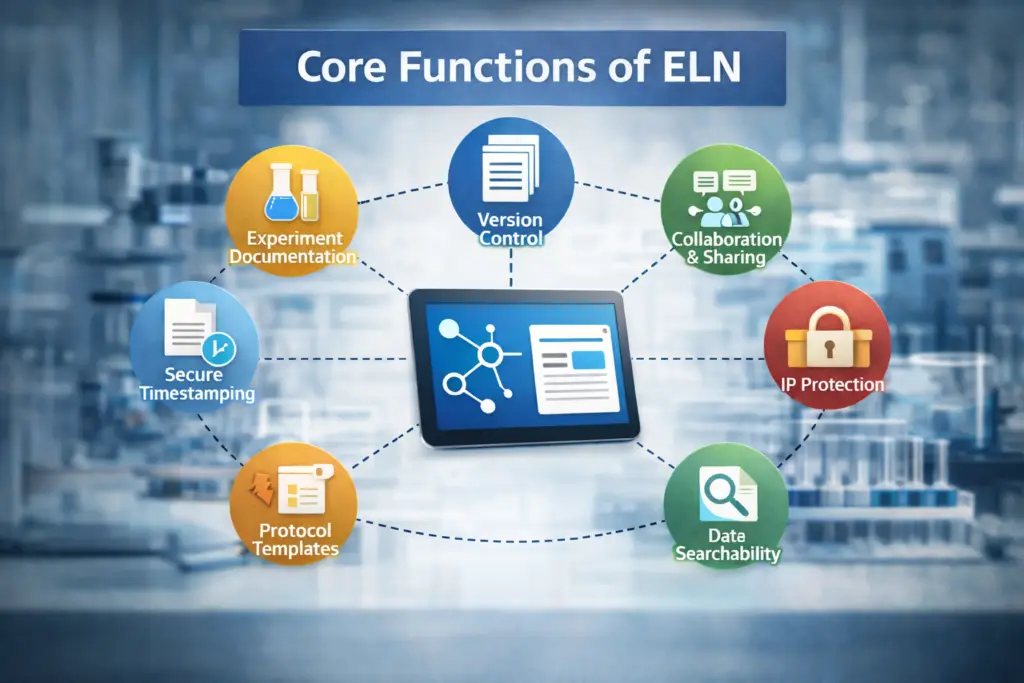
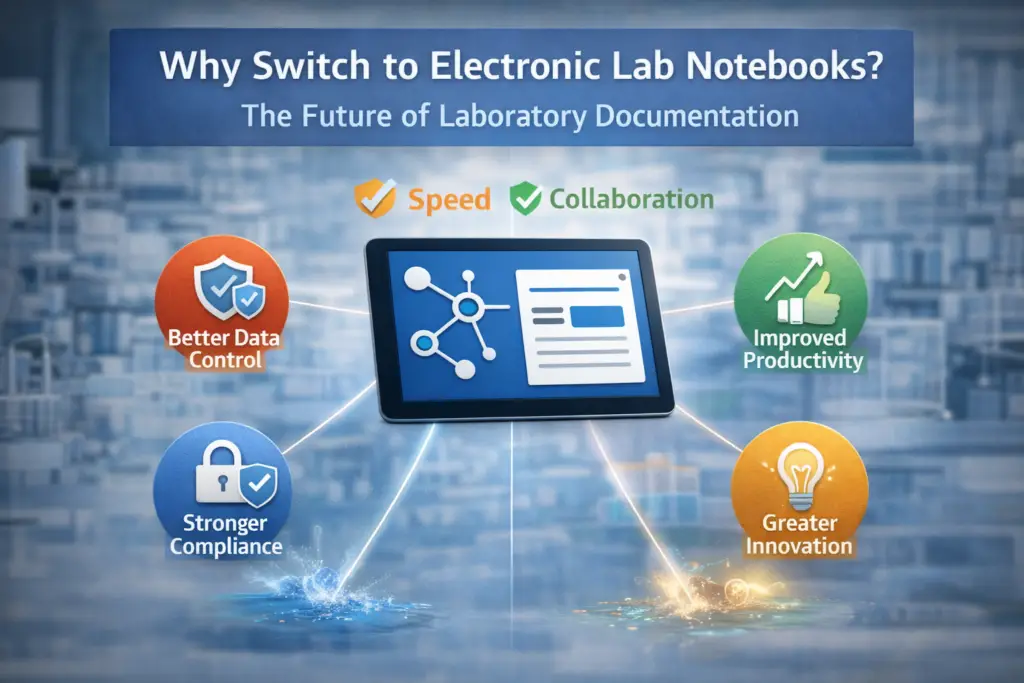
An ELN keeps the notebook’s role, a chronological record of what was done and why, and adds:
- full-text search across all experiments and authors;
- templates for recurring protocols, so entries are more complete and comparable;
- attached raw data, images and files next to the entry that describes them;
- automatic time stamps, version history and audit trails;
- electronic signatures and review workflows, including witnessing;
- backups and access from any authorized location;
- links to inventory, sample tracking or a LIMS.
It also brings costs and risks that paper does not have: licences or hosting, time to configure templates and train users, dependence on a vendor or on internal IT, and the need to export records in usable formats if you change system. Our ELN pricing benchmark shows that entry-level commercial plans are relatively affordable and that free academic tiers and open-source options exist, so licence cost is rarely the main obstacle today. Adoption usually is.
Compliance and evidence: how the two compare
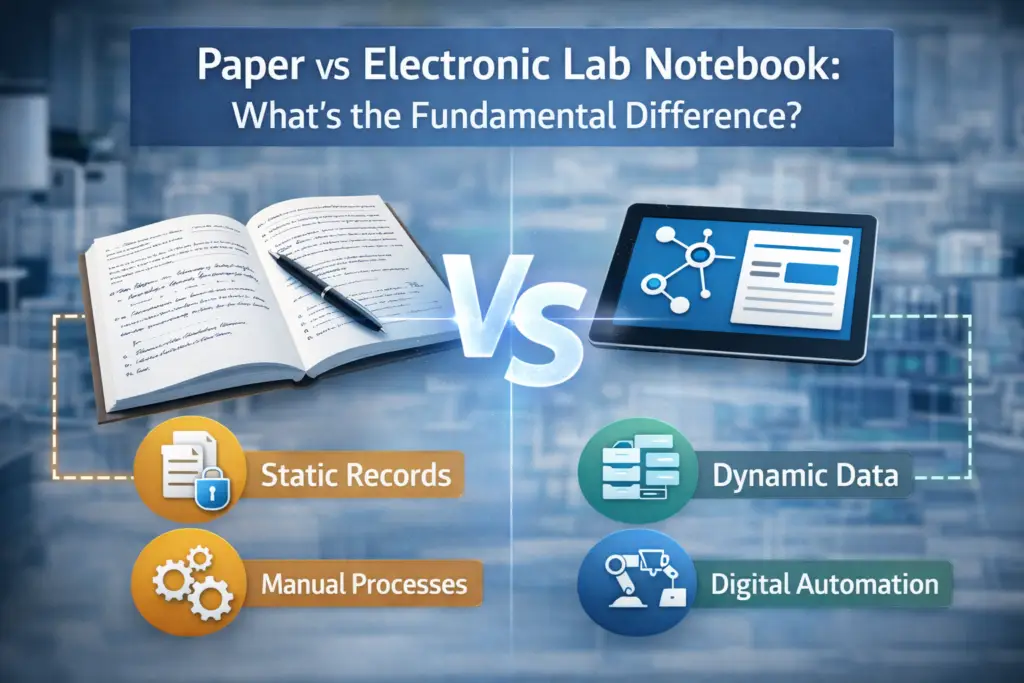
| Paper notebook | Electronic lab notebook | |
|---|---|---|
| Attribution | Handwritten name, initials, signature | User account, logged automatically |
| Dating | Written by the author | System time stamp |
| Changes | Single strike-through, reason, date, initials | Audit trail with old and new values, user, time, reason |
| Signatures and witnessing | Wet ink, needs physical access | Electronic signatures; for FDA-regulated records, controls under 21 CFR Part 11 |
| Backup | None unless scanned | Automatic, depending on hosting |
| Main weakness | Loss, illegibility, no search | Weak configuration, shared accounts, poor export at exit |
On intellectual property, the picture is more nuanced than vendors suggest. Since the US moved to first-inventor-to-file in 2013, notebooks matter less for priority, but they still support inventorship, derivation disputes and prior user rights. Some IP practitioners, such as Palovich writing in ACS Medicinal Chemistry Letters (2014), have argued that paper can be easier to defend in court because judges and juries understand it and tampering is visible. An ELN can provide strong evidence, but only if audit trails, time stamps, signatures and access controls are properly configured. See ELN vs LIMS for the IP context and our ELN compliance guide for the controls that make electronic records credible.
Why switches fail, and how to avoid it
Most ELN projects that stall do so for practical reasons, not because of the software’s features.
- No usable device at the bench. If scientists must walk to an office to write, they will take notes on paper and transcribe later. Plan tablets or bench computers, and check glove and chemical compatibility.
- Templates that do not match the work. Rigid templates push users back to free text or paper. Build them with the people who run the experiments.
- An endless hybrid period. When both paper and ELN are allowed indefinitely, nobody knows where the record is.
- Treating it as an IT project. Adoption depends on group leaders using the ELN themselves and reviewing work in it.
- Choosing without a trial. Ease of use at the bench is the deciding factor, and it can only be judged by real users on real experiments.
A practical transition plan
- Define the need. Which groups, which record types, regulated or not, and which instruments and systems to connect. Our how to choose an ELN checklist helps structure this.
- Shortlist and trial. Test two or three ELNs with a pilot group for several weeks on real work. For academic groups, see the best ELNs for academic labs; for self-hosting, the open-source ELN guide; for hosting choices, cloud vs on-premise ELN.
- Prepare the bench. Devices, network access, instrument file transfer and templates for the most common protocols.
- Write the rules. Where the official record lives, how entries are signed and reviewed, naming conventions, and what happens to paper during the transition.
- Set a cut-over date. From that date, new experiments start in the ELN. Keep a short, defined overlap for experiments already in progress.
- Decide what to do with legacy notebooks. Usually: archive them securely with an index, and scan only the notebooks still in active use. If a scan is meant to replace the original in a regulated context, it must be a verified true copy, meaning a copy checked and signed as containing the same information, context and structure as the original.
- Review after three months. Check entry completeness, template use and remaining paper use, then adjust.
Frequently asked questions
Are paper lab notebooks still legally valid?
Yes. Regulations such as FDA’s GLP rules describe how paper entries must be made, and paper remains acceptable when those rules are followed.
Is an ELN better for patents?
It can be, if audit trails, time stamps and signatures are properly configured. Some IP practitioners still consider paper easier to present as evidence, so organizations with high patent exposure should involve their IP counsel when choosing and configuring an ELN.
Can we scan our old notebooks and throw them away?
Only if your regulatory and institutional retention rules allow it and the scans qualify as verified true copies. In most research settings, archiving the originals and scanning selectively is the safer choice.
How long does a switch take?
For a research group, a pilot and roll-out can take a few months. Regulated deployments take longer because the ELN must be validated.
What if our scientists refuse to use it?
Resistance usually points to a practical problem: no device at the bench, poor templates or slow performance. Fix those before pushing adoption.
The bottom line
Paper notebooks are a legitimate record and still work for very small groups. Beyond that, their weaknesses in search, data linkage, backup and collaboration cost more than an ELN does. The decision to switch is usually easy to justify; the transition is where labs succeed or fail. Put devices at the bench, build templates with users, define the master record and end the hybrid period on a set date.
This article is independent editorial content. No vendor paid for inclusion. Read how we review lab software.
Sources
- U.S. eCFR, 21 CFR 58.130, Conduct of a nonclinical laboratory study: https://www.ecfr.gov/current/title-21/chapter-I/subchapter-A/part-58/subpart-E/section-58.130
- U.S. eCFR, 21 CFR Part 11, Electronic Records; Electronic Signatures: https://www.ecfr.gov/current/title-21/chapter-I/subchapter-A/part-11
- Kanza, S. et al., Electronic lab notebooks: can they replace paper?, Journal of Cheminformatics (2017): https://jcheminf.biomedcentral.com/articles/10.1186/s13321-017-0221-3
- Palovich, T. U., Electronic Notebooks in the Post-America Invents Act World, ACS Medicinal Chemistry Letters (2014): https://pmc.ncbi.nlm.nih.gov/articles/PMC4265811/
- USPTO, America Invents Act (AIA) Frequently Asked Questions: https://www.uspto.gov/patents/laws/america-invents-act-aia/america-invents-act-aia-frequently-asked
- MHRA, GXP Data Integrity Guidance and Definitions, Revision 1 (March 2018): https://assets.publishing.service.gov.uk/media/5aa2b9ede5274a3e391e37f3/MHRA_GxP_data_integrity_guide_March_edited_Final.pdf
- Max Planck Digital Library, Electronic Laboratory Notebooks: https://rdm.mpdl.mpg.de/during-research/electronic-laboratory-notebooks-eln/