| This best lims guide reviews 7 LIMS platforms based on independently verified information from vendor documentation, product release notes, user reviews on G2 and Capterra, and industry sources. No vendor has paid for inclusion or editorial positioning. Pricing is not included — published rates vary by configuration, region, and contract. Always contact vendors for current quotes. |
What Is a LIMS — And Why Does Choosing the Right One Matter in 2026?
A Laboratory Information Management System (LIMS) is the operational backbone of a modern laboratory. It manages the complete sample lifecycle — from receipt through testing, result capture, and final reporting — while enforcing data integrity, regulatory compliance, and traceability across every step.
In 2026, the LIMS market spans an unusually wide range of platforms: from decades-old enterprise systems deployed across global pharmaceutical networks, to cloud-native tools that went from zero to a major market position in under five years. Choosing the wrong LIMS — or the right LIMS for the wrong context — is one of the most expensive mistakes a laboratory organization can make. Implementations in regulated environments are measured in months and cost hundreds of thousands of dollars before the first sample is tracked.
This guide helps you cut through the noise. We cover 7 platforms with verified, sourced data organized by what they actually do well — and who they are actually designed for. Don’t hesitate to have a look at our complete Lims guide for additional information.
| Quick navigation: Each vendor review includes a verified spec card, an independent assessment, clear strengths and limitations, and a direct ‘best for’ recommendation. Skip to any vendor using the headings or jump to the comparison tables at the end. |
7 LIMS Platforms at a Glance: 2026 Independent Overview
The table below summarizes the 7 platforms reviewed in this guide. Pricing is not included — see each vendor review for pricing guidance. Deployment and industry data is sourced from official vendor documentation.
| LIMS Platform | Vendor / Owner | Platform Scope | Deployment | Primary Industries |
|---|---|---|---|---|
| LabWare LIMS | LabWare (private) | Enterprise LIMS + ELN + LES | Cloud + On-premise | Pharma, biotech, environmental, forensics, QC |
| LabVantage | LabVantage Solutions | Enterprise LIMS + ELN + LES + SDMS | Cloud (AWS) + On-premise | Pharma, biobanking, food & bev, forensics, oil & gas |
| SampleManager LIMS | Thermo Fisher Scientific | LIMS + SDMS + ELN + LES | Cloud (AWS) + On-premise | Pharma, food & bev, oil & gas, environmental, contract testing |
| STARLIMS | Francisco Partners (ex-Abbott) | LIMS + ELN + SDMS + analytics | Cloud + On-premise | Clinical, forensics, pharma, public health, environmental |
| Benchling | Benchling (private) | R&D cloud platform (LIMS + ELN) | Cloud SaaS | Biotech R&D, molecular biology, biopharma discovery |
| QBench | QBench (private) | Cloud LIMS + QMS + billing | Cloud SaaS | Testing labs: biotech, food & bev, agriculture, diagnostics |
| Clarity LIMS | Illumina | Genomics-specific LIMS | Cloud SaaS | Genomics / NGS labs, sequencing service providers |
| How to read this guide: Platform Scope refers to the breadth of modules offered beyond core LIMS (ELN = Electronic Lab Notebook, LES = Laboratory Execution System, SDMS = Scientific Data Management System). A broader scope means more consolidation potential — but also more implementation complexity and cost. |
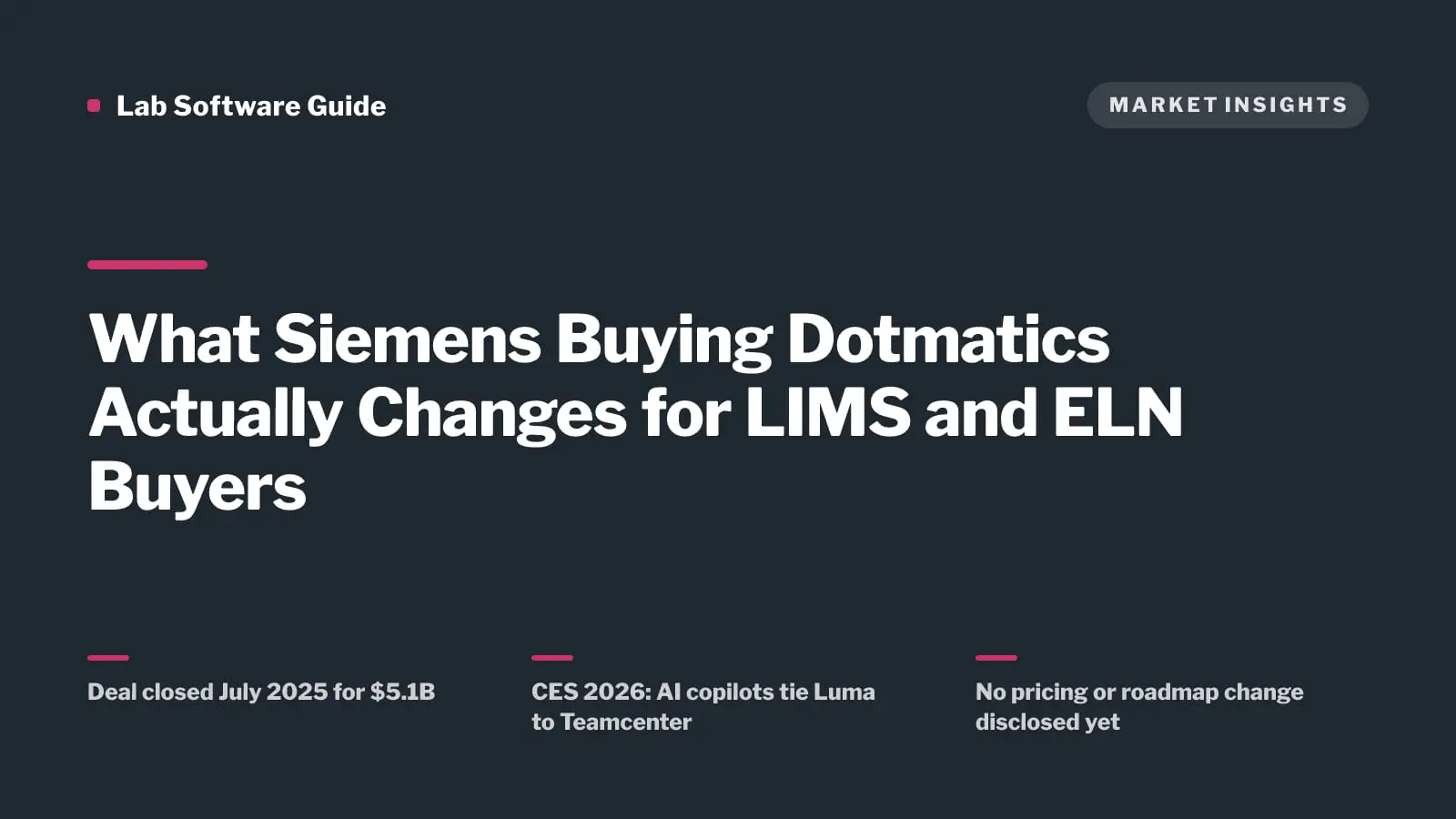
Note on STARLIMS: In 2025, Francisco Partners, a private equity firm specializing in technology businesses, announced the acquisition of STARLIMS from Abbott. STARLIMS continues to operate independently as a dedicated laboratory informatics business. The platform serves over 1,100 customers across 60 countries.
| ENTERPRISE LIMS — Large-Scale, Regulated, Multi-Site Deployments |
1. LabWare LIMS
| Vendor | LabWare (privately owned, founded 1988) |
| Platform | LabWare LIMS + ELN + LES (Enterprise Laboratory Platform) |
| Deployment | Cloud (SaaS on LabWare infrastructure) + On-premise + Hybrid |
| Customer base | 14,000 laboratories in 125 countries (per vendor) |
| SaaS portfolio | LabWare QAQC, LabWare GROW, LabWare ASSURE (launched 2025) |
| Industries | Pharma, biotech, environmental, forensics, food safety, QC manufacturing |
| Compliance | 21 CFR Part 11, EU Annex 11, ISO 17025, GLP, GMP, ALCOA+ |
| Mobile | Yes — iOS and Android app |
LabWare is among the most widely deployed enterprise LIMS platforms in the world, with a 30+ year track record in pharmaceutical, biotech, and regulated laboratory environments. It is privately owned and has remained independent through a market where most competitors have been acquired. Users frequently cite stability and longevity as key factors in their purchase decision.
The platform is organized around the LabWare Enterprise Laboratory Platform: a core LIMS at the centre, with an integrated ELN for experiment documentation and a Laboratory Execution System (LES) for guided procedure execution. This means a single LabWare implementation can replace multiple separate tools — a significant operational and compliance advantage for complex organizations.
In March 2025 at Pittcon, LabWare announced an expansion of its SaaS portfolio with three distinct offerings: LabWare QAQC for quality control workflows, LabWare GROW for growing organizations, and LabWare ASSURE for food safety and microbiology environments. These SaaS tiers are positioned as lower-friction entry points compared to the full enterprise deployment, with OpEx pricing and pre-configured best-practice workflows.
What users consistently highlight
- Depth of configurability using LabWare’s built-in scripting language — complex lab processes can be modelled without replacing the platform
- Instrument integration framework capable of handling hundreds of instrument models across analytical, QC, and chromatography environments
- Robust compliance history: widely deployed in FDA-inspected environments with validated electronic signatures and immutable audit trails
- SAP-certified integration for ERP connectivity in pharmaceutical manufacturing environments
- Multi-language support — custom fields and interfaces available in 15+ languages for global deployments
- 98% customer satisfaction rate and active European Customer Education Conference community (next edition: The Hague, June 2026)
What users consistently flag
- Implementation complexity: enterprise LabWare deployments typically require months of professional services and significant internal resource allocation
- Interface inconsistency: the UI differs between modules and is considered dated compared to modern cloud-native platforms
- Customization lock-in: the proprietary LIMS Basic scripting language means modifications often require internal expertise or vendor services
- Not the right fit for labs looking for a rapid SaaS deployment without dedicated IT and project resources
Best for: Large pharmaceutical companies, global multi-site organizations, regulated manufacturing labs, and CROs that require a deep, configurable, proven enterprise platform. The SaaS tiers (QAQC, GROW, ASSURE) extend LabWare’s reach to mid-market labs that want enterprise-grade compliance without a full custom deployment.
2. LabVantage LIMS

| Vendor | LabVantage Solutions (Somerset, NJ; 40+ years in market) |
| Platform | LIMS + ELN + LES + SDMS + Advanced Analytics |
| Current version | LabVantage 8.9 (released March 2025) |
| Deployment | Cloud SaaS (AWS) + On-premise |
| Customer base | 1,500+ customers across life sciences, pharma, food & bev, forensics, and more |
| Interface | 100% browser-based, zero-footprint (no client software required) |
| Industries | Pharma/biopharma, biobanking, food & beverage, oil & gas, forensics, contract testing |
| Compliance | 21 CFR Part 11, EU Annex 11, ALCOA+, FAIR data principles, GDPR, CLIA |
| AI | Predictive analytics, AI bots (LabVantage Open Talk), embedded AI agents in v8.9 |
LabVantage occupies a strong position in the enterprise LIMS market, combining the depth of a decades-old platform with a modern, fully browser-based architecture. Its zero-footprint deployment model — no client software, plugins, or apps required — is a genuine practical advantage in complex IT environments and for organizations with geographically distributed lab networks.
Version 8.9, released at Pittcon 2025, introduced several notable advances: database partitioning for large-dataset performance, a new customizable interface mode (‘Stellar’), AI voice command processing through the LabVantage Portal (Open Talk Interactive Experience), configuration management and transfer automation, and enhanced ELN capabilities. The CEO’s positioning of v8.9 as the foundation for ‘SaaS 2.0’ reflects the company’s trajectory toward AI-embedded, service-enriched cloud delivery.
LabVantage’s industry accelerators are a significant differentiator for organizations that want to avoid starting from scratch. Pre-configured packages are available for pharma/biopharma, biobanking, cancer research, diagnostics, contract testing, oil & gas, and food & beverage — each embedding the compliance requirements, terminology, and workflow logic specific to that sector. This reduces implementation time and professional services dependency compared to a fully custom deployment.
In March 2025, LabVantage also launched a Customer Success Services Portfolio offering structured post-deployment support: Master Data Management, Flex configuration support, Automated Testing and Validation Services, and the VantageXpert eLearning platform. The stated outcomes include 75% reduction in testing effort and 50% reduction in support ticket volume.
What users consistently highlight
- Modern, intuitive browser-based interface — consistently rated more user-friendly than comparable enterprise LIMS
- Breadth of integrated platform: LIMS, ELN, LES, SDMS, and advanced analytics available in one system
- Strong configurability without requiring programming in a proprietary language — most configuration done via GUI
- Industry-specific pre-configurations that accelerate deployment for target sectors
- Pre-validation available for regulated industries — reduces customer-side validation burden
- Semantic layering roadmap: ability to search both internal LIMS data and external public data via natural language
What users consistently flag
- Enterprise-scale deployment still requires significant internal resourcing and project management
- Post-deployment optimization — particularly in complex multi-site configurations — benefits from vendor Customer Success engagement
Best for: Pharmaceutical and biopharma organizations, biobanking networks, food & beverage QC labs, and contract testing organizations wanting a modern, browser-based enterprise LIMS with strong AI roadmap and industry-specific accelerators.
3. Thermo Fisher SampleManager LIMS
| Vendor | Thermo Fisher Scientific |
| Platform | SampleManager LIMS + SDMS + ELN + LES (single integrated application) |
| Current version | 21.3 (latest as of 2025) |
| Deployment | AWS Cloud (Thermo-managed) + Customer on-premise + Customer’s cloud |
| Development | ISO 9001 certified quality environment |
| Industries | Pharma, food & beverage, oil & gas, petrochemical, water & environmental, manufacturing, contract testing |
| Compliance | 21 CFR Part 11, EU Annex 11 (Eudralex Vol IV), GMP, ISO 17025, ALCOA++ |
| AI | Autonomous Test Revisor (ATR), predictive analytics, anomaly detection via neural network models |
SampleManager is one of the most widely deployed LIMS platforms in the world, with a global presence spanning more than 30 years of continuous development. It is Thermo Fisher Scientific’s primary enterprise laboratory informatics offering, developed and supported in an ISO 9001-certified environment.
A defining characteristic of SampleManager is that LIMS, SDMS, ELN, and LES capabilities are delivered within a single integrated application — not as separate modules that need to be integrated. This reduces system complexity, interface points, and the validation surface that regulated labs must manage. The Laboratory Execution System (LES) component is particularly relevant for regulated manufacturing: it guides analysts step-by-step through SOPs, captures complete procedural history, and prevents out-of-sequence execution.
Version 21.3 (2025) expanded integration capabilities, added token authentication and hardened session handling for the REST API, and improved the Chromeleon CDS link for centralized chromatography data management. The Data Analytics Solution — available as an add-on — introduces an Autonomous Test Revisor (ATR) that uses statistical models and neural network autoencoders to detect anomalies in results at the time of entry, supporting ‘review-by-exception’ workflows that reduce analyst burden in high-throughput environments.
A notable integration advantage: SampleManager connects natively with Thermo Scientific Chromeleon CDS, which is widely used in pharmaceutical QC labs. For organizations already running Chromeleon, this eliminates a major integration project and creates a unified data flow from instrument run to LIMS result record.
What users consistently highlight
- Single-application architecture covering LIMS, SDMS, ELN, and LES — simplifies validation and reduces integration overhead
- Native Chromeleon CDS integration for pharmaceutical QC environments using Thermo Fisher chromatography instruments
- Flexible deployment: Thermo-managed AWS cloud, customer on-premise, or customer’s own cloud infrastructure
- Mobile application (tablet) enabling LES execution at the bench without a dedicated workstation
- Long track record in highly regulated environments with documented validation support
What users consistently flag
- Implementation and configuration require significant professional services investment, particularly for complex regulated workflows
- Some user feedback notes that performance and UI can feel less modern compared to newer cloud-native platforms
- Best evaluated as part of a broader Thermo Fisher ecosystem strategy — organizations not using Thermo instruments should confirm the integration value applies to their context
Best for: Pharmaceutical, food & beverage, oil & gas, and environmental labs needing a proven, single-application LIMS/SDMS/LES/ELN solution — particularly organizations already within the Thermo Fisher instrument and informatics ecosystem.
4. STARLIMS
| Vendor | STARLIMS (acquired by Francisco Partners from Abbott, 2025) |
| Platform | LIMS + ELN + SDMS + Advanced Analytics |
| Deployment | Cloud (STARLIMS-managed infrastructure) + On-premise |
| Customer base | 1,100+ customers across 60 countries |
| Tech stack | Unified web-based platform; HTML5 interface |
| Industries | Pharma & biotech, clinical & diagnostic, forensics, environmental, public health, food & beverage, chemical |
| Compliance | 21 CFR Part 11, GMP, ISO 17025, HIPAA, GDPR |
| ELN portfolio | Acquired Labstep (modern cloud ELN) to extend R&D and IP documentation capability |
STARLIMS has been a major enterprise LIMS platform for over 35 years, serving a particularly broad cross-section of regulated industries. It is recognized for its compliance depth across a wide range of regulatory frameworks: pharmaceutical GMP, clinical and diagnostic lab requirements, forensics chain-of-custody, public health surveillance, and environmental testing are all established use cases with verifiable customer deployments.
A key strategic event for STARLIMS in 2025 was the announced acquisition by Francisco Partners, following its decade-long period as part of Abbott’s informatics division. Francisco Partners, which manages over $25 billion in assets and has invested in more than 300 technology companies, is positioning STARLIMS for independent growth as a dedicated laboratory informatics business. The STARLIMS and Labstep teams continue to operate, with Labstep providing the modern, interactive ELN component for R&D workflows that complements STARLIMS’s traditional strength in regulated operations.
The platform’s cloud offering is managed by STARLIMS’s own infrastructure team, covering data security (including HIPAA and GDPR requirements), disaster recovery, and system monitoring. This fully managed cloud model reduces the IT burden on customer organizations and is relevant for labs in sectors — such as public health and forensics — where dedicated IT teams are often limited.
What users consistently highlight
- Breadth of compliance coverage: one of the few platforms with documented deployments across pharma, forensics, clinical, public health, and environmental simultaneously
- Comprehensive ecosystem: LIMS, ELN (Labstep), SDMS, and advanced analytics in one platform relationship
- Strong out-of-the-box instrument integration, including Thermo Chromeleon and Waters Empower CDS interfaces
- Forensics and clinical capabilities: evidence chain-of-custody, DNA workflow management, outbreak surveillance — specialized features most LIMS platforms do not offer
- SAP integration and MES connectivity for manufacturing quality environments
What users consistently flag
- Interface design: user feedback consistently notes the UI can feel dated and that some modules (particularly SDMS and ELN) are less intuitive than the core LIMS
- Performance: results entry module noted as slow by some users in high-volume environments
- Customization requires expertise: workflow adaptations often require STARLIMS or partner involvement
- Enterprise focus: overhead and complexity may be disproportionate for smaller labs or those with straightforward workflows
Best for: Government, public health, forensics, and clinical labs with complex compliance requirements; regulated pharma and environmental testing organizations needing a broad-scope informatics platform across diverse operational contexts.
| CLOUD R&D & MODERN PLATFORMS — Fast-Growing Teams, Life Science R&D |
5. Benchling

| Vendor | Benchling (privately funded, founded 2012) |
| Platform | R&D Cloud: LIMS + ELN + Registry + Automation + Study Management |
| Deployment | Cloud SaaS (cloud-native) |
| Customer base | 1,300+ biotech companies worldwide (per vendor, October 2025) |
| Notable customers | Merck, Moderna, Sanofi (per Benchling) |
| Industries | Biotech R&D, biopharma, cell & gene therapy, molecular biology, antibody discovery |
| Compliance | 21 CFR Part 11 (GxP tier), audit trails, electronic signatures |
| 2025 releases | Benchling AI (command center), Biologics solution (PipeBio acquisition), Automation advances |
Benchling is the de facto standard R&D informatics platform for well-funded US biotech, having expanded from its origins as an ELN into a comprehensive R&D cloud that encompasses LIMS-class sample and workflow management, biological entity registration, study management, automation integration, and — as of 2025 — an embedded AI layer.
At its annual customer conference Benchtalk in October 2025, Benchling announced Benchling AI — described as the first command center for scientific AI, bringing agents and predictive models directly into scientists’ workflows. The company also announced a unified biologics solution integrating PipeBio’s sequence analysis tools with Benchling’s biologics registry following the PipeBio acquisition, enabling scientists to annotate sequences, register hits, and trace data from discovery to development in a single connected workspace.
The platform is built around a unified data model in which the ELN, LIMS, registry, and automation components share the same underlying data structure. This means that a sample tracked in the LIMS is the same entity linked to in the ELN entry, which is the same record in the registry — traceability across the R&D lifecycle without manual data transfer or reconciliation.
For regulated environments, Benchling offers a GxP-validated cloud tier with 21 CFR Part 11-compliant electronic signatures, audit trails, and versioning. Implementation in a regulated context requires careful planning — the platform is built for R&D agility rather than QC process rigidity, and organizations should evaluate whether the compliance feature set meets their specific validation requirements.
What users consistently highlight
- Best-in-class molecular biology tooling: sequence editor, plasmid map viewer, primer management, and biologics registry — purpose-built for biotech R&D workflows
- Unified data model connecting ELN, LIMS, registry, and automation — eliminates data silos common in multi-tool R&D environments
- Cloud-native architecture: rapid onboarding, no IT infrastructure, automatic updates
- Codeless configuration enabling client-side administrators to adapt workflows without vendor involvement
- REST APIs, event-triggered integrations, and a built-in data warehouse for deep instrument and system integration
- Strong partner ecosystem including Tecan and other automation vendors
What users consistently flag
- Pricing is structured for funded biotech — not well-suited to early-stage startups or academic labs with limited budgets
- Feature depth can be disproportionate for organizations with straightforward documentation needs
- Data migration planning: structured data model makes extraction for migration to another platform a non-trivial exercise
- QC and manufacturing workflows: some consultants note that Benchling is optimized for R&D rather than QC operations, and organizations needing strong QC functionality should evaluate carefully
Best for: Funded biotech and biopharma R&D teams — from Series A through global biopharma — working on molecular biology, cell and gene therapy, antibody discovery, or complex biological workflows where R&D data integration and modern user experience are top priorities.
| MODERN CLOUD LIMS — Testing Labs, SMEs, and Growing Organizations |
6. QBench

| Vendor | QBench (privately owned — families and software investors, 30+ year lab background) |
| Platform | Cloud LIMS + QMS + Inventory + Customer Portal + Billing + Analytics |
| Deployment | Cloud SaaS (AWS) |
| Update cadence | Bi-weekly product releases (confirmed from product release blog) |
| G2 recognition | #1 Highest-Rated LIMS, #1 Easiest to Use LIMS, Momentum Leader — G2 2025/Winter 2026 |
| Industries | Biotech, food & beverage, agriculture, diagnostics, cannabis testing, environmental |
| Compliance | ISO 17025, HIPAA, 21 CFR Part 11, CLIA |
| Support | Premium Support tier with 24hr coverage (launched 2025) |
QBench has established itself as the leading modern cloud LIMS for testing labs and growing organizations that want a highly configurable, fast-to-deploy system without the implementation overhead and vendor dependency of legacy enterprise platforms. It is consistently rated #1 on G2 for both highest rating and ease of use in the LIMS category, with over 125 verified reviews as of early 2026.
The platform is organized around a modular architecture in which core LIMS (sample tracking, workflow automation, reporting) is complemented by integrated tools that testing labs typically source from separate vendors: a Quality Management System (equipment management, document control, issues and logs, training sets), Customer Portal for external order submission and report delivery, Billing and invoice management, Inventory management, and a developer REST API for custom integrations.
QBench’s approach to configurability is a defining differentiator. Rather than requiring proprietary scripting or vendor-driven customization, labs can modify workflow names, field configurations, user roles, automations, and report templates through a no-code interface. The team releases product updates every two to three weeks — a significantly faster cadence than legacy LIMS vendors that ship one to two major releases per year.
The company is privately owned by families and software investors with declared long-term horizons, explicitly contrasting this with the private equity ownership structure of several competitors where short-term extraction dynamics can affect product investment and customer relationship priorities.
What users consistently highlight
- Rapid deployment compared to legacy LIMS — weeks rather than months for standard configurations
- Highly configurable without custom code — workflow names, fields, automations, and reports all adjustable by lab admins
- Bi-weekly product release cadence — feature requests from customers directly influence the roadmap
- Integrated QMS, billing, customer portal, and inventory reduce the need for separate tools
- Strong customer support reputation — multiple reviews highlight responsiveness of the support team
- #1 G2 ratings across multiple categories for multiple consecutive years
What users consistently flag
- UI performance on pages with large sample volumes can be slower — noted by some users as a minor friction point
- Some advanced enterprise features (SSO, MFA, QMS) are on higher pricing tiers rather than the base plan
- Best suited to testing labs and growing organizations — not designed for the complex multi-site enterprise deployments where LabWare and LabVantage excel
Best for: Testing labs in biotech, food & beverage, agriculture, diagnostics, and environmental industries — particularly ‘second-time LIMS buyers’ who have experienced the limitations of legacy systems and want a modern, configurable, cloud-native platform they can actually control and adapt themselves.
| SPECIALIZED LIMS — Purpose-Built for a Specific Scientific Domain |
7. Clarity LIMS (Illumina)
| Vendor | Illumina (global genomics leader) |
| Platform | Genomics-specific LIMS |
| Deployment | Cloud SaaS |
| Designed for | Next-Generation Sequencing (NGS) and arrays — genomics labs specifically |
| Preconfigured workflows | 60+ prepackaged Illumina NGS and array workflows |
| Industries | Academic genomics, clinical genomics, public health genomics, sequencing service labs |
| Compliance | eSignature, audit trails, reagent and lot tracking, privacy and security controls |
| Integration | Native integration with Illumina sequencing instruments; BaseSpace Sequence Hub; bioinformatics pipelines |
Clarity LIMS is the dominant LIMS choice for genomics and NGS laboratories, combining purpose-built workflow management with native integration into the Illumina sequencing ecosystem. It is not a general-purpose LIMS — it is a highly specialized tool designed to solve the specific operational challenges of labs running Illumina NGS instruments and array platforms.
The platform’s core value is speed of implementation and operational reliability for NGS workflows. With over 60 prepackaged workflows for Illumina sample and library preparation kits and instruments, labs can begin tracking samples and running NGS-specific quality control without custom configuration. The drag-and-drop interface for pool management prevents common NGS errors — such as pooling samples with identical indices — at the point of sample handling.
Clarity LIMS integrates directly with Illumina liquid-handling automation: the LIMS can inform liquid-handling robots on sample placement and container types in real time, enabling end-to-end automation from sample receipt through sequencing run setup. Integration with BaseSpace Sequence Hub provides a pathway from LIMS sample management into Illumina’s bioinformatics and secondary analysis environment.
For genomics labs operating Illumina instruments as their primary platform, Clarity LIMS provides a streamlined, validated, and well-supported workflow management solution. For labs operating multi-vendor sequencing environments or requiring general laboratory management capabilities beyond genomics workflows, the platform’s scope becomes a constraint rather than a feature.
What users consistently highlight
- Purpose-built for Illumina NGS: 60+ preconfigured workflows cover most common library prep and sequencing applications out of the box
- Native instrument integration: real-time communication with Illumina sequencers and liquid-handling automation
- Rapid implementation for standard Illumina workflows — labs can be operational quickly without extensive configuration
- Advanced Search for flexible, shareable data mining queries across all LIMS data
- Real-time dashboard with color-coded project and workflow status for operational visibility
- Proven in high-throughput environments: used in major genomics centers including the New York Genome Center and in the UK’s 100,000 Genomes Project
What users consistently flag
- Scope limitation: Clarity LIMS is excellent for Illumina NGS and arrays — labs using non-Illumina sequencing platforms or requiring broader laboratory management capabilities should evaluate alternatives
- Support model: some users and service partners note that escalating complex technical issues requires routing through external partner networks rather than a direct Illumina Level 2 support team
- Interface and performance: user feedback includes references to interface complexity and performance at very high throughput scales
Best for: Academic and clinical genomics labs, genomic sequencing service providers, public health genomics organizations, and research institutions running Illumina NGS or array platforms as their primary sequencing technology.
Compliance and Regulatory Support: Platform Comparison
Regulatory compliance is often the most critical factor in LIMS selection. The matrix below reflects compliance capabilities based on official vendor documentation as of early 2026. The presence of a ‘Yes’ indicates the vendor explicitly claims and documents support for that standard. A dash (—) indicates the vendor does not explicitly list this as a supported standard in their documentation — it does not mean non-compliant.
| Standard | LabWare | LabVantage | SampleMgr | STARLIMS | Benchling | QBench | Clarity |
|---|---|---|---|---|---|---|---|
| 21 CFR Part 11 | Yes | Yes | Yes | Yes | Yes (GxP tier) | Yes | Yes |
| EU Annex 11 / GMP | Yes | Yes | Yes | Yes | Supported | — | — |
| ISO 17025 | Yes | Yes | Yes | Yes | — | Yes | — |
| GLP | Yes | Yes | Yes | Yes | — | — | — |
| HIPAA / CLIA | — | Yes | — | Yes | — | Yes | — |
| ALCOA+ data integrity | Yes | Yes | Yes | Yes | Yes | — | Yes |
| Important: Claiming compliance support is not the same as validated compliance. For 21 CFR Part 11 and GMP environments, always request the vendor’s validation documentation package (IQ/OQ/PQ templates or equivalent) and confirm your organization’s internal validation strategy before committing to a platform. |
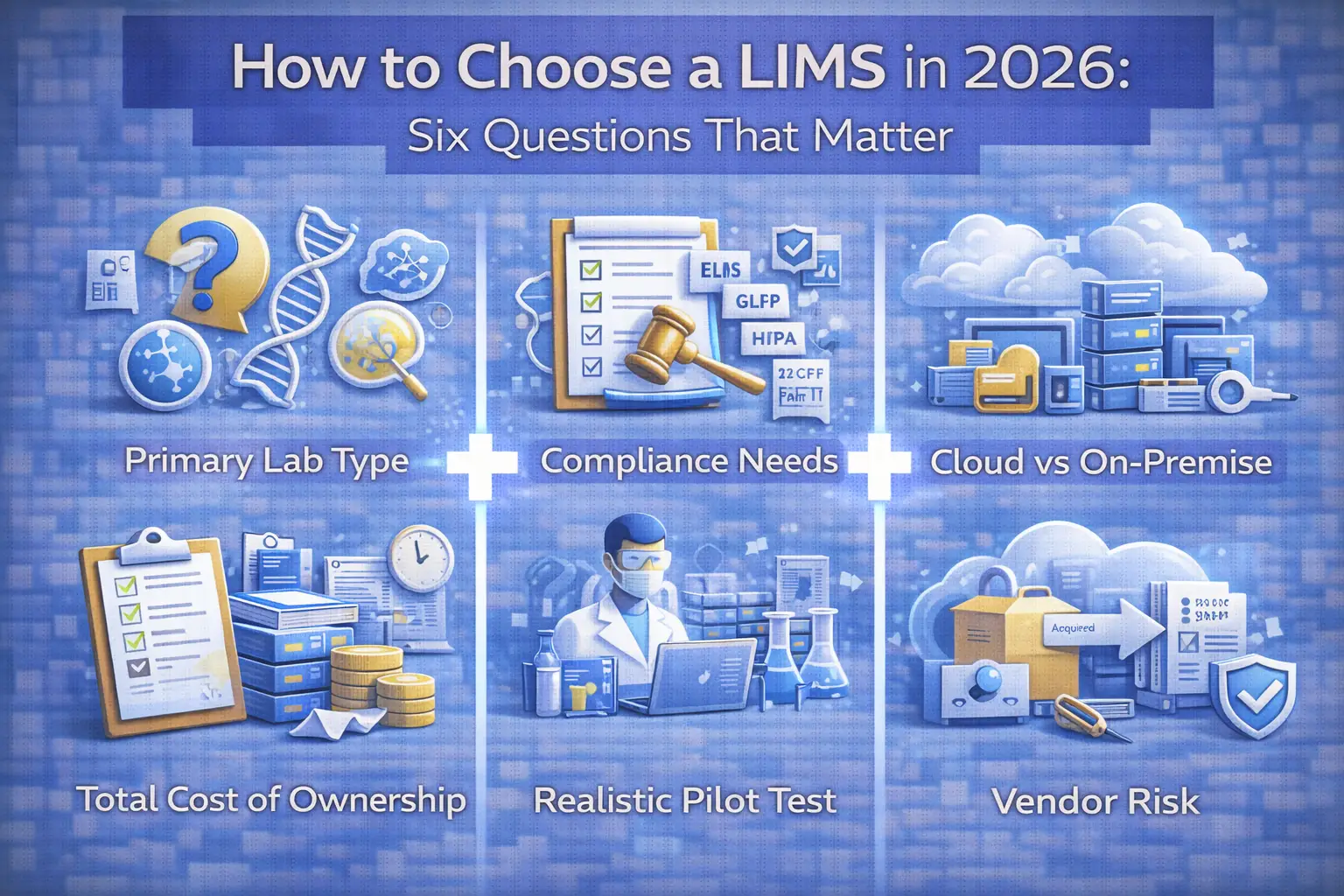
How to Choose a LIMS in 2026: Six Questions That Matter
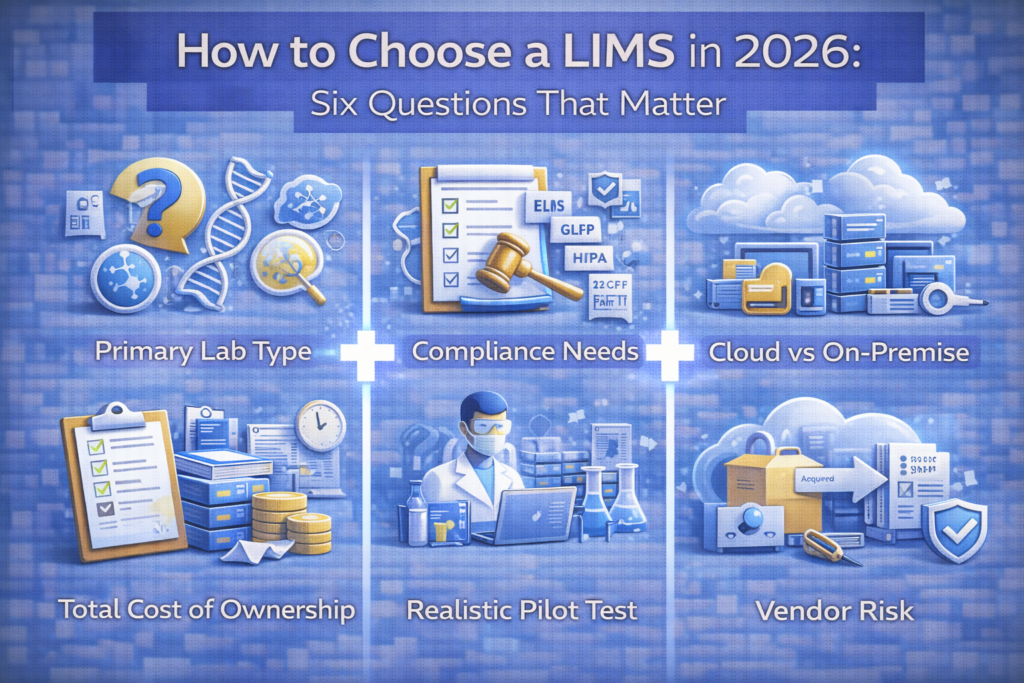
With LIMS implementations measured in months and costing from tens of thousands to hundreds of thousands of dollars, the selection decision warrants serious due diligence. These six questions should drive your evaluation before any vendor demo.
1. What is your primary lab type and scientific workflow?
This is the most important question and the one most labs under-invest in answering before engaging vendors. A pharma QC lab has fundamentally different LIMS requirements from an NGS genomics lab, which has fundamentally different requirements from a biotech R&D team. The right platform for one is the wrong platform for another. Document your top 5 workflow use cases in concrete terms before you open a vendor brochure.
2. What are your non-negotiable compliance requirements?
Map these before any vendor conversation and treat them as binary disqualifiers. 21 CFR Part 11, EU Annex 11, ISO 17025, GLP, GMP, HIPAA, CLIA — whichever apply to your environment should be confirmed as actively supported (not just mentioned) by any vendor you evaluate. Ask specifically for their validation documentation approach and the experience of reference customers in your regulatory context.
3. Cloud, on-premise, or hybrid — and does it actually matter for you?
Most modern LIMS platforms now offer cloud SaaS as a viable option even in highly regulated environments. The question has shifted from cloud vs. on-premise to which cloud architecture, hosted by whom, with what security controls and data residency guarantees. If your organization has specific requirements around data sovereignty, government contracts, or internal IT governance policies, surface these early — they will eliminate some platforms from consideration.
4. What is the realistic total cost of ownership over 3 years?
Published subscription or license costs are rarely the full picture. Build your 3-year TCO model to include: implementation and professional services (which can match or exceed the annual license cost for enterprise platforms), validation costs for regulated labs, training (initial and for ongoing staff turnover), annual maintenance and support, and internal IT administration time. The cost difference between a ‘lower price’ legacy platform and a ‘higher price’ modern platform frequently inverts when professional services and internal time are honestly accounted for.
5. Have you run a realistic pilot with bench scientists — not just IT?
The most important evaluation step. A 30-day pilot using your actual workflows, your actual data types, and your actual bench scientists will expose usability issues, missing features, and integration gaps that vendor demos — which are curated to show the platform at its best — will never reveal. Budget for this as a structured project phase with clear evaluation criteria defined before the pilot begins.
6. What happens to your data if the vendor is acquired or shuts down?
The LIMS market has seen significant consolidation. Understanding data portability — including the format in which your data can be extracted, the effort required to migrate, and the timeline — is essential to evaluating long-term risk. Ask every vendor explicitly: ‘If we needed to migrate to a different LIMS in 5 years, what would that involve and what format would our data come out in?’
LIMS Recommendations by Lab Type: Quick Reference
Large pharmaceutical and biopharma organizations
The primary candidates for global, multi-site, GxP-regulated pharmaceutical environments are LabWare LIMS, LabVantage, and SampleManager LIMS. All three have documented deployments in FDA-inspected environments, provide GMP-validated configurations, and support ERP integration (SAP). The distinguishing factors are: LabWare’s depth of configurability and broad installed base; LabVantage’s modern browser-based interface and industry accelerators; SampleManager’s tight Thermo Fisher instrument integration. STARLIMS also has strong pharma presence, particularly for QA manufacturing environments.
Clinical and diagnostic laboratories
STARLIMS has the most established footprint in clinical and public health settings — donor testing labs, government public health labs, and diagnostic networks. Its HIPAA, CLIA, and forensics capabilities are well-documented. LabVantage also serves clinical and diagnostic environments with specific configurations. QBench explicitly supports HIPAA and CLIA for clinical testing contexts.
CROs and CMOs
Contract research and manufacturing organizations need robust client data segregation, sponsor-level audit trail access, and multi-project management. LabWare, LabVantage, and SampleManager are the most common choices in this segment, selected for their depth of compliance documentation and multi-site architecture. Benchling is a growing option for CROs focused on biotech and biologics discovery work.
Biotech R&D teams
For early-stage through mid-stage biotech focused on discovery and development R&D — particularly molecular biology, cell and gene therapy, and biologics — Benchling is the clear market leader. It is purpose-built for this workflow in a way that general LIMS platforms are not. Labs transitioning from Benchling toward regulated manufacturing will eventually need to evaluate whether a more compliance-oriented platform is required for QC operations.
Testing labs and growing commercial labs
QBench is the top-rated choice on G2 for testing labs that need a modern, configurable, fast-to-deploy cloud LIMS. It excels in food & beverage, agriculture, diagnostics, environmental, and biotech testing environments where workflow flexibility and compliance (ISO 17025, CLIA) are required but enterprise-scale complexity is not.
Genomics and NGS laboratories
Clarity LIMS is the dominant choice for labs operating Illumina NGS and array platforms. Its 60+ preconfigured workflows, native Illumina instrument integration, and automation connectivity make it the lowest-friction path to operational NGS sample management. Labs with non-Illumina or multi-vendor sequencing environments should evaluate general LIMS platforms — LabVantage, Benchling, or STARLIMS — with appropriate NGS configuration.
Environmental testing and water quality labs
SampleManager LIMS has strong presence in water and environmental testing. LabWare, LabVantage, and QBench also serve environmental testing environments. The key requirements in this segment are ISO 17025 compliance, chain-of-custody management, and flexibility to handle diverse sample matrices and regulatory reporting formats.
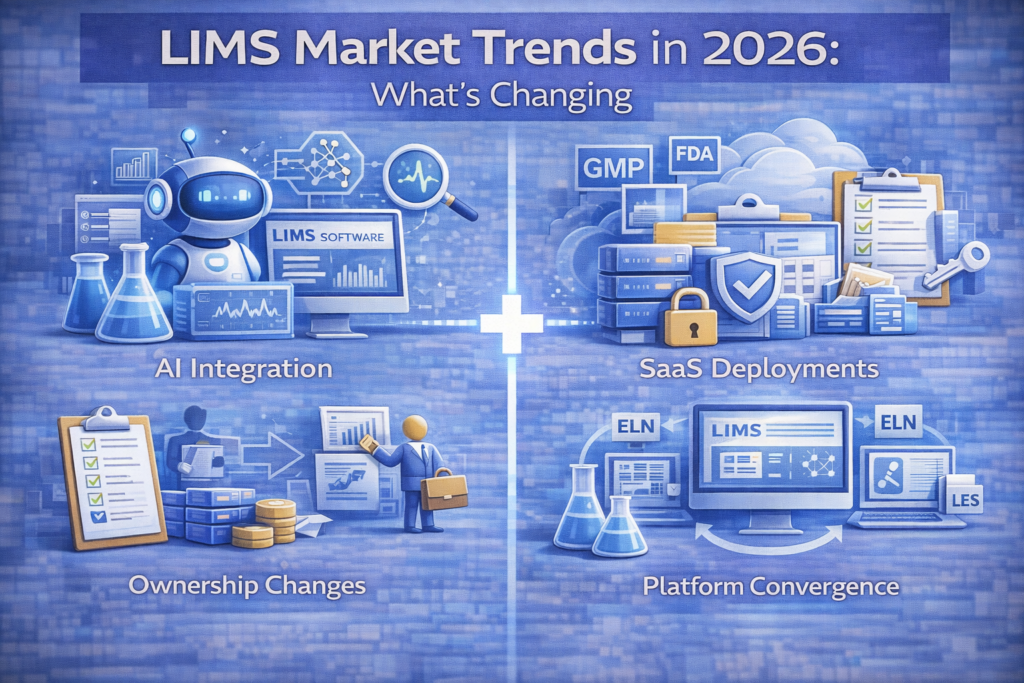
LIMS Market Trends in 2026: What’s Changing
AI is becoming a product reality, not just a roadmap promise
Several platforms moved from AI as a marketing claim to AI as a working feature in 2025 and early 2026. LabVantage’s Open Talk voice processing and predictive analytics agents, SampleManager’s Autonomous Test Revisor (using neural network models for anomaly detection), and Benchling’s dedicated Benchling AI command center represent concrete AI deployments — not vaporware. The practical question for labs evaluating these features is: what specific workflow outcome does this AI capability improve, and can the vendor demonstrate it in a live session with my data type?
SaaS is now viable for the most regulated environments
Cloud SaaS LIMS deployments in FDA-regulated and GMP environments are now routine, not exceptional. LabWare, LabVantage, SampleManager, and STARLIMS all offer validated cloud options with documented compliance frameworks. The remaining objections — data sovereignty, security controls, disaster recovery SLAs — are addressable through contract and architecture specifics rather than representing a fundamental barrier to cloud adoption.
Ownership changes are reshaping the competitive landscape
STARLIMS’s departure from Abbott to Francisco Partners reflects a broader trend of private equity and strategic investors reshaping enterprise laboratory software ownership. This has practical implications for customers: investment priorities, support quality, pricing trajectories, and product roadmap continuity can all shift with ownership changes. Understanding the ownership structure and investment thesis behind any platform you are evaluating over a 10-year horizon is part of sound vendor due diligence.
Convergence between LIMS, ELN, SDMS, and LES continues
The traditional boundaries between LIMS (operational), ELN (research), SDMS (data management), and LES (execution) are progressively dissolving. Most enterprise platforms now offer some combination of all four. The evaluation question is increasingly not ‘which LIMS?’ but ‘what is our laboratory informatics strategy?’ — and which platform provides the best foundation for that strategy over a 5 to 10 year horizon.
Modern platforms are winning replacement business from legacy LIMS
A meaningful segment of LIMS procurement in 2026 is replacement business — labs moving from legacy platforms to newer systems. QBench explicitly markets to ‘second-time LIMS buyers.’ The drivers are predictable: dated interfaces that reduce adoption, proprietary scripting languages that create vendor dependency, and implementation cycles that take the better part of a year. Modern cloud platforms offering faster deployment, self-service configuration, and transparent pricing are capturing this replacement demand.
Frequently Asked Questions About LIMS Software
What is a LIMS?
A Laboratory Information Management System (LIMS) is software that manages laboratory operations: tracking samples from receipt through testing and reporting, automating workflow steps, capturing instrument data, enforcing standard operating procedures, and maintaining the audit trails and data integrity records required for regulatory compliance.
What is the difference between a LIMS and an ELN?
A LIMS is primarily focused on operational management: tracking samples, workflows, test results, resources, and compliance in a structured, repeatable laboratory environment. An ELN (Electronic Lab Notebook) is primarily focused on research documentation: capturing what experiments were done, by whom, and what was observed, in a flexible and researcher-driven format. Many modern platforms combine both functions. For QC and manufacturing labs, start with LIMS. For research labs, start with ELN. For labs doing both, evaluate integrated platforms.
How long does a LIMS implementation take?
For cloud LIMS platforms with pre-configured workflows and small teams: weeks to a few months. For enterprise platforms with custom configuration and integration into existing systems: 3 to 12 months is typical. For enterprise LIMS implementations in regulated environments requiring full GxP validation (IQ/OQ/PQ): 6 to 18 months is common, with validation activities often taking more time than the technical implementation itself.
What is 21 CFR Part 11 and why does it matter for LIMS?
21 CFR Part 11 is a US FDA regulation that governs electronic records and electronic signatures in FDA-regulated environments. A LIMS deployed in a pharma, medical device, or food & beverage lab subject to FDA oversight must meet these requirements: secure access controls, immutable audit trails, electronic signatures with identity verification, and validated system documentation. Non-compliance can result in FDA observations, warning letters, or data that is inadmissible in regulatory submissions. Any LIMS evaluated for FDA-regulated use should be assessed specifically against Part 11 requirements.
Should I choose cloud or on-premise LIMS?
For most labs in 2026, cloud SaaS is the pragmatic choice: lower infrastructure cost, faster deployment, automatic updates, and scalability. On-premise remains relevant for organizations with specific data sovereignty requirements, government security mandates, or internal IT governance policies that restrict external hosting. Hybrid models — where the LIMS application is hosted in cloud infrastructure managed by the vendor but within a defined geographic boundary — are increasingly available as a middle path.
What does LIMS implementation typically cost?
LIMS costs vary enormously by platform and organization size. Enterprise platforms (LabWare, LabVantage, SampleManager, STARLIMS) typically involve significant license or subscription fees plus implementation professional services that can match or exceed the annual license cost — particularly in regulated environments where validation activities add to the project scope. Modern cloud platforms like QBench and Benchling offer more transparent subscription pricing, but total cost still depends heavily on implementation scope, integrations, and training requirements. For any platform, request a full 3-year TCO estimate including all professional services before comparing on license cost alone.
How do I migrate from one LIMS to another?
LIMS migration is one of the most underestimated challenges in laboratory informatics. Key steps include: auditing and exporting all existing data in the source system, mapping data structures between the old and new platform, validating data integrity after migration, re-configuring workflows and reports in the new system, training users, and running parallel operation until the new system is verified. For regulated labs, the migration itself must be validated and documented. Budget for this as a significant project — often 3 to 6 months for mid-market platforms, longer for enterprise systems.
Conclusion: The Right LIMS in 2026 Depends on One Thing Above All
After reviewing 7 LIMS platforms with verified data, the single most important conclusion is straightforward: the right LIMS is not the one with the most features, the best G2 rating, or the longest customer list. It is the one that fits your specific scientific workflow, regulatory context, and organizational scale — and that you will actually adopt and use effectively.
LabWare remains the benchmark for large, complex, regulated enterprise deployments where depth of configurability and compliance history are paramount. LabVantage offers a modern browser-based alternative with strong industry accelerators and a compelling AI roadmap. SampleManager LIMS is the leading choice for organizations in the Thermo Fisher ecosystem and those needing a single-application LIMS/SDMS/LES solution. STARLIMS provides the broadest regulatory coverage across clinical, forensics, public health, and pharma contexts. Benchling owns the biotech R&D space for funded organizations focused on molecular biology and biologics. QBench is the top-rated modern cloud option for testing labs and growing organizations that have outgrown simpler tools without needing enterprise-level complexity. Clarity LIMS is the clear choice for Illumina NGS labs.
The buying process advice is consistent regardless of which platform you are evaluating: define your requirements before vendor engagement, involve bench scientists in the pilot, model the true total cost of ownership including professional services, and evaluate the vendor relationship — not just the software.
| This article is updated regularly as the LIMS market evolves. Bookmark labsoftwareguide.com for independent reviews, comparisons, and implementation guides for laboratory software. |
Explore More LIMS Resources on LabSoftwareGuide
- LIMS vs ELN: Which Does Your Lab Actually Need?
- Our LIMS Software Guide
- Best LIMS for Small Laboratories: Independent 2026 Guide
- Best LIMS for Environmental Laboratories
- LabWare LIMS: Independent Review
- LabVantage LIMS: Independent Review
- QBench LIMS: Independent Review
- Benchling LIMS: Independent Review
- 21 CFR Part 11 Compliance for LIMS: A Practical Guide
- How to Write a LIMS Requirements Document
- LIMS Implementation Guide: How to Avoid the Most Common Mistakes
LabSoftwareGuide is an independent editorial resource. We do not accept payment for vendor rankings or editorial positioning in our pillar guides or comparison articles. All data in this article is sourced from vendor official documentation, product release announcements, G2 and Capterra user reviews, and verified industry sources. Pricing is intentionally excluded — published rates change frequently and vary by configuration. Some individual articles on this site may contain clearly disclosed sponsored content.