| This article is based on the original FAIR Guiding Principles published in Nature Scientific Data (Wilkinson et al., 2016), the GO FAIR Initiative framework, and the NIH Data Management and Sharing Policy (effective January 2023). It is for informational purposes only. |
What Are the FAIR Data Principles?
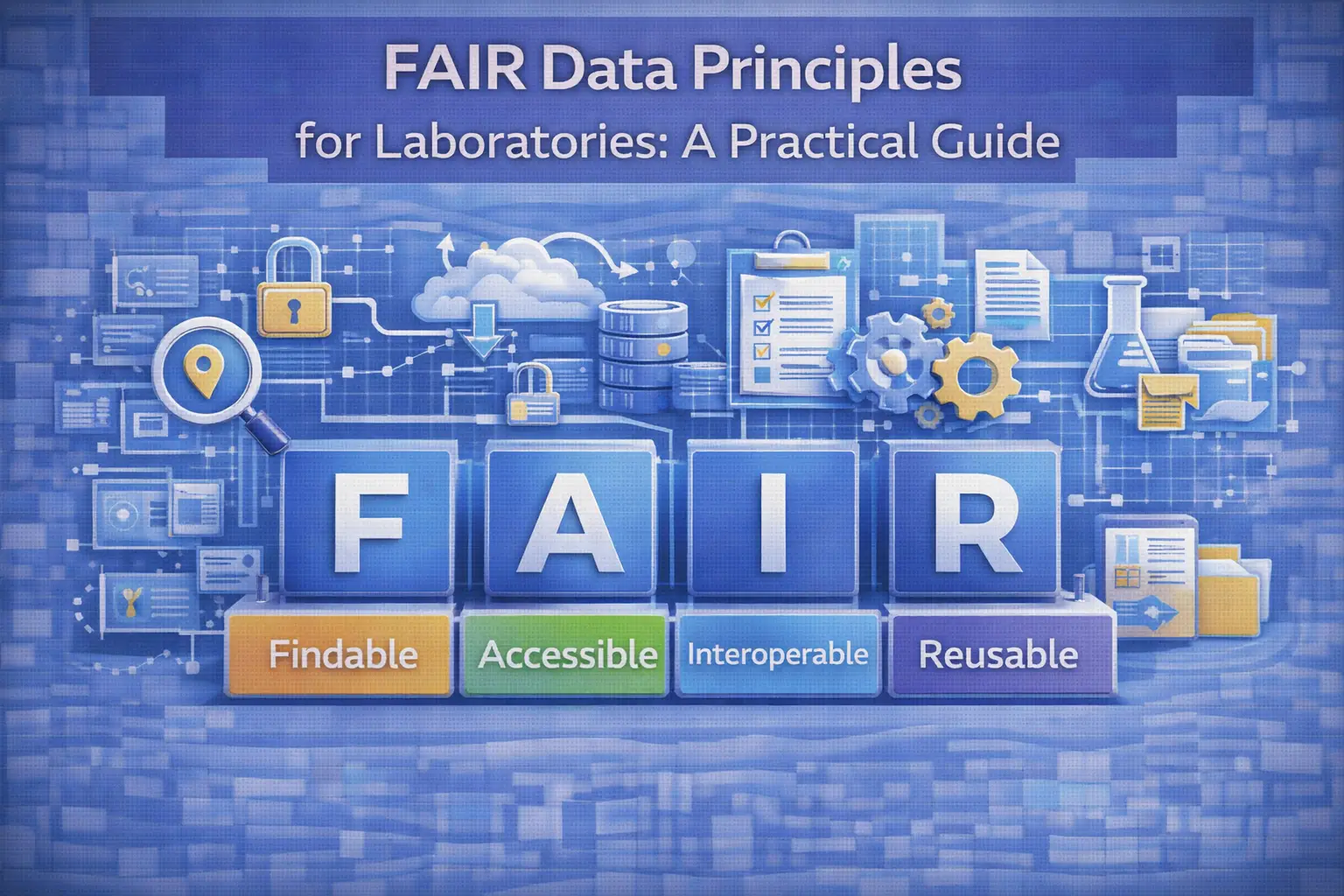
FAIR stands for Findable, Accessible, Interoperable, and Reusable. Originally published in 2016 in the journal Scientific Data (Nature Publishing Group) by an international group of researchers representing academia, industry, funding agencies, and publishers, the FAIR Guiding Principles define a minimum standard for scientific data management and stewardship that enables data to be effectively discovered, accessed, and reused — by both humans and machines.
The distinction between human and machine readability is deliberate and important. As the original authors noted, laboratories increasingly rely on computational systems to handle data at a scale, speed, and volume that exceeds what any human team can manage manually. A dataset that is findable by a researcher browsing a repository is not necessarily findable by an AI model or an automated pipeline. FAIR addresses both simultaneously.
Since their publication, the principles have moved from academic guideline to regulatory expectation. The NIH Data Management and Sharing Policy (effective January 25, 2023) explicitly references FAIR as the framework guiding its requirements, making FAIR compliance a practical necessity for any laboratory receiving NIH funding. The European Commission’s Horizon Europe research programme applies FAIR standards by default to all funded research output. For regulated environments, FAIR principles align closely with ALCOA+ data integrity requirements and with the data governance expectations of 21 CFR Part 11 and EU GMP Annex 11.
The Four Principles: What Each Means in Your Laboratory
Each FAIR principle translates differently depending on whether your laboratory is primarily a research environment, a regulated QC lab, or a clinical or industrial setting. The following cards map each principle to concrete laboratory practice.
| F — Findable |
| Data and metadata must be easy to locate for both humans and computational systems, using unique persistent identifiers and rich, machine-readable metadata registered in searchable resources.In the lab: Every experiment record, sample, and dataset is assigned a unique identifier (sample ID, assay ID, project code) that follows a consistent, documented naming convention across the lab. No record exists only as a file named “data_final_v3.xlsx” in a shared drive.In LIMS/ELN: LIMS and ELN platforms assign system-generated unique identifiers to every record automatically. These IDs persist even if records are archived or the system is migrated. Metadata schemas (who collected it, when, with which instrument, under which protocol version) are defined at the system level and enforced at the point of entry.Common gap: Data stored in files on personal drives or lab servers with inconsistent naming — common in labs without a LIMS — is effectively invisible to anyone who was not present when the file was created. |
| A — Accessible |
| Once found, data must be retrievable using a standardised, open communications protocol, with clear rules about authentication and authorisation. Metadata must remain accessible even if the data itself is no longer available.In the lab: Archived data from completed projects remains retrievable through a defined procedure (not “ask the person who left the lab”). Access control is documented: who can read, who can edit, who can delete. Data deposited in a repository has a persistent URL that does not break when lab websites change.In LIMS/ELN: Role-based access controls in LIMS ensure that every user’s access permissions are defined and logged. When records are archived, the metadata (when the experiment was run, by whom, under which conditions) remains searchable even if the raw data files are moved to cold storage. Cloud-based LIMS avoid the single-point-of-failure problem of a local server.Common gap: Data that lives exclusively on a departing researcher’s laptop, or in a proprietary system with no export capability, fails the Accessible principle entirely. “Accessible on request by email” does not meet the FAIR standard for publicly funded research. |
| I — Interoperable |
| Data must use formal, shared, broadly applicable languages and vocabularies for knowledge representation, enabling integration across different datasets, systems, and workflows.In the lab: Assay results are recorded using standardized units (SI where possible), controlled vocabularies (e.g., SNOMED, ChEBI for chemical entities, NCBI taxonomy for organisms), and open file formats (CSV, JSON, mzML for mass spectrometry) rather than proprietary formats readable only by one instrument’s software.In LIMS/ELN: Modern LIMS platforms support ontology-based metadata (ISA-TAB, MIAME standards), API-based data exchange with instruments and external systems, and export in standard formats. Instrument integration that pushes results directly into the LIMS in a structured format is the operational definition of interoperability for most QC labs.Common gap: Instrument data locked in proprietary software formats, result tables recorded in manually formatted Excel spreadsheets with inconsistent column names across users, or lab-specific abbreviations with no controlled vocabulary — these are the most common interoperability failures in practice. |
| R — Reusable |
| Data must be sufficiently described and documented so that it can be replicated and combined in different settings, with clear provenance, licensing, and domain-relevant community standards.In the lab: A dataset from three years ago can be understood and used by someone who was not part of the original experiment, because every record captures who performed it, with which reagents (lot numbers, expiry dates), with which instrument (model, calibration date), under which protocol version, and under what environmental conditions.In LIMS/ELN: ELN templates enforce the capture of complete experimental context at the time of recording — not as an optional field to fill in later. LIMS workflow definitions link results to the specific method version, sample preparation steps, and instrument configuration used. Change control processes version-control protocol documents so that historical data can always be matched to the exact procedure that generated it.Common gap: The most common reusability failure is “I can find the data but I cannot interpret it without talking to the person who ran it.” This happens when experimental context (reagent lots, protocol versions, instrument settings) is not captured in the record alongside the results. |
Why FAIR Matters for Your Laboratory Right Now
Regulatory and Funding Requirements
FAIR has moved from academic principle to compliance expectation. Since January 2023, all NIH grant applications and renewals that generate scientific data must include a Data Management and Sharing Plan (DMSP) that explicitly addresses how data will be managed according to FAIR principles. The NIH Strategic Plan for Data Science (2025–2030) references FAIR as a core framework for ensuring that NIH-funded research data can be found, accessed, integrated, and reused. The European Commission’s Horizon Europe programme applies FAIR as open-access data as the default for all funded research.
For labs in regulated industries, FAIR principles align directly with existing compliance requirements. The ALCOA+ data integrity framework requires that records be Complete, Consistent, Enduring, and Available — attributes that map precisely to FAIR’s Accessible and Reusable principles. A laboratory that achieves genuine FAIR compliance is, by definition, making substantial progress toward ALCOA+ compliance as well.
AI Readiness: FAIR as Infrastructure
As covered in our companion article on AI in laboratory software, 68% of AI initiatives fail due to poor data quality and governance. FAIR-compliant data is, by construction, AI-ready data: it is consistently structured, richly described, persistently identified, and accessible through standard interfaces. Labs that have invested in FAIR infrastructure — standardized metadata, unique identifiers, open formats, comprehensive provenance capture — are the same labs successfully deploying machine learning for anomaly detection, predictive maintenance, and cross-experiment analysis.
The relationship runs both directions: FAIR data enables AI, and AI tools increasingly require FAIR data as a prerequisite for reliable outputs. A LIMS that supports FAIR principles is not just a compliance investment — it is the foundational infrastructure for every AI application your laboratory might want to deploy over the next five years.
Reproducibility and Scientific Integrity
The reproducibility crisis in biomedical research has been well documented: a significant proportion of published findings cannot be independently replicated, with poor data management identified as a primary contributing factor. FAIR principles directly address the documentation gap that causes most reproducibility failures. When experimental context is fully captured — reagent lots, protocol versions, instrument settings, environmental conditions — independent replication becomes genuinely possible. For regulated environments, this is not a scientific nicety but a regulatory requirement: 21 CFR Part 211.194(a) requires that laboratory records be complete enough to reconstruct the analysis.
FAIR Is Not the Same as Open: An Important Distinction
A persistent misconception is that FAIR data must be publicly accessible. This conflates FAIR with Open Data, which are related but distinct frameworks. FAIR governs how data is managed; Open governs who can access it.
Patient health records can be fully FAIR — findable through a registry, accessible to authorised users through standardised authentication, interoperable with other clinical systems, and reusable with complete provenance — while remaining strictly protected under GDPR, HIPAA, or other privacy regulations. Proprietary pharmaceutical data can be FAIR within an organisation without being shared externally at all. A biotech company might manage its compound screening data according to FAIR principles internally while making none of it publicly available.
| The key FAIR principle that clarifies this is A1.2: ‘The protocol allows for an authentication and authorisation procedure, where necessary.’FAIR explicitly anticipates that some data will have access restrictions. What FAIR requires is that the rules for accessing the data are clearly defined and documented — not that the data is freely available to everyone.FAIR data that is not open is still fully FAIR. The goal is well-managed, well-described data with clear access controls, not unrestricted public sharing. |
Making Your Laboratory More FAIR: Where to Start
FAIR implementation is not an all-or-nothing project. The original authors explicitly noted that ‘the Principles may be adhered to in any combination and incrementally, as data providers’ environments evolve to increasing degrees of FAIRness.’ The following steps are ordered by impact and practical feasibility for most laboratory settings.
Step 1: Standardize your identifiers (Findable)
Define and enforce a unique identifier scheme for every object your lab tracks: samples, experiments, methods, instruments, reagent lots. If you use a LIMS or ELN, this is largely handled by the system — verify that IDs are system-generated (not manually entered), persistent (not reused), and propagated to all downstream records.
Step 2: Define your metadata schema (Findable + Reusable)
Identify the minimum set of metadata fields that must be captured for every experiment type in your lab: who ran it, when, with which protocol version, with which instrument and calibration state, with which reagent lots. Encode this in your ELN templates or LIMS workflow definitions so that these fields are mandatory, not optional.
Step 3: Use open, standard formats where possible (Interoperable)
Audit your instrument data outputs. Where instruments produce proprietary formats, establish a conversion step to an open standard format (mzML for mass spectrometry, JCAMP-DX for spectroscopy, CSV for tabular data) as part of the workflow. Ensure your LIMS can export records in standard formats — ask vendors explicitly before purchase.
Step 4: Define and document your access rules (Accessible)
Document, in writing, who has access to which data under which conditions. Implement this through role-based access controls in your LIMS rather than through informal agreements. For publicly funded research, identify the appropriate repository for each data type before the project generates the data, not after.
Step 5: Assess your FAIR readiness with GO FAIR tools (all principles)
The GO FAIR Initiative — the international body that maintains and develops the FAIR framework — provides free maturity assessment tools and guidance on the FAIRification process. The FAIR Maturity Indicators are a standardized way to evaluate your current data management practices against each sub-principle and identify the highest-priority gaps.
Official Sources and Reference Documents
| Source | Description | Publisher |
|---|---|---|
| FAIR Guiding Principles (Wilkinson et al., 2016) | Original publication in Nature Scientific Data — the foundational reference for all FAIR implementations | Nature / Scientific Data |
| GO FAIR — FAIR Principles | Official GO FAIR framework with all 15 sub-principles and implementation guidance | GO FAIR Initiative |
| NIH Data Management and Sharing Policy | NIH DMS Policy (effective Jan 2023) — references FAIR as the guiding framework for all NIH-funded research data | NIH |
| NIH — FAIR Data Principles at NIAID | NIH NIAID practical guidance on FAIR implementation for biomedical research labs | NIH / NIAID |
| NIH Strategic Plan for Data Science 2025–2030 | NIH plan explicitly referencing FAIR as the standard for federally-funded research data management | NIH ODSS |
| European Commission — FAIR Data in Horizon Europe | FAIR as default for all Horizon Europe research output — key reference for EU-based labs | European Commission |
| PMC — FAIR Principles full text (open access) | Open-access version of the original 2016 Scientific Data publication | PMC / NLM |
Frequently Asked Questions
Does FAIR apply to all laboratories, or only research labs?
FAIR originated in academic research but applies to any laboratory that generates and manages scientific data. For regulated pharmaceutical and medical device labs, FAIR principles are increasingly aligned with existing GxP and data integrity requirements. For environmental testing and clinical labs, FAIR provides a practical framework for improving data quality and long-term accessibility. The NIH DMS Policy applies specifically to NIH-funded research, but the underlying FAIR principles are relevant to any laboratory managing scientific data at scale.
Do I need a LIMS or ELN to implement FAIR?
Not strictly, but paper-based and manual file-based systems make most FAIR sub-principles very difficult to implement consistently. A LIMS or ELN that enforces structured data capture, assigns persistent unique identifiers, supports role-based access controls, and exports in standard formats provides the technical infrastructure that makes FAIR achievable in daily practice rather than as an aspirational goal. The most important FAIR investments — consistent metadata, unique identifiers, documented access rules — require system-level enforcement to be reliable at the scale of a working laboratory.
What is the difference between FAIR and ALCOA+?
FAIR and ALCOA+ are complementary frameworks with different origins and primary audiences. ALCOA+ (Attributable, Legible, Contemporaneous, Original, Accurate, Complete, Consistent, Enduring, Available) is a regulatory data integrity standard primarily used in GxP-regulated environments (pharmaceutical, medical device, clinical). FAIR is a scientific data management framework originating in research and now adopted by research funders globally. They overlap significantly: ALCOA+’s ‘Enduring’ and ‘Available’ map directly to FAIR’s Accessible principle; ALCOA+’s ‘Complete’ and ‘Accurate’ support FAIR’s Reusable principle. A laboratory implementing both achieves data that is both regulatorily compliant and scientifically reusable.
How do I document FAIR compliance for a grant application?
For NIH grant applications requiring a Data Management and Sharing Plan, address each FAIR principle explicitly: describe how data will be identified (Findable), which repository and access protocol will be used (Accessible), which file formats and vocabularies will be used (Interoperable), and how experimental context and provenance will be documented (Reusable). The NIH provides DMSP templates via the DMPTool platform. The GO FAIR Three-point FAIRification Framework is a useful practical guide for documenting your approach.
Summary
FAIR data principles — Findable, Accessible, Interoperable, Reusable — define the modern standard for scientific data management in any laboratory that generates data intended to be used beyond the immediate experiment. Originally published in 2016 and now embedded in major research funding requirements (NIH, Horizon Europe), FAIR is simultaneously a scientific integrity framework, a reproducibility standard, and the prerequisite infrastructure for effective AI adoption in laboratory environments.
For laboratory managers and software decision-makers, FAIR is best understood not as a compliance checkbox but as a practical quality standard for your data infrastructure. Data that is well-identified, consistently described, documented with complete provenance, and accessible through defined protocols is data that retains its value over time — for your team, for regulators, for collaborators, and for the computational tools that will increasingly be asked to analyze it.
| This article is part of labsoftwareguide.com’s data management series.Related reading: What is ALCOA+? Data Integrity in Laboratory Environments | AI in Laboratory Software: What’s Actually Working in 2026 | Best ELN Software 2026 | 21 CFR Part 11: A Practical Guide for Lab Software |
This article is for informational purposes only. Regulatory policies and grant requirements are subject to revision — always consult current official sources (sharing.nih.gov, go-fair.org, ec.europa.eu) and your institution’s research office for decisions specific to your grant or regulatory context.