A practical buyer’s guide for lab managers, quality directors, and IT teams evaluating Laboratory Information Management Systems.
Selecting a Laboratory Information Management System (LIMS) is one of the most consequential technology decisions a lab can make. Get it right, and you gain a powerful platform that automates sample tracking, enforces compliance, and accelerates every workflow. Get it wrong, and you face years of expensive customization, frustrated staff, and regulatory risk.
The challenge is that LIMS vendors are excellent at demonstrations. Every platform looks polished in a 30-minute sales call. The real differences only emerge when you probe beneath the surface — asking the uncomfortable questions before you sign a contract, not after.
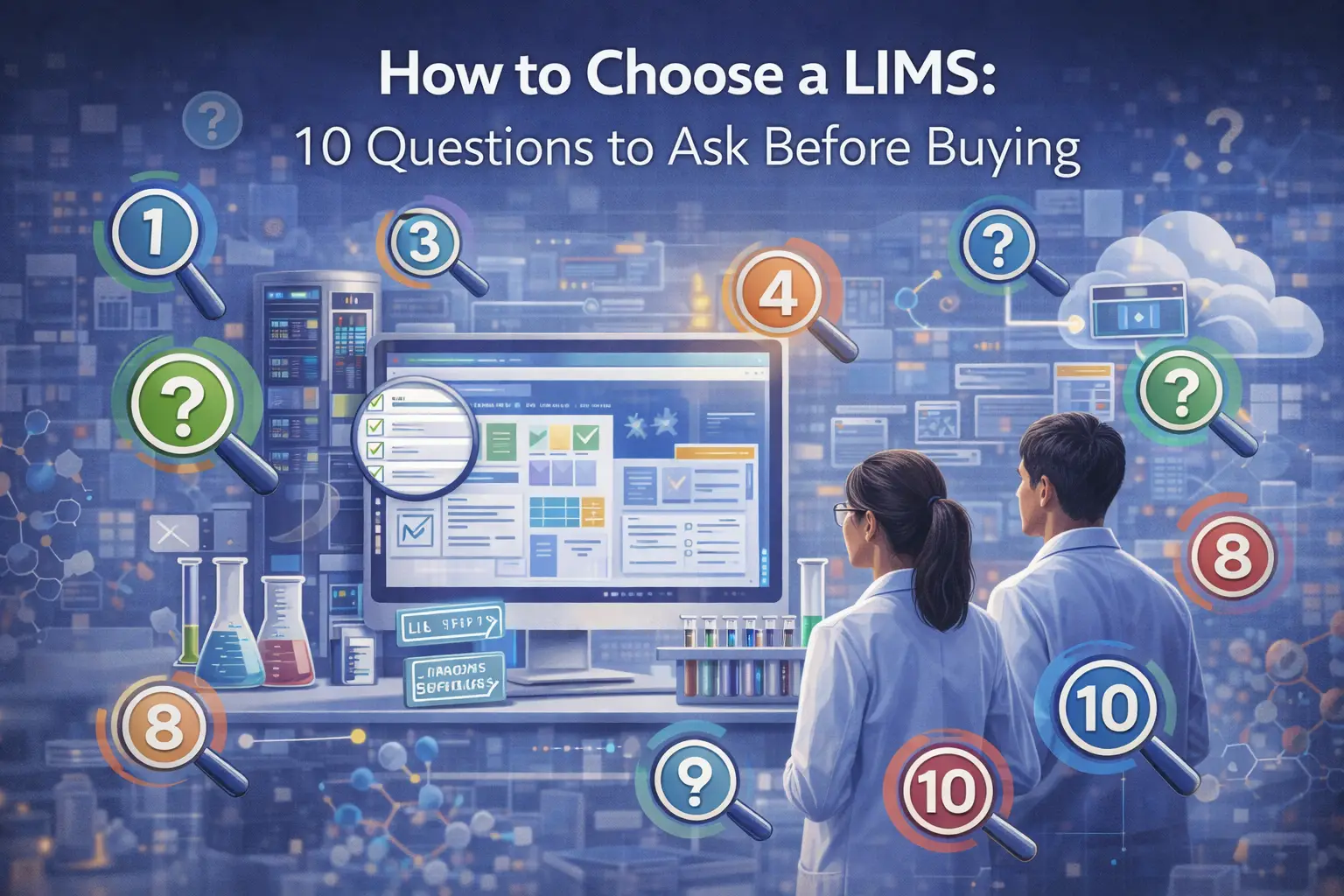
This guide gives you the 10 essential questions to ask any LIMS vendor. Whether you are evaluating your first system or replacing a legacy platform, these questions will help you cut through marketing noise and identify the solution that truly fits your laboratory’s needs.
| Why This MattersAccording to industry data, LIMS implementation failures are most often caused not by technology limitations, but by poor fit between the platform and the lab’s specific workflows, compliance requirements, and integration needs — all of which could have been identified during vendor evaluation. |
Question 1: Does It Support Your Specific Workflows — Not Just ‘Labs’ in General?
The most common mistake in LIMS evaluation is accepting generic capability claims at face value. ‘We support laboratory workflows’ is not a meaningful answer. Your workflows are specific: you may need chain-of-custody tracking for environmental samples, GMP-compliant batch records for pharma manufacturing, or real-time PCR result capture for a genomics lab.
Ask the vendor to demonstrate your actual workflows — not their canned demo. Request a sandbox environment with your sample types, your naming conventions, and your test methods configured. If they struggle to configure even a basic version of your process during evaluation, the full implementation will be far more painful.
Key follow-up: “Can we run a proof of concept using our own data before signing?” A confident vendor will say yes.
Question 2: What Are the True Total Costs Over 5 Years?
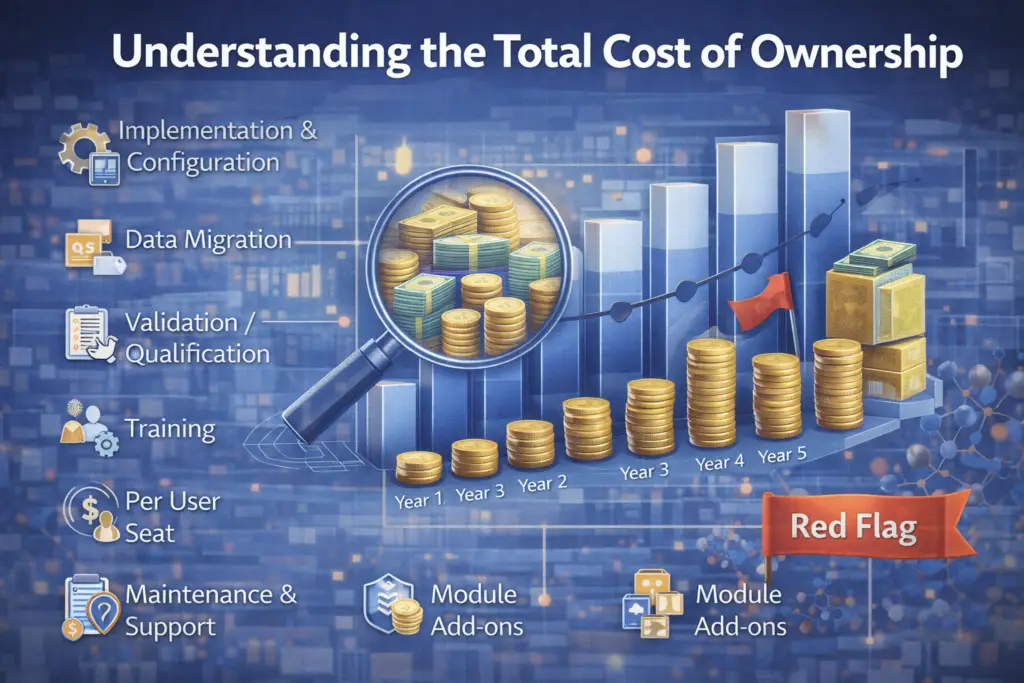
LIMS pricing is notoriously opaque. The quoted license fee is rarely the full story. Implementation, training, validation, annual support, module add-ons, and user seat increases can multiply the initial cost by a factor of three to five over a five-year period.
Request a Total Cost of Ownership (TCO) breakdown that includes all of the following:
- Implementation and configuration services
- Data migration from your current system
- Validation and qualification (IQ/OQ/PQ) if required
- Training for initial users and new hires
- Annual maintenance and support fees
- Cost per additional user seat
- Pricing for modules you might need in year 2 or 3
Red flag: Vendors who are unwilling to provide a multi-year TCO estimate are often hiding significant costs in year 2 onwards.
Question 3: How Does It Handle Regulatory Compliance for Your Environment?
Compliance requirements differ dramatically by industry. A pharmaceutical QC lab operating under FDA 21 CFR Part 11 and GMP regulations has very different needs from an environmental testing laboratory under ISO 17025, or an academic research lab with no formal regulatory mandate.
Do not assume compliance — verify it. Ask specifically:
- Is 21 CFR Part 11 compliance built-in or does it require configuration?
- Does the system maintain a complete, tamper-evident audit trail?
- Can it support electronic signatures with the required identity verification?
- Has it been used in an FDA inspection or audit? With what outcome?
For European labs, ask about GDPR data handling, and for ISO-accredited labs, ask specifically about method validation record management and proficiency testing documentation.
| Pro TipAsk the vendor for a list of current customers in your regulatory environment and contact at least two of them directly. A vendor’s relationship with regulated customers is the most reliable indicator of their compliance capability. |
Question 4: What Instruments and Systems Does It Currently Integrate With?
A LIMS that cannot talk to your instruments is just an expensive spreadsheet. Integration capability — with both laboratory instruments and enterprise systems like ERP, QMS, or ELN — is one of the most critical and most frequently oversold capabilities in the LIMS market.
Ask for a published list of certified integrations, not just ‘integration capability.’ There is a significant difference between a pre-built, tested connector for your mass spectrometer or HPLC system and a generic API that theoretically could be used to build one.
Also ask about bidirectional data flow: can the LIMS send worklists to instruments as well as receive results? Can it trigger instrument runs automatically? These capabilities define whether you are getting automation or just data collection.
Question 5: Cloud, On-Premise, or Hybrid — What Are the Real Implications?
The deployment model you choose will affect security, cost structure, IT overhead, and performance for the entire lifetime of the system. Both cloud and on-premise have legitimate advantages depending on your organization’s situation.
Cloud-based LIMS typically offers faster deployment, lower upfront cost, automatic updates, and easier remote access. On-premise deployments give you greater control over data sovereignty, network performance, and security — often critical for highly regulated environments or organizations with sensitive intellectual property.
The right questions here are:
- Where exactly is our data stored and which data sovereignty regulations apply?
- What is the guaranteed uptime SLA, and what are the compensation terms if it is breached?
- How are software updates handled, and do they require our re-validation?
- What happens to our data if we decide to leave?
Question 6: How Long Does Implementation Actually Take?
LIMS vendors consistently underestimate implementation timelines during the sales process. A system that takes 18 months to fully implement instead of the promised 6 months creates enormous costs in parallel operations, staff time, and delayed ROI.
Ask for references from customers with a similar scope of implementation — similar number of users, similar number of instruments, similar regulatory environment. Ask those customers directly: how long did implementation actually take, and what caused the delays?
Important: Also ask who is responsible for what. Many vendors hand off large parts of implementation to third-party consultants. Understanding who your actual implementation team is — and their experience level — is as important as evaluating the software itself.
Question 7: What Does Configuration vs. Customization Mean in Practice?
Modern LIMS platforms market themselves as highly configurable — meaning lab teams can adapt workflows, fields, and reports without coding. This is a major advantage over older ‘customizable’ systems that required developer involvement for every change.
However, the line between configuration and customization is frequently blurred in vendor communications. Ask for a live demonstration where the vendor — or better, where you — reconfigure a workflow in real time. If every change requires a support ticket or a professional services engagement, the system is not truly configurable.
This distinction has significant long-term cost implications. Every hard-coded customization becomes a liability at upgrade time, often requiring expensive rework to maintain compatibility with new versions.
| Key Question to Ask“If our lab process changes six months after go-live, can our own team modify the workflow, or does it require vendor involvement?” The answer reveals the true nature of the platform. |
Question 8: What Does the Support Model Look Like After Go-Live?
The sales team is attentive and responsive. The support team post-implementation is an entirely different experience at many vendors. Understanding the support model before you sign is essential.
Ask specifically:
- What are the support hours and response time SLAs for critical vs. non-critical issues?
- Is telephone support included or only ticket-based support?
- What is the process for escalating a critical system failure outside of business hours?
- Is there a customer success manager assigned to our account?
- What training resources are available for staff turnover?
Also investigate the vendor’s financial stability. A LIMS is a 10+ year investment for most organizations. A vendor that is acquired, pivots, or goes out of business midway through your contract creates catastrophic disruption. Review their funding status, customer base size, and ownership structure.
Question 9: How Does the System Scale as Our Lab Grows?
A LIMS that works for 20 users and 5,000 samples per month may perform very differently at 200 users and 500,000 samples. Understanding the scaling characteristics of the platform — and the pricing implications — prevents painful surprises down the road.
Ask for documented performance benchmarks at scale, not just general assurances. Ask for references from customers who have scaled significantly since implementation.
Also consider multi-site scenarios. If your organization is likely to expand to additional locations, ask how the LIMS handles multi-site operations: shared vs. independent sample number spaces, inter-site transfer of samples and data, consolidated reporting across sites, and role-based access control across organizational units.
Question 10: What Is the Data Migration and Exit Strategy?
This question makes vendors uncomfortable, which is exactly why you should ask it. Understanding how you would get your data out of the system — cleanly, completely, and in a usable format — is as important as understanding how you get it in.
A vendor who cannot clearly explain the data export capabilities and format options is one who is designing for lock-in. Your historical sample data, audit trails, and reports have significant value and represent years of organizational knowledge. Ensure you retain control of that data regardless of what happens to your vendor relationship.
Ask for:
- A sample export of data in a standard format (CSV, XML, JSON) from a demo environment
- Documentation on which data is exportable and which is held in proprietary formats
- The process and timeline for data migration if you decide to switch systems
- Contract terms regarding data ownership and retention
Quick Reference: 10 Questions at a Glance
| # | Topic | Core Question |
|---|---|---|
| 1 | Workflow Fit | Does it support your specific processes, not just generic labs? |
| 2 | Total Cost | What is the 5-year TCO including implementation, support, and add-ons? |
| 3 | Compliance | Does it meet your exact regulatory requirements (21 CFR, ISO, GMP)? |
| 4 | Integrations | What instruments and enterprise systems does it connect to today? |
| 5 | Deployment Model | Cloud or on-premise — and what are the data, security, and cost implications? |
| 6 | Implementation Time | What is the realistic timeline, and who is responsible for delivery? |
| 7 | Configuration | Can your team modify workflows post-go-live without vendor involvement? |
| 8 | Support Model | What are the SLAs and support structure after go-live? |
| 9 | Scalability | How does it perform and price at 10× your current volume? |
| 10 | Data Exit | How do you export your data, and what are the exit terms? |
The Bottom Line
Choosing a LIMS is not a purchasing decision — it is a partnership decision. The vendor you select will be deeply embedded in your laboratory operations for many years. The questions above are designed to reveal not just technical capability, but organizational alignment, financial transparency, and the long-term reliability of that partnership.
The best LIMS for your lab is the one that fits your workflows today, scales with your ambitions tomorrow, and is supported by a vendor you can trust for the next decade. Take the time to ask the hard questions. Your future self — and your laboratory team — will thank you.
| Next StepsDownload our free LIMS RFP Template and Vendor Scorecard to systematically evaluate shortlisted vendors using these 10 criteria. Available exclusively to Lab Software Guide subscribers. |