| The defining differentiator for chemists | Signals Notebook is the only cloud-native ELN with native, embedded ChemDraw. ChemDraw has been the industry-standard chemical drawing tool since 1985. If your lab includes synthetic chemists who draw structures, calculate stoichiometry, or search by chemical substructure and similarity, Signals Notebook’s native ChemDraw integration is the single most important capability no other ELN in this series can match on equal terms. For labs where biology is the primary discipline and chemical structure handling is not central, this advantage is reduced, and other ELNs may provide equivalent or better value. |
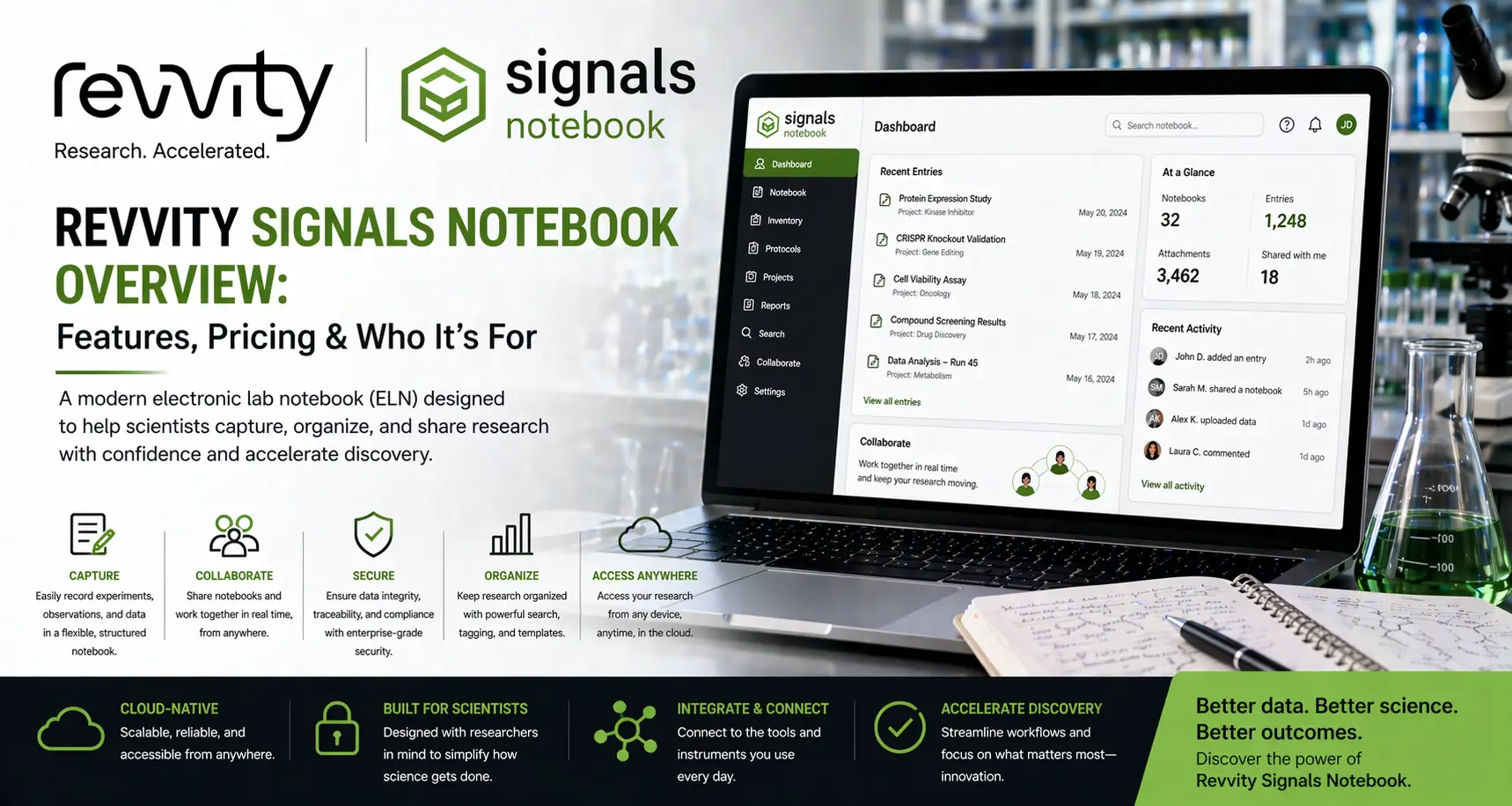
Signals Notebook is the flagship ELN of Revvity Signals Software, the informatics division of Revvity, Inc. (NYSE: RVTY). It is the most widely adopted ELN in this review series by any measurable scale: 1 million scientists at 4,000 organisations use it (AWS Marketplace). Named customers include Eli Lilly, Roche Diagnostics, AstraZeneca, Merck KGaA, Lundbeck, Givaudan, and FrieslandCampina. Stanford University and the NIH intramural research programme both run it. Revvity Signals Software employs approximately 720 people and serves those 1 million users worldwide (revvitysignals.com/company/about-us).
Understanding Signals Notebook requires understanding where it comes from. Revvity’s informatics lineage begins with CambridgeSoft, the company that developed ChemDraw in 1985. CambridgeSoft was sold to PerkinElmer in 2011 (Wikipedia), and its lab notebook product — then called E-Notebook — was developed as an enterprise ELN for decades. In 2022, PerkinElmer split into two independent public companies: the life sciences and diagnostics businesses became Revvity, Inc. (NYSE: RVTY); the applied and enterprise businesses kept the PerkinElmer name and went private. Revvity’s software division became Revvity Signals Software, and Signals Notebook is the cloud-native successor to E-Notebook — rebuilt from scratch on a microservice architecture rather than ported to the cloud (white paper, revvitysignals.com).
This article draws on revvitysignals.com (product pages, About Us, case studies, white papers, NEXUS Europe 2025 recap, FAQ pages), the Signals Notebook August 2024 data sheet, the ‘5 Benefits of Signals Notebook’ white paper (January 2025), the Eli Lilly case study (May 2025), AWS Marketplace (product listing and verified reviews), NIH Office of Intramural Research ELN policy (confirmed as active Signals Notebook deployment), Stanford University Science Library (confirmed active licence), G2 (Revvity Signals seller page: 4.4/5, 42 reviews), PeerSpot, ChemDraw Wikipedia article, Wikipedia (Revvity). Revvity Signals has not reviewed, sponsored, or paid for this article.
Company and heritage — why the ChemDraw lineage matters
Revvity is not a startup building a new ELN. It is the scientific informatics arm of a company with 65+ years of history in life sciences and analytical chemistry, with direct lineage to the most trusted chemical drawing tool in existence. This heritage is operationally relevant: Signals Notebook’s native ChemDraw integration is not a partnership or an API connection — ChemDraw is developed by the same organisation, on the same platform, and updated in lockstep with Signals Notebook.
The informatics product line progression is: CambridgeSoft E-Notebook (1990s–2011) → PerkinElmer E-Notebook (2011–2022) → Revvity Signals Notebook (2022–present). Signals Notebook was built cloud-native from the ground up — not a cloud-hosted version of legacy on-premise software. The original E-Notebook product has been sunset. Signals Notebook Standard is the current active product; the Individual Edition reached End of Life on March 1, 2025 (Revvity Signals support portal), with data migration paths to Standard provided.
Revvity Signals Software also maintains an exclusive partnership with Spotfire (the TIBCO/Cloud Software Group data analytics platform), embedding it within the Signals platform for scientific data visualisation. This Spotfire relationship provides advanced analytics capability directly connected to ELN data — a combination that is otherwise unavailable in a single vendor stack from any other ELN in this series.
| On the Revvity corporate context | Revvity (NYSE: RVTY) is a publicly traded company with initial revenues of approximately $3 billion (Wikipedia) and approximately 11,000 employees. Revvity Signals Software is one division within Revvity. Lab managers signing multi-year ELN contracts benefit from the vendor stability that public company status provides — financial disclosures, public accountability, and institutional investment discipline. The risk of unexpected acquisition or discontinuation is lower than for small private ELN vendors. The offsetting consideration is that Revvity is a large organisation: product decisions reflect enterprise-wide priorities, not just the ELN user community. |
At a glance
| Field | Details |
| Product | Signals Notebook — cloud-native ELN and scientific collaboration platform |
| Parent company | Revvity Signals Software, division of Revvity, Inc. (NYSE: RVTY). HQ: Waltham, Massachusetts, USA. ~11,000 employees (Revvity). ~720 employees (Revvity Signals Software). Origins: CambridgeSoft → PerkinElmer Informatics → Revvity Signals. |
| Scale | 1 million scientists at 4,000 organisations worldwide (AWS Marketplace product listing, April 2026). |
| Product type | ELN (Electronic Lab Notebook) and scientific collaboration platform. Primary purpose: experiment documentation, data capture, collaboration, IP protection, and regulatory compliance in R&D environments. |
| Architecture | Cloud-native SaaS built on AWS. Microservice architecture — each component operates independently; self-healing and resilient. No on-premise version available. |
| Release cadence | 10 releases per year (confirmed on product page and FAQ). Updates deployed automatically — no customer IT action required. |
| Free trial | Yes — available on revvitysignals.com. No credit card required for trial. |
| ChemDraw | Native, embedded integration. The only cloud ELN with ChemDraw. Automates stoichiometry calculations, supports SMILES, CAS Number search, structure/substructure/similarity search. Full access to PubChem safety data sheets. |
| Spotfire | Exclusive partnership for scientific data analytics and visualisation. Embedded within the Signals platform for advanced data analysis connected directly to ELN data. |
| Signals DLX | Digital Lab Exchange (powered by Scitara): automated instrument data capture, parsing, and organisation directly into Signals Notebook. Eliminates manual transcription from analytical instruments. |
| Signals One | Higher-tier offering adding AI-enhanced workflows, structured data handling, structure-activity relationship (SAR) analysis, and deeper data intelligence on top of Signals Notebook foundations. |
| Signals Inventa | Enterprise data analytics and management layer for the Signals platform. |
| Signals VitroVivo | In vitro/in vivo biological data management module within the Signals platform. |
| Inventory | Chemical and sample inventory management built directly within Signals Notebook. Barcode scanning, location tracking, automatic low-stock alerts, material traceability. |
| Compliance | 21 CFR Part 11 (audit trails, e-signatures, version control, page locking), GxP-ready, IP protection (sign/close/witness workflows). SOC 2 Type II certified. FedRAMP in progress (provisional NCATS ATO for NIH use). IQ/OQ/PQ templates and validation packages provided. |
| Security | SOC 2 Type II certified. Enterprise-grade AWS infrastructure. Encryption at rest and in transit. Role-based access controls. Multi-factor authentication. (revvitysignals.com FAQ) |
| Industries | Pharmaceutical and biotechnology, chemicals and materials science, food, flavor and fragrance, electronics, energy and petrochemicals (revvitysignals.com About Us). |
| Languages | Not explicitly confirmed beyond English in public sources. Global deployment across 4,000 organisations confirmed. |
| Pricing | Not publicly listed per-user. Standard Edition purchasable via Revvity Shop and AWS Marketplace (contract-based). Free trial available. Quote-based for enterprise deployments. Individual Edition reached End of Life March 1, 2025. |
| G2 | Revvity Signals products: 4.4/5 from 42 verified reviews (G2 seller page, April 2026). Signals Notebook listed with reviews on G2 and PeerSpot. |
What Signals Notebook does — and what makes it distinct
Signals Notebook’s core function is the same as every ELN in this series: provide a digital replacement for paper lab notebooks that captures experimental data with compliance, searchability, and collaboration. What distinguishes it is the scientific depth of the tooling built into that core, and the scale at which it operates.
Experiment documentation
Scientists create experiment records using flexible templates, rich text formatting, and embedded multimedia. The template system supports both free-form documentation and structured data capture across disciplines: synthetic chemistry, biology, formulations, and analytical work. Templates are highly customisable, and the AWS Marketplace review notes that template updating is “straightforward and everything is automatically saved.” Drag-and-drop file attachment works for a wide variety of data types including raw instrument data files, Office documents (versioned and captured in the audit trail), images, graphs, and videos.
Folder structures are customisable; cross-referencing between experiments is built in; and full-text search across the entire notebook is described by users as “lightning-fast” in the product description. The NIH Office of Intramural Research ELN policy confirms that Signals provides “CFR Part 11 compliant electronic signatures, audit trails, time stamps, page locking, and other features needed to support research expected to generate intellectual property.”
ChemDraw integration — why it matters operationally
For any lab that employs synthetic chemists, this is the critical section. ChemDraw has been the global standard for chemical structure drawing since 1985. More than a quarter century of the world’s published chemistry has been drawn in ChemDraw. Chemists who use ChemDraw every day can work in Signals Notebook without switching applications: draw a reaction, and stoichiometry is calculated automatically; paste a SMILES string or drag a ChemDraw file, and the structure is embedded in the experiment record; search by CAS Number, structure name, or chemical substructure/similarity across the notebook and across all registered materials.
The cloud-native ChemSearch engine (confirmed in the ‘5 Benefits’ white paper) is built on Elastic Search — the same engine behind most modern online search systems — enabling substructure and similarity searching at scale across tens of millions of structures. The 2024 launch of Signals ChemDraw (web-based ChemDraw+) fully integrates ChemDraw with the Signals platform, and AstraZeneca presented at NEXUS Europe 2025 on advanced HELM features in ChemDraw for new modalities including peptides, oligonucleotides, and antibody-drug conjugates.
Collaboration
Signals Notebook is explicitly designed for decentralised and multi-site teams: “a central communication hub across decentralised organizations” (AWS Marketplace). Sharing is granular — notebooks, experiments, and individual pages can be shared with configurable permissions. Commenting, review, approval, and @mention notifications work in real time. The Roche case study (revvitysignals.com) describes a global rollout across research, manufacturing, and quality functions — confirming that the collaboration model scales to large, multi-geography organisations.
Signals DLX — instrument data capture
Signals DLX (Digital Lab Exchange, powered by Scitara Corporation) is the integration layer that connects analytical instruments to Signals Notebook. Without DLX, scientists manually export instrument data files and attach them to ELN entries — a common source of transcription errors and compliance risk. With DLX, instrument data is automatically captured, parsed, and organised into the relevant notebook entry. At NEXUS Europe 2025, Merck Electronics described how they deployed Scitara DLX to capture data from a wide range of analytical instruments and send it both to Signals Notebook and to a relational database for further analysis. Scitara DLX can also act as an AI mediator to integrate APIs across platforms — including with Waters Empower CDS (confirmed at NEXUS Europe 2025).
Inventory management
An inventory module is built directly within Signals Notebook — chemicals, reagents, and samples are tracked without switching systems. Features confirmed on revvitysignals.com: barcode scanning for rapid material capture, built-in location tracking, full material traceability, and automatic low-stock alerts. Merck Electronics presented at NEXUS Europe 2025 on using Signals Notebook Inventory to unify their chemical inventory management across the organisation. This is a direct response to the common pain of ELNs that require a separate inventory system and manual linkage.
Compliance and IP protection
Signals Notebook’s compliance architecture covers the two distinct regulatory environments that pharma and biotech labs navigate:
- 21 CFR Part 11 (FDA electronic records): Automated audit trails with complete change history, configurable electronic signatures, role-based access controls, multi-factor authentication, and version control. The Eli Lilly case study confirms sign/close/witness workflows and the ability to capture reasons for changes as required for 21 CFR Part 11.
- GxP environments (GLP, GMP): GxP-ready with IQ/OQ/PQ templates and validation packages provided by Revvity for regulated deployments. Eli Lilly implemented Signals Notebook in a GxP environment, with Revvity providing comprehensive documentation. NIH OIR confirms: “GxP compliant-ready; suitable for use in user-validated GLP and GMP environments.”
- Intellectual property protection: Sign/close/witness workflows with timestamped, page-locked entries create legally defensible records for IP documentation.
- SOC 2 Type II: Certified — confirms that Revvity’s security controls have been independently audited and verified over time, not just at a single point.
- FedRAMP (US federal government): In progress. NIH OIR confirms Signals Notebook is operating under a provisional ATO with NCATS sponsorship while pursuing full FedRAMP certification. Relevant for US government and federally-funded academic labs.
Signals One — the enterprise evolution
Signals One is positioned as the next layer beyond Signals Notebook, adding AI-enhanced workflows, structured data handling, deeper SAR (structure-activity relationship) insights, and integrated analytics (via Signals Inventa). Per the revvitysignals.com Signals One description: it takes Signals Notebook’s experimental capture, interfaces and integrations, inventory, and material registration and adds “data intelligence, including structured data handling, Signals analytics, SAR analysis and decisioning, and AI enhancement.” For labs moving from paper-based processes, Signals Notebook Standard is the appropriate starting point. For large enterprises with existing Signals Notebook deployments wanting AI-driven decision support, Signals One is the natural evolution.
Named customers and verified context
Signals Notebook has the most extensively documented named customer list of any ELN reviewed in this series. All references below are confirmed from revvitysignals.com customer presentations or named institutional deployments:
| Customer | Industry / function | Confirmed context |
| Eli Lilly | Global pharma, GxP R&D | Full case study published May 2025. IT Manager Alycia Hargraves presented at Revvity Signals event on implementing and maintaining Signals Notebook in a GxP environment: drivers, selection, testing, validation, deployment, and ongoing maintenance. (revvitysignals.com case study) |
| Roche Diagnostics | Global biopharma, manufacturing and quality | Research Labs PM Jen Kraljevich presented on global rollout of Signals Notebook across research, manufacturing, and quality functions, with specific focus on GxP in manufacturing. (revvitysignals.com industry peer presentations) |
| AstraZeneca | Global pharma, new drug modalities | Presented at NEXUS Europe 2025 on collaboration with Revvity Signals to develop HELM features in Signals ChemDraw for peptides, oligonucleotides, and antibody-drug conjugates. (revvitysignals.com NEXUS 2025 recap) |
| Merck KGaA (Electronics division) | Electronics / speciality materials | Dr. Mark Goulding presented on Signals Notebook Inventory for chemical inventory management. Also featured at NEXUS Europe 2025 for deploying Scitara DLX to capture analytical instrument data into Signals Notebook. (revvitysignals.com) |
| Lundbeck | Pharma, CNS drug discovery | Presented at NEXUS Europe 2025. (revvitysignals.com NEXUS 2025 recap) |
| Givaudan | Flavours & fragrances | Presented at NEXUS Europe 2025. (revvitysignals.com NEXUS 2025 recap) |
| FrieslandCampina | Food & nutrition | Presented at NEXUS Europe 2025. (revvitysignals.com NEXUS 2025 recap) |
| Stanford University | Academic research | Active institutional licence for Signals Notebook Standard + ChemDraw+. Accessible to all Stanford users via Science Library. (Stanford Science Library access guide, March 2026) |
| NIH (Intramural Research) | Federal government research | Active deployment under provisional ATO with NCATS sponsorship. NIH OIR ELN policy mandates electronic lab notebooks for all new intramural research as of June 30, 2024; Signals Notebook is one of two approved platforms. (NIH OIR ELN Policy page) |
| Named customer note | All customer references in the table above are confirmed from vendor-published case studies, named presentations at Revvity’s own user conference (NEXUS Europe 2025), and independent institutional documentation (NIH OIR policy, Stanford library). Efficiency metrics and implementation outcomes from Eli Lilly and Roche are drawn from vendor-published materials and are attributed accordingly as vendor-published. Lab managers should request direct reference calls with customers in their industry vertical before committing. |
Pricing
Revvity does not publish per-user pricing publicly. Signals Notebook Standard Edition is purchasable directly via the Revvity Shop (shop.revvitysignals.com) and the AWS Marketplace, but pricing is not displayed without account engagement. The AWS Marketplace listing confirms pricing is “based on the duration and terms of your contract with the vendor.” Enterprise deployments are quote-based.
Two important product changes to note for lab managers:
- Individual Edition is discontinued (EOL March 1, 2025): The Individual Edition — previously bundled with ChemOffice/ChemDraw licences — reached End of Life on March 1, 2025. Users who had Individual Edition accounts lost access on that date, with data destroyed unless exported or migrated to Standard (Revvity Signals support portal, confirmed). If your organisation previously used Individual Edition, migration to Standard is the supported path.
- Free trial available: A full-featured free trial of Signals Notebook Standard is available at revvitysignals.com with no credit card required. This is the most direct way for lab managers to evaluate the product before engaging the sales team.
| Pricing approach for lab managers | Start with the free trial before any sales conversation. Use the trial to evaluate ChemDraw integration with your chemists’ actual structures, test collaboration workflows across your team, and assess template configurability for your most complex protocols. Then request a quote specifying: number of named users; whether you need Signals One or just Signals Notebook Standard; Signals DLX instrument integration requirements; validation package support; and whether you are on AWS and wish to use AWS Marketplace procurement. Stanford’s Science Library note confirms the system requires a manual licence provisioning step by an administrator — factor implementation support into your timeline. |
Who Signals Notebook is designed for
Based on Revvity’s stated verticals, the named customer base, and the product’s architectural choices, the clearest fit for Signals Notebook is:
- Pharmaceutical and biopharma R&D and development organisations whose scientists work in synthetic chemistry, medicinal chemistry, or chemical biology — where native ChemDraw is not a nice-to-have but a daily workflow requirement. If your chemists currently draw structures in ChemDraw and copy them into a separate ELN, Signals Notebook eliminates that friction entirely.
- Global, multi-site R&D organisations that need real-time collaboration across geographies and time zones. The product’s cloud-native architecture, combined with the named deployments at Eli Lilly, Roche, AstraZeneca, and Merck KGaA, confirms the enterprise-scale, multi-site model is production-tested.
- Regulated labs (GxP, 21 CFR Part 11) that need a cloud ELN with validated compliance workflows and IQ/OQ/PQ documentation support. The Eli Lilly GxP case study is the most specific validated production evidence in this series.
- Chemicals, materials science, food and fragrance, and flavour labs that work with chemical structures and formulations. Revvity’s verticals explicitly include specialty and agro-chemicals, energy and petrochemicals, flavors and fragrances, and food and beverage — and named customers Givaudan and FrieslandCampina confirm real deployments in those sectors.
- University and academic research groups that have institutional ChemDraw licences (Stanford, NIH) and want a cloud ELN that works within that same vendor relationship.
- Labs standardising on a cloud-native architecture with automatic updates, no on-premise infrastructure, and flexible scaling for growing teams.
Signals Notebook is less commonly the right choice for:
- Labs whose primary discipline is biology, genomics, or molecular biology — where ChemDraw is not central to daily work. In those environments, Benchling (with deep molecular biology tooling), SciSure, or Labguru may provide equal or better value without paying for ChemDraw capability that goes unused.
- Labs that require on-premise deployment for data sovereignty or IT governance reasons. Signals Notebook is cloud-only (AWS). For on-premise ELN, BIOVIA Notebook, E-WorkBook, or Sapio Sciences are better positioned.
- Small labs or individual researchers on tight budgets who were relying on the Individual Edition. That product is now End of Life. Signals Notebook Standard requires a licence engagement with Revvity. Free open-source alternatives like eLabFTW, or lower-cost commercial ELNs like Labguru, are better positioned for small teams.
- Labs that need a fully integrated LIMS+ELN in a single product. Signals Notebook is an ELN that integrates with external LIMS via API. For a unified LIMS+ELN from a single vendor, BIOVIA ONE Lab, Sapio Sciences, or Labguru may be more appropriate.
What users say
Revvity Signals products are rated 4.4/5 from 42 verified G2 reviews (G2 seller page, April 2026). AWS Marketplace surfaces reviews from both G2 and PeerSpot for Signals Notebook specifically. The overall pattern from independent reviews is positive on core functionality and negative on workflow complexity and support responsiveness.
What users praise
- Ease of use: Multiple reviewers describe Signals Notebook as intuitive and modern, “looks and feels like modern consumer apps.” One AWS/G2 reviewer rates it 9/10 specifically because of ease of use.
- Cross-site collaboration: A chemical process development user describes compiling data from multiple projects and working across two sites in different cities as a concrete operational improvement: “we can work on one experiment across different sites of the company.”
- Template system: Reviewers describe templates as easy to create and update, significantly reducing repetitive data entry. “We can use templates for experiment creation, allowing us to avoid repetitive tasks.”
- Stability at scale: One reviewer describes deploying to nearly 100,000 users in a single client environment, describing Signals Notebook as stable at that scale. “Since it was developed from scratch, it is a very stable product.”
- Speed vs. legacy systems: Signals Notebook is described as swift compared to other vendor-built software where “you have to customize templates and write a lot of code.”
What users criticise
- Workflow implementation: The most consistent criticism is that complex workflows rely on Spotfire with added plugins that are not natively integrated into Signals Notebook. One reviewer states this “makes execution slow and less effective in meeting all scientific workflow needs” and that Revvity’s workflow products outside core Signals Notebook are described as less stable. This is a meaningful distinction: Signals Notebook core is praised; the ecosystem products connecting it to analytics are described as less mature.
- Support responsiveness: Multiple reviewers independently describe support response times as slow. “Even known problems take time due to a lack of a strong developer support team.” This is the most consistent negative across independent reviews.
- Complex data integration requires developer resources: For advanced data integration beyond the standard product, reviewers note that using Revvity’s REST API to expose data to a data lake “can be costly and resource-intensive.” One reviewer explicitly advises evaluating whether complex analytics use cases are achievable before committing.
- Overall rating context: One reviewer rates Signals Notebook 6/10 due to concern about Revvity’s focus being narrowed to core products while peripheral products receive less attention. This is a single data point but worth noting for labs that plan to use the full Signals ecosystem rather than Signals Notebook alone.
| Review context for lab managers | The consistent pattern in independent reviews is: Signals Notebook core ELN — highly rated. Workflow automation and ecosystem integration at the edges — less mature and more complex. Labs evaluating Signals Notebook for pure ELN functionality (documentation, collaboration, ChemDraw, compliance) should be reassured by the consistency of positive core reviews. Labs planning to deploy Signals Notebook as the centre of a complex automation and analytics ecosystem should specifically evaluate the workflow and DLX capabilities in a trial before committing, and should ask Revvity directly about the current state of the non-Notebook products they plan to use. |
Quick verdict
| Best for | Pharmaceutical, biopharma, chemicals, materials science, and food/fragrance R&D organisations where synthetic chemistry is a central or significant workflow, native ChemDraw is a requirement rather than a preference, and scientists work across multiple sites or geography. Signals Notebook’s combination of native ChemDraw, Spotfire analytics, GxP-validated compliance architecture, and a named customer base that includes Eli Lilly, Roche, AstraZeneca, Merck KGaA, Lundbeck, and Givaudan makes it the most validated ELN for chemistry-intensive pharma and specialty chemicals environments. The 10 releases per year, SOC 2 Type II certification, and cloud-native AWS architecture provide the vendor maturity and security posture that enterprise procurement teams require. |
| Consider alternatives if | Your lab is primarily biology-focused and ChemDraw is not a daily tool: Benchling or Labguru are better positioned for molecular biology, genomics, and life science R&D workflows. If you need on-premise deployment, BIOVIA Notebook or Sapio Sciences offer regulated on-premise options. For small labs or individual researchers previously using the Individual Edition: the EOL of that product on March 1, 2025 means you now need a Standard licence — evaluate whether eLabFTW (free, open-source) or Labguru Standard serve your needs at lower cost. For an integrated LIMS+ELN in one product rather than an ELN with LIMS API integration, BIOVIA ONE Lab, Sapio Sciences, or Labguru offer tighter native unification. |
Further reading
- Signals Notebook official product page
- Signals Notebook free trial
- Eli Lilly GxP implementation case study (May 2025)
- 5 Benefits of Signals Notebook — white paper (January 2025)
- Signals Notebook August 2024 data sheet
- NEXUS Europe 2025 — customer presentations recap (AstraZeneca, Roche, Merck KGaA, Lundbeck, Givaudan)
- Industry peer use case presentations (Eli Lilly, Roche, Merck Electronics)
- Revvity Signals About Us (720 employees, 1M users)
- Signals Notebook on AWS Marketplace (verified reviews)
- NIH OIR ELN Policy (confirms active deployment and FedRAMP status)
- Sunset Notice: Signals Notebook Individual Edition (EOL March 1, 2025)
- Revvity — Wikipedia (company history and PerkinElmer split)
- ChemDraw — Wikipedia (CambridgeSoft history, 1985 origins)
- labsoftwareguide.com: Best ELN Software 2026
| Editorial note | This article draws on: revvitysignals.com (Signals Notebook product page, About Us, FAQ, Signals Notebook FAQs, NEXUS Europe 2025 event recap, industry peer presentations page, Signals Research Platform FAQs); the Signals Notebook August 2024 data sheet PDF; the ‘5 Benefits of Signals Notebook’ white paper (January 2025); the Eli Lilly GxP ELN implementation case study (May 2025); AWS Marketplace (Signals Notebook product listing and verified G2/PeerSpot reviews, April 2026); Revvity Signals support portal (Sunset Notice: Individual Edition, March 2024; Signals Notebook Individual Edition EOL confirmation); Wikipedia (Revvity, Inc. — PerkinElmer split history; ChemDraw — CambridgeSoft history); Drug Discovery World (Revvity rebrand announcement, May 2023); NIH Office of Intramural Research ELN Policy (confirmed active deployment, FedRAMP provisional ATO); Stanford University Science Library access guide (confirmed active institutional licence, March 2026); G2 Revvity Signals seller page (4.4/5, 42 reviews, April 2026); PeerSpot (Revvity Signals Notebook reviews). All customer references from revvitysignals.com are vendor-published and attributed accordingly. Independent user review quotes are sourced from AWS Marketplace (G2/PeerSpot verified reviews) and attributed as such. Revvity Signals Software has not reviewed, sponsored, or paid for this article. Last verified: April 2026. |