| The single most important thing to know | If your lab runs Agilent instruments, SLIMS has a native advantage no other LIMS in this series can match. SLIMS 7.2 introduced bidirectional, automated integration with Agilent MassHunter (LC/MS) and Agilent OpenLab CDS (chromatography). Worklists generate directly from your sample database and results return automatically — without manual transcription. If you operate Agilent LC-MS, HPLC, TapeStation, Bravo liquid handlers, or the Alissa genomics platform, SLIMS connects to your existing instrument ecosystem natively. If your lab does not use Agilent instruments, this differentiator does not apply, and other LIMS in this series — with stronger independent review bases and more transparent pricing — deserve equal or greater consideration. |
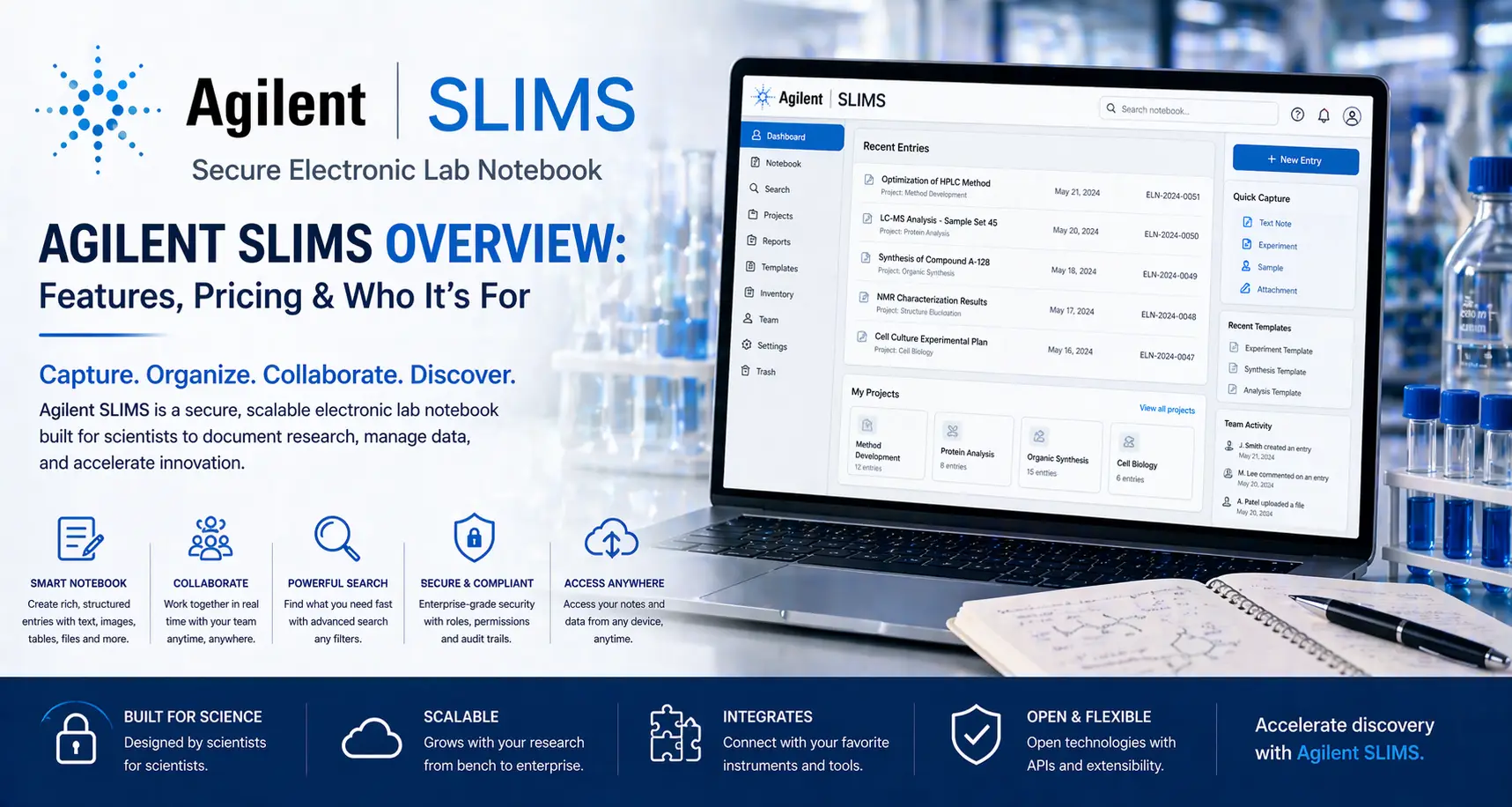
Agilent SLIMS is a Laboratory Execution System (LES) that combines LIMS, ELN, and workflow management in a single platform. It is one of the few LIMS products in this series owned by a publicly traded analytical instrument manufacturer — Agilent Technologies (NYSE: A), a global leader in life sciences, diagnostics, and applied chemical markets with revenues of approximately $6.8 billion. That parentage is both SLIMS’s greatest differentiator and a key factor in understanding who it is built for.
SLIMS was created by Genohm, a company founded in Ghent, Belgium in 2002 (as a two-person bioinformatics shop) that re-established itself in 2011 as an EPFL spin-out at the Innovation Park in Lausanne, Switzerland. Genohm released SLIMS in 2010 and grew it across Europe, the Middle East, Asia Pacific, and the US before Agilent acquired the company in May 2018 (Business Wire, 2 May and 14 May 2018). At acquisition, Genohm had 40 employees and offices in Lausanne, Ghent, and Durham, North Carolina. The acquisition was framed by Agilent as adding LIMS and workflow management to its software portfolio — specifically to complement its OpenLab chromatography software suite.
The current version is SLIMS 7.2, released in 2025, which introduced a modernised interface aligned with Agilent’s visual identity, a touchscreen Bench UI for protocol execution at the bench, and deeper integration with MassHunter and OpenLab CDS. SLIMS is deployed in more than 20 countries and supports nine languages: Chinese (Simplified), Dutch, English, French, German, Italian, Japanese, Korean, and Spanish.
This article draws on agilent.com/slims, explore.agilent.com (SLIMS product pages), the Agilent Business Wire acquisition press releases (May 2018), the EPFL press release on the acquisition, G2, Capterra, GetApp, and a competitor-authored Scispot pricing analysis (September 2025). Agilent has not reviewed, sponsored, or paid for this article.
At a glance
| Field | Details |
| Product | Agilent SLIMS (Smart Laboratory Information Management System). Current version: 7.2. |
| Product type | Lab Execution System (LES): unified LIMS + ELN + workflow management in one platform. |
| Origin | Created by Genohm SA (founded 2002 Ghent, Belgium; re-established 2011 EPFL Innovation Park, Lausanne, Switzerland). SLIMS released 2010. Acquired by Agilent Technologies May 2018. |
| Parent company | Agilent Technologies, Inc. (NYSE: A). Global leader in life sciences, diagnostics, and applied chemical markets. ~$6.8B revenue (FY2024). 14,200+ employees worldwide. |
| Deployment | On-premise (customer’s own server), Agilent-hosted cloud, or customer’s preferred cloud provider. Browser-based — no client software needed on workstations. Tablet-accessible. Confirmed on agilent.com/slims and pharma product page. |
| Verticals | Pharmaceutical and biopharma QC, analytical chemistry, NGS (next-generation sequencing), biobanks/biorepositories, R&D research, PFAS testing, cannabis testing. Confirmed on agilent.com product pages. |
| Languages | Chinese (Simplified), Dutch, English, French, German, Italian, Japanese, Korean, Spanish. Confirmed on GetApp. |
| API | Yes — REST API available. Confirmed on GetApp and explore.agilent.com. |
| SLIMS Store | Pre-packaged configurations library: sample types, locations, metadata, automation snippets, sample sheets, workflow templates. Allows rapid deployment of pre-built content rather than starting from scratch. |
| Compliance | FDA 21 CFR Part 11, EU Annex 11, GAMP5, ISO/IEC 17025, EPA 40 CFR Part 160, ISO 20387:2018 (biobanks), ISBER Best Practices (biobanks), SPREC (biospecimen preanalytical variables), HIPAA, CLIA, ISO 13485, ISO 15189 (NGS). Confirmed on agilent.com product pages. |
| ISO 27001 | Agilent SLIMS ISO 27001 certificate available at agilent.com/quality/SLIMS_27001.pdf (confirmed on agilent.com). |
| Key Agilent integrations | OpenLab CDS (bidirectional, automated, versions 2.6+), MassHunter (bidirectional, LC/MS worklists + results, v7.2), Alissa Interpret (genomic variant analysis), TapeStation (DNA/RNA QC, automatic result transfer), Bravo liquid handler. Confirmed on agilent.com/slims/whats-new and pharma/NGS/biobank product pages. |
| Non-Agilent integrations | SAP (ERP), iLab (lab management), identity management systems, billing systems, EMR (electronic medical records via plugins), Illumina BaseSpace (NGS), sequencing instruments. API enables third-party connections. |
| Global deployment | 20+ countries (agilent.com biobanks page). First customers: EPFL research units (EPFL press release, 2018). |
| Named customers | doTERRA (essential oils company, saves 50+ hours/week by replacing paper workflows, explore.agilent.com). Anonymous: “SLIMS became crucial to our activities and is now the keystone of all our operations.” Anonymous pharma application note: biopharma QC lab for mAb release tests (agilent.com). No named pharmaceutical or biobank customers confirmed in press releases. |
| Pricing | Entirely quote-based. No published tiers. No free trial. Implementation requires paid professional deployment services. Contact Agilent directly. |
| G2 / Capterra | Both listed. G2 profile has limited features. Review count on both platforms is small compared to other LIMS in this series. G2 alternatives page lists reviews in the Pharmaceuticals industry category. |
| Support options | Email/Help Desk, FAQs/Forum, Phone Support, Knowledge Base (GetApp). Global SLIMS engineers for installation, validation, training, customisation confirmed on agilent.com. |
What Agilent SLIMS does — and what makes it a LES, not just a LIMS
Most LIMS manage samples and results. SLIMS is positioned as a Lab Execution System (LES) — a term that reflects a scope beyond sample tracking. Agilent’s own definition on explore.agilent.com describes an LES as “a combination of LIMS functionality and ELN functionality” that converts “paper-based processes into fully automated and integrated digital workflows.” In practice, this means SLIMS is designed not just to record what happened, but to guide analysts through each step as they work — step-by-step protocol execution, instrument control, result retrieval, and review, all from a single system.
The four core functional layers, all confirmed on agilent.com and explore.agilent.com:
1. Sample management (LIMS layer)
Sample tracking through the full lifecycle: intake, storage, location management, status monitoring, lineage (parent-child relationships for derived samples, aliquots), chain-of-custody logging, and disposal. Every change is timestamped and attributed to the user making it. The system supports barcode and label integration. Inventory management covers reagents, consumables, and instruments — including maintenance scheduling, calibration tracking, and usage restrictions (ensuring only approved instruments and valid reagents are used for a given test).
2. Workflow and protocol execution (ELN/LES layer)
The Workflow Module is SLIMS’s most distinctive feature relative to traditional LIMS. Analysts are guided through procedures step-by-step via digital protocols — what the system calls “task-based workflow execution.” The output of one step automatically becomes the input for the next. A single sample can be used in multiple parallel tests (e.g., the same material simultaneously routed to a pH test and an HPLC test) without duplication. Lab managers see in real time who is working on what, what stage each sample is at, and what work remains. The v7.2 Bench UI adds touchscreen execution for running protocols directly at the bench without a keyboard.
Protocols are designed to avoid the “monolithic electronic protocol” problem — where a paper SOP is copied into a digital form verbatim, creating a long scrolling document that does not reflect actual lab operations. SLIMS allows operators to define modular, linked workflow steps that mirror how work actually flows.
3. Instrument integration
This is where SLIMS’s Agilent parentage delivers the most concrete operational value for labs already in the Agilent instrument ecosystem. Confirmed integrations and their mechanics:
- OpenLab CDS (chromatography): Bidirectional, automated, secure. SLIMS instruments are accessible in OpenLab; while the sequence runs, results are processed in OpenLab CDS Data Analysis and returned automatically to the SLIMS test protocol without user involvement. Compatible with OpenLab CDS versions 2.6 and later. Confirmed on agilent.com pharma page and v7.2 release notes.
- MassHunter (LC-MS): Bidirectional integration added in v7.2. Generate worklists directly from the SLIMS sample database and automatically retrieve LC/MS results. Confirmed on agilent.com/slims/whats-new.
- TapeStation (DNA/RNA QC): Automatic result transfer. Confirmed on agilent.com biobanks page.
- Bravo liquid handler: Automation control. Confirmed on NGS page.
- Alissa Interpret (genomics): Integration with Agilent’s variant analysis platform for NGS pipelines. Confirmed on NGS page.
- Non-Agilent instruments: SLIMS can interface any CDS to control instruments and retrieve results. SAP, iLab, identity management, billing, and EMR integrations confirmed. Illumina BaseSpace confirmed for NGS. REST API available for custom integration.
| The instrument integration decision | For lab managers making a LIMS purchasing decision: the native Agilent instrument integrations are a meaningful operational advantage if your lab uses Agilent LC/MS (MassHunter), HPLC (OpenLab CDS), DNA analysis (TapeStation), or genomics (Alissa). Results return automatically and traceability is maintained without custom scripting. For labs that use non-Agilent instruments predominantly (e.g., Waters HPLC, Thermo Fisher instruments, Beckman liquid handlers), this advantage is reduced — though the REST API and non-Agilent CDS integration capability remain available. Evaluate which instruments represent the majority of your automated data flows before weighting instrument integration in your SLIMS assessment. |
4. Reporting and compliance
SLIMS generates customisable reports for certification and delivery to customers. Pass/fail reports are automated based on pre-defined specifications. Audit trails capture every action with user attribution and timestamp. Review by exception workflows route only flagged items to supervisors, reducing review burden. Electronic signatures support 21 CFR Part 11 and EU Annex 11 requirements. For biobanks, SLIMS supports ISBER guidelines and ISO 20387:2018. For NGS labs, HIPAA, CLIA, ISO 13485, ISO 15189 compliance support is confirmed.
Vertical configurations — how SLIMS adapts to your lab type
Rather than one generic LIMS, Agilent maintains distinct configurations for each major vertical, documented on separate product pages and the SLIMS Store:
Pharmaceutical and biopharma QC
SLIMS is positioned as a complement to (or replacement for) existing LIMS in pharma QC environments. It covers the analytical workflow from request submission through sample preparation, instrument execution, result review, and final report delivery. The pharma page features an application note on a biopharmaceutical QC lab configured to emulate mAb (monoclonal antibody) release testing — described as a paperless digitisation of a biopharma QC workflow. Stability testing is covered by a dedicated Stability Module: define study conditions (temperature, humidity, photolysis), packaging, timepoints, and specifications; SLIMS manages batch enrollment, sample pulls, testing plans, and trending reports. Compliance: FDA 21 CFR Part 11, EU Annex 11, GAMP5, ISO 17025.
NGS (Next-Generation Sequencing)
SLIMS for NGS is described as “one automated system that supports your entire NGS workflow.” It covers sample intake, plate management, batch processing, library preparation, sequencer integration (Illumina BaseSpace, sample sheet generation), and variant analysis (Alissa Interpret). Pre-loaded index plates from Agilent SureSelect, Illumina Nextera XT, BGI, and 10x Genomics. No programming needed: SLIMS writes the instrument control scripts. Compliance: HIPAA, CLIA, ISO 13485, ISO 15189.
Biobanks
SLIMS for Biobanks manages the full biospecimen lifecycle: consent tracking, subject registration, visit scheduling, collection events, processing, storage (with location hierarchy), monitoring, retrieval, sharing, and shipment. Configurable metadata captures all preanalytical variables per SPREC standard. Personal data is encrypted and coded under consent management. ISO 20387:2018 and ISBER Best Practice support confirmed. Notable: “deployments by SLIMS engineers in over 20 countries” confirmed on this page. Rapid deployment through preconfigured workflows (sample registration, consent tracking, storage management) deployable in minutes.
PFAS testing (new in v7.2)
A pre-packaged SLIMS for PFAS configuration was added in v7.2, covering EPA methods 533 and 1633. Ready-made content: PFAS-specific consumables, sample preparation workflows, pre-configured regulatory limits, end-to-end traceability from intake to final report. This is a significant addition for environmental and water testing labs facing PFAS regulatory requirements — and an expansion of SLIMS’s vertical coverage beyond its life-science origins.
R&D and research labs
For R&D environments, SLIMS acts as an ELN with asset management. Interactive note-taking, drag-and-drop media, protocol templates, version control, SOPs, and access rights management. Ad hoc templates facilitate data sharing. The quote on explore.agilent.com from an unnamed user: “SLIMS brings together different management systems for reagents, antibodies, mice, everything… all in a single system. There’s a depth and a richness to what’s being captured that didn’t exist before.”
Deployment options
SLIMS supports three deployment models, all confirmed on agilent.com and the pharma/biobanks product pages. No client software is needed on end-user workstations — access is entirely browser-based (Edge, Chrome) and tablets are supported:
- Agilent-hosted cloud: Agilent manages the server, maintenance, updates, and security. Described as “scalable, powerful, secure.” EU customers: Agilent’s infrastructure in the Lausanne region. The Agilent SLIMS team manages deployment.
- Customer’s preferred cloud provider: The customer chooses their cloud vendor (AWS, Azure, GCP) and Agilent deploys SLIMS there. Relevant for organisations with existing cloud contracts or cloud security policies.
- On-premise: Installed on the customer’s own server infrastructure. Appropriate for organisations with data sovereignty requirements or GxP-validated on-premise infrastructure.
In all three cases, Agilent’s global SLIMS engineers assist with installation, validation, training, and customisation. The SLIMS Store provides pre-configured packages to accelerate deployment. The pharma page describes deployment as “rapid but realistic,” following a milestone-based approach that minimises disruption to ongoing lab operations. Agilent explicitly trains customers to maintain SLIMS themselves for routine changes — reducing dependency on paid support for standard administration.
Pricing
Agilent does not publish SLIMS pricing. There is no free trial, no community edition, and no pricing calculator. All pricing is quote-based and requires engaging the Agilent sales team.
The only independent pricing signal comes from a competitor-authored Scispot analysis (September 2025), which estimates base licensing in the range of $5,000 to $7,000 per user annually, placing SLIMS in the same cost tier as Benchling enterprise. The same analysis notes that implementation requires a paid professional deployment project, and that standard support explicitly excludes “assistance involving program development, coding, or customisation” — meaning custom configurations may require additional consulting fees. Travel and accommodation costs for Agilent’s team during on-site work are billed separately per the Agilent service terms cited in that analysis.
This competitor-authored analysis (Scispot is a LIMS competitor and the source is attributed accordingly) provides useful directional context but should not be treated as confirmed pricing. Labs must contact Agilent directly for actual figures.
| Pricing approach for lab managers | When engaging Agilent on SLIMS pricing, request a comprehensive total cost of ownership quote covering: base licence fees per user or per module; implementation project fees (professional services); validation documentation support; annual maintenance and support costs; cloud hosting fees if Agilent-hosted; training costs; and the specific cost implications of any customisation beyond the SLIMS Store pre-built configurations. Given the enterprise price tier and implementation complexity, labs evaluating SLIMS should also assess whether their Agilent instrument portfolio size and integration value justifies the premium relative to alternatives. |
Who Agilent SLIMS is designed for
SLIMS’s design choices — deep Agilent instrument integration, LES workflow execution, multi-vertical pre-built configurations, and enterprise price tier — converge on a clear buyer profile:
- Labs already operating Agilent instruments, particularly those using OpenLab CDS for chromatography, MassHunter for LC-MS, TapeStation for DNA/RNA QC, or Bravo for liquid handling. The bidirectional, automated instrument integrations in v7.2 directly eliminate manual transcription errors in these workflows. If your lab runs predominantly Agilent analytical instruments, SLIMS is the natural single-vendor option.
- Pharmaceutical and biopharma QC labs in regulated environments needing FDA 21 CFR Part 11, EU Annex 11, and GAMP5 compliance with audit-ready traceability, electronic signatures, and review-by-exception workflows. The mAb release testing application note demonstrates this use case in production.
- NGS and genomics facilities managing high-volume plate workflows, library preparation, sequencing instrument integration, and variant analysis pipelines from a single system. The Alissa Interpret and Illumina BaseSpace integrations are purpose-built for this vertical.
- Biobanks and biorepositories with consent tracking, complex specimen lifecycle management, and ISO 20387:2018 compliance needs. SLIMS’s 20+ country deployment record in this vertical is a meaningful signal.
- PFAS testing laboratories that need EPA methods 533 and 1633 workflows pre-configured and ready to deploy. The v7.2 PFAS package is an immediate answer to a pressing environmental regulatory requirement.
- Mid-size to large labs with dedicated IT or informatics staff who can manage implementation and ongoing administration. SLIMS is not designed for self-service deployment.
SLIMS is less commonly the right choice for:
- Labs that primarily use non-Agilent instruments and do not need the OpenLab/MassHunter integration advantage. For these labs, the premium pricing is harder to justify against alternatives like QBench, STARLIMS, or Sapio Sciences that serve analytical and pharma workflows at comparable or lower cost with stronger review bases.
- Small labs or startups with limited IT support and tight budgets. The implementation complexity, enterprise pricing, and absence of a self-service path make SLIMS a poor fit for organisations that need to be up and running quickly on modest budgets. Labguru, SciCord, or eLabFTW are better positioned for those needs.
- Environmental, water/wastewater, food & beverage, and contract testing labs focused on regulatory accreditation (NELAC, ELAP) and high-volume sample throughput. The ATL/Confience Sample Master or CloudLIMS are purpose-built for those verticals at more accessible price points.
- Labs that require transparent per-user pricing before engaging a vendor. SLIMS’s fully opaque pricing model with a mandatory sales process is a procurement friction that some organisations cannot accommodate.
What users say
The public review base for Agilent SLIMS is smaller than most vendors in this series. G2 has a limited-feature profile. Capterra lists the product. Sourceforge notes no reviews submitted. The most substantive independent user signals come from G2 and from vendor-published anonymous quotes.
From G2 verified reviews
- A reviewer who had been using SLIMS for a few months describes it as “very convenient” and highlights the deployment flexibility: “easy to be deployed on-premise or cloud.” The primary positive: “I realised we don’t need another software for equipment and everything can be integrated — that was the best part.” The only notable negative: difficulty finding SOPs for some functionalities in the provided documentation.
- A second reviewer specifically praises “the connection between lab journal and experiment files or raw data” — the ability to link directly from an experiment record to the raw data file it references. Describes using SLIMS to “note down lab work and keep track of it without worrying about equipment from third parties.”
From vendor-published quotes (explore.agilent.com, attributed as vendor-published)
- doTERRA customer (named, explore.agilent.com): Saved over 50 hours per week by replacing paper workflows with SLIMS.
- Anonymous (explore.agilent.com): “SLIMS became crucial to our activities and is now the keystone of all our operations. SLIMS is used daily by our team members. It not only simplifies our access to data or replaces repetitive tasks, it seamlessly ensures traceability in compliance with our high-quality standards, it integrates analytical equipment to accelerate day-to-day laboratory procedures, and it serves as repository for SOPs and important documentation.”
- Anonymous R&D customer (explore.agilent.com): “SLIMS brings together different management systems for reagents, antibodies, mice, everything… all in a single system. There’s a depth and a richness to what’s being captured that didn’t exist before.”
| Review base note | SLIMS has a thin public review base by the standards of this series. Labguru (163 G2 reviews), SciSure (193), and STARLIMS (158) all have substantially larger review pools. For a lab manager making a significant purchasing decision, the public evidence base for SLIMS user satisfaction is insufficient on its own. The doTERRA case study (named) and the anonymous “keystone” quote provide some independent signal, but direct reference calls with existing SLIMS customers in your specific industry vertical are essential due diligence before committing to SLIMS at enterprise pricing levels. |
Quick verdict
| Best for | Labs running Agilent instruments — particularly those with OpenLab CDS (HPLC), MassHunter (LC-MS), TapeStation, or Bravo liquid handlers — where native bidirectional integration eliminates manual transcription and keeps the full analytical workflow within one system. Beyond instrument integration, SLIMS is purpose-built for pharmaceutical/biopharma QC, NGS facilities, biobanks, and PFAS testing labs that need a compliant, workflow-guided LES with a global Agilent engineering team supporting deployment. The backing of a $6.8B public company provides strong vendor continuity signals. For labs where the Agilent instrument ecosystem is central to their analytical workflow, SLIMS deserves priority evaluation. |
| Consider alternatives if | Your lab uses non-Agilent instruments predominantly and the instrument integration advantage does not apply. For pharma/QC regulated environments, STARLIMS, Sapio Sciences, or SciCord offer comparable compliance depth with stronger independent review bases and more established pricing signals. For NGS and R&D biotech without the Agilent instrument ecosystem, Benchling or Labguru are well-reviewed alternatives. For biobanks requiring open-source flexibility and no software cost, eLabFTW provides a community-supported ELN path. For analytical testing labs needing transparent pricing and fast deployment, QBench or CloudLIMS are better positioned. |
Further reading
- Agilent SLIMS official product page
- What’s new in SLIMS 7.2 (MassHunter, OpenLab CDS, PFAS, Bench UI)
- SLIMS for Pharmaceutical Labs
- SLIMS for NGS Laboratories
- SLIMS for Biobanks
- SLIMS overview — LIMS, ELN, and LES explained
- Agilent SLIMS on G2
- Agilent SLIMS on Capterra
- Agilent acquires Genohm — Business Wire, May 2018
- EPFL press release on Genohm acquisition
- labsoftwareguide.com: Best LIMS Software 2026
- labsoftwareguide.com: ISO 17025 and LIMS
| Editorial note | This article draws on: agilent.com/slims (main product page, v7.2 release notes, pharma page, NGS page, biobanks page); explore.agilent.com/AgilentSLIMS (SLIMS overview with customer quotes); the Agilent Business Wire press release (2 May 2018, acquisition announcement); the Agilent Business Wire completion press release (14 May 2018); the EPFL press release on the Genohm acquisition (EPFL Innovation Park, 2018); G2 (verified reviews); Capterra (listing); GetApp (product overview including languages, API, customer types); Scientific Computing World LIMS 2025 guide (January 2025); the Agilent ISO 27001 certificate PDF (agilent.com/quality/SLIMS_27001.pdf); and a Scispot competitor-authored pricing analysis (September 2025, attributed as competitor-authored). The doTERRA customer reference (50+ hours/week saved) and anonymous customer quotes are vendor-published on explore.agilent.com and attributed accordingly. Pricing estimates from Scispot are competitor-authored and attributed as such — labs must contact Agilent directly for actual pricing. Agilent Technologies has not reviewed, sponsored, or paid for this article. Last verified: April 2026. |