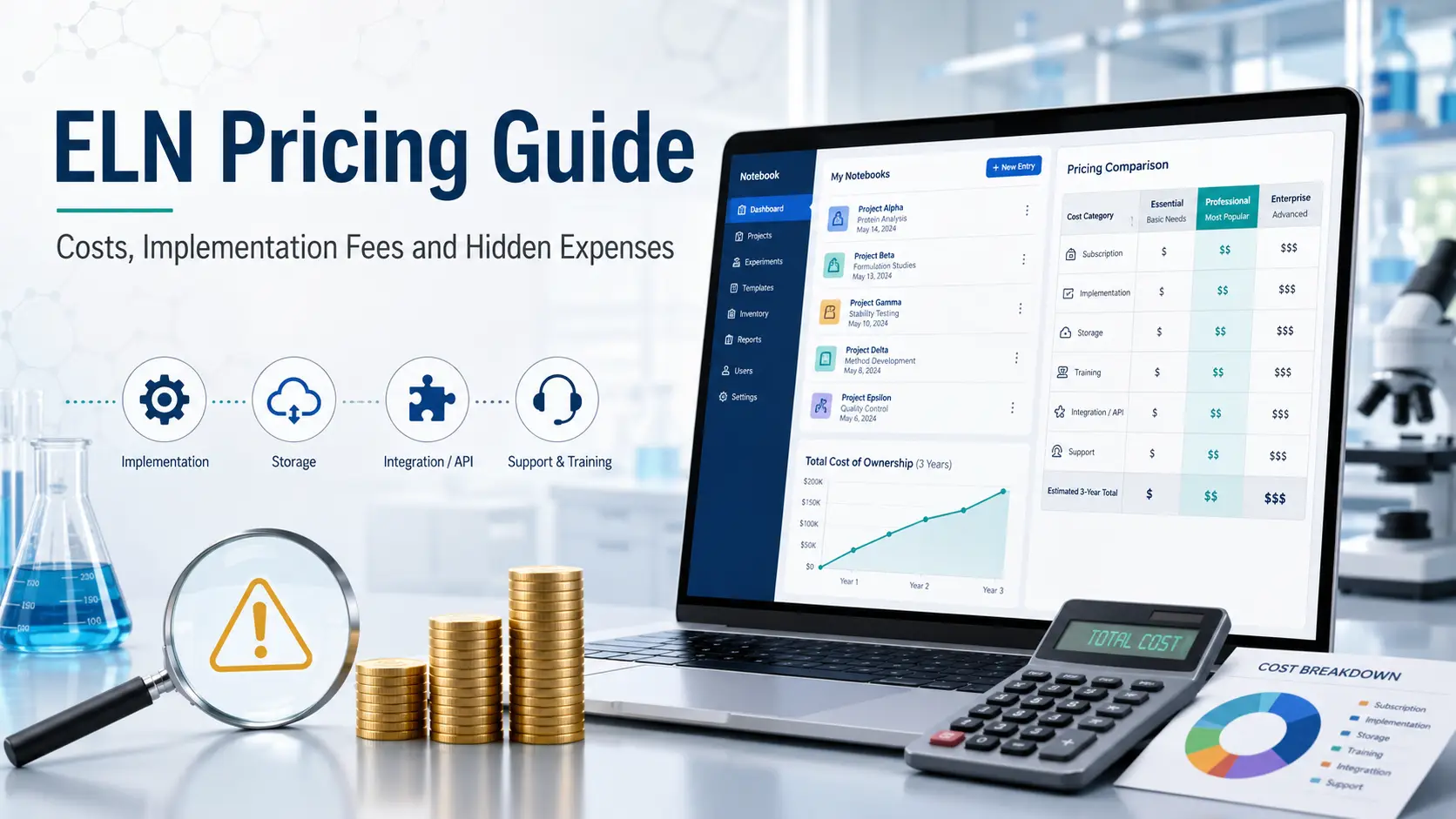
Electronic lab notebook pricing is rarely as simple as multiplying a monthly subscription by the number of scientists in your laboratory.
The visible license price may cover access to the software, but the real cost of an ELN can also include implementation, workflow configuration, data migration, integrations, validation, training, storage, support and long-term system administration.
Pricing transparency also varies significantly between vendors. Some ELN providers publish exact prices online. Others provide a free academic plan but require commercial organizations to request a quote. Enterprise platforms may not disclose any public pricing at all.
This guide explains:
- the main ELN pricing models;
- officially published prices from selected ELN vendors;
- the difference between license and implementation costs;
- the most common additional and hidden expenses;
- how to calculate the three-year total cost of ownership;
- the questions laboratories should ask before signing a contract.
Readers who are still defining their requirements can first consult our complete guide to electronic lab notebook software and our practical guide explaining how to choose an ELN.
Read this first
The single most important thing to understand about ELN pricing is that the lowest subscription price does not necessarily produce the lowest total cost.
A low-cost ELN may become expensive when a laboratory needs extensive configuration, data migration, custom integrations or regulated validation. Conversely, a platform with a higher annual subscription may include onboarding, support or functionality that would otherwise need to be purchased separately.
Laboratories should therefore compare vendors using a three-year total cost of ownership rather than the advertised license price alone.
ELN pricing at a glance
The table below includes only prices publicly displayed by the vendors themselves as of July 16, 2026.
| ELN or service | Officially published price | Pricing unit | Important details |
|---|---|---|---|
| LabArchives Free | $0 | Free plan | Two owned notebooks, 1 GB of storage per user and a 25 MB file-size limit |
| LabArchives Professional | $330 academic / $575 corporate | Per user, per year | 100 GB of storage per user |
| LabArchives ELN + Inventory | $360 academic / $675 corporate | Per user, per year | ELN and inventory management |
| LabArchives Education | $25 | Per student, per term | Designed for classroom use |
| Signals Notebook Standard Edition | $1,425 | Per person, annually | Includes one production tenant, automatic updates and standard support |
| Signals Notebook Jump Start Essentials | $6,700 | Implementation package | A separately priced implementation service |
| eLabFTW self-hosted software | €0 software license | Open-source deployment | The organization remains responsible for hosting, maintenance and administration |
| eLabFTW PRO Hosting 32 | €3,200 | Per year | Up to 32 active users and at least 320 GB of storage |
| eLabFTW PRO Hosting Plus | €4,985 | Per year | Approximately 128 active users and at least 500 GB of storage |
| eLabFTW PRO Hosting Universe | €7,900 | Per year | Approximately 1,024 active users and at least 1 TB of storage |
| eLabFTW training webinar | €470 | Per 90-minute session | Remote training service |
| eLabFTW PRO Support | €3,000 | Per year | Support for organizations operating a self-hosted installation |
LabArchives publishes separate prices for academic and corporate customers. Its Professional plan costs $330 per academic user per year or $575 per corporate user per year. The ELN and Inventory package costs $360 per academic user or $675 per corporate user annually. The vendor also offers a free plan, enterprise pricing on request and a classroom plan at $25 per student per term.
Revvity lists Signals Notebook Standard Edition at $1,425 per person annually. The official listing states that the subscription includes one production tenant, automatic updates and standard support. Revvity also publishes a separate Jump Start Essentials implementation package at $6,700.
The eLabFTW application can be downloaded and self-hosted as open-source software. Deltablot, the company behind eLabFTW, separately sells managed hosting, support and training. Its published annual hosting plans start at €3,200 for up to 32 active users, €4,985 for approximately 128 active users and €7,900 for approximately 1,024 active users.
Important pricing disclaimer
These figures are reference prices, not guaranteed quotations.
The final amount paid by a laboratory may depend on:
- country and billing currency;
- applicable taxes;
- academic, nonprofit or government eligibility;
- contract duration;
- number and type of users;
- storage requirements;
- implementation scope;
- integrations and custom development;
- validation and support requirements;
- negotiated enterprise discounts.
A written quotation and contract should always take precedence over a price displayed on a public webpage.
Why ELN vendors use different pricing models
There is no universal unit for purchasing an electronic lab notebook. Understanding the billing model is therefore essential before comparing two quotations.
It is also important to establish whether an ELN is genuinely the right type of software for the project. Our ELN vs LIMS comparison explains when laboratories may instead need sample-centric workflow management or a combined ELN-LIMS platform.
1. Named-user pricing
Under a named-user model, every person with an account generally requires a paid license.
A laboratory with 40 occasional users may therefore pay for 40 licenses even when only 20 people use the ELN during a typical week.
Named-user pricing is easy to forecast, but laboratories should clarify whether the following people require full licenses:
- laboratory scientists;
- principal investigators;
- technicians;
- quality reviewers;
- external collaborators;
- contractors;
- read-only users;
- system administrators.
LabArchives and Signals Notebook publicly present their commercial entry-level pricing on a per-person or per-user annual basis.
2. Active-user pricing
An active-user model charges according to the number of accounts that use the system during a defined period.
Deltablot defines an active eLabFTW user as an account that has used the application at least once during the month. Its managed hosting plans are organized around approximate or maximum numbers of active users rather than individual named-seat prices.
This model can be beneficial for organizations with a large population of occasional users. However, the contract should clearly define:
- what activity makes a user active;
- whether API or automated activity counts;
- what happens when the limit is exceeded;
- whether temporary users can be deactivated;
- how frequently usage is measured.
3. Organization-wide or capacity-based pricing
Some ELN services use an annual platform fee based on an organizational capacity, such as:
- maximum active users;
- storage volume;
- number of environments;
- number of sites;
- support level;
- infrastructure or security requirements.
The eLabFTW hosting plans are examples of capacity-based annual pricing. A customer purchases a hosted environment with a specified active-user and storage capacity rather than paying a fixed public price for every named account.
This model can produce a low effective cost per user when the available capacity is fully utilized. It can be less attractive when a laboratory purchases a large tier but uses only a small fraction of it.
4. Freemium pricing
A freemium ELN provides a permanently free entry-level version and charges for additional capabilities, capacity or institutional management.
For example:
- LabArchives offers a free plan with two owned notebooks and 1 GB of storage per user;
- Benchling offers a free academic plan that includes its Notebook and Molecular Biology applications;
- SciNote offers a free plan for individual researchers;
- Labstep promotes free access for academic users, with paid upgrades for groups and institutions.
Free plans can be useful for individual researchers, evaluations and small academic teams. They should not automatically be treated as equivalent to an institutional deployment.
Important limitations may include:
- restricted storage;
- limited notebook ownership;
- reduced administrative controls;
- no institutional single sign-on;
- fewer integration options;
- reduced support;
- no service-level agreement;
- limited validation documentation;
- missing enterprise security features;
- restrictions on commercial use.
For a broader evaluation of these options, see our independent guide to open-source and free ELN and LIMS software.
5. Quote-based enterprise pricing
Many ELN vendors require prospective customers to request a demonstration or contact sales before receiving pricing.
Official pages currently show quote-based commercial pricing for platforms including Benchling, SciNote, Labstep and Genemod.
Benchling publishes a free academic plan but directs industry customers to its sales team. SciNote provides a free individual plan while its premium plans require a quotation. Labstep advertises free academic access and commercial options without publishing numerical industry prices. Genemod lists Team, Business and Enterprise packages but requires customers to request a demonstration or quotation.
Quote-based pricing is not automatically a negative sign. Enterprise prices can depend heavily on deployment scope, security, integrations and service requirements.
However, a lack of public pricing makes disciplined procurement more important. Laboratories should ask every shortlisted vendor to respond to the same requirements and pricing template.
Official ELN pricing examples
LabArchives pricing
LabArchives is one of the clearest examples of publicly available per-user ELN pricing.
Free plan
The LabArchives Free plan includes:
- two owned notebooks;
- 1 GB of storage per user;
- a maximum file size of 25 MB.
The plan costs $0, although laboratories should assess whether its capacity and administrative controls are sufficient for institutional use.
Professional plan
The Professional plan is listed at:
- $330 per academic user per year;
- $575 per corporate user per year.
It includes 100 GB of storage per user. LabArchives states that its academic pricing applies to academic, government and nonprofit organizations.
ELN and Inventory package
The combined ELN and Inventory package is listed at:
- $360 per academic user per year;
- $675 per corporate user per year.
This package may be relevant to laboratories that want to connect experimental documentation with inventory and materials management.
Enterprise plan
LabArchives does not publish a standard price for its Enterprise plan. The plan is presented as a custom offering that can include unlimited storage, larger file uploads, SAML single sign-on, API access, a service-level agreement and a dedicated customer success manager.
Optional LabArchives products
LabArchives also publishes prices for related products:
- Inventory: $99 per academic user or $199 per corporate user annually;
- Scheduler: $35 per academic user or $105 per corporate user annually.
Additional storage can be purchased separately. Training and implementation requirements are discussed directly with the vendor rather than priced publicly.
All of these prices and plan inclusions can be checked on the official LabArchives pricing page.
Example LabArchives budgets
Using the published annual prices:
| Scenario | Calculation | Annual subscription |
|---|---|---|
| 10 academic Professional users | 10 × $330 | $3,300 |
| 10 corporate Professional users | 10 × $575 | $5,750 |
| 10 academic ELN + Inventory users | 10 × $360 | $3,600 |
| 10 corporate ELN + Inventory users | 10 × $675 | $6,750 |
| 25 corporate Professional users | 25 × $575 | $14,375 |
These calculations cover the listed subscriptions only. They do not include taxes, additional storage, implementation, training, integrations or other services.
Signals Notebook pricing
Revvity publishes a price for Signals Notebook Standard Edition through its official online store.
For a complete evaluation of the product beyond pricing, read our independent Revvity Signals Notebook review.
Standard Edition subscription
Signals Notebook Standard Edition is listed at:
- $1,425 per person annually.
The official product listing states that this includes one production tenant, automatic updates and standard support.
Jump Start Essentials
Revvity separately lists its Signals Notebook Jump Start Essentials package at:
- $6,700.
Because this is a separate implementation offering, buyers should not assume that every implementation service is included in the annual subscription.
Both figures are published on the official Signals Notebook Standard Edition store page.
Example Signals Notebook budget
For a team of 10 users:
- annual subscriptions: 10 × $1,425 = $14,250;
- Jump Start Essentials: $6,700;
- illustrative first-year total: $20,950.
This calculation uses only the two publicly listed amounts. It does not include taxes, optional modules, additional services, migration, integrations or negotiated pricing.
For 25 users, the public subscription price would equal $35,625 per year before implementation and other expenses.
eLabFTW pricing
eLabFTW differs from conventional proprietary ELNs because its software is open source and can be deployed on an organization’s own infrastructure.
The absence of a software license fee does not mean that a self-hosted deployment has no cost. The organization still needs infrastructure, backups, security controls, software administration, monitoring and internal or external technical support.
Our guide to the advantages and limitations of open-source ELN software examines this trade-off in more detail.
Managed hosting
Deltablot publishes several managed hosting options.
PRO Hosting 32
- €3,200 per year;
- up to 32 active users;
- at least 320 GB of storage;
- PRO Support included.
PRO Hosting Plus
- €4,985 per year;
- approximately 128 active users;
- at least 500 GB of storage;
- PRO Support included.
PRO Hosting Universe
- €7,900 per year;
- approximately 1,024 active users;
- at least 1 TB of storage;
- PRO Support included.
Deltablot also lists a SecNumCloud-hosted option at €8,700 per year, with approximately 1,024 active users and at least 1 TB of storage.
Training and support
Deltablot publishes the following service prices:
- 90-minute training webinar: €470 per session;
- PRO Support for self-hosted installations: €3,000 per year;
- custom development: price on request.
Current prices and service inclusions are available on the official Deltablot eLabFTW pricing page.
Effective cost per user
A capacity-based plan should not be compared directly with a named-user subscription without considering utilization.
For example, the €3,200 PRO Hosting 32 plan has a nominal annual cost of:
- €100 per active-user capacity when all 32 places are used;
- €200 per user when 16 people use the environment;
- €320 per user when only 10 people use it.
These calculations do not mean that Deltablot charges per user. They illustrate how utilization changes the effective cost of a fixed-capacity plan.
Free and quote-based ELN platforms
The absence of a public commercial price does not prevent a platform from being shortlisted. It means that the laboratory needs to obtain a detailed quotation before comparing it with transparent-price alternatives.
Benchling
Benchling offers a free academic plan that includes its Notebook and Molecular Biology applications. Commercial and industry pricing is not numerically listed on its public pages and requires contact with the sales team.
A Benchling quotation should therefore separate:
- platform subscriptions;
- applications or modules;
- implementation services;
- partner services;
- integrations;
- data migration;
- support;
- additional environments;
- renewal pricing.
SciNote
SciNote’s official plans page provides access to a free option for individual users. Its industry plans require a custom quotation.
The vendor states that its plans include access to onboarding resources, customer support, setup, ongoing maintenance and updates. Buyers should nevertheless establish exactly what “setup” and “onboarding” cover. A kickoff and introductory training session are not necessarily equivalent to workflow design, historical data migration or integration development.
Labstep
Labstep provides free access for academic users, with the option to upgrade for laboratory groups and institutions. Numerical industry prices are not publicly displayed on the academic pricing page.
Academic laboratories should verify:
- whether the intended use remains eligible for the free plan;
- what happens when a project becomes commercially funded;
- whether institutional administration requires a paid upgrade;
- which support, integration and security features are included.
Genemod
Genemod presents Team, Business and Enterprise packages on its official pricing page, but customers must request a demonstration to receive a commercial price.
The company also advertises application-based annual discounts for academic and nonprofit organizations without publishing fixed discount amounts.
When comparing these packages, laboratories should request a feature and service matrix showing exactly what changes between tiers.
ELN license cost versus implementation cost
The software subscription gives users access to the ELN. Implementation turns that software into a usable laboratory system.
These are related but distinct cost categories.
A basic implementation for a small research team may consist of account creation, standard templates and introductory training. A larger implementation may involve multiple sites, regulated workflows, thousands of historical records, instrument integrations and formal computer system validation.
Common implementation cost categories
1. Requirements and workflow analysis
Before configuring an ELN, the project team must document how experiments, samples, protocols, reviews and approvals are currently managed.
This work may include:
- stakeholder interviews;
- process mapping;
- identification of user roles;
- documentation of security requirements;
- definition of metadata;
- assessment of existing systems;
- preparation of user requirements;
- prioritization of workflows.
A vendor may include limited discovery in an onboarding package. Extensive business analysis may require additional professional services or internal staff time.
2. ELN configuration
Configuration can include:
- notebook and project structures;
- experiment templates;
- metadata fields;
- naming conventions;
- permissions;
- review and approval workflows;
- controlled vocabularies;
- inventory connections;
- dashboards;
- notifications.
A highly configurable ELN can reduce the need for custom code, but configuration still requires decisions, testing and documentation.
3. Data migration
Migration costs are influenced by the condition and complexity of the source data.
Potential sources include:
- paper notebooks;
- PDF archives;
- shared drives;
- spreadsheets;
- legacy ELNs;
- LIMS databases;
- document management systems;
- scientific data repositories.
Migration may involve:
- inventorying the existing data;
- deciding what should be migrated;
- cleaning inconsistent records;
- mapping old fields to the new data model;
- extracting files and metadata;
- transforming the data;
- loading it into the ELN;
- reconciling migrated records;
- documenting errors and exceptions;
- retaining or decommissioning the legacy system.
A vendor’s statement that “migration is included” should be tested against this full scope. The included service may cover only a standard technical transfer rather than data cleaning, mapping and verification.
4. Integrations
An ELN may need to exchange information with:
- a LIMS;
- inventory software;
- scientific instruments;
- an SDMS;
- chromatography or analytical software;
- identity management;
- data warehouses;
- cloud storage;
- Microsoft 365 or Google Workspace;
- registration systems;
- ERP or quality systems.
Integration pricing may be based on:
- a standard connector;
- an API entitlement;
- professional-service hours;
- custom development;
- middleware;
- ongoing support;
- data volume or transaction limits.
Laboratories should ask whether API access is included in the selected package. LabArchives, for example, lists developer API access among the capabilities of its custom Enterprise plan rather than its standard public plans.
5. Identity and security configuration
Institutional deployments often require:
- single sign-on;
- SAML or another identity standard;
- multifactor authentication;
- role-based access;
- domain restrictions;
- audit logs;
- retention policies;
- security reviews;
- penetration-test documentation;
- data-processing agreements.
Some vendors reserve advanced security and identity features for enterprise plans. LabArchives identifies SAML single sign-on as an Enterprise capability, illustrating why laboratories must compare packages rather than license prices alone.
Deployment also changes the cost and responsibility model. Our cloud ELN vs on-premise ELN comparison examines hosting, maintenance, data sovereignty and security trade-offs.
6. Validation and regulated use
Organizations operating in regulated environments may need documented evidence that the ELN is fit for its intended use.
The associated work can include:
- risk assessment;
- user requirements;
- configuration specifications;
- validation planning;
- installation or environment verification;
- functional testing;
- user acceptance testing;
- traceability;
- deviation management;
- final reporting;
- standard operating procedures;
- change-control processes;
- periodic review.
A vendor may provide documentation or validation support, but the regulated organization remains responsible for defining intended use and approving the validated state.
The quotation should specify whether validation materials and services are included, optional or unavailable.
For additional context, see our guides to ELN compliance and data integrity, 21 CFR Part 11 and the ALCOA+ data-integrity principles.
7. Training and change management
Training may be delivered through:
- self-service videos;
- remote group sessions;
- train-the-trainer programs;
- administrator training;
- role-specific courses;
- on-site workshops;
- recorded sessions;
- office hours after launch.
Deltablot’s published €470 price for a 90-minute training webinar provides a useful example of a separately priced training service. Other vendors may include standard onboarding but charge for additional sessions or custom training materials.
Internal change-management costs can be equally important. Scientists need time to attend training, redesign templates, migrate active work and adapt their daily practices.
Laboratories still considering whether the transition is justified can review our comparison of paper and electronic lab notebooks.
8. Launch and post-launch support
The implementation budget may also need to cover:
- pilot support;
- data corrections;
- launch-day assistance;
- additional administrator capacity;
- user questions;
- workflow adjustments;
- adoption monitoring;
- support after the initial project closes.
A low implementation quotation can become misleading when important post-launch activities are excluded.
The hidden and frequently overlooked costs of an ELN
“Hidden cost” does not necessarily mean that a vendor is intentionally concealing a fee. In many cases, the cost is omitted because it depends on the customer’s requirements or was never requested during procurement.
1. Minimum license commitments
A vendor may quote a per-user price while requiring a minimum number of users or a minimum annual contract value.
Ask:
- Is there a minimum number of licenses?
- Can licenses be added during the contract?
- Can they be removed at renewal?
- Are read-only accounts chargeable?
- Are external collaborators chargeable?
- Are administrator accounts chargeable?
2. Storage and file-size limits
Laboratories generate images, raw instrument files, reports, sequence data and other large scientific records. Storage assumptions can therefore materially affect long-term costs.
LabArchives publicly lists 1 GB per user for its free plan and 100 GB per user for its Professional plan. The free plan has a 25 MB maximum file size, while Professional supports files of up to 250 MB and Enterprise supports files of up to 16 GB.
Deltablot’s hosted eLabFTW plans include defined storage capacities, and the vendor offers additional storage separately.
Before purchasing an ELN, calculate:
- current scientific file volume;
- annual growth;
- retention period;
- expected number of users;
- average attachment size;
- need to retain raw data;
- duplication across the ELN, LIMS and SDMS;
- cost of exporting data later.
3. Optional modules
The base ELN subscription may not include:
- inventory management;
- sample tracking;
- molecular biology tools;
- chemical drawing or structure search;
- registration;
- workflow automation;
- advanced analytics;
- artificial intelligence features;
- electronic signatures;
- advanced integrations.
LabArchives illustrates the importance of separating modules: its Professional ELN and combined ELN plus Inventory offering have different public prices.
Request a line-by-line list of included modules rather than relying on a generic product demonstration.
4. Sandbox and test environments
Regulated or complex organizations may require separate environments for:
- development;
- testing;
- validation;
- training;
- production.
The publicly listed Signals Notebook Standard Edition includes one production tenant. Buyers that require additional environments should establish whether those environments are included or separately priced.
5. API access and integrations
An ELN may advertise an API while limiting access by package, transaction volume or support level.
Clarify:
- whether API access is included;
- whether there are usage limits;
- whether service accounts require licenses;
- whether standard connectors cost extra;
- who maintains custom integrations;
- whether integration support is included after upgrades.
6. Support tiers
Standard support may differ from premium or enterprise support.
Potential differences include:
- response times;
- support hours;
- named contacts;
- telephone access;
- escalation paths;
- service-level commitments;
- implementation assistance;
- administrator support.
Signals Notebook Standard Edition includes standard support. eLabFTW’s hosted PRO plans include PRO Support, while organizations running eLabFTW themselves can purchase PRO Support for €3,000 per year.
7. Data migration and cleansing
A migration quote may cover only the technical import. Internal teams may still need to:
- remove duplicates;
- correct inconsistent metadata;
- locate missing files;
- resolve ownership;
- identify records subject to retention;
- approve the migrated data;
- document reconciliation.
These activities can require significant scientist, quality and IT time even when the vendor does not charge a separate migration fee.
8. Validation documentation
Some vendors offer validation documentation or services as optional packages.
Ask whether the quotation includes:
- standard test scripts;
- configuration specifications;
- traceability documentation;
- release documentation;
- supplier assessment material;
- assistance with user acceptance testing;
- support following software updates.
The license price should never be assumed to include a complete validation service unless the contract explicitly says so.
9. Internal administration
Every ELN needs an owner after implementation.
Internal responsibilities may include:
- creating and deactivating users;
- managing permissions;
- approving templates;
- supporting users;
- monitoring storage;
- coordinating upgrades;
- reviewing audit logs;
- maintaining integrations;
- controlling changes;
- updating procedures;
- reporting adoption.
The cost of this role belongs in the total cost of ownership, even though it is not invoiced by the vendor.
10. Contract renewal and price increases
An attractive first-year discount can obscure the long-term cost.
Before signing, request:
- the undiscounted list price;
- the renewal price;
- the permitted annual increase;
- notice periods;
- minimum renewal quantities;
- consequences of reducing user numbers;
- multi-year commitments;
- termination conditions.
A three-year forecast should not assume that an introductory discount will continue unless it is contractually guaranteed.
11. Data export and system exit
The ability to leave the system should be assessed before entering it.
Ask:
- Can all records and attachments be exported?
- Is the export machine-readable?
- Are relationships and metadata preserved?
- Are audit trails included?
- Are electronic signatures included?
- Is bulk export included in the subscription?
- Does the vendor charge professional-service fees?
- How long is data retained after termination?
- Is continued read-only access available?
A low-cost ELN can create a high exit cost when data cannot be exported in a usable form.
How to calculate ELN total cost of ownership
A practical three-year calculation should include the following categories.
Year-one costs
Year-one TCO =
Software subscription
- implementation package
- configuration
- data migration
- integrations
- validation
- training
- additional infrastructure
- internal project time
- contingency
Recurring annual costs
Annual recurring cost =
Software renewal
- support
- additional storage
- integration maintenance
- internal administration
- validation maintenance
- additional users or modules
Exit and replacement costs
A complete financial model should also consider:
- final data export;
- archive access;
- contract termination fees;
- replacement implementation;
- migration to the next system;
- overlap between old and new subscriptions.
Example three-year comparison template
| Cost category | Vendor A: Year 1 | Vendor A: Year 2 | Vendor A: Year 3 | Vendor B: Year 1 | Vendor B: Year 2 | Vendor B: Year 3 |
|---|---|---|---|---|---|---|
| Subscription | ||||||
| Additional modules | ||||||
| Implementation | — | — | — | — | ||
| Migration | — | — | — | — | ||
| Integrations | ||||||
| Validation | ||||||
| Training | ||||||
| Storage | ||||||
| Premium support | ||||||
| Internal administration | ||||||
| Exit provision | ||||||
| Total |
Every supplier should complete the same table using the same assumptions.
Questions to ask every ELN vendor
A laboratory should obtain written answers to the following questions before comparing quotations.
Licensing
- What is the exact pricing unit?
- Is pricing based on named, concurrent or active users?
- Is there a minimum number of licenses?
- Do administrators require licenses?
- Are read-only and external users chargeable?
- Can user numbers be reduced at renewal?
- Are academic and commercial uses priced differently?
Features
- Which modules are included in the quoted package?
- Is inventory management included?
- Are electronic signatures included?
- Is API access included?
- Is single sign-on included?
- Are additional test or validation environments included?
Implementation
- What implementation work is included?
- How many consulting or configuration hours are included?
- Does onboarding include workflow design?
- Is historical data migration included?
- Are integrations included?
- Is training included, and for how many users?
- What is explicitly excluded from the implementation scope?
Infrastructure and support
- How much storage is included?
- What are the maximum file sizes?
- How is additional storage priced?
- What support hours and response times are included?
- Is there a service-level agreement?
- Are upgrades included?
- Who is responsible for testing integrations after upgrades?
Validation and compliance
- What validation documentation is available?
- Is validation support included or optional?
- How are configuration changes controlled?
- What audit and export capabilities are included?
- What documentation is supplied after each release?
Contract and exit
- What is the total first-year cost?
- What is the expected three-year cost?
- What discount has been applied?
- What will the renewal price be?
- Is there a limit on annual price increases?
- How can all data and metadata be exported?
- Are export services chargeable?
- What happens to the data after contract termination?
How to reduce ELN costs without selecting the cheapest product
Start with a defined use case
Do not purchase every available module simply because it appeared in a demonstration.
Identify:
- the first workflows to digitize;
- the users who genuinely need access;
- mandatory integrations;
- regulated requirements;
- expected storage;
- future expansion that is reasonably likely.
Pilot representative workflows
A pilot should test real scientific work rather than a generic vendor demonstration.
Include:
- a routine experiment;
- a complex experiment;
- attachment of scientific files;
- collaboration;
- review and approval;
- search and retrieval;
- data export;
- at least one planned integration.
The objective is to discover configuration and adoption problems before committing to a larger rollout.
Separate mandatory and optional requirements
Classify requirements as:
- mandatory at launch;
- required within 12 months;
- desirable;
- optional.
This prevents an oversized first implementation while preserving a credible roadmap.
Negotiate the complete commercial package
Negotiation should cover more than the subscription rate.
Possible topics include:
- implementation hours;
- data migration;
- training;
- additional environments;
- storage;
- price protection;
- support level;
- renewal terms;
- exit assistance.
A small reduction in the annual license price may be less valuable than included migration or a contractual cap on renewal increases.
Invest in internal governance
Clear ownership reduces expensive rework.
Define:
- system owner;
- template approval process;
- naming conventions;
- user lifecycle;
- change control;
- integration ownership;
- training responsibilities;
- data retention;
- support escalation.
An ELN that is poorly governed can accumulate inconsistent templates and metadata, reducing the value of the original investment.
Which ELN pricing model is best?
There is no universally superior model.
A free or low-cost academic plan may suit:
- an individual researcher;
- a small academic group;
- an early evaluation;
- a team with simple workflows;
- users without institutional integration requirements.
Per-user SaaS pricing may suit:
- organizations seeking predictable budgeting;
- teams with a stable number of users;
- laboratories that prefer vendor-managed infrastructure;
- organizations with limited internal IT resources.
Capacity-based hosting may suit:
- institutions with many occasional users;
- organizations comfortable managing utilization;
- teams that want a predictable platform-level fee;
- customers seeking an open-source application with managed hosting.
Quote-based enterprise pricing may suit:
- multisite organizations;
- regulated laboratories;
- companies needing extensive integrations;
- organizations requiring enterprise identity management;
- laboratories purchasing several connected applications;
- customers needing professional implementation services.
The correct decision depends on the complete requirements and total cost, not the apparent simplicity of the pricing model.
Frequently asked questions about ELN pricing
How much does an ELN cost?
There is no single market price.
Verified public examples range from free individual or academic plans to annual commercial subscriptions and enterprise quotations.
Published examples include:
- LabArchives Professional at $330 per academic user or $575 per corporate user annually;
- LabArchives ELN plus Inventory at $360 per academic user or $675 per corporate user annually;
- Signals Notebook Standard Edition at $1,425 per person annually;
- eLabFTW managed hosting from €3,200 per year for a plan supporting up to 32 active users.
These amounts cannot be compared correctly without examining included functionality, implementation, storage and support.
Why do many ELN vendors not publish prices?
Enterprise ELN projects can differ substantially in number of users, modules, integrations, deployment, validation and services.
Custom quotations allow vendors to price those requirements individually. However, laboratories should insist on an itemized quotation to prevent software, implementation and optional services from being combined into an unclear total.
Is a free ELN really free?
The software or entry-level account may be free, but the organization may still incur costs for:
- hosting;
- IT administration;
- backups;
- security;
- support;
- training;
- migration;
- integrations;
- validation;
- internal user support.
Free plans can also impose storage, feature or institutional-management limits. LabArchives, for example, limits its free plan to two owned notebooks, 1 GB of storage per user and files of up to 25 MB.
Is open-source ELN software free?
Open-source software can be used without paying a proprietary license fee, subject to its license terms. Operating it still requires infrastructure and expertise.
eLabFTW can be self-hosted as open-source software, while Deltablot sells optional hosting, support, training and custom development.
Is ELN implementation included in the subscription?
It depends on the vendor and package.
SciNote states that its plans include access to onboarding resources, setup, customer support, maintenance and updates. Revvity separately lists a $6,700 Jump Start Essentials implementation package for Signals Notebook. LabArchives asks customers to discuss implementation and training requirements directly.
Buyers should ask for a written definition of onboarding and implementation rather than assuming that the terms are interchangeable.
What is normally included in an ELN subscription?
A subscription typically gives licensed users access to a defined software package and an agreed level of hosting, updates and support.
The exact inclusions vary. Signals Notebook Standard Edition publicly includes one production tenant, automatic updates and standard support. LabArchives differentiates its standard plans from an Enterprise package that can include SAML single sign-on, developer API access, a service-level agreement and dedicated success management.
Does an ELN charge separately for storage?
Some subscriptions include a fixed storage allocation, while additional capacity may be chargeable.
LabArchives and Deltablot both publish defined storage allowances and indicate that customers can obtain additional storage.
Is cloud ELN pricing cheaper than self-hosting?
Not necessarily.
Cloud subscriptions bundle infrastructure and vendor operations into the price. Self-hosting may avoid a proprietary hosting fee but requires servers or cloud infrastructure, backups, monitoring, security and technical administration.
The correct comparison is the total cost of operating each option at the required service and security level.
How should a regulated laboratory budget for an ELN?
A regulated laboratory should budget for more than software access.
The financial plan may need to include:
- requirements definition;
- supplier assessment;
- risk assessment;
- configuration documentation;
- validation planning and testing;
- procedures;
- training;
- change control;
- periodic review;
- testing after updates;
- long-term records management.
The vendor quotation should identify which documentation and services are included and which remain the customer’s responsibility.
Can ELN prices be negotiated?
Commercial terms may be negotiable, particularly for larger user volumes or multi-year contracts.
The most important negotiated points may include:
- subscription rate;
- implementation;
- training;
- storage;
- additional environments;
- renewal increases;
- support;
- migration;
- termination and export assistance.
Any negotiated commitment should appear in the contract rather than remain in an email or sales presentation.
Quick verdict
ELN pricing should be evaluated as a combination of five elements:
- software access;
- implementation and configuration;
- data, integrations and validation;
- ongoing operation and support;
- renewal and exit conditions.
For transparent public pricing, LabArchives provides clear per-user academic and corporate rates. Signals Notebook publishes a Standard Edition subscription and a separate implementation package. eLabFTW provides a distinctive open-source model with published managed-hosting and support prices.
Other major platforms, including Benchling, SciNote, Labstep and Genemod, require commercial customers to request a quotation. Their absence of public numerical pricing makes a standardized requirements document and three-year cost template particularly important.
The cheapest license is not necessarily the most economical ELN. The best-value system is the one that meets the laboratory’s scientific, technical and compliance requirements with a sustainable total cost and a credible exit path.
Recommended further reading
- Electronic Lab Notebook Software: The Complete Guide
- How to Choose an ELN: 10 Questions to Ask Before Buying
- Open-Source ELN and LIMS: The Honest Guide
- ELN Compliance and Data Integrity
- What Is 21 CFR Part 11?
- Cloud ELN vs On-Premise ELN
- ELN vs LIMS: What’s the Difference?
- Paper vs Electronic Lab Notebook
- Benchling Overview: Features, Pricing and Who It’s For
- Revvity Signals Notebook Review
- eLabFTW Overview: Features, Pricing and Who It’s For
- Genemod LIMS and ELN Overview
Official pricing sources
- LabArchives pricing
- Signals Notebook Standard Edition and Jump Start Essentials
- eLabFTW official website
- Deltablot eLabFTW hosting, support and training pricing
- Benchling for Academics
- SciNote plans
- Labstep academic pricing
- Genemod plans and pricing
Pricing methodology and editorial independence
Lab Software Guide is an independent publication. Our full review process is described on our methodology page.
Every numerical price in this guide was taken from an official vendor webpage or official vendor store available on July 16, 2026. Third-party pricing estimates, crowdsourced figures and unverified sales claims were excluded.
When a vendor did not publish a numerical commercial price, the platform was identified as quote-based rather than assigned an estimated price.
Prices can change, and a vendor quotation may differ according to region, organization type, number of users, contract duration and implementation requirements. Readers should verify the latest commercial terms directly with each shortlisted provider before making a purchasing decision.