| Who Genemod competes with | Genemod is not competing with STARLIMS, BIOVIA, or Waters NuGenesis. It competes with Benchling, Labguru, and Scispot — cloud-native, modern LIMS/ELN platforms aimed at life science R&D labs transitioning away from paper notebooks and Excel. If your lab is a small-to-mid biotech, an academic research group, or an early-stage biopharma team that needs an affordable, easy-to-deploy unified LIMS and ELN, Genemod is in the right comparison set. If your lab is a regulated QC or manufacturing environment requiring a fully validated enterprise LIMS, the enterprise products in this series are more appropriate. |
Genemod is a Seattle-area software company that builds a unified LIMS and ELN platform for life science research labs. Founded in 2017 or 2018 (Tracxn and PitchBook report slightly different dates) by Jacob Lee (CEO) and Jin Choe (CTO), the company has raised $7.22 million across three funding rounds, with a $4.5 million Seed round closing in May 2023 led by Defy and LDV Partners (Tracxn). Other investors include Canaan, Cercano Management, Dolby Family Ventures, and Looking Glass Capital (PitchBook, 8 investors total). The company participated in SLAS 2024, one of the primary lab automation and screening conferences in the industry.
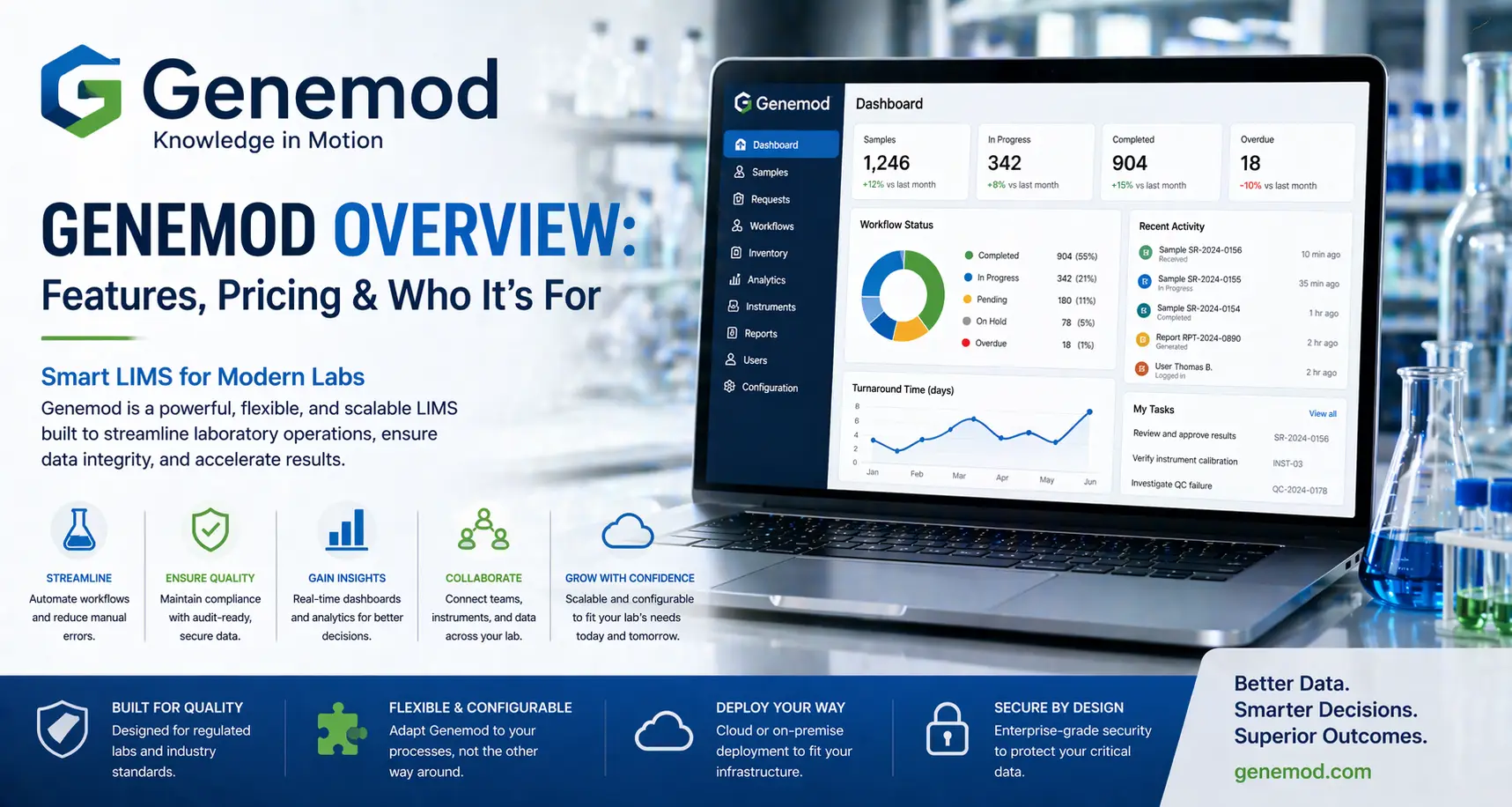
Genemod’s core pitch is consolidation: replace the fragmented mix of Excel spreadsheets, Google Docs, physical freezer logs, and paper notebooks that most small and mid-size labs still operate on, and do it in a single cloud-native platform at a price point below the enterprise LIMS market. The platform manages 10 million+ records (genemod.net homepage). Its most praised feature — confirmed across every independent review source — is the visual freezer management system, which replicates the physical layout of a lab’s freezers on-screen.
This article draws on genemod.net (all product, pricing, solutions, and FAQ pages), Tracxn, PitchBook, Crunchbase, G2, Capterra, Sourceforge, the Labsistant competitor pricing page (March 2026 verification, attributed as competitor-authored), and the Genemod pricing FAQ. Genemod has not reviewed, sponsored, or paid for this article.
Company and funding context
Understanding Genemod’s stage and scale is the most important context for a lab manager making a purchasing decision. This is a seed-stage startup, not a mature software company with decades of development behind it. Tracxn lists approximately 2 employees as of December 2024 (this appears to undercount; PitchBook lists 13 total employees, which is more consistent with an active multi-product software company). The company has raised $7.22M in total funding — meaningful for a seed stage, but modest relative to Benchling ($900M+) or even Scispot ($2.8M ARR on smaller funding).
For lab managers, the practical implications of Genemod’s stage are:
- Responsiveness and flexibility: Multiple independent reviewers on both G2 and Capterra describe the Genemod team as unusually responsive — building requested features quickly and answering support questions within hours. This is a characteristic advantage of small, founder-led software companies.
- Product evolution: The platform has a rapidly evolving roadmap. Features that reviewers noted as missing have often been added in subsequent months. This is a double-edged quality: the product improves quickly, but it is also not fully mature.
- Vendor risk: A seed-stage company with $7.22M raised and a small team carries more vendor continuity risk than a publicly traded company or a PE-backed roll-up. Lab managers signing multi-year contracts should consider data export and migration policies before committing.
| Vendor risk context for lab managers | Genemod requires annual contract commitments (confirmed on FAQ). Before signing, ask specifically: what happens to your data if Genemod ceases operations or pivots; what data export formats are available and how complete they are; and what the transition plan would be to another system. These questions are standard due diligence for any startup LIMS vendor and are not a criticism of Genemod specifically — but they are more important here than for enterprise vendors. |
At a glance
| Field | Details |
| Founded | 2017 or 2018 (Tracxn and PitchBook report different dates). Co-founders: Jacob Lee (CEO) and Jin Choe (CTO). |
| HQ | Seattle / Edmonds, Washington, USA (PitchBook: Edmonds, WA; SoftwareSuggest: Seattle). |
| Employees | ~13 (PitchBook). Tracxn lists 2, which appears to undercount. |
| Funding | $7.22M total over 3 rounds. Latest: $4.5M Seed, May 4, 2023, led by Defy and LDV Partners (Tracxn). Other investors: Canaan, Cercano Management, Dolby Family Ventures, Looking Glass Capital (PitchBook: 8 investors total). |
| Platform | Unified LIMS + ELN cloud-native SaaS. Single platform covering inventory (virtual freezers), consumables, order management, equipment scheduling, ELN, protocols, and audit trails. |
| Scale | 10M+ records managed (genemod.net homepage). |
| Architecture | Cloud-native SaaS hosted on AWS. Annual contracts required. No on-premise option confirmed. |
| Compliance | 21 CFR Part 11 compliance supported (FAQ). AWS infrastructure carries ISO 27001, SOC 1, SOC 2 — these are AWS’s own certifications for the infrastructure; Genemod’s own product-level SOC 2 certification is not separately confirmed in public sources. Audit trails and version control built in. |
| AI features | AI Agent LIMS (genemod.net/products/ai-lims): AI-powered workflow support, automated spreadsheet column matching, AI-driven recommendations. Described as “in-platform workflow support for every task.” |
| API | Open API framework confirmed (research.com, genemod.net FAQ). |
| Languages | English (Sourceforge). |
| Pricing | Starts at approximately $199/month (Sourceforge; Labsistant competitor page, March 2026 verification). 4 tiers, annual contracts required. 14-day free trial available. Academia plan for .edu emails (discounted, up to 10 users). No permanent free tier. Multi-year discounts available. |
| Industries | Biopharma R&D, industrial biotech, biorepository, clinical research, biomanufacturing, contract services, chemistry, diagnostics (genemod.net solutions pages). |
| G2 profile | Active, claimed by Genemod. Limited features plan. Verified reviews published. Top G2 praise themes: inventory management, ease of use, user interface, lab management, lab automation. |
| Capterra | Listed with non-incentivized verified reviews. Consistent praise for visual freezer management and responsive support. |
| Notable events | Participated in SLAS 2024 (Society for Laboratory Automation and Screening). (genemod.net/events/slas2024) |
What Genemod does — platform by module
Genemod’s platform is organised around six functional areas, all available within a single cloud environment. The strength of each area is not uniform: inventory management is mature and heavily validated by user reviews; the ELN is newer and improving; the AI layer is early-stage.
1. Virtual freezer management and inventory (the core differentiator)
This is Genemod’s most differentiated and most consistently praised feature. The virtual freezer replicates the physical layout of a lab’s actual freezers — rack by rack, shelf by shelf, box by box — in a visual on-screen interface. Scientists drag samples into their correct positions digitally, and the system maintains a real-world mirror of what is stored where. A Capterra reviewer who came from -80°C freezer management describes it as: “This software is useful for users who prefer better visualizations of real-life environment. Very easy to manage sample data.”
Beyond freezers, the inventory module covers: reagent management with customisable item types (presets for common reagent categories, fully custom types for unusual materials); consumable management organised by category and location; advanced search with filters, sorting, and ranking to locate any reagent across any freezer in seconds; automatic expiry tracking with alerts when reagents approach expiration; low-stock alerts; and a complete activity log (audit trail) for all inventory actions.
The most direct competitive comparison is with labs that manage inventory in multiple Excel spreadsheets — which Capterra reviewers confirm is the most common prior state. A Capterra reviewer: “Switching from a bunch of Excel spreadsheets to its inventory management features has really streamlined our research process.” A G2 reviewer confirms the same transition: “We used excel spreadsheets and google docs for inventory management and report generation, but Genemod LIMS & ELN helped to accelerate our research.”
2. Electronic Lab Notebook (ELN)
The ELN was added as a second major feature layer and has become a primary driver for labs that switch from commercial ELNs to Genemod’s integrated platform. A Capterra reviewer: “We recently started to use Genemod’s ELN as well, and it helped us save a lot of budget by stopping the use of another ELN that we had been using for years.”
Confirmed ELN features from genemod.net/eln-software: real-time collaborative editing with live updates (multiple users working simultaneously); flexible protocol and experiment templates that teams can share and reuse; rich text and multimedia documentation; internal messaging and commenting directly on experiment records; version control with automatic versioning on all updates; and folder-based organisation for projects and files. The ELN is described as “a user-friendly digital lab workspace” on the pricing page.
The ELN integrates directly with the LIMS inventory: scientists can link reagents and samples from the inventory directly into experiment records, creating traceable connections between what was used and what was observed. This is the core value of a unified LIMS+ELN versus two separate systems — and it is the architectural choice that distinguishes Genemod from labs running separate inventory and ELN tools.
| ELN maturity note | The ELN is newer than the inventory module and carries a “missing features” (5 mentions) and “limited functionality” (4 mentions) pattern in G2 reviews. Lab managers should evaluate the ELN specifically against their most complex protocol documentation needs during a trial before relying on it for regulated experiments. The Genemod team’s track record of building requested features within weeks is a meaningful offset to current gaps for labs that can work iteratively with the vendor. |
3. Order management
A centralised order management dashboard tracks all purchase requests and their current status in one place. Scientists submit order requests through Genemod; lab managers receive notifications and can approve or process orders. This closes the loop between inventory depletion (tracked in the LIMS) and procurement: when a reagent stock falls below a threshold, a low-stock alert triggers an order request in the same system. No separate procurement tracking in email or spreadsheets.
4. Equipment scheduling and management
A visual equipment availability calendar shows which instruments are booked and when, allowing scientists to schedule time on shared equipment without conflicts. Maintenance tracking is also supported. A G2 reviewer specifically praises the equipment scheduling as a differentiating feature: “It integrates the reservation of equipment, laboratory notebook, and management of the freezer and consumables of the laboratory in a single platform.” Instrument availability at a glance, integrated with the rest of the lab management system, is a common pain point for labs sharing expensive instruments across multiple teams.
5. AI Agent LIMS
Genemod has launched an AI layer described as an “AI Agent LIMS” (genemod.net/products/ai-lims). Confirmed capabilities include: in-platform workflow support and guidance for any task; automated spreadsheet column matching for data imports (reducing manual mapping effort); AI-driven recommendations for routine tasks; and real-time analytics across lab operations. The AI features are positioned as reducing setup friction for new data imports and providing data-driven insights from existing lab records. This is an early-stage feature set, and no independent user validation of AI-specific outcomes is available as of April 2026. Lab managers should evaluate AI features in trial rather than treating them as production-ready capabilities without their own validation.
6. Compliance and audit infrastructure
Genemod’s compliance infrastructure covers the requirements relevant to its primary market — R&D and early-stage regulated environments. Confirmed features: built-in audit trails for all actions (who changed what, when), version control across all records, 21 CFR Part 11 compliance support, and role-based access controls. The FAQ states that 21 CFR Part 11 compliance is supported and that the AWS infrastructure carries ISO 27001, SOC 1, and SOC 2 certifications.
An important distinction for regulated lab managers: the AWS infrastructure certifications (SOC 2, ISO 27001) confirm that Amazon’s data centres and core services meet those security standards. This is different from a product-level SOC 2 Type II certification for Genemod’s own application and processes, which is what platforms like Revvity Signals Notebook carry. Lab managers in regulated environments (GxP, FDA-audited facilities) should ask Genemod specifically whether they hold their own product-level SOC 2 Type II report and what IQ/OQ/PQ validation documentation is available.
Pricing
Genemod’s pricing is more transparent than most enterprise LIMS vendors in this series. Key confirmed facts:
- Starting price: approximately $199/month (Sourceforge; Labsistant competitor page, March 2026, attributed as competitor-authored). Annual contract required.
- 4 tiers (Labsistant, March 2026). The tiers correspond to different feature sets and scale levels. The Team plan for Industry is described by Genemod’s own FAQ as “geared towards startups” and offering “our most popular features.”
- Annual contracts required: All plans. “All Genemod plans currently require annual contract commitments” (genemod.net/pricing/common/FAQ, confirmed).
- 14-day free trial (Labsistant competitor page, March 2026). The Krowdbase listing says “no free trial,” which may reflect an older state. Lab managers should verify current trial availability directly at genemod.net.
- No permanent free tier: Unlike eLabFTW (free, open-source) or some freemium competitors. Genemod is a paid SaaS product.
- Academia plan: Available for .edu email addresses. Up to 10 users. Discounted. Requires application (genemod.net/pricing/common/Academia). Confirmed for new customers only.
- Multi-year discounts: Available for longer commitments (FAQ).
- Academic discount: Separate from the Academia plan; discounted pricing available for academic labs and institutions (FAQ).
| Pricing note for lab managers | At approximately $199/month (starting, annual), Genemod is positioned well below the mid-market LIMS vendors in this series (QBench starts at $275/user/month for 5 users minimum = $1,375/month minimum). For a small biotech of 5–10 scientists needing inventory + ELN, Genemod’s total annual cost is a fraction of most alternatives. However, annual contract commitments mean you cannot exit quickly if the platform does not meet your needs. Confirm exactly what features are included in each tier before signing, and use the trial period to test your most critical workflows. The Labsistant competitor analysis (competitor-authored, March 2026) notes that Genemod at $199/month represents approximately 4x the cost of a pure-inventory alternative — but the ELN and equipment scheduling included in that price changes the total cost comparison against a multi-vendor approach. |
Who Genemod is designed for
Genemod’s design choices — visual freezer interface, unified LIMS+ELN, cloud-native SaaS, affordable pricing, startup-responsive support — define a very clear buyer profile:
- Biotech startups and early-stage biopharma companies that are currently managing inventory in Excel or Google Sheets and need a purpose-built system without enterprise LIMS complexity or pricing. Multiple Capterra and G2 reviewers confirm this is Genemod’s most natural customer: labs coming from spreadsheets, not from a legacy LIMS.
- Academic research labs and university groups with .edu email eligibility for the Academia plan. Genemod offers a cheaper path to unified inventory and ELN than most commercial alternatives at academic pricing levels.
- Labs managing physical sample collections — biobanks, biorepositories, cell line libraries, reagent banks — where the visual freezer interface and spatial tracking provide concrete operational value daily.
- Life science R&D teams that previously managed ELN and inventory in separate systems and want to consolidate onto one platform. The Capterra review confirming an ELN switch away from a previously paid ELN to Genemod’s built-in ELN is the clearest evidence of this use case.
- Labs in early-stage regulated environments where 21 CFR Part 11 audit trail support and version control are required, but full GxP validation with IQ/OQ/PQ documentation is not yet the primary driver.
- Diagnostics companies processing daily sample volumes that need automated barcoding, batching, PCR/sequencing/immunoassay workflow customisation, and real-time turnaround monitoring (genemod.net/solutions/diagnostics).
Genemod is not the right choice for:
- Labs in fully validated GxP manufacturing or quality control environments requiring vendor-provided IQ/OQ/PQ packages, a product-level SOC 2 Type II report, and a large enterprise support organisation. STARLIMS, SciCord, or Revvity Signals Notebook are more appropriate.
- Pharmaceutical analytical labs running Waters Empower or Agilent OpenLab CDS that need native instrument-data system integration. Agilent SLIMS or Waters NuGenesis are better positioned.
- Organisations that need on-premise deployment. Genemod is cloud-only.
- Labs with chemistry-intensive workflows requiring native chemical structure drawing, substructure search, and stoichiometry calculation (ChemDraw-level functionality). Revvity Signals Notebook is purpose-built for that need.
- Large multi-site enterprises needing an ELN that has been deployed at Eli Lilly, Roche, and AstraZeneca scale with global rollout track records. Genemod’s customer base, while growing, does not have publicly confirmed named enterprise deployments at that scale.
What users say
Genemod has verified reviews on both G2 and Capterra. The review base is modest in size but consistent in themes. No incentivised reviews are confirmed — both Capterra and G2 note non-incentivised verification for their review processes.
Consistent positives across all sources
- Visual freezer management: The most universally praised feature. Reviewers from multiple disciplines all return to the freezer visualisation as the primary operational value. A Capterra reviewer: “Very easy to manage sample data” coming from -80°C freezer management. A G2 reviewer: “Custom design a virtual freezer that matches its real-life counterpart, shelf for shelf and item for item.”
- Ease of use: The second most consistently cited praise. “Intuitively designed and easy to learn” (Capterra). G2 surfaces “Ease of Use” in 11 of the verified reviews. Multiple reviewers describe switching from Excel with minimal disruption.
- Support responsiveness: Described across multiple reviews as unusually fast for a software product. “Responds to any software-related questions within a few hours” (Capterra). “Genemod staff members have been quite responsive to our comments and suggestions, showing a willingness to improve the platform to tailor it to the users” (G2).
- Feature-building responsiveness: Multiple reviewers note that features they requested were actually built. “The Genemod team developed [features] to accommodate our requirements” (Capterra). “Minor limitations with the platform were quickly fixed by the Genemod staff members” (G2). This is a pattern characteristic of a small, founder-led company with a fast release cycle.
- Unified platform value: Labs integrating equipment scheduling, ELN, and inventory in a single system describe meaningful workflow improvements. A G2 reviewer: “It integrates the reservation of equipment, laboratory notebook, and management of the freezer and consumables of the laboratory in a single platform.”
Consistent criticisms
- Missing features / limited functionality: The most common negative pattern on G2 (missing features: 5 mentions; limited functionality: 4 mentions). For a young platform with an active release roadmap, this is expected — but lab managers should evaluate whether their specific workflows are fully covered now, not just in a future release.
- No mobile app (or limited mobile access): Multiple G2 reviewers note the absence of a mobile app as a gap for on-the-go access. Research.com mentions a mobile app as a Genemod feature; G2 reviewers describe it as missing or limited. Lab managers with field or mobile data entry needs should verify current mobile status directly with Genemod.
- Access limitations: G2 surfaces “access limitations” (3 mentions) and “limited access” (2 mentions) as negative themes, suggesting some users find the permission/role system more restrictive than expected. Worth evaluating during the trial for labs with complex access control requirements.
- Data management issues: 2 mentions on G2. The specific nature is not confirmed without reading individual reviews. Lab managers should probe this during evaluation.
Quick verdict
| Best for | Biotech startups, academic research groups, biopharma R&D teams, and labs with significant physical sample collections that need to replace fragmented Excel/Google Docs workflows with a unified, cloud-native LIMS and ELN at an accessible price point. Genemod’s visual freezer management is genuinely innovative and validated by multiple independent reviewers as a real operational improvement over spreadsheet-based inventory. The unified platform — inventory, ELN, equipment scheduling, and orders in one place — eliminates the multi-vendor complexity that plagues small labs. For a team of 5–15 scientists transitioning from paper and spreadsheets, Genemod delivers the right combination of usability, responsiveness, and price. The startup team’s track record of building requested features quickly is a meaningful differentiator for labs willing to engage actively with the vendor on their roadmap. |
| Consider alternatives if | You need a fully GxP-validated platform with vendor-provided IQ/OQ/PQ documentation and a product-level SOC 2 Type II report: consider SciCord, STARLIMS, or Revvity Signals Notebook for regulated pharma QC and manufacturing. For chemistry-intensive R&D with native ChemDraw and substructure search, Revvity Signals Notebook is purpose-built. For a larger enterprise biotech needing a proven platform with hundreds of named enterprise customers, Benchling or Labguru have more mature track records at that scale. For a free, community-supported ELN with no software cost and no vendor lock-in risk, eLabFTW is the open-source alternative. And if your lab’s primary need is physical sample management with deep automation integration rather than ELN documentation, Mosaic by Cenevo is a purpose-built specialist platform. |
Further reading
- Genemod official website
- Genemod LIMS product overview
- Genemod ELN product overview
- Genemod AI Agent LIMS
- Genemod pricing and FAQ
- Genemod Academia plan
- Genemod pricing FAQ (contracts, data backup, compliance)
- Genemod on G2 — verified reviews
- Genemod on Capterra — verified reviews
- Genemod funding profile — Tracxn
- Genemod at SLAS 2024
- labsoftwareguide.com: Best LIMS Software 2026
- labsoftwareguide.com: How to choose a LIMS
| Editorial note | This article draws on: genemod.net (homepage, LIMS software page, ELN software page, AI LIMS page, solutions pages for biopharma R&D/industrial biotech/biorepository/clinical research/biomanufacturing/contract services/chemistry/diagnostics, pricing page, Academia plan page, pricing FAQ page, SLAS 2024 event page, blog posts); Tracxn (founders Jacob Lee and Jin Choe, funding rounds, $4.5M Seed May 2023, investors Defy and LDV Partners, employee count); PitchBook (13 employees, Edmonds WA, $6.16M raised, 8 investors including Cercano Management/Dolby Family Ventures/LDV Partners/Looking Glass Capital/Canaan); Crunchbase (company profile); G2 (Genemod product page, verified reviews, AI-generated review summary of themes); Capterra (verified non-incentivised reviews, multiple individual review excerpts); Sourceforge (pricing starts at $199/month, English language confirmed); the Labsistant competitor pricing page (March 2026 verification — attributed throughout as competitor-authored; $199/month, 4 tiers, annual contracts, 14-day trial noted); Krowdbase (product listing); research.com (product overview, API confirmation, mobile app mention); the Genemod SLAS 2024 blog post. Employee counts from Tracxn (2) and PitchBook (13) are inconsistent; both are cited with attribution. No named customer case studies with company names are confirmed in independent public sources. All Capterra and G2 review excerpts are from verified, non-incentivised reviews as stated on those platforms. Genemod has not reviewed, sponsored, or paid for this article. Last verified: April 2026. |