
Best LIMS Software in 2026: The Independent Guide to Laboratory Information Management Systems
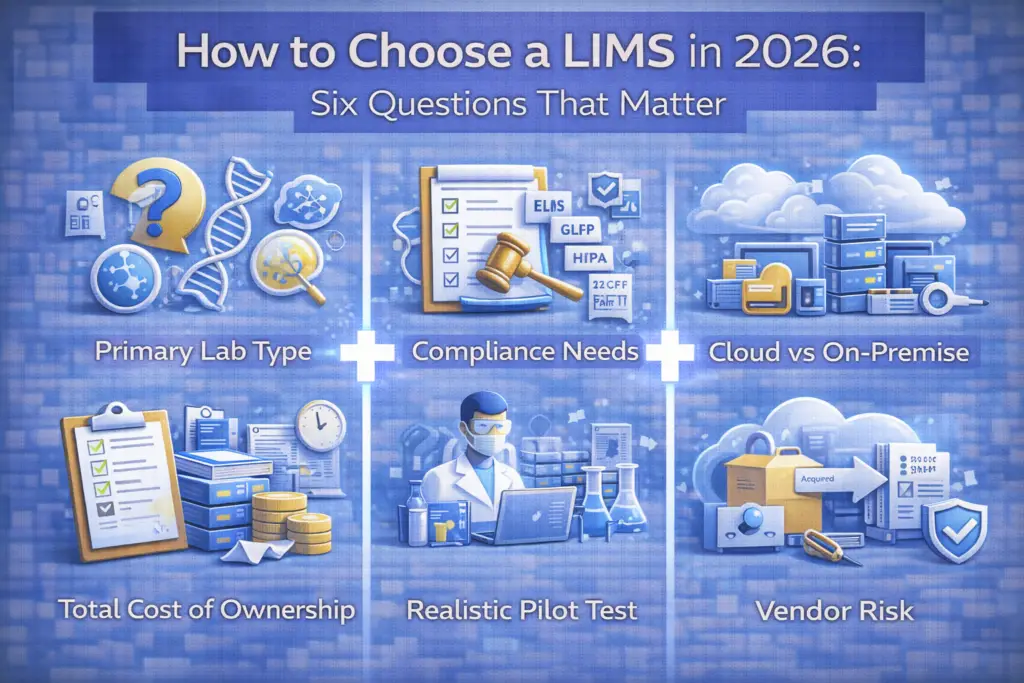
This best lims guide reviews 7 LIMS platforms based on independently verified information from vendor documentation, product release notes, user reviews on G2 and Capterra, and industry sources. No vendor has paid for inclusion or editorial positioning. Pricing is not included — published rates vary by configuration, region, and contract. Always contact vendors for current quotes. What Is a LIMS — And Why Does Choosing the Right One Matter in 2026? A Laboratory Information Management System (LIMS) is the operational backbone of a modern laboratory. It manages the complete sample lifecycle — from receipt through testing, result capture, and final reporting — while enforcing data integrity, regulatory compliance, and traceability across every step. In 2026, the LIMS market spans an unusually wide range of platforms: from decades-old enterprise systems deployed across global pharmaceutical networks, to cloud-native tools that went from zero to a major market position in under five years. Choosing the wrong LIMS — or the right LIMS for the wrong context — is one of the most expensive mistakes a laboratory organization can make. Implementations in regulated environments are measured in months and cost hundreds of thousands of dollars before the first sample is tracked. This guide helps you cut through the noise. We cover 7 platforms with verified, sourced data organized by what they actually do well — and who they are actually designed for. Don’t hesitate to have a look at our complete Lims guide for additional information. Quick navigation: Each vendor review includes a verified spec card, an independent assessment, clear strengths and limitations, and a direct ‘best for’ recommendation. Skip to any vendor using the headings or jump to the comparison tables at the end. 7 LIMS Platforms at a Glance: 2026 Independent Overview The table below summarizes the 7 platforms reviewed in this guide. Pricing is not included — see each vendor review for pricing guidance. Deployment and industry data is sourced from official vendor documentation. LIMS Platform Vendor / Owner Platform Scope Deployment Primary Industries LabWare LIMS LabWare (private) Enterprise LIMS + ELN + LES Cloud + On-premise Pharma, biotech, environmental, forensics, QC LabVantage LabVantage Solutions Enterprise LIMS + ELN + LES + SDMS Cloud (AWS) + On-premise Pharma, biobanking, food & bev, forensics, oil & gas SampleManager LIMS Thermo Fisher Scientific LIMS + SDMS + ELN + LES Cloud (AWS) + On-premise Pharma, food & bev, oil & gas, environmental, contract testing STARLIMS Francisco Partners (ex-Abbott) LIMS + ELN + SDMS + analytics Cloud + On-premise Clinical, forensics, pharma, public health, environmental Benchling Benchling (private) R&D cloud platform (LIMS + ELN) Cloud SaaS Biotech R&D, molecular biology, biopharma discovery QBench QBench (private) Cloud LIMS + QMS + billing Cloud SaaS Testing labs: biotech, food & bev, agriculture, diagnostics Clarity LIMS Illumina Genomics-specific LIMS Cloud SaaS Genomics / NGS labs, sequencing service providers How to read this guide: Platform Scope refers to the breadth of modules offered beyond core LIMS (ELN = Electronic Lab Notebook, LES = Laboratory Execution System, SDMS = Scientific Data Management System). A broader scope means more consolidation potential — but also more implementation complexity and cost. Note on STARLIMS: In 2025, Francisco Partners, a private equity firm specializing in technology businesses, announced the acquisition of STARLIMS from Abbott. STARLIMS continues to operate independently as a dedicated laboratory informatics business. The platform serves over 1,100 customers across 60 countries. ENTERPRISE LIMS — Large-Scale, Regulated, Multi-Site Deployments 1. LabWare LIMS Vendor LabWare (privately owned, founded 1988) Platform LabWare LIMS + ELN + LES (Enterprise Laboratory Platform) Deployment Cloud (SaaS on LabWare infrastructure) + On-premise + Hybrid Customer base 14,000 laboratories in 125 countries (per vendor) SaaS portfolio LabWare QAQC, LabWare GROW, LabWare ASSURE (launched 2025) Industries Pharma, biotech, environmental, forensics, food safety, QC manufacturing Compliance 21 CFR Part 11, EU Annex 11, ISO 17025, GLP, GMP, ALCOA+ Mobile Yes — iOS and Android app LabWare is among the most widely deployed enterprise LIMS platforms in the world, with a 30+ year track record in pharmaceutical, biotech, and regulated laboratory environments. It is privately owned and has remained independent through a market where most competitors have been acquired. Users frequently cite stability and longevity as key factors in their purchase decision. The platform is organized around the LabWare Enterprise Laboratory Platform: a core LIMS at the centre, with an integrated ELN for experiment documentation and a Laboratory Execution System (LES) for guided procedure execution. This means a single LabWare implementation can replace multiple separate tools — a significant operational and compliance advantage for complex organizations. In March 2025 at Pittcon, LabWare announced an expansion of its SaaS portfolio with three distinct offerings: LabWare QAQC for quality control workflows, LabWare GROW for growing organizations, and LabWare ASSURE for food safety and microbiology environments. These SaaS tiers are positioned as lower-friction entry points compared to the full enterprise deployment, with OpEx pricing and pre-configured best-practice workflows. What users consistently highlight What users consistently flag Best for: Large pharmaceutical companies, global multi-site organizations, regulated manufacturing labs, and CROs that require a deep, configurable, proven enterprise platform. The SaaS tiers (QAQC, GROW, ASSURE) extend LabWare’s reach to mid-market labs that want enterprise-grade compliance without a full custom deployment. 2. LabVantage LIMS Vendor LabVantage Solutions (Somerset, NJ; 40+ years in market) Platform LIMS + ELN + LES + SDMS + Advanced Analytics Current version LabVantage 8.9 (released March 2025) Deployment Cloud SaaS (AWS) + On-premise Customer base 1,500+ customers across life sciences, pharma, food & bev, forensics, and more Interface 100% browser-based, zero-footprint (no client software required) Industries Pharma/biopharma, biobanking, food & beverage, oil & gas, forensics, contract testing Compliance 21 CFR Part 11, EU Annex 11, ALCOA+, FAIR data principles, GDPR, CLIA AI Predictive analytics, AI bots (LabVantage Open Talk), embedded AI agents in v8.9 LabVantage occupies a strong position in the enterprise LIMS market, combining the depth of a decades-old platform with a modern, fully browser-based architecture. Its zero-footprint deployment model — no client software, plugins, or apps required — is a
What is ALCOA+? Data Integrity in Laboratory Environments
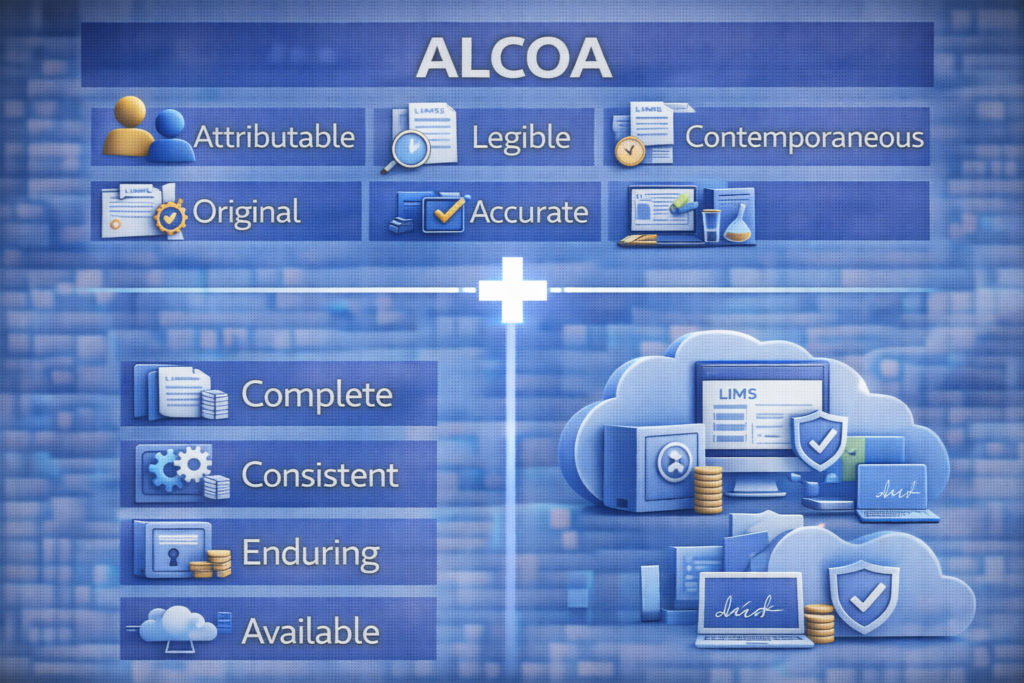
This article is based on official regulatory sources: FDA’s 2018 Data Integrity and CGMP guidance, PIC/S PI 041, EMA’s 2010 Reflection Paper, MHRA’s GxP Data Integrity guidance, and WHO TRS Annex 5. It is for informational purposes only and does not constitute regulatory or legal advice. What Is ALCOA+? ALCOA+ is the universally recognized data integrity framework used in pharmaceutical, biotech, clinical, and laboratory environments regulated by the FDA, EMA, MHRA, WHO, and PIC/S. It defines the minimum quality attributes that every laboratory record — whether written on paper or generated by a LIMS, ELN, or instrument — must satisfy to be considered trustworthy and compliant. ALCOA stands for Attributable, Legible, Contemporaneous, Original, and Accurate. The original five attributes were introduced in the early 1990s by FDA compliance expert Dr. Stan Woollen as a training tool for GLP inspectors. In 2010, the European Medicines Agency (EMA) formally extended the framework by adding four qualities — Complete, Consistent, Enduring, and Available — creating ALCOA+. Today, ALCOA+ is referenced explicitly or implicitly in every major data integrity regulatory document globally: FDA’s CGMP guidance (21 CFR Parts 211 and 11), PIC/S PI 041, MHRA’s GxP Data Integrity Guide, WHO TRS Annex 5, and EU GMP Annex 11. It applies equally to paper systems and fully digital laboratory environments. ALCOA+ and 21 CFR Part 11 are complementary, not interchangeable. Part 11 defines the technical controls an electronic system must implement (audit trails, e-signatures, access controls). ALCOA+ defines the quality standard that every record — regardless of system — must achieve. A technically Part 11-compliant LIMS can still generate ALCOA+-non-compliant records if organizational processes are inadequate. The 9 ALCOA+ Attributes: What Each Means in Practice Each attribute is both a documentation standard and a practical compliance checkpoint. Regulators use them as the lens through which they evaluate records during inspections, Form 483 observations, and warning letter investigations. A — Attributable Regulatory anchor: 21 CFR 211.194(a) — initials/signatures required; EU GMP Annex 11 §12.4 — operator identity must be recordedPaper: Analyst initials and date on every manual entry; no blank lines in batch recordsElectronic: Unique user login in LIMS/ELN — system captures user ID and timestamp automatically; no shared accountsCommon violation: Shared login credentials (e.g., ‘lab1’ / ‘admin’) — one of the most common FDA 483 findings L — Legible Regulatory anchor: 21 CFR 211.180 — records legible and readily available; EU GMP Annex 11 §8.1 — human-readable throughout lifecyclePaper: Ink entries (not pencil), no overwriting; crossed-out errors signed and dated, original value still visibleElectronic: LIMS records displayed and exported in consistent, readable format across systems; font and encoding preservedCommon violation: Pencil entries, illegible handwriting, whiteout over errors — any of these can invalidate a record during inspection C — Contemporaneous Regulatory anchor: 21 CFR 211.100(b) — each step documented at the time performed; PIC/S PI-041 — contemporaneous recording is a critical ALCOA principlePaper: pH recorded directly onto the batch record during in-process testing, not transcribed later from a scrap noteElectronic: Instrument data auto-captured into LIMS with system timestamp at point of generation; no retroactive entryCommon violation: Backdating entries, recording results from memory after the fact, or pre-recording anticipated results O — Original Regulatory anchor: 21 CFR 211.194 — original record or true certified copy; FDA Data Integrity Q&A 2018 — ‘first capture of information’Paper: The handwritten batch record page is the original; a photocopy used as working document must be marked ‘true copy’ and verifiedElectronic: Raw instrument data file is the original; a PDF export is a secondary copy — both must be retained; data migration must preserve originalsCommon violation: Deleting raw chromatography files after generating a report, or presenting a printout as the original when the electronic record exists A — Accurate Regulatory anchor: 21 CFR 211.68 — automated systems must produce accurate results; FDA Data Integrity guidance: ‘data should reflect what actually occurred’Paper: Results transcribed exactly from instrument printout; calculations verified independently before entryElectronic: Instrument integration directly into LIMS eliminates manual transcription; validated calculation routines auditable in systemCommon violation: Entering assumed or expected values instead of actual measurements; selective reporting that omits out-of-specification results The ‘+’ Attributes — Added by EMA (2010) and adopted by PIC/S, MHRA, WHO The four ‘+’ attributes extend ALCOA from a point-in-time quality check to a lifecycle quality standard. They address what happens to a record after it is created — through its entire retention period. C+ — Complete Regulatory anchor: PIC/S PI-041 §7 — complete records include all raw data, metadata, and audit trails; FDA: ‘all data, including repeats and rejects’Paper: Batch record includes all in-process checks including failed ones; no pages removed or left blank without explanationElectronic: LIMS retains all instrument runs including failed sequences; audit trail captures all attempts, not just the final accepted resultCommon violation: Deleting or hiding failed test runs from the record; presenting only passing results to auditors C+ — Consistent Regulatory anchor: PIC/S PI-041 — data must be internally coherent and follow an expected, documented sequencePaper: Logbook entries in chronological order with no gaps; dates and times consistent across related documentsElectronic: LIMS timestamps synchronized to a validated, locked time server; no ability for users to manually override system timeCommon violation: Timestamps in audit trails that precede the login event; logbook entries that are out of sequence or have unexplained time gaps E — Enduring Regulatory anchor: 21 CFR 211.180(a) — records retained for required period; PIC/S PI-041 — records must remain accessible for their entire lifecyclePaper: Batch records stored in controlled, fire-proof archive for defined retention period (typically 1 year post-expiry or 5+ years)Electronic: LIMS/ELN data backed up with verified restore procedures; vendor contract includes post-subscription data portability clauseCommon violation: Data stored on obsolete media (CDs, old proprietary formats) that cannot be read; cloud subscription ends without data export plan A+ — Available Regulatory anchor: 21 CFR 211.180(c) — records readily available for inspection; EU GMP Annex 11 §17 — available during entire retention periodPaper: Archived paper records indexed and retrievable within a defined timeframe; location documented in SOPElectronic: LIMS
What is 21 CFR Part 11?
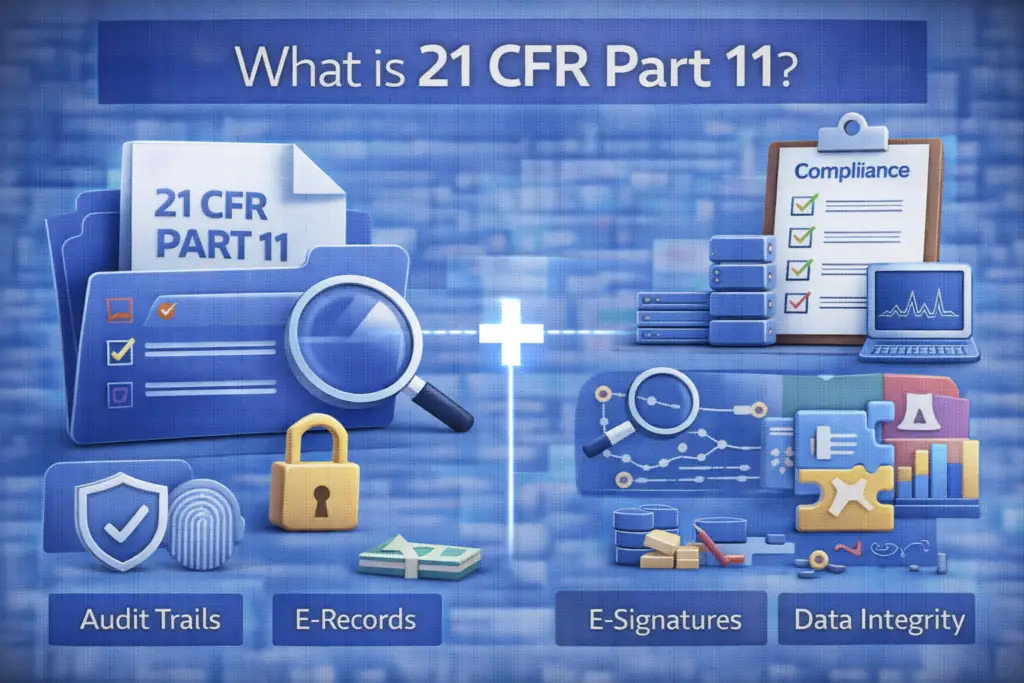
A Practical Guide for Lab Software in 2026 This guide is based on the official 21 CFR Part 11 regulatory text (eCFR), FDA’s Scope and Application Guidance (2003), FDA’s final Electronic Systems Q&A guidance (October 2024), and the finalized Computer Software Assurance (CSA) guidance (September 2025). It is for informational purposes and does not constitute legal or regulatory advice. What Is 21 CFR Part 11? 21 CFR Part 11 is the section of Title 21 of the United States Code of Federal Regulations that governs electronic records and electronic signatures in FDA-regulated environments. Published in final form in March 1997 and effective from August 1997, it establishes the criteria under which the FDA considers electronic records and electronic signatures to be trustworthy, reliable, and legally equivalent to paper records and handwritten signatures. In plain terms: if your laboratory is regulated by the FDA and you use software to create, manage, or store records that the FDA requires you to keep, those records and any digital signatures associated with them must meet Part 11’s requirements. Non-compliance exposes your organization to FDA observations, warning letters, and — in serious cases — injunctions or import bans. The full regulatory text is available at: eCFR.gov — 21 CFR Part 11 Who Does 21 CFR Part 11 Apply To? Part 11 applies to any organization regulated by the FDA that uses electronic systems to fulfill regulatory record-keeping or submission requirements. This includes: The key concept is the “predicate rule”: Part 11 activates when electronic records replace paper records that would otherwise be required by another FDA regulation — called the predicate rule. For example, 21 CFR Part 211 (pharmaceutical cGMP) requires certain manufacturing records. If those records are stored electronically, Part 11 governs how they are created, secured, and signed. Important: Part 11 does not apply to paper records. If your organization maintains authorized paper copies as the official record and only uses electronic systems for convenience (not as the authoritative record), Part 11’s scope may not fully apply. However, any system controlling a regulated process — even if it doesn’t store the authoritative record — may still require validation under predicate rules such as 21 CFR 820.70(i). The Core Requirements of 21 CFR Part 11 Part 11 is organized into two subparts that cover electronic records (Subpart B, §11.10) and electronic signatures (Subpart C, §§11.100–11.300). The table below summarizes every key requirement from the official regulatory text. Section Requirement What It Means in Practice §11.10(a) System validation Software must be validated to ensure accuracy, reliability, consistent performance, and ability to detect altered records §11.10(b) Accurate copies Ability to generate exact, human-readable and electronic copies for inspection §11.10(c) Record retention Records remain accessible and accurate throughout the required retention period §11.10(d) Audit trails Secure, computer-generated, time-stamped audit trails recording all creation, modification, and deletion — cannot be edited §11.10(e) Sequence controls System controls ensuring only authorized sequences of steps are executed §11.10(f) Authority checks System confirms user is authorized to perform the specific action before executing §11.10(g) Device checks Valid inputs at all entry points to ensure data integrity §11.10(h) Training Personnel trained to understand the development and use of computerized systems under their responsibility §11.10(i) Accountability Written policies covering sign-off responsibilities, training, and system protection consequences §11.10(j) Documentation System documentation: development, maintenance history, and change control records §11.50 Signed records Electronic records containing: the signature, meaning of signature, date and time — all permanently linked to the record §11.100 Signature uniqueness Each electronic signature unique to one individual, never reused or reassigned to another §11.200 Signature components Non-biometric signatures require at least two components (e.g., username + password); biometric signatures require unique biometric data §11.300 Safeguards Controls including unique combinations, periodic checks, forced password changes, loss management, and use by authorized holders only Source: eCFR — 21 CFR Part 11 (official text) Closed Systems vs Open Systems One of the most practically important distinctions in Part 11 is between closed and open systems, because the two have different compliance requirements. Closed system (§11.3(b)(4)): an environment in which system access is controlled by persons responsible for the content of electronic records. Most LIMS, ELN, and laboratory software platforms deployed under the vendor’s cloud infrastructure are closed systems — access is controlled by the vendor and the customer organization, not available to arbitrary external parties. Open system (§11.3(b)(9)): an environment in which system access is not controlled by the persons responsible for the content, such as public internet-facing systems or shared external data repositories. Open systems require all the closed-system controls plus additional measures including encryption and digital signatures to ensure record authenticity and confidentiality. In practice, virtually all commercial LIMS and ELN platforms operate as closed systems. When evaluating vendor Part 11 claims, confirm they are specifically addressing the closed-system requirements of §11.10 — not just making a general ‘Part 11 compliant’ claim. What 21 CFR Part 11 Means for LIMS and ELN Software For laboratories evaluating LIMS and ELN platforms, Part 11 translates into a concrete checklist of capabilities that the software must support and that the organization must implement correctly. Vendor claims and actual validated compliance are not the same thing. 1. System Validation The software must be validated for its intended use. Validation demonstrates that the system reliably does what it claims to do: accurately captures data, correctly controls access, preserves audit trails, and maintains record integrity. Validation is documented in an Installation Qualification (IQ), Operational Qualification (OQ), and Performance Qualification (PQ) — collectively called IQ/OQ/PQ. Reputable LIMS and ELN vendors provide validation documentation packages (VDPs) to support this process, but the validation itself must be performed and owned by your organization. Note on CSA (September 2025): The FDA’s finalized Computer Software Assurance (CSA) guidance — published September 24, 2025 — replaces the previous rigid documentation-heavy validation approach with a risk-based framework. Organizations can now focus validation effort on software functions that directly impact record integrity and product quality, rather than testing everything uniformly. Read the FDA CSA Guidance. 2. Audit
LIMS Software Pricing Models Explained
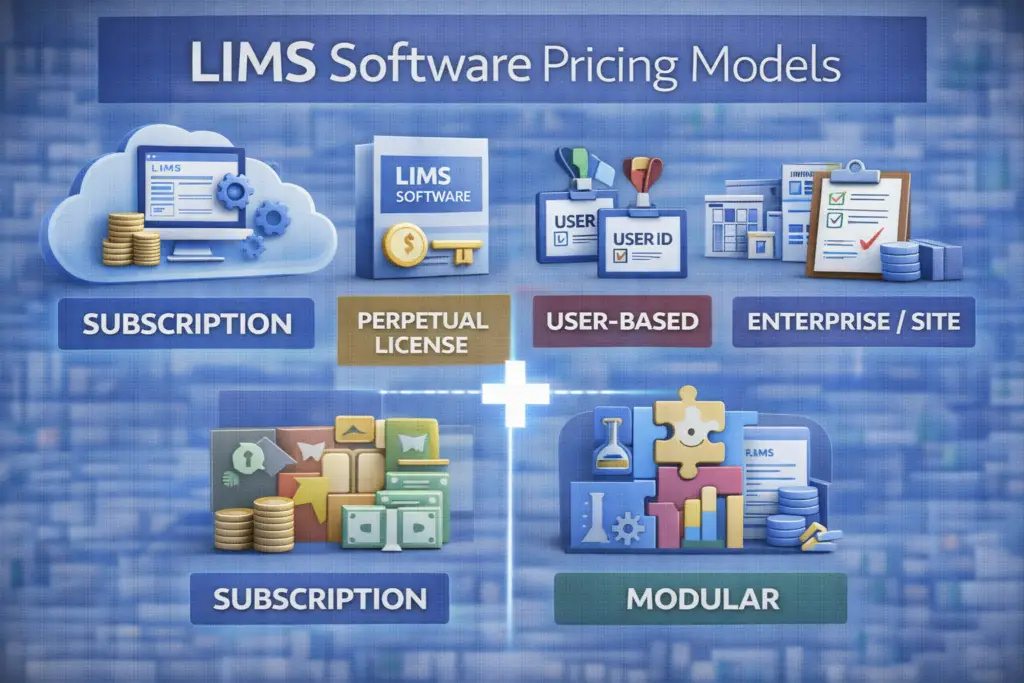
Selecting a Laboratory Information Management System (LIMS) is not just a technical decision—it is a financial strategy. Understanding LIMS Software Pricing Models Explained is essential before signing any contract. LIMS platforms impact operations, compliance, productivity, and scalability. But pricing structures vary dramatically between vendors. Without a clear understanding of cost models, laboratories risk overspending or underestimining long-term commitments. In this comprehensive guide, we break down LIMS Software Pricing Models Explained so laboratory directors, CFOs, QA managers, and IT leaders can make informed decisions. Introduction to LIMS Software Pricing Models Explained The laboratory software market has evolved significantly. Analysts like Gartner consistently highlight the shift from capital-intensive software purchases to flexible subscription models. Yet in regulated industries, pricing decisions must consider more than monthly fees. They must account for: Understanding pricing structure is as important as understanding system functionality. Why Understanding LIMS Pricing Is Critical Financial Impact on Laboratory Operations LIMS implementation affects: Poor pricing decisions can impact profitability for years. Hidden Costs and Long-Term Commitments Many organizations focus on licensing fees—but overlook: Total Cost of Ownership (TCO) matters more than initial price. The Main Types of LIMS Software Pricing Models Explained Let’s explore the most common pricing models. 1. Subscription-Based Pricing (SaaS Model) This is the most common model for modern cloud LIMS. Characteristics: Advantages: Risks: This model is ideal for growing laboratories seeking flexibility. 2. Perpetual License Model Traditional on-premise LIMS often use perpetual licensing. Characteristics: Advantages: Risks: This model is often used by large enterprise labs. 3. User-Based Pricing Many vendors charge per named or concurrent user. Named User Pricing:Each user license is assigned to one individual. Concurrent User Pricing:A limited number of users can log in simultaneously. Risk:Rapid scaling increases costs dramatically. User-based pricing must align with workforce size and growth projections. 4. Modular Pricing Vendors may offer core modules with optional add-ons: While modular pricing offers flexibility, costs can rise quickly as features are added. 5. Enterprise or Site Licensing Large organizations may negotiate enterprise-wide agreements. This model offers: It is ideal for global pharmaceutical or diagnostic organizations. Cloud vs On-Premise Cost Structures Cloud pricing typically includes: On-premise pricing requires: Cloud often reduces infrastructure burden but increases recurring expenses. Implementation and Professional Services Costs Implementation often represents 1–2x the software cost. Professional services may include: Underestimating implementation costs is one of the biggest financial mistakes in LIMS projects. Validation and Compliance Costs In regulated environments overseen by agencies such as the U.S. Food and Drug Administration, validation is mandatory. Costs include: Cloud LIMS may reduce infrastructure validation, but system validation remains required. Customization vs Configuration Costs Customization significantly increases: Configuration (using standard features) is usually more cost-effective. Over-customization inflates total ownership cost. Integration and API Pricing Considerations Modern labs require integration with: Integration pricing may include: Always clarify integration pricing early in vendor negotiations. Data Migration and Legacy System Costs Migrating data from: requires: Data migration is often underestimated in budget planning. Maintenance and Support Fees Maintenance may include: Perpetual licenses typically charge annual maintenance. Cloud subscriptions often include maintenance—but may charge premium support tiers. Scalability and Cost Over Time Labs must evaluate: Subscription models scale easily—but increase recurring costs. Perpetual licenses require infrastructure upgrades as scale increases. Long-term modeling is essential. Negotiation Strategies for LIMS Buyers To optimize pricing: Pricing is rarely fixed. Negotiation is expected. Frequently Asked Questions 1. What is the average cost of LIMS software? Costs vary widely—from tens of thousands to millions depending on scale and complexity. 2. Is cloud LIMS cheaper than on-premise? Short-term, yes. Long-term costs depend on subscription duration and scale. 3. What is the biggest hidden cost in LIMS pricing? Implementation and validation expenses. 4. Are validation documents included in pricing? Some vendors provide templates, but validation responsibility remains with the lab. 5. How long do LIMS contracts typically last? Often 3–5 years for subscription models. 6. Can pricing be negotiated? Yes. Enterprise agreements often include discounts. Conclusion: Choosing the Right LIMS Pricing Strategy Understanding LIMS Software Pricing Models Explained allows laboratories to move from reactive purchasing to strategic investment. The right pricing model depends on: Subscription models provide flexibility and faster deployment. Perpetual licenses offer control and potential long-term savings. Modular and user-based models offer flexibility—but require careful forecasting. In the end, LIMS pricing is not about choosing the cheapest option—it is about selecting the most sustainable, compliant, and scalable investment for your laboratory’s future. Smart financial planning turns LIMS from an expense into a strategic asset.
Common LIMS Implementation Challenges
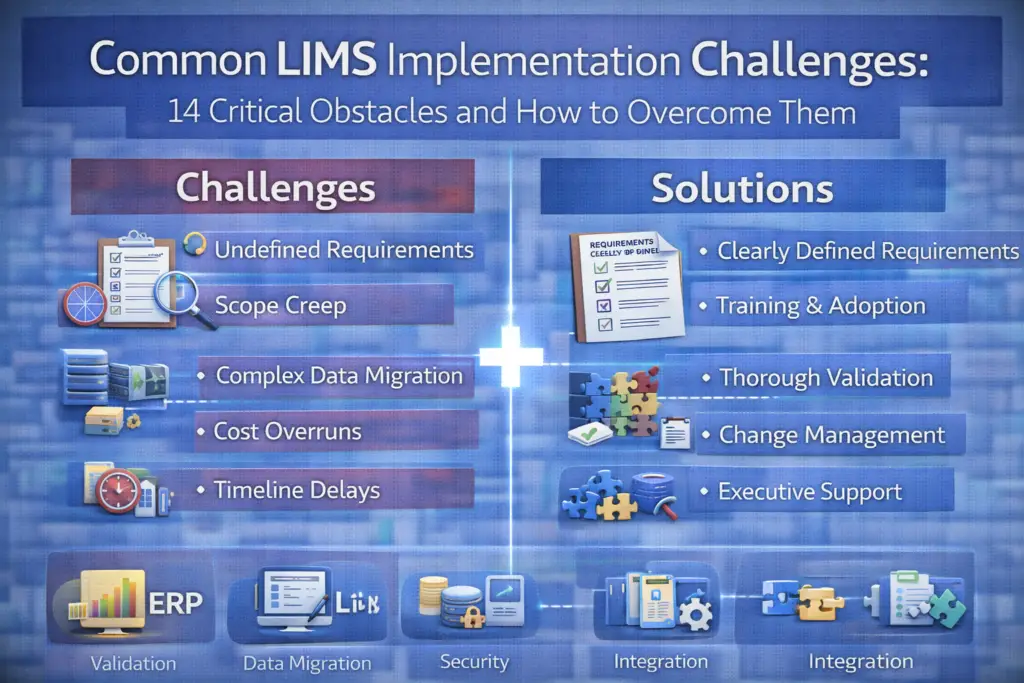
Implementing a Laboratory Information Management System (LIMS) is one of the most strategic decisions a laboratory can make. However, understanding Common LIMS Implementation Challenges is essential before starting the journey. LIMS platforms impact sample tracking, workflow automation, compliance, reporting, and data integrity. But despite their long-term benefits, implementations are often complex, time-consuming, and resource-intensive. The reality is simple: most LIMS projects fail not because of technology—but because of planning, governance, and execution issues. Let’s explore the Common LIMS Implementation Challenges laboratories face and how to address them effectively. Introduction to Common LIMS Implementation Challenges A LIMS touches nearly every operational layer of a laboratory: In regulated industries overseen by agencies such as the U.S. Food and Drug Administration, LIMS implementations must also meet strict validation and data integrity requirements. This combination of operational and regulatory complexity creates significant implementation risks. Why LIMS Implementations Are Complex Operational Scope and Process Variability Every laboratory operates differently. Even within the same organization, workflows may vary by: Standardizing these processes before configuring LIMS is often difficult. Regulatory and Compliance Requirements Regulated laboratories must ensure: Validation alone can add months to project timelines. Common LIMS Implementation Challenges Explained 1. Poorly Defined Requirements One of the most frequent causes of failure is unclear requirements. Without a detailed User Requirements Specification (URS), projects drift, features are misunderstood, and rework becomes inevitable. Solution: Invest heavily in upfront requirement workshops. 2. Scope Creep Stakeholders often add new requirements mid-project. While improvements may seem beneficial, uncontrolled scope expansion leads to delays and budget overruns. Solution: Implement strict change control governance. 3. Underestimating Data Migration Complexity Migrating data from legacy systems, spreadsheets, or paper records can be extremely complex. Challenges include: Solution: Conduct a detailed data assessment before migration. 4. Integration with Existing Systems Modern labs require LIMS integration with: Integration failures can delay projects significantly. Solution: Map integration architecture early. 5. User Resistance and Change Management Users often resist change. Common concerns include: Without user buy-in, adoption suffers. Solution: Implement structured change management and training programs. 6. Insufficient Executive Sponsorship LIMS projects require leadership support. Without executive sponsorship: Strong leadership ensures accountability. 7. Budget Overruns Hidden costs often include: Poor planning leads to unexpected financial strain. 8. Timeline Delays Typical causes of delays include: Realistic timelines are essential. 9. Validation and Compliance Burden In regulated environments, LIMS must undergo: Validation documentation can become overwhelming. 10. Inadequate Testing (IQ/OQ/PQ) Skipping rigorous testing increases long-term risk. Incomplete test scripts lead to compliance gaps. 11. Vendor Dependency Risks Over-reliance on vendor consultants can create: Internal capability building is critical. Data Migration and Legacy System Risks Legacy systems often contain: Migrating flawed data into a new LIMS multiplies problems. Data cleansing should precede migration. Regulatory and Validation Challenges Organizations must align with: Failure to validate correctly can result in audit findings. Validation is not optional—it is mandatory in regulated environments. IT Infrastructure and Cybersecurity Issues LIMS implementation requires: Cloud-based systems reduce infrastructure burden but require vendor qualification. Customization vs Configuration Dilemma Heavy customization increases: Configuration (using standard features) is usually safer. Over-customization is one of the most underestimated Common LIMS Implementation Challenges. Training and Adoption Barriers Without proper training: Continuous training programs are essential. Post-Go-Live Challenges Implementation does not end at go-live. Post-deployment issues include: Maintenance planning is critical. Best Practices for Successful LIMS Implementation To overcome Common LIMS Implementation Challenges: Successful implementation is about governance, not just software. Frequently Asked Questions 1. How long does a LIMS implementation take? Typically 6–18 months depending on complexity. 2. What is the biggest risk in LIMS implementation? Poor requirement definition and scope creep. 3. Is validation mandatory? Yes, in regulated environments. 4. Can cloud LIMS reduce implementation challenges? It can reduce infrastructure burden but does not eliminate validation requirements. 5. Why do LIMS projects exceed budget? Hidden costs and uncontrolled scope expansion. 6. What ensures long-term success? Strong governance, training, and executive support. Conclusion: Turning Implementation Challenges into Strategic Success Understanding Common LIMS Implementation Challenges is the first step toward successful digital transformation. LIMS implementation is not merely a software project—it is an organizational transformation initiative. Labs that approach deployment strategically: are far more likely to succeed. When executed properly, LIMS becomes not just an operational tool—but a compliance asset, efficiency driver, and competitive advantage. Preparation turns complexity into opportunity.
Open-Source ELN Software: Pros and Cons – Critical Factors Every Lab Should Evaluate
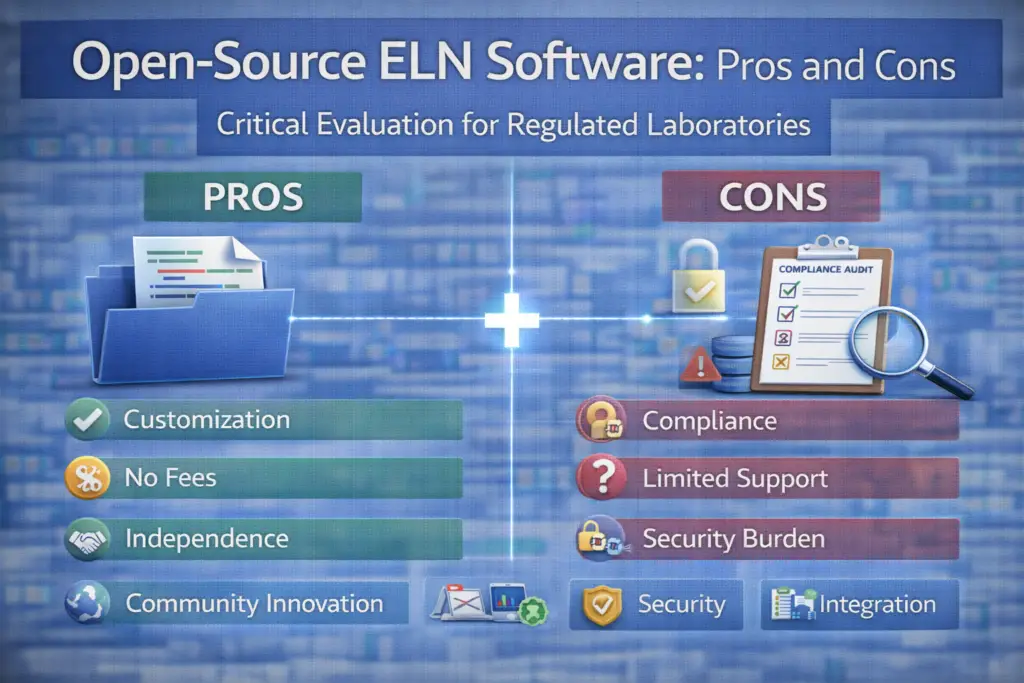
As laboratories accelerate digital transformation, many organizations explore alternatives to expensive proprietary platforms. One option that often attracts attention is Open-Source ELN Software: Pros and Cons. At first glance, open-source Electronic Laboratory Notebooks (ELNs) seem highly attractive: no licensing fees, full customization, and community-driven innovation. But beneath the surface, there are important trade-offs. Understanding Open-Source ELN Software: Pros and Cons is critical before making a strategic technology decision that impacts compliance, data integrity, and intellectual property. Let’s break it down clearly and objectively. Introduction to Open-Source ELN Software: Pros and Cons Open-source solutions have transformed many industries. From operating systems to databases, open-source technology has proven powerful and innovative. Organizations like Linux Foundation have demonstrated how open collaboration can drive global adoption. But laboratory environments are different. Regulated laboratories must consider: Open-source ELNs can offer flexibility—but they also introduce responsibility. What Is Open-Source ELN Software? Definition and Core Characteristics Open-source ELN software is a digital laboratory notebook platform whose source code is publicly available. This allows organizations to: The software is typically distributed under open-source licenses such as GPL, MIT, or Apache. How Open-Source Licensing Works Open-source licenses define: Unlike commercial ELNs, open-source projects may not provide formal warranties or guaranteed support. This distinction matters significantly in regulated environments. Why Laboratories Consider Open-Source ELNs Laboratories often explore open-source ELNs for several reasons: For startups or academic institutions, eliminating licensing fees can be appealing. However, free software does not mean zero cost. Open-Source ELN Software: Pros and Cons Explained Major Advantages of Open-Source ELN 1. No Licensing FeesOpen-source ELNs typically eliminate recurring software licensing costs. 2. Full CustomizationAccess to source code allows labs to tailor features precisely to workflow needs. 3. TransparencyCode transparency enables full visibility into system logic. 4. Vendor IndependenceLabs avoid being tied to a single commercial provider. 5. Community InnovationGlobal developer communities may continuously improve features. These advantages are particularly attractive for research-focused labs. Key Disadvantages and Limitations 1. Compliance ResponsibilityRegulated labs must validate the system independently. Agencies such as the U.S. Food and Drug Administration require validated computerized systems. Open-source vendors rarely provide validation documentation. 2. Limited Formal SupportCommunity forums cannot replace guaranteed SLAs. 3. Security Management BurdenInternal teams must manage: 4. Long-Term Sustainability RisksOpen-source projects may lose community support. 5. Hidden Infrastructure CostsHosting, maintenance, and IT staffing can outweigh licensing savings. Open-source shifts responsibility from vendor to laboratory. Cost Considerations: Free vs Total Cost of Ownership The biggest misconception about open-source ELNs is cost. While licensing may be free, total cost includes: In many cases, total cost of ownership (TCO) rivals or exceeds commercial ELN subscriptions. Cost must be evaluated holistically. Customization and Flexibility Open-source ELNs provide unmatched customization potential. Labs can: However, deep customization increases: Customization freedom comes with lifecycle responsibility. Security and Data Protection Implications Security depends entirely on internal governance. Open-source ELNs require: Commercial vendors often invest heavily in cybersecurity certifications. Open-source environments rely on internal capabilities. Regulatory Compliance and Validation Challenges Regulated labs must ensure: Open-source projects may provide functionality—but rarely provide: Validation burden rests entirely on the lab. For GMP, GLP, or ISO environments, this can be a major obstacle. Community Support vs Commercial Support Community support typically includes: Commercial support offers: In mission-critical environments, guaranteed support often outweighs cost savings. Scalability and Long-Term Sustainability Open-source ELNs can scale technically. But sustainability depends on: Abandoned projects can create long-term risk. Labs must evaluate project maturity and roadmap stability. Integration with LIMS and Other Systems Modern laboratories require integration with: Open-source ELNs may require custom API development. Commercial ELNs often provide pre-built connectors. Integration complexity increases validation scope. When Open-Source ELN Is the Right Choice Open-source ELNs may be suitable for: In low-regulatory contexts, open-source can be effective. When Commercial ELN May Be Safer Commercial ELNs are generally safer for: Compliance infrastructure is often built into commercial solutions. Frequently Asked Questions 1. Is open-source ELN software truly free? Licensing may be free, but infrastructure and support costs remain. 2. Can open-source ELN meet FDA requirements? Yes, but validation responsibility lies entirely with the laboratory. 3. Is open-source less secure? Not inherently. Security depends on implementation quality. 4. Who provides support for open-source ELNs? Usually community contributors unless a commercial partner offers support. 5. Can open-source ELN integrate with LIMS? Yes, but often requires custom development. 6. What is the biggest risk of open-source ELN? Long-term sustainability and compliance burden. Conclusion: Should Your Lab Choose Open-Source ELN Software? When evaluating Open-Source ELN Software: Pros and Cons, the answer is not simple. Open-source offers: But it also demands: For research-focused, non-regulated labs, open-source ELNs can be powerful tools. For highly regulated environments, commercial ELNs often provide safer, compliance-ready infrastructure. Ultimately, the right choice depends on your laboratory’s regulatory scope, IT maturity, risk tolerance, and long-term digital strategy. Technology decisions in laboratory environments are never purely technical—they are strategic. Choose accordingly.
Cloud ELN vs On-Premise ELN: Powerful Insights to Choose the Right Deployment Model
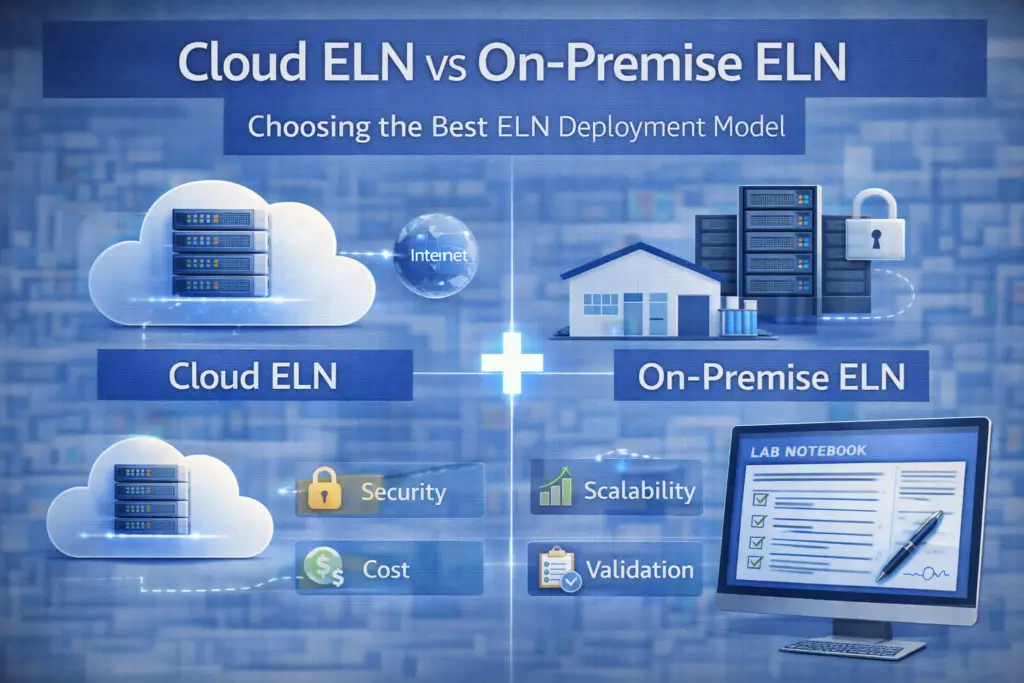
As laboratories accelerate digital transformation, one critical decision emerges: Cloud ELN vs On-Premise ELN. Electronic Laboratory Notebooks (ELNs) are now central to compliance, collaboration, and data integrity. But choosing how to deploy your ELN is just as important as choosing the software itself. The debate around Cloud ELN vs On-Premise ELN is not simply technical—it’s strategic. It impacts compliance, IT governance, validation workload, cost structure, and long-term scalability. Let’s break it down clearly for modern laboratory decision-makers. Introduction to Cloud ELN vs On-Premise ELN ELNs have become a foundational element of digital lab infrastructure. Organizations ranging from biotech startups to global pharmaceutical companies rely on ELNs for documentation, compliance, and intellectual property protection. Industry analysts like Gartner consistently highlight cloud adoption as a key trend in enterprise software—including laboratory systems. Yet regulated industries remain cautious. So how do you choose? Understanding the differences is essential. What Is a Cloud ELN? Definition and Architecture A Cloud ELN is hosted on external servers managed by a vendor or third-party provider. Users access it through a web browser. Most Cloud ELNs follow a Software-as-a-Service (SaaS) model, meaning: Infrastructure, maintenance, and security patching are typically handled by the provider. Typical Cloud Deployment Models (SaaS, PaaS) Common models include: Cloud ELNs are designed for scalability and rapid deployment. What Is an On-Premise ELN? Local Infrastructure Model An On-Premise ELN is installed on servers within the organization’s physical infrastructure. The laboratory’s IT department manages: Everything remains under internal control. IT Ownership and Maintenance With on-premise systems: This model appeals to organizations with strict internal IT governance. Cloud ELN vs On-Premise ELN: Core Technical Differences Hosting and Infrastructure Cloud ELN On-Premise ELN Hosted externally Hosted internally Vendor-managed infrastructure Lab-managed servers Automatic updates Manual update cycles Cloud removes infrastructure burden.On-premise increases control but adds responsibility. Accessibility and Remote Collaboration Cloud ELNs allow: On-premise ELNs may require VPN access, which can limit flexibility. In today’s distributed research environment, accessibility matters. Security Comparison: Myth vs Reality Security is often the main concern in the Cloud ELN vs On-Premise ELN debate. Data Encryption and Cybersecurity Modern cloud providers invest heavily in: Large providers often maintain stronger cybersecurity frameworks than internal IT departments. Physical vs Virtual Risk Exposure On-premise systems face risks such as: Cloud systems face: Security depends more on governance than deployment model. Regulatory Compliance Considerations 21 CFR Part 11 and GxP Alignment Regulations enforced by the U.S. Food and Drug Administration apply regardless of hosting model. Both deployment types must support: Compliance is not determined by cloud vs on-premise—it is determined by system configuration and validation. Vendor Qualification and Audit Rights For cloud systems, laboratories must: Vendor oversight becomes critical. Validation and Change Control Cloud ELNs: On-premise ELNs: Cloud often reduces validation complexity—but not validation accountability. Scalability and Performance Cloud ELNs scale easily: On-premise scaling requires: For growing labs, scalability is a decisive factor. Cost Analysis: CAPEX vs OPEX Cloud ELNs operate on OPEX (operational expense): On-premise ELNs require CAPEX (capital expense): Long-term cost comparisons depend on scale and internal resources. Implementation Speed and IT Burden Cloud deployment: On-premise deployment: Speed matters for innovation-driven labs. Disaster Recovery and Business Continuity Cloud ELNs typically include: On-premise systems require: Business continuity planning is often more robust in cloud environments. When to Choose Cloud ELN Choose Cloud ELN if: When to Choose On-Premise ELN Choose On-Premise ELN if: Hybrid Approaches: The Emerging Middle Ground Many organizations now adopt hybrid strategies: Hybrid models offer flexibility and risk balance. Frequently Asked Questions 1. Is Cloud ELN compliant with FDA regulations? Yes, if properly configured and validated. 2. Is On-Premise more secure than Cloud? Not necessarily. Security depends on implementation and governance. 3. Which is more expensive long-term? It depends on infrastructure scale and IT staffing costs. 4. Is validation easier in the Cloud? Infrastructure validation may be reduced, but system validation remains required. 5. Can labs migrate from On-Premise to Cloud? Yes, with proper data migration planning and validation. 6. What is the biggest risk in cloud adoption? Insufficient vendor qualification and unclear responsibility boundaries. Conclusion: Making a Strategic ELN Deployment Decision The decision between Cloud ELN vs On-Premise ELN is not about right or wrong—it’s about alignment. Cloud offers: On-Premise offers: Modern laboratories must evaluate: Ultimately, the best deployment model is the one that supports compliance, data integrity, and operational excellence—without slowing innovation. In a rapidly evolving scientific environment, strategic deployment decisions shape long-term success.
ELN Compliance and Data Integrity: Critical Strategies to Ensure Regulatory Confidence and Scientific Trust
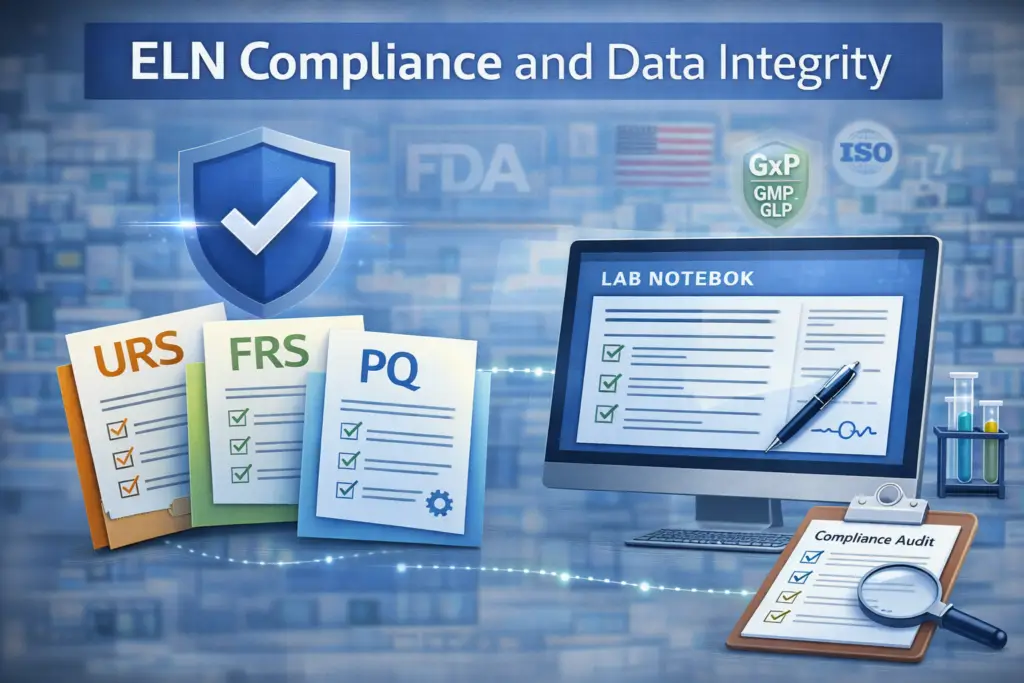
In today’s regulated laboratory landscape, ELN Compliance and Data Integrity are no longer optional technical features—they are foundational requirements for operational legitimacy and scientific credibility. Electronic Laboratory Notebooks (ELNs) have replaced paper notebooks in many research and quality environments. But moving from paper to digital does not remove compliance obligations. In fact, it increases regulatory scrutiny. Understanding ELN Compliance and Data Integrity is essential for QA managers, lab directors, IT compliance officers, and regulatory affairs professionals. Without strong controls, laboratories risk inspection findings, warning letters, data rejection, or reputational damage. Let’s explore how to get it right. Introduction to ELN Compliance and Data Integrity Digital transformation in laboratories has accelerated dramatically. Regulatory agencies now expect electronic systems to meet strict standards for reliability, traceability, and security. Authorities such as the U.S. Food and Drug Administration require that electronic records be trustworthy, accurate, and protected against unauthorized changes. ELNs directly impact: That is why compliance and integrity must be designed into the system—not added later. What Does ELN Compliance Mean? Regulatory Alignment in Digital Laboratories ELN compliance means that the system: It is not just about software functionality—it is about documented proof that the system works as intended. Electronic Records and Signatures Requirements Electronic records must be: Electronic signatures must be: These requirements are central to compliance frameworks worldwide. Understanding Data Integrity in Scientific Environments The ALCOA+ Principles Data integrity is often summarized by ALCOA+: The “+” includes: ELNs must support all these principles natively. Why Data Integrity Is Under Regulatory Scrutiny Regulatory agencies have increased enforcement actions related to data manipulation, incomplete audit trails, and undocumented changes. Data integrity failures can lead to: Digital systems must therefore prove they maintain integrity automatically and consistently. Key Regulatory Frameworks Impacting ELN Compliance 21 CFR Part 11 21 CFR Part 11 governs electronic records and electronic signatures for FDA-regulated entities. It requires: GxP, GMP, and GLP Good Practice (GxP) regulations apply across: All require validated computerized systems and documented procedures. ISO Standards and International Expectations Standards such as ISO 17025 and ISO 9001 emphasize: Global laboratories must align with both regional and international frameworks. Core Technical Controls Supporting ELN Compliance and Data Integrity Strong ELN compliance depends on technical safeguards. Audit Trails Audit trails must: Audit trails are a cornerstone of inspection readiness. Electronic Signatures Electronic signatures must: They must not be transferable or shared. Role-Based Access Control Access must follow the principle of least privilege. Users should only access: Segregation of duties reduces compliance risk. Secure Time Stamping Time stamps must be: This ensures entries are contemporaneous. Risk Management in ELN Systems Compliance should follow a risk-based approach. Risk assessments should evaluate: High-risk functions require stronger controls and deeper validation. Risk-based thinking aligns with global regulatory guidance. Cloud-Based ELN Compliance Considerations Cloud ELNs introduce additional factors: Cloud does not eliminate compliance responsibilities. It shifts part of the responsibility to shared governance. Vendor audits become critical. Data Governance and Lifecycle Management Data governance includes: Data must remain accessible and readable throughout its required retention period. Improper lifecycle management can invalidate compliance. Validation and Periodic Review of ELNs Validation ensures the ELN works as intended. This includes: Periodic review ensures continued compliance after: Validation is not a one-time activity. Common Compliance Pitfalls in ELN Implementation Common mistakes include: Technology alone does not guarantee compliance. Governance does. Building a Compliance-First ELN Strategy To ensure strong ELN Compliance and Data Integrity: Compliance must be embedded in organizational culture. Frequently Asked Questions 1. Is ELN validation mandatory? Yes, in regulated environments under FDA, GMP, GLP, or ISO frameworks. 2. Can cloud ELNs be compliant? Yes, provided vendor controls, security, and validation meet regulatory expectations. 3. What is the biggest compliance risk in ELNs? Weak audit trails and poor access control management. 4. How often should ELNs be reviewed? Periodic reviews are recommended annually or after major changes. 5. Are electronic signatures legally binding? Yes, when implemented according to regulatory requirements. 6. Does compliance slow innovation? No. Properly designed systems support both compliance and efficiency. Conclusion: Why ELN Compliance and Data Integrity Define Modern Laboratory Excellence When discussing ELN Compliance and Data Integrity, we are discussing the foundation of scientific credibility. A compliant ELN: In modern laboratories, digital documentation is not just convenient—it is accountable. Organizations that prioritize ELN compliance gain more than regulatory approval. They gain trust, resilience, and long-term competitive advantage. And in regulated science, trust is everything.
LIMS Validation Explained : Critical Steps to Ensure Compliance, Data Integrity, and Audit Readiness
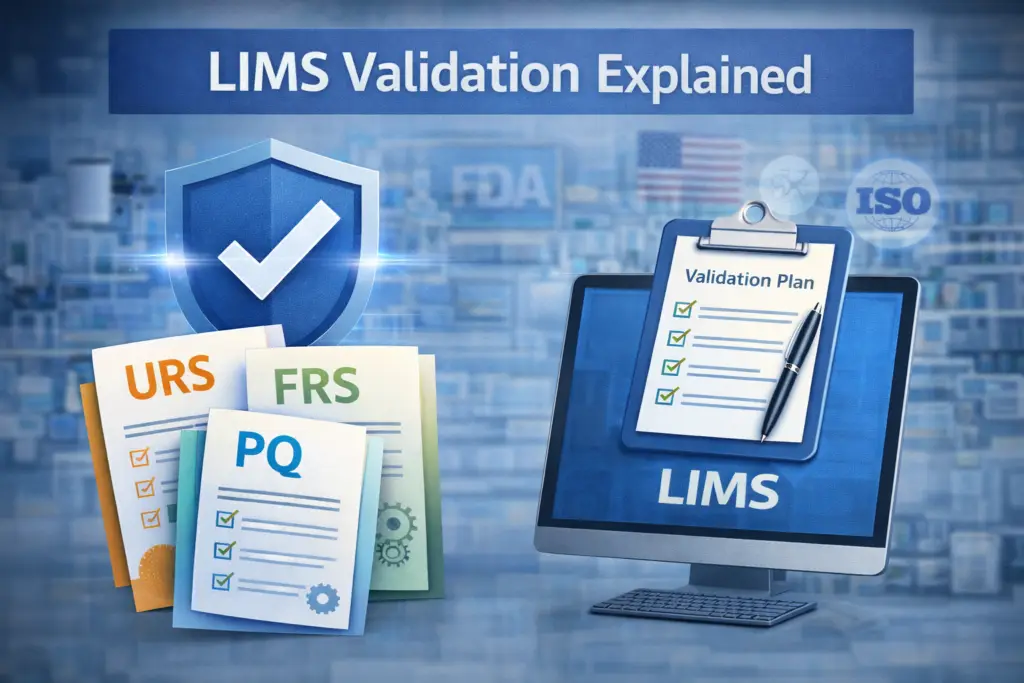
In regulated laboratory environments, few topics are as critical—and as misunderstood—as LIMS Validation Explained. Whether you operate in pharmaceutical manufacturing, clinical diagnostics, biotech R&D, or environmental testing, validating your Laboratory Information Management System (LIMS) is not optional. It is a regulatory and operational necessity. Understanding LIMS Validation Explained is essential for lab directors, QA managers, IT teams, and compliance officers. A properly validated LIMS protects data integrity, ensures regulatory compliance, and safeguards your organization against costly audit findings. Let’s break it down clearly and strategically. Introduction to LIMS Validation Explained A LIMS manages sample tracking, workflows, reporting, and data storage. When that system operates in a regulated environment, authorities require proof that it functions correctly and consistently. Validation provides that proof. Agencies such as the U.S. Food and Drug Administration expect computerized systems that impact product quality or patient safety to be validated. Without proper validation documentation, a laboratory risks warning letters, fines, or operational shutdown. Simply put: validation protects both your data and your reputation. What Is LIMS Validation? Definition and Purpose LIMS validation is a documented process that demonstrates a LIMS system performs as intended, consistently and reliably, according to predefined requirements. It answers three fundamental questions: Validation ensures traceability from business needs to system functionality. Why Validation Is Mandatory in Regulated Labs In regulated sectors, digital records are treated with the same seriousness as physical records. Any system that stores, modifies, or transmits regulated data must prove: Without validation, there is no formal assurance that the system works as required. Regulatory Frameworks Governing LIMS Validation 21 CFR Part 11 One of the most recognized regulations is 21 CFR Part 11. It governs electronic records and electronic signatures. It requires: Compliance is mandatory for companies regulated by the U.S. Food and Drug Administration. GxP, GMP, and GLP Requirements Good Practice (GxP) guidelines apply to: All require validated computerized systems that affect product quality or data reliability. ISO Standards and Data Integrity Guidelines Standards such as ISO 17025 and ISO 9001 emphasize: Validation supports all these requirements. Why LIMS Validation Is Critical for Modern Laboratories Validation is not just regulatory bureaucracy. It provides: Without validation, laboratories face operational uncertainty and reputational risk. In short, validation builds trust. The Risk-Based Approach to LIMS Validation Modern validation strategies follow a risk-based methodology. Instead of validating everything equally, laboratories assess: High-risk components receive deeper testing and documentation. This approach aligns with guidance from international regulators and ensures efficient use of validation resources. The LIMS Validation Lifecycle Explained The validation lifecycle typically follows structured phases. User Requirements Specification (URS) The URS defines what the lab needs from the LIMS. It includes: The URS becomes the foundation of validation. Functional Requirements Specification (FRS) The FRS describes how the system will meet those needs. It translates business needs into technical functions. Design Qualification (DQ) DQ confirms that the selected LIMS solution is suitable for its intended purpose. Installation Qualification (IQ) IQ verifies that: Operational Qualification (OQ) OQ tests that the system operates according to specifications under controlled conditions. Performance Qualification (PQ) PQ confirms the system performs effectively in real-world operational conditions. Together, IQ, OQ, and PQ provide structured evidence of system reliability. Validation Documentation: What You Must Have A complete validation package includes: During audits, inspectors will request this documentation. Incomplete records often trigger observations. Common Mistakes in LIMS Validation Organizations often make critical errors, including: Remember: vendors support validation—but ultimate responsibility remains with the laboratory. Cloud-Based LIMS Validation Considerations Cloud LIMS solutions introduce additional considerations: Cloud does not remove validation requirements. It shifts focus toward vendor audits and shared responsibility models. Maintaining Validation: Change Control and Periodic Review Validation does not end at go-live. Systems evolve through: Each change must be evaluated under formal change control procedures. Periodic review ensures the system remains compliant over time. Ongoing validation maintenance protects long-term integrity. Frequently Asked Questions 1. Is LIMS validation required for all laboratories? It is mandatory for regulated laboratories operating under FDA, GMP, GLP, or ISO requirements. 2. How long does LIMS validation take? Typically several months, depending on complexity and customization. 3. Can vendors provide validation documents? Yes, but laboratories remain responsible for final validation. 4. Is cloud LIMS easier to validate? It can simplify infrastructure validation but still requires documentation and risk assessment. 5. What happens during an audit? Inspectors review validation documentation, change control records, and audit trails. 6. What is the biggest risk of not validating? Regulatory penalties, warning letters, or operational shutdown. Conclusion: Why LIMS Validation Is a Strategic Investment When we talk about LIMS Validation Explained, we are not just discussing compliance checkboxes. We are discussing: Validation transforms a LIMS from a software tool into a trusted compliance asset. For laboratories operating in regulated industries, LIMS validation is not simply a requirement—it is a strategic safeguard. Organizations that invest in structured validation reduce risk, strengthen governance, and build long-term operational resilience. And in today’s highly regulated scientific landscape, that competitive advantage is priceless.
Paper vs Electronic Lab Notebook: 11 Powerful Reasons Smart Labs Are Going Digital
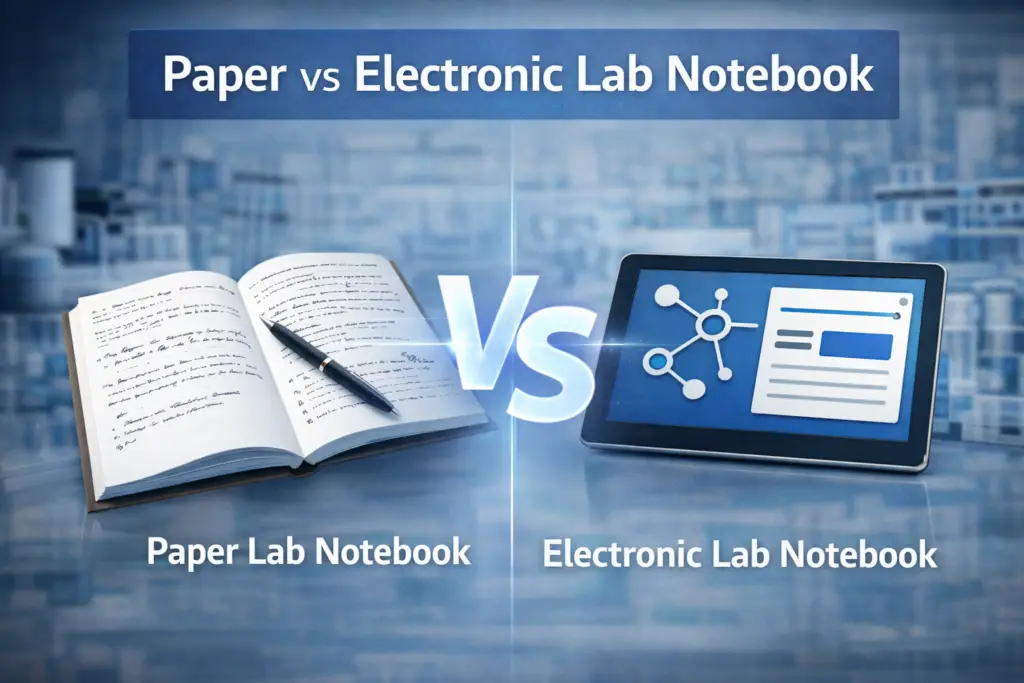
Laboratories around the world are facing a critical decision: Paper vs Electronic Lab Notebook. For decades, scientists relied on handwritten notebooks to document experiments, record observations, and protect intellectual property. But today, the digital transformation of laboratories is reshaping how research is conducted. The debate around Paper vs Electronic Lab Notebook is no longer just about preference—it’s about efficiency, compliance, scalability, and competitive advantage. If your goal is to modernize laboratory operations and future-proof research processes, understanding this comparison is essential. Let’s explore it in depth. Introduction to Paper vs Electronic Lab Notebook The traditional lab notebook has been a symbol of scientific discovery for centuries. From handwritten chemical formulas to carefully taped chromatograms, paper notebooks have captured groundbreaking innovations. However, science has evolved. Data volumes have exploded. Regulations have tightened. Teams are more global than ever. This shift has brought Electronic Lab Notebooks (ELNs) into the spotlight. So when we compare Paper vs Electronic Lab Notebook, we are really comparing tradition versus transformation. What Is a Traditional Paper Lab Notebook? A paper lab notebook is a bound notebook used to document experiments, procedures, observations, and results in handwritten format. How Paper Notebooks Have Served Science for Centuries Historically, paper notebooks have: Famous researchers across history relied on handwritten records to protect discoveries and establish patents. Common Practices in Paper-Based Documentation Typical paper notebook practices include: While these practices ensure traceability, they are entirely manual—and prone to human error. What Is an Electronic Lab Notebook (ELN)? An Electronic Lab Notebook (ELN) is a digital platform designed to replace paper-based scientific documentation. Organizations like Gartner classify ELNs as a key component of laboratory digital transformation. Definition and Core Concept An ELN is: It replicates the function of paper but enhances it with automation and connectivity. Key Functional Capabilities Modern ELNs offer: In short, an ELN turns documentation into structured, usable data. Paper vs Electronic Lab Notebook: What’s the Fundamental Difference? At its core, the debate over Paper vs Electronic Lab Notebook centers on how data is stored, accessed, and protected. Static Records vs Dynamic Data Paper notebooks are static. Once written, information cannot be easily modified, reorganized, or searched. Retrieving past experiments requires manual flipping through pages. ELNs are dynamic. They allow: Information becomes living, accessible data—not just ink on paper. Manual Processes vs Digital Automation Paper requires: ELNs automate: Automation reduces administrative burden significantly. Data Integrity and Compliance Considerations In regulated environments, documentation isn’t optional—it’s mandatory. Audit Trails and Regulatory Requirements Agencies such as the U.S. Food and Drug Administration require clear, traceable documentation. Paper notebooks can meet compliance standards—but only with strict oversight. ELNs provide built-in: Compliance becomes systematic rather than procedural. 21 CFR Part 11 and GMP Alignment ELNs are often designed to align with: Paper systems must rely entirely on procedural discipline. Efficiency and Productivity Comparison Time Spent Searching and Rewriting With paper: With ELN: Time saved directly impacts productivity. Workflow Optimization ELNs standardize processes. They ensure: Paper systems often vary by individual user. Collaboration and Knowledge Sharing Modern research is collaborative. Paper notebooks: ELNs: In a world of distributed labs, digital collaboration is essential. Risk Management and Data Security Paper notebooks can be: ELNs offer: Data security improves dramatically. Intellectual Property Protection IP protection depends on clear, verifiable documentation. ELNs: Paper documentation can be challenged more easily in disputes. For innovation-driven biotech companies, this is critical. Scalability for Growing Labs As labs grow: Paper systems become chaotic. Storage rooms fill up. Retrieval slows down. Audits become complex. ELNs scale effortlessly: Growth demands digital infrastructure. Cost Analysis: Short-Term vs Long-Term Paper seems cheap initially. But hidden costs include: ELNs require upfront investment but deliver long-term ROI through: Over time, digital wins. Real-World Use Cases in Modern Labs Industries rapidly adopting ELNs include: The shift is not theoretical—it’s operational. Migration: Transitioning from Paper to ELN Transition steps include: Successful migration requires strategy—not just software installation. Frequently Asked Questions 1. Is paper legally valid for lab documentation? Yes, but compliance relies heavily on manual discipline. 2. Are ELNs secure? Modern ELNs use encryption, access control, and secure cloud hosting. 3. Is ELN implementation difficult? With proper planning, deployment can take weeks to months. 4. Do ELNs replace LIMS? No. ELNs focus on documentation, while LIMS manage samples and operations. 5. Can small labs afford ELNs? Cloud-based subscription models make ELNs accessible for smaller labs. 6. What is the biggest advantage of ELN? Searchability, compliance automation, and collaboration. Conclusion: Why the Future Is Electronic When evaluating Paper vs Electronic Lab Notebook, the conclusion is clear. Paper represents tradition.Electronic represents transformation. In today’s data-driven scientific environment, speed, compliance, collaboration, and scalability are no longer optional—they are essential. Labs that adopt Electronic Lab Notebooks gain: The future of laboratory documentation is not bound by paper—it is powered by digital intelligence. And smart labs are already making the switch.