
LIMS for Pharmaceutical QC: The Compliance-First Buyer’s Guide
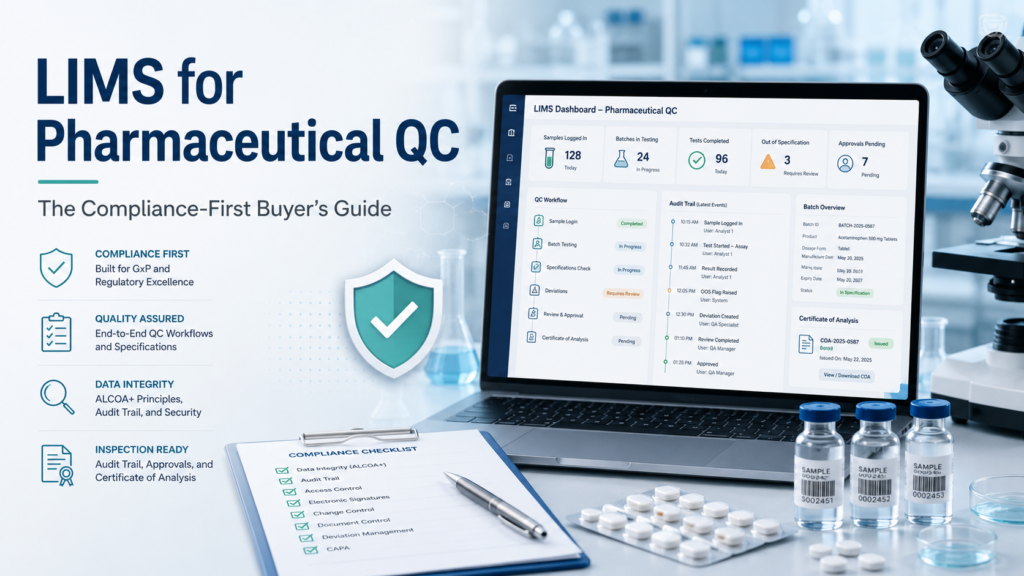
Quick verdict: In a pharmaceutical quality control lab, a LIMS is not a productivity tool with compliance features bolted on — it is a compliance system that happens to manage samples. The right choice is governed less by the length of a feature list than by the discipline of the system’s audit trails, its electronic-signature controls, its validation posture, and how well it withstands an FDA or EMA inspection. This guide explains what pharma QC actually demands of a LIMS in 2026, how the regulatory ground has shifted this year, and which vendors fit which kind of QC operation — with an honest account of their trade-offs. Why pharmaceutical QC is a category of its own Every laboratory cares about accurate data. A pharmaceutical QC lab has to prove it — to a regulator, on demand, years after the fact. That single difference reshapes everything about how a QC lab should evaluate a Laboratory Information Management System. In a pharma QC environment, the LIMS sits at the center of release decisions: raw material testing, in-process checks, finished-product analysis, stability studies, environmental monitoring, and microbiology all flow through it, and the data it holds ultimately underwrites whether a batch reaches patients. Because those records support GMP decisions, the system that creates, modifies, stores, or transmits them falls squarely under FDA 21 CFR Part 11 — the same obligation that applies to chromatography data systems, stability chambers, and QMS platforms. A LIMS in this setting is a regulated computerized system, and it must be selected, configured, and validated as one. This is why a QC buyer’s evaluation criteria look nothing like a research lab’s. Usability and speed still matter, but they sit beneath a non-negotiable foundation: data integrity, traceability, and inspection readiness. Get those wrong and no amount of workflow polish will save you from a warning letter. The regulatory ground has moved in 2026 — three shifts to understand Anyone buying or re-evaluating a pharma QC LIMS this year needs to understand three regulatory developments, because they change what “compliant” means in practice. First, the FDA’s Computer Software Assurance (CSA) guidance became final in February 2026. This is the most consequential shift for LIMS validation in years. CSA replaces the traditional, documentation-heavy approach to computerized system validation with a risk-based, proportionate model that concentrates testing effort on the functions that directly affect patient safety and product quality. In plain terms: instead of validating every function to the same exhaustive standard and generating mountains of paper, QC labs are now expected to think critically about risk and focus assurance where it matters most. When you evaluate a vendor, ask how their validation tooling and documentation support a CSA-aligned, risk-based approach — not just legacy CSV. Second, EU Annex 11 is being revised. The European GMP framework for computerized systems is undergoing its most significant update in over a decade, with the draft expanding emphasis on lifecycle traceability, stricter audit-trail expectations, and data governance. If your products touch European markets, a LIMS decision made in 2026 should anticipate the revised Annex 11, not just the current text. Third, data integrity remains the single most common cause of regulatory findings. This is not an abstract risk. The FDA issued more than 160 warning letters specifically citing data integrity deficiencies between 2017 and 2022, and analyses of 483 citations in the years since show that a majority relate to incomplete audit trails, backdated entries, or unvalidated systems. When inspectors arrive, the LIMS is often the first place they look. Choosing a system that makes data integrity the path of least resistance — rather than something staff must work around — is the most effective warning-letter insurance a QC lab can buy. The compliance foundations your QC LIMS must deliver Beneath the vendor marketing, a pharmaceutical QC LIMS must operationalize a specific set of controls. These are the features that inspectors actually probe, and the ones your evaluation should weight most heavily. ALCOA+ as the working standard Inspectors evaluate whether your records are trustworthy using the ALCOA+ framework: data must be Attributable, Legible, Contemporaneous, Original, and Accurate — plus Complete, Consistent, Enduring, and Available. A capable QC LIMS enforces these properties by design rather than by procedure: it timestamps entries contemporaneously, ties every action to an authenticated individual, preserves original captured values, and keeps records retrievable for the full retention period. When you assess a system, walk each ALCOA+ principle through a real workflow and ask how the software enforces it. Our deeper explainer on ALCOA+ and data integrity in the laboratory unpacks each element. Field-level, immutable audit trails The audit trail is the beating heart of a pharma QC LIMS. To satisfy Part 11 and survive inspection, it must be field-level, immutable, and human-readable, capturing for every change the old value, the new value, the user identity, the timestamp, and the reason for the change. Two capabilities separate adequate systems from strong ones: the granularity of what gets logged, and the ease of reviewing those logs. Audit-trail review is itself a GMP expectation, so a system that makes routine review practical — with filtering, exception flagging, and readable output — is worth far more than one that merely records everything into an unusable mass. Electronic signatures bound to the individual Part 11 requires that electronic signatures be uniquely linked to an individual and traceable, carrying the signer’s name, the date, and the reason for signing, with legal equivalence to a handwritten signature. In QC practice, signatures gate the actions that matter: approving results, releasing batches, authorizing method changes. A strong LIMS enforces signature meanings explicitly and prevents the signature from being detached from its record. Confirm, too, that the vendor supports the access controls that make signatures meaningful — unique user identities, enforced authentication, and role-based permissions consistent with cybersecurity best practice. Validation to intended use A LIMS is not compliant out of the box; it becomes compliant through validation to its intended use, and stays compliant through ongoing oversight. This is the point
Best ELN for Academic and Research Laboratories
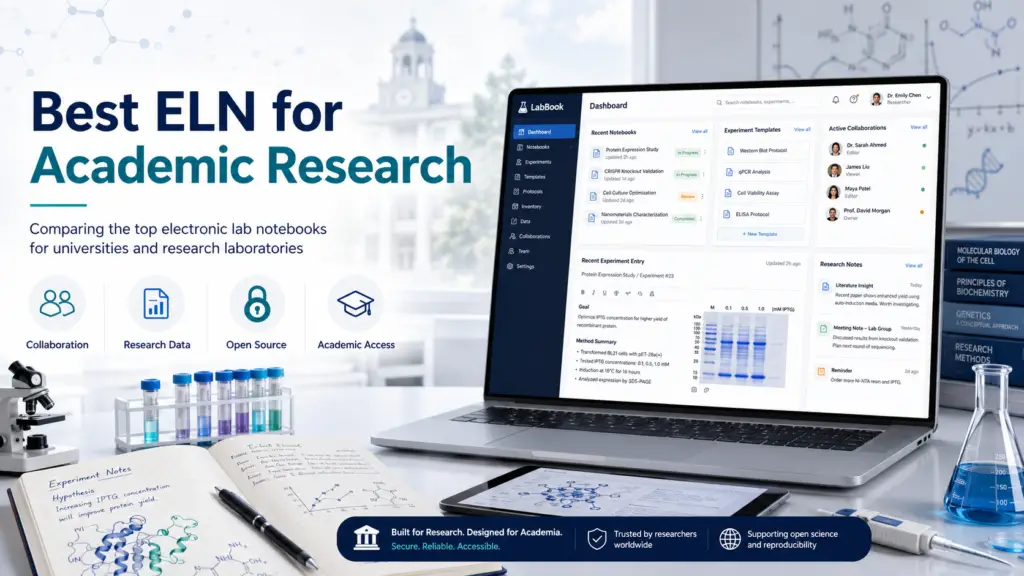
The best electronic lab notebook for an academic laboratory is not necessarily the platform with the most features. University laboratories, public research institutes and nonprofit research organizations face a distinctive combination of requirements: An ELN that works well for a large pharmaceutical company may be too expensive or complex for an academic group. Conversely, a free notebook designed for individual researchers may not provide the governance, data ownership, user administration or continuity required by an entire university. Our overall recommendation for a typical multidisciplinary academic research laboratory is LabArchives. It combines a relatively accessible cloud platform, published academic pricing, institutional administration and broad support for scientific documentation. However, it is not the best choice for every laboratory. This guide compares these platforms by use case, pricing, deployment, research workflow, collaboration and institutional suitability. Readers beginning their ELN evaluation can also consult our complete guide to electronic lab notebook software and our practical guide explaining how to choose an ELN. Quick verdict: the best academic ELN by use case Academic or research use case Recommended ELN Why it stands out Best overall for general academic research LabArchives Accessible, broadly applicable and designed for research and education Best free ELN for molecular biology Benchling Academic Free academic access to Notebook and Molecular Biology tools Best open-source ELN eLabFTW No software license fee, self-hosting and strong data-control options Best for FAIR data and institutional infrastructure RSpace Open-source platform with institutional storage, integrations and research data management focus Best for project-oriented research teams SciNote Combines experiments, tasks, inventory and team collaboration Best for protocol-driven laboratories Labstep Interactive protocols, structured data capture and connected instruments Best for straightforward documentation Labfolder Browser-based ELN with a relatively conventional notebook experience Best for teaching laboratory courses LabArchives Education Course-management tools with published student pricing Best for chemistry and materials research RSpace or Labstep Chemistry tooling and support for structured scientific workflows Best for academic-to-industry transition SciNote or Labstep Clearer progression toward structured, auditable and controlled workflows The best ELN software for academic laboratories at a glance Platform Best for Deployment Public academic pricing Main limitation LabArchives General academic research, universities and teaching Cloud SaaS Free tier; $330 per academic user annually; $360 with Inventory Advanced institutional capabilities may require Enterprise Benchling Academic Molecular biology, genomics and life-science research Cloud SaaS Free for eligible academics Academic plan excludes Inventory and Registry RSpace Universities, research institutes, FAIR data and infrastructure integration Cloud, private cloud, on-premise or self-hosted Open-source self-hosting; managed Team plan at $5,000 annually for 15 academic users More institutional and technical complexity than a simple notebook eLabFTW Open-source deployments, privacy and data sovereignty Self-hosted or managed hosting Free software; managed hosting starts at €3,200 annually for up to 32 active users Self-hosting requires internal technical resources SciNote Project-based academic teams and compliance readiness Cloud SaaS Free for individual users; premium plans by quotation Team and institution-level capabilities generally require a paid plan Labstep Protocol execution, multidisciplinary research and connected devices Cloud SaaS Free for academia; upgrades for groups and institutes Numerical institutional pricing is not publicly displayed Labfolder Small laboratories prioritizing simple documentation Browser-based cloud platform Pricing by quotation Less specialized scientific functionality than domain-specific ELNs The prices above were verified on official vendor pages on July 16, 2026. Pricing can change and institutional quotations may differ according to user numbers, storage, support, security and implementation requirements. LabArchives publishes a free plan, a $330 academic Professional subscription and a $360 academic ELN and Inventory bundle. RSpace publishes a $5,000 annual academic Team plan for 15 users. eLabFTW is free to self-host, while its official managed service begins at €3,200 annually. Benchling and Labstep offer free academic access, while SciNote provides a free option for individual users. How we selected the best academic ELNs This is an independent editorial comparison. No vendor has paid for inclusion or placement. We did not attempt to identify a universal “winner” using an arbitrary numerical score. Academic laboratories have sufficiently different needs that a platform can be excellent for one research group and inappropriate for another. The evaluation focused on the following criteria. 1. Suitability for academic budgets We considered: A free plan received credit only when it provided genuine ELN functionality. A limited trial was not treated as a free ELN. 2. Ease of use Academic groups often cannot dedicate several months to software implementation. A suitable platform should allow researchers to: The best platform on paper will fail if students and researchers continue using private documents, spreadsheets or paper notebooks alongside it. 3. Support for research continuity Academic laboratories experience regular staff turnover. PhD candidates graduate, postdoctoral researchers move to other institutions, visiting scientists leave and principal investigators change roles. The ELN must preserve: A laboratory should be able to remove a departing user without losing control of their research. 4. Collaboration We examined support for: Collaboration should not require researchers to duplicate sensitive data in email attachments or personal cloud storage. 5. Research data management An ELN does not replace a complete institutional repository or research data management strategy. It can, however, improve the documentation, organization and provenance of data throughout a project. The NIH Data Management and Sharing Policy requires relevant NIH-funded research to maintain a Data Management and Sharing Plan. Updated requirements applying from May 25, 2026 continue to encourage practices aligned with FAIR principles: making data Findable, Accessible, Interoperable and Reusable. We therefore considered: 6. Institutional governance and security Individual research groups may need only basic permissions. Universities and research institutes may require: These requirements often distinguish a free individual account from an institution-ready ELN. 7. Scientific workflow fit A generic notebook may be sufficient for some laboratories. Others need specialist capabilities such as: The best academic ELN is the one that fits the laboratory’s actual research, not the platform with the longest feature list. 1. LabArchives: best overall ELN for academic research Our verdict LabArchives is our best overall recommendation for a typical academic or university research laboratory. It is particularly appropriate for laboratories seeking
Best LIMS for Small Laboratories: An Honest Buyer’s Guide
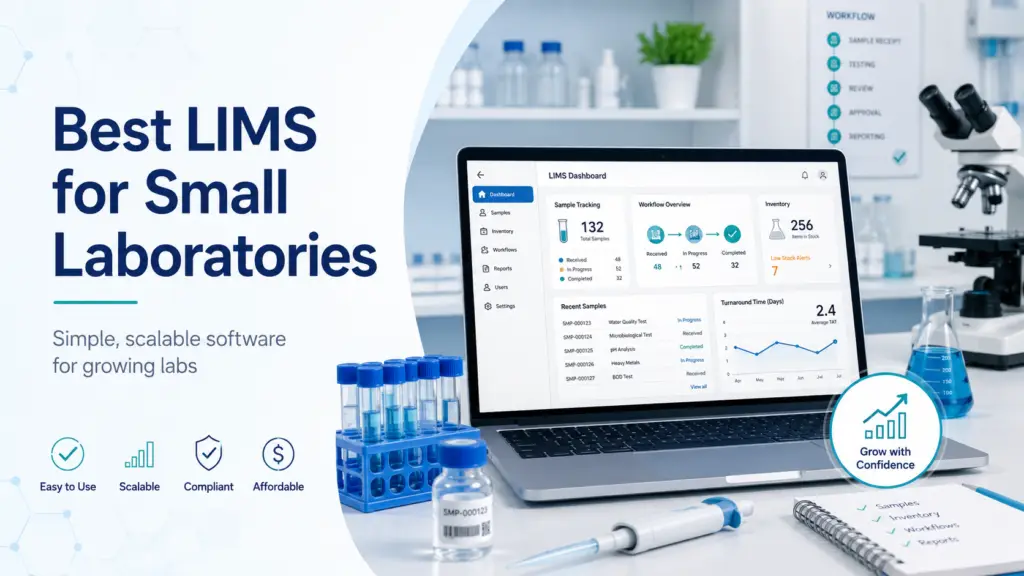
Quick verdict: Small labs don’t need less software than enterprise labs — they need different software. The right LIMS for a 3-to-25-person lab is one that deploys in weeks rather than quarters, prices transparently, requires no dedicated IT staff, and doesn’t bury core sample tracking behind enterprise tiers you’ll never use. This guide covers what actually matters when you’re small, which vendors fit which situations, and the buying mistakes that cost small labs the most money. Why “small lab” is a real category, not just a smaller budget The biggest mistake small teams make is assuming that a LIMS is a LIMS, and that choosing one is simply a matter of finding a cheaper version of what the big labs buy. It isn’t. Enterprise LIMS platforms — the LabWare, LabVantage, and Thermo Fisher SampleManager tier — are built around the assumption that you have a validation team, an IT department, a multi-month implementation budget, and a project manager to run it all. A small lab has none of those things. Deploying an enterprise platform in a five-person lab is like installing an industrial kitchen in a food truck: technically possible, ruinously impractical. Independent buyer guidance in 2026 keeps returning to the same point: the cheapest LIMS is rarely the best value, but neither is the most powerful. Small labs that pick a free or ultra-cheap tool, struggle with its limitations for a year or more, then rip it out and re-implement something else, frequently spend more in total than if they’d chosen the right-sized tool at the start. The sweet spot is a system purpose-built for your size and workflow — because vendors who serve small labs well do so deliberately, not by accident. So before comparing products, it helps to be honest about what a small lab actually is, in software terms: If that describes you, the vendors below are the ones worth your attention. What small labs should actually evaluate Feature checklists from enterprise buyer guides will steer you wrong, because they weight capabilities that a small lab will never switch on. Here are the criteria that genuinely predict whether a small lab will be happy in eighteen months. 1. Speed and burden of implementation For a small lab, a lengthy IT project isn’t just inconvenient — it’s often impossible, because there’s no one to run it. This is why “low implementation burden” appears again and again in small-lab buyer guidance as a make-or-break criterion. Some modern vendors advertise deployment in around 30 days precisely because they know small labs can’t absorb the six-to-twelve-month timelines that enterprise rollouts demand. Ask any vendor for a realistic, named go-live date for a lab your size, and treat vagueness as a red flag. 2. Cloud-native, not cloud-retrofitted A small lab should not be racking servers. Cloud-hosted SaaS LIMS remove the need for on-premises hardware, in-house backups, and manual patching — the vendor handles infrastructure so you can focus on the science. There’s a genuine trade-off to understand here: a fully web-based system depends on a solid network connection, and some vendors counter this with offline-capable desktop apps to avoid data loss during outages. But for the overwhelming majority of small labs, cloud-native is the correct default. 3. Honest, reachable pricing Small labs live or die by total first-year cost, not headline monthly price. The real number includes setup fees, implementation, training, and any per-user escalation as you grow. Published small-lab comparisons in 2026 show LIMS pricing ranging anywhere from around $29 per month at the entry level to $11,000 per month at the top — an enormous spread that makes transparent pricing a genuine differentiator. If a vendor won’t give you a realistic first-year total for a lab your size, that opacity is itself information. (For a deeper breakdown, see our guide to how LIMS pricing models work.) 4. Configuration without code Enterprise LIMS are powerful partly because they’re endlessly customizable — but that customization usually means paid professional services and vendor-written code, which is exactly what a small lab can’t afford in money or time. Look instead for no-code or low-code configuration you can manage yourself: building your own workflows, report templates, and sample types without filing a change request. This single factor separates a LIMS you can grow with from one you’ll resent. 5. Right-sized compliance Not every small lab is regulated — but many are, and compliance can’t be bolted on later. If you need 21 CFR Part 11 support for FDA-facing work, or ISO/IEC 17025 support for testing and calibration accreditation, that requirement should shape your shortlist from the very first day. The trap is over-buying: paying for a heavyweight validated enterprise platform when a lighter compliant system would satisfy your auditors just as well. The honest question first: do you even need a LIMS, or an ELN? Before you shop, be sure you’re shopping in the right aisle. Many small labs — especially in academic and early-stage research — describe their problem as “we need a LIMS” when what they actually need is an Electronic Lab Notebook, or the two combined. A LIMS is built around samples, batches, and formal traceability; an ELN is built around experiments, protocols, and documentation. Research labs often lead with the ELN; testing and QC labs almost always lead with the LIMS. Getting this distinction right before you demo anything will save you from buying a beautifully engineered solution to a problem you don’t have. If you’re unsure, our guide on choosing an ELN walks through the questions that clarify which side of the line you’re on. The vendors worth considering when you’re small There is no single best LIMS for every small lab. The right choice depends heavily on whether you run a testing workflow or a research workflow, and on how regulated you are. Below are the platforms that consistently earn their place on small-lab shortlists in 2026, grouped by the kind of lab they suit. For regulated testing and QC labs CloudLIMS is one of the most
Best LIMS for Biotech: A Scale-Aware Buyer’s Guide
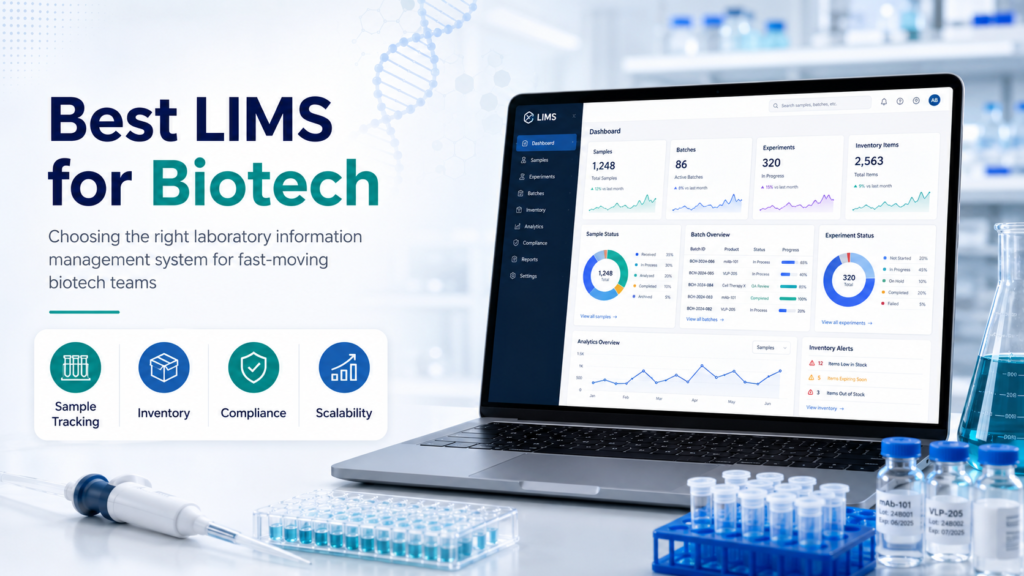
Quick verdict: The best LIMS for a biotech isn’t a fixed answer — it’s a moving target that depends on where you are on the growth curve. A discovery-stage lab of eight scientists, a Series B company scaling past thirty, and a clinical-stage organization approaching regulated work each need a different system, and the platform that fits one can actively hurt another. This guide maps the biotech LIMS landscape by stage and workflow rather than by feature count, explains the trade-offs the vendor marketing won’t, and helps you choose a system you won’t have to rip out in eighteen months. Why biotech breaks the usual LIMS rules Most LIMS buyer guides assume a stable lab with a stable workflow. Biotech violates that assumption constantly. A biotech company’s defining characteristic is change: headcount doubles, programs multiply, workflows shift from exploratory science toward structured process development, and — for many — the organization eventually moves toward regulated, IND-enabling work. The LIMS decision therefore isn’t “what fits my lab today?” but “what will still fit when my lab is three times larger and doing more serious work?” This is also why biotech sits awkwardly between the two traditional software categories. Early biotech work is experiment-centric and looks like a job for an Electronic Lab Notebook (ELN); as samples, inventory, and cross-team coordination grow, it becomes sample-centric and looks like a job for a LIMS. Most biotechs need both, ideally in one system — which is why the modern biotech platform market has converged on unified ELN + LIMS + inventory tools rather than standalone products. If you’re still clarifying which side of that line your lab is on, our guide to choosing an ELN is the right starting point, and our broader LIMS software pillar frames the category. The practical consequence: the criteria that matter for biotech are not the same ones that matter for a stable QC lab. They are, in rough order of importance, the ones below. What actually matters when choosing a biotech LIMS Scale-readiness: the criterion most labs underweight The single most common biotech LIMS mistake is choosing for the lab you are, not the lab you’re becoming. Teams repeatedly report the same pattern: spreadsheets stop scaling somewhere around fifteen scientists, the team adopts an ELN-first or lightweight tool, and then — as more samples move through the lab, more people touch the same materials, and experiments become interdependent — that early choice starts to strain. The system that was perfect for quick, flexible discovery work becomes the thing that’s hardest to manage once operational structure, sample governance, and traceability become daily needs. The lesson isn’t that flexible tools are bad; it’s that flexibility without structure has a cost that only appears at scale. When you evaluate, ask each vendor concretely what happens at three times your current size: more users, a second and third program, external CROs in the workflow, and the first serious conversation about compliance. Unified data model vs. stitched stack Biotechs that assemble separate ELN, LIMS, and inventory tools pay what some in the industry call an “integration tax” — the ongoing cost of connectors, data reconciliation, and sync failures between systems that were never designed to be one. A platform built on a single underlying data model, where experiments tie directly to samples, inventory, and workflows, avoids that tax. This is a genuine architectural advantage, not just marketing — but verify it in a trial rather than taking it on faith, because “unified” is a word every vendor uses. R&D-native tooling for molecular biology If your science is molecular — cloning, sequencing, CRISPR, plasmid and molecule registration — then native tooling for that work is a first-class requirement, not a nice-to-have. Some platforms build sequence editors, plasmid maps, and molecule registration directly into the system; others treat them as afterthoughts. A biotech doing heavy molecular biology should weight this heavily; one doing industrial fermentation or diagnostics may not need it at all. Match the tool to your actual science. API-first architecture and instrument connectivity Biotech labs live in a broader ecosystem of instruments, automation, and analytics. An API-first design determines whether your LIMS becomes the connected hub of that ecosystem or an island you’re forever exporting data out of. For labs running automation — bioreactors, liquid handlers, sequencers — out-of-the-box integrations versus custom-development requirements can be the difference between a two-week and a two-quarter deployment. Pricing transparency and total cost Biotech LIMS pricing is notoriously opaque, and the gap between budgeted and quoted cost is where many buying processes stall. Insist on an all-in number and understand where the price jumps — often when you cross a team-size threshold between tiers. For a deeper treatment, see our LIMS pricing models explainer. The key discipline is comparing total first-year cost across your real shortlist, not headline figures. Data portability and exit strategy An underrated criterion: how hard is it to leave? Some widely used platforms store data in proprietary formats with limited export options, which makes migration difficult and turns a multi-year contract into a lock-in with no exit strategy. Before you sign, ask exactly how you would extract your data — experiments, samples, and files — if you chose to leave. A vendor confident in their product will answer plainly. The vendors, mapped by biotech stage and workflow There is no single best biotech LIMS. Below, the platforms that consistently appear on biotech shortlists in 2026, grouped by the situation they serve best — with honest trade-offs, since several of the most-cited comparisons online are published by vendors about their own competitors and should be read with that bias in mind. For molecular-biology-heavy R&D: Benchling Benchling has become something close to the default for high-growth biotech and life-science R&D, and for good reason. It’s less a traditional LIMS than a unified platform combining molecular biology tools — sequence editors, plasmid maps, CRISPR design, molecule registration — with an ELN and LIMS capabilities in one system. Its R&D-native tooling is best-in-class for molecular work,
ELN Pricing Guide: Costs, Implementation Fees and Hidden Expenses
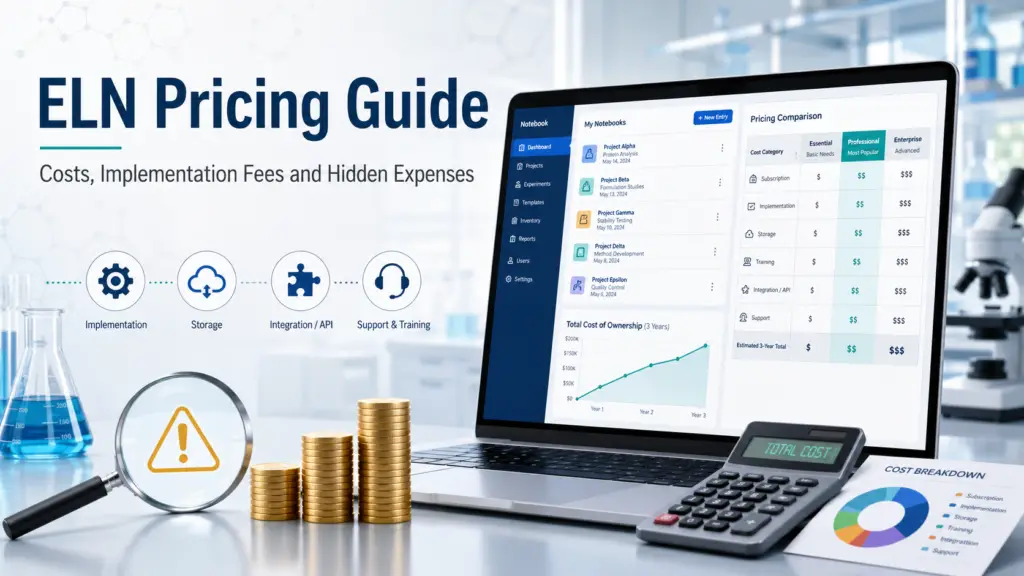
Electronic lab notebook pricing is rarely as simple as multiplying a monthly subscription by the number of scientists in your laboratory. The visible license price may cover access to the software, but the real cost of an ELN can also include implementation, workflow configuration, data migration, integrations, validation, training, storage, support and long-term system administration. Pricing transparency also varies significantly between vendors. Some ELN providers publish exact prices online. Others provide a free academic plan but require commercial organizations to request a quote. Enterprise platforms may not disclose any public pricing at all. This guide explains: Readers who are still defining their requirements can first consult our complete guide to electronic lab notebook software and our practical guide explaining how to choose an ELN. Read this first The single most important thing to understand about ELN pricing is that the lowest subscription price does not necessarily produce the lowest total cost. A low-cost ELN may become expensive when a laboratory needs extensive configuration, data migration, custom integrations or regulated validation. Conversely, a platform with a higher annual subscription may include onboarding, support or functionality that would otherwise need to be purchased separately. Laboratories should therefore compare vendors using a three-year total cost of ownership rather than the advertised license price alone. ELN pricing at a glance The table below includes only prices publicly displayed by the vendors themselves as of July 16, 2026. ELN or service Officially published price Pricing unit Important details LabArchives Free $0 Free plan Two owned notebooks, 1 GB of storage per user and a 25 MB file-size limit LabArchives Professional $330 academic / $575 corporate Per user, per year 100 GB of storage per user LabArchives ELN + Inventory $360 academic / $675 corporate Per user, per year ELN and inventory management LabArchives Education $25 Per student, per term Designed for classroom use Signals Notebook Standard Edition $1,425 Per person, annually Includes one production tenant, automatic updates and standard support Signals Notebook Jump Start Essentials $6,700 Implementation package A separately priced implementation service eLabFTW self-hosted software €0 software license Open-source deployment The organization remains responsible for hosting, maintenance and administration eLabFTW PRO Hosting 32 €3,200 Per year Up to 32 active users and at least 320 GB of storage eLabFTW PRO Hosting Plus €4,985 Per year Approximately 128 active users and at least 500 GB of storage eLabFTW PRO Hosting Universe €7,900 Per year Approximately 1,024 active users and at least 1 TB of storage eLabFTW training webinar €470 Per 90-minute session Remote training service eLabFTW PRO Support €3,000 Per year Support for organizations operating a self-hosted installation LabArchives publishes separate prices for academic and corporate customers. Its Professional plan costs $330 per academic user per year or $575 per corporate user per year. The ELN and Inventory package costs $360 per academic user or $675 per corporate user annually. The vendor also offers a free plan, enterprise pricing on request and a classroom plan at $25 per student per term. Revvity lists Signals Notebook Standard Edition at $1,425 per person annually. The official listing states that the subscription includes one production tenant, automatic updates and standard support. Revvity also publishes a separate Jump Start Essentials implementation package at $6,700. The eLabFTW application can be downloaded and self-hosted as open-source software. Deltablot, the company behind eLabFTW, separately sells managed hosting, support and training. Its published annual hosting plans start at €3,200 for up to 32 active users, €4,985 for approximately 128 active users and €7,900 for approximately 1,024 active users. Important pricing disclaimer These figures are reference prices, not guaranteed quotations. The final amount paid by a laboratory may depend on: A written quotation and contract should always take precedence over a price displayed on a public webpage. Why ELN vendors use different pricing models There is no universal unit for purchasing an electronic lab notebook. Understanding the billing model is therefore essential before comparing two quotations. It is also important to establish whether an ELN is genuinely the right type of software for the project. Our ELN vs LIMS comparison explains when laboratories may instead need sample-centric workflow management or a combined ELN-LIMS platform. 1. Named-user pricing Under a named-user model, every person with an account generally requires a paid license. A laboratory with 40 occasional users may therefore pay for 40 licenses even when only 20 people use the ELN during a typical week. Named-user pricing is easy to forecast, but laboratories should clarify whether the following people require full licenses: LabArchives and Signals Notebook publicly present their commercial entry-level pricing on a per-person or per-user annual basis. 2. Active-user pricing An active-user model charges according to the number of accounts that use the system during a defined period. Deltablot defines an active eLabFTW user as an account that has used the application at least once during the month. Its managed hosting plans are organized around approximate or maximum numbers of active users rather than individual named-seat prices. This model can be beneficial for organizations with a large population of occasional users. However, the contract should clearly define: 3. Organization-wide or capacity-based pricing Some ELN services use an annual platform fee based on an organizational capacity, such as: The eLabFTW hosting plans are examples of capacity-based annual pricing. A customer purchases a hosted environment with a specified active-user and storage capacity rather than paying a fixed public price for every named account. This model can produce a low effective cost per user when the available capacity is fully utilized. It can be less attractive when a laboratory purchases a large tier but uses only a small fraction of it. 4. Freemium pricing A freemium ELN provides a permanently free entry-level version and charges for additional capabilities, capacity or institutional management. For example: Free plans can be useful for individual researchers, evaluations and small academic teams. They should not automatically be treated as equivalent to an institutional deployment. Important limitations may include: For a broader evaluation of these options, see our independent guide
Agilent SLIMS Overview: Features, Pricing & Who It’s For (2026)
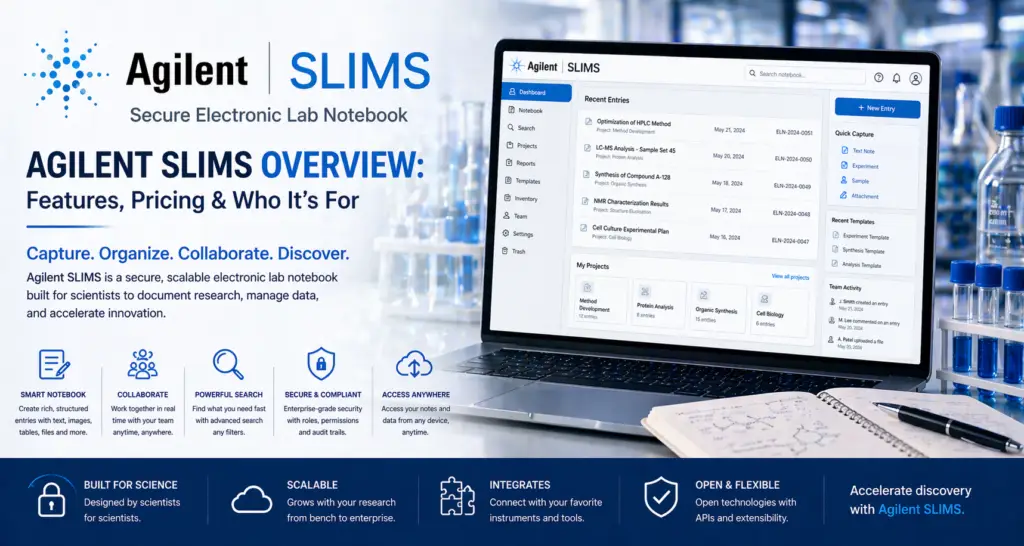
The single most important thing to know If your lab runs Agilent instruments, SLIMS has a native advantage no other LIMS in this series can match. SLIMS 7.2 introduced bidirectional, automated integration with Agilent MassHunter (LC/MS) and Agilent OpenLab CDS (chromatography). Worklists generate directly from your sample database and results return automatically — without manual transcription. If you operate Agilent LC-MS, HPLC, TapeStation, Bravo liquid handlers, or the Alissa genomics platform, SLIMS connects to your existing instrument ecosystem natively. If your lab does not use Agilent instruments, this differentiator does not apply, and other LIMS in this series — with stronger independent review bases and more transparent pricing — deserve equal or greater consideration. Agilent SLIMS is a Laboratory Execution System (LES) that combines LIMS, ELN, and workflow management in a single platform. It is one of the few LIMS products in this series owned by a publicly traded analytical instrument manufacturer — Agilent Technologies (NYSE: A), a global leader in life sciences, diagnostics, and applied chemical markets with revenues of approximately $6.8 billion. That parentage is both SLIMS’s greatest differentiator and a key factor in understanding who it is built for. SLIMS was created by Genohm, a company founded in Ghent, Belgium in 2002 (as a two-person bioinformatics shop) that re-established itself in 2011 as an EPFL spin-out at the Innovation Park in Lausanne, Switzerland. Genohm released SLIMS in 2010 and grew it across Europe, the Middle East, Asia Pacific, and the US before Agilent acquired the company in May 2018 (Business Wire, 2 May and 14 May 2018). At acquisition, Genohm had 40 employees and offices in Lausanne, Ghent, and Durham, North Carolina. The acquisition was framed by Agilent as adding LIMS and workflow management to its software portfolio — specifically to complement its OpenLab chromatography software suite. The current version is SLIMS 7.2, released in 2025, which introduced a modernised interface aligned with Agilent’s visual identity, a touchscreen Bench UI for protocol execution at the bench, and deeper integration with MassHunter and OpenLab CDS. SLIMS is deployed in more than 20 countries and supports nine languages: Chinese (Simplified), Dutch, English, French, German, Italian, Japanese, Korean, and Spanish. This article draws on agilent.com/slims, explore.agilent.com (SLIMS product pages), the Agilent Business Wire acquisition press releases (May 2018), the EPFL press release on the acquisition, G2, Capterra, GetApp, and a competitor-authored Scispot pricing analysis (September 2025). Agilent has not reviewed, sponsored, or paid for this article. At a glance Field Details Product Agilent SLIMS (Smart Laboratory Information Management System). Current version: 7.2. Product type Lab Execution System (LES): unified LIMS + ELN + workflow management in one platform. Origin Created by Genohm SA (founded 2002 Ghent, Belgium; re-established 2011 EPFL Innovation Park, Lausanne, Switzerland). SLIMS released 2010. Acquired by Agilent Technologies May 2018. Parent company Agilent Technologies, Inc. (NYSE: A). Global leader in life sciences, diagnostics, and applied chemical markets. ~$6.8B revenue (FY2024). 14,200+ employees worldwide. Deployment On-premise (customer’s own server), Agilent-hosted cloud, or customer’s preferred cloud provider. Browser-based — no client software needed on workstations. Tablet-accessible. Confirmed on agilent.com/slims and pharma product page. Verticals Pharmaceutical and biopharma QC, analytical chemistry, NGS (next-generation sequencing), biobanks/biorepositories, R&D research, PFAS testing, cannabis testing. Confirmed on agilent.com product pages. Languages Chinese (Simplified), Dutch, English, French, German, Italian, Japanese, Korean, Spanish. Confirmed on GetApp. API Yes — REST API available. Confirmed on GetApp and explore.agilent.com. SLIMS Store Pre-packaged configurations library: sample types, locations, metadata, automation snippets, sample sheets, workflow templates. Allows rapid deployment of pre-built content rather than starting from scratch. Compliance FDA 21 CFR Part 11, EU Annex 11, GAMP5, ISO/IEC 17025, EPA 40 CFR Part 160, ISO 20387:2018 (biobanks), ISBER Best Practices (biobanks), SPREC (biospecimen preanalytical variables), HIPAA, CLIA, ISO 13485, ISO 15189 (NGS). Confirmed on agilent.com product pages. ISO 27001 Agilent SLIMS ISO 27001 certificate available at agilent.com/quality/SLIMS_27001.pdf (confirmed on agilent.com). Key Agilent integrations OpenLab CDS (bidirectional, automated, versions 2.6+), MassHunter (bidirectional, LC/MS worklists + results, v7.2), Alissa Interpret (genomic variant analysis), TapeStation (DNA/RNA QC, automatic result transfer), Bravo liquid handler. Confirmed on agilent.com/slims/whats-new and pharma/NGS/biobank product pages. Non-Agilent integrations SAP (ERP), iLab (lab management), identity management systems, billing systems, EMR (electronic medical records via plugins), Illumina BaseSpace (NGS), sequencing instruments. API enables third-party connections. Global deployment 20+ countries (agilent.com biobanks page). First customers: EPFL research units (EPFL press release, 2018). Named customers doTERRA (essential oils company, saves 50+ hours/week by replacing paper workflows, explore.agilent.com). Anonymous: “SLIMS became crucial to our activities and is now the keystone of all our operations.” Anonymous pharma application note: biopharma QC lab for mAb release tests (agilent.com). No named pharmaceutical or biobank customers confirmed in press releases. Pricing Entirely quote-based. No published tiers. No free trial. Implementation requires paid professional deployment services. Contact Agilent directly. G2 / Capterra Both listed. G2 profile has limited features. Review count on both platforms is small compared to other LIMS in this series. G2 alternatives page lists reviews in the Pharmaceuticals industry category. Support options Email/Help Desk, FAQs/Forum, Phone Support, Knowledge Base (GetApp). Global SLIMS engineers for installation, validation, training, customisation confirmed on agilent.com. What Agilent SLIMS does — and what makes it a LES, not just a LIMS Most LIMS manage samples and results. SLIMS is positioned as a Lab Execution System (LES) — a term that reflects a scope beyond sample tracking. Agilent’s own definition on explore.agilent.com describes an LES as “a combination of LIMS functionality and ELN functionality” that converts “paper-based processes into fully automated and integrated digital workflows.” In practice, this means SLIMS is designed not just to record what happened, but to guide analysts through each step as they work — step-by-step protocol execution, instrument control, result retrieval, and review, all from a single system. The four core functional layers, all confirmed on agilent.com and explore.agilent.com: 1. Sample management (LIMS layer) Sample tracking through the full lifecycle: intake, storage, location management, status monitoring, lineage (parent-child relationships for derived samples, aliquots), chain-of-custody logging, and disposal. Every change is timestamped and attributed to the user
BIOVIA ONE Lab Review (Dassault Systèmes): Features, Pricing & Who It’s For (2026)
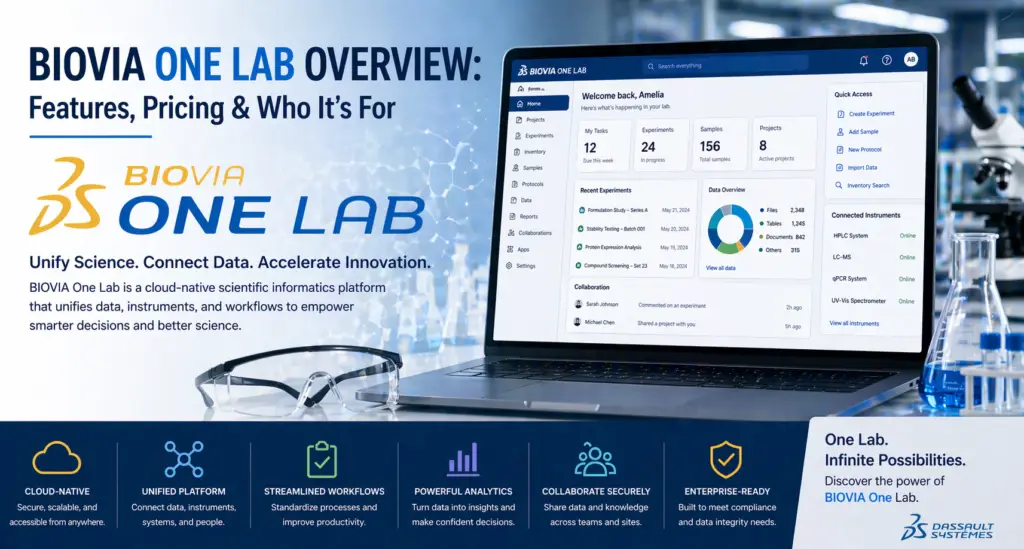
Read this first BIOVIA ONE Lab is not a mid-market LIMS. It is the lab informatics layer of a comprehensive scientific innovation platform that also covers molecular modelling, formulation design, manufacturing analytics, and regulatory quality management — all connected on a single RDF data model. Labs evaluating ONE Lab are not choosing between it and QBench or CloudLIMS. They are choosing between it and LabWare LIMS, Thermo Fisher SampleManager, or Veeva Vault for quality. The correct buyer profile is a large pharmaceutical, biopharma, CPG, or materials science organisation that needs end-to-end digital integration from molecule to market, not a 20-person contract testing laboratory that needs compliant sample tracking. If your lab fits the latter, other vendors in this series will deliver faster time to value at a fraction of the cost. BIOVIA ONE Lab is the laboratory informatics platform of BIOVIA, the scientific innovation brand of Dassault Systèmes. It combines Electronic Lab Notebook (ELN), LIMS, and Laboratory Execution System (LES) functions in a single, unified environment built on one data model — a design choice that separates it structurally from nearly every other LIMS in this series, where ELN, LIMS, and workflow modules are separate products integrated at the API layer. Dassault Systèmes (Euronext Paris: DSY.PA) is the 3DEXPERIENCE Company, founded in 1981 and best known for CATIA (aerospace engineering) and SOLIDWORKS (industrial design). Its BIOVIA brand was created in May 2014 when Dassault acquired Accelrys, Inc. for $750 million — a company that was itself a fusion of five scientific software firms including Molecular Simulations Inc. and Oxford Molecular. Accelrys brought a 20-year legacy of pharmaceutical and materials science software, including the predecessor products to what is now ONE Lab. BIOVIA is headquartered in San Diego, California, and operates as Dassault Systèmes’ scientific arm alongside the broader 3DEXPERIENCE platform used by 370,000+ companies globally. More than 2,000 companies across life sciences, chemistry, oil & gas, consumer packaged goods, and other industries use BIOVIA solutions (3ds.com). Named users of the BIOVIA portfolio include Pfizer, AstraZeneca, BASF, Shell, Unilever, and L’Oréal — though these references are to the BIOVIA platform broadly, not confirmed specifically to ONE Lab. The lab informatics layer (ONE Lab) is described as trusted by large pharmaceutical enterprises for standardising and accelerating testing in QA/QC labs (3ds.com/products/biovia/one-lab/les). This article draws on 3ds.com (ONE Lab, LIMS, LES, ELN, Equipment Management, and AI-ready lab product pages), discover.3ds.com, the Axendia independent analyst briefing on ONE Lab (April 2024), the BIOVIA GxP compliance blog post (3ds.com), Wikipedia (BIOVIA and Dassault Systèmes history), the Dassault Systèmes BIOVIA brand introduction press release (May 2014), the BIOVIA ONE Lab datasheet PDF, G2 (BIOVIA Notebook and CISPro reviews), and a Scispot competitor-authored pricing analysis (November 2025, attributed accordingly). BIOVIA/Dassault Systèmes has not reviewed, sponsored, or paid for this article. Understanding BIOVIA — the platform context every lab manager needs The most common mistake in evaluating BIOVIA ONE Lab is treating it as a standalone LIMS. It is not. ONE Lab is one component of the BIOVIA portfolio on the 3DEXPERIENCE platform, which also covers: All of these products share the same RDF-based data model on the 3DEXPERIENCE platform. This means experimental data captured in ONE Lab is immediately accessible to Pipeline Pilot for analytics, to Discovery Studio for modelling feedback, and to Quality Management for compliance records — without export, transformation, or integration middleware. This “digital thread from R&D to manufacturing” is the architectural proposition that distinguishes BIOVIA from every other vendor in this series. For lab managers at large pharmaceutical or CPG organisations already using Dassault Systèmes products (CATIA, SOLIDWORKS, Medidata for clinical trials), ONE Lab’s integration into that existing 3DEXPERIENCE infrastructure is a significant consideration. For lab managers at organisations with no existing Dassault footprint, the question is whether the breadth of the platform justifies the implementation complexity and cost relative to a purpose-built LIMS. Strategic context for LabOps directors The Axendia independent analyst briefing on ONE Lab (April 2024) quotes BIOVIA’s Director of Marketing Stephen Hayward: “Elements of ONE Lab can be deployed individually, together, or added over time as part of a company’s digital transformation journey.” This is the correct framing. Organisations do not need to deploy the entire BIOVIA portfolio to benefit from ONE Lab. A pharma QA/QC lab can deploy the LIMS and LES components alone. A biotech R&D group can start with the ELN. The RDF data model means each component’s data is immediately available to future components without migration. The strategic value multiplier, as Hayward describes it, is horizontal and vertical integration as additional components are added over time. At a glance Field Details Product BIOVIA ONE Lab — unified ELN + LIMS + LES on the 3DEXPERIENCE platform Parent company Dassault Systèmes (Euronext Paris: DSY.PA). Founded 1981. HQ: Vélizy-Villacoublay, France. BIOVIA HQ: San Diego, California, USA. BIOVIA history BIOVIA brand created May 2014 from acquisition of Accelrys, Inc. for $750M (Wikipedia). Accelrys was itself formed in 2001 from five scientific software companies including Molecular Simulations Inc. and Oxford Molecular. Scale (BIOVIA) 2,000+ companies use BIOVIA solutions across life sciences, chemistry, oil & gas, CPG, and other industries (3ds.com). Named customer references include Pfizer, AstraZeneca, BASF, Shell, Unilever, L’Oréal, Aboca. ONE Lab scope ELN + LIMS + LES + Equipment Management + Inventory Management in one platform with a single RDF data model. Removes artificial barriers between traditionally separate systems. ELN options Three ELNs, all integrated with ONE Lab: BIOVIA Scientific Notebook (cloud-native, knowledge graph architecture), BIOVIA Notebook (established IP-focused ELN), BIOVIA Workbook (research-focused). All available on cloud. Data model RDF (Resource Description Framework) / knowledge graph architecture. FAIR data (Findable, Accessible, Interoperable, Reusable) by design. 80% reduction in AI data preparation time reported (3ds.com — vendor-published). Deployment Cloud (BIOVIA ScienceCloud / 3DEXPERIENCE platform — global datacentres, sovereign data control), on-premise, or hybrid. Same code stream across all deployment options (easy migration). Quick Start programme for ELN with pre-packaged configurations. Compliance FDA 21 CFR Part 11, EU Annex 11, EPA, GxP (GLP, GMP, GCP). 3DEXPERIENCE platform is
Waters NuGenesis LMS / SDMS Overview: Features, Pricing & Who It’s For (2026)
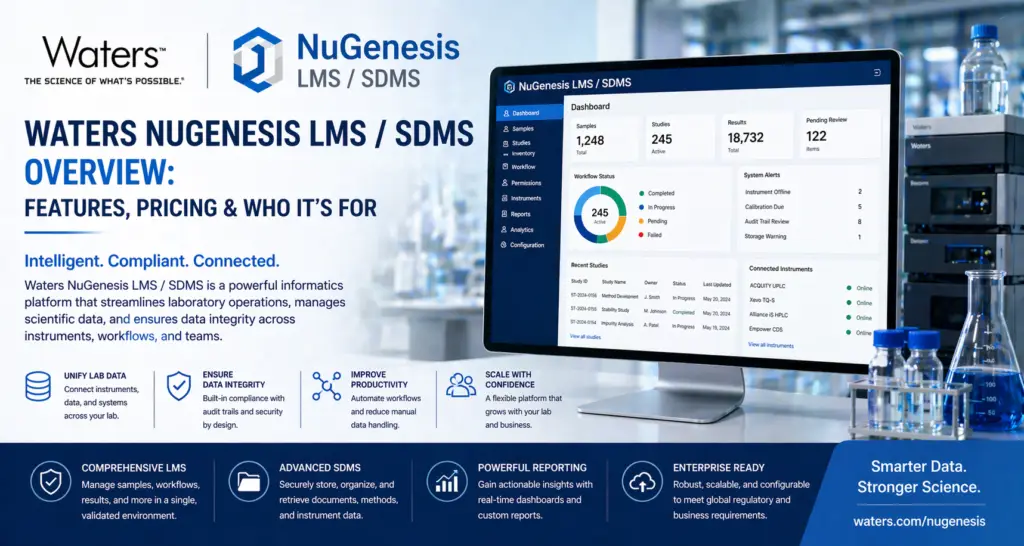
Read this first — NuGenesis is not a traditional LIMS Waters itself markets NuGenesis as “LIMS capabilities without the complexity” and as “a unique and powerful alternative to a traditional LIMS” (Waters video; European Pharmaceutical Review launch). If you are evaluating NuGenesis as your laboratory’s primary LIMS — the system that manages all your samples, tests, methods, and compliance workflows — you are likely evaluating the wrong product. NuGenesis is primarily an SDMS (Scientific Data Management System) and ELN platform that sits alongside a traditional LIMS, not in place of one. Its SDK explicitly integrates with external LIMS products (LabWare, Chemware). Its most powerful use case is as the compliance-ready data archive and ELN for labs already running Waters Empower chromatography data system. If your lab uses Empower heavily, NuGenesis is the natural next layer. If your lab does not use Empower and needs a primary LIMS, other vendors in this series serve that need more directly. Waters NuGenesis is a laboratory information management platform that combines a Scientific Data Management System (SDMS), an Electronic Lab Notebook (ELN), and a Sample Management layer into what Waters calls a Lab Management System (LMS). The platform is developed and supported by Waters Corporation (NYSE: WAT), a global leader in analytical instruments and software headquartered in Milford, Massachusetts. Waters was founded in 1958 by James Logan Waters and is known for Empower chromatography data system, MassLynx mass spectrometry software, ACQUITY UPLC and HPLC systems, and the NuGenesis LMS. FY2024 revenue: $2,958 million. Approximately 7,600 employees operating in 35 countries (Waters FY2024 press release). NuGenesis SDMS has been adopted by “hundrends of companies around the world” (waters.com/nugenesis-sdms). The Sumble technology adoption platform identifies 153 organisations currently using NuGenesis (Sumble, April 2026). The platform is available in Japan via Waters Informatics Strategic Partner B-EN-G (Business Engineering Corporation), which publishes implementation templates and a dedicated September 2025 article on NuGenesis for the Japanese biopharma market — confirming active commercial presence in Asia. Named customers include BIOVECTRA, a biotech CDMO serving the pharma industry, which is featured in a waters.com webinar series on ongoing NuGenesis LMS implementation success. This article draws on waters.com (all NuGenesis product pages), the NuGenesis 9.3 What’s New white paper (Waters, January 2024), the Waters 21 CFR Part 11 white paper for NuGenesis SDMS, the Waters Application Programming Interfaces page, the Waters Knowledge Base (AWS deployment article), European Pharmaceutical Review (NuGenesis LMS launch announcement), SelectScience (NuGenesis SDMS product listing and case study), Sumble (technology adoption data), B-EN-G (Waters Informatics Strategic Partner, Japan), Wikipedia (Waters Corporation), Waters FY2024 financial results press release, IntuitionLabs LIMS vs SDMS guide, and a Scispot competitor-authored pricing analysis (November 2025, attributed). Waters Corporation has not reviewed, sponsored, or paid for this article. Understanding Waters — and why NuGenesis exists Waters Corporation has been a dominant force in analytical chemistry instrumentation for over 65 years, particularly in HPLC and UPLC separations and mass spectrometry. Its Empower Chromatography Data System is one of the most widely deployed CDS platforms in pharmaceutical QC globally, with deep regulatory acceptance. The challenge Empower creates is also what NuGenesis solves: Empower generates massive volumes of instrument data — chromatograms, spectra, processing methods, raw files, printouts — that must be securely archived, searchable, auditable, and accessible for years under 21 CFR Part 11 and EU Annex 11 requirements. NuGenesis SDMS was built specifically to address this problem: automatically capture, index, and archive all data flowing out of Empower (and other instruments) into a compliant, searchable central repository without manual intervention. The NuGenesis LMS layer then adds ELN-style documentation, sample submission, results review, and stability testing workflow on top of that repository. This origin is why NuGenesis is most accurately evaluated as “the informatics complement to Empower” rather than as a standalone LIMS. A lab running Empower as its CDS, with no SDMS, has uncontrolled data files sitting on instrument PCs, difficult to back up, audit, or search. NuGenesis SDMS solves that immediately. A lab with no Empower deployment evaluating a primary LIMS would typically look at STARLIMS, LabWare, or Thermo Fisher SampleManager rather than NuGenesis. The Empower + NuGenesis stack The most common NuGenesis deployment pattern, confirmed by the IntuitionLabs LIMS/SDMS guide and the Astrix global biopharma case study, is: Thermo Fisher SampleManager (or another LIMS) manages samples and test results. Waters Empower 3 controls HPLC and UPLC instruments and processes chromatographic data. Waters NuGenesis SDMS automatically archives all Empower data files, raw chromatograms, and printouts into a searchable, 21 CFR Part 11-compliant central repository. In this stack, NuGenesis is not replacing the LIMS — it is adding the SDMS layer that the LIMS cannot provide on its own. At a glance Field Details Product Waters NuGenesis Software — comprising NuGenesis SDMS, NuGenesis LMS (ELN + Sample Management), NuGenesis Sample Management, NuGenesis Stability, and NuGenesis Dashboards. Current version 9.3 (NuGenesis 9.3 What’s New white paper, Waters, January 2024). Supports Empower 3.8 and Windows Server 2016 / 2019. Parent company Waters Corporation (NYSE: WAT). Founded 1958, Milford, Massachusetts, USA. FY2024 revenue: $2,958M. ~7,600 employees. 35 countries. Primary competitors: Agilent Technologies, Thermo Fisher Scientific, Revvity, Danaher (Wikipedia). What it actually is A Scientific Data Management System (SDMS) + ELN + Sample Management platform. NOT a traditional LIMS. Waters markets it explicitly as “LIMS capabilities without the complexity.” External LIMS (LabWare, Chemware) can connect via the NuGenesis SDK. Best understood as the data management and ELN complement to Waters Empower CDS. Primary market Pharmaceutical and biopharma analytical labs, QC labs, R&D, and CDMOs that use Waters Empower as their chromatography data system and need compliant data archiving, scientific search, ELN workflow, sample management, and stability management without deploying a full enterprise LIMS. Adoption “Hundreds of companies around the world” (waters.com SDMS page). 153 organisations confirmed on Sumble (April 2026). Named customer: BIOVECTRA (biotech CDMO, pharma). Waters Informatics Strategic Partner active in Japan: B-EN-G (September 2025 publication). Deployment On-premise (Windows Server). Cloud on AWS is NOT officially supported as of NuGenesis 9.4 per Waters Knowledge Base (WKB305387). The NuGenesis
Revvity Signals Notebook ELN Review: Features, Pricing & Who It’s For (2026)
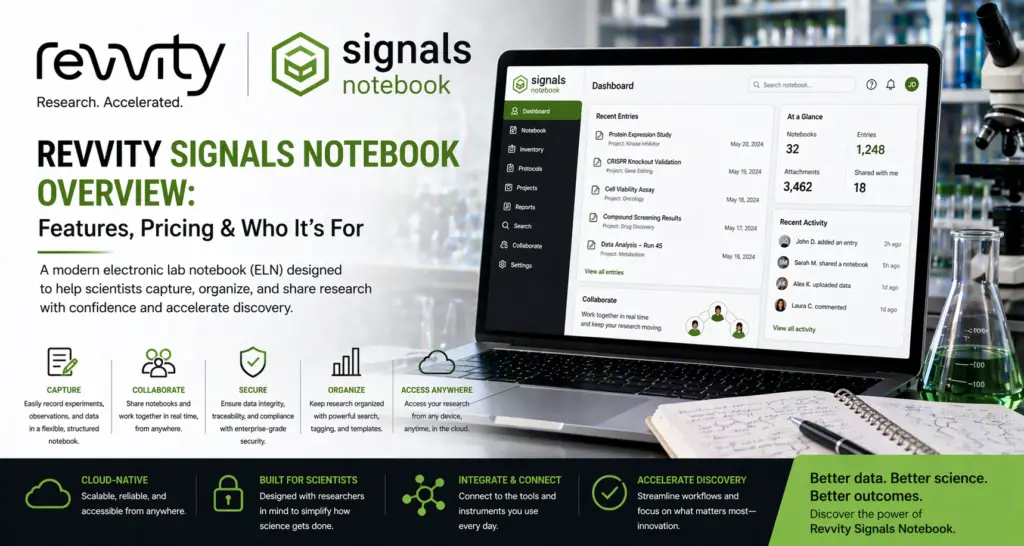
The defining differentiator for chemists Signals Notebook is the only cloud-native ELN with native, embedded ChemDraw. ChemDraw has been the industry-standard chemical drawing tool since 1985. If your lab includes synthetic chemists who draw structures, calculate stoichiometry, or search by chemical substructure and similarity, Signals Notebook’s native ChemDraw integration is the single most important capability no other ELN in this series can match on equal terms. For labs where biology is the primary discipline and chemical structure handling is not central, this advantage is reduced, and other ELNs may provide equivalent or better value. Signals Notebook is the flagship ELN of Revvity Signals Software, the informatics division of Revvity, Inc. (NYSE: RVTY). It is the most widely adopted ELN in this review series by any measurable scale: 1 million scientists at 4,000 organisations use it (AWS Marketplace). Named customers include Eli Lilly, Roche Diagnostics, AstraZeneca, Merck KGaA, Lundbeck, Givaudan, and FrieslandCampina. Stanford University and the NIH intramural research programme both run it. Revvity Signals Software employs approximately 720 people and serves those 1 million users worldwide (revvitysignals.com/company/about-us). Understanding Signals Notebook requires understanding where it comes from. Revvity’s informatics lineage begins with CambridgeSoft, the company that developed ChemDraw in 1985. CambridgeSoft was sold to PerkinElmer in 2011 (Wikipedia), and its lab notebook product — then called E-Notebook — was developed as an enterprise ELN for decades. In 2022, PerkinElmer split into two independent public companies: the life sciences and diagnostics businesses became Revvity, Inc. (NYSE: RVTY); the applied and enterprise businesses kept the PerkinElmer name and went private. Revvity’s software division became Revvity Signals Software, and Signals Notebook is the cloud-native successor to E-Notebook — rebuilt from scratch on a microservice architecture rather than ported to the cloud (white paper, revvitysignals.com). This article draws on revvitysignals.com (product pages, About Us, case studies, white papers, NEXUS Europe 2025 recap, FAQ pages), the Signals Notebook August 2024 data sheet, the ‘5 Benefits of Signals Notebook’ white paper (January 2025), the Eli Lilly case study (May 2025), AWS Marketplace (product listing and verified reviews), NIH Office of Intramural Research ELN policy (confirmed as active Signals Notebook deployment), Stanford University Science Library (confirmed active licence), G2 (Revvity Signals seller page: 4.4/5, 42 reviews), PeerSpot, ChemDraw Wikipedia article, Wikipedia (Revvity). Revvity Signals has not reviewed, sponsored, or paid for this article. Company and heritage — why the ChemDraw lineage matters Revvity is not a startup building a new ELN. It is the scientific informatics arm of a company with 65+ years of history in life sciences and analytical chemistry, with direct lineage to the most trusted chemical drawing tool in existence. This heritage is operationally relevant: Signals Notebook’s native ChemDraw integration is not a partnership or an API connection — ChemDraw is developed by the same organisation, on the same platform, and updated in lockstep with Signals Notebook. The informatics product line progression is: CambridgeSoft E-Notebook (1990s–2011) → PerkinElmer E-Notebook (2011–2022) → Revvity Signals Notebook (2022–present). Signals Notebook was built cloud-native from the ground up — not a cloud-hosted version of legacy on-premise software. The original E-Notebook product has been sunset. Signals Notebook Standard is the current active product; the Individual Edition reached End of Life on March 1, 2025 (Revvity Signals support portal), with data migration paths to Standard provided. Revvity Signals Software also maintains an exclusive partnership with Spotfire (the TIBCO/Cloud Software Group data analytics platform), embedding it within the Signals platform for scientific data visualisation. This Spotfire relationship provides advanced analytics capability directly connected to ELN data — a combination that is otherwise unavailable in a single vendor stack from any other ELN in this series. On the Revvity corporate context Revvity (NYSE: RVTY) is a publicly traded company with initial revenues of approximately $3 billion (Wikipedia) and approximately 11,000 employees. Revvity Signals Software is one division within Revvity. Lab managers signing multi-year ELN contracts benefit from the vendor stability that public company status provides — financial disclosures, public accountability, and institutional investment discipline. The risk of unexpected acquisition or discontinuation is lower than for small private ELN vendors. The offsetting consideration is that Revvity is a large organisation: product decisions reflect enterprise-wide priorities, not just the ELN user community. At a glance Field Details Product Signals Notebook — cloud-native ELN and scientific collaboration platform Parent company Revvity Signals Software, division of Revvity, Inc. (NYSE: RVTY). HQ: Waltham, Massachusetts, USA. ~11,000 employees (Revvity). ~720 employees (Revvity Signals Software). Origins: CambridgeSoft → PerkinElmer Informatics → Revvity Signals. Scale 1 million scientists at 4,000 organisations worldwide (AWS Marketplace product listing, April 2026). Product type ELN (Electronic Lab Notebook) and scientific collaboration platform. Primary purpose: experiment documentation, data capture, collaboration, IP protection, and regulatory compliance in R&D environments. Architecture Cloud-native SaaS built on AWS. Microservice architecture — each component operates independently; self-healing and resilient. No on-premise version available. Release cadence 10 releases per year (confirmed on product page and FAQ). Updates deployed automatically — no customer IT action required. Free trial Yes — available on revvitysignals.com. No credit card required for trial. ChemDraw Native, embedded integration. The only cloud ELN with ChemDraw. Automates stoichiometry calculations, supports SMILES, CAS Number search, structure/substructure/similarity search. Full access to PubChem safety data sheets. Spotfire Exclusive partnership for scientific data analytics and visualisation. Embedded within the Signals platform for advanced data analysis connected directly to ELN data. Signals DLX Digital Lab Exchange (powered by Scitara): automated instrument data capture, parsing, and organisation directly into Signals Notebook. Eliminates manual transcription from analytical instruments. Signals One Higher-tier offering adding AI-enhanced workflows, structured data handling, structure-activity relationship (SAR) analysis, and deeper data intelligence on top of Signals Notebook foundations. Signals Inventa Enterprise data analytics and management layer for the Signals platform. Signals VitroVivo In vitro/in vivo biological data management module within the Signals platform. Inventory Chemical and sample inventory management built directly within Signals Notebook. Barcode scanning, location tracking, automatic low-stock alerts, material traceability. Compliance 21 CFR Part 11 (audit trails, e-signatures, version control, page locking), GxP-ready, IP protection (sign/close/witness workflows). SOC 2
Mosaic by Cenevo Overview: Features, Pricing & Who It’s For (2026)
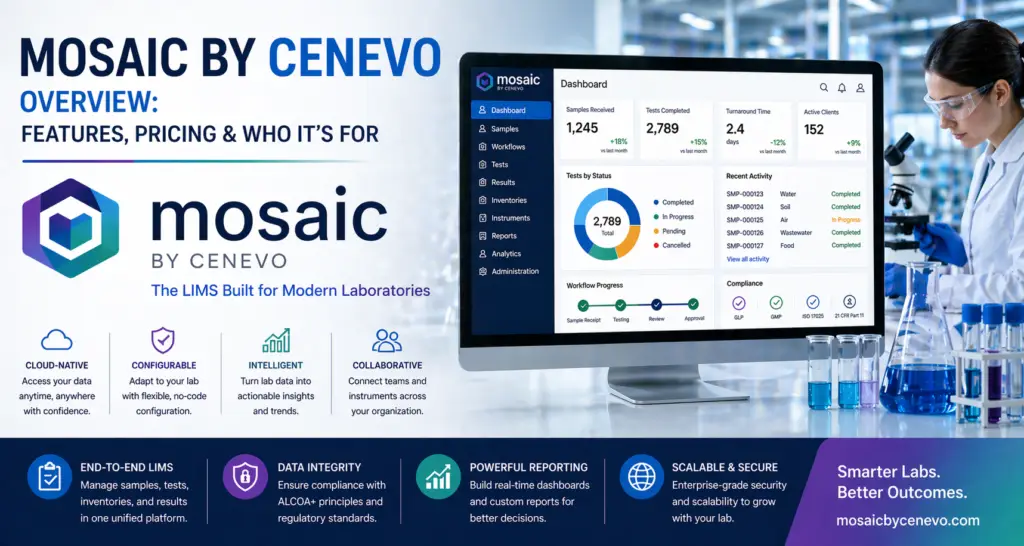
Read this first Mosaic is not a traditional LIMS. If you are searching for a system to manage test workflows, results entry, CoA generation, or QC analytical testing, Mosaic is not what you need. Mosaic is a specialist sample management platform — one of the most established in the life sciences industry — that tracks the physical lifecycle of samples (compounds, biologicals, reagents, biospecimens) from registration through storage, request, fulfilment, dispensing, and disposal. Think of it as the system that answers “where is my sample, in what container, at what location, at what concentration, with what history?” — not the system that records results. Labs that need both often run Mosaic alongside a traditional LIMS or ELN; within Cenevo’s portfolio, that ELN/LIMS is Labguru. Mosaic is the flagship product of Cenevo, a London-headquartered life science software company formed in July 2025 when Titian Software (the creator of Mosaic) and Labguru merged under the Cenevo brand. The product itself has a 25-year track record: Titian Software was founded in 1999 by Edmund Wilson and Richard Fry, and the first Mosaic system went into production in 2003 (titian.co.uk IT information page). As of April 2026, Mosaic operates in R&D environments in 13 of the world’s top 20 biopharma companies, has more than 60 installations worldwide, over 10,000 users, and manages over one billion samples (titian.co.uk IT information page). That scale and longevity are the most important facts a lab manager evaluating Mosaic needs to understand. This is not a startup product. It is a deeply established, specialist system that has been continuously refined over two decades to solve one specific problem: the accurate, automated, audit-compliant management of physical sample lifecycles at scale. Its customer base — which includes Evotec (nearly 20 years), Charles River Laboratories (renewed 3-year agreement 2023), Tyra Biosciences, Sygnature Discovery, Compounds Australia, and unnamed Japanese pharma and global biopharma companies — reflects a consistent focus on pharma, biopharma, biobank, and CRO environments where sample fidelity is mission-critical. This article draws on titian.co.uk, cenevo.com, Business Wire press releases (Battery Ventures investment June 2022; Mosaic 9.0 launch September 2023; Charles River 3-year agreement 2023; Compounds Australia November 2024), the Cenevo 2025 Year in Review (December 2025), the Cenevo Product Advisory Council 2025 write-up, SelectScience, Tracxn, and industry sources. Mosaic/Cenevo has not reviewed, sponsored, or paid for this article. Corporate history and the Cenevo context Understanding Mosaic’s ownership chain is important for any lab manager making a multi-year commitment: Date Event Detail 1999 Titian Software founded Founded in London, UK by Edmund Wilson and Richard Fry (Tracxn). Focused exclusively on sample management software for life science laboratories. 2003 Mosaic first deployment First Mosaic system goes into production (titian.co.uk IT information). A 20+ year continuous product evolution begins. 2003–2022 Organic growth Titian grows as a bootstrapped, founder-led specialist. Builds customer base in pharma, biopharma, and CRO environments. Establishes Mosaic as a recognised category leader for compound management. Expands to US and Asia offices. Jun 2022 Battery Ventures majority investment Battery Ventures (Boston-based global technology investment firm) makes a significant majority investment in Titian Software Ltd. Terms undisclosed (Business Wire, 22 June 2022). Edmund Wilson retains a meaningful ownership stake and remains closely involved. Justin Rosner (Battery) joins Titian’s board. Investment purpose: support organic growth and future acquisitions. Sep 2023 Mosaic 9.0 / Charles River Mosaic 9.0 released, adding real-time multi-site inventory synchronisation and global sample logistics. Charles River Laboratories and Titian announce a renewed and expanded 3-year partnership agreement (Business Wire, September 2023). Apr 2024 Labguru joins Battery portfolio Battery Ventures acquires Labguru (BioData Inc.) from Holtzbrinck Digital. Labguru joins the same Battery portfolio as Titian Software. Edmund Wilson appointed as Labguru’s Founder and Chief Product Officer in press materials. Jan 2025 Keith Hale named Group CEO Keith Hale appointed Group CEO of Titian Software (titian.co.uk press page, January 2025). Edmund Wilson transitions to Chief Product Officer role. Jul 2025 Cenevo rebrand Titian Software and Labguru rebrand as Cenevo (PRNewswire, 30 July 2025). Mosaic and Labguru continue as distinct products. Combined entity: 950+ customers, 45,000+ scientists, 200+ staff, offices in UK, US, Israel, and Poland. Nov 2024 Compounds Australia Compounds Australia (Griffith University, Queensland) selects Mosaic to manage their 1.5 million+ sample compound collection across 50 member organisations worldwide (Cenevo press release, 19 November 2024). 2025 150+ integrations, 120 new customers Cenevo 2025 Year in Review confirms: 150+ off-the-shelf automations and integrations, 120+ new customers, 300+ existing customers deepened partnerships, 140+ customer projects delivered. Battery Ventures and PE context for lab managers Battery Ventures is a well-regarded technology investment firm with a long track record (founded 1983) and specific expertise in life science informatics. Their investment in Titian in June 2022 was described as supporting organic growth and potential acquisitions — which the Labguru acquisition in 2024 confirmed. The Cenevo rebrand brings two complementary products (Mosaic sample management + Labguru ELN/LIMS) under one corporate roof. Labs buying Mosaic are buying into a PE-backed business with an active acquisition strategy. The Cenevo 2025 Year in Review commits explicitly to continued investment in Mosaic: “we will continue to invest in Mosaic to maintain and extend” its position. Buyers should clarify in contract negotiations what specific product and support commitments they can lock in for their contract term. At a glance Field Details Product Mosaic Sample Management Platform (by Cenevo, formerly Titian Software) Parent company Cenevo (formed July 2025 from merger of Titian Software and Labguru). HQ: London, UK. Mosaic founded 1999 (Titian Software Ltd, London). First production: 2003. Continuous product evolution for 25+ years. Founders Edmund Wilson and Richard Fry (Tracxn). Edmund Wilson = Co-Founder & CPO at Cenevo. CEO: Keith Hale (appointed January 2025). Ownership Battery Ventures (majority investment June 2022, terms undisclosed). Scale (Mosaic) 13 of the world’s top 20 biopharma companies. 60+ installations worldwide. 10,000+ users. 1 billion+ samples managed. (titian.co.uk IT information page) Cenevo combined 950+ customer organisations. 45,000+ scientist users. 200+ staff. Offices in UK, US, Israel, Poland. Product scope Specialist sample management platform: physical inventory tracking, sample lifecycle