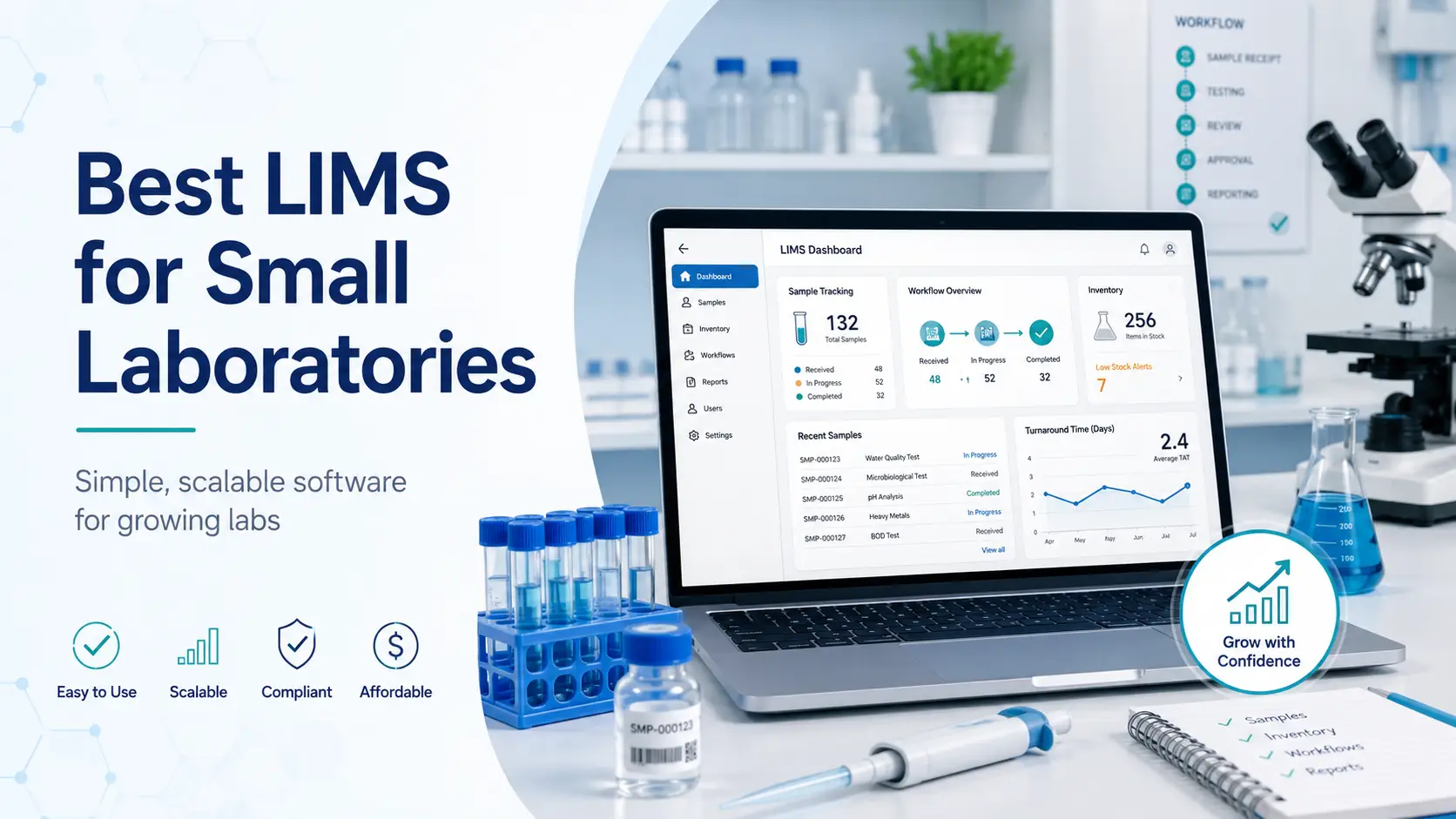
Quick verdict: Small labs don’t need less software than enterprise labs — they need different software. The right LIMS for a 3-to-25-person lab is one that deploys in weeks rather than quarters, prices transparently, requires no dedicated IT staff, and doesn’t bury core sample tracking behind enterprise tiers you’ll never use. This guide covers what actually matters when you’re small, which vendors fit which situations, and the buying mistakes that cost small labs the most money.
Why “small lab” is a real category, not just a smaller budget
The biggest mistake small teams make is assuming that a LIMS is a LIMS, and that choosing one is simply a matter of finding a cheaper version of what the big labs buy. It isn’t. Enterprise LIMS platforms — the LabWare, LabVantage, and Thermo Fisher SampleManager tier — are built around the assumption that you have a validation team, an IT department, a multi-month implementation budget, and a project manager to run it all. A small lab has none of those things. Deploying an enterprise platform in a five-person lab is like installing an industrial kitchen in a food truck: technically possible, ruinously impractical.
Independent buyer guidance in 2026 keeps returning to the same point: the cheapest LIMS is rarely the best value, but neither is the most powerful. Small labs that pick a free or ultra-cheap tool, struggle with its limitations for a year or more, then rip it out and re-implement something else, frequently spend more in total than if they’d chosen the right-sized tool at the start. The sweet spot is a system purpose-built for your size and workflow — because vendors who serve small labs well do so deliberately, not by accident.
So before comparing products, it helps to be honest about what a small lab actually is, in software terms:
- Headcount: roughly 3 to 25 people who will touch the system.
- Budget: commonly $5,000–$50,000 per year for the software, though genuinely small or academic labs may need to stay well under that.
- IT resources: limited or none. Nobody on staff wants to run a server or manage a validation project.
- Time horizon: you need to be live in weeks, not quarters.
If that describes you, the vendors below are the ones worth your attention.
What small labs should actually evaluate
Feature checklists from enterprise buyer guides will steer you wrong, because they weight capabilities that a small lab will never switch on. Here are the criteria that genuinely predict whether a small lab will be happy in eighteen months.
1. Speed and burden of implementation
For a small lab, a lengthy IT project isn’t just inconvenient — it’s often impossible, because there’s no one to run it. This is why “low implementation burden” appears again and again in small-lab buyer guidance as a make-or-break criterion. Some modern vendors advertise deployment in around 30 days precisely because they know small labs can’t absorb the six-to-twelve-month timelines that enterprise rollouts demand. Ask any vendor for a realistic, named go-live date for a lab your size, and treat vagueness as a red flag.
2. Cloud-native, not cloud-retrofitted
A small lab should not be racking servers. Cloud-hosted SaaS LIMS remove the need for on-premises hardware, in-house backups, and manual patching — the vendor handles infrastructure so you can focus on the science. There’s a genuine trade-off to understand here: a fully web-based system depends on a solid network connection, and some vendors counter this with offline-capable desktop apps to avoid data loss during outages. But for the overwhelming majority of small labs, cloud-native is the correct default.
3. Honest, reachable pricing
Small labs live or die by total first-year cost, not headline monthly price. The real number includes setup fees, implementation, training, and any per-user escalation as you grow. Published small-lab comparisons in 2026 show LIMS pricing ranging anywhere from around $29 per month at the entry level to $11,000 per month at the top — an enormous spread that makes transparent pricing a genuine differentiator. If a vendor won’t give you a realistic first-year total for a lab your size, that opacity is itself information. (For a deeper breakdown, see our guide to how LIMS pricing models work.)
4. Configuration without code
Enterprise LIMS are powerful partly because they’re endlessly customizable — but that customization usually means paid professional services and vendor-written code, which is exactly what a small lab can’t afford in money or time. Look instead for no-code or low-code configuration you can manage yourself: building your own workflows, report templates, and sample types without filing a change request. This single factor separates a LIMS you can grow with from one you’ll resent.
5. Right-sized compliance
Not every small lab is regulated — but many are, and compliance can’t be bolted on later. If you need 21 CFR Part 11 support for FDA-facing work, or ISO/IEC 17025 support for testing and calibration accreditation, that requirement should shape your shortlist from the very first day. The trap is over-buying: paying for a heavyweight validated enterprise platform when a lighter compliant system would satisfy your auditors just as well.
The honest question first: do you even need a LIMS, or an ELN?
Before you shop, be sure you’re shopping in the right aisle. Many small labs — especially in academic and early-stage research — describe their problem as “we need a LIMS” when what they actually need is an Electronic Lab Notebook, or the two combined. A LIMS is built around samples, batches, and formal traceability; an ELN is built around experiments, protocols, and documentation. Research labs often lead with the ELN; testing and QC labs almost always lead with the LIMS. Getting this distinction right before you demo anything will save you from buying a beautifully engineered solution to a problem you don’t have. If you’re unsure, our guide on choosing an ELN walks through the questions that clarify which side of the line you’re on.
The vendors worth considering when you’re small
There is no single best LIMS for every small lab. The right choice depends heavily on whether you run a testing workflow or a research workflow, and on how regulated you are. Below are the platforms that consistently earn their place on small-lab shortlists in 2026, grouped by the kind of lab they suit.
For regulated testing and QC labs
CloudLIMS is one of the most frequently cited options for smaller labs that want a cloud-hosted system without IT overhead. Founded in 2013 and headquartered in Delaware, it’s built exclusively on cloud technology, positions itself explicitly around affordability, and targets biobanking, clinical diagnostics, environmental, food-and-beverage, and cannabis testing labs — sectors dominated by small and mid-sized operations. It’s designed to meet GLP and FDA guidelines including 21 CFR Part 11, which makes it a natural first look for a regulated small lab. One nuance worth raising with the vendor during evaluation: for labs with strict validation requirements, automatic product updates can trigger re-validation, so confirm how updates are handled for your compliance regime. Our full CloudLIMS review covers the details.

QBench is a strong candidate for small analytical and testing labs that want a genuinely traditional LIMS workflow — sample management, QC records, instrument-linked data, and formal traceability — without enterprise weight. Founded in 2016 and privately held by a group with long lab experience, QBench has been recognized in G2’s 2026 LIMS category awards specifically in small-business dimensions such as usability and customer relationship, and consistently scores well on ease of use, ease of setup, and quality of support. If your buying signal is “I run a testing lab and I want something that behaves like a real LIMS but doesn’t need a project team,” QBench belongs on the list. See our QBench review for the full picture.
SciCord is narrower by design, purpose-built for pharmaceutical and biopharma labs rather than trying to serve every sector. Its distinguishing feature is a spreadsheet-style, no-code engine that enables rapid deployment — often within about 30 days — with minimal IT overhead, while supporting GxP and 21 CFR Part 11 compliance. For a small regulated lab that finds itself between “too small for enterprise” and “too regulated for lightweight,” SciCord is worth a demo. Details in our SciCord review.
For modern research and biotech labs
Scispot is one of the faster-growing platforms aimed at modern biotech and diagnostics labs. Founded in 2020 and built cloud-native from the start, it emphasizes automating each step of the sample workflow — intake, instrument data transfer, validation, and reporting — with the explicit pitch of helping labs scale throughput without adding headcount. For a young, growth-minded life-science lab that wants a modern interface and automation-first design rather than a decades-old platform, Scispot is a natural fit. Our Scispot review goes deeper.
Genemod competes in the same modern, cloud-native tier — going head to head with the likes of Benchling and the Labguru platform rather than with legacy enterprise systems — and targets life-science teams that want a combined LIMS/ELN experience with a clean, contemporary feel. It’s a sensible option for small research labs that value usability and an integrated notebook-plus-inventory approach. See our Genemod review.
Labguru has long been recommended for small labs that want to streamline and scale with a focus on simplicity and ease of use, historically leaning more ELN-forward with strong inventory management alongside its LIMS. One important 2026 update for buyers: Labguru and Titian Software rebranded as a single company, Cenevo, in July 2025, backed by Battery Ventures, combining Labguru’s ELN/LIMS with Titian’s Mosaic sample-management technology across a 200-plus-person organization. The Labguru product continues, but you’re now buying into a larger connected-lab platform rather than a standalone tool — a plus for future capability, and a point to weigh if part of Labguru’s original appeal was its smaller, focused footprint. Our Labguru review has the background.
For budget-constrained and open-source-friendly labs
eLabFTW deserves a place in this guide precisely because it upends the pricing conversation: the software is open-source under the AGPLv3 licence, with no per-seat charge and no vendor lock-in. For an academic or budget-near-zero lab with the willingness — and the technical comfort — to self-host and absorb some setup overhead, a free, open-source system can be entirely appropriate. The trade-off is that you take on more of the operational burden yourself, and open-source tools may lack some of the advanced automation of commercial platforms. Our eLabFTW overview and our broader honest guide to open-source ELN and LIMS explain when free genuinely wins and when it quietly costs more.
A simple way to shortlist
If you strip away the marketing, most small labs can reach a shortlist of two or three vendors by answering four questions honestly:
First, testing or research? A testing or QC lab that depends on samples, QC records, and formal traceability should start with traditional-workflow systems like QBench or CloudLIMS. A research or biotech lab building around experiments and protocols should start with the modern LIMS/ELN tier — Scispot, Genemod, or Labguru.
Second, how regulated are you? If 21 CFR Part 11 or ISO 17025 is non-negotiable, let that filter the list before anything else, and confirm each vendor’s compliance claims against your specific auditors’ expectations rather than the website.
Third, what’s your true first-year budget? Insist on an all-in number — licence, setup, training, and any per-user growth — and compare totals, not monthly stickers.
Fourth, who will run it? If the answer is “no one full-time,” weight no-code configuration and fast, vendor-managed implementation above raw feature count. A slightly less powerful system you can actually operate beats a more capable one that sits half-configured.
The mistakes that cost small labs the most
The most expensive error isn’t choosing the “wrong” vendor from a shortlist of reasonable options — it’s choosing from the wrong shortlist entirely. Two patterns recur. The first is over-buying: a small lab is impressed by an enterprise demo, signs up for a platform built for a 500-person organization, and then can’t implement or afford to run it. The second is under-buying: a lab picks the cheapest or free option to save money up front, hits its limits within a year or two, and pays again to migrate — often exceeding what the right tool would have cost from the start. Both stem from the same root cause: treating LIMS selection as a price decision rather than a fit decision.
The antidote is unglamorous but reliable. Define your workflow type and compliance needs first. Build a shortlist of two or three vendors that serve labs your size on purpose. Get real, named implementation timelines and all-in first-year quotes. And run a genuine trial with your own samples and your own people before signing anything.
Where to go next
If you’re still clarifying the fundamentals, start with our pillar guide to LIMS software, which frames the whole category, or the pricing models explainer if budget is your first constraint. If you’re weighing regulated requirements, the ISO 17025 guide is the place to begin. And if you’re genuinely unsure whether you need a LIMS, an ELN, or both, our ELN buyer’s questions will settle it quickly.
The reassuring truth for small labs in 2026 is that the market has finally caught up with you. A decade ago, “small lab LIMS” meant an awkwardly downsized enterprise product. Today there are vendors — cloud-native, no-code, transparently priced, fast to deploy — that were designed for labs exactly your size. The task is no longer finding one that will tolerate you. It’s choosing, deliberately, the one that fits.
This guide is updated as vendor offerings and ownership change. Pricing, compliance capabilities, and product positioning should always be confirmed directly with each vendor before purchase. LabSoftwareGuide is an independent editorial resource and is not affiliated with the vendors listed above.
Sources
- Third Wave Analytics — Best LIMS Software for Labs (2026): https://thirdwaveanalytics.com/blog/best-lims-software/
- QBench — The Best LIMS of 2026: The Industry Winners: https://qbench.com/blog/best-lims-the-industry-winners
- SciCord — Best LIMS of 2026: https://scicord.com/best-lims-of-2026/
- Scispot — Top 15 LIMS Vendors in 2026: https://www.scispot.com/blog/top-lims-vendors
- CloudLIMS — The 7 Best LIMS for Materials Testing Labs in 2026: https://cloudlims.com/the-7-best-lims-for-materials-testing-labs-in-2026/
- Gistia — Best LIMS for Small Laboratories: https://gistia.com/compare/small-lab-lims
- SimpleLabOS — Best LIMS for Small Labs (2026 Comparison): https://simplelabos.com/compare/best-lims-small-labs
- Cenevo (formerly Labguru + Titian) — rebrand announcement (PR Newswire, July 30, 2025): https://www.prnewswire.com/news-releases/labguru-and-titian-software-rebrand-as-cenevo-302517253.html
- R&D World — Cenevo launches two AI agents (Feb 2026): https://www.rdworldonline.com/cenevo-launches-two-ai-agents-for-lab-protocol-conversion-and-workflow-automation/