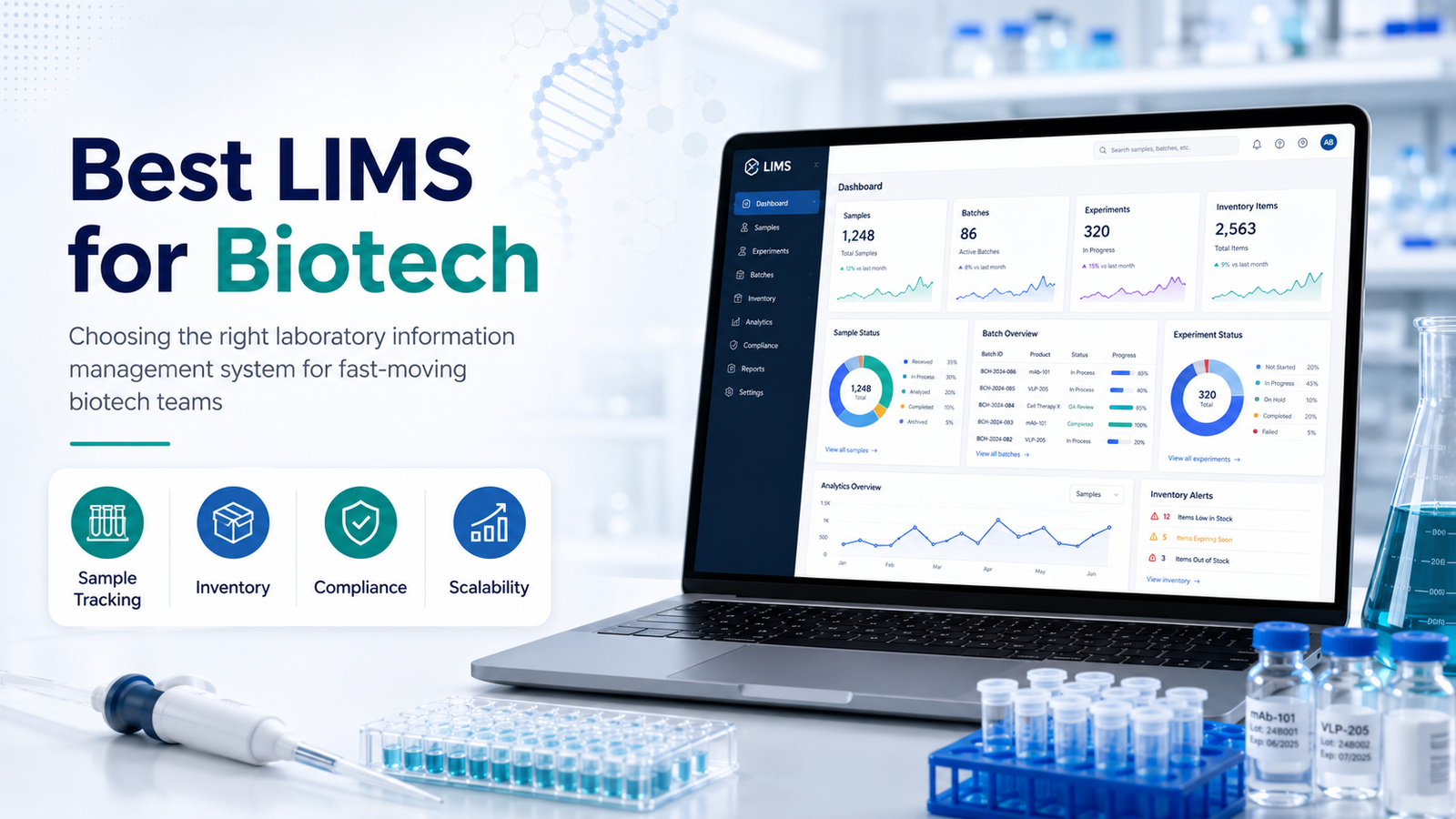
Quick verdict: The best LIMS for a biotech isn’t a fixed answer — it’s a moving target that depends on where you are on the growth curve. A discovery-stage lab of eight scientists, a Series B company scaling past thirty, and a clinical-stage organization approaching regulated work each need a different system, and the platform that fits one can actively hurt another. This guide maps the biotech LIMS landscape by stage and workflow rather than by feature count, explains the trade-offs the vendor marketing won’t, and helps you choose a system you won’t have to rip out in eighteen months.
Why biotech breaks the usual LIMS rules
Most LIMS buyer guides assume a stable lab with a stable workflow. Biotech violates that assumption constantly. A biotech company’s defining characteristic is change: headcount doubles, programs multiply, workflows shift from exploratory science toward structured process development, and — for many — the organization eventually moves toward regulated, IND-enabling work. The LIMS decision therefore isn’t “what fits my lab today?” but “what will still fit when my lab is three times larger and doing more serious work?”
This is also why biotech sits awkwardly between the two traditional software categories. Early biotech work is experiment-centric and looks like a job for an Electronic Lab Notebook (ELN); as samples, inventory, and cross-team coordination grow, it becomes sample-centric and looks like a job for a LIMS. Most biotechs need both, ideally in one system — which is why the modern biotech platform market has converged on unified ELN + LIMS + inventory tools rather than standalone products. If you’re still clarifying which side of that line your lab is on, our guide to choosing an ELN is the right starting point, and our broader LIMS software pillar frames the category.
The practical consequence: the criteria that matter for biotech are not the same ones that matter for a stable QC lab. They are, in rough order of importance, the ones below.
What actually matters when choosing a biotech LIMS
Scale-readiness: the criterion most labs underweight
The single most common biotech LIMS mistake is choosing for the lab you are, not the lab you’re becoming. Teams repeatedly report the same pattern: spreadsheets stop scaling somewhere around fifteen scientists, the team adopts an ELN-first or lightweight tool, and then — as more samples move through the lab, more people touch the same materials, and experiments become interdependent — that early choice starts to strain. The system that was perfect for quick, flexible discovery work becomes the thing that’s hardest to manage once operational structure, sample governance, and traceability become daily needs.
The lesson isn’t that flexible tools are bad; it’s that flexibility without structure has a cost that only appears at scale. When you evaluate, ask each vendor concretely what happens at three times your current size: more users, a second and third program, external CROs in the workflow, and the first serious conversation about compliance.
Unified data model vs. stitched stack
Biotechs that assemble separate ELN, LIMS, and inventory tools pay what some in the industry call an “integration tax” — the ongoing cost of connectors, data reconciliation, and sync failures between systems that were never designed to be one. A platform built on a single underlying data model, where experiments tie directly to samples, inventory, and workflows, avoids that tax. This is a genuine architectural advantage, not just marketing — but verify it in a trial rather than taking it on faith, because “unified” is a word every vendor uses.
R&D-native tooling for molecular biology
If your science is molecular — cloning, sequencing, CRISPR, plasmid and molecule registration — then native tooling for that work is a first-class requirement, not a nice-to-have. Some platforms build sequence editors, plasmid maps, and molecule registration directly into the system; others treat them as afterthoughts. A biotech doing heavy molecular biology should weight this heavily; one doing industrial fermentation or diagnostics may not need it at all. Match the tool to your actual science.
API-first architecture and instrument connectivity
Biotech labs live in a broader ecosystem of instruments, automation, and analytics. An API-first design determines whether your LIMS becomes the connected hub of that ecosystem or an island you’re forever exporting data out of. For labs running automation — bioreactors, liquid handlers, sequencers — out-of-the-box integrations versus custom-development requirements can be the difference between a two-week and a two-quarter deployment.
Pricing transparency and total cost
Biotech LIMS pricing is notoriously opaque, and the gap between budgeted and quoted cost is where many buying processes stall. Insist on an all-in number and understand where the price jumps — often when you cross a team-size threshold between tiers. For a deeper treatment, see our LIMS pricing models explainer. The key discipline is comparing total first-year cost across your real shortlist, not headline figures.
Data portability and exit strategy
An underrated criterion: how hard is it to leave? Some widely used platforms store data in proprietary formats with limited export options, which makes migration difficult and turns a multi-year contract into a lock-in with no exit strategy. Before you sign, ask exactly how you would extract your data — experiments, samples, and files — if you chose to leave. A vendor confident in their product will answer plainly.
The vendors, mapped by biotech stage and workflow
There is no single best biotech LIMS. Below, the platforms that consistently appear on biotech shortlists in 2026, grouped by the situation they serve best — with honest trade-offs, since several of the most-cited comparisons online are published by vendors about their own competitors and should be read with that bias in mind.
For molecular-biology-heavy R&D: Benchling

Benchling has become something close to the default for high-growth biotech and life-science R&D, and for good reason. It’s less a traditional LIMS than a unified platform combining molecular biology tools — sequence editors, plasmid maps, CRISPR design, molecule registration — with an ELN and LIMS capabilities in one system. Its R&D-native tooling is best-in-class for molecular work, its API-first architecture integrates well with existing infrastructure, and its polished UX means scientists actually adopt it.
Two honest caveats define who Benchling is not for. First, pricing: the academic tier is genuinely free and unlimited, which is why Benchling is ubiquitous in university labs — but commercial pricing is opaque and steep, reported to start around $15,000/year for a small five-person lab and scaling to enterprise contracts far beyond that, with sharp jumps when you cross tier thresholds. Second, sample-management depth and portability: independent reviewers note that the inventory module can feel secondary to the R&D tooling, and that data export is limited enough to make leaving difficult. Benchling is the right choice for molecular-biology-centric teams that will extract real value from its sequence tooling — and an expensive mismatch for labs whose work isn’t molecular. Our Benchling overview covers the details.
For scaling mid-market biotech: Genemod
Genemod targets the segment squeezed between spreadsheets and enterprise platforms — roughly Series A through Series C companies in the 15-to-200-scientist range that need unified ELN, LIMS, and inventory with a credible compliance posture and a fast time-to-value. Its pitch centers on operational structure: experiments tied directly to samples, inventory, files, and workflows in one schema, so the lab gains governance and traceability as it grows without migrating systems. For a team hitting the limits of an ELN-first tool and wanting more operational maturity, Genemod is a strong candidate. As with any vendor evaluation, validate the compliance and scale claims against your own workflow in a trial. See our Genemod review.
For automation-heavy and industrial biotech: Scispot
Scispot is built around an API-first, no-code philosophy and positions itself as an “alt-ELN, alt-LIMS, alt-LIS, and alt-SDMS” — a single configurable platform serving pharma, biotech, clinical, and diagnostic labs. Its distinguishing strength is integration with automation: it advertises validated, out-of-the-box integrations for equipment such as bioreactors where competing platforms require custom development, and its API-first design suits labs with custom systems or unusual workflows. Pricing is more transparent than much of the market — an AWS Marketplace listing has shown an Essential plan around $9,000/year — and Scispot can either replace a traditional stack or integrate alongside tools like Benchling. It’s a natural fit for automation-forward and industrial-biotech labs that value flexible integration. Our Scispot review goes deeper.
For labs approaching regulated, enterprise-grade work: Sapio Sciences and LabVantage
As a biotech moves toward clinical-stage and regulated operations, the requirements shift toward validated workflows, GxP-grade compliance, and enterprise integration — and the shortlist changes accordingly.
Sapio Sciences offers enterprise-grade LIMS and ELN capability with a more modern, low-code, AI-forward architecture than the legacy platforms, making it attractive to biotechs that need regulated-ready workflows without accepting the implementation weight and dated interfaces of the oldest enterprise systems. See our Sapio Sciences review.
LabVantage suits larger biotech and regulated enterprise labs that want an integrated platform embedding ELN, LES, and SDMS alongside the LIMS, with deployment flexibility across cloud, on-premises, and hybrid — a fit for organizations consolidating multiple informatics layers under one contract. Our LabVantage overview explains where it fits. Biotechs whose trajectory points toward pharmaceutical-grade quality control should also read our dedicated guide to LIMS for pharmaceutical QC.
For research, academic, and budget-conscious teams
Labguru — now part of Cenevo following its 2025 merger with Titian Software under Battery Ventures — remains a solid mid-market option with a well-regarded ELN, LIMS features covering the fundamentals, and steadily expanding AI capabilities, oriented toward labs that want simplicity and ease of use. Our Labguru review has the background, including the ownership change.
For academic and budget-near-zero labs, two paths deserve mention. Benchling’s free academic tier is genuinely unlimited and often the right answer for PhD students and postdocs — and your institution may already hold a site license for it or a comparable notebook, so check before purchasing anything. And open-source options remain viable for teams willing to self-host and absorb setup overhead; our eLabFTW overview and honest guide to open-source ELN and LIMS explain when free genuinely wins. Smaller biotechs may also find our best LIMS for small laboratories guide a useful companion.
Matching the LIMS to your specific biotech workflow
“Biotech” spans wildly different scientific operations, and the right LIMS often depends less on your company stage than on what your lab actually does all day. A few workflow-specific considerations sharpen the choice.
NGS and genomics labs have distinctive needs: high sample throughput, complex multi-step library-prep workflows, plate and barcode tracking, and the generation of large raw sequencing files. The friction point here is twofold — whether the LIMS can model high-throughput, plate-based workflows natively, and how it handles (or offloads) large-file storage, since some platforms charge or strain under heavy raw-data volumes. A genomics core facility should stress-test both the workflow modeling and the data-handling economics before committing.
Cell and gene therapy labs face the steepest trajectory from research into regulated territory, often compressing the discovery-to-clinical timeline that other biotechs spread over years. For these teams, choosing a platform that can carry them from early exploratory work into GxP-grade, validated, IND-enabling operations on the same system is especially valuable, because re-platforming while simultaneously scaling and entering regulation is close to a worst-case scenario. Weight scale-readiness and compliance posture heavily from day one.
Drug discovery and molecular-biology R&D teams lean hardest on native sequence and molecule tooling, registration systems, and collaboration features — the area where R&D-native platforms distinguish themselves. If your scientists spend their days designing constructs, registering molecules, and documenting cloning, prioritize depth in that tooling above operational breadth.
Industrial and synthetic biology operations — fermentation, strain engineering, bioprocessing — prioritize instrument and automation integration, particularly with bioreactors and process equipment. Here, out-of-the-box automation integrations and API flexibility matter more than molecular-biology editors, which may go largely unused.
Diagnostics and clinical-adjacent labs blend research needs with sample-governance and, frequently, regulatory requirements, sitting closer to the QC end of the spectrum. These labs benefit from stronger traceability and compliance features earlier than a pure discovery lab would.
The practical takeaway: two biotechs of identical size and funding stage can need entirely different systems if one runs a sequencing core and the other engineers microbial strains. Let your dominant daily workflow, not just your headcount, drive the shortlist.
The AI question in biotech LIMS
No biotech software conversation in 2026 is complete without addressing AI, and the LIMS market has moved quickly here — though not always substantively. Vendors increasingly advertise “AI-native” or “agentic” capabilities: assistive search across notebooks, protocol conversion from unstructured documents into structured formats, natural-language workflow automation, and design tools for molecular work. Some of this is genuinely useful; some is a thin layer over conventional functionality.
The buyer’s discipline is to separate AI that changes your daily work from AI that decorates a datasheet. Ask for a live demonstration on your data or a close analogue, and judge whether the feature saves real time — converting a paper protocol into a structured, reusable workflow, or surfacing a buried result across hundreds of experiments — versus whether it’s a chatbot bolted onto a search bar. Ask, too, whether AI features were built into the platform’s foundation or retrofitted onto a legacy architecture, since the former tends to work more coherently across the system. AI capability is a reasonable tiebreaker between otherwise comparable platforms, but it should rarely be the primary selection criterion; the fundamentals of data model, scale-readiness, workflow fit, and cost still decide whether a biotech LIMS succeeds or fails.
A decision framework for biotech buyers
Cut through the marketing by answering five questions honestly, in order.
First, where are you on the growth curve — and where will you be in two years? Choose for the second answer, not the first. A discovery-stage lab that will be doing IND-enabling work in eighteen months should weight compliance-readiness and scale far more heavily than its current size suggests.
Second, how molecular is your science? If cloning, sequencing, and CRISPR are central, native molecular tooling (Benchling’s core strength) becomes a top-tier requirement. If your work is fermentation, diagnostics, or industrial, prioritize automation integration and operational structure instead.
Third, one platform or a stack? Decide deliberately whether you want a unified ELN + LIMS + inventory system or best-of-breed tools you’ll integrate. The unified path avoids the integration tax; the stack path offers best-in-class components at the cost of ongoing connection work.
Fourth, what’s the true total cost — including the jump? Get an all-in first-year figure and, crucially, understand where the price escalates as you add users or cross a tier boundary. Opaque pricing is itself a data point.
Fifth, how do you get out? Confirm the data-export and migration story before signing a multi-year contract. An exit strategy you never use is still worth having.
The two mistakes that cost biotechs the most
The first is buying for today’s lab. A biotech that optimizes for its current eight-person, flexible, discovery-stage reality frequently finds that the very flexibility that made a tool easy to adopt becomes the hardest thing to manage once the team hits twenty or thirty people and adds a second program. Re-platforming mid-growth is expensive, disruptive, and slow — often an eighteen-month problem. Choosing a system that grows with you, even if it’s slightly more than you need on day one, is usually the cheaper path over a two-to-three-year horizon.
The second is treating opaque pricing and lock-in as afterthoughts. The obvious shortlist name is not always affordable, and the gap between “we need a real platform” and “we can’t afford the obvious one” is exactly where a careful buyer earns their keep. Insist on transparent total cost, understand the tier jumps, and secure a data-export path — before the sales conversation gets deep enough that switching feels impossible.
Where to go next
Start with our LIMS software pillar for the full category picture, or the pricing models explainer if budget is your first constraint. If you’re weighing whether you need a LIMS, an ELN, or both, our ELN buyer’s questions will settle it, and biotechs on a regulated trajectory should read our LIMS for pharmaceutical QC guide.
The good news for biotech in 2026 is that the market has matured around exactly your problem. There are now platforms designed for the messy, fast-moving, scale-driven reality of a growing life-science company — unified, API-first, and increasingly AI-enabled — rather than downsized enterprise systems or overgrown notebooks. The task isn’t to find the one with the most features. It’s to choose, deliberately, the one that will still fit the lab you’re about to become.
This guide is updated as vendor offerings, ownership, and pricing change. Pricing, compliance capabilities, and product positioning should always be confirmed directly with each vendor before purchase. Several widely cited biotech LIMS comparisons are published by vendors about their competitors; this guide flags that bias where relevant. LabSoftwareGuide is an independent editorial resource and is not affiliated with the vendors listed above.
Sources
- Onymos — 6 Best LIMS Software in 2026: https://onymos.com/blog/best-lims-software/
- QBench — The Best LIMS of 2026: The Industry Winners: https://qbench.com/blog/best-lims-the-industry-winners
- Scientist in Progress — Benchling Review 2026 (pricing, academic tier, lock-in): https://scientistinprogress.com/blog/benchling-review/
- 37degrees — Electronic Lab Notebooks in 2026: The Modern Scientist’s Guide: https://www.37degrees.io/resources/eln-landscape-2026/
- Genemod — Mid-Market Biotech Buyer’s Guide 2026: https://genemod.net/blog/benchling-alternative-mid-market-biotech-2026
- Scispot — Best Industrial Biotech LIMS 2026: https://www.scispot.com/blog/best-industrial-biotech-lims
- Igor Lab App — Best Benchling Alternatives (pricing detail): https://www.igorlabapp.com/post/best-benchling-alternatives
- Toolradar — Benchling Reviews, Pricing & Alternatives (2026): https://toolradar.com/tools/benchling
- Folio3 Digital Health — 15 Best LIMS Software for 2026: https://digitalhealth.folio3.com/blog/best-lims-software/