
Cloud vs On-Premise ELN: How to Choose Your Deployment Model
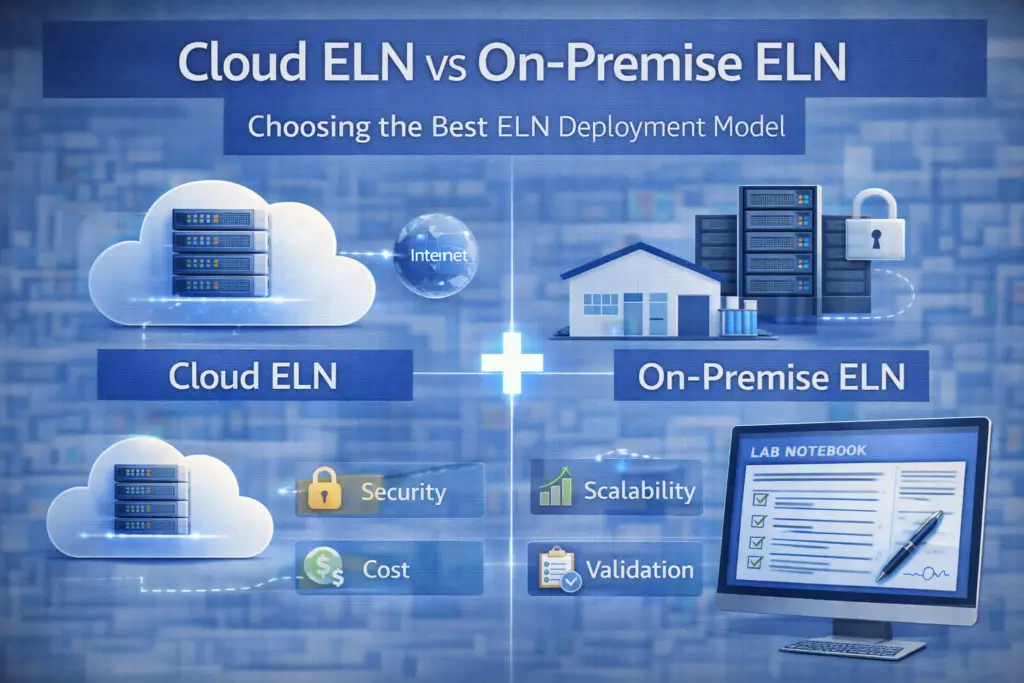
Quick verdict: For most labs, a cloud (SaaS) ELN is the practical default: faster to deploy, no servers to run, updates included, and accepted by regulators when the lab keeps proper oversight of the provider. On-premise still makes sense in specific cases: strict data residency or network isolation requirements, heavy integration with local instruments and systems, an IT team already running validated infrastructure, or a need to control exactly when the software changes. The decision should rest on those constraints and on a five-year cost comparison that includes internal IT effort, not on a general belief that one option is more secure. What the two models mean in practice Cloud ELN (SaaS). The vendor hosts the application, usually on a major cloud platform, and runs infrastructure, security patching, backups and upgrades. You access it through a browser and pay a subscription. Most instances are multi-tenant: your data is logically separated from other customers on shared infrastructure. Some vendors offer a single-tenant or private cloud option at a higher price. On-premise ELN. You install the software on servers you control, in your own data centre or in a cloud account managed by your IT team. You buy a licence (or a subscription for self-hosted software), and your team handles servers, databases, backups, security, and the timing of upgrades. Open-source ELNs such as eLabFTW are often self-hosted this way. The boundary is less sharp than the labels suggest. A “self-hosted” ELN running in your own cloud subscription gives you on-premise control with cloud infrastructure, and a vendor-managed single-tenant instance sits in between. Side-by-side comparison Cloud (SaaS) ELN On-premise ELN Deployment speed Fast: no infrastructure to build Slower: servers, database, network and security setup Who runs infrastructure Vendor Your IT team Upgrades Vendor schedule, frequent releases Your schedule, less frequent, often larger projects Cost profile Recurring subscription (operating expense) Upfront licence and hardware (capital expense), then maintenance and IT staff Remote access and collaboration Built in Requires VPN or exposed services, set up by IT Instrument and local system integration Needs connectors or gateways to reach the lab network Direct access on the local network Data location Vendor’s hosting regions; check contract Wherever you host it Validation focus Supplier assessment, release impact assessment Infrastructure qualification, upgrade revalidation Exit Depends on export terms in the contract Data already in your environment Security: where the real differences are A common assumption is that data is safer on servers inside the building. In practice, security depends on who runs the controls and how well. A reputable SaaS provider typically offers encryption in transit and at rest, a dedicated security team, continuous patching, and independent attestations such as ISO/IEC 27001 certification or SOC 2 reports. Many labs could not match that level internally. The risks move elsewhere: account security (strong authentication, single sign-on, removal of leavers), the provider’s own practices, and the terms that govern access to your data. On-premise gives you full control, which is an advantage only if your organization patches, monitors, backs up and tests recovery with the same discipline. A server that misses security updates for months, or a backup that has never been restored, is a larger risk than most cloud configurations. What to ask a cloud ELN vendor: current certifications or audit reports and their scope, hosting regions, encryption approach, backup frequency and tested recovery times, incident notification commitments, and support for single sign-on and multi-factor authentication. Compliance and validation Regulators do not require on-premise systems. What they require is that the lab stays in control of its regulated records, whatever the hosting model. The validation work shifts rather than disappears: Our ELN compliance and data integrity guide covers the controls in detail, and the LIMS validation guide describes the risk-based lifecycle that applies to both system types. Cost: compare five years, not year one Cloud ELN pricing is usually per user per month; our ELN pricing benchmark documents current published plans. On-premise pricing combines a licence or self-hosted subscription with costs that rarely appear in a vendor quote: servers or cloud infrastructure, database licences, backup and disaster recovery, security tooling, and IT staff time for maintenance and upgrades. A fair comparison uses the same scope for both options over five years: Our ELN pricing guide walks through the total cost of ownership calculation. Collaboration and integration Cloud ELNs make collaboration across sites, home working and external partners straightforward, because access only requires a browser and an account. On-premise systems can offer the same, but IT has to expose the application securely. Integration works the other way. Instruments, network drives and local systems sit on the lab network, which an on-premise ELN can reach directly. A cloud ELN needs an agent, gateway or middleware to collect instrument files and push them to the cloud. Before choosing cloud, list the instruments and systems you need to connect and ask each vendor how they are integrated today, in production, at a comparable lab. Which model fits your lab? Cloud is usually the better fit if: On-premise is usually the better fit if: Consider a middle option (self-hosted in your own cloud account, or a vendor-managed single-tenant instance) when you need control over data location or change timing without running physical servers. Frequently asked questions Can a cloud ELN be used for FDA-regulated or GLP work?Yes. The lab must assess the provider, define responsibilities in the contract, validate the system for its intended use, and retain the ability to retrieve complete records. Is on-premise more secure than cloud?Not by default. Security depends on the controls in place and how consistently they are operated. Many SaaS providers maintain controls that small internal IT teams cannot. Which option is cheaper?Cloud usually costs less in the first years. Over a longer period on-premise can compete, but only when infrastructure, IT staff and upgrade projects are counted. Can we move from on-premise to cloud later?Usually, but plan it as a data migration project: check export formats, metadata and audit trail transfer, and revalidation effort before committing. What
ELN Compliance and Data Integrity: A Practical Guide for Regulated Labs
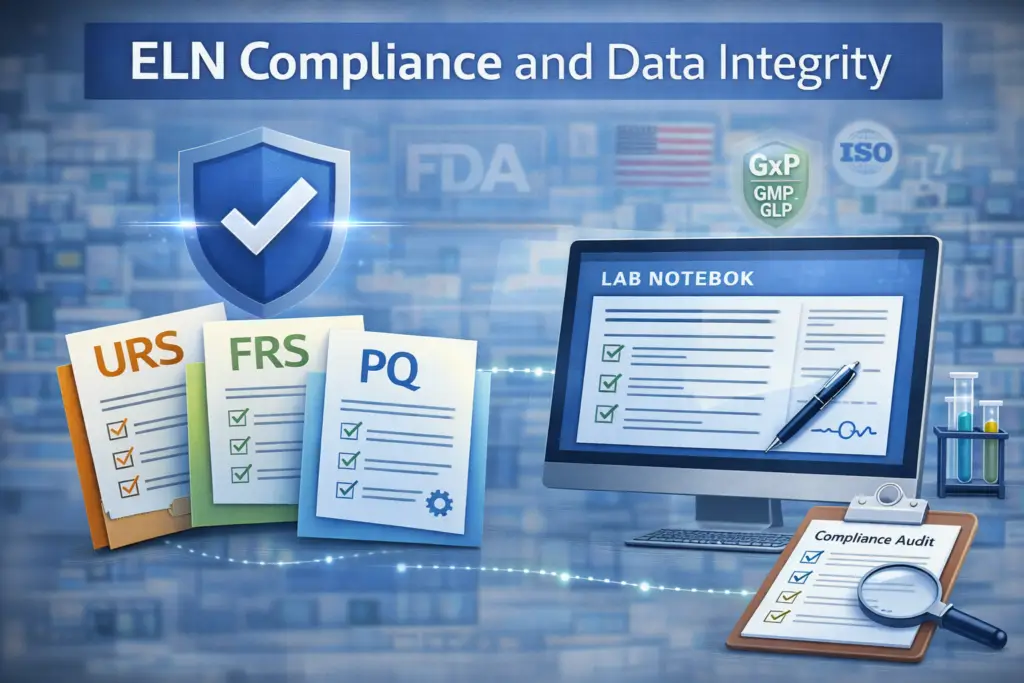
Quick verdict: An electronic lab notebook is not compliant or non-compliant by itself. It becomes a compliance question the moment it holds records that a regulation requires you to keep: GLP study data, GMP development records, clinical investigation data. From that point, the ELN must meet the same expectations as any other GxP computerised system: validation for intended use, attributable and secure audit trails, controlled electronic signatures, and records that stay complete and readable for the full retention period. In research-only labs the drivers are different (IP, reproducibility, funder data policies), but the same controls are what make notebook records credible. When compliance applies to an ELN Most ELN compliance confusion comes from mixing two situations. 1. The ELN holds regulated records. Examples: a GLP test facility documenting a nonclinical safety study, a pharma development group producing data that will support a GMP filing, a lab generating data for a clinical investigation. Here the regulations apply directly: 2. The ELN is used for research that is not regulated. No GxP regulation applies, but three pressures remain: proving inventorship and dates for patents, reproducing results, and meeting funder or journal data policies. The NIH Data Management and Sharing Policy, in force since January 2023, is one example. Many organizations have both situations in one ELN. In that case, define in your procedures which projects or notebooks are regulated, and apply validated controls to those at minimum. Data integrity: what ALCOA+ means inside a notebook Regulators assess electronic records against the ALCOA+ principles: attributable, legible, contemporaneous, original, accurate, plus complete, consistent, enduring and available. Our ALCOA+ guide covers the framework. In an ELN, each principle turns into specific, testable behaviour: Principle What it means in an ELN What to check Attributable Every entry and change is linked to one named user No shared accounts; audit trail records user, date, time Legible Records readable for the full retention period Export formats, long-term readability of attachments Contemporaneous Data recorded when the work is done Server-side time stamps; clock synchronization; no editable entry dates Original The first capture of data is kept, or a verified true copy Raw instrument files attached, not only screenshots or retyped values Accurate Calculations and transcriptions are correct Validated templates and calculations; locked formulas Complete Nothing deleted or hidden, including metadata Deleted or abandoned experiments remain traceable Enduring and available Records survive system changes and can be retrieved for inspection Backup, archiving, vendor exit terms The technical controls that matter most Audit trails Part 11 §11.10(e) requires secure, computer-generated, time-stamped audit trails that record the date and time of operator entries and actions, without obscuring previously recorded information. GLP rules go further: 21 CFR 58.130(e) also requires the reason for each change. In practice, a usable ELN audit trail shows the old value, the new value, who changed it, when, and why. Two common weak points: Recording changes is only half of the requirement. The FDA’s data integrity Q&A and the draft Annex 11 revision both expect audit trails for critical data to be reviewed, at a risk-based frequency. Electronic signatures and witnessing Part 11 requires signatures to show the signer’s printed name, the date and time, and the meaning of the signature, such as authorship, review or approval (§11.50), and to be permanently linked to the record (§11.70). In an ELN, check: Access control Role-based permissions should prevent users from altering others’ entries, disabling audit trails, or changing system settings. Administrator rights should sit with people who do not generate the data they could modify. Templates and calculations Templates bring structure to ELN data, and they are also where errors spread. A calculation built into a template used by 40 scientists is a validated function, not a convenience. Lock formulas, version templates, and test critical calculations as part of validation. Records, copies and exports MHRA’s guidance distinguishes static records from dynamic records, where the user can reprocess or interact with data. A PDF export of a notebook page is a static copy: it can lose metadata, audit trail and the ability to re-examine the original data. Before relying on exports for archiving or for sharing with partners, confirm they qualify as complete, true copies for your purpose. Validation of an ELN An ELN that holds regulated records must be validated for its intended use, like a LIMS. The approach is the same risk-based lifecycle described in our LIMS validation guide: requirements, supplier assessment, risk assessment, testing proportionate to risk, and ongoing change control and periodic review. ELNs differ from LIMS in where the risk sits. A LIMS concentrates risk in workflows, specifications and result approval. An ELN concentrates it in: Cloud ELNs Most ELNs sold today are cloud or SaaS products. Regulators accept this, provided the lab keeps control. The OECD’s 2023 supplement on GLP and cloud computing states the principle clearly: test facility management keeps responsibility for GLP compliance even when operations are outsourced. In practice, the service agreement should cover roles and responsibilities, data location, security, backup and disaster recovery, change control, and your right to obtain all data and metadata, including audit trails, in a readable format when the contract ends. For the deployment choice itself, see cloud vs on-premise ELN. Common compliance gaps in ELN deployments What to ask ELN vendors Our how to choose an ELN checklist covers the non-compliance criteria, and ELN vs LIMS explains when a notebook is the wrong tool for regulated testing. Frequently asked questions Does every ELN need to be validated?Only when it holds records required by GxP regulations or supports accredited results. A research-only ELN has no validation obligation, although verifying templates and calculations is still good practice. Can a cloud ELN be used in a GLP or GMP environment?Yes, if the lab assesses the provider, defines responsibilities in the service agreement, validates the system for its intended use and keeps the ability to retrieve complete records. Are ELN electronic signatures legally equivalent to handwritten ones?For FDA-regulated records, Part 11 sets the conditions under which electronic signatures
LIMS Validation Explained: A Risk-Based Guide for Regulated Labs
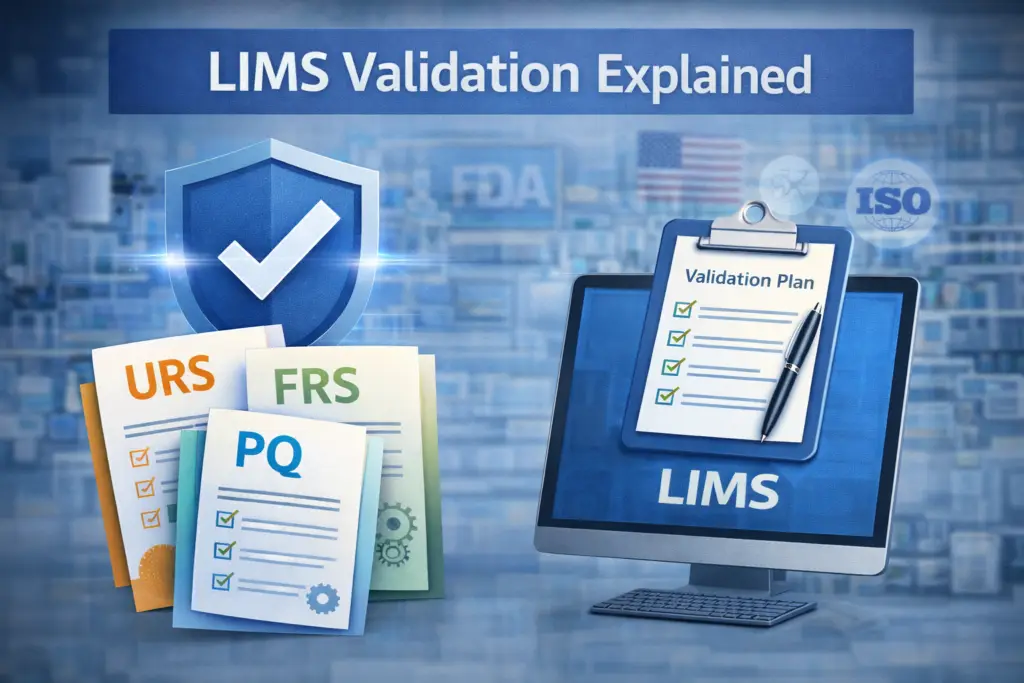
Quick verdict: Validating a LIMS means producing documented evidence that your configured system, as your lab uses it, does what it is supposed to do and protects the integrity of your data. It is required wherever the LIMS holds regulated records: GMP, GLP, clinical or ISO/IEC 17025-accredited testing. The vendor can make it much easier, but cannot do it for you. The modern expectation is not more paperwork: regulators and industry guidance (GAMP 5 Second Edition, FDA’s Computer Software Assurance guidance) push towards risk-based effort: deep testing where errors would affect product quality, patient safety or reported results, and lighter assurance everywhere else. What LIMS validation is, and what it is not Validation answers one question: is this system fit for its intended use in this lab? Three consequences follow, and they are where most misunderstandings start. Terminology varies: pharma traditionally says computerized system validation (CSV), device manufacturers increasingly say computer software assurance (CSA), and ISO/IEC 17025 simply requires the system to be “validated for functionality”. The underlying idea is the same. Which rules require it Framework Applies to What it requires of a LIMS FDA 21 CFR Part 11 Electronic records required by FDA regulations §11.10(a): validation of systems to ensure accuracy, reliability, consistent intended performance and the ability to discern invalid or altered records; plus audit trails, access and authority checks FDA Data Integrity Q&A (2018) Drug CGMP Expects validated systems, controlled access and review of audit trails for critical data EU GMP Annex 11 (revision drafted July 2025) EU GMP manufacturers Treats computerised systems as GMP-controlled assets: risk-based validation, supplier contracts, audit trail review, periodic review, cybersecurity MHRA GxP Data Integrity Guidance (2018) UK GxP organizations Systems validated for intended purpose; oversight of IT and cloud service providers ISO/IEC 17025:2017, clause 7.11 Accredited testing and calibration labs Information management systems “validated for functionality”; configuration changes authorized and validated before use; external providers checked FDA CSA guidance (final Sept 2025, revised Feb 2026) Medical device production and quality management system software Risk-based assurance proportionate to process risk; less scripted testing for lower-risk functions Two nuances worth stating plainly: For the underlying record-keeping rules, see our guides to 21 CFR Part 11, ALCOA+ and ISO 17025 and LIMS. The risk-based approach in practice The most widely used framework is ISPE’s GAMP 5, whose Second Edition (2022) puts critical thinking at the centre: subject-matter experts decide where assurance effort is needed, instead of applying the same depth of testing everywhere. Start by classifying what you are validating. GAMP 5 describes software categories, now used as one input among others in the risk assessment: Then assess risk function by function. For each requirement, ask what happens if it fails: could a wrong result be reported, a batch released, a sample misidentified, or a record altered without trace? High-impact functions such as result calculations, specification checks, approvals and e-signatures, audit trails, instrument interfaces and certificate of analysis generation get detailed, documented testing. Low-impact functions such as cosmetic screens or convenience features can rely on vendor testing and lighter verification. Leverage the supplier. Both GAMP 5 and CSA encourage using supplier documentation and test evidence rather than repeating work, provided you have assessed the supplier’s quality system. That assessment is itself part of your validation file. The validation lifecycle, step by step Classic IQ/OQ/PQ terminology still appears in many validation plans and remains acceptable; what matters is that the evidence is proportionate to risk and traceable to requirements. Cloud and SaaS LIMS: what changes A cloud LIMS does not remove validation, it redistributes responsibility. If you are still choosing a deployment model, our LIMS pricing benchmark and how to choose a LIMS checklist cover the commercial side. Common mistakes (and how to avoid them) What to ask vendors about validation Validation effort is a large part of implementation time: our LIMS implementation timeline guide shows how regulated projects extend schedules, and our pharmaceutical QC LIMS guide compares how much validation support vendors offer. Frequently asked questions Is LIMS validation required for every lab?It is required when the LIMS holds records subject to GxP regulations or supports ISO/IEC 17025-accredited results. A non-regulated research lab has no legal obligation, although verifying calculations and data transfers remains good practice. Can the vendor validate the LIMS for us?The vendor can provide documentation, test evidence and services that reduce your effort. Responsibility for validating the system for your intended use stays with your organization. Is a cloud LIMS easier to validate?It removes infrastructure qualification from your scope, but adds supplier oversight and the need to assess frequent vendor releases. Does CSA replace CSV for pharma labs?Not formally. FDA’s CSA guidance covers medical device production and quality system software. Its risk-based principles align with GAMP 5 Second Edition, which pharma and biotech organizations widely use. How often should a validated LIMS be reviewed?There is no universal interval. Set a risk-based periodic review frequency in your procedures (higher for systems with critical GMP data) and assess every change under change control in between. The bottom line LIMS validation is a risk-based discipline that proves your configured system works for its intended use and keeps proving it as the system changes. Put your effort where errors would matter, use your supplier’s evidence where you have assessed it, and treat change control, audit trail review and periodic review as part of running the system, rather than as paperwork after go-live. This article is independent editorial content and does not replace regulatory advice for your specific context. No vendor paid for inclusion. Read how we review lab software. Sources
Paper vs Electronic Lab Notebook: When to Switch and How to Do It Well
Quick verdict: Paper lab notebooks are still legally acceptable, including in regulated work, and they remain easy to use, cheap and hard to tamper with invisibly. Their limits appear as soon as a lab needs to find, share, reuse or protect its data at scale: records cannot be searched, instrument data lives in folders disconnected from the notebook, and a lost or damaged book cannot be restored. An electronic lab notebook (ELN) solves those problems, but introduces software costs, adoption effort and dependence on a system. For most research groups beyond a handful of people, switching is worth it. The part that decides success is the transition itself: a clear master record, workable devices at the bench, and firm rules for the paper-electronic overlap. Paper is not obsolete, and regulations do not ban it No major laboratory regulation requires electronic records. FDA’s GLP regulations, for example, describe how paper entries should be made: data recorded promptly and legibly in ink, each entry dated and signed or initialled, and changes made without obscuring the original entry, with the reason and the date (21 CFR 58.130(e)). A well-kept paper notebook that follows those rules is a valid record. Paper also has practical strengths that are easy to underestimate: A user study published in the Journal of Cheminformatics in 2017 (Kanza et al.) found that these qualities, together with the lack of suitable devices at the bench, were central to why many researchers kept using paper. Tools have improved since, but the findings still describe the objections labs raise today. Where paper breaks down The problems with paper are rarely about a single notebook. They appear across a group, over years. What an ELN changes An ELN keeps the notebook’s role, a chronological record of what was done and why, and adds: It also brings costs and risks that paper does not have: licences or hosting, time to configure templates and train users, dependence on a vendor or on internal IT, and the need to export records in usable formats if you change system. Our ELN pricing benchmark shows that entry-level commercial plans are relatively affordable and that free academic tiers and open-source options exist, so licence cost is rarely the main obstacle today. Adoption usually is. Compliance and evidence: how the two compare Paper notebook Electronic lab notebook Attribution Handwritten name, initials, signature User account, logged automatically Dating Written by the author System time stamp Changes Single strike-through, reason, date, initials Audit trail with old and new values, user, time, reason Signatures and witnessing Wet ink, needs physical access Electronic signatures; for FDA-regulated records, controls under 21 CFR Part 11 Backup None unless scanned Automatic, depending on hosting Main weakness Loss, illegibility, no search Weak configuration, shared accounts, poor export at exit On intellectual property, the picture is more nuanced than vendors suggest. Since the US moved to first-inventor-to-file in 2013, notebooks matter less for priority, but they still support inventorship, derivation disputes and prior user rights. Some IP practitioners, such as Palovich writing in ACS Medicinal Chemistry Letters (2014), have argued that paper can be easier to defend in court because judges and juries understand it and tampering is visible. An ELN can provide strong evidence, but only if audit trails, time stamps, signatures and access controls are properly configured. See ELN vs LIMS for the IP context and our ELN compliance guide for the controls that make electronic records credible. Why switches fail, and how to avoid it Most ELN projects that stall do so for practical reasons, not because of the software’s features. A practical transition plan Frequently asked questions Are paper lab notebooks still legally valid?Yes. Regulations such as FDA’s GLP rules describe how paper entries must be made, and paper remains acceptable when those rules are followed. Is an ELN better for patents?It can be, if audit trails, time stamps and signatures are properly configured. Some IP practitioners still consider paper easier to present as evidence, so organizations with high patent exposure should involve their IP counsel when choosing and configuring an ELN. Can we scan our old notebooks and throw them away?Only if your regulatory and institutional retention rules allow it and the scans qualify as verified true copies. In most research settings, archiving the originals and scanning selectively is the safer choice. How long does a switch take?For a research group, a pilot and roll-out can take a few months. Regulated deployments take longer because the ELN must be validated. What if our scientists refuse to use it?Resistance usually points to a practical problem: no device at the bench, poor templates or slow performance. Fix those before pushing adoption. The bottom line Paper notebooks are a legitimate record and still work for very small groups. Beyond that, their weaknesses in search, data linkage, backup and collaboration cost more than an ELN does. The decision to switch is usually easy to justify; the transition is where labs succeed or fail. Put devices at the bench, build templates with users, define the master record and end the hybrid period on a set date. This article is independent editorial content. No vendor paid for inclusion. Read how we review lab software. Sources
ELN vs LIMS: What’s the Difference?
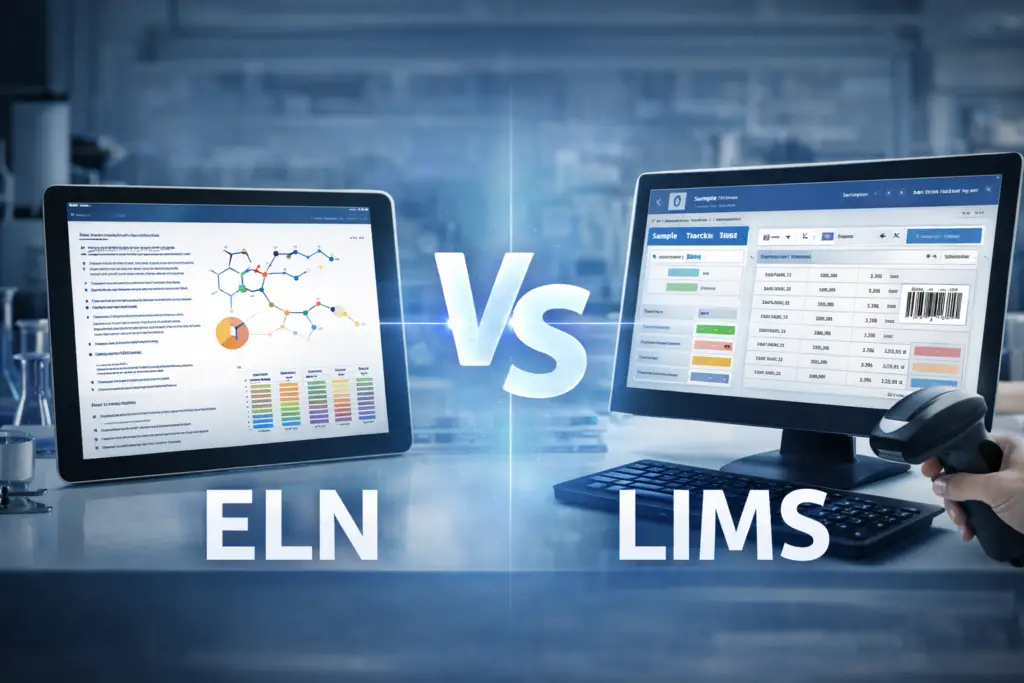
Quick verdict: A LIMS manages samples and the work done on them; an ELN manages experiments and the reasoning behind them. If your lab’s core output is a tested result delivered against a specification (QC, clinical, environmental or contract testing), you need a LIMS. If your core output is knowledge, such as a validated hypothesis, a new construct or a patent filing, you need an ELN. Many R&D organizations eventually need both, and a growing group of vendors now sell them as one platform. That convergence is useful, but it can hide the questions you should ask before buying. Why the distinction still matters Vendors increasingly describe themselves as “ELN + LIMS” or “unified lab platforms”, and several of the products we review do cover both. The difference still matters, for a practical reason: the two systems are built around different units of work. A LIMS is organized around the sample. Registration, tests, results, approvals and reports all hang off a sample record moving through a defined workflow. An ELN is organized around the experiment. The aim, protocol, observations, raw data and conclusions all hang off a notebook entry authored by a scientist. When a hybrid platform is strong on one model and thin on the other, you will feel it within weeks of go-live. Knowing which model your lab actually runs on is the first and most important step in any evaluation. ASTM’s reference guide for laboratory informatics (E1578-18) treats LIMS and ELN as distinct system types alongside LES, LIS, SDMS and CDS, for the same reason. What a LIMS does A Laboratory Information Management System manages the operational life of samples in a lab. Its job is to ensure that every sample is accounted for, tested according to the right method, and reported correctly. Typical LIMS capabilities: Where LIMS dominates: pharmaceutical and biotech QC, contract testing, environmental and food testing, and clinical labs (which often use a LIS for patient-facing diagnostics; see our clinical and diagnostic LIMS guide). The defining trait of a good LIMS is enforced structure: a technician cannot skip a step, enter a result outside the permitted sequence, or release a batch without the required approvals. That rigidity makes it valuable in regulated testing, and it frustrates research scientists who try to use it as a notebook. What an ELN does An Electronic Lab Notebook replaces the paper notebook, but its real value lies in making experimental work searchable, shareable and defensible. Typical ELN capabilities: Where ELN dominates: discovery research, academic labs, process development and early-stage R&D, where the workflow changes from one experiment to the next. The defining trait of a good ELN is structured flexibility: enough structure that data is findable and comparable later, without forcing scientists into a fixed sequence that does not match how research works. For the academic end of the market, see our comparison of the best ELNs for academic and research labs; for chemistry-heavy teams, our drug discovery ELN guide. ELN vs LIMS at a glance LIMS ELN Unit of work Sample Experiment Core question it answers “What happened to this sample, and is the result valid?” “What did we do, why, and what did we learn?” Workflow Predefined, enforced Flexible, author-driven Typical users Technicians, analysts, QA reviewers Research scientists, principal investigators Typical data Structured results against specifications Mixed: text, images, files, structured tables Primary compliance driver GxP, ISO/IEC 17025, 21 CFR Part 11 IP protection, reproducibility, and GxP when used in regulated development Implementation Months, configuration-heavy Weeks to months, lighter configuration Pricing pattern Opaque, often quote-based More transparent, frequent free/academic tiers Compliance: both can be compliant, for different reasons It is a common misconception that LIMS is “the compliant one” and ELN is “the flexible one”. Both system types can meet regulatory requirements; what differs is why compliance matters to the typical user. In a LIMS, compliance is the product. In GMP QC or accredited testing, results feed release decisions and client reports, so the system is expected to be validated and to meet the controls described in FDA’s 21 CFR Part 11: validation, access control, secure computer-generated time-stamped audit trails, operational and authority checks (§11.10), signature manifestations showing the signer’s name, date/time and meaning (§11.50), and signatures linked to their records (§11.70). In an ELN, compliance historically centered on intellectual property. Notebook records support inventorship and priority questions. The United States moved to a first-inventor-to-file system under the America Invents Act on 16 March 2013, which reduced the role of notebooks without eliminating it: records still matter for derivation proceedings, prior user rights and proving inventorship. Some IP practitioners also caution that electronic records can face more scrutiny in litigation than paper notebooks, so audit trails, time-stamping and signature controls in the ELN matter. When an ELN is used in regulated development (for example GLP studies or process development feeding a GMP filing), the same Part 11 and data integrity expectations apply as for a LIMS. Two practical consequences for buyers: Cost and implementation: the gap is real The two markets price very differently. Implementation follows the same pattern. A LIMS must be configured around your sample types, tests, specifications, instruments and reports; our LIMS implementation timeline guide documents projects ranging from about 6 weeks to 12 months or more. An ELN can often be rolled out to a research team much faster, because it imposes less structure up front. A regulated ELN deployment with validation, however, brings timelines closer to those of a LIMS. The trade-off: the cheaper, faster ELN is not a budget LIMS. Labs that try to run sample-driven testing in an ELN usually end up rebuilding chain of custody and approvals in templates and spreadsheets, which is where many LIMS projects start. Hybrid ELN-LIMS platforms: what they solve and what to check A growing share of the market sells ELN and LIMS capabilities in a single platform. Among the products we have reviewed: What a hybrid solves: one data model from experiment to sample, no integration to build and maintain between