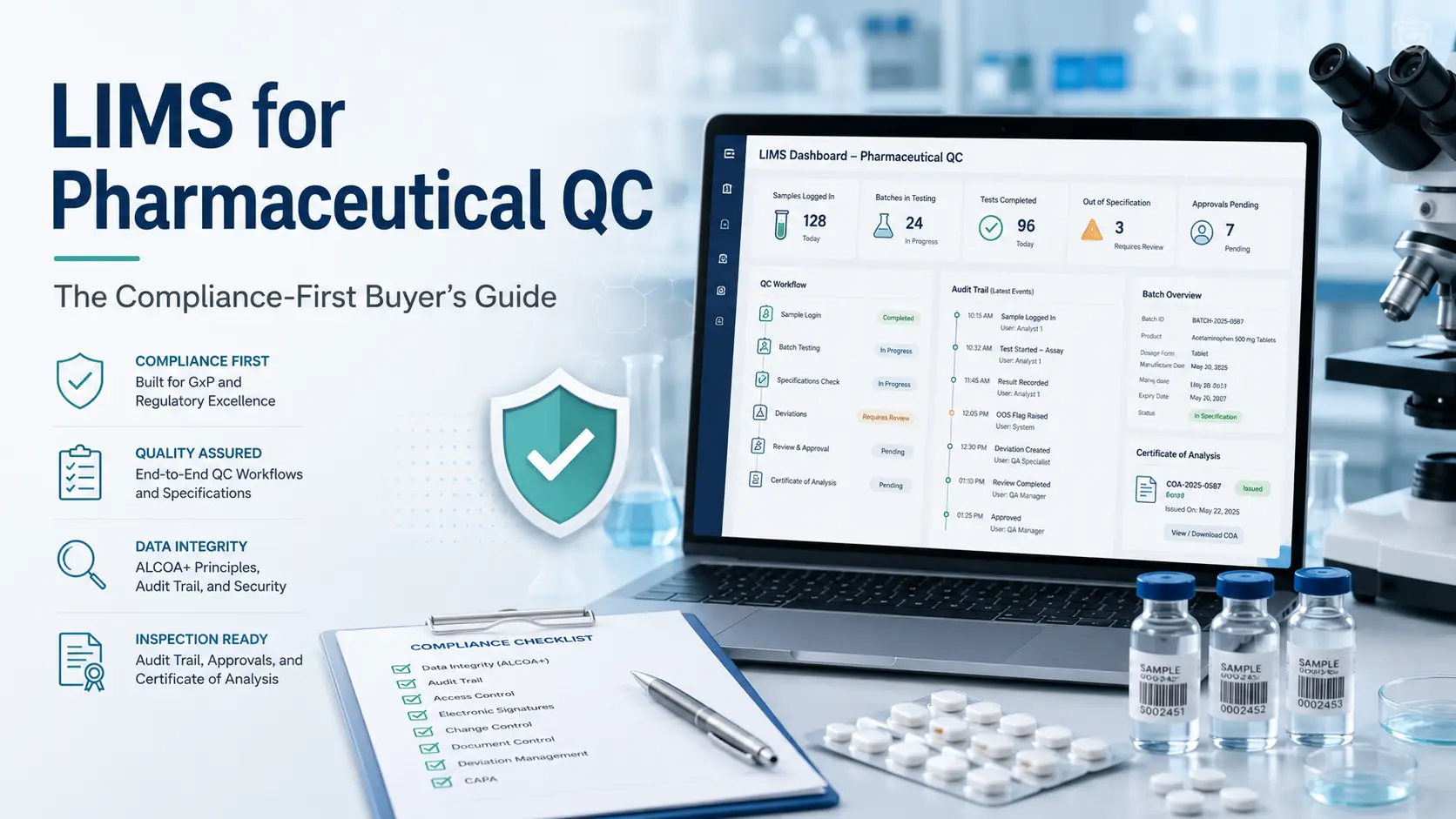
Quick verdict: In a pharmaceutical quality control lab, a LIMS is not a productivity tool with compliance features bolted on — it is a compliance system that happens to manage samples. The right choice is governed less by the length of a feature list than by the discipline of the system’s audit trails, its electronic-signature controls, its validation posture, and how well it withstands an FDA or EMA inspection. This guide explains what pharma QC actually demands of a LIMS in 2026, how the regulatory ground has shifted this year, and which vendors fit which kind of QC operation — with an honest account of their trade-offs.
Why pharmaceutical QC is a category of its own
Every laboratory cares about accurate data. A pharmaceutical QC lab has to prove it — to a regulator, on demand, years after the fact. That single difference reshapes everything about how a QC lab should evaluate a Laboratory Information Management System.
In a pharma QC environment, the LIMS sits at the center of release decisions: raw material testing, in-process checks, finished-product analysis, stability studies, environmental monitoring, and microbiology all flow through it, and the data it holds ultimately underwrites whether a batch reaches patients. Because those records support GMP decisions, the system that creates, modifies, stores, or transmits them falls squarely under FDA 21 CFR Part 11 — the same obligation that applies to chromatography data systems, stability chambers, and QMS platforms. A LIMS in this setting is a regulated computerized system, and it must be selected, configured, and validated as one.
This is why a QC buyer’s evaluation criteria look nothing like a research lab’s. Usability and speed still matter, but they sit beneath a non-negotiable foundation: data integrity, traceability, and inspection readiness. Get those wrong and no amount of workflow polish will save you from a warning letter.
The regulatory ground has moved in 2026 — three shifts to understand
Anyone buying or re-evaluating a pharma QC LIMS this year needs to understand three regulatory developments, because they change what “compliant” means in practice.
First, validation expectations have shifted decisively toward risk-based assurance. FDA finalized its Computer Software Assurance (CSA) guidance in September 2025 and revised it in February 2026. Formally, CSA covers software used in medical device production and quality systems, so it does not bind pharmaceutical QC labs. But its risk-based, proportionate logic mirrors ISPE’s GAMP 5 Second Edition, which pharma widely follows: concentrate testing effort on the functions that directly affect patient safety and product quality, instead of validating every function to the same exhaustive standard and generating mountains of paper. When you evaluate a vendor, ask how their validation tooling and documentation support a CSA-aligned, risk-based approach — not just legacy CSV.
Second, EU Annex 11 is being revised. The European GMP framework for computerized systems is undergoing its most significant update in over a decade, with the draft expanding emphasis on lifecycle traceability, stricter audit-trail expectations, and data governance. If your products touch European markets, a LIMS decision made in 2026 should anticipate the revised Annex 11, not just the current text.
Third, data integrity remains the single most common cause of regulatory findings. This is not an abstract risk. The FDA issued more than 160 warning letters specifically citing data integrity deficiencies between 2017 and 2022, and analyses of 483 citations in the years since show that a majority relate to incomplete audit trails, backdated entries, or unvalidated systems. When inspectors arrive, the LIMS is often the first place they look. Choosing a system that makes data integrity the path of least resistance — rather than something staff must work around — is the most effective warning-letter insurance a QC lab can buy.
The compliance foundations your QC LIMS must deliver
Beneath the vendor marketing, a pharmaceutical QC LIMS must operationalize a specific set of controls. These are the features that inspectors actually probe, and the ones your evaluation should weight most heavily.
ALCOA+ as the working standard
Inspectors evaluate whether your records are trustworthy using the ALCOA+ framework: data must be Attributable, Legible, Contemporaneous, Original, and Accurate — plus Complete, Consistent, Enduring, and Available. A capable QC LIMS enforces these properties by design rather than by procedure: it timestamps entries contemporaneously, ties every action to an authenticated individual, preserves original captured values, and keeps records retrievable for the full retention period. When you assess a system, walk each ALCOA+ principle through a real workflow and ask how the software enforces it. Our deeper explainer on ALCOA+ and data integrity in the laboratory unpacks each element.
Field-level, immutable audit trails
The audit trail is the beating heart of a pharma QC LIMS. To satisfy Part 11 and survive inspection, it must be field-level, immutable, and human-readable, capturing for every change the old value, the new value, the user identity, the timestamp, and the reason for the change. Two capabilities separate adequate systems from strong ones: the granularity of what gets logged, and the ease of reviewing those logs. Audit-trail review is itself a GMP expectation, so a system that makes routine review practical — with filtering, exception flagging, and readable output — is worth far more than one that merely records everything into an unusable mass.
Electronic signatures bound to the individual
Part 11 requires that electronic signatures be uniquely linked to an individual and traceable, carrying the signer’s name, the date, and the reason for signing, with legal equivalence to a handwritten signature. In QC practice, signatures gate the actions that matter: approving results, releasing batches, authorizing method changes. A strong LIMS enforces signature meanings explicitly and prevents the signature from being detached from its record. Confirm, too, that the vendor supports the access controls that make signatures meaningful — unique user identities, enforced authentication, and role-based permissions consistent with cybersecurity best practice.
Validation to intended use
A LIMS is not compliant out of the box; it becomes compliant through validation to its intended use, and stays compliant through ongoing oversight. This is the point buyers most often underestimate. The vendor supplies a validatable product; the QC lab is responsible for validating the configured system as deployed, and for revalidating when it materially changes. This is precisely where risk-based validation (GAMP 5 Second Edition, with principles shared by FDA’s CSA guidance) reshapes effort — toward intended-use testing. When comparing vendors, weigh how much validated tooling, documentation, and support each provides, because that directly determines your validation burden. For the broader picture of what compliant software must support, see our guide to 21 CFR Part 11 and what your LIMS must do. For the full validation lifecycle, read LIMS validation explained.
A note on automatic updates
One subtle but important QC consideration: some cloud LIMS vendors push automatic product updates. For a highly regulated lab with strict validation requirements, an unscheduled update can disturb a validated state and, in principle, trigger re-validation. This isn’t a reason to avoid cloud systems — it’s a reason to ask, explicitly, how each vendor handles updates for regulated customers, and whether you can control update timing to align with your change-control process.
The vendors: matching the platform to the QC operation
There is no single best LIMS for pharmaceutical QC, because “pharmaceutical QC” spans everything from a lean contract testing lab to a global manufacturer running dozens of validated sites. The systems below consistently appear on pharma QC shortlists in 2026, grouped by the kind of operation they suit — with the trade-offs stated plainly.
For large, multi-site, enterprise QC
Thermo Scientific SampleManager is a mature, validated platform with a strong pedigree in regulated pharmaceutical environments. It offers validated packages aligned to 21 CFR Part 11, Annex 11, and GMP, and its defining strength is instrument connectivity — deep integration with chromatography data systems and the broader Thermo Fisher instrument portfolio, plus scheduling and automated data capture. For a QC lab whose operational center of gravity is high-volume, instrument-intensive analytical testing — and especially one already standardized on Thermo Fisher instrumentation — SampleManager is frequently the reference option.
LabWare is one of the longest-established names in laboratory informatics and positions itself as a comprehensive pharmaceutical solution, with an extensive module library spanning stability testing, environmental monitoring, and batch management, deployed across many global sites. Its strength is configurability and scale for large, diverse organizations standardizing across multiple locations. The honest caveat, reported consistently by verified users, is implementation weight: pharma deployments frequently run 6–12 months or longer for full functionality, demand substantial IT resources, and carry a steep learning curve. LabWare rewards organizations that have the project capacity to exploit its depth — and punishes those that don’t. Our LabWare LIMS overview covers this in detail.
STARLIMS, part of the Abbott Informatics lineage, is built for regulated, end-to-end data management, with strengths in stability, method validation, and multi-industry compliance across GxP and ISO environments. It is often cited as offering one of the more complete platforms for pharmaceutical continuity from early R&D through commercial QC. The trade-off, again reported by users, is user experience: the interface feels dated relative to modern alternatives, and implementations routinely exceed projected timelines and complexity. STARLIMS suits labs that prioritize breadth of validated capability and can invest in the technical expertise to configure and run it. See our STARLIMS overview.

LabVantage traces its origins back more than three decades and is a strong fit for large pharmaceutical and regulated enterprise labs that want an integrated platform — embedding ELN, LES, and SDMS alongside the LIMS, with robust QC modules and deployment flexibility across cloud, on-premises, and hybrid. For organizations that want one contract and one platform spanning several informatics layers, LabVantage consolidates what would otherwise be multiple systems. Our LabVantage overview goes deeper.
For mid-sized and modern regulated labs
Sapio Sciences is worth attention from QC labs that want enterprise-grade capability with a more modern, low-code, AI-forward architecture than the legacy platforms offer. It combines LIMS and ELN in a configurable platform, appealing to organizations that need regulated workflows but are reluctant to accept the implementation weight and dated interfaces of the older enterprise tier. Our Sapio Sciences review explains where it fits.
Autoscribe Informatics (Matrix Gemini) brings one of the longest track records in the market together with a configuration-driven approach that lets labs adapt workflows without deep custom coding — a meaningful advantage for QC labs that need to tailor the system to validated processes while containing change-management risk. Autoscribe has published specific guidance on pharmaceutical LIMS, stability studies, and Part 11 signature traceability, signaling genuine focus on regulated QC. See our Autoscribe Matrix Gemini overview.
For focused, faster-deploying regulated QC
SciCord is purpose-built for pharmaceutical and biopharma laboratories and takes a deliberately narrower path than the enterprise giants. Its spreadsheet-style, no-code engine supports rapid deployment — often within about 30 days — while maintaining GxP and 21 CFR Part 11 compliance, which makes it a compelling option for a regulated QC lab caught between “too small for a 12-month enterprise rollout” and “too regulated for a lightweight generalist tool.” Our SciCord overview has the specifics.
CloudLIMS merits consideration for smaller regulated QC operations that need a cloud-hosted, Part 11–capable system without IT overhead. It is designed to meet GLP and FDA guidelines including 21 CFR Part 11 and serves testing sectors that skew toward small and mid-sized labs. As noted above, confirm how it handles automatic updates against your validation requirements. Our CloudLIMS review covers the trade-offs, and smaller labs may also find our guide to the best LIMS for small laboratories useful for framing the decision.
How to run a QC LIMS selection that survives inspection
A pharmaceutical QC selection process should differ from a general LIMS purchase in specific ways. The following sequence reflects what actually protects a QC lab.
Begin by defining intended use and risk before you look at vendors. Document the regulated functions the system will perform — result entry and approval, batch release, stability scheduling, audit-trail review — and rank them by patient-safety and product-quality impact. This is the foundation of a CSA-aligned validation and, not incidentally, an excellent filter for vendor demos: you’ll evaluate systems against your workflows rather than their showcases.
Next, inspect the audit trail and signature behavior directly, in a hands-on trial. Don’t accept a compliance datasheet. Make a change to a result, then find it in the audit trail: is the old value, new value, user, timestamp, and reason all captured, field-level, and readable? Sign a record and confirm the signature’s meaning is bound to it. This single exercise separates genuinely inspection-ready systems from those that merely claim Part 11 support.
Then, interrogate validation and update handling. Ask each vendor exactly what validated documentation and tooling they provide, how their approach supports risk-based CSA, and — for cloud systems — how updates are controlled so a validated state isn’t disturbed without your change-control approval.
Finally, get realistic, named implementation timelines and total cost. For enterprise platforms in particular, weigh the widely reported gap between projected and actual deployment timelines. A system that is theoretically more capable but takes 12–18 months and heavy IT investment to reach usability may serve your QC operation worse than a focused platform that is validated and live in a quarter.
The mistake that costs QC labs the most
The most expensive error in pharmaceutical QC LIMS selection is treating compliance as a checkbox rather than an operating discipline. A system’s marketing may claim “21 CFR Part 11 compliance,” but that phrase describes a capability, not a state your lab automatically inherits. Compliance is achieved through how the system is configured, validated to intended use, and overseen day to day — with unique access controls enforced, immutable audit trails configured, and those trails actually reviewed on a routine basis. Labs that align the three pillars — ALCOA+ as the inspection-facing standard, Part 11 as the legal requirement, and a risk-based validation methodology (GAMP 5 Second Edition, consistent with FDA’s CSA principles) — maintain inspection readiness continuously, rather than scrambling to remediate when an inspection is announced.
Put simply: the vendor gives you a system that can be compliant. Whether it is compliant is determined by you. Choose a platform that makes that discipline easier to sustain, and the software becomes an asset in your next inspection rather than a liability.
Where to go next
If you’re establishing the fundamentals, start with our pillar guide to LIMS software for the full category picture, or the pricing models explainer if budget planning comes first. Testing labs pursuing accreditation should also review our ISO 17025 guide, and any lab weighing whether it needs a LIMS, an ELN, or both will find clarity in our ELN buyer’s questions.
For all the regulatory pressure it carries, pharmaceutical QC is also where a well-chosen LIMS pays back the most: it turns inspection readiness from a periodic fire drill into a steady state, and frees analysts to do science instead of defending records. The task is not to find the system with the most features — it’s to choose the one whose compliance discipline you can sustain, inspection after inspection, year after year.
This guide is updated as regulations and vendor offerings evolve. Regulatory requirements, validated-package availability, and product capabilities should always be confirmed directly with each vendor and against current FDA and EMA guidance before purchase. LabSoftwareGuide is an independent editorial resource and is not affiliated with the vendors listed above.
Sources
- Lab Manager — Pharma LIMS: Meeting GxP and 21 CFR Part 11 Data Integrity Requirements: https://www.labmanager.com/pharma-lims-meeting-gxp-and-21-cfr-part-11-data-integrity-requirements-35509
- Pharmaguideline — 21 CFR Part 11 Requirements for Laboratories: https://www.pharmaguideline.com/2025/11/21-cfr-part-11-requirements-for-laboratories.html
- IntuitionLabs — 21 CFR Part 11 Compliance: Requirements & Data Integrity (incl. draft Annex 11 revision): https://intuitionlabs.ai/articles/21-cfr-part-11-compliance-requirements
- FDA Guidelines — Data Integrity & Electronic Record Compliance Frameworks: https://www.fdaguidelines.com/data-integrity-electronic-record-compliance-frameworks-fda-21-cfr-part-11-and-global-regulatory-alignment-year/
- G2 — Best LIMS Software (2026): https://learn.g2.com/best-lims-software
- Scispot — Best Pharmaceutical LIMS Software 2026: https://www.scispot.com/blog/best-pharmaceutical-lims-software
- Scispot — Best LIMS for Quality Control 2026: https://www.scispot.com/blog/best-lims-for-quality-control
- Onymos — 6 Best LIMS Software in 2026: https://onymos.com/blog/best-lims-software/
- PharmaNow — 8 Best LIMS Software 2026 (Pharma Buyer Guide): https://www.pharmanow.live/pharma-manufacturing/best-lims-software-2026
- Autoscribe Informatics — How LIMS Ensures FDA 21 CFR Part 11 Compliance: https://www.autoscribeinformatics.com/resources/blog/how-lims-ensures-fda-21-cfr-part-11-compliance
- U.S. FDA — Computer Software Assurance for Production and Quality Management System Software (final guidance, revised February 2026): https://www.fda.gov/regulatory-information/search-fda-guidance-documents/computer-software-assurance-production-and-quality-management-system-software
Correction (16 September 2026): an earlier version of this guide stated that FDA’s CSA guidance became final in February 2026 and that pharmaceutical QC labs were now expected to follow it. CSA was finalized in September 2025, revised in February 2026, and formally applies to medical device production and quality system software. The text has been corrected.