What’s actually new here
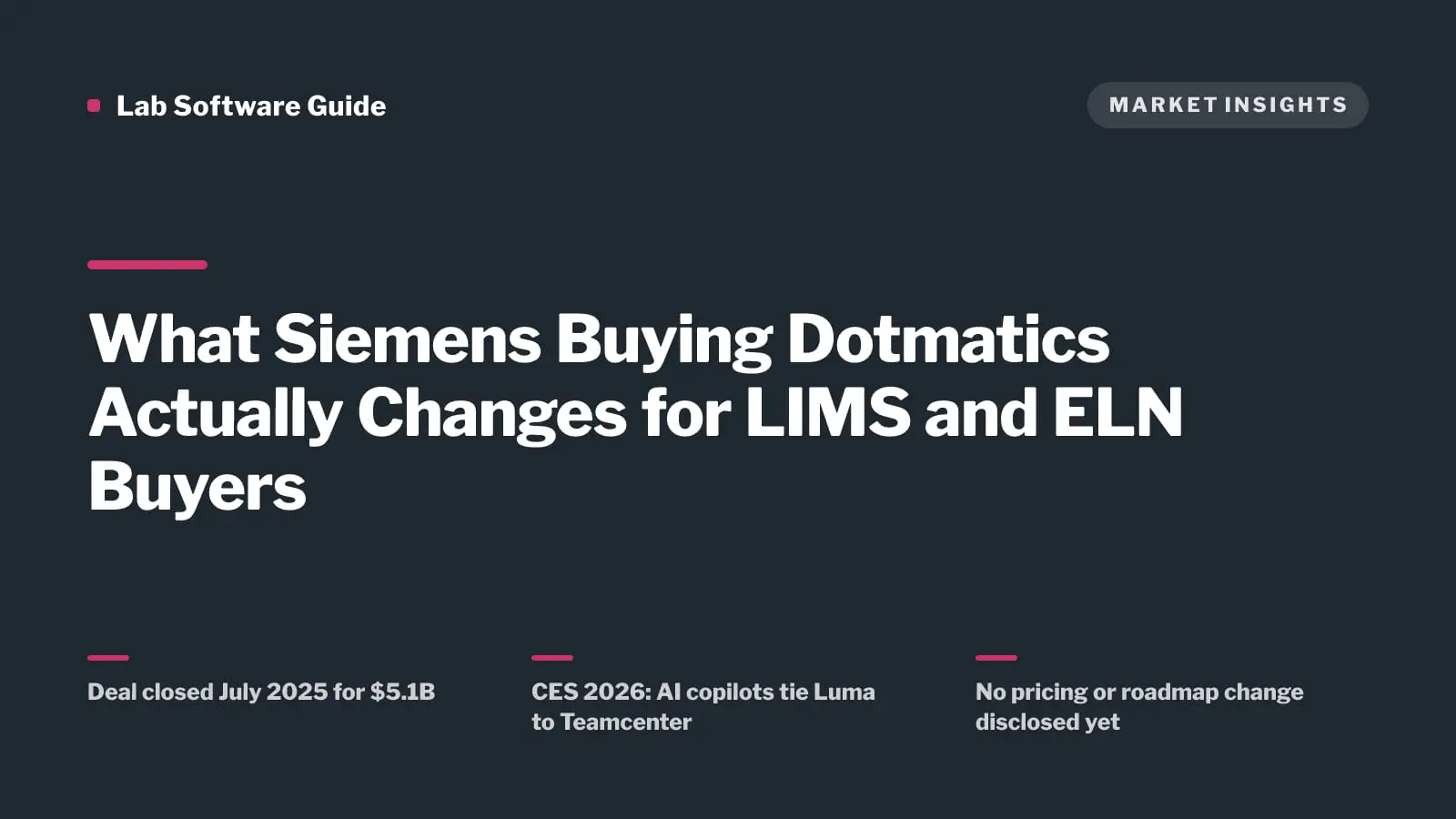
Siemens announced its acquisition of Dotmatics on April 2, 2025, and closed the deal on July 1, 2025, at an enterprise value of $5.1 billion, according to Siemens’ own press release. Dotmatics, whose portfolio spans an ELN, LIMS modules, and the Luma scientific data platform, moved from being owned by the private equity firm Insight Partners into Siemens’ Digital Industries Software business.
For over a year after closing, the acquisition mostly read as a balance-sheet story: Siemens paying up for a life-sciences R&D software company with, according to its own disclosures at the time of the deal, more than $300 million in expected fiscal 2025 revenue and an adjusted EBITDA margin above 40%. The part that matters to someone shopping for a LIMS or an ELN arrived later. At CES 2026 in January, Siemens said it would ship nine AI-powered copilots across its software lineup, including Teamcenter, Polarion and Opcenter, and tied that announcement explicitly to Dotmatics’ Luma platform as the layer that unifies lab and instrument data for those copilots to draw on. That is the first concrete, dated signal of what the acquisition is meant to produce in the product itself, rather than in an investor slide.
A year is a long gap between a deal closing and a product-level announcement, and it is worth sitting with why. Enterprise software acquisitions of this size usually take twelve to eighteen months before any customer-visible integration ships, because the acquiring company spends the first months on organizational integration, contract harmonization and technical due diligence before touching the product roadmap. Judged against that baseline, the CES 2026 announcement arrived on a fairly ordinary schedule, not early and not unusually delayed.
What this changes for a buyer evaluating LIMS or ELN software today
If you are choosing between Dotmatics and a competitor this quarter, the honest answer is: not much yet, with one exception worth checking directly with your sales rep.
| Question a buyer is asking | Where things stand |
|---|---|
| Is the Dotmatics ELN/LIMS product different today? | No announced feature changes tied to the acquisition itself as of this writing |
| Is pricing changing? | Not disclosed by either company |
| Is there a new integration story? | Yes: Luma is positioned as the data layer feeding Siemens’ Teamcenter, Polarion and Opcenter copilots, announced at CES 2026 |
| Does this matter outside the Siemens ecosystem? | Marginally, unless your lab already runs Siemens PLM or manufacturing software |
| Is there a published compliance or hosting change? | Not found in the sources reviewed for this article |
The one thread worth pulling is the Teamcenter, Polarion and Opcenter tie-in. Those are Siemens product lifecycle, application lifecycle and manufacturing operations systems, respectively, used mostly by device and pharma manufacturing organizations rather than by pure discovery-stage biotechs. Siemens describes the intent as connecting research data captured in Dotmatics through to production, which is a genuinely different pitch than what a standalone ELN vendor makes. A buyer who already runs Siemens manufacturing software has a reason to put Dotmatics higher on the shortlist than they might have a year ago. A buyer choosing an ELN purely for bench science, with no manufacturing handoff in view, gets little from this specific integration.
What to ask a Dotmatics sales rep right now
A few concrete questions separate a real answer from a slide deck, and it is reasonable to expect Dotmatics’ sales team to answer them directly rather than in general terms about the acquisition’s strategic rationale.
- Which specific Dotmatics modules feed into the Luma layer referenced in the CES 2026 announcement, and does that include the ELN and LIMS products specifically, or only certain data-capture tools.
- Is there a published or even a draft timeline for when a Teamcenter or Opcenter integration would be available to a customer that is not already running those Siemens products.
- Has anything in the support, hosting or compliance documentation (21 CFR Part 11, GDPR data residency) changed since the acquisition closed, and if not, is a change planned.
- For labs on a multi-year contract signed before July 2025, does the acquisition trigger any renegotiation clause, and will renewal pricing reference Siemens’ enterprise licensing structure or the prior Dotmatics terms.
None of these questions have public answers as of this writing, which is itself useful information: a vendor able to answer them clearly and specifically is further along in integration planning than the public record suggests, while one that reverts to talking points from the original press release probably is not.
How this fits the wider consolidation wave
Dotmatics landing inside Siemens is one entry in a longer pattern of ownership changes across lab software over the past several years, and it is not the first time a lab informatics vendor has changed hands into a much larger industrial or technology parent. STARLIMS, for comparison, has been owned by the private equity firm Francisco Partners since 2021, a financial rather than a strategic-industrial buyer, which is a materially different kind of owner than an industrial conglomerate like Siemens with its own manufacturing software stack to connect into. That distinction matters for buyers: a private-equity owner’s incentives usually center on margin and eventual resale, while an industrial owner like Siemens has a plausible product reason (its own PLM and manufacturing execution portfolio) to keep investing in the acquired product over a longer horizon, though intent and delivery are not the same thing.
What the two companies say, and what they don’t say
Siemens’ own materials describe the deal as extending an “AI-powered software portfolio” into life sciences and frame the medium-term goal as connecting “data from research through to production.” Siemens has also stated it expects revenue synergies of around $100 million per year in the medium term, rising to more than $500 million per year in the long term; these are Siemens’ own projected figures, not independently audited results, and neither company has published data showing the synergies materializing yet.
Dotmatics, for its part, has continued to publish product and blog content under its own name and brand, with no public statement indicating an end to Dotmatics as a distinct product line. That is worth noting because past life-sciences software acquisitions have sometimes led to product sunsetting or forced migrations within a few years; nothing in the sources reviewed here suggests that is planned, but nothing rules it out either, and buyers with multi-year contracts should ask the question directly rather than assume continuity.
Independent commentary has been more measured than either company’s own framing. Analysis from Everest Group frames the acquisition as a bet on connecting early R&D data to downstream manufacturing and clinical development, a genuine structural gap in life-sciences software today, while also noting that realizing that vision depends on execution that has not yet been demonstrated at scale.
The counter-argument: this may matter less than the price tag suggests
A $5.1 billion price tag invites the assumption that something big changes for everyone touched by the acquired product. That is not automatically true. Dotmatics was already a multi-product platform assembled from earlier acquisitions (including Labguru, Geneious and others over the preceding decade), so absorbing another owner is not a new experience for its engineering or support organization. The CES 2026 announcement itself was framed around Siemens’ broader AI copilot strategy across its whole software portfolio, with Dotmatics as one data source among several, not as the centerpiece. A lab evaluating an ELN today that has no plan to touch Siemens manufacturing software should weigh this acquisition mainly as a signal of financial backing and long-term investment, not as a reason to expect new lab-facing features imminently.
The real limitation in writing about this now is timing: Siemens closed the deal over a year ago, and the only product-level integration announcement to date is the January 2026 CES copilot lineup, which was described at a portfolio level rather than with a Dotmatics-specific roadmap or release date. Anyone telling you today exactly which Dotmatics features will change, and when, is speculating beyond what either company has published.
The bottom line
The acquisition is closed, the money is real, and the first concrete product signal, the Luma-to-Teamcenter/Polarion/Opcenter copilot integration announced at CES 2026, is more than a press-release promise because it names specific Siemens products rather than a vague “AI initiative.” For most labs shopping for an ELN or LIMS purely on bench-science criteria, that signal does not change the near-term evaluation, and the product you would sign a contract for today is functionally the same one Dotmatics was selling before the deal closed. For labs and manufacturers already inside the Siemens Xcelerator ecosystem, it is a legitimate reason to ask Dotmatics’ sales team for specifics rather than to assume nothing has changed, and to put a written answer to those questions into the contract rather than relying on a verbal assurance from a sales cycle. Our Dotmatics overview covers the product itself in more detail, and labs comparing options for discovery-stage work can start from our guide to the best drug discovery ELNs. We will revisit this analysis once Siemens or Dotmatics publishes a dated, product-specific roadmap rather than a portfolio-level announcement.
FAQ
When did Siemens finish acquiring Dotmatics?
Siemens announced the deal on April 2, 2025 and completed the acquisition on July 1, 2025, for an enterprise value of $5.1 billion, according to Siemens’ own press release.
Does Dotmatics still operate as a separate product line?
Yes, as of this writing Dotmatics products, including its ELN and LIMS modules, are sold under the Dotmatics name and now sit inside Siemens’ Digital Industries Software business rather than being merged into an existing Siemens product.
Will existing Dotmatics customers see pricing changes?
Neither company has published pricing changes tied to the acquisition. Existing contracts are unaffected in the short term, but buyers renewing multi-year agreements should ask directly whether Siemens’ enterprise licensing terms will apply at the next renewal.
Does this acquisition affect labs that are not in the Siemens ecosystem?
Not directly in the short term. The announced integration work, connecting Dotmatics’ Luma platform to Teamcenter, Polarion and Opcenter, is aimed at manufacturers already running Siemens PLM software. A standalone biotech lab with no Siemens footprint is unlikely to see any product change from this deal for now.
Sources
- Siemens completes acquisition of Dotmatics (accessed 2026-09-21)
- Siemens Unveils Technologies to Accelerate the Industrial AI Revolution at CES 2026 (accessed 2026-09-21)
- Dotmatics Acquired by Siemens for $5.1 Billion to Accelerate AI Innovation in Life Sciences (accessed 2026-09-21)
- What Siemens’ US$5.1 Billion Acquisition of Dotmatics Means for the Life Sciences Industry (accessed 2026-09-21)