
What Siemens Buying Dotmatics Actually Changes for LIMS and ELN Buyers
Siemens closed its $5.1B purchase of Dotmatics over a year ago. What actually changed for LIMS and ELN buyers, and what is still just a roadmap slide.
AI Agents in the Lab: Hype vs Reality (2026)
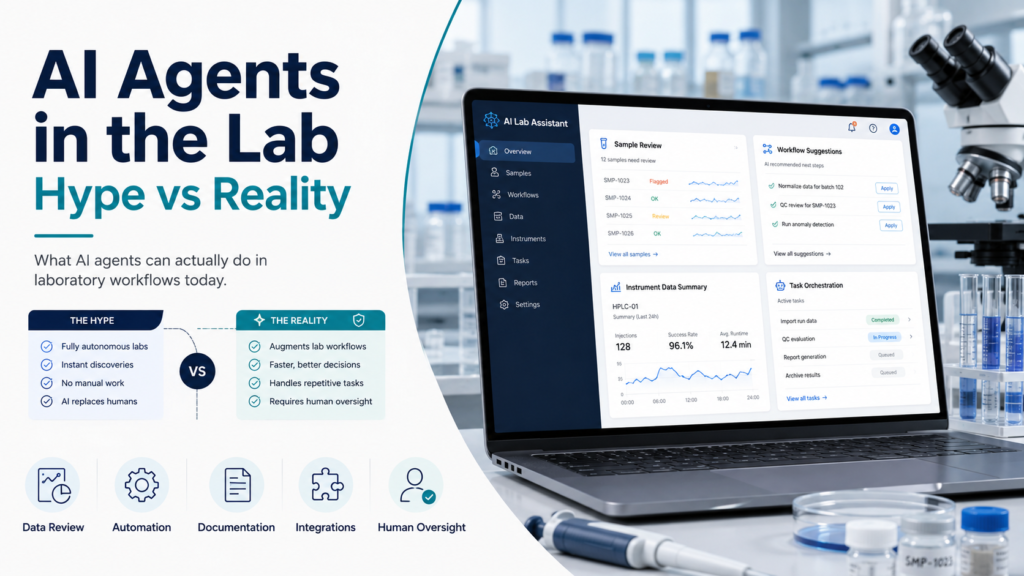
AI agents in laboratories are simultaneously more real and less transformative than the marketing suggests. Genuine autonomous systems have optimized real chemical reactions, run 17 days of unattended inorganic synthesis, and designed experimentally validated nanobodies — these are documented results, not demos. But the fully autonomous lab that picks its own questions and needs no scientists does not exist, and the enterprise track record is sobering: MIT’s Project NANDA found 95% of generative AI pilots deliver no measurable P&L impact, while Gartner projects over 40% of agentic AI projects will be cancelled by end of 2027. The gap between the two pictures isn’t model quality. It’s whether your data, workflows, and governance are ready for an agent to operate inside them. This guide separates what works from what’s being sold. Defining terms, because the vocabulary is doing a lot of work “AI agent” is used loosely enough that vendors and buyers frequently mean different things, and the ambiguity is commercially convenient. An AI assistant answers questions or drafts text when asked. An AI agent takes actions autonomously against a goal — monitoring, deciding, and executing without a human triggering each step. Agentic orchestration places multiple agents inside a controlled process framework with audit trails, approval steps, and defined decision boundaries. The distinction matters because most “agents” sold today are the first category wearing the second category’s name. Industry research is direct about this: 80% of IT leaders say most of their agents today are still limited to chatbots or assistants, and 48% operate in silos rather than inside end-to-end workflows. When a vendor demonstrates an “AI agent” for your lab, the first question is whether it acts or merely answers. What genuinely works today Set the scepticism aside for a moment, because the real results are substantial and worth knowing precisely. Autonomous experimentation has produced peer-reviewed results. An LLM-driven agent (Coscientist) optimised real chemical reactions. Berkeley’s A-Lab ran autonomous inorganic synthesis for 17 consecutive days. In 2025, the Virtual Lab’s AI agents designed nanobodies that were subsequently experimentally validated. These are not vendor case studies; they are published science. The common thread explains where autonomy succeeds: these work because the goal and the success signal are crisp. Where the objective is well-defined and the system can measure whether it succeeded, agents perform. That single condition is the most useful predictor of whether an agentic application will work in your lab. Operational agents are deployed in labs now, in less glamorous but more immediately valuable roles. Agents connected to LIMS, instruments and inventory systems can continuously monitor incoming samples, test orders, instrument availability and queue depth — automatically routing STAT samples to the fastest available instrument, batching routine samples for efficiency, and reordering queues as priorities shift, in real time without human intervention. This is sample-routing optimization, not scientific discovery, and it is precisely the kind of bounded, measurable task where agents earn their keep. Prediction and design loops are reducing wet-lab cost. A July 2026 paper (Hur & Lee, ICML AI-for-Science Workshop) targets what it calls the validation bottleneck with two mechanisms: a prior-aware experiment-design loop that proposes fewer but more informative next experiments, and a cost-aware surrogate that predicts expensive high-resolution measurements from cheap low-resolution ones, choosing between measurement types based on predicted uncertainty. The economic logic is compelling — spend fewer wet-lab rounds to reach the same answer. What doesn’t work — and what’s being oversold The autonomous lab that needs no scientists does not exist. What marketing often implies — a laboratory that picks its own questions — is not a current capability. Even the headline results were steered by humans, and in A-Lab’s case, the findings required correction after outside scrutiny. Autonomy still fails on open-ended judgment and ambiguous results, which is precisely where laboratory science spends most of its difficulty. The enterprise failure rate is the number nobody quotes in a demo. MIT’s Project NANDA study — based on 150 leader interviews, a 350-employee survey, and analysis of 300 public AI deployments — found approximately 95% of generative AI pilots deliver no measurable P&L return, with only about 5% capturing value at scale. Supporting data compounds the picture: S&P Global found 42% of companies abandoned most of their AI initiatives in 2025, up from 17% the prior year, and Gartner projects over 40% of agentic AI projects cancelled by end of 2027, citing escalating costs, unclear business value and inadequate risk controls. Critically, MIT traced the failure rate not to model quality but to a learning gap in how organizations put AI to work. The technology mostly isn’t the problem. Most labs aren’t structurally ready. A global study found 85% of organizations lack the process maturity needed to deploy agentic orchestration at scale. For laboratories, that translates into a specific near-term priority: standardizing data, workflows and system connections before agents can operate safely inside them. Business models are still shaking out. Strateos operated one of the earliest fully automated cloud labs and pivoted from the public “lab-as-a-service” model toward private on-premises deployments — a signal that remote-access shared robotic infrastructure faced commercial challenges at scale. The lesson isn’t that the infrastructure lacks value; it’s that labs want control over their physical infrastructure rather than a black-box service. The regulatory ceiling nobody mentions in the demo For any lab in a GMP environment, there is a hard constraint that overrides the entire capability discussion — and it is remarkably absent from vendor AI marketing. The EU’s draft Annex 22, published alongside the Annex 11 revision in July 2025, limits AI in GMP-critical applications to static, deterministic models. Dynamic models, generative AI and large language models are excluded from critical use. Read that against how laboratory software is currently marketed. A vendor’s generative AI feature may be genuinely useful for non-critical work — searching notebooks, drafting documentation, summarizing results — while being unusable for anything touching product quality or a release decision. When evaluating platforms, the question is not “does it have AI?” but “which AI
AI in Laboratory Software: What’s Actually Working in 2026
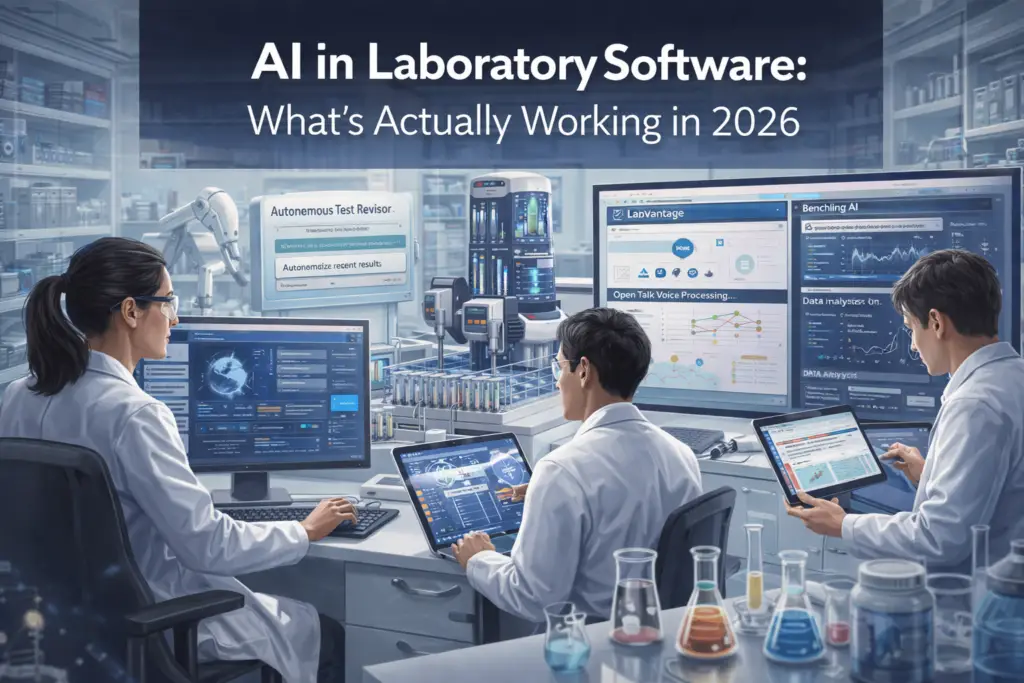
81%of pharma firms now deploy some form of AI in R&D 68%of AI initiatives fail due to poor data quality 14%annual increase in AI use across labs (Pistoia Alliance, 2024) The marketing is everywhere. Every LIMS and ELN vendor now claims to be ‘AI-powered.’ Conference keynotes promise autonomous laboratories that run experiments overnight without human oversight. Venture capital poured over $8 billion into AI-driven life sciences platforms in 2025 alone. And yet, when you ask laboratory scientists what AI is actually doing in their day-to-day work right now — the answer is usually more modest, more specific, and far more interesting than the headlines suggest. This article separates signal from noise. Based on current vendor implementations, peer-reviewed research, regulatory guidance published in 2025 and 2026, and industry surveys, here is an honest picture of where AI in laboratory software is genuinely delivering value today — and where the hype is still running ahead of the reality. The Honest Baseline: Where Labs Actually Stand in 2026 Before discussing what AI can do, it is worth establishing what most laboratories are actually working with. The data is instructive about the gap between ambition and readiness. According to the Pistoia Alliance’s Lab of the Future 2024 Global Survey, AI use across laboratories increased by 14% year-over-year — a significant adoption signal. But the same survey revealed that nearly 40% of respondents struggle to make their data FAIR (Findable, Accessible, Interoperable, and Reusable), with inconsistent metadata standards cited as the primary barrier to effective AI implementation. Cisco’s 2024 AI Readiness Index found that fewer than one in three organizations believe their current data infrastructure is prepared for AI at all. The most telling statistic comes from a broader technology survey: 68% of tech executives cite poor data quality and governance as the primary reason AI initiatives fail. In laboratory environments, this is not an abstract concern — it is the central operational challenge. A LIMS or ELN can only deliver AI-driven insights from the data it contains. If that data is inconsistent, incomplete, or poorly structured, the AI layer amplifies the problem rather than solving it. The single biggest predictor of AI success in a laboratory is not the sophistication of the AI layer — it is the quality of the data infrastructure underneath it.Labs that have invested in structured data capture, standardized metadata, and validated LIMS workflows consistently outperform those that attempt to layer AI onto fragmented, inconsistent data systems.Before evaluating AI features in any LIMS or ELN, the first question to ask is: is our data ready? What’s Actually Working: Five AI Applications Delivering Real Value 1. Intelligent Audit Trail Review and Anomaly Detection In regulated laboratories, audit trail review has historically been a manual, time-consuming quarterly process — exactly the kind of high-volume, pattern-recognition task where machine learning excels. Modern LIMS platforms are beginning to deploy ML models that flag anomalous access patterns, out-of-sequence entries, and statistical outliers in real time, rather than waiting for a monthly review cycle. The practical impact is significant. Traditional audit trail review is conducted monthly or quarterly and is inherently backward-looking — violations are discovered after the fact. AI-assisted review can flag a suspicious login pattern or an improbable sequence of result entries within minutes of it occurring. For regulated environments operating under 21 CFR Part 11 and ALCOA+ requirements, this shift from periodic to continuous monitoring is not just an efficiency gain — it is a meaningful improvement in data integrity posture. Platforms that implement this well integrate the anomaly detection directly into the existing audit trail infrastructure — not as a separate dashboard. Look for systems where AI flags are linked to the specific audit trail record and routable to a QMS deviation workflow. 2. Predictive Instrument Maintenance Instrument downtime is one of the most expensive and disruptive operational events in any laboratory. ML models trained on instrument telemetry data — oven temperatures, pump pressures, detector signal baselines, calibration drift patterns — can identify the early signatures of impending failures with enough lead time to schedule preventive maintenance before a breakdown occurs. This application works because the data is well-structured, high-frequency, and directly correlated with known failure modes. Unlike many AI applications in lab software that require complex data preparation, instrument telemetry is typically already captured in a structured numerical format. The models are relatively straightforward to train, and the ROI is measurable: a single avoided HPLC failure during a critical QC batch can justify months of implementation effort. 3. Automated Data Structuring in ELNs One of the persistent frustrations with traditional ELN adoption is that scientists use free-text fields to record information that should be structured — instrument parameters entered as prose, concentration values embedded in narrative notes, protocol deviations described in unformatted comments. This unstructured data is technically captured but practically unusable for downstream analysis or cross-experiment comparison. AI-assisted data structuring addresses this directly. Using natural language processing and large language models, modern ELN platforms can parse free-text entries and propose structured representations — extracting concentration values, reagent identities, and procedural steps into queryable fields. Benchling’s AI layer, launched in late 2025, includes agents specifically designed to clean and restructure legacy unstructured experiment data, making previously siloed historical records searchable and analytically useful. This is genuinely transformative for organizations with years of ELN data that was captured but never properly structured. A biotech with five years of protein expression experiments recorded in free-text ELN entries can, for the first time, run cross-experiment queries to identify which conditions correlate with the highest yields — without manually re-entering historical data. 4. Conversational Querying of Laboratory Data Natural language interfaces to laboratory data — the ability to ask ‘which batches failed pH specification in Q3?’ or ‘show me all stability samples due for testing this week’ in plain English — are moving from prototype to production in 2026. Rather than requiring analysts to construct complex database queries or navigate multi-level LIMS menu structures, conversational AI agents translate natural language questions into structured queries
Paper vs Electronic Lab Notebook: When to Switch and How to Do It Well
Quick verdict: Paper lab notebooks are still legally acceptable, including in regulated work, and they remain easy to use, cheap and hard to tamper with invisibly. Their limits appear as soon as a lab needs to find, share, reuse or protect its data at scale: records cannot be searched, instrument data lives in folders disconnected from the notebook, and a lost or damaged book cannot be restored. An electronic lab notebook (ELN) solves those problems, but introduces software costs, adoption effort and dependence on a system. For most research groups beyond a handful of people, switching is worth it. The part that decides success is the transition itself: a clear master record, workable devices at the bench, and firm rules for the paper-electronic overlap. Paper is not obsolete, and regulations do not ban it No major laboratory regulation requires electronic records. FDA’s GLP regulations, for example, describe how paper entries should be made: data recorded promptly and legibly in ink, each entry dated and signed or initialled, and changes made without obscuring the original entry, with the reason and the date (21 CFR 58.130(e)). A well-kept paper notebook that follows those rules is a valid record. Paper also has practical strengths that are easy to underestimate: A user study published in the Journal of Cheminformatics in 2017 (Kanza et al.) found that these qualities, together with the lack of suitable devices at the bench, were central to why many researchers kept using paper. Tools have improved since, but the findings still describe the objections labs raise today. Where paper breaks down The problems with paper are rarely about a single notebook. They appear across a group, over years. What an ELN changes An ELN keeps the notebook’s role, a chronological record of what was done and why, and adds: It also brings costs and risks that paper does not have: licences or hosting, time to configure templates and train users, dependence on a vendor or on internal IT, and the need to export records in usable formats if you change system. Our ELN pricing benchmark shows that entry-level commercial plans are relatively affordable and that free academic tiers and open-source options exist, so licence cost is rarely the main obstacle today. Adoption usually is. Compliance and evidence: how the two compare Paper notebook Electronic lab notebook Attribution Handwritten name, initials, signature User account, logged automatically Dating Written by the author System time stamp Changes Single strike-through, reason, date, initials Audit trail with old and new values, user, time, reason Signatures and witnessing Wet ink, needs physical access Electronic signatures; for FDA-regulated records, controls under 21 CFR Part 11 Backup None unless scanned Automatic, depending on hosting Main weakness Loss, illegibility, no search Weak configuration, shared accounts, poor export at exit On intellectual property, the picture is more nuanced than vendors suggest. Since the US moved to first-inventor-to-file in 2013, notebooks matter less for priority, but they still support inventorship, derivation disputes and prior user rights. Some IP practitioners, such as Palovich writing in ACS Medicinal Chemistry Letters (2014), have argued that paper can be easier to defend in court because judges and juries understand it and tampering is visible. An ELN can provide strong evidence, but only if audit trails, time stamps, signatures and access controls are properly configured. See ELN vs LIMS for the IP context and our ELN compliance guide for the controls that make electronic records credible. Why switches fail, and how to avoid it Most ELN projects that stall do so for practical reasons, not because of the software’s features. A practical transition plan Frequently asked questions Are paper lab notebooks still legally valid?Yes. Regulations such as FDA’s GLP rules describe how paper entries must be made, and paper remains acceptable when those rules are followed. Is an ELN better for patents?It can be, if audit trails, time stamps and signatures are properly configured. Some IP practitioners still consider paper easier to present as evidence, so organizations with high patent exposure should involve their IP counsel when choosing and configuring an ELN. Can we scan our old notebooks and throw them away?Only if your regulatory and institutional retention rules allow it and the scans qualify as verified true copies. In most research settings, archiving the originals and scanning selectively is the safer choice. How long does a switch take?For a research group, a pilot and roll-out can take a few months. Regulated deployments take longer because the ELN must be validated. What if our scientists refuse to use it?Resistance usually points to a practical problem: no device at the bench, poor templates or slow performance. Fix those before pushing adoption. The bottom line Paper notebooks are a legitimate record and still work for very small groups. Beyond that, their weaknesses in search, data linkage, backup and collaboration cost more than an ELN does. The decision to switch is usually easy to justify; the transition is where labs succeed or fail. Put devices at the bench, build templates with users, define the master record and end the hybrid period on a set date. This article is independent editorial content. No vendor paid for inclusion. Read how we review lab software. Sources
ELN vs LIMS: What’s the Difference?
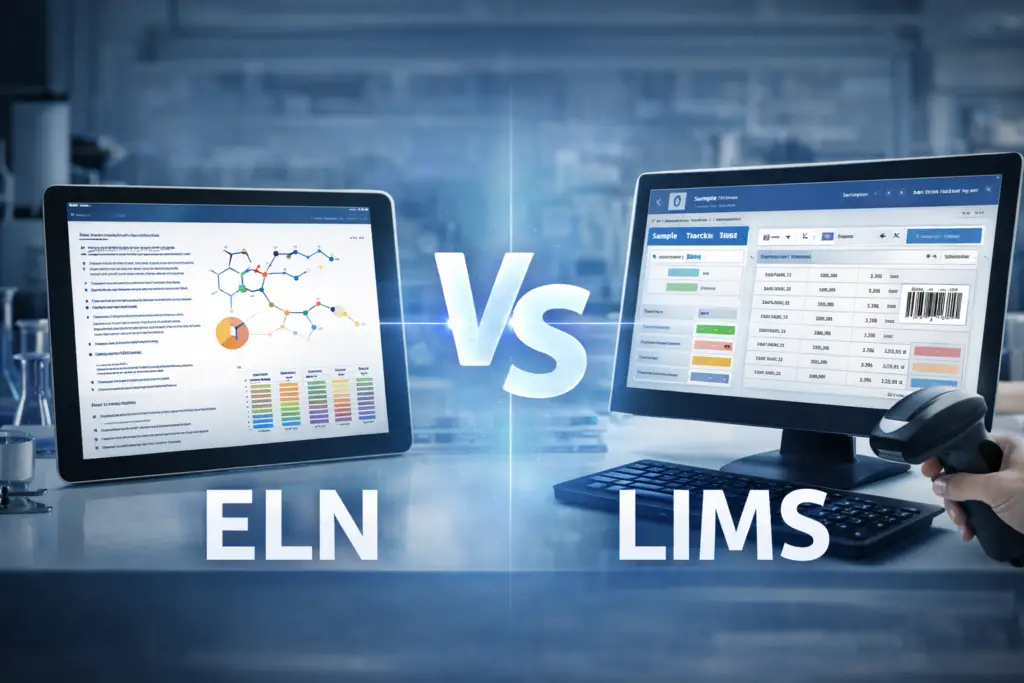
Quick verdict: A LIMS manages samples and the work done on them; an ELN manages experiments and the reasoning behind them. If your lab’s core output is a tested result delivered against a specification (QC, clinical, environmental or contract testing), you need a LIMS. If your core output is knowledge, such as a validated hypothesis, a new construct or a patent filing, you need an ELN. Many R&D organizations eventually need both, and a growing group of vendors now sell them as one platform. That convergence is useful, but it can hide the questions you should ask before buying. Why the distinction still matters Vendors increasingly describe themselves as “ELN + LIMS” or “unified lab platforms”, and several of the products we review do cover both. The difference still matters, for a practical reason: the two systems are built around different units of work. A LIMS is organized around the sample. Registration, tests, results, approvals and reports all hang off a sample record moving through a defined workflow. An ELN is organized around the experiment. The aim, protocol, observations, raw data and conclusions all hang off a notebook entry authored by a scientist. When a hybrid platform is strong on one model and thin on the other, you will feel it within weeks of go-live. Knowing which model your lab actually runs on is the first and most important step in any evaluation. ASTM’s reference guide for laboratory informatics (E1578-18) treats LIMS and ELN as distinct system types alongside LES, LIS, SDMS and CDS, for the same reason. What a LIMS does A Laboratory Information Management System manages the operational life of samples in a lab. Its job is to ensure that every sample is accounted for, tested according to the right method, and reported correctly. Typical LIMS capabilities: Where LIMS dominates: pharmaceutical and biotech QC, contract testing, environmental and food testing, and clinical labs (which often use a LIS for patient-facing diagnostics; see our clinical and diagnostic LIMS guide). The defining trait of a good LIMS is enforced structure: a technician cannot skip a step, enter a result outside the permitted sequence, or release a batch without the required approvals. That rigidity makes it valuable in regulated testing, and it frustrates research scientists who try to use it as a notebook. What an ELN does An Electronic Lab Notebook replaces the paper notebook, but its real value lies in making experimental work searchable, shareable and defensible. Typical ELN capabilities: Where ELN dominates: discovery research, academic labs, process development and early-stage R&D, where the workflow changes from one experiment to the next. The defining trait of a good ELN is structured flexibility: enough structure that data is findable and comparable later, without forcing scientists into a fixed sequence that does not match how research works. For the academic end of the market, see our comparison of the best ELNs for academic and research labs; for chemistry-heavy teams, our drug discovery ELN guide. ELN vs LIMS at a glance LIMS ELN Unit of work Sample Experiment Core question it answers “What happened to this sample, and is the result valid?” “What did we do, why, and what did we learn?” Workflow Predefined, enforced Flexible, author-driven Typical users Technicians, analysts, QA reviewers Research scientists, principal investigators Typical data Structured results against specifications Mixed: text, images, files, structured tables Primary compliance driver GxP, ISO/IEC 17025, 21 CFR Part 11 IP protection, reproducibility, and GxP when used in regulated development Implementation Months, configuration-heavy Weeks to months, lighter configuration Pricing pattern Opaque, often quote-based More transparent, frequent free/academic tiers Compliance: both can be compliant, for different reasons It is a common misconception that LIMS is “the compliant one” and ELN is “the flexible one”. Both system types can meet regulatory requirements; what differs is why compliance matters to the typical user. In a LIMS, compliance is the product. In GMP QC or accredited testing, results feed release decisions and client reports, so the system is expected to be validated and to meet the controls described in FDA’s 21 CFR Part 11: validation, access control, secure computer-generated time-stamped audit trails, operational and authority checks (§11.10), signature manifestations showing the signer’s name, date/time and meaning (§11.50), and signatures linked to their records (§11.70). In an ELN, compliance historically centered on intellectual property. Notebook records support inventorship and priority questions. The United States moved to a first-inventor-to-file system under the America Invents Act on 16 March 2013, which reduced the role of notebooks without eliminating it: records still matter for derivation proceedings, prior user rights and proving inventorship. Some IP practitioners also caution that electronic records can face more scrutiny in litigation than paper notebooks, so audit trails, time-stamping and signature controls in the ELN matter. When an ELN is used in regulated development (for example GLP studies or process development feeding a GMP filing), the same Part 11 and data integrity expectations apply as for a LIMS. Two practical consequences for buyers: Cost and implementation: the gap is real The two markets price very differently. Implementation follows the same pattern. A LIMS must be configured around your sample types, tests, specifications, instruments and reports; our LIMS implementation timeline guide documents projects ranging from about 6 weeks to 12 months or more. An ELN can often be rolled out to a research team much faster, because it imposes less structure up front. A regulated ELN deployment with validation, however, brings timelines closer to those of a LIMS. The trade-off: the cheaper, faster ELN is not a budget LIMS. Labs that try to run sample-driven testing in an ELN usually end up rebuilding chain of custody and approvals in templates and spreadsheets, which is where many LIMS projects start. Hybrid ELN-LIMS platforms: what they solve and what to check A growing share of the market sells ELN and LIMS capabilities in a single platform. Among the products we have reviewed: What a hybrid solves: one data model from experiment to sample, no integration to build and maintain between