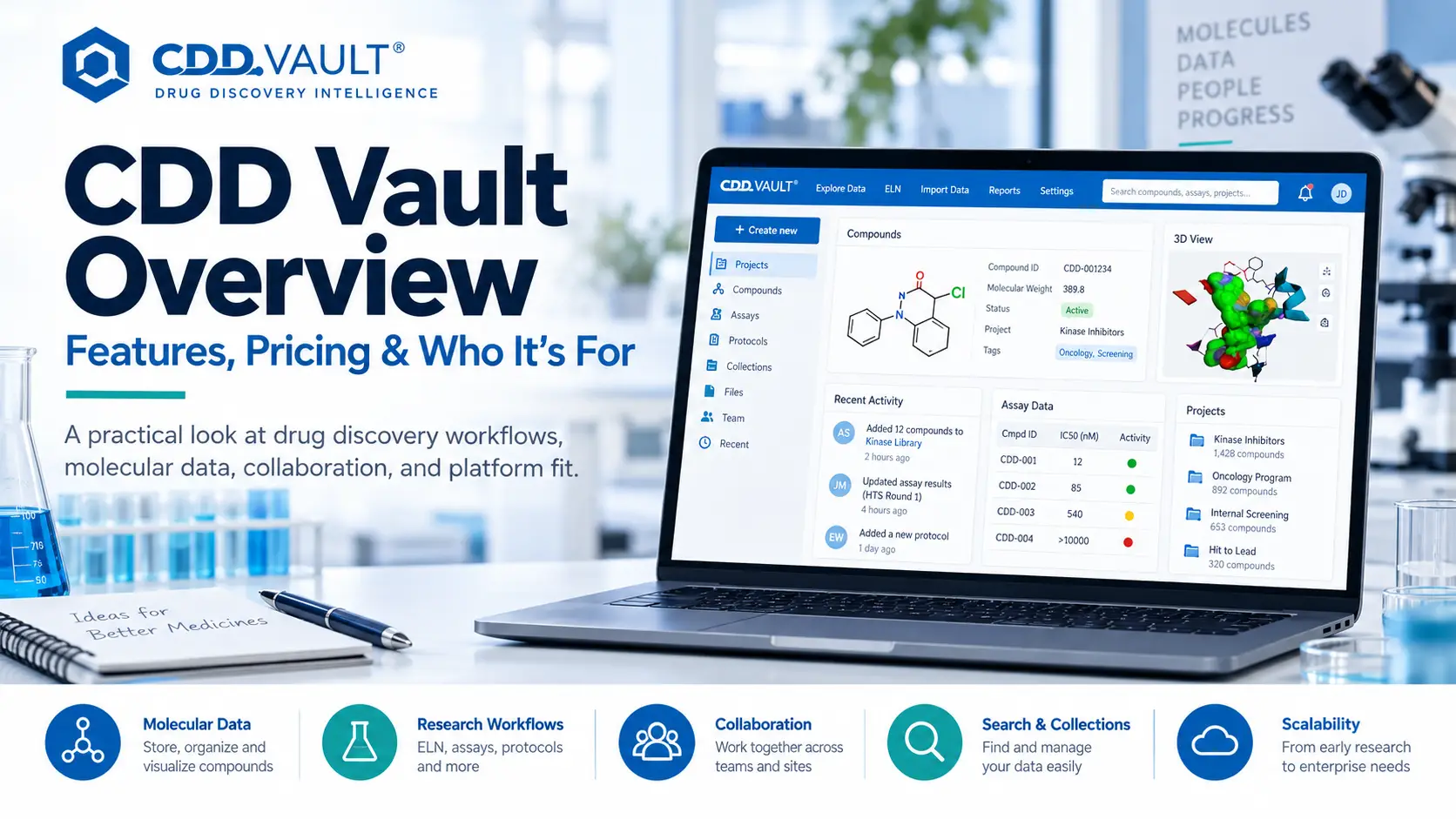
CDD Vault is the pragmatist’s drug discovery platform — a hosted, modular informatics system covering chemical registration, bioassay data management, SAR analysis, ELN and inventory, built around being genuinely usable by both chemists and biologists from day one. Its defining advantages are speed and cost: reviewers report deployments live within days to a week, and “the price” appears repeatedly as the stated reason for choosing it. The trade-offs are equally clear — graphing capability that sends users back to GraphPad Prism, and sample-lifecycle depth that stops at compound inventory rather than full LIMS coverage.
Best for: small-to-mid-sized discovery teams, biotech startups, academic drug discovery labs, and distributed collaborations that need chemistry–biology data unified without an enterprise implementation project.
Consider alternatives if: you need enterprise-scale governance across many sites, full LIMS sample lifecycle management, or publication-grade graphing inside the platform.
What CDD Vault is
CDD Vault is the flagship product of Collaborative Drug Discovery, founded in 2004 and based in Burlingame, California — making it one of the longer-established independents in discovery informatics, and notably still independent in a market that has consolidated heavily.
The platform is a comprehensive SaaS database and informatics system for drug discovery data, hosted through a web interface, letting multidisciplinary project teams securely manage, analyze and collaborate on chemical and biological data. It serves scientists at academic institutions and biotech or pharmaceutical companies, including collaborative projects spanning both — and extends beyond pure drug discovery into agritechnology, formulation and other research-intensive environments.
Its positioning is deliberately different from the enterprise platforms: rather than a governed system of record requiring workflow modelling and a deployment project, CDD Vault aims to be adopted quickly and cheaply by teams that need industrial-grade data management without industrial-grade overhead.
Modules and capabilities
CDD Vault is sold modularly, which matters for both cost and fit. The core components:
Activity & Registration — the chemical registration and assay data backbone, described as a modern web application for chemical registration, assay data management and SAR analysis. The registration system handles both small molecule and biologics data from lab experiments.
Electronic Lab Notebook — integrated directly with the chemical and biological assay data repositories and the analysis environment, allowing teams to archive and search experiments and collaborate securely. Users can document research using text, images, tables and files, and design custom ELN forms.
Visualization — a dynamic analysis tool for plotting and analyzing large datasets to find patterns, activity hotspots and outliers. Teams can search experiments and results in a SAR table, filter substructures to detect patterns, and measure result quality through heatmap visualizations or plate statistics.
Inventory — compound and reagent tracking, letting supervisors maintain compound details, pre-order compounds, allocate resources and track location using barcodes, with visibility across in-house and externally shared stock.
APIs and hosting — a fully documented API and secure online hosting, with data flowing between ELN, database, built-in analytics and integrated third-party tools.
Additional capabilities reported include curve analytics, workflow automation, AI features, access controls and permissions, audit management, electronic signature and secure data storage. For what regulated environments require of these, see our 21 CFR Part 11 explainer.
Strengths
Speed to value — the standout differentiator
This is where CDD Vault separates itself most sharply from enterprise alternatives. Independent evaluation rates CDD Vault 4.7 out of 5 on implementation services and domain expertise, with users reporting fast time-to-value and deployments often live within days to a week. The vendor’s own framing — that no implementation is needed — is broadly corroborated by an academic user who described the system as easy, flexible and intuitive, requiring nearly zero maintenance.
Set that against the enterprise discovery platforms, where reviewers consistently report lengthy setup and heavy coordination, and the contrast defines who each product serves. Our implementation timeline guide covers why this gap matters so much in practice.
Cost-effectiveness
Affordability is the most consistently cited reason users choose CDD Vault. One reviewer’s stated reason for choosing the platform was simply “The price!” Another, who had experience with Daylight, Modgraph, CambridgeSoft, Dotmatics and ChemAxon, returned to CDD when joining a new startup, citing a very cost-effective, easily customizable and quick way to store, review and retrieve data. An academic user described it as a cost-effective way to recapitulate industrial-style databases in a smaller environment.
Genuine chemistry–biology usability
The platform’s central claim — that chemists and biologists can both work in it daily — holds up in user accounts. A biologist who brought CDD Vault into a new discovery programme described it as enabling easy data-sharing between chemistry and biology so cross-discipline discussions become clear and productive, with screening data from raw or normalized plate formats linked to compound structures and computed properties making sorting and ranking straightforward. Another reviewer confirmed it serves both biologists and medicinal chemists, and that integration with external resources such as PDB and chemogenomics databases assists in first-step hit characterization.
Support quality
Support emerges as an unusually strong theme. One reviewer wrote that the support team deserves 13 out of 10 stars, calling it among the best they had received; another described technical support as astonishingly fast and helpful. Independent evaluation notes that the support team includes scientists who understand the domain — a meaningful distinction from generic software support.
External collaboration
The platform is built for distributed research teams collaborating securely in real time, with flexible controls for sharing data with internal teams and external partners. For academic groups and virtual biotechs coordinating with CROs and collaborators worldwide, this is a core capability rather than a feature.
Limitations
Graphing is the most consistent complaint. Several reviewers cite limitations in graph customization versus tools like GraphPad Prism. One user was explicit: they like the customizability and the optional ELN, but find the graphs non-adjustable, so figures for papers and grants still go through Prism. This is a workflow friction rather than a functional gap, but plan for a separate graphing tool in your stack.
Sample lifecycle depth stops at compound inventory. Some users want broader LIMS-style sample lifecycle depth beyond compound inventory tracking. If your needs extend into full sample management, chain of custody and workflow-driven testing, this is a genuine boundary — see our ELN vs LIMS explainer for where that line falls.
Documentation gaps on advanced features. A minority of feedback notes documentation gaps for advanced features and integration scenarios, and one reviewer suggested advanced features could use more detailed guides for new-user adoption.
Performance with very large datasets. One reviewer noted that loading large datasets occasionally takes time and the system can slow down.
Integration with existing systems can be challenging, according to third-party assessment — worth probing against your specific instrument and software stack.
No mobile app, noted as a wish by a reviewer who wanted quick lookups while travelling or in meetings.
AI and automation readiness is mid-range. Independent scoring rates CDD Vault 4.3 out of 5 on whether its data structure and governance realistically support automation, copilots and predictive analytics — respectable, but not a leader. Our AI agents in the lab analysis covers how to evaluate such claims generally.
Pricing
CDD Vault does not publish list pricing; the starting price is not disclosed and quotes come via a sales conversation. The platform is modular and scales with project teams, and a free trial is available — unusual in this segment and genuinely useful for evaluation.
One nuance deserves attention because it complicates the “affordable” reputation. Independent evaluation notes that pricing and module fit work well for biotech startups but can feel heavy for small academic groups, and that smaller academic teams may find total cost higher than lightweight spreadsheet workflows. That sits in tension with academic users praising cost-effectiveness — the likely reconciliation being that CDD Vault is excellent value relative to industrial platforms while still representing real spend relative to spreadsheets. Which comparison applies depends on what you’re replacing. Our spreadsheets vs LIMS guide covers that decision, and our ELN pricing benchmark the wider market.
Practical advice: because the platform is modular, ask specifically which modules you need versus which are bundled, and get a quote scoped to your actual usage rather than a full-platform figure.
Who it’s for
Strong fit: biotech startups and small-to-mid discovery teams needing industrial-grade data management without an implementation project; academic drug discovery labs wanting industrial-style databases at accessible cost; distributed collaborations sharing data with external partners and CROs; organizations replacing spreadsheets for chemistry and assay data; teams where both chemists and biologists need daily access to the same system.
Poor fit: enterprise organizations needing multi-site governance and deep workflow modelling; labs requiring full LIMS sample lifecycle management; teams needing publication-quality graphing natively; groups whose primary need is instrument-centric testing rather than discovery data.
Alternatives worth evaluating
Dotmatics is the enterprise counterpart — far broader, unifying chemistry, biology and assay data across a large application portfolio, but with substantially heavier deployment. It is the right comparison when organizational scale justifies the investment; see our Dotmatics overview.
Benchling is stronger for biologics and molecular-biology-centric R&D with best-in-class sequence tooling, though commercial pricing is significantly higher — see our Benchling overview.
Revvity Signals and IDBS E-WorkBook serve the regulated pharma enterprise tier, and Sapio Sciences offers a low-code alternative — see our Sapio Sciences review.
For the full landscape, our best drug discovery ELN guide maps platforms by the chemistry-native versus biology-native divide.
The bottom line
CDD Vault occupies a position few competitors contest directly: real discovery informatics — registration, SAR, bioassay management, ELN — delivered fast enough to be live in a week and cheap enough that price is the stated reason people choose it. For a biotech startup or academic discovery group, that combination is genuinely hard to beat, and the consistently exceptional support reinforces it.
What you give up is breadth. Graphing sends you elsewhere, sample management stops at compounds, and enterprise-scale governance isn’t the design goal. Those are coherent trade-offs rather than oversights — CDD Vault is built for teams that want to get working, not teams that want to model an organization. Know which you are, and the fit is usually obvious.
Where to go next
For the wider discovery landscape, see our best drug discovery ELN guide. For category framing, our ELN vs LIMS explainer and how to choose an ELN checklist. For budgeting, our ELN pricing benchmark.
This overview reflects publicly available information as of August 2026. Pricing, modules and capabilities change; confirm all details directly with the vendor before purchase. LabSoftwareGuide is an independent editorial resource and is not affiliated with Collaborative Drug Discovery.
Sources
- G2 — CDD Vault Reviews 2026 (module list, verified user accounts, platform description): https://www.g2.com/products/cdd-vault/reviews
- Capterra — CDD Vault Reviews and Pricing 2026 (capabilities, target users, training options, verified reviews): https://www.capterra.com/p/171280/CDD-Vault/
- Capterra — CDD Vault Reviews (earlier verified reviews: pricing as reason for choosing, support quality, cross-discipline use): https://www.capterra.com/p/235653/CDD-Vault/reviews/
- Software Advice — CDD Vault Profile and Reviews (inventory module detail, academic user account, dataset performance note): https://www.softwareadvice.com/medical-lab/cdd-vault-profile/
- RFP.wiki — CDD Vault Reviews, Life Sciences Software (implementation scoring 4.7/5, AI readiness 4.3/5, academic pricing nuance, graphing and LIMS-depth limitations): https://www.rfp.wiki/specialty-industries/healthcare-life-sciences/life-sciences-software/cdd-vault
- CB Insights — Collaborative Drug Discovery company profile (founding date, location): https://www.cbinsights.com/compare/collaborative-drug-discovery-vs-perkinelmer-informatics
- Global Laboratory eTools — CDD Vault (API, ecosystem, small molecule and biologics registration): https://www.lab-etools.org/etool/cdd-vault/
- SpotSaaS — CDD Vault Reviews, Features, Pricing (third-party limitation assessment): https://www.spotsaas.com/product/cdd-vault