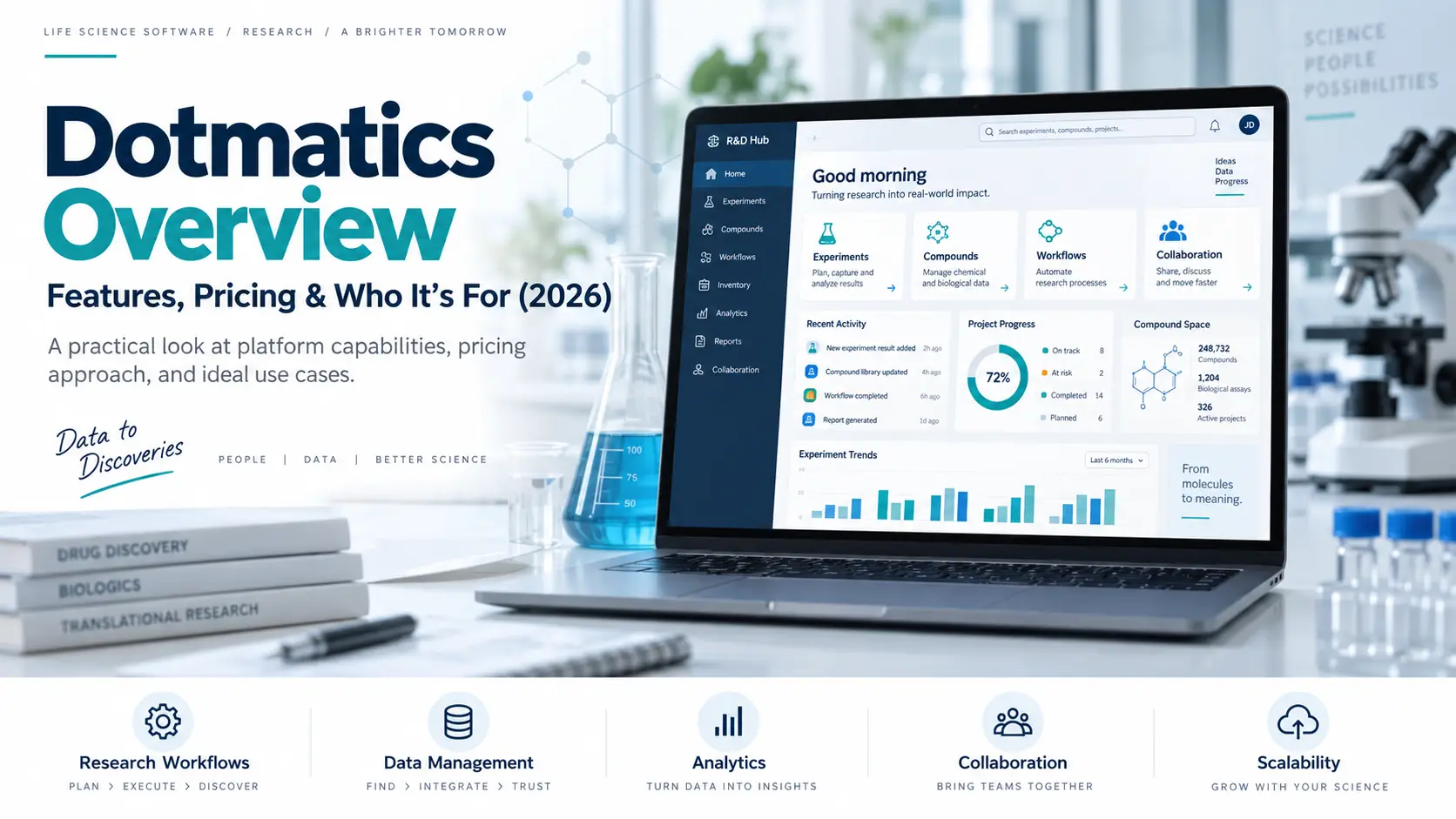
Dotmatics is one of the most complete integrated discovery informatics platform on the market — an ELN, compound and biologics registration, assay data management, and analytics layer, wrapped around a portfolio of applications most scientists already use daily, including GraphPad Prism, SnapGene and Geneious. Its genuine strength is unifying chemistry and biology on one backbone. Its genuine cost is deployment weight: reviewers consistently report lengthy setup and heavy coordination. And the defining fact of 2026 is that Dotmatics is no longer a private-equity-backed independent — Siemens acquired it for $5.1 billion, a change that brings scale and raises questions every prospective buyer should ask.
Best for: large discovery organizations, biopharma, CRO/CDMOs and industrial R&D running both chemistry and biology programmes that need a single governed system of record.
Consider alternatives if: you’re a small lab wanting a notebook-first tool, you need fast time-to-value, or your workflows are instrument-centric rather than discovery-centric.
What Dotmatics is
Dotmatics is a scientific R&D platform combining an electronic lab notebook, sample and sequence registration, inventory management, workflow automation, and scientific data search and analytics in one connected system. It targets biopharma, CRO/CDMOs and industrial R&D, positioning itself as a replacement for disconnected point tools and spreadsheets with a governed system of record.
What distinguishes it from most ELN vendors is that Dotmatics is not really one product. It is an enterprise platform plus a portfolio of well-known scientific applications assembled through acquisition — a structure that has both compounding advantages and integration challenges.
The portfolio: what’s actually included
Understanding Dotmatics means understanding its constituent parts, because buyers frequently already own several of them.
The platform layer. The ELN & Data Discovery Platform is the core notebook and registration environment, with centralized registration and inventory. Luma, released in October 2023, is the newer AI-native multimodal scientific intelligence platform — a low-code SaaS layer that aggregates data across instruments and software into clean data structures for AI and ML analysis, bringing together instrument outputs, application data and enterprise sources for analysis across biology, chemistry and materials.
Cheminformatics. Vortex handles chemical data visualization and analysis, supporting the structure-centric workflows that small-molecule discovery depends on.
The applications. This is where Dotmatics’ reach becomes unusual:
- GraphPad Prism — statistics and graphing, acquired March 2021, near-ubiquitous in life sciences
- SnapGene — cloning planning and visualization, acquired July 2019, described as the world’s most popular cloning tool
- Geneious Prime and Geneious Biologics — DNA analysis and visualization
- Protein Metrics (Byos) — mass-spectrometry protein analysis
- LabArchives — a separate ELN, widely used in academia
- OMIQ, FCS Express, EasyPanel — flow cytometry analysis and panel design
- SoftGenetics, nQuery, Cytapex, De Novo, M-Star — variant analysis, trial design and modelling
The strategic logic is integration: connecting Prism outputs, Geneious sequence work and flow cytometry data into the Luma platform so results flow into a single governed environment rather than living in silos. In practice, that integration has been delivered progressively rather than all at once, and how complete it is for your specific combination of tools is a fair demo question.
Core capabilities for discovery
Compound and biologics registration. Dotmatics spans ELN, BioRegister, compound registration and assay data management — the registration backbone that turns informal chemistry into an institutional asset. Our drug discovery ELN guide explains why this matters more than most feature comparisons suggest.
Chemistry–biology unification. Independent review synthesis credits Dotmatics specifically with unifying chemistry, biology and assay data on one backbone — the capability that separates genuine discovery platforms from biology-first notebooks.
Compliance and governance. Role-based permissions, audit trails and compliance-ready controls support regulated workflows, with flexible integrations to existing lab and enterprise systems. Dotmatics has also pursued FedRAMP certification for its ELN, relevant for government laboratories and a signal of enterprise security posture. For what regulated environments require, see our 21 CFR Part 11 explainer and LIMS validation guide.
Traceability. Scientists can plan and capture experiments, track materials with full chain of custody, and connect results to the right samples, sequences and studies so prior work is findable and reusable.
The Siemens acquisition: what buyers should know
This is the most consequential development in Dotmatics’ history and deserves direct treatment rather than a footnote.
What happened. Siemens announced on 2 April 2025 that it would acquire Dotmatics for $5.1 billion from Insight Partners, and announced completion on 1 July 2025. Dotmatics joined Siemens’ Digital Industries Software business, extending the Siemens Xcelerator portfolio into life sciences.
The scale behind the price. Dotmatics was expected to generate more than $300 million in revenue in fiscal 2025, described as highly profitable and cash generative with an adjusted EBITDA margin above 40% and mid-teens revenue growth. Siemens projected revenue synergies of around $100 million per year in the medium term, accelerating to over $500 million long-term, and valued the expanded addressable market at $11 billion.
The strategic thesis. Siemens’ stated aim is a first-of-its-kind end-to-end digital thread connecting research data through to production — combining Dotmatics’ scientific platform with Siemens’ digital twin and manufacturing capabilities. For organizations that take molecules from discovery into manufacturing, that vision is genuinely differentiated.
The history behind it. Dotmatics reached this point through sustained consolidation. Insight Partners first invested in 2017; Insightful Science acquired Dotmatics in March 2021 in a deal valued at up to $690 million; the combined entity rebranded as Dotmatics in April 2022; and Insight Partners supported 14 strategic acquisitions across that period. By 2022 the company reported more than two million scientists and 10,000 customers.
The honest questions for a buyer. Ownership changes of this magnitude affect roadmaps, pricing and support models, and it is legitimate to ask about them directly. Reasonable questions for a sales conversation: how has product roadmap prioritization changed under Siemens; what happens to standalone application licensing (Prism, SnapGene, Geneious) versus platform bundling; whether pricing models are being revised; and how the Siemens integration affects support structures. None of these have publicly known answers, and a vendor who engages with them candidly tells you something useful. Our migration guide covers what vendor changes mean for existing customers.
Strengths
Genuine chemistry–biology integration, which few competitors match at this depth — the core reason Dotmatics appears on discovery shortlists.
Application portfolio reach. Owning Prism, SnapGene and Geneious means Dotmatics is already inside most discovery organizations before any platform conversation begins, and the integration path is shorter than adopting an unfamiliar ecosystem.
Strong configurability once workflows are modelled, according to independent review synthesis, with approachable day-to-day usability relative to legacy enterprise LIMS suites — a meaningful distinction from older enterprise platforms.
Breadth across ELN, registration and assay modules in one governed environment.
Enterprise and regulatory posture, including FedRAMP pursuit and compliance-ready controls.
Limitations
Deployment weight is the recurring theme. Reviewers report lengthy initial setup and slow onboarding with heavy coordination during enterprise deployment. This is not a defect so much as the cost of breadth, but it must be budgeted realistically — see our implementation timeline guide for what enterprise deployments actually take.
Search and advanced query capabilities lag top instrument-centric LIMS competitors, according to the same independent synthesis.
Integration friction with certain external systems is reported, notably clinical LIS tools — relevant if your organization spans discovery and clinical operations. Our clinical and diagnostic labs guide covers that boundary.
Not sized for small labs. The platform fits large discovery organizations well, while smaller labs may prefer simpler notebook-first tools. A five-person startup will find the platform’s governance and configuration capabilities largely unused overhead.
Technical expertise required. A competitor analysis argues Dotmatics may require more customization and technical expertise to fully leverage its capabilities, and that its interface may not be as intuitive as newer alternatives. That assessment comes from a direct competitor and should be weighed accordingly, but it is broadly consistent with the independent onboarding findings.
Pricing
Dotmatics does not publish list pricing, which is standard at the enterprise end of this market. Third-party estimates place enterprise chemical data management platforms in this tier at $50,000+ annually, varying by modules, users and deployment model, with the same source noting that enterprise pricing can be prohibitive for smaller organizations.
Practical guidance: ask specifically what is included in the platform licence versus billed as separate application licences, since your organization may already be paying for Prism or SnapGene independently. Ask where the price steps up as you add modules or users. And ask what implementation and professional services will cost, given the deployment weight described above. Our ELN pricing benchmark and LIMS pricing benchmark cover how opaque this market is generally.
Who it’s for
Strong fit: large biopharma and discovery organizations running parallel chemistry and biology programmes; CRO/CDMOs needing governed, multi-client data management; industrial R&D in chemicals and materials; organizations already standardized on Prism, SnapGene or Geneious wanting to consolidate; teams whose pipeline runs from discovery into manufacturing, where the Siemens digital thread thesis may pay off.
Poor fit: small labs and early-stage biotechs wanting fast setup and minimal administration; teams needing time-to-value in weeks rather than quarters; instrument-centric testing operations better served by a dedicated LIMS; organizations without the internal capacity to model workflows and coordinate an enterprise deployment.
Alternatives worth evaluating
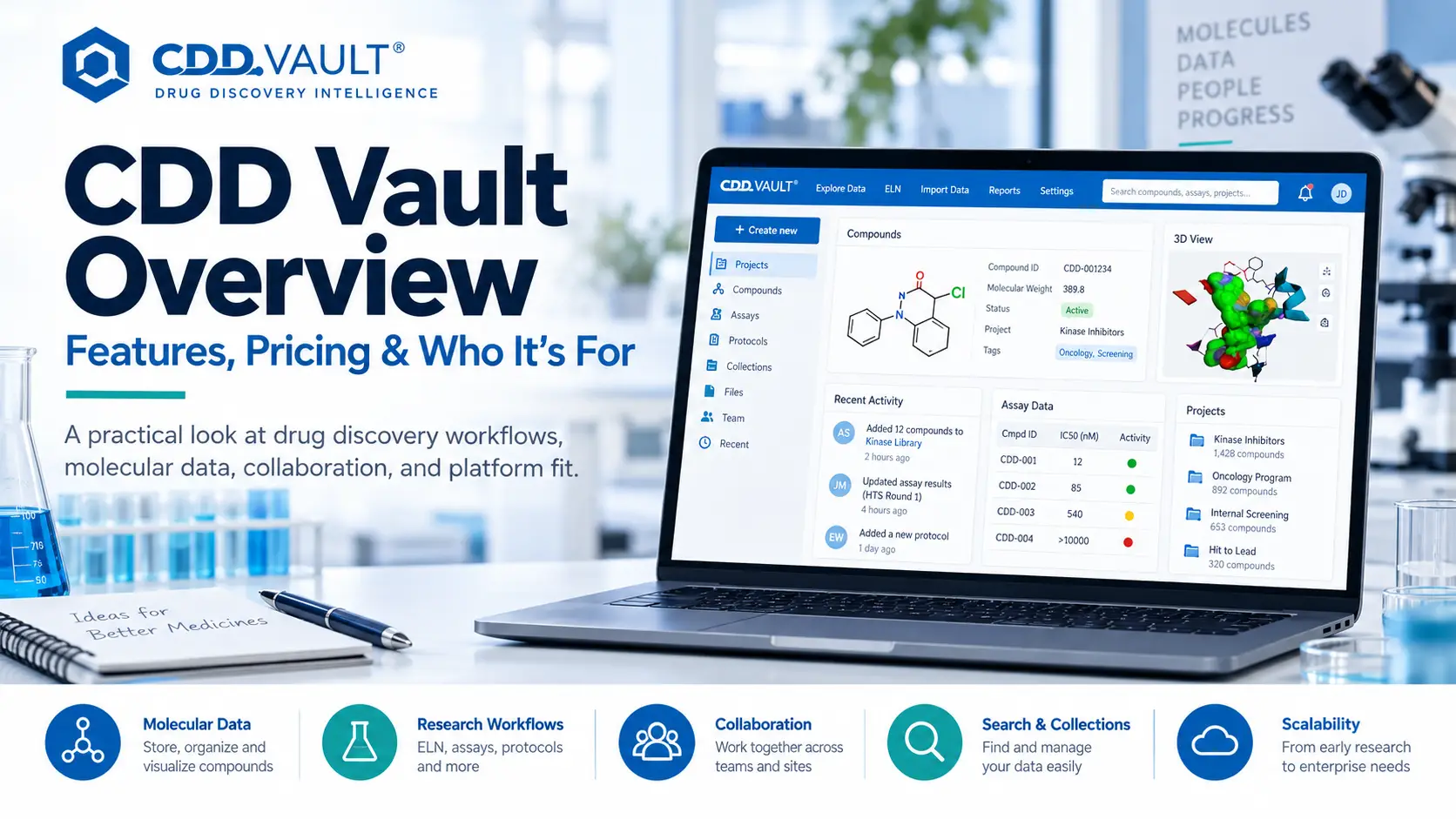
CDD Vault is the natural comparison for chemistry-native discovery at lower cost and faster deployment — users consistently cite cost-effectiveness and speed to value, making it the sensible alternative for smaller discovery teams.
Benchling is stronger for biologics and molecular-biology-centric R&D, with best-in-class sequence tooling, though its chemistry support is lighter for small molecules — see our Benchling overview and Benchling vs Genemod comparison.
Revvity Signals and IDBS E-WorkBook compete at the regulated pharma enterprise tier.
Sapio Sciences offers a low-code, AI-forward alternative with lighter deployment weight — see our Sapio Sciences review.
The bottom line
Dotmatics is the platform to evaluate when your organization is large enough to need governed chemistry–biology unification and prepared to invest in the deployment it requires. Its portfolio reach is a genuine structural advantage that no competitor replicates, and the independent verdict — strong integration and configurability, offset by lengthy setup and coordination burden — is consistent enough to plan around.
The Siemens acquisition is the open variable. It brings scale, financial stability and an ambitious discovery-to-manufacturing thesis. It also brings the uncertainty that follows any change of this size. Buyers evaluating Dotmatics in 2026 should treat roadmap, licensing and support continuity as explicit diligence items rather than assuming the platform they see in the demo is the platform they’ll have in three years.
Where to go next
For the wider discovery landscape, see our best drug discovery ELN guide. For category framing, our ELN vs LIMS explainer and how to choose an ELN checklist. For deployment planning, our implementation timeline guide.
This overview reflects publicly available information as of August 2026. Pricing, capabilities, product roadmap and ownership arrangements change; confirm all details directly with the vendor before purchase. Some cited assessments are authored by competing vendors and are flagged as such. LabSoftwareGuide is an independent editorial resource and is not affiliated with Dotmatics or Siemens.
Sources
Primary and corporate
- Siemens — Siemens acquires Dotmatics (announcement, 2 April 2025; financials, synergies): https://press.siemens.com/global/en/pressrelease/siemens-acquires-dotmatics-extend-ai-powered-software-portfolio-life-sciences
- Siemens — Siemens completes acquisition of Dotmatics (1 July 2025): https://press.siemens.com/global/en/pressrelease/siemens-completes-acquisition-dotmatics
- Dotmatics — Dotmatics Acquired by Siemens for $5.1 Billion (Insight Partners, 14 acquisitions): https://www.dotmatics.com/news/dotmatics-acquired-by-siemens-ai-life-sciences
- Dotmatics — Product Portfolio: https://www.dotmatics.com/portfolio
- Dotmatics — Set to Transform the Future of Scientific Software (2022 rebrand, scale figures): https://www.dotmatics.com/news/dotmatics-previously-insightful-science-set-to-transform-the-future
Independent analysis
- G2 — Dotmatics Reviews 2026 (platform scope, Luma data layer): https://www.g2.com/products/dotmatics-dotmatics/reviews
- RFP.wiki — CDD Vault Alternatives and Competitors (independent review synthesis: strengths and onboarding findings): https://www.rfp.wiki/specialty-industries/healthcare-life-sciences/life-sciences-software/cdd-vault/alternatives-and-competitors
- IntuitionLabs — Dotmatics Platform & AI Integration in Lab Informatics (acquisition history, FedRAMP, application portfolio): https://intuitionlabs.ai/articles/dotmatics-platform-ai-integration-lab-informatics
- Pharmaceutical Technology — Siemens Acquires Dotmatics (rebrand history, strategic context): https://www.pharmtech.com/view/siemens-acquires-dotmatics-extending-ai-software-portfolio-into-life-sciences
- Dealroom — Dotmatics Joins Siemens (Insightful Science acquisition, $690M valuation): https://app.dealroom.co/news/note/dotmatics-joins-siemens-bridging-scientific-research-and-industrial-software
- Wikipedia — Dotmatics (portfolio list, Luma launch date, acquisition timeline): https://en.wikipedia.org/wiki/Dotmatics
- Gitnux — Top 10 Best Chemical Data Management Software of 2026 (enterprise pricing indication): https://gitnux.org/best/chemical-data-management-software/
Vendor-authored (labelled)
- Scispot — A Comprehensive Guide to Finding the Best ELN and LIMS for Drug Discovery (competitor assessment): https://www.scispot.com/blog/a-comprehensive-guide-to-finding-the-best-eln-and-lims-for-drug-discovery