Scispot is a cloud-based laboratory informatics platform founded in 2020 by Guru Singh and Satya Singh in Kitchener, Ontario, Canada. The company’s founding insight, as described by co-founder Satya Singh in a GeekWire interview (May 2024), was that “80% of biotech data never gets analyzed” due to paper-based processes, unique file formats, and lack of platform integration in labs. Guru Singh’s previous experience included scaling life science startups including Scientist.com, Science Exchange, and LabTwin. Satya Singh was a data platform executive at Expedia.
Within weeks of launching in 2020, Scispot was accepted into Y Combinator’s Summer 2021 batch — confirmed on Scispot’s own blog and the Y Combinator company directory. The company has also completed programmes at Creative Destruction Lab (CDL) in Seattle. According to PitchBook, total funding raised is $606,000 from 11 investors including Communitech, Ontario Genomics, the Federal Economic Development Agency for Southern Ontario, Alliance of Angels, and Creative Destruction Lab. PitchBook lists 23 total employees as of its most recent data point.
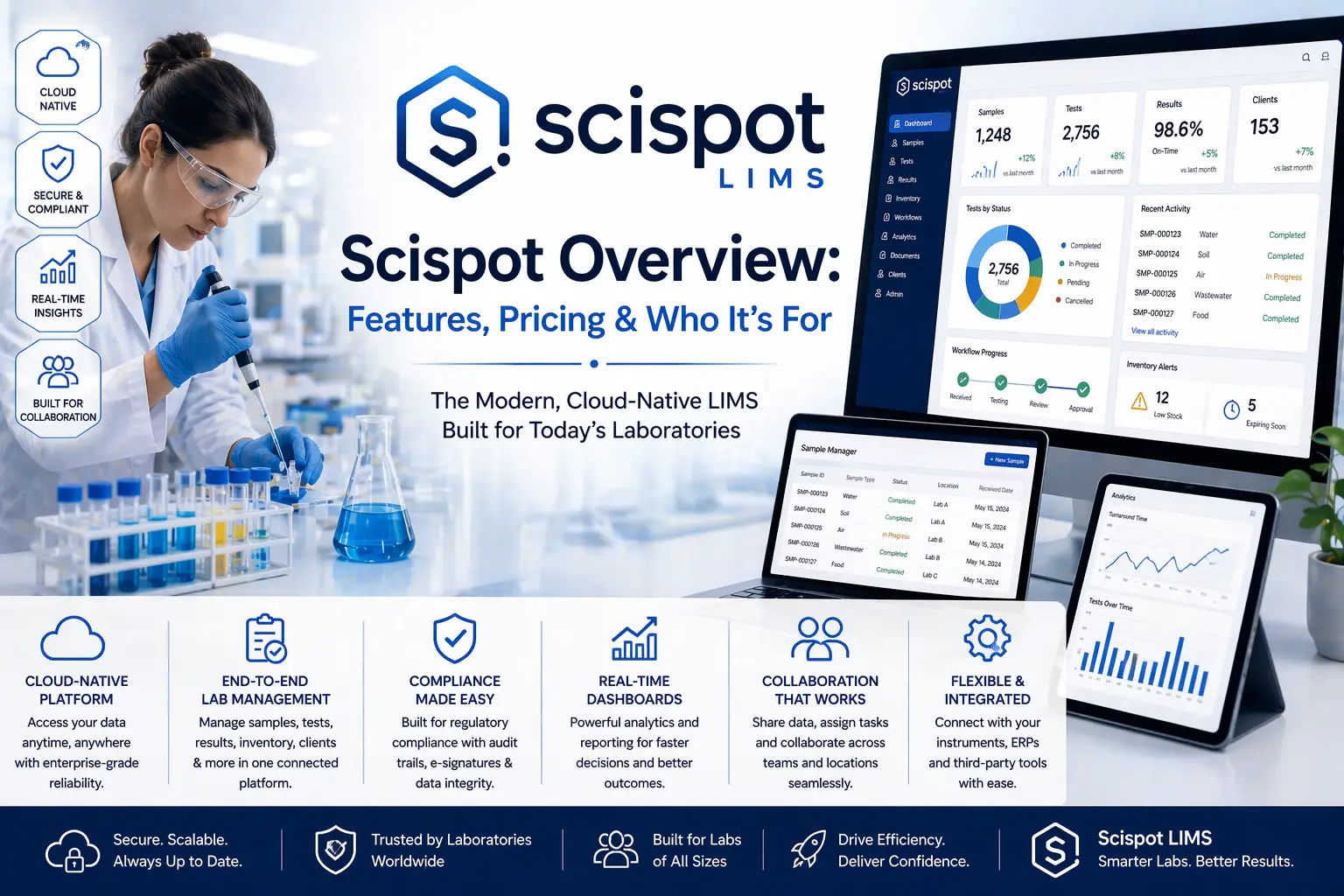
Scispot positions itself not as a traditional LIMS but as a “Lab Operating System” (LabOS) — a no-code, unified platform integrating ELN, LIMS, and SDMS capabilities in a single system, with a strong emphasis on data integration via its proprietary GLUE engine and AI-powered automation via its Scibot assistant.
This article draws exclusively on Scispot’s official website and pricing page, Y Combinator’s company directory, PitchBook, Tracxn, Crunchbase, GeekWire, the Indee Labs press release, G2, Software Advice, and GetApp. Scispot has not reviewed, sponsored, or paid for this article.
At a glance
| Field | Details |
| Vendor | Scispot Inc. (operating as Scispot.io) |
| Founded | 2020 |
| Headquarters | Kitchener, Ontario, Canada |
| Co-founders | Guru Singh (CEO) and Satya Singh (CPO/COO) |
| Accelerators | Y Combinator Summer 2021 batch; Creative Destruction Lab (CDL) Seattle |
| Investors | Communitech, Ontario Genomics, FEDAS, Alliance of Angels, Creative Destruction Lab, Pack Ventures (total 11 investors per PitchBook) |
| Funding raised | $606,000 (PitchBook). Revenue reported at $2.8M ARR in October 2024 (Latka/GetLatka). |
| Employees | 23 (PitchBook). 18 reported by GetLatka. YC directory states 16. |
| Deployment | Cloud-only SaaS. Hosted on AWS (AWS GovCloud optionally for government labs). Single-tenant deployments available for high-security requirements. |
| Platform scope | LabOS: alt-ELN (Labspaces) + alt-LIMS (Labsheets) + alt-SDMS (Lakehouse) + GLUE integration engine + Scibot AI assistant + Labflows workflow automation |
| Key industries | Biotech R&D, CROs, molecular diagnostics, clinical labs, biobanking, pathology, government labs, cell and gene therapy |
| Named customers | Arrakis Therapeutics (quoted on website). Indee Labs (press release, May 2023). Persist AI (press release, July 2023). CAN Health Network (June 2025). |
| Compliance | 21 CFR Part 11, SOC 2, HIPAA, GDPR, GLP, ISO 17025, CLIA, CAP, ISO 15189 — all documented on scispot.com. Compliance confirmed in Indee Labs press release (HIPAA, SOC 2, CFR Part 11). |
| ELN included | Yes — Labspaces (alt-ELN) is part of the core platform |
| AI assistant | Scibot — NLP-powered search, workflow recommendations, AI analytics dashboards |
| Pricing | Quote-based. Tiered: Essential, Growth, Enterprise. GLUE priced separately by connectivity and data throughput. No publicly listed per-user prices. |
| Free trial | Not confirmed. Demo available. |
| G2 rating | Listed. Reviews present but count is modest. Most recent activity confirmed through 2024-2025 based on Software Advice profile. |
What Scispot does
Scispot describes its platform as a Lab Operating System (LabOS) — a positioning that explicitly distinguishes it from traditional LIMS. Rather than adopting the established LIMS, ELN, and SDMS categories, Scispot uses the prefix “alt-” (alt-LIMS, alt-ELN, alt-SDMS) to signal a different architectural philosophy: a unified, API-first, data-science-ready platform built for biotech teams that want to eliminate the integration overhead of running separate best-of-breed tools.
The platform consists of several interconnected components, all documented on scispot.com:
- Labsheets (alt-LIMS): A spreadsheet-style, no-code data modelling layer for sample tracking, inventory management, and workflow execution. Labs design custom schemas, link experiments to inventory, automate sample labelling and barcoding, and generate Certificates of Analysis (CoA). Described as enabling configurable data models without coding.
- Labspaces (alt-ELN): The electronic notebook component for experiment documentation, SOP storage, and team collaboration.
- Lakehouse (alt-SDMS): A scientific data management layer described as a “lakehouse” — a staging environment where data is ingested, cleansed, transformed, and prepared for analysis, then pushed to cloud data warehouses such as Snowflake or Databricks. This is explicitly positioned for data science and AI/ML workflows.
- GLUE integration engine: Scispot’s proprietary integration layer, described on the GLUE product page as connecting 200+ lab instruments and 7,000+ software applications. Supports API, SFTP, ASTM, HL7, and agent-based capture for air-gapped PCs. Instruments documented include LCMS, HPLC, plate readers, qPCR, sequencers, flow cytometers, liquid handlers, and freezers. GLUE Robo (announced on YC), an extension connecting lab robotics and plate-movement systems in real time, was introduced in 2024.
- Labflows: A workflow automation platform for sample-centric workflows in commercial and regulated labs, announced in September 2024 (CB Insights). Positioned for clinical and diagnostic settings including molecular diagnostics. Supports 21 CFR Part 11, IVDR, HIPAA, CLIA, ISO 15189, and CAP standards per Scispot’s Labflows page.
- Scibot (AI assistant): An NLP-powered AI lab assistant described on the Scispot website as enabling natural language queries, AI-driven workflow recommendations, and automated dashboard creation. Users can query sample locations, ask about experiment status, and receive AI suggestions on assay design and data interpretation.
- Location Manager: An AI-powered freezer management application launched in May 2025 (CB Insights), enabling visual identification of sample locations.
- Computational Toolkit: Documented on scispot.com as including APIs, embedded JupyterHub, Python SDK, and CLI for code-first automation and computational biology workflows.
A notable architectural choice: Scispot’s pricing page confirms the platform can be used as individual components (alt-LIMS alone, GLUE alone) or as the full LabOS bundle, providing modular entry points for labs that do not need the full suite from day one.
Company context: startup scale in an enterprise market
Scispot occupies an unusual position in the LIMS market. It competes for deals against platforms backed by private equity (Sapio Sciences, GHO Capital), decades of customer deployments (LabWare since 1987, LabVantage since 1981), and significant venture capital (Benchling, $418M). Scispot’s total disclosed funding is $606,000 — orders of magnitude smaller than its most prominent competitors.
This context matters for buyers evaluating the platform’s long-term viability, support capacity, and enterprise readiness. PitchBook lists 23 employees; GetLatka estimated 18 in 2024; the YC directory listed 16. Revenue was reported by GetLatka at $2.8M ARR in October 2024, up from $1.7M in 2023 — indicating real and growing commercial traction, though at a scale consistent with a startup rather than an established mid-market vendor.
| Scale note | Scispot’s team size and funding position are relevant to procurement decisions in regulated environments. Labs should evaluate: Can Scispot support a multi-site implementation? What contractual SLAs are available? What happens to data and contracts if the company’s growth trajectory changes? These are standard enterprise diligence questions that apply more acutely to a startup-scale vendor than to incumbents. Scispot’s G2 reviewers consistently praise the support team’s responsiveness — delivered partly via Slack channels — which is a model that scales differently from a traditional enterprise support organisation. |
Deployment and compliance
Scispot is cloud-only, hosted on AWS. For government labs with higher security requirements, Scispot’s government LIMS page documents support for AWS GovCloud (US) deployment and single-tenant instances. Standard deployments are multi-tenant.
Compliance documentation on scispot.com and confirmed in the Indee Labs press release (May 2023) covers:
- 21 CFR Part 11 (FDA): Confirmed on scispot.com, Indee Labs press release, Labflows page, and GLUE product page. Electronic signatures, audit trails, RBAC, and e-signatures are documented.
- SOC 2: Confirmed on Scispot’s pricing page (“CFR Part 11 & SOC 2 aligned”) and in the Indee Labs press release.
- HIPAA: Confirmed across multiple Scispot product pages and the Indee Labs press release.
- GDPR: Confirmed on Scispot’s LIMS page and government LIMS page.
- ISO 17025, CLIA, CAP, ISO 15189: Documented on Scispot’s government LIMS page and Labflows page.
- GxP and GLP: Documented on the Scispot website and IntuitionLabs’ independent listing.
Scispot’s pricing page references a “GxP validation package for regulated deployments” as an add-on to the Growth tier. IQ/OQ/PQ validation templates and documentation are referenced on the pricing page as available within that package.
| Validation note | Scispot’s pricing page documents IQ/OQ/PQ validation templates and “inspection prep with a dedicated team” as part of a GxP validation package. Unlike some enterprise LIMS vendors, Scispot does not appear to offer a fully pre-validated system equivalent to LabVantage Pharma’s 90-day pre-validated deployment. Labs in heavily regulated GMP environments should clarify the scope and status of validation documentation before committing. |
Pricing
Scispot does not publish specific per-user or per-module prices. The pricing page at scispot.com documents a tiered structure with three named tiers for LabOS and a separate pricing model for GLUE:
- Essential tier: Includes alt-ELN, alt-LIMS, alt-SDMS, CFR Part 11 and SOC 2 alignment, RBAC, audit trails, e-signatures, encryption at rest and in transit, hourly backups, standard support, and access to the Computational Toolkit (APIs + JupyterHub + Python/R). Optional GLUE integration for instrument data ingestion.
- Growth tier: Everything in Essential, plus advanced workflows, custom dashboards, priority implementation and white-glove onboarding, a dedicated success manager, integrated alt-QMS, automation pack, clinic and patient portal, and SLA-backed priority support. GxP validation package available as add-on.
- Enterprise tier: Custom scope. Described for organisations that need to unify data, projects, and tools across daily lab operations.
- GLUE (separate pricing): Priced by connected systems, data pipelines, and streaming volume. Scispot engineers all connectors; data lands in Labsheet structure with automated harmonisation, QC rules, and lineage.
Scispot’s own positioning blog describes pricing as “structured to grow with your company, providing enterprise-quality lab management without enterprise-level complexity or cost” — an indication of competitive pricing relative to LabWare or LabVantage. However, no specific pricing figures are published and all must be obtained by contacting Scispot’s sales team.
Who Scispot is designed for
Based on Scispot’s website vertical pages, YC company profile, press releases, and customer testimonials, the platform is primarily positioned for:
- Biotech startups and scale-ups that need to move off spreadsheets and paper notebooks without the complexity or cost of enterprise LIMS implementations
- Biotech R&D teams working in genomics, NGS, cell and gene therapy, immunotherapy, computational biology, and drug discovery who want data-science-ready infrastructure
- Molecular diagnostics and clinical labs needing HIPAA, CLIA, CAP, and 21 CFR Part 11 compliance with instrument connectivity (QuantStudio, Roche LightCycler, qPCR, NGS platforms) and HL7/FHIR integration with LIS/HIS/EHR systems
- CROs and contract labs that need to handle multiple client workflows in a configurable, multi-tenant environment
- Labs with in-house data science or bioinformatics teams who want to use Python, R, JupyterHub, APIs, and Snowflake/Databricks natively within their lab informatics stack
- Government and public health labs requiring GLP, HIPAA, and ISO 17025 compliance with optional AWS GovCloud deployment
Scispot is less commonly the right fit for:
- Organisations that need contractual SLAs from a large, established vendor with a multi-decade track record and enterprise support organisation
- Highly regulated GMP manufacturing environments requiring a fully pre-validated system with comprehensive vendor-supplied IQ/OQ/PQ documentation equivalent to LabVantage Pharma or LabWare’s validated SaaS products
- Labs that require on-premise deployment and cannot work in a cloud-only environment
- Large multi-site enterprise deployments where vendor financial stability and longevity are primary procurement criteria
What users say
G2 and Software Advice both list Scispot with verified reviews. The review count on G2 is modest compared to QBench (133 reviews) or LabWare (100+ reviews). The following themes are drawn from G2, Software Advice, GetApp, and the verified Indee Labs press release.
Frequently praised
- Support responsiveness: The single most consistent theme in Scispot’s reviews across every platform. G2 reviewers describe the team as responding “near instantly on Slack” and compare this favourably to prior LIMS experiences where responses took “48 hours to weeks.” Software Advice reviewers describe support as “right there on Slack or a call.” One reviewer states Scispot has “resident scientists and computational biologists who help write custom scripts, configure custom schemas, and give suggestions on workflow automation.”
- GLUE integration engine: G2 reviewers cite GLUE as a key differentiator for connecting instruments and databases without manual data entry. One reviewer describes integrating qPCR data and automating inventory management, saving “significant time.” Another highlights seamless instrument integration for high-throughput screening workflows.
- No-code configurability: Reviewers note the ability to configure workflows and schema without programming knowledge. One G2 reviewer states: “I really like that Scispot is easy to configure to what we need, and you don’t need to be a programmer to do it.”
- Fast onboarding: A G2 reviewer describes completing a transition from a legacy LIMS “in merely a couple of days.” The Indee Labs press release describes their adoption process as enabling them to “operationalise as a true Digital Biotech company.”
- Data centralisation for multi-modal research: One G2 reviewer describes using Scispot to centralise animal research data across live animal data, clinical chemistry, clinical pathology, histology, anatomic pathology, and associated metadata in a single platform.
Frequently criticised
- Limited GLUE connectors at early stages: One G2 reviewer expresses a desire for more connectors as their lab grows, noting the team is “collaborative to make that happen.” This reflects both a current limitation and the startup’s model of building connectors on demand.
- Platform maturity and occasional glitches: QBench’s independently published competitor analysis (August 2025) notes G2 reviews mentioning “occasional bugginess and glitches” and links this to the company’s startup pace of development. This is an independent source with a clear competitive bias, but the underlying observation — that a fast-moving startup product may have rough edges — is a reasonable consideration for regulated labs.
- Small team scale: Not a G2 criticism per se, but a structural observation: support delivered via Slack channels and a team of ~20 people is a meaningful consideration for labs evaluating long-term enterprise contracts, multi-site rollouts, or complex regulatory deployments.
Quick verdict
| Best for | Biotech startups, scale-ups, and CROs that want a unified LabOS platform combining ELN, LIMS, SDMS, and data integration in a single system — with genuine data-science capability (JupyterHub, Python SDK, Snowflake/Databricks connectivity) built in. Scispot’s GLUE engine and 200+ instrument integrations give it a connectivity story that outpaces most LIMS vendors at a comparable price point. Its support model — near-instant response via Slack from scientists and computational biologists — is genuinely differentiated. Best suited for technically capable teams who want control over their data infrastructure and are comfortable working with a startup-scale vendor. |
| Consider alternatives if | Your organisation needs contractual SLAs, large enterprise support infrastructure, or a fully pre-validated system with comprehensive vendor-supplied IQ/OQ/PQ documentation. For GMP-regulated biomanufacturing at scale, Sapio Sciences (GxP validated 2024) or LabVantage (pre-validated Pharma tier) are more established options. For analytical testing labs needing ISO 17025, HIPAA, and fast deployment with transparent pricing, QBench offers a more mature support organisation. For on-premise deployment, Scispot is not an option. |
Further reading
- Scispot on Y Combinator — company profile
- Scispot on G2 — verified user reviews
- Indee Labs adopts Scispot — press release, May 2023
- GeekWire: From Expedia to Scispot — co-founder interview, May 2024
- Scispot YC announcement blog post
- labsoftwareguide.com: How to choose a LIMS
- labsoftwareguide.com: Open-source ELN and LIMS guide
- labsoftwareguide.com: Best LIMS Software 2026
| Editorial note | This article is based on: Scispot’s official website and pricing page; Y Combinator company directory; PitchBook; Tracxn; Crunchbase; GeekWire (co-founder interview, May 2024); the Indee Labs partnership press release (May 2023); CB Insights; GetLatka (revenue figures); G2; Software Advice; GetApp; and IntuitionLabs’ independent software listing. Revenue and employee figures vary across sources (PitchBook: 23 employees; GetLatka: 18; YC: 16; funding: $606K per PitchBook) and are attributed to their sources. Statistics published on Scispot’s own blog without independent verification have not been included. Scispot has not reviewed, sponsored, or paid for this article. Last verified: April 2026. |