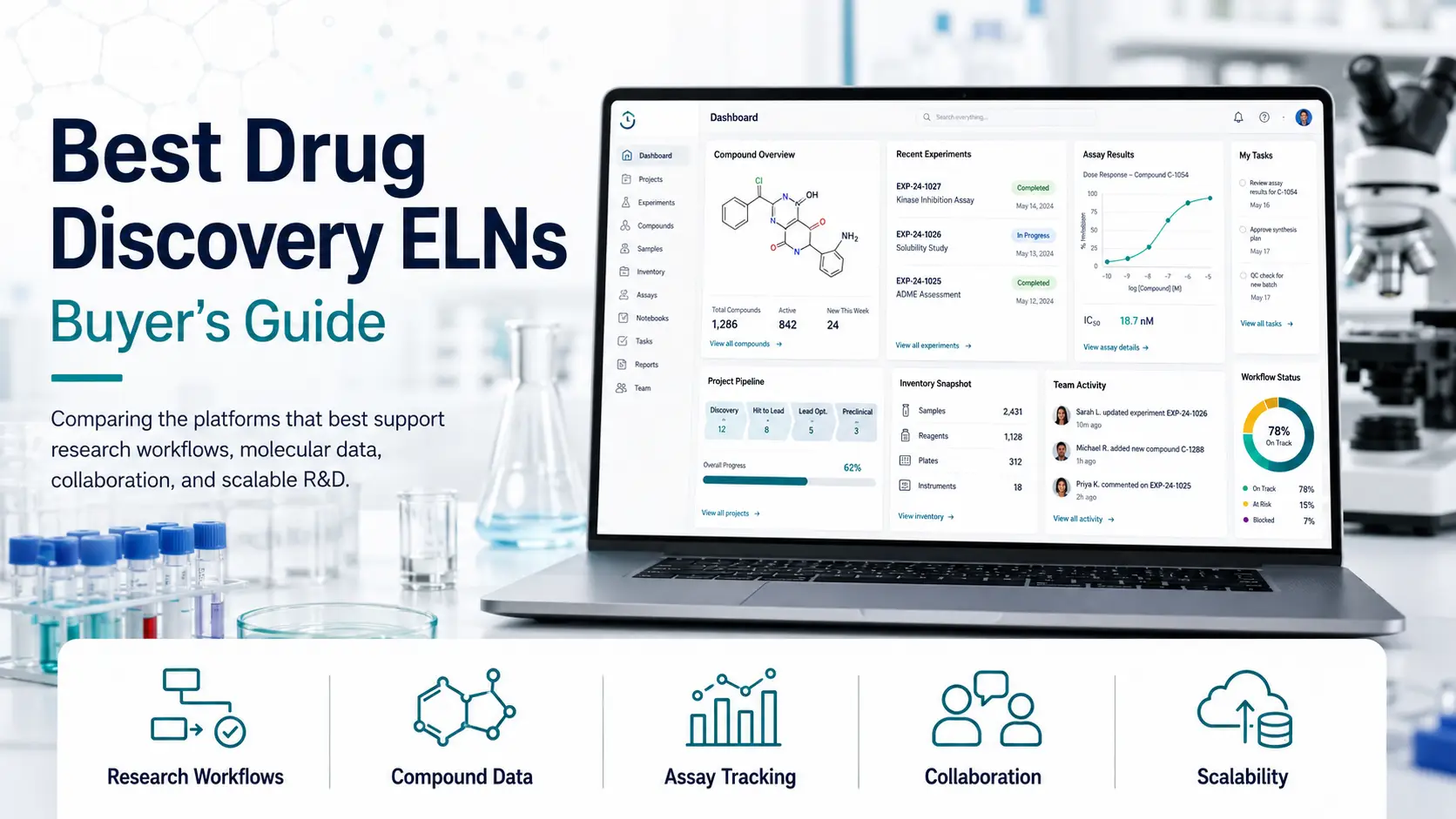
The decisive question in drug discovery ELN selection is not usability, price, or AI features ; it’s whether the platform is chemistry-native or biology-native. Small-molecule discovery lives on chemical structure search, compound registration, and SAR analysis, and platforms built around biology handle these as afterthoughts if at all. Dotmatics and CDD Vault are the chemistry-native options; Benchling and its peers dominate biologics and molecular biology; Revvity Signals and IDBS serve regulated pharma at enterprise scale. Buy across that line and you will spend years working around a gap no configuration can close.
Why drug discovery breaks the general ELN market
Most ELN buyer guides treat the category as one market with different price points. Drug discovery exposes that framing as wrong, because it demands two capabilities that most notebooks were never built to combine.
A discovery programme runs on chemistry: designing and registering compounds, searching by structure and substructure, tracking analogues, and building structure–activity relationships across hundreds or thousands of molecules. It simultaneously runs on biology: assay design, screening data, dose–response curves, and target validation. The whole point of a discovery informatics platform is that these two halves talk to each other — that a chemist can see which analogue moved potency, and a biologist can trace an assay result back to the exact compound and batch.
Platforms that grew out of molecular biology handle sequences, plasmids and constructs superbly and treat chemical structures as attachments. Platforms that grew out of cheminformatics do the reverse. Independent buyer guidance is blunt about the consequence: without structure-search capability, chemists cannot efficiently mine their own data for insights — and the recommendation for chemistry-heavy teams is to prioritize built-in cheminformatics over add-ons or plugins.
That is the single most useful filter you can apply before looking at any feature list. Our ELN vs LIMS explainer covers the wider category distinction, and our how to choose an ELN checklist structures the general evaluation.
What drug discovery actually demands
To discover what are the best drug discovery eln, we have to look at specific recquirements of a drug discovery lab. Beyond generic ELN features, five capabilities separate a discovery platform from a digital notebook.
Chemical structure and substructure search
The ability to query by chemical structure — searching molecular properties, substructures, and the biological activity attached to them — is the foundation. Without it, your accumulated chemistry is a filing cabinet rather than a dataset. Test this in a demo with your own compounds, not the vendor’s examples.
Compound registration
Registration assigns unique, governed identities to molecules and batches, handling salts, stereochemistry, and parent–batch relationships. Dotmatics spans ELN, BioRegister, compound registration and assay data management as an integrated platform, and CDD Vault provides chemical registration, assay data management and SAR analysis in a single web application. Registration is where informal spreadsheet chemistry becomes an institutional asset — and where platforms without it force you into a separate system.
Live SAR analysis
The ideal system supports live updates as molecules are drawn and allows visual mapping of structure–activity relationships. SAR analysis is central to optimizing small molecules in medicinal chemistry, and a platform that requires exporting to a separate tool for every SAR question imposes a tax on the core activity of the discipline.
Chemistry–biology data flow
The value of an integrated platform is cross-disciplinary clarity. One verified CDD Vault user — a biologist who brought the system into a new discovery programme — described the technology as enabling easy data-sharing between chemistry and biology so cross-discipline discussions become clear and productive, with screening data from raw or normalized plate formats linked to compound structures and computed properties making sorting and ranking straightforward.
Regulatory posture, where relevant
21 CFR Part 11 — requiring signer name, date and time, signature meaning, and an audit trail for any post-signature change — is described as the dominant ELN selection criterion for pharma and biotech labs. Early discovery is often outside GxP scope, but if your programme will move toward IND-enabling work, buying a platform that can carry you there avoids a painful migration later. Our LIMS for pharmaceutical QC guide covers what regulated environments require.
The platforms, by profile
There is no single best drug discovery ELN, so the grouping below is by the kind of organization each serves.
Chemistry-native platforms
Dotmatics is the most complete integrated scientific informatics platform for discovery, spanning ELN, BioRegister, compound registration and assay data management, with Studies and Vortex for visualization. Its Luma layer extends this with a unified data layer bringing together instrument outputs, application data and enterprise sources across biology, chemistry and materials, and it targets biopharma, CRO/CDMOs and industrial R&D with role-based permissions, audit trails and compliance-ready controls.
Independent review synthesis credits Dotmatics with unifying chemistry, biology and assay data on one backbone, strong configurability once workflows are modelled, and approachable day-to-day usability relative to legacy enterprise LIMS suites. The honest caveats are consistent too: reviewers report lengthy initial setup and slow onboarding with heavy coordination during enterprise deployment, search and advanced query capabilities that lag instrument-centric LIMS competitors, and integration friction with some external systems. The platform fits large discovery organizations well, while smaller labs may prefer simpler notebook-first tools.
CDD Vault, from Collaborative Drug Discovery — founded in 2004 and based in Burlingame, California — offers chemical registration, assay data management, SAR analysis, an optional ELN, data visualization, AI-driven analysis, automation and inventory management in an intuitive web interface. Its reputation among users is built on cost-effectiveness and speed to value: one long-term reviewer who had experience with Daylight, Modgraph, CambridgeSoft, Dotmatics and ChemAxon returned to CDD when starting at a new company, citing a very cost-effective, easily customizable and quick way to store, review and retrieve data.
The recurring criticism is analytics presentation — one reviewer praised the customizability and optional ELN while noting the graphing is not adjustable enough, so figures for papers and grants still go through GraphPad Prism. That’s a workflow friction rather than a disqualifier, but worth knowing.
Enterprise regulated pharma
Revvity Signals Notebook (the former PerkinElmer Informatics lineage, a 28-year-old business) is one of only two ELN vendors publishing list pricing, at $1,425 per user per year — positioning it firmly at the enterprise end. It serves regulated pharma workflows where compliance depth and vendor scale carry weight.
IDBS E-WorkBook, marketed under the Polar brand for its cloud generation, is a long-established platform in regulated pharmaceutical R&D and appears consistently in comparisons of platforms needing deep Part 11 support.
LabWare ELN and Sapio Sciences ELN both extend from LIMS-first heritages, suiting organizations that want notebook and sample management under one vendor. See our Sapio Sciences review and LabWare overview.
Biology-native platforms (and their limits for small molecules)

Benchling is the strongest platform in the market for molecular biology and biologics — sequence editors, plasmid maps, CRISPR design and molecule registration are first-class capabilities. Reviewers praise its intuitive ELN and purpose-built life-sciences design, and it remains the default for biologics-focused discovery.
For small-molecule discovery specifically, the picture is different. A competitor analysis argues that Benchling primarily focuses on molecular biology applications and that limited chemistry support could be a significant drawback for companies working on small molecule therapeutics — a claim to weigh carefully given its source, but one broadly consistent with independent reviewer notes that instrument and enterprise system integration is weaker than dedicated LIMS competitors and that pricing and enterprise cost are common concerns for smaller labs.
The practical reading: if your discovery programme is biologics, antibodies, or cell and gene therapy, Benchling’s strengths align with your science. If it is medicinal chemistry on small molecules, a chemistry-native platform will serve you better. Our Benchling overview and Benchling vs Genemod comparison cover the platform in depth.
Labguru (now part of Cenevo) provides project management and equipment tracking useful for organizing research efforts, and suits research groups whose chemistry needs are lighter. See our Labguru review.
Budget-conscious and academic

LabArchives publishes list pricing at $330–$575 per user per year — the affordable end of the transparent-pricing spectrum, and widely deployed through institutional site licences. Academic discovery groups should check institutional access before purchasing anything. SciNote and RSpace also appear in academic-oriented comparisons, and our ELN pricing benchmark covers the wider market including free and open-source options.
The new-modalities problem nobody’s guide mentions
Here is a consideration that will matter increasingly and that almost no buyer guide raises.
The pharmaceutical industry’s shift toward new drug modalities — therapeutic peptides, modified oligonucleotides, and antibody–drug conjugates — has exposed fundamental limitations in how existing systems register, represent and search molecules. Work published from AstraZeneca describes the concrete difficulty: therapeutic peptide discovery using non-natural amino acids requires a defined monomer for each variant in HELM notation, and managing that diversity is challenging even with supervised registration. Peptides with complex structural features expose fundamental limitations in HELM itself, and SAR analysis becomes harder when sequences contain non-natural residues.
The practical implication for buyers: if your pipeline includes or may include peptides, oligonucleotides, ADCs, PROTACs or molecular glues, ask specifically how the platform registers and searches those entities — not whether it “supports biologics.” A system architected around small-molecule SMILES or around protein sequences may handle neither modality well. This is the question that separates a platform that will still fit in three years from one that won’t.
The pricing reality
Drug discovery ELN pricing is opaque, and buyers should calibrate expectations accordingly.
Only two vendors publish list prices, and they sit at opposite ends: LabArchives at $330–575 per user per year, Revvity Signals Notebook at $1,425 per user per year. Enterprise chemical data management platforms are reported to start around $50,000+ annually depending on modules, users and deployment model, with the same source flagging that enterprise pricing can be prohibitive for smaller organizations and that steep learning curves accompany extensive customization options.
Benchling publishes no commercial list price; independent reporting puts its commercial minimum around $15,000 per year for a small team. For the wider market picture, see our ELN pricing benchmark.
For context on market direction, the global ELN software market was estimated at $659.8 million in 2023 with projections of $966.2 million by 2030 — a growing but not explosive category, which is why consolidation and platform bundling are the dominant vendor strategies.
How to decide
First, classify your chemistry. Small molecules and medicinal chemistry → chemistry-native (Dotmatics, CDD Vault). Biologics, antibodies, cell and gene therapy → biology-native (Benchling). Mixed pipelines → prioritize the platform whose weaker half you can most easily supplement.
Second, size the organization. Large discovery organizations with dedicated informatics capacity can absorb Dotmatics’ setup and onboarding weight and will benefit from its breadth. Smaller teams and virtual biotechs are frequently better served by CDD Vault’s cost-effectiveness and speed to value, or by simpler notebook-first tools.
Third, test structure search and SAR with your own data. Load real compounds. Draw a molecule and watch whether SAR updates live. Run a substructure query. This single exercise reveals more than any feature matrix.
Fourth, ask about your modalities explicitly, especially if peptides, oligos or conjugates are in scope now or later.
Fifth, check the analytics exit. If figures for publications and grants will still route through a separate tool, know that before you buy rather than discovering it at submission time.
Sixth, project your regulatory trajectory. If your programme heads toward IND-enabling work, Part 11 capability should be on the requirements list from day one rather than added later.
The bottom line
Drug discovery ELN selection is one of the few software decisions where the category boundary matters more than the vendor comparison. The chemistry-native platforms — Dotmatics for scale and breadth, CDD Vault for cost-effectiveness and speed — serve small-molecule discovery in ways that biology-first notebooks structurally cannot, however polished those notebooks are. The reverse is equally true for biologics.
No single ELN wins across every criterion; the market splits into academic and cost-sensitive options, biotech discovery tools, and regulated pharma platforms. Your job is not to find the best ELN. It is to correctly identify which of those three groups you belong to, then choose within it — and to ask the new-modalities question before your pipeline makes it urgent.
Where to go next
For platform-specific detail, see our Benchling overview, Labguru review and Sapio Sciences review. For category framing, our ELN vs LIMS explainer and how to choose an ELN checklist. For budgeting, our ELN pricing benchmark, and for biotech-wide platform selection, our best LIMS for biotech guide.
This guide reflects publicly available information as of August 2026. Pricing, capabilities and product positioning change frequently and should be confirmed directly with each vendor. Some cited assessments are authored by competing vendors, and this guide flags those where relevant. LabSoftwareGuide is an independent editorial resource and is not affiliated with the vendors listed above.
Sources
Independent analysis and reviews
- IntuitionLabs — Best Electronic Lab Notebooks (ELN) in 2026: Top 10 Compared (published list pricing, Part 11 as dominant criterion, market sizing): https://intuitionlabs.ai/articles/best-electronic-lab-notebook-software
- RFP.wiki — CDD Vault Alternatives and Competitors (independent review synthesis for Dotmatics and Benchling): https://www.rfp.wiki/specialty-industries/healthcare-life-sciences/life-sciences-software/cdd-vault/alternatives-and-competitors
- Capterra — CDD Vault Reviews and Pricing 2026 (verified user accounts): https://www.capterra.com/p/171280/CDD-Vault/
- G2 — Dotmatics Reviews 2026 (platform scope, Luma data layer): https://www.g2.com/products/dotmatics-dotmatics/reviews
- CB Insights — Collaborative Drug Discovery vs Revvity Signals (company profiles and founding data): https://www.cbinsights.com/compare/collaborative-drug-discovery-vs-perkinelmer-informatics
- AIMultiple — Top 10 Drug Discovery Software (Dotmatics platform scope, Cresset Flare positioning): https://aimultiple.com/drug-discovery-software
- Gitnux — Top 10 Best Chemical Data Management Software of 2026 (enterprise pricing indication): https://gitnux.org/best/chemical-data-management-software/
Peer-reviewed
- Journal of Chemical Information and Modeling — Advancing Biochemical Molecule Registration, Representation and Search for New Drug Modalities (AstraZeneca; HELM limitations, NNAA peptide SAR): https://doi.org/10.1021/acs.jcim.6c00587
Vendor-authored (labelled)
- Collaborative Drug Discovery — How to Choose the Best ELN or LIMS for Early-Stage Drug Discovery (structure search, cheminformatics-over-plugins guidance): https://www.collaborativedrug.com/cdd-blog/how-to-choose-the-right-eln-or-lims-for-early-stage-drug-discovery
- Scispot — A Comprehensive Guide to Finding the Best ELN and LIMS for Drug Discovery (competitor assessment of Benchling and Dotmatics): https://www.scispot.com/blog/a-comprehensive-guide-to-finding-the-best-eln-and-lims-for-drug-discovery
- Excelra — Structure–Activity Relationship (SAR) in Drug Discovery (SAR/ELN/SDMS integration context): https://www.excelra.com/glossary/structure-activity-relationship/