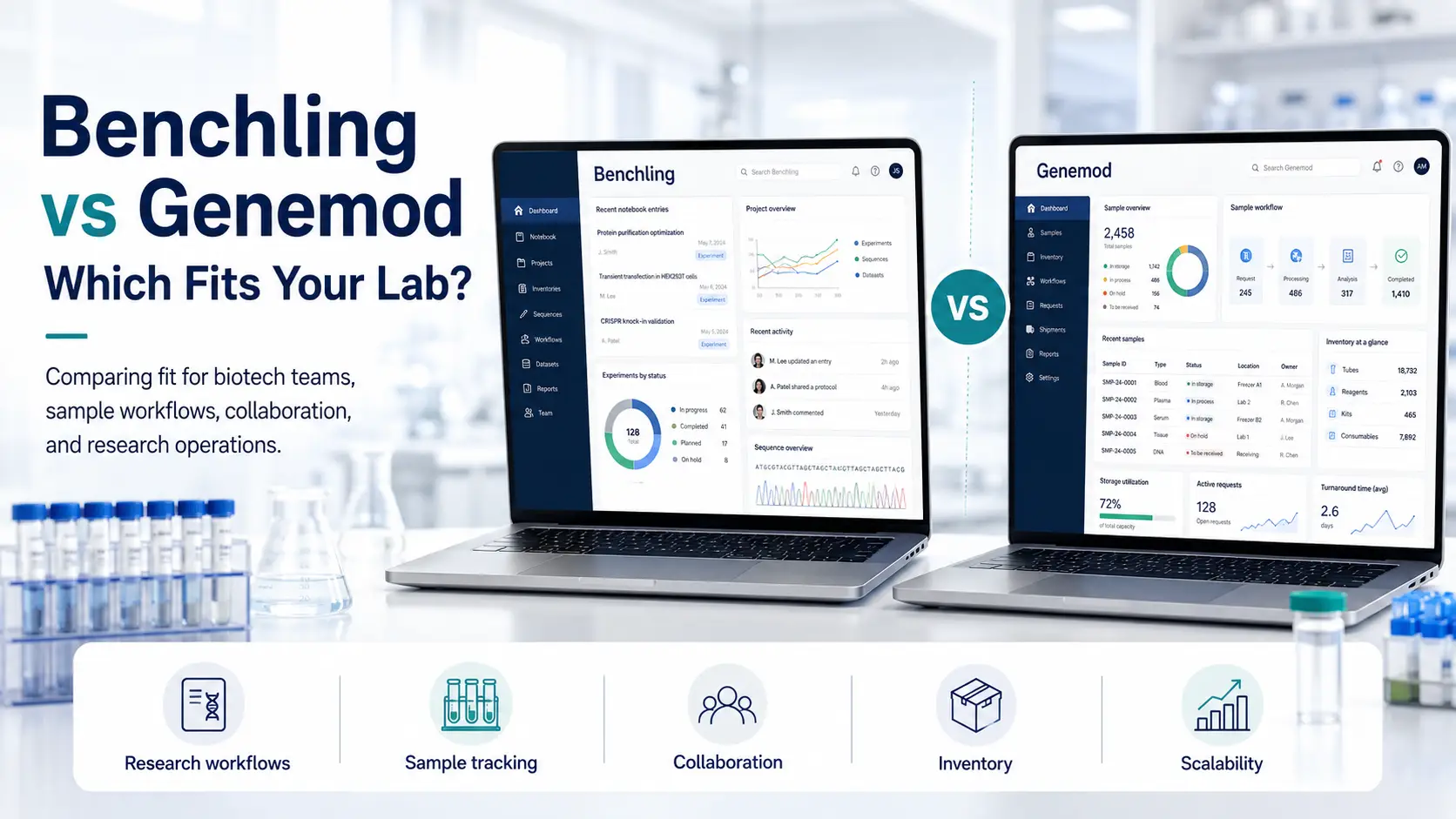
These platforms are not competing for the same lab, and treating this as a winner-takes-all comparison is the fastest way to buy the wrong one. Benchling wins where molecular biology depth, sequence tooling, ecosystem maturity, and enterprise-scale credibility decide the outcome — and its free unlimited academic tier is unmatched. Genemod wins where a unified ELN + LIMS + inventory data model, transparent pricing, fast setup, and mid-market economics decide it — and independent G2 data shows it scoring higher on usability, support, and product direction. The right question is not which is better, but which set of constraints is yours.
A note on sources, because it matters here
Search “Benchling vs Genemod” and something becomes obvious quickly: nearly every comparison on the first page is published by Genemod. Their guides are well-argued and, to their credit, openly acknowledge the bias — one states plainly that they make a competing product and will be honest about who Genemod is and is not for. But a market where one competitor authors most of the comparative literature is not one where buyers can easily calibrate.
This guide therefore leans on independent G2 review data for the head-to-head scoring, cites vendor material only where clearly labelled, and states where the evidence is thin. Where G2 sample sizes are small — and several are — we say so rather than presenting a score as settled fact.
The independent scorecard
G2’s direct comparison gives the clearest neutral signal available.
| Dimension | Benchling | Genemod |
|---|---|---|
| Overall rating | 4.5 / 5 (64 reviews) | 4.8 / 5 (49 reviews) |
| Meets requirements | 8.2 (39) | 9.1 (43) |
| Ease of use | 8.2 (39) | 9.4 (43) |
| Ease of setup | 8.9 (9) | 9.4 (32) |
| Quality of support | 8.4 (32) | 9.6 (40) |
| Product direction (% positive) | 8.6 (34) | 9.7 (41) |
| Good partner in doing business | 9.2 (11) | 8.8 (7) |
| Entry-level pricing | Not published | Free tier available |
| Free trial | Not listed | Available |
| Market segment | 63.9% small business | 61.2% small business |
Review counts in parentheses. Several dimensions rest on fewer than 15 reviews — treat those as directional, not definitive.
G2’s own summary: reviewers found Genemod easier to use, set up and administer, felt it met their needs better, and preferred its support and roadmap direction. Reviewers preferred doing business with Benchling overall — the one dimension where Benchling leads, though on very small samples for both.
The pattern is consistent enough to be meaningful: Genemod’s users report a better day-to-day experience, while Benchling retains an edge in the commercial relationship dimension that often correlates with organizational maturity and account management depth.
Where Benchling wins

Molecular biology and sequence-heavy science
This is Benchling’s genuine moat, and no amount of competitive positioning changes it. Its sequence editors, plasmid maps, CRISPR design tools, and molecule registration are built into the platform as first-class capabilities, and its molecular biology tooling is widely acknowledged as the category benchmark — even by competitors, who concede it shines for biologics workflows.
If your scientists spend their days designing constructs, registering molecules, and documenting cloning, this is not a feature comparison — it is the reason the platform exists. A lab doing heavy molecular work will extract value from Benchling that a more operationally-focused platform simply does not offer.
Computational biology and scientific reasoning
Benchling has invested in stitching scientific foundation models into its R&D suite, and even Genemod’s own comparison concedes that Benchling AI shines on scientific reasoning, document migration, and computational biology. For teams with computational capability who want AI applied to the science rather than to lab logistics, this is the stronger fit.
Academic labs — free and unlimited
Benchling’s academic tier is genuinely free and unlimited, which is why it is ubiquitous in university labs. For a PhD student, postdoc, or academic group, this is close to unbeatable, and many institutions already hold access. Check before you buy anything.
Scale, ecosystem, and enterprise credibility
Benchling operates at a scale Genemod does not yet match: over 200,000 scientists at more than 7,000 academic and research institutions, with sustained triple-digit ARR growth through its expansion years, and a 4.5/5 G2 rating placing it near the top of the LIMS and ELN categories. Its API-first architecture integrates well with existing infrastructure, and its ecosystem maturity means fewer unknowns for a large organization.
For a buyer whose procurement process weights vendor stability, reference customers at scale, and ecosystem depth, Benchling carries advantages that a younger competitor cannot manufacture.
The best fit for Benchling
Molecular-biology-centric R&D teams; biologics and computational biology groups; academic labs (free tier); established teams already standardized on Benchling looking to extend into LIMS without switching vendors; organizations where enterprise-scale credibility is a procurement requirement.
Where Genemod wins

The unified data model
Genemod’s core architectural argument is that experiments tie directly to samples, inventory, files and workflows in a single schema — avoiding what the industry calls the “integration tax” of stitching separate ELN, LIMS and inventory tools together. Their own framing is that they built both ELN and LIMS properly from the start rather than making buyers choose between a modern notebook lacking LIMS depth or a robust LIMS with a clunky interface.
The independent data supports this holding up in practice: Genemod scores 9.2 on Lab Informatics against Benchling’s 7.8, and leads across chain-of-custody dimensions. Notably, even Genemod’s competitors’ framing of Benchling concedes that its inventory module works but doesn’t feel like a first-class citizen of the platform.
Sample and inventory management depth
For labs whose daily pain is sample tracking, freezer management and inventory reconciliation rather than sequence design, this is the decisive difference. Genemod offers real-time freezer mapping, structured ELN templates, and versioned protocol management — the operational infrastructure of running a lab.
Mid-market pricing and transparency
Genemod publishes plans with a free entry tier and a free trial; Benchling publishes no commercial pricing at all. The commercial gap is significant: Benchling is reported to start around $15,000/year for a small team, and Genemod’s positioning explicitly targets the moment when “the quote arrives, it is roughly twice what the team budgeted, and it covers fewer modules than expected.”
That is a vendor’s framing of its own opportunity, but the underlying dynamic is corroborated by independent reviewers and by Benchling’s own pricing opacity. For a Series A–C biotech in the 15–200 scientist range, price-to-value at smaller scale is a genuine constraint. Our ELN pricing benchmark covers the wider market.
Usability, setup speed and support
The independent numbers are the strongest evidence here: ease of use 9.4 vs 8.2, ease of setup 9.4 vs 8.9, support quality 9.6 vs 8.4. For a lab without dedicated informatics staff, adoption speed and responsive support often matter more than feature ceiling — a slightly less capable system that scientists actually use beats a more powerful one sitting half-configured.
Operational AI
Where Benchling’s AI targets scientific reasoning, Genemod’s agent targets the operational work of running a lab — bulk sample operations, freezer reorganization, ELN drafting tied to real inventory, audit-trail-aware execution — explicitly designed to work without a computational biology team to operate it. Neither approach is superior in the abstract; they solve different problems. Our AI agents in the lab analysis covers how to evaluate such claims.
The best fit for Genemod
Mid-market biotechs (roughly 15–200 scientists) squeezed between spreadsheets and enterprise pricing; diagnostics CROs and NGS core facilities; labs whose primary pain is sample and inventory operations rather than sequence design; teams needing fast time-to-value without dedicated informatics staff; organizations wanting transparent, predictable pricing as they grow.
The honest trade-offs on both sides
A comparison that only lists strengths isn’t useful, so here are the constraints each carries.
Benchling’s trade-offs. Commercial pricing is opaque and steep, with sharp jumps at tier thresholds. Independent reviewers flag limited data export, which makes migration difficult and turns a multi-year contract into a dependency with no easy exit — ask specifically how you would extract experiments, samples and files before signing. Inventory and sample management, while functional, are secondary to the R&D tooling. And the G2 usability and support scores, while respectable, sit consistently below its challenger’s.
Genemod’s trade-offs. It is a substantially younger and smaller company — founded in 2018, with a $4.5M seed round in 2023 — against a competitor operating at 200,000-scientist scale. Its G2 sample sizes are smaller in absolute terms, and enterprise buyers weighting vendor longevity and reference depth will see a shorter track record, notwithstanding named customers including AstraZeneca, Bristol-Myers Squibb and Merck. It does not attempt to match Benchling’s molecular biology and computational depth — by design, but that is still a gap if your science needs it. And G2 reviewers gave Benchling the edge on the commercial partnership dimension.
How to decide in one pass
Answer these four questions honestly and the choice usually resolves itself.
Is your science molecular? If cloning, sequencing, CRISPR and molecule registration are central, Benchling’s tooling is the reason to choose it. If your work is diagnostics, operations-heavy, or process-oriented, that advantage doesn’t apply to you.
Is your daily pain experiments or samples? Benchling optimizes the experiment; Genemod optimizes the operation around it. Whichever consumes more of your team’s week should drive the decision.
Are you academic? Check institutional access first. Benchling’s free unlimited academic tier may make this decision for you at zero cost.
What is your realistic budget, and how predictable does it need to be? If a five-figure annual minimum with opaque tier jumps is workable, Benchling’s constraints are manageable. If you need transparent, scaling pricing you can forecast, that weighs toward Genemod.
Two practical tests worth running in any demo, regardless of which way you’re leaning: ask each vendor to show you the data model in one diagram covering ELN, LIMS and inventory — the answer reveals whether “unified” is architecture or marketing. And ask exactly how you would export your data if you left in three years.
The bottom line
Both platforms are genuinely good at what they were built for, and the market has room for both because they answer different questions.
Benchling is the stronger platform for molecular biology depth, computational science, academic use, and enterprise-scale assurance — a mature, widely adopted system whose R&D tooling remains the category benchmark. Genemod is the stronger platform for unified ELN + LIMS operations, mid-market economics, fast adoption, and sample-centric workflows — with independent review data showing higher satisfaction on usability, support and product direction.
The failure mode isn’t picking the “wrong” one. It’s picking either without first deciding whether your lab’s centre of gravity is the experiment or the operation. Settle that, and the comparison stops being difficult.
Where to go next
For platform-specific detail, see our Benchling overview and Genemod review. For the wider landscape, our best LIMS for biotech guide maps vendors by growth stage, and our ELN vs LIMS explainer helps if you’re still deciding which category you need. For budgeting, see our ELN pricing benchmark and LIMS pricing benchmark, and our how to choose an ELN checklist to structure the evaluation.
This comparison reflects publicly available data as of August 2026. G2 scores change as reviews accumulate, and several dimensions cited rest on small samples. Pricing, features and positioning should be confirmed directly with each vendor. Much of the published comparative content on these two platforms is authored by Genemod; this guide draws its head-to-head scoring from independent review data and labels vendor sources explicitly. LabSoftwareGuide is an independent editorial resource and is not affiliated with either vendor.
Sources
Independent
- G2 — Compare Benchling and Genemod (head-to-head scoring, ratings, market segments): https://www.g2.com/compare/benchling-vs-genemod
- G2 — Genemod Reviews 2026: https://www.g2.com/products/genemod/reviews
- Contrary Research — Benchling Business Breakdown & Founding Story (scale, G2 standing, Genemod funding and customers): https://research.contrary.com/company/benchling
- Scientist in Progress — Benchling Review 2026 (commercial pricing, export limitations): https://scientistinprogress.com/blog/benchling-review/
Vendor-authored (labelled)
- Genemod — Outgrown Your Spreadsheet, Priced Out of Benchling? Mid-Market Biotech Buyer’s Guide: https://genemod.net/blog/benchling-alternative-mid-market-biotech-2026
- Genemod — Genemod AI Agent vs. Benchling AI: A Practical Comparison: https://genemod.net/blog/genemod-ai-vs-benchling-ai
- Genemod — Top 10 AI LIMS Platforms in 2026: https://genemod.net/blog/top-10-ai-agentic-lims-platforms-2026
- Genemod — Best Lab Management Software for Biotech Startups in 2026: https://genemod.net/blog/best-lab-management-software-biotech-startups-2026