
What Are the Best Drug Discovery ELNs? (Buyer’s Guide)
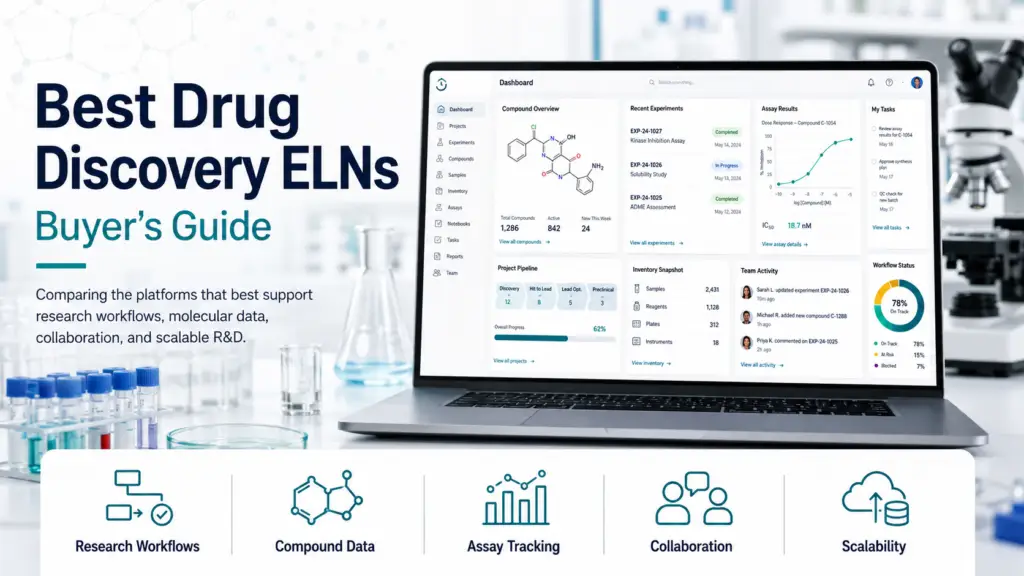
The decisive question in drug discovery ELN selection is not usability, price, or AI features ; it’s whether the platform is chemistry-native or biology-native. Small-molecule discovery lives on chemical structure search, compound registration, and SAR analysis, and platforms built around biology handle these as afterthoughts if at all. Dotmatics and CDD Vault are the chemistry-native options; Benchling and its peers dominate biologics and molecular biology; Revvity Signals and IDBS serve regulated pharma at enterprise scale. Buy across that line and you will spend years working around a gap no configuration can close. Why drug discovery breaks the general ELN market Most ELN buyer guides treat the category as one market with different price points. Drug discovery exposes that framing as wrong, because it demands two capabilities that most notebooks were never built to combine. A discovery programme runs on chemistry: designing and registering compounds, searching by structure and substructure, tracking analogues, and building structure–activity relationships across hundreds or thousands of molecules. It simultaneously runs on biology: assay design, screening data, dose–response curves, and target validation. The whole point of a discovery informatics platform is that these two halves talk to each other — that a chemist can see which analogue moved potency, and a biologist can trace an assay result back to the exact compound and batch. Platforms that grew out of molecular biology handle sequences, plasmids and constructs superbly and treat chemical structures as attachments. Platforms that grew out of cheminformatics do the reverse. Independent buyer guidance is blunt about the consequence: without structure-search capability, chemists cannot efficiently mine their own data for insights — and the recommendation for chemistry-heavy teams is to prioritize built-in cheminformatics over add-ons or plugins. That is the single most useful filter you can apply before looking at any feature list. Our ELN vs LIMS explainer covers the wider category distinction, and our how to choose an ELN checklist structures the general evaluation. What drug discovery actually demands To discover what are the best drug discovery eln, we have to look at specific recquirements of a drug discovery lab. Beyond generic ELN features, five capabilities separate a discovery platform from a digital notebook. Chemical structure and substructure search The ability to query by chemical structure — searching molecular properties, substructures, and the biological activity attached to them — is the foundation. Without it, your accumulated chemistry is a filing cabinet rather than a dataset. Test this in a demo with your own compounds, not the vendor’s examples. Compound registration Registration assigns unique, governed identities to molecules and batches, handling salts, stereochemistry, and parent–batch relationships. Dotmatics spans ELN, BioRegister, compound registration and assay data management as an integrated platform, and CDD Vault provides chemical registration, assay data management and SAR analysis in a single web application. Registration is where informal spreadsheet chemistry becomes an institutional asset — and where platforms without it force you into a separate system. Live SAR analysis The ideal system supports live updates as molecules are drawn and allows visual mapping of structure–activity relationships. SAR analysis is central to optimizing small molecules in medicinal chemistry, and a platform that requires exporting to a separate tool for every SAR question imposes a tax on the core activity of the discipline. Chemistry–biology data flow The value of an integrated platform is cross-disciplinary clarity. One verified CDD Vault user — a biologist who brought the system into a new discovery programme — described the technology as enabling easy data-sharing between chemistry and biology so cross-discipline discussions become clear and productive, with screening data from raw or normalized plate formats linked to compound structures and computed properties making sorting and ranking straightforward. Regulatory posture, where relevant 21 CFR Part 11 — requiring signer name, date and time, signature meaning, and an audit trail for any post-signature change — is described as the dominant ELN selection criterion for pharma and biotech labs. Early discovery is often outside GxP scope, but if your programme will move toward IND-enabling work, buying a platform that can carry you there avoids a painful migration later. Our LIMS for pharmaceutical QC guide covers what regulated environments require. The platforms, by profile There is no single best drug discovery ELN, so the grouping below is by the kind of organization each serves. Chemistry-native platforms Dotmatics is the most complete integrated scientific informatics platform for discovery, spanning ELN, BioRegister, compound registration and assay data management, with Studies and Vortex for visualization. Its Luma layer extends this with a unified data layer bringing together instrument outputs, application data and enterprise sources across biology, chemistry and materials, and it targets biopharma, CRO/CDMOs and industrial R&D with role-based permissions, audit trails and compliance-ready controls. Independent review synthesis credits Dotmatics with unifying chemistry, biology and assay data on one backbone, strong configurability once workflows are modelled, and approachable day-to-day usability relative to legacy enterprise LIMS suites. The honest caveats are consistent too: reviewers report lengthy initial setup and slow onboarding with heavy coordination during enterprise deployment, search and advanced query capabilities that lag instrument-centric LIMS competitors, and integration friction with some external systems. The platform fits large discovery organizations well, while smaller labs may prefer simpler notebook-first tools. CDD Vault, from Collaborative Drug Discovery — founded in 2004 and based in Burlingame, California — offers chemical registration, assay data management, SAR analysis, an optional ELN, data visualization, AI-driven analysis, automation and inventory management in an intuitive web interface. Its reputation among users is built on cost-effectiveness and speed to value: one long-term reviewer who had experience with Daylight, Modgraph, CambridgeSoft, Dotmatics and ChemAxon returned to CDD when starting at a new company, citing a very cost-effective, easily customizable and quick way to store, review and retrieve data. The recurring criticism is analytics presentation — one reviewer praised the customizability and optional ELN while noting the graphing is not adjustable enough, so figures for papers and grants still go through GraphPad Prism. That’s a workflow friction rather than a disqualifier, but worth knowing. Enterprise regulated pharma Revvity
QBench vs CloudLIMS: Which Cloud LIMS Fits Your Lab?
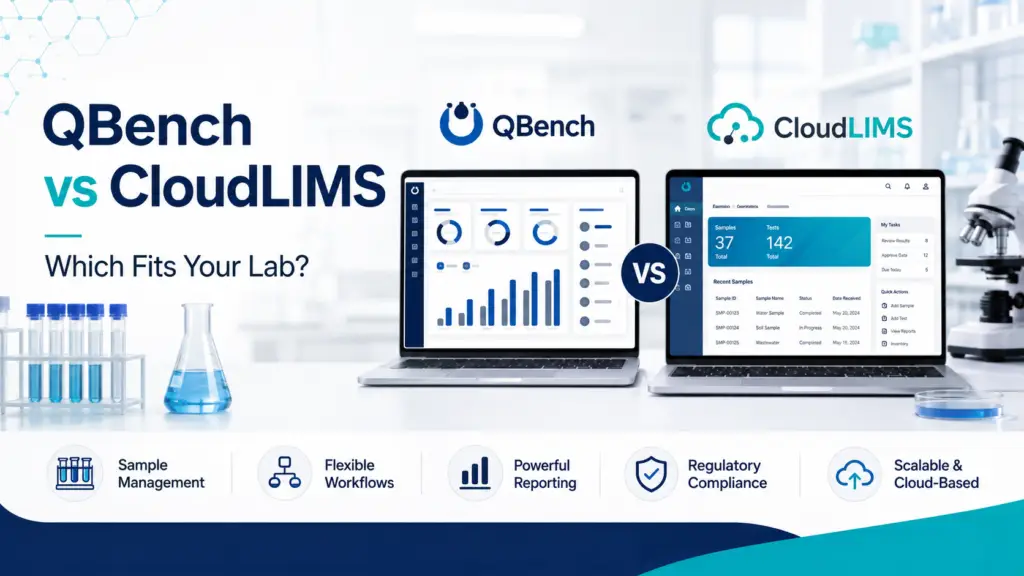
This is the closest matchup in the small-to-mid-market cloud LIMS segment, and both platforms genuinely deserve their shortlist spots. QBench wins on day-to-day usability, support quality, no-code configurability, and API-driven integration — backed by a substantially larger independent review base and repeated G2 usability rankings. CloudLIMS wins on value for money, field and mobile sample workflows, and breadth of regulated-sector coverage from biobanking to environmental testing. One verified user who evaluated both summed the trade-off up precisely: QBench was the more polished product, but the budget didn’t stretch. That sentence is the whole comparison in miniature. Why these two end up on the same shortlist QBench and CloudLIMS occupy nearly identical market territory: cloud-native, SaaS-delivered, fast to deploy, aimed at small and mid-sized testing labs that need real LIMS capability without enterprise weight or an IT department. Independent buyer guidance repeatedly names them together as the strongest options for labs seeking a reliable, affordable system. They’re also both genuinely well-rated, which is not something you can say about every head-to-head. The interesting question is therefore not “which is better” but which trade-off you’d rather make — polish and support depth, or price and sector reach. The independent scorecard Neither vendor’s marketing is the right basis for this decision, so here’s what independent review platforms show. Dimension QBench CloudLIMS G2 rating 4.5 / 5 (139 reviews) Fewer G2 reviews available Capterra rating 5.0 / 5 (3 reviews) 4.6 / 5 (46 reviews) Capterra starting price $249 / user / month $230 / user / month G2 entry tier $275 / user / month (Foundation) — Market segment 77.1% small business Small and mid-market testing labs Free version / trial Free trial and free version listed Free trial and free version listed Ease of use (G2) 8.3 (136 reviews) — Ease of setup (G2) 7.5 (76 reviews) — Quality of support (G2) 9.3 (103 reviews) — Good partner in business (G2) 9.6 (49 reviews) — Product direction (G2) 9.7 (108 reviews) — Two important caveats on this table. First, the review bases are asymmetric: QBench has far more G2 reviews (139) while CloudLIMS has the deeper Capterra base (46 versus QBench’s 3). Comparing a 5.0 from three reviewers against a 4.6 from forty-six is not a like-for-like comparison, and the larger sample is the more reliable signal. Second, QBench’s published price varies by source — $249 on Capterra, $275 as the G2 Foundation tier, and $375 in one G2 editorial listing. These cannot all be current simultaneously. The likeliest explanation is a 2026 price revision or tier renaming, and the practical lesson is to confirm current pricing directly rather than trusting any published figure. Our LIMS pricing benchmark covers this market-wide opacity in detail. Where QBench wins Day-to-day usability This is QBench’s clearest advantage, and it comes from independent sources rather than its own marketing. G2’s editorial comparison of the LIMS category states directly that while CloudLIMS is also user-friendly, QBench tends to stand out more for ease of day-to-day use. QBench has ranked #1 for usability in G2’s Spring 2026 LIMS rankings and has won “Best Relationship” and “Easiest to Do Business With” badges across multiple cycles. An independent review synthesising over 100 verified reviews from G2, Capterra and Software Advice found the pattern remarkably consistent: QBench wins on speed, no-code configurability, and support. Support quality QBench’s G2 support score of 9.3 across 103 reviews is genuinely strong, and reviewers repeatedly cite hands-on, responsive staff who understand lab work as the standout feature. For a small lab without informatics staff, this often matters more than any feature comparison. No-code configurability QBench’s configurability lets lab managers change workflows, fields, filters and reports themselves without waiting on vendor developers — a meaningful advantage for labs whose processes evolve, and one that avoids the cost and delay of vendor-side change requests. API and integrations QBench offers a modern REST API and nine listed integrations including NetSuite, Salesforce, QuickBooks, Tableau and HubSpot. For labs that need their LIMS connected to accounting, CRM or BI tooling, this ecosystem depth is a practical differentiator. Built-in QMS and commercial tooling QBench bundles inventory management, customer portals, billing, and a quality management system alongside core LIMS functionality — useful for commercial testing labs where client billing and audit-readiness are daily operational concerns. Best fit for QBench: commercial and analytical testing labs prioritizing usability and support; teams wanting to configure workflows themselves without vendor dependency; labs needing billing, client portals and QMS in one platform; second-time LIMS buyers burned by rigid legacy systems; organizations that need API integration with business systems. Where CloudLIMS wins Value for money This is CloudLIMS’s most consistently cited advantage, and unusually it’s corroborated by an independent voice rather than only the vendor. A verified Capterra reviewer who evaluated both platforms wrote that QBench was more polished than CloudLIMS, but the budget didn’t accommodate it — choosing CloudLIMS on price and reporting satisfaction with its interface, instrument integration and flexible pricing. CloudLIMS positions itself explicitly around affordability with zero upfront cost, and its Capterra starting price of $230/user/month sits below QBench’s published tiers. CloudLIMS’s own competitive analysis also notes that QBench training is priced separately at typically $5,000–$10,000 with professional services varying by scope — a competitor’s claim that should be verified directly, but a fair prompt to ask both vendors what’s included versus billed. Field and mobile sample workflows G2’s editorial assessment is direct on this point: the best cloud-based LIMS with mobile access for field sample collection is CloudLIMS, being fully browser-based across mobile, tablet and laptop, letting field teams collect, track and upload samples in real time — and it notes QBench is an option but CloudLIMS is better suited for field-based workflows. For environmental labs, remote sampling operations, or any lab where custody begins outside the building, this is a decisive capability. Our LIMS for environmental and food testing labs guide covers why field custody matters so much in that sector. Breadth of regulated sector coverage CloudLIMS serves biobanking, clinical diagnostics,
Benchling vs Genemod: Which Fits Your Lab?
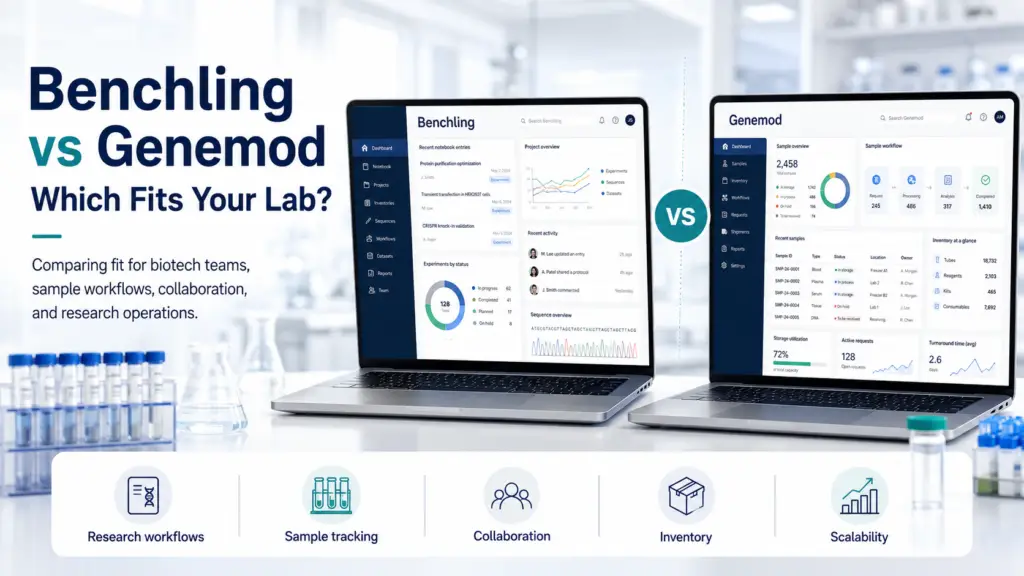
These platforms are not competing for the same lab, and treating this as a winner-takes-all comparison is the fastest way to buy the wrong one. Benchling wins where molecular biology depth, sequence tooling, ecosystem maturity, and enterprise-scale credibility decide the outcome — and its free unlimited academic tier is unmatched. Genemod wins where a unified ELN + LIMS + inventory data model, transparent pricing, fast setup, and mid-market economics decide it — and independent G2 data shows it scoring higher on usability, support, and product direction. The right question is not which is better, but which set of constraints is yours. A note on sources, because it matters here Search “Benchling vs Genemod” and something becomes obvious quickly: nearly every comparison on the first page is published by Genemod. Their guides are well-argued and, to their credit, openly acknowledge the bias — one states plainly that they make a competing product and will be honest about who Genemod is and is not for. But a market where one competitor authors most of the comparative literature is not one where buyers can easily calibrate. This guide therefore leans on independent G2 review data for the head-to-head scoring, cites vendor material only where clearly labelled, and states where the evidence is thin. Where G2 sample sizes are small — and several are — we say so rather than presenting a score as settled fact. The independent scorecard G2’s direct comparison gives the clearest neutral signal available. Dimension Benchling Genemod Overall rating 4.5 / 5 (64 reviews) 4.8 / 5 (49 reviews) Meets requirements 8.2 (39) 9.1 (43) Ease of use 8.2 (39) 9.4 (43) Ease of setup 8.9 (9) 9.4 (32) Quality of support 8.4 (32) 9.6 (40) Product direction (% positive) 8.6 (34) 9.7 (41) Good partner in doing business 9.2 (11) 8.8 (7) Entry-level pricing Not published Free tier available Free trial Not listed Available Market segment 63.9% small business 61.2% small business Review counts in parentheses. Several dimensions rest on fewer than 15 reviews — treat those as directional, not definitive. G2’s own summary: reviewers found Genemod easier to use, set up and administer, felt it met their needs better, and preferred its support and roadmap direction. Reviewers preferred doing business with Benchling overall — the one dimension where Benchling leads, though on very small samples for both. The pattern is consistent enough to be meaningful: Genemod’s users report a better day-to-day experience, while Benchling retains an edge in the commercial relationship dimension that often correlates with organizational maturity and account management depth. Where Benchling wins Molecular biology and sequence-heavy science This is Benchling’s genuine moat, and no amount of competitive positioning changes it. Its sequence editors, plasmid maps, CRISPR design tools, and molecule registration are built into the platform as first-class capabilities, and its molecular biology tooling is widely acknowledged as the category benchmark — even by competitors, who concede it shines for biologics workflows. If your scientists spend their days designing constructs, registering molecules, and documenting cloning, this is not a feature comparison — it is the reason the platform exists. A lab doing heavy molecular work will extract value from Benchling that a more operationally-focused platform simply does not offer. Computational biology and scientific reasoning Benchling has invested in stitching scientific foundation models into its R&D suite, and even Genemod’s own comparison concedes that Benchling AI shines on scientific reasoning, document migration, and computational biology. For teams with computational capability who want AI applied to the science rather than to lab logistics, this is the stronger fit. Academic labs — free and unlimited Benchling’s academic tier is genuinely free and unlimited, which is why it is ubiquitous in university labs. For a PhD student, postdoc, or academic group, this is close to unbeatable, and many institutions already hold access. Check before you buy anything. Scale, ecosystem, and enterprise credibility Benchling operates at a scale Genemod does not yet match: over 200,000 scientists at more than 7,000 academic and research institutions, with sustained triple-digit ARR growth through its expansion years, and a 4.5/5 G2 rating placing it near the top of the LIMS and ELN categories. Its API-first architecture integrates well with existing infrastructure, and its ecosystem maturity means fewer unknowns for a large organization. For a buyer whose procurement process weights vendor stability, reference customers at scale, and ecosystem depth, Benchling carries advantages that a younger competitor cannot manufacture. The best fit for Benchling Molecular-biology-centric R&D teams; biologics and computational biology groups; academic labs (free tier); established teams already standardized on Benchling looking to extend into LIMS without switching vendors; organizations where enterprise-scale credibility is a procurement requirement. Where Genemod wins The unified data model Genemod’s core architectural argument is that experiments tie directly to samples, inventory, files and workflows in a single schema — avoiding what the industry calls the “integration tax” of stitching separate ELN, LIMS and inventory tools together. Their own framing is that they built both ELN and LIMS properly from the start rather than making buyers choose between a modern notebook lacking LIMS depth or a robust LIMS with a clunky interface. The independent data supports this holding up in practice: Genemod scores 9.2 on Lab Informatics against Benchling’s 7.8, and leads across chain-of-custody dimensions. Notably, even Genemod’s competitors’ framing of Benchling concedes that its inventory module works but doesn’t feel like a first-class citizen of the platform. Sample and inventory management depth For labs whose daily pain is sample tracking, freezer management and inventory reconciliation rather than sequence design, this is the decisive difference. Genemod offers real-time freezer mapping, structured ELN templates, and versioned protocol management — the operational infrastructure of running a lab. Mid-market pricing and transparency Genemod publishes plans with a free entry tier and a free trial; Benchling publishes no commercial pricing at all. The commercial gap is significant: Benchling is reported to start around $15,000/year for a small team, and Genemod’s positioning explicitly targets the moment when “the quote arrives, it is roughly twice what
Best ELN for Academic and Research Laboratories
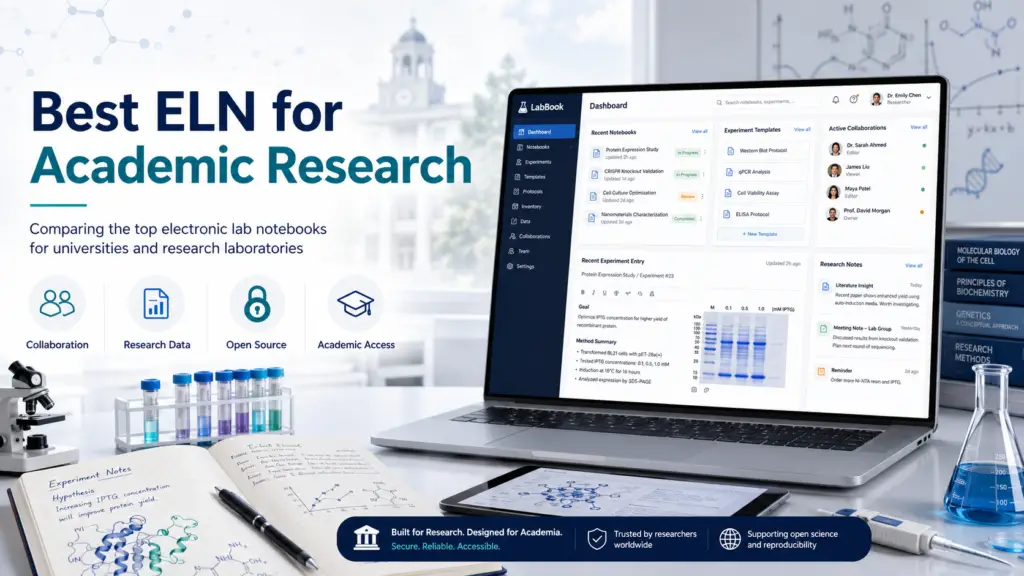
The best electronic lab notebook for an academic laboratory is not necessarily the platform with the most features. University laboratories, public research institutes and nonprofit research organizations face a distinctive combination of requirements: An ELN that works well for a large pharmaceutical company may be too expensive or complex for an academic group. Conversely, a free notebook designed for individual researchers may not provide the governance, data ownership, user administration or continuity required by an entire university. Our overall recommendation for a typical multidisciplinary academic research laboratory is LabArchives. It combines a relatively accessible cloud platform, published academic pricing, institutional administration and broad support for scientific documentation. However, it is not the best choice for every laboratory. This guide compares these platforms by use case, pricing, deployment, research workflow, collaboration and institutional suitability. Readers beginning their ELN evaluation can also consult our complete guide to electronic lab notebook software and our practical guide explaining how to choose an ELN. Quick verdict: the best academic ELN by use case Academic or research use case Recommended ELN Why it stands out Best overall for general academic research LabArchives Accessible, broadly applicable and designed for research and education Best free ELN for molecular biology Benchling Academic Free academic access to Notebook and Molecular Biology tools Best open-source ELN eLabFTW No software license fee, self-hosting and strong data-control options Best for FAIR data and institutional infrastructure RSpace Open-source platform with institutional storage, integrations and research data management focus Best for project-oriented research teams SciNote Combines experiments, tasks, inventory and team collaboration Best for protocol-driven laboratories Labstep Interactive protocols, structured data capture and connected instruments Best for straightforward documentation Labfolder Browser-based ELN with a relatively conventional notebook experience Best for teaching laboratory courses LabArchives Education Course-management tools with published student pricing Best for chemistry and materials research RSpace or Labstep Chemistry tooling and support for structured scientific workflows Best for academic-to-industry transition SciNote or Labstep Clearer progression toward structured, auditable and controlled workflows The best ELN software for academic laboratories at a glance Platform Best for Deployment Public academic pricing Main limitation LabArchives General academic research, universities and teaching Cloud SaaS Free tier; $330 per academic user annually; $360 with Inventory Advanced institutional capabilities may require Enterprise Benchling Academic Molecular biology, genomics and life-science research Cloud SaaS Free for eligible academics Academic plan excludes Inventory and Registry RSpace Universities, research institutes, FAIR data and infrastructure integration Cloud, private cloud, on-premise or self-hosted Open-source self-hosting; managed Team plan at $5,000 annually for 15 academic users More institutional and technical complexity than a simple notebook eLabFTW Open-source deployments, privacy and data sovereignty Self-hosted or managed hosting Free software; managed hosting starts at €3,200 annually for up to 32 active users Self-hosting requires internal technical resources SciNote Project-based academic teams and compliance readiness Cloud SaaS Free for individual users; premium plans by quotation Team and institution-level capabilities generally require a paid plan Labstep Protocol execution, multidisciplinary research and connected devices Cloud SaaS Free for academia; upgrades for groups and institutes Numerical institutional pricing is not publicly displayed Labfolder Small laboratories prioritizing simple documentation Browser-based cloud platform Pricing by quotation Less specialized scientific functionality than domain-specific ELNs The prices above were verified on official vendor pages on July 16, 2026. Pricing can change and institutional quotations may differ according to user numbers, storage, support, security and implementation requirements. LabArchives publishes a free plan, a $330 academic Professional subscription and a $360 academic ELN and Inventory bundle. RSpace publishes a $5,000 annual academic Team plan for 15 users. eLabFTW is free to self-host, while its official managed service begins at €3,200 annually. Benchling and Labstep offer free academic access, while SciNote provides a free option for individual users. How we selected the best academic ELNs This is an independent editorial comparison. No vendor has paid for inclusion or placement. We did not attempt to identify a universal “winner” using an arbitrary numerical score. Academic laboratories have sufficiently different needs that a platform can be excellent for one research group and inappropriate for another. The evaluation focused on the following criteria. 1. Suitability for academic budgets We considered: A free plan received credit only when it provided genuine ELN functionality. A limited trial was not treated as a free ELN. 2. Ease of use Academic groups often cannot dedicate several months to software implementation. A suitable platform should allow researchers to: The best platform on paper will fail if students and researchers continue using private documents, spreadsheets or paper notebooks alongside it. 3. Support for research continuity Academic laboratories experience regular staff turnover. PhD candidates graduate, postdoctoral researchers move to other institutions, visiting scientists leave and principal investigators change roles. The ELN must preserve: A laboratory should be able to remove a departing user without losing control of their research. 4. Collaboration We examined support for: Collaboration should not require researchers to duplicate sensitive data in email attachments or personal cloud storage. 5. Research data management An ELN does not replace a complete institutional repository or research data management strategy. It can, however, improve the documentation, organization and provenance of data throughout a project. The NIH Data Management and Sharing Policy requires relevant NIH-funded research to maintain a Data Management and Sharing Plan. Updated requirements applying from May 25, 2026 continue to encourage practices aligned with FAIR principles: making data Findable, Accessible, Interoperable and Reusable. We therefore considered: 6. Institutional governance and security Individual research groups may need only basic permissions. Universities and research institutes may require: These requirements often distinguish a free individual account from an institution-ready ELN. 7. Scientific workflow fit A generic notebook may be sufficient for some laboratories. Others need specialist capabilities such as: The best academic ELN is the one that fits the laboratory’s actual research, not the platform with the longest feature list. 1. LabArchives: best overall ELN for academic research Our verdict LabArchives is our best overall recommendation for a typical academic or university research laboratory. It is particularly appropriate for laboratories seeking
Best LIMS for Small Laboratories: An Honest Buyer’s Guide
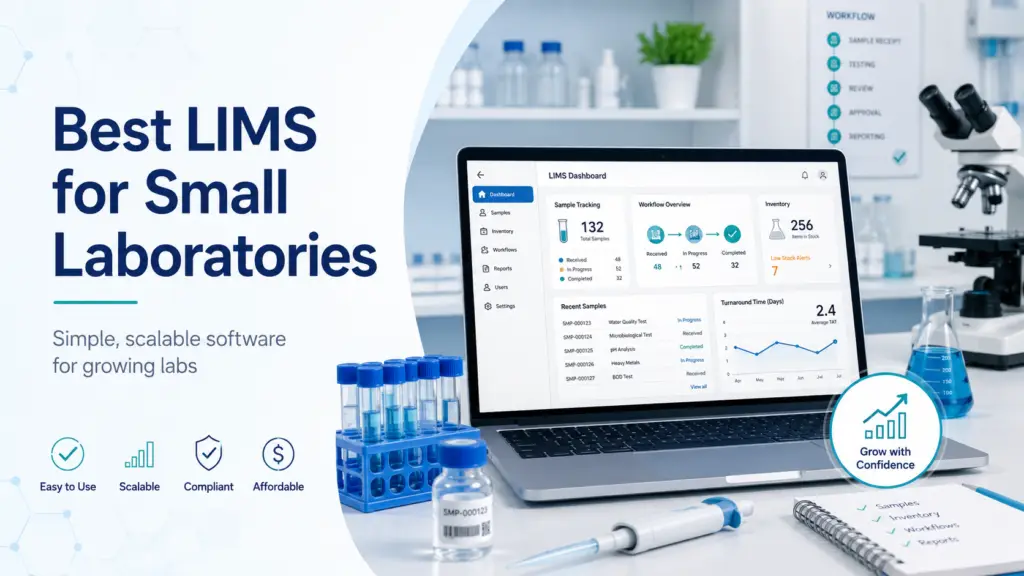
Quick verdict: Small labs don’t need less software than enterprise labs — they need different software. The right LIMS for a 3-to-25-person lab is one that deploys in weeks rather than quarters, prices transparently, requires no dedicated IT staff, and doesn’t bury core sample tracking behind enterprise tiers you’ll never use. This guide covers what actually matters when you’re small, which vendors fit which situations, and the buying mistakes that cost small labs the most money. Why “small lab” is a real category, not just a smaller budget The biggest mistake small teams make is assuming that a LIMS is a LIMS, and that choosing one is simply a matter of finding a cheaper version of what the big labs buy. It isn’t. Enterprise LIMS platforms — the LabWare, LabVantage, and Thermo Fisher SampleManager tier — are built around the assumption that you have a validation team, an IT department, a multi-month implementation budget, and a project manager to run it all. A small lab has none of those things. Deploying an enterprise platform in a five-person lab is like installing an industrial kitchen in a food truck: technically possible, ruinously impractical. Independent buyer guidance in 2026 keeps returning to the same point: the cheapest LIMS is rarely the best value, but neither is the most powerful. Small labs that pick a free or ultra-cheap tool, struggle with its limitations for a year or more, then rip it out and re-implement something else, frequently spend more in total than if they’d chosen the right-sized tool at the start. The sweet spot is a system purpose-built for your size and workflow — because vendors who serve small labs well do so deliberately, not by accident. So before comparing products, it helps to be honest about what a small lab actually is, in software terms: If that describes you, the vendors below are the ones worth your attention. What small labs should actually evaluate Feature checklists from enterprise buyer guides will steer you wrong, because they weight capabilities that a small lab will never switch on. Here are the criteria that genuinely predict whether a small lab will be happy in eighteen months. 1. Speed and burden of implementation For a small lab, a lengthy IT project isn’t just inconvenient — it’s often impossible, because there’s no one to run it. This is why “low implementation burden” appears again and again in small-lab buyer guidance as a make-or-break criterion. Some modern vendors advertise deployment in around 30 days precisely because they know small labs can’t absorb the six-to-twelve-month timelines that enterprise rollouts demand. Ask any vendor for a realistic, named go-live date for a lab your size, and treat vagueness as a red flag. 2. Cloud-native, not cloud-retrofitted A small lab should not be racking servers. Cloud-hosted SaaS LIMS remove the need for on-premises hardware, in-house backups, and manual patching — the vendor handles infrastructure so you can focus on the science. There’s a genuine trade-off to understand here: a fully web-based system depends on a solid network connection, and some vendors counter this with offline-capable desktop apps to avoid data loss during outages. But for the overwhelming majority of small labs, cloud-native is the correct default. 3. Honest, reachable pricing Small labs live or die by total first-year cost, not headline monthly price. The real number includes setup fees, implementation, training, and any per-user escalation as you grow. Published small-lab comparisons in 2026 show LIMS pricing ranging anywhere from around $29 per month at the entry level to $11,000 per month at the top — an enormous spread that makes transparent pricing a genuine differentiator. If a vendor won’t give you a realistic first-year total for a lab your size, that opacity is itself information. (For a deeper breakdown, see our guide to how LIMS pricing models work.) 4. Configuration without code Enterprise LIMS are powerful partly because they’re endlessly customizable — but that customization usually means paid professional services and vendor-written code, which is exactly what a small lab can’t afford in money or time. Look instead for no-code or low-code configuration you can manage yourself: building your own workflows, report templates, and sample types without filing a change request. This single factor separates a LIMS you can grow with from one you’ll resent. 5. Right-sized compliance Not every small lab is regulated — but many are, and compliance can’t be bolted on later. If you need 21 CFR Part 11 support for FDA-facing work, or ISO/IEC 17025 support for testing and calibration accreditation, that requirement should shape your shortlist from the very first day. The trap is over-buying: paying for a heavyweight validated enterprise platform when a lighter compliant system would satisfy your auditors just as well. The honest question first: do you even need a LIMS, or an ELN? Before you shop, be sure you’re shopping in the right aisle. Many small labs — especially in academic and early-stage research — describe their problem as “we need a LIMS” when what they actually need is an Electronic Lab Notebook, or the two combined. A LIMS is built around samples, batches, and formal traceability; an ELN is built around experiments, protocols, and documentation. Research labs often lead with the ELN; testing and QC labs almost always lead with the LIMS. Getting this distinction right before you demo anything will save you from buying a beautifully engineered solution to a problem you don’t have. If you’re unsure, our guide on choosing an ELN walks through the questions that clarify which side of the line you’re on. The vendors worth considering when you’re small There is no single best LIMS for every small lab. The right choice depends heavily on whether you run a testing workflow or a research workflow, and on how regulated you are. Below are the platforms that consistently earn their place on small-lab shortlists in 2026, grouped by the kind of lab they suit. For regulated testing and QC labs CloudLIMS is one of the most
Best LIMS for Biotech: A Scale-Aware Buyer’s Guide
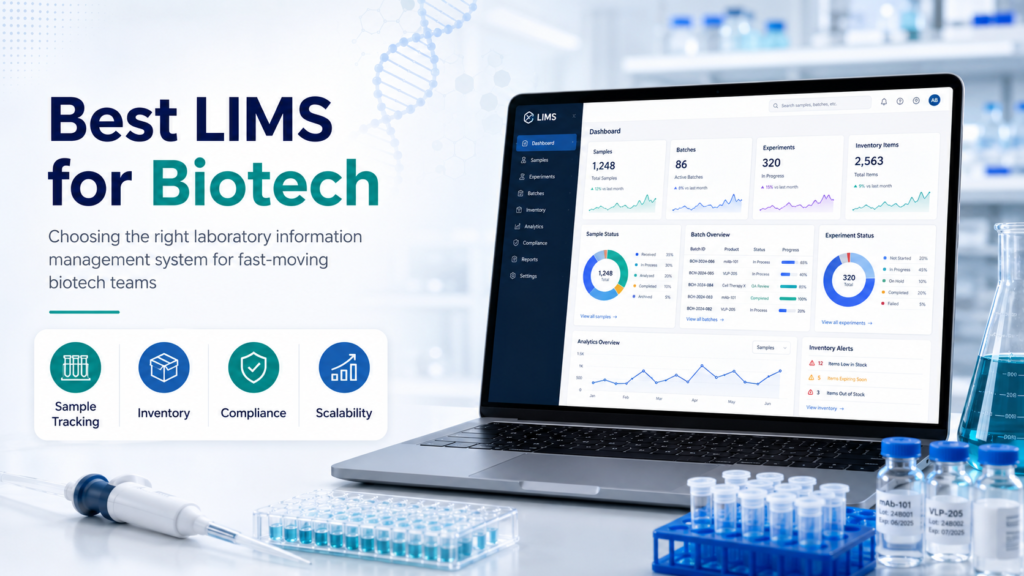
Quick verdict: The best LIMS for a biotech isn’t a fixed answer — it’s a moving target that depends on where you are on the growth curve. A discovery-stage lab of eight scientists, a Series B company scaling past thirty, and a clinical-stage organization approaching regulated work each need a different system, and the platform that fits one can actively hurt another. This guide maps the biotech LIMS landscape by stage and workflow rather than by feature count, explains the trade-offs the vendor marketing won’t, and helps you choose a system you won’t have to rip out in eighteen months. Why biotech breaks the usual LIMS rules Most LIMS buyer guides assume a stable lab with a stable workflow. Biotech violates that assumption constantly. A biotech company’s defining characteristic is change: headcount doubles, programs multiply, workflows shift from exploratory science toward structured process development, and — for many — the organization eventually moves toward regulated, IND-enabling work. The LIMS decision therefore isn’t “what fits my lab today?” but “what will still fit when my lab is three times larger and doing more serious work?” This is also why biotech sits awkwardly between the two traditional software categories. Early biotech work is experiment-centric and looks like a job for an Electronic Lab Notebook (ELN); as samples, inventory, and cross-team coordination grow, it becomes sample-centric and looks like a job for a LIMS. Most biotechs need both, ideally in one system — which is why the modern biotech platform market has converged on unified ELN + LIMS + inventory tools rather than standalone products. If you’re still clarifying which side of that line your lab is on, our guide to choosing an ELN is the right starting point, and our broader LIMS software pillar frames the category. The practical consequence: the criteria that matter for biotech are not the same ones that matter for a stable QC lab. They are, in rough order of importance, the ones below. What actually matters when choosing a biotech LIMS Scale-readiness: the criterion most labs underweight The single most common biotech LIMS mistake is choosing for the lab you are, not the lab you’re becoming. Teams repeatedly report the same pattern: spreadsheets stop scaling somewhere around fifteen scientists, the team adopts an ELN-first or lightweight tool, and then — as more samples move through the lab, more people touch the same materials, and experiments become interdependent — that early choice starts to strain. The system that was perfect for quick, flexible discovery work becomes the thing that’s hardest to manage once operational structure, sample governance, and traceability become daily needs. The lesson isn’t that flexible tools are bad; it’s that flexibility without structure has a cost that only appears at scale. When you evaluate, ask each vendor concretely what happens at three times your current size: more users, a second and third program, external CROs in the workflow, and the first serious conversation about compliance. Unified data model vs. stitched stack Biotechs that assemble separate ELN, LIMS, and inventory tools pay what some in the industry call an “integration tax” — the ongoing cost of connectors, data reconciliation, and sync failures between systems that were never designed to be one. A platform built on a single underlying data model, where experiments tie directly to samples, inventory, and workflows, avoids that tax. This is a genuine architectural advantage, not just marketing — but verify it in a trial rather than taking it on faith, because “unified” is a word every vendor uses. R&D-native tooling for molecular biology If your science is molecular — cloning, sequencing, CRISPR, plasmid and molecule registration — then native tooling for that work is a first-class requirement, not a nice-to-have. Some platforms build sequence editors, plasmid maps, and molecule registration directly into the system; others treat them as afterthoughts. A biotech doing heavy molecular biology should weight this heavily; one doing industrial fermentation or diagnostics may not need it at all. Match the tool to your actual science. API-first architecture and instrument connectivity Biotech labs live in a broader ecosystem of instruments, automation, and analytics. An API-first design determines whether your LIMS becomes the connected hub of that ecosystem or an island you’re forever exporting data out of. For labs running automation — bioreactors, liquid handlers, sequencers — out-of-the-box integrations versus custom-development requirements can be the difference between a two-week and a two-quarter deployment. Pricing transparency and total cost Biotech LIMS pricing is notoriously opaque, and the gap between budgeted and quoted cost is where many buying processes stall. Insist on an all-in number and understand where the price jumps — often when you cross a team-size threshold between tiers. For a deeper treatment, see our LIMS pricing models explainer. The key discipline is comparing total first-year cost across your real shortlist, not headline figures. Data portability and exit strategy An underrated criterion: how hard is it to leave? Some widely used platforms store data in proprietary formats with limited export options, which makes migration difficult and turns a multi-year contract into a lock-in with no exit strategy. Before you sign, ask exactly how you would extract your data — experiments, samples, and files — if you chose to leave. A vendor confident in their product will answer plainly. The vendors, mapped by biotech stage and workflow There is no single best biotech LIMS. Below, the platforms that consistently appear on biotech shortlists in 2026, grouped by the situation they serve best — with honest trade-offs, since several of the most-cited comparisons online are published by vendors about their own competitors and should be read with that bias in mind. For molecular-biology-heavy R&D: Benchling Benchling has become something close to the default for high-growth biotech and life-science R&D, and for good reason. It’s less a traditional LIMS than a unified platform combining molecular biology tools — sequence editors, plasmid maps, CRISPR design, molecule registration — with an ELN and LIMS capabilities in one system. Its R&D-native tooling is best-in-class for molecular work,
Best LIMS Software in 2026: The Independent Guide to Laboratory Information Management Systems
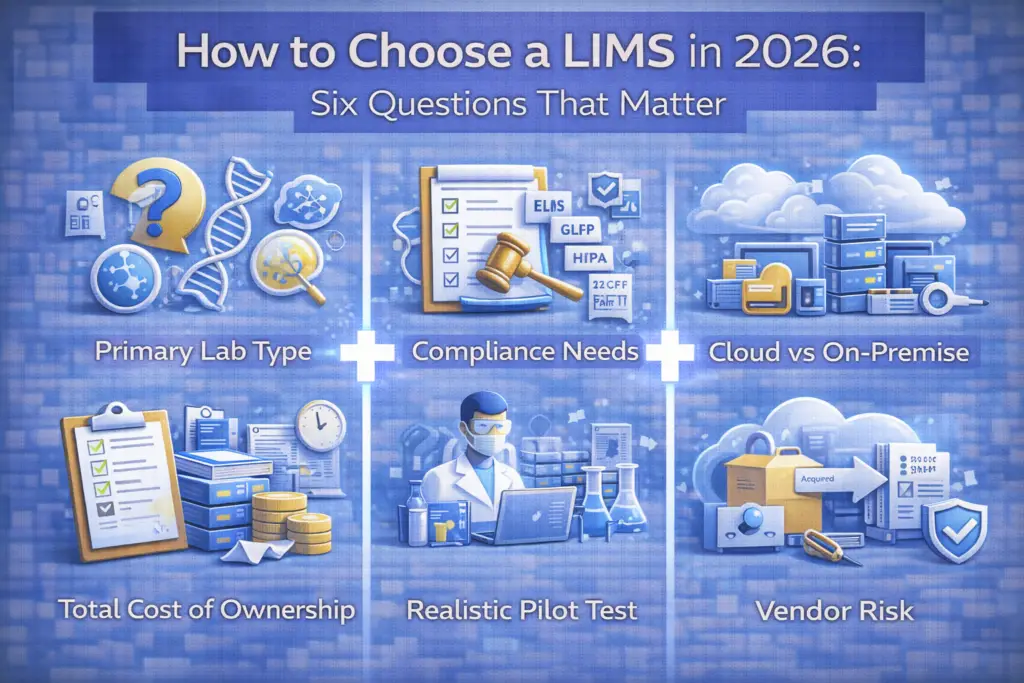
This best lims guide reviews 7 LIMS platforms based on independently verified information from vendor documentation, product release notes, user reviews on G2 and Capterra, and industry sources. No vendor has paid for inclusion or editorial positioning. Pricing is not included — published rates vary by configuration, region, and contract. Always contact vendors for current quotes. What Is a LIMS — And Why Does Choosing the Right One Matter in 2026? A Laboratory Information Management System (LIMS) is the operational backbone of a modern laboratory. It manages the complete sample lifecycle — from receipt through testing, result capture, and final reporting — while enforcing data integrity, regulatory compliance, and traceability across every step. In 2026, the LIMS market spans an unusually wide range of platforms: from decades-old enterprise systems deployed across global pharmaceutical networks, to cloud-native tools that went from zero to a major market position in under five years. Choosing the wrong LIMS — or the right LIMS for the wrong context — is one of the most expensive mistakes a laboratory organization can make. Implementations in regulated environments are measured in months and cost hundreds of thousands of dollars before the first sample is tracked. This guide helps you cut through the noise. We cover 7 platforms with verified, sourced data organized by what they actually do well — and who they are actually designed for. Don’t hesitate to have a look at our complete Lims guide for additional information. Quick navigation: Each vendor review includes a verified spec card, an independent assessment, clear strengths and limitations, and a direct ‘best for’ recommendation. Skip to any vendor using the headings or jump to the comparison tables at the end. 7 LIMS Platforms at a Glance: 2026 Independent Overview The table below summarizes the 7 platforms reviewed in this guide. Pricing is not included — see each vendor review for pricing guidance. Deployment and industry data is sourced from official vendor documentation. LIMS Platform Vendor / Owner Platform Scope Deployment Primary Industries LabWare LIMS LabWare (private) Enterprise LIMS + ELN + LES Cloud + On-premise Pharma, biotech, environmental, forensics, QC LabVantage LabVantage Solutions Enterprise LIMS + ELN + LES + SDMS Cloud (AWS) + On-premise Pharma, biobanking, food & bev, forensics, oil & gas SampleManager LIMS Thermo Fisher Scientific LIMS + SDMS + ELN + LES Cloud (AWS) + On-premise Pharma, food & bev, oil & gas, environmental, contract testing STARLIMS Francisco Partners (ex-Abbott) LIMS + ELN + SDMS + analytics Cloud + On-premise Clinical, forensics, pharma, public health, environmental Benchling Benchling (private) R&D cloud platform (LIMS + ELN) Cloud SaaS Biotech R&D, molecular biology, biopharma discovery QBench QBench (private) Cloud LIMS + QMS + billing Cloud SaaS Testing labs: biotech, food & bev, agriculture, diagnostics Clarity LIMS Illumina Genomics-specific LIMS Cloud SaaS Genomics / NGS labs, sequencing service providers How to read this guide: Platform Scope refers to the breadth of modules offered beyond core LIMS (ELN = Electronic Lab Notebook, LES = Laboratory Execution System, SDMS = Scientific Data Management System). A broader scope means more consolidation potential — but also more implementation complexity and cost. Note on STARLIMS: In 2025, Francisco Partners, a private equity firm specializing in technology businesses, announced the acquisition of STARLIMS from Abbott. STARLIMS continues to operate independently as a dedicated laboratory informatics business. The platform serves over 1,100 customers across 60 countries. ENTERPRISE LIMS — Large-Scale, Regulated, Multi-Site Deployments 1. LabWare LIMS Vendor LabWare (privately owned, founded 1988) Platform LabWare LIMS + ELN + LES (Enterprise Laboratory Platform) Deployment Cloud (SaaS on LabWare infrastructure) + On-premise + Hybrid Customer base 14,000 laboratories in 125 countries (per vendor) SaaS portfolio LabWare QAQC, LabWare GROW, LabWare ASSURE (launched 2025) Industries Pharma, biotech, environmental, forensics, food safety, QC manufacturing Compliance 21 CFR Part 11, EU Annex 11, ISO 17025, GLP, GMP, ALCOA+ Mobile Yes — iOS and Android app LabWare is among the most widely deployed enterprise LIMS platforms in the world, with a 30+ year track record in pharmaceutical, biotech, and regulated laboratory environments. It is privately owned and has remained independent through a market where most competitors have been acquired. Users frequently cite stability and longevity as key factors in their purchase decision. The platform is organized around the LabWare Enterprise Laboratory Platform: a core LIMS at the centre, with an integrated ELN for experiment documentation and a Laboratory Execution System (LES) for guided procedure execution. This means a single LabWare implementation can replace multiple separate tools — a significant operational and compliance advantage for complex organizations. In March 2025 at Pittcon, LabWare announced an expansion of its SaaS portfolio with three distinct offerings: LabWare QAQC for quality control workflows, LabWare GROW for growing organizations, and LabWare ASSURE for food safety and microbiology environments. These SaaS tiers are positioned as lower-friction entry points compared to the full enterprise deployment, with OpEx pricing and pre-configured best-practice workflows. What users consistently highlight What users consistently flag Best for: Large pharmaceutical companies, global multi-site organizations, regulated manufacturing labs, and CROs that require a deep, configurable, proven enterprise platform. The SaaS tiers (QAQC, GROW, ASSURE) extend LabWare’s reach to mid-market labs that want enterprise-grade compliance without a full custom deployment. 2. LabVantage LIMS Vendor LabVantage Solutions (Somerset, NJ; 40+ years in market) Platform LIMS + ELN + LES + SDMS + Advanced Analytics Current version LabVantage 8.9 (released March 2025) Deployment Cloud SaaS (AWS) + On-premise Customer base 1,500+ customers across life sciences, pharma, food & bev, forensics, and more Interface 100% browser-based, zero-footprint (no client software required) Industries Pharma/biopharma, biobanking, food & beverage, oil & gas, forensics, contract testing Compliance 21 CFR Part 11, EU Annex 11, ALCOA+, FAIR data principles, GDPR, CLIA AI Predictive analytics, AI bots (LabVantage Open Talk), embedded AI agents in v8.9 LabVantage occupies a strong position in the enterprise LIMS market, combining the depth of a decades-old platform with a modern, fully browser-based architecture. Its zero-footprint deployment model — no client software, plugins, or apps required — is a