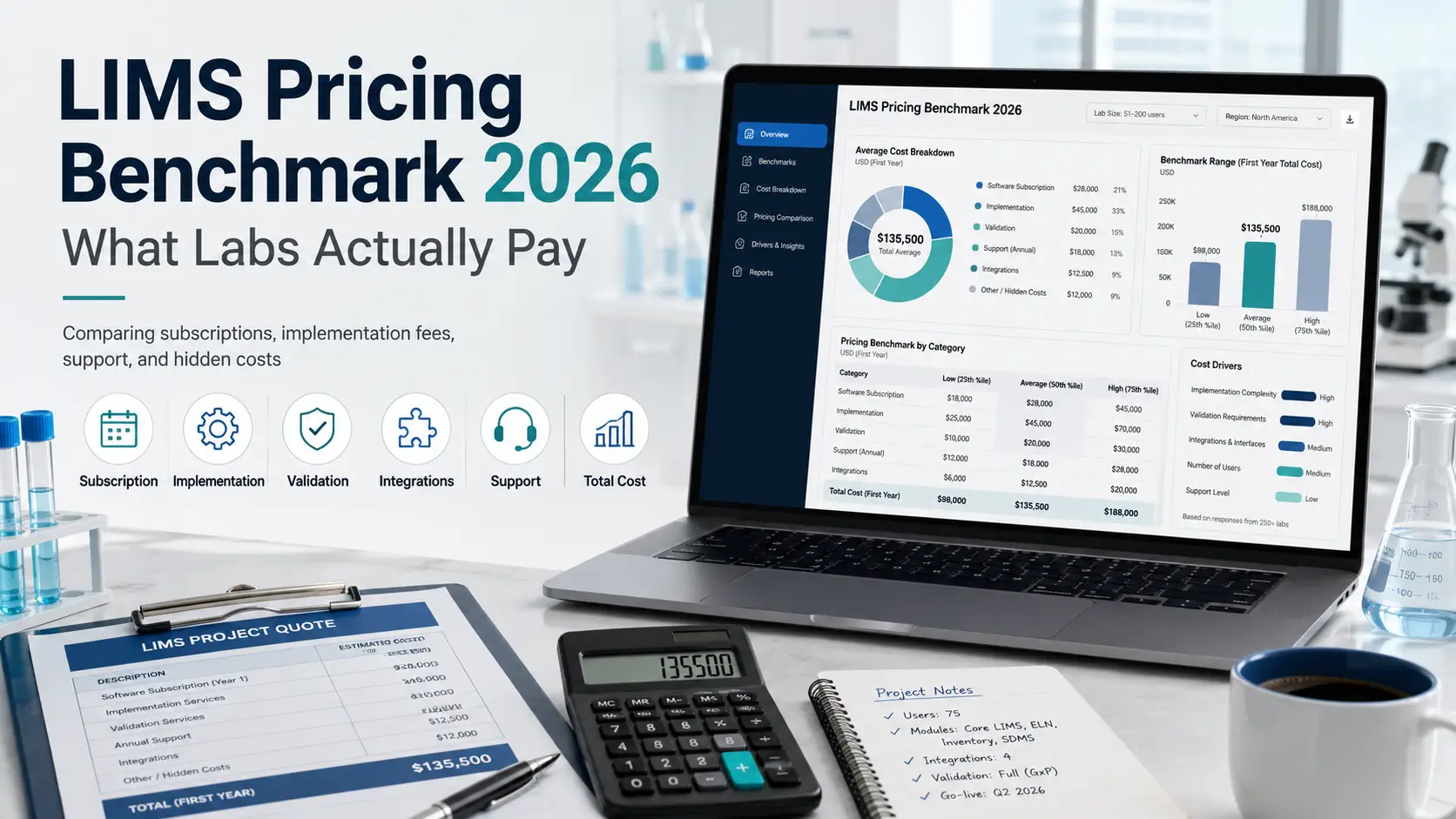
Cloud LIMS subscriptions in 2026 cluster between roughly $40 and $300 per user per month, with published vendor tiers concentrated in the $250–$425 range for mid-market testing platforms. Perpetual on-premise licences start around $20,000–$50,000 and reach seven figures for enterprise deployments, with annual maintenance typically adding 20–25% of the licence cost. But the single most useful finding of this benchmark is methodological: most LIMS pricing circulating online is estimated rather than verified, sources contradict each other on the same products, and at least one widely cited pricing aggregator discloses that its figures are AI-generated extrapolations. This guide separates what is genuinely documented from what is guesswork.
Why this benchmark exists — and why it comes with caveats
Ask what a LIMS costs and you enter one of the most opaque software markets in the enterprise landscape. Most vendors publish nothing, releasing numbers only after a demo and a sales conversation. That opacity has produced a secondary industry of pricing “guides” that fill the vacuum with estimates, and those estimates then get cited as though they were facts.
We think a pricing benchmark is only useful if it is honest about the provenance of every figure. So this guide tiers its data by how well-evidenced it is:
- Tier A — Vendor-published: prices the vendor states publicly on its own pricing page or an official marketplace listing.
- Tier B — Aggregator-reported: figures published by review platforms such as G2 and Capterra, typically supplied by the vendor or drawn from public pricing materials.
- Tier C — Third-party estimated: ranges published by consultancies, competitors, or pricing sites that model or extrapolate rather than observe. Useful for orientation, unreliable for budgeting.
One warning belongs up front. ITQlick, which ranks prominently for many LIMS pricing queries, states on its pages that its content includes contributions from OpenAI’s ChatGPT and Google’s Gemini, and its own methodology notes describe competitor figures as extrapolated from single-user or 100-user pricing with onboarding and hidden fees excluded “due to lack of available data.” Those numbers may be directionally reasonable, but they are models, not observations, and they should not anchor a procurement budget. We exclude them from the vendor table below and cite them only where labelled as estimates.
For how these costs are structured rather than what they total, see our LIMS pricing models explainer.
Vendor-level pricing: what is actually documented
The following table covers vendors whose pricing is either published directly or reported by major aggregators. Where sources disagree, we show the disagreement rather than averaging it away.
| Vendor | Reported price | Tier | Source & notes |
|---|---|---|---|
| QBench | Starter $249/user/mo; Growth $299; Advanced $399; Enterprise on request | B | Capterra, June 2026. Volume discounts available; no free version or trial listed. |
| QBench | Foundation $275/user/mo; Growth $325; Advanced $425 | B/C | G2 lists entry at $275; a competitor blog (Scispot) reports the $275/$325/$425 ladder. See conflict note below. |
| Scispot | Up to 10 complimentary user seats on most plans; seat-based with volume discounts thereafter; one-time implementation fee | A | Scispot published pricing page. Vendor also markets an Essential plan around $9,000/year via marketplace listing. |
| Benchling | Free unlimited academic tier; commercial reported to start around $15,000/year for a small team | B/C | Academic tier is vendor-published (A); the commercial figure is third-party reported and Benchling does not publish list pricing. |
| Qualis LIMS | Basic cloud package $9,600/year, hard-capped at 5 users; beyond that “customizable on request” | B/C | Reported by Scispot (a competitor); the 5-user cap and undisclosed higher tiers are the substantive points. |
| 1LIMS | $45–95 (€38–80) per user/month; setup €5,500–23,000 (~$6,400–27,000); labs of 2–35 users pay €400–1,700/month recurring | A | Self-published by the vendor, unusually transparent. Includes a named case: a 10-user QC lab paying $5,888 setup. |
| Genemod | Plans listed publicly; prices not disclosed. Discount programmes for diagnostics labs and academic departments | A (structure) | Genemod pricing page. A competitor confirms plans are listed without prices. |
| LabWare, LabVantage, STARLIMS, SampleManager | Not published | — | No public list pricing. Any per-user figures circulating for these platforms are third-party estimates, several explicitly AI-extrapolated. |
The QBench conflict is instructive. Capterra reports a Starter tier at $249/user/month, while G2 lists entry pricing at $275 and a competitor’s blog describes a $275/$325/$425 ladder. These cannot all be current simultaneously. The likeliest explanations are a mid-2026 price revision, tier renaming (Starter versus Foundation), or a competitor citing figures selectively. The lesson for buyers is not that any source is dishonest, but that published LIMS pricing has a short shelf life and must be confirmed with the vendor directly. Our QBench review covers the platform itself.
Note also who publishes competitor pricing analyses. Several of the most detailed “X pricing explained” articles are written by direct competitors, and they consistently emphasize tier jumps and hidden costs — framing that is accurate as far as it goes but selected to disadvantage the subject. Read them for the structural insight, not the verdict.
Market-level benchmarks: the ranges labs actually encounter
Where vendor-specific data is unavailable, market ranges give useful orientation. These come from published guidance, and we attribute each so you can weigh the source’s incentives.
Cloud subscription, per user per month. CloudLIMS publishes a range of $40 to $300+ per user per month for cloud systems, noting that per-user cost falls as user count rises. A separate buyer’s guide cites a wider band of $75 to $1,600 per user per month, and a healthcare-focused guide gives $25 to $1,600. The wide upper bounds reflect clinical and heavily regulated systems rather than typical mid-market LIMS. For planning, the $40–300 band matches the published vendor tiers above far more closely.
Perpetual on-premise licences. CloudLIMS cites $50,000 to $250,000+ upfront. One vendor puts perpetual licences at roughly $50,000–70,000 (€43,000–60,000), while a buyer’s guide gives a much wider $20,000 to over $1 million depending on scale, and a healthcare guide cites $10,000 to $500,000. The consistent element across all sources is the annual maintenance charge: 20–25% of initial licence cost, with support fees in regulated environments commonly running 15–25%.
Annual all-in totals by lab size. QBench’s own guidance segments the market into entry-level platforms under about $25,000/year, a mid-range of $25,000–50,000 (naming QBench, Genemod and CloudLIMS in that band), and legacy enterprise contracts above $50,000, with total cost of ownership reaching $100,000–200,000 once training, development and implementation are included — an overall span of roughly $10,000 to $100,000+ per year. A European vendor gives first-year costs of €10,000–15,000 for small labs rising to €40,000–50,000+ for large or complex ones. These two independent segmentations agree closely, which raises confidence in them.
Volume discounting is real and steep. One guide illustrates per-user cost falling to around $66/user/month at 50 users, against entry pricing several times higher. If you are pricing a growing lab, model the discount curve rather than multiplying the sticker price by headcount.
The costs that don’t appear in any pricing table
Every credible source converges on the same warning: the subscription line is not the budget. Licences and subscription fees account for roughly 40–60% of total LIMS cost, meaning implementation, migration and change management make up the balance.
Implementation and onboarding. Published implementation figures range from around $5,000 for a small business to over $50,000 for larger enterprises, and one vendor’s transparent breakdown puts setup — assessment, configuration, import and training — at €5,500–23,000. Treat any quote that omits implementation as incomplete.
Data migration. Consistently identified as the most common budget surprise. Historical results and sample records living in spreadsheets or legacy systems require cleaning, mapping, validation and import, and the messier the source data, the longer and costlier it becomes. Our implementation timeline guide covers how this affects the schedule as well as the budget.
Compliance and validation. For regulated labs, this is where a seemingly affordable LIMS becomes a six-figure purchase. Audit trails, electronic signatures and formal validation packs carry real cost, and assuming the vendor’s standard documentation will satisfy your auditors is a common and expensive budgeting error. See our LIMS validation guide and 21 CFR Part 11 explainer.
Tier thresholds. Several platforms impose hard caps — Qualis reportedly limits its $9,600/year cloud package to five users, with undisclosed pricing beyond — or steep step-ups between tiers. Ask every vendor where the next price jump sits relative to your growth plan.
How to use this benchmark
Treat these figures as a sanity check on quotes, not as a substitute for them. Three practical rules follow from the data.
First, budget the total, not the licence. If subscriptions are 40–60% of true cost, a $30,000 annual licence implies a realistic first-year commitment closer to $50,000–75,000 once implementation, migration and training are counted.
Second, verify every number with the vendor, in writing, dated. The QBench discrepancy above shows that even well-maintained aggregator listings drift out of date within months. Ask for a written quote specifying users, tier, implementation, migration, training, and the price at renewal.
Third, weight transparency as a selection criterion. Vendors who publish pricing — Scispot, QBench, 1LIMS among them — make budgeting possible and reduce negotiation asymmetry. Opacity is not proof of expense, but it does transfer risk to you.
For structuring the wider evaluation, our how to choose a LIMS checklist is the natural next step, and smaller labs should see our best LIMS for small laboratories guide for the fast-deploying, transparently priced end of the market.
Methodology and limitations
This benchmark compiles publicly available pricing published or reported as of July 2026. We have not received vendor quotes, conducted a buyer survey, or audited any figure against a signed contract — and we say so plainly, because several sources presenting comparable data do not.
Specific limitations worth stating. Prices change frequently and several figures here already conflict across sources. Enterprise platforms publish nothing, so their absence from the table reflects the market’s opacity rather than an omission. Vendor-published figures are entry prices, and real quotes vary with configuration, integrations and negotiation. Several sources are competitors of the vendors they price. And we have deliberately excluded AI-extrapolated aggregator figures from the vendor table, since a modelled number presented as an observed one is worse than no number at all.
If you have received a dated written quote and are willing to share the figures, we would welcome the contribution — verified buyer-side data is exactly what this market lacks.
The honest bottom line
LIMS pricing in 2026 is knowable in broad strokes and unknowable in specifics without a quote. The broad strokes are consistent enough to plan against: $40–300 per user per month for cloud subscriptions, $25,000–50,000 annually for a mid-market platform, $50,000+ for enterprise, licences at 40–60% of true cost, and maintenance at 20–25% of any perpetual licence. Those numbers are corroborated across independent sources and match the vendor tiers that are actually published.
What no benchmark can give you is your number. The gap between the market range and your quote will be determined by your user count, your compliance burden, your migration complexity, and how well you negotiate — and the labs that budget well are the ones that priced the whole programme rather than the subscription line.
Prices compiled July 2026 from publicly available sources and subject to change. Figures should be confirmed directly with vendors before any purchasing decision; nothing here constitutes a quote. LabSoftwareGuide is an independent editorial resource and is not affiliated with the vendors listed. Where a cited source is a competitor of the vendor being priced, we say so.
Sources
Vendor-published (Tier A)
- Scispot — Pricing: https://www.scispot.com/pricing
- Genemod — Plans and Pricing: https://genemod.net/pricing
- QBench — LIMS Pricing: https://qbench.com/pricing
- 1LIMS — LIMS Software Costs Breakdown (self-published detail): https://www.1lims.com/blog/lims-software-costs-breakdown
Aggregator-reported (Tier B)
- Capterra — QBench Software Pricing (June 2026): https://www.capterra.com/p/275266/QBench/
- G2 — QBench Pricing: https://www.g2.com/products/qbench/pricing
Market ranges and analysis (Tier B/C)
- CloudLIMS — How Much Does a LIMS Cost? Pricing Comparison, TCO & ROI: https://cloudlims.com/how-much-does-a-lims-cost-pricing-comparison-tco-roi/
- QBench — The Hidden Costs of a LIMS: https://qbench.com/blog/the-hidden-costs-of-a-lims-what-to-know-before-you-buy
- Riveraxe — LIMS System Price: A 2026 Buyer’s Guide: https://riveraxe.com/lims-system-price/
- Healthray — LIMS Pricing Guide 2026: https://healthray.com/blog/lims/lims-pricing-guide-cost-subscription-and-roi/
- Scispot — Qbench Pricing Explained (competitor analysis): https://www.scispot.com/blog/qbench-pricing-explained-is-it-worth-it
- Scispot — Qualis LIMS Pricing (competitor analysis): https://www.scispot.com/blog/qualis-lims-pricing-complete-cost-breakdown
Excluded from vendor table — methodology disclosed as AI-assisted/extrapolated
- ITQlick — LabWare LIMS Pricing: https://www.itqlick.com/labware-lims/pricing
- ITQlick — BioMed LIMS Pricing: https://www.itqlick.com/biomed-lims/pricing