A LIMS implementation takes anywhere from about 6 weeks to 12 months or more, and the range isn’t vagueness — it’s the single most important thing to understand before you start. Where your project lands depends on three variables: your lab’s size and number of sites, how much you customize versus configure, and — most decisively — whether you did the readiness work before signing. This guide gives realistic, phase-by-phase timelines by lab type, names the stages where projects actually slip, and separates the genuine horror stories from the avoidable ones.
Why “how long does it take?” has no single answer
Ask a vendor how long a LIMS takes to implement and you’ll get an answer calibrated to close a sale. Ask a lab that just finished one and you’ll get a number shaped by their specific pain. Neither is dishonest, but neither generalizes — because implementation time is driven by factors that vary enormously from lab to lab.
The useful way to think about it is that a LIMS implementation is not a software installation; it’s a multi-phase project that aligns a system with your workflows, your data, your instruments, and your compliance obligations. Two labs buying the identical product can see a 6-week gap and a 9-month project depending on scale, customization, and readiness. So rather than quoting a single figure, this guide gives you ranges anchored to your situation, and — just as importantly — shows you which of your own decisions move the number. It closes with the organizational risks that sit outside the schedule.
Realistic timelines by lab type
The ranges below reflect timelines reported across vendor implementation guides, practitioner accounts, and industry sources in 2026. Treat them as planning anchors, not promises.
Small, single-site labs with minimal customization: roughly 6–12 weeks. A focused lab adopting a modern cloud LIMS, using vendor pre-configured templates and deferring nice-to-have features, can reach go-live quickly. Aggressive 6-to-8-week deployments are genuinely possible for simple scenarios — but they come with trade-offs: compressed testing and validation, limited stakeholder engagement time, and a heavier post-go-live support burden. Fast is achievable; fast-and-thorough is harder.
Mid-sized labs with integrations: roughly 3–6 months. Once you add instrument integrations, meaningful configuration to match established workflows, and real data migration, the timeline extends. A commonly cited range for configurable LIMS at this scale is around 6 to 9 months when the system is tailored closely to the lab’s processes, though well-scoped cloud deployments can land at the shorter end.
Focused clinical or specialty labs: roughly 8–16 weeks. Cloud LIS/LIMS deployments for a single clinical or specialty lab typically run in this band, extending for multi-site or multi-specialty operations. The interface build — connecting to EHRs and instruments — is frequently the critical path here. Our LIMS for clinical and diagnostic labs guide covers the clinical specifics.
Enterprise and multi-site deployments: roughly 6–12 months, sometimes longer. Multiple locations, diverse lab types under one system, complex enterprise integrations (ERP, CRM), and thousands of users push projects into the 6-to-12-month range and occasionally beyond. These are best implemented in waves — by geography or lab type — with central configuration management rather than a single big-bang cutover. Enterprise platforms like LabWare, LabVantage, and STARLIMS live here; see our reviews of LabWare, LabVantage, and STARLIMS for how their heft affects deployment.
A calibrating rule of thumb from practitioner reports: add 30–50% to each phase if the internal project owner is allocated less than half-time to the implementation. Under-resourcing the project lead is one of the most reliable ways to blow the timeline.
The phases — and where each one hides delay
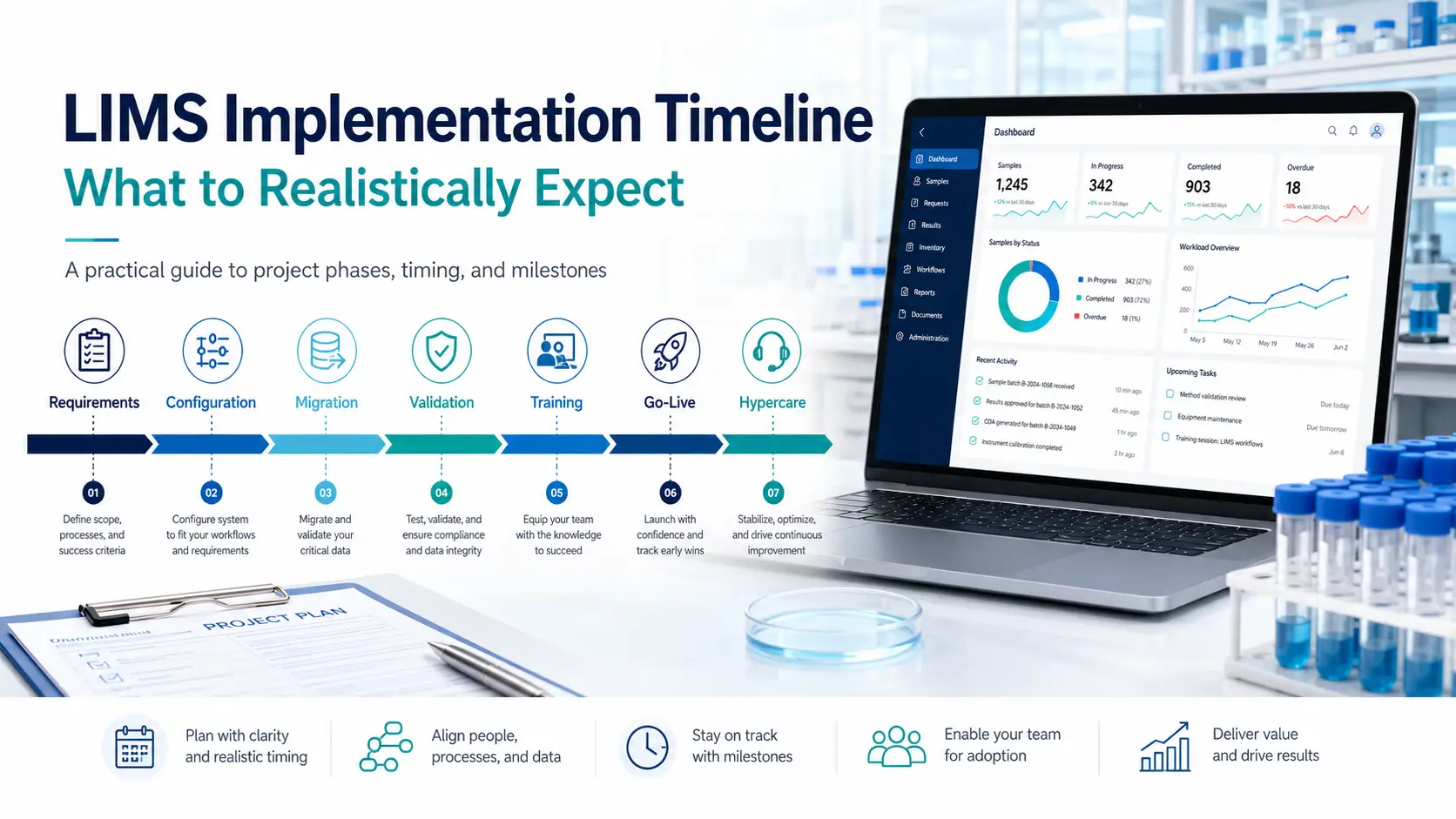
Regardless of size, a LIMS implementation moves through the same sequence. Understanding what each phase demands is how you build a timeline that survives contact with reality.
Phase 1 — Discovery and requirements (often underestimated)
The project begins not with software but with mapping what your lab actually does: workflows, sample types, result templates, approval chains, report formats, and the regulations that bind you. This phase also prioritizes requirements into “must have” versus “nice to have” — a distinction that later governs whether you stay on schedule. Skipping or rushing discovery is the root cause of a large share of failed implementations, because everything downstream is built on it. Well-run projects treat the first stretch as configuration-away-from-production: your instance is built to match your workflows while the lab keeps running exactly as before, and staff don’t touch new software yet.
Phase 2 — Configuration (and the customization trap)
Here the system is shaped to your processes. The single biggest timeline risk in this phase is scope creep: as users see what’s possible, feature requests multiply, each requiring additional development, testing, and validation that pushes go-live back. Industry guidance is emphatic that customization should happen only where it delivers genuine business value, because every customization compounds future maintenance, migration, and validation effort. The discipline of implementing must-haves first, in an iterative approach, is what keeps projects from bogging down.
Phase 3 — Data migration (the most common budget and time surprise)
If there’s one phase that consistently runs longer than planned, it’s this one. Data management and migration is almost always a bigger job than anticipated. Historical results, method parameters, and sample records living in spreadsheets or legacy systems must be cleaned, mapped, validated, and imported — and the messier the source data, the longer it takes. Poor compatibility between old and new systems can cause corruption, loss, or duplication that requires extensive validation and can stretch the process for months. The fix is to treat migration as its own workstream with a named owner, and to do the data cleanup before deployment rather than discovering it mid-project.
Phase 4 — Integration and testing
Connecting instruments and enterprise systems is where technical reality bites: protocol mismatches, legacy-equipment limitations, and manufacturer incompatibilities can all impede seamless data flow. Testing must cover data integrity, workflow alignment, security, and instrument integration, ideally simulating real-world scenarios before go-live. For regulated labs, formal validation is layered on top — see our LIMS validation guide for what audit-ready validation requires and how it extends the timeline.
Phase 5 — Training, parallel run, and go-live
A well-run rollout is phased, not a Monday-morning cutover. The recommended pattern introduces the LIMS to a contained slice of the operation first, gathers feedback, and refines before full deployment — with the old system still running until the new one is proven. A parallel-running period (commonly a few weeks) validates that data flows correctly before you fully depend on the new system. This is your safety net; compressing it to save time is a false economy.
Beyond go-live
Deployment doesn’t end at launch. The weeks after go-live involve measuring against your pre-project baseline (commonly at week six to eight), watching for the “Excel fallback” where staff quietly revert to spreadsheets, and building internal admin expertise so the lab owns the system rather than depending on the vendor for every adjustment.
What the failure statistics actually say
The fear surrounding LIMS timelines isn’t irrational, but it’s often misdirected. A 2024 Deloitte survey found that 92% of genomics labs cite LIMS modernization as a top digital-transformation priority, yet 63% report failed attempts or major disruptions during migration — attributed primarily to poor planning, compliance gaps, and lack of architectural foresight. That’s a striking failure rate, but notice the causes: they’re overwhelmingly about readiness and planning, not the software itself.
The most honest framing in the industry literature is that the horror stories — months of downtime, staff in revolt, data lost in migration — tend to involve one of three things: enterprise ERP projects miscategorized as LIMS work, implementations run without proper discovery, or vendors who sold software without the services to support it. A structured, well-scoped implementation with the right partner looks nothing like those cautionary tales. In other words, the timeline risk is real but largely controllable.
Two human factors deserve specific mention because they silently extend timelines. First, staff resistance: around 29% of labs cite it as a top barrier to digitalization, and it’s rarely about the system itself but about sudden, unfamiliar change — the fix is involving key staff in the assessment phase before configuration decisions are made. Second, the expertise gap: partially automated labs often discover they need someone who can configure workflows and troubleshoot integrations without calling the vendor every time, and that person must be identified and developed deliberately.
What actually moves your timeline
If you want a shorter, more predictable project, the levers are clear and mostly within your control.
Readiness is the master variable. The single most reliable predictor of hitting your timeline is whether pre-implementation work — workflow mapping, baseline KPIs, data cleanup, scope definition — is treated as a real project phase rather than a pre-meeting checklist. Labs that ask “are we ready for any system?” before “which system should we buy?” consistently do better.
Configuration beats customization. Leaning on vendor-configurable functionality rather than bespoke development shortens the build, testing, and validation effort simultaneously. This is a strong argument for choosing a platform whose out-of-the-box capabilities match your needs — our how to choose a LIMS checklist helps assess that fit.
Data readiness prevents the most common overrun. Because migration is the top time-and-budget surprise, cleaning and mapping your source data before the project starts removes the single biggest source of slippage.
A dedicated project owner protects the schedule. Given the 30–50% penalty for a half-allocated lead, ensuring the internal owner has genuine time for the project is one of the highest-leverage decisions you can make.
Deployment model matters. Cloud deployments often compress infrastructure setup because the vendor handles provisioning, while on-premises and heavily regulated environments add time for hardware, security, and validation. Modern cloud-native platforms increasingly advertise weeks-not-months go-lives — see our best LIMS for small laboratories guide for the fast-deploying options.
Risks beyond the schedule
Timelines slip for technical reasons, but three organizational risks decide whether a LIMS is still used well a year after go-live. None of them shows up in a vendor’s project plan.
Weak executive sponsorship
A LIMS changes how QA, the lab and IT work together, and those groups rarely agree on priorities without arbitration. Projects without a named sponsor who has budget authority tend to stall on decisions: which workflows to standardize, which legacy data to migrate, whether a request is configuration or scope creep. Before kick-off, name the sponsor, agree how scope disputes are escalated, and plan a steering meeting at each phase gate.
Change management and user adoption
Technicians who have run a lab on spreadsheets for years judge a new system on the first week, not the business case. Adoption problems usually come from workflows configured without the people who run them, training delivered too early or too generically, and a parallel run that lets users fall back on old habits indefinitely. Involve key users in requirements and testing, train on the lab’s own workflows close to go-live, and set a firm end date for the parallel run.
Dependency on the vendor
Every configuration choice that only the vendor can maintain increases the cost of future changes and of leaving. The risk grows with custom code, proprietary scripting and SaaS contracts that do not specify data export. During selection and implementation, ask who will be able to change workflows and reports after go-live, document configurations in-house, and confirm in the contract that you can export complete data, including audit trails, in a usable format. Our LIMS validation guide covers the regulatory side of vendor oversight.
The honest bottom line
A realistic LIMS timeline is a range, and the range is wide because so much depends on decisions you control. A small single-site lab that configures rather than customizes and prepares its data can be live in a couple of months; a multi-site enterprise doing heavy integration and validation should plan for the better part of a year and implement in waves. The projects that fail their timelines almost always failed their readiness first — miscategorized scope, skipped discovery, or migration treated as an afterthought.
The practical takeaway is reassuring: you are not at the mercy of an unpredictable process. Scope honestly, prepare your data, resource your project lead, favor configuration over customization, and phase your rollout — and a LIMS implementation becomes a manageable project with a timeline you can actually forecast, rather than the open-ended ordeal the horror stories suggest.
Where to go next
Before you start, read our how to choose a LIMS checklist to structure selection. Regulated labs should review our LIMS validation guide and 21 CFR Part 11 explainer, and anyone still framing the budget should see our LIMS pricing models guide, since implementation and migration are the most underestimated line items in the total cost.
This guide is updated as the laboratory software landscape evolves. Timelines vary by lab, vendor, and scope; the ranges here are planning anchors, not guarantees. Much of the published guidance on this topic originates from LIMS vendors, and this guide presents timelines critically rather than as sales estimates. LabSoftwareGuide is an independent editorial resource.
Sources
- Revol LIMS — The Complete LIMS Implementation Guide: 12-Week Roadmap to Go-Live Success: https://revollims.com/lims-implementation-guide-roadmap
- Wavefront Software — LIMS Implementation Time: How long is a LIMS implementation?: https://www.wavefrontsoftware.com/faq-items/lims-implementation-time/
- QIA — LIMS Implementation: What to Expect in 90 Days: https://www.qi-a.com/learning-center/lims-implementation-what-to-expect-in-90-days/
- LIMS IQ — LIS Implementation Timeline & Onboarding Process: https://limsiq.com/lis-implementation-timeline/
- 1LIMS — LIMS Deployment Guide: How to Prepare, What It Costs, and How to Succeed After Go-Live: https://www.1lims.com/blog/9-best-practices-for-lims-implementation
- Astrix — Common Causes of LIMS Implementation Failures: https://astrixinc.com/blog/commmon-causes-of-lims-implementation-failures/
- NonStop — LIMS Modernization 2026: A Complete Step-by-Step Guide for Genomics & Clinical Labs (Deloitte survey data): https://nonstopio.com/blogs/lims-modernization-2026-a-complete-step-by-step-guide-for-genomics-clinical-labs
- Infosys — The LIMS Puzzle: Challenges of LIMS Implementation (scope creep): https://blogs.infosys.com/engineering-services/industrial-iot/the-lims-puzzle-challenges-of-lims-implementation.html
- Splashlake — Common Challenges With LIMS Implementation: https://www.splashlake.com/lims-integrations/common-challenges-with-lims-implementation-and-how-to-solve-them
- Sapio Sciences — The Scientist’s Survival Guide: Navigating complex LIMS implementation: https://www.sapiosciences.com/resource/the-scientists-survival-guide-navigating-complex-lims-implementation/