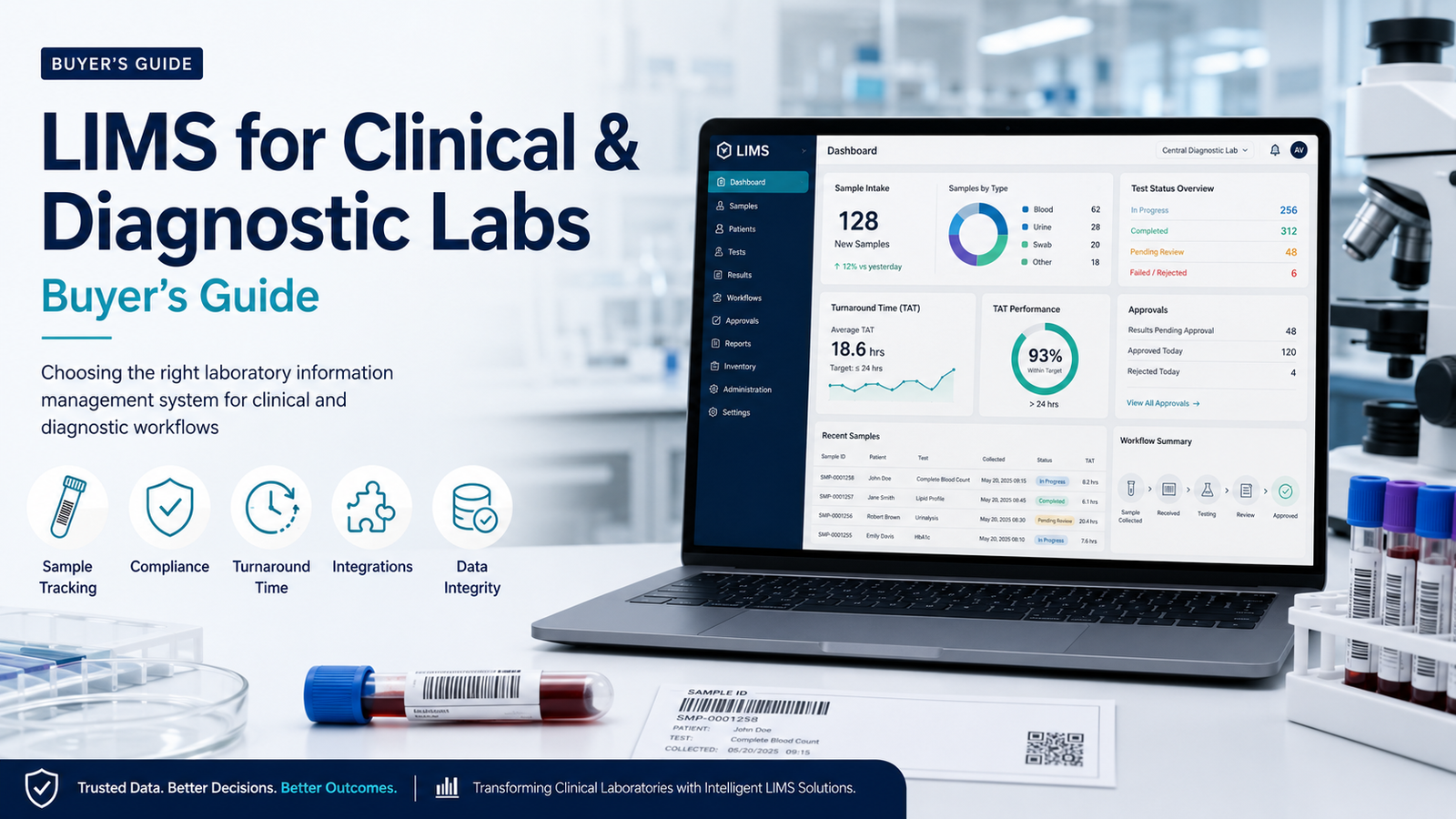
Quick verdict: Before you shortlist a single product, settle a prior question most buyer guides skip: does your lab need a LIMS, a LIS, or both? Clinical and diagnostic laboratories run patient-centric workflows governed by CLIA, CAP and HIPAA, which is LIS territory — while molecular and specialty labs increasingly need LIMS-style batch traceability that traditional LIS platforms were never designed to provide. Getting this categorization wrong is the single most expensive mistake in clinical lab software procurement, and it happens constantly. This guide resolves it first, then maps the vendor landscape by lab type.
The distinction that decides everything
The terms LIMS and LIS are used loosely across the industry, and in healthcare contexts many vendors and buyers now treat them as interchangeable. That looseness is convenient in conversation and dangerous in procurement, because the two categories were built around fundamentally different objects.
A LIS is organized around the patient. Orders arrive tied to a patient encounter — via paper requisition, provider portal, or HL7 ORM message from an EMR. The output is a clinical report that lands in a chart and informs a care decision. The regulatory frame is CLIA, CAP accreditation, HIPAA and state licensure. The system must handle bidirectional EMR connectivity, reference lab routing, autoverification, and payer-clean billing handoffs, capturing CPT codes and diagnosis linkages for claim generation.
A LIMS is organized around the sample. Specimens enter tied to a project, batch, or production run rather than a patient encounter — patient identity may be absent entirely. The workflow is multi-step preparation, aliquoting, batch instrument runs, and analytical computation, with reagent lots, plates, and freezer locations as first-class data. The compliance frame is GLP, GMP, ISO 15189/17025, or 21 CFR Part 11 — not CLIA.
The historical origin explains the divergence: LIMS emerged from research and industrial laboratories where sample management and chain of custody dominate, while LIS emerged from clinical diagnostics where result reporting and EHR integration dominate. Our LIMS software pillar covers the broader category, and labs still weighing categories should read our ELN buyer’s questions too.
The practical test: if your mission is patient diagnostics and your output goes into a medical record, you need LIS capability. If your specimens are batched, aliquoted and tracked through analytical workflows without patient identity as the organizing principle, you need LIMS capability. Most modern clinical specialty labs sit somewhere in the middle — which is exactly why this article exists.
Why so many clinical labs genuinely need both
The middle ground is now the majority case, not the exception. A toxicology lab runs an LIS workflow — chain of custody, HL7 ORM/ORU messaging, CLIA-aligned QC — while needing LIMS-style batch processing. A molecular diagnostics lab reports patient results but runs library preparation, plate-based batching, sequencing runs, and bioinformatics pipelines that look nothing like classical clinical chemistry.
This is where a real tension has emerged in 2026. Some vendors argue that molecular diagnostic labs are outgrowing traditional LIS platforms, pointing out that a LIS typically cannot automatically move data between sequencers, bioinformatics platforms, and reporting — forcing labs into error-prone manual export-and-reimport cycles — and that LIS architectures were never designed for the batch-level traceability and documentation depth that molecular work demands. It’s a fair critique of the workflow gap, though it’s worth noting that the most vocal versions of this argument come from LIMS vendors selling into that gap.
The pragmatic resolution most labs reach is not rip-and-replace but coexistence: a LIMS handling the analytical and batch workflow, integrated bidirectionally with the LIS via HL7 or FHIR for orders and patient reporting. When evaluating any platform for a specialty clinical lab, the integration story between these two layers deserves as much scrutiny as either system’s standalone features.
What clinical and diagnostic labs must evaluate
Regulatory compliance is the entry ticket
Clinical labs face a compliance stack that research labs never encounter. CLIA ’88 governs testing performed on human specimens — CMS regulates roughly 320,000 lab entities under the program — with CAP accreditation, HIPAA, and state licensure layered on top. Several states impose additional requirements, with New York’s CLEP program among the most demanding, alongside California, Florida and Pennsylvania. Labs performing FDA-regulated work may face 21 CFR Part 11 obligations as well.
What this means practically: role-based access control, timestamped audit logs capturing every field change with before-and-after values, electronic signature workflows, and encryption of protected health information aren’t premium features — they’re baseline requirements. CLIA requires them and CAP auditors expect them. Scale matters here too: where a research LIMS might log tens of thousands of activities monthly, a CLIA-certified lab can generate millions of audit records annually, since every order, result and amendment must be traceable.
Interoperability determines whether the system works at all
A clinical lab that cannot exchange data cleanly with its ordering providers is not operational. Modern platforms integrate bidirectionally with major EHR systems — Epic, Oracle Cerner, MEDITECH, athenahealth — using HL7 v2 for order and result messaging and, increasingly, FHIR R4 resources such as DiagnosticReport and Observation. Evaluate this concretely: ask which specific EHRs a vendor has live bidirectional interfaces with, how long a typical interface build takes, and what it costs. Interface work is frequently the largest hidden line item in a clinical lab implementation.
Autoverification and rules engines
For any lab with meaningful volume, autoverification — the rules-driven automatic release of results meeting defined criteria — is the difference between a system that scales and one that requires a technologist reviewing every normal result. Related capabilities include Westgard QC rules, critical value notification, and rule sequencing. These features carry direct labor implications, so weight them heavily if throughput matters.
Billing and revenue cycle
Unlike research labs, clinical labs must get paid, and the billing handoff is where many operations lose money invisibly. The system must capture CPT/HCPCS codes and diagnosis linkages cleanly enough to generate payable claims. Some vendors integrate revenue cycle management directly into the platform rather than requiring a separate billing system — a meaningful architectural choice worth evaluating deliberately.
Realistic timelines and total cost
Clinical implementations are substantially heavier than research deployments, and buyers should plan accordingly. Published guidance for clinical LIMS projects suggests roughly 6–9 months for a small lab under 20 users, 9–14 months for mid-size labs of 20–75 users, and 12–18 months for hospital or multi-site deployments, with total costs ranging from about $150,000 to $750,000 or more depending on size, integrations, and deployment model. Treat any vendor promising a dramatically faster clinical go-live with informed skepticism, and see our LIMS pricing models explainer for how these costs are typically structured.
The vendor landscape by lab type
The clinical software market segments more sharply by lab type than by size, so the shortlist below is organized accordingly.
Hospital and health-system laboratories
Labs inside a health system frequently find the decision partly made for them by the enterprise EHR. Epic Beaker, MEDITECH Expanse, and Oracle Health offer LIS modules that integrate natively with their respective EHR platforms — a substantial advantage in data continuity and a common default for organizations already standardized on that vendor. The trade-off is flexibility: customization and iteration speed can be constrained by enterprise governance and the EHR vendor’s release cycles. If your health system runs Epic, Beaker deserves serious evaluation on integration grounds alone, but evaluate it against best-of-breed alternatives rather than assuming it.
Independent, reference and outreach laboratories
Clinisys holds one of the broadest portfolios in laboratory informatics, spanning clinical pathology, anatomic pathology, outreach networking and cloud modernization, with autoverification, KPI dashboards and multi-lab networking capabilities for distributed operations. An important buyer consideration: Clinisys has assembled multiple legacy product lines — Sunquest, PowerPath, CoPathPlus and Orchard — and is working to consolidate them onto a unified cloud-native platform, a multi-year effort. That consolidation brings deep legacy expertise, but users report that switching between product lines can be complicated. Ask directly where your specific product sits on that roadmap.
Orchard Software, now part of Clinisys, serves independent, reference and hospital-affiliated labs through its Enterprise and Harvest platforms, commonly adopted by labs scaling beyond physician-office environments, with modular support for outreach, molecular and anatomic pathology workflows.
CompuGroup Medical covers distinct segments with LABDAQ in ambulatory and outreach settings, AP EASY for cloud-based anatomic pathology, and SCHUYLAB for smaller labs with integrated billing — a portfolio often evaluated by labs with straightforward workflows and cost sensitivity.
Pathology groups and labs prioritizing billing integration
LigoLab markets a combined LIS and revenue cycle management platform, positioning itself for pathology groups that want clinical operations and billing consolidated under one contract. For labs where billing complexity is a primary pain point, an integrated LIS+RCM architecture is worth evaluating against the alternative of best-of-breed systems connected by interfaces.
NovoPath focuses on anatomic pathology with case management, digital pathology integration and synoptic reporting, and is frequently cited for a clear SaaS roadmap and consistent release cadence — relevant if true multi-tenant SaaS with standardized upgrade paths matters to you. SCC WindoPath and Psyche Systems also serve pathology and discipline-specific clinical workflows.
Molecular diagnostics and genomics laboratories
This is the segment where the LIMS/LIS distinction bites hardest. Options span specialized LIS platforms with molecular capability, enterprise systems, and LIMS platforms built around batch and run workflows.
Sapio Sciences offers a low-code, AI-forward platform with the configurability that molecular workflows often demand — see our Sapio Sciences review. LabVantage is best known for LIMS but markets medical and pathology solutions, with some networks adapting it for diagnostic workflows, though depth in anatomic pathology varies; our LabVantage overview has the detail. STARLIMS is frequently cited for regulated, multi-site governance — see our STARLIMS overview.
The honest guidance for this segment: there is no single best system for clinical molecular diagnostics. Enterprise platforms suit large multi-discipline or health-system labs already standardized on that vendor, while focused molecular genetics and NGS labs organized around cases, panels, runs and variants are often better served by a system built specifically around that workflow. Labs on this path should also read our best LIMS for biotech guide, which covers NGS workflow considerations in depth.
Smaller diagnostic and specialty labs
CrelioHealth offers a cloud-based system designed specifically for clinical diagnostics, pathology and radiology workflows, automating test ordering, result validation and patient reporting. QBench brings modern cloud LIMS capability with configurable workflows and real-time dashboards, and is well regarded for usability and ease of setup — our QBench review covers it. CloudLIMS provides SaaS sample lifecycle management with compliance tooling for clinical and diagnostic settings; see our CloudLIMS review. Smaller operations should also consult our best LIMS for small laboratories guide.
Discipline-specific considerations
Clinical laboratory is not a single workflow, and the discipline you practice often matters more than your headcount when shortlisting.
Anatomic and surgical pathology revolves around cases rather than samples: accessioning, gross and microscopic descriptions, block and slide tracking, synoptic reporting, and increasingly digital pathology. The specific capabilities to probe are case management depth, synoptic report templates aligned to CAP protocols, and digital pathology readiness — viewer-agnostic integrations, case synchronization, and AI-ready workflows are emerging differentiators as image-based analysis matures. Platforms with dedicated AP heritage generally outperform generalist systems here.
Clinical chemistry and hematology are volume disciplines where throughput economics dominate. Analyzer interfacing, middleware, autoverification coverage, and Westgard QC rule support determine how many results a technologist must touch. A one-percentage-point improvement in autoverification rate compounds meaningfully across daily volume, so evaluate rules-engine sophistication rather than checking a feature box.
Microbiology carries workflow characteristics that generic systems handle poorly: multi-day incubation timelines, organism identification and susceptibility results, cascading reflex testing, and antibiogram reporting. Systems with rule-based engines built for microbiology handle these natively; those without require workarounds that persist for years.
Molecular diagnostics and genomics, as discussed above, sit at the LIMS/LIS boundary — organized around cases, panels, runs and variants, with bioinformatics pipelines that traditional LIS platforms typically cannot orchestrate automatically. Batch-level traceability across library preparation, sequencing runs and analysis is the decisive capability.
Toxicology and pain management combine clinical reporting obligations with chain-of-custody rigor closer to forensic practice, plus batch-oriented analytical runs. These labs genuinely straddle both categories and should evaluate the LIMS/LIS integration story especially carefully.
Physician office laboratories operate at the opposite end of the complexity spectrum: modest test menus, tight budgets, minimal IT support, and a need for straightforward EHR connectivity. Simpler platforms designed for this segment usually serve better than a scaled-down enterprise system.
Public health and reference laboratories add reporting obligations to registries and surveillance systems, multi-site data harmonization, and test routing across networks — capabilities that only a subset of platforms support natively.
How to run a clinical lab software selection
Start by classifying your workflow honestly. Write down what actually enters your lab (patient-linked orders or batched specimens), what leaves it (a clinical report into a chart or a dataset), and which regulations bind you (CLIA and CAP, or GLP and ISO). That classification determines whether you’re shopping for a LIS, a LIMS, or an integrated pair — and it prevents the expensive mismatch of a clinical lab fighting a research system on patient reporting, or a research lab fighting a clinical system on flexible sample types.
Map your integration targets before demos. List every system that must exchange data: EHRs by name and version, reference labs, public health registries, billing systems, instruments and middleware. Ask each vendor for live customer references using the same interfaces.
Test compliance features hands-on, not on paper. Amend a result and inspect the audit trail: does it capture user, timestamp, and before-and-after values at field level, in readable form? Configure an autoverification rule. Run a critical-value notification. Compliance datasheets are marketing; behavior in a sandbox is evidence.
Budget for the whole program, not the licence. Interface builds, data migration from your legacy system, validation, training and parallel-running costs frequently exceed the software line item. Insist on an all-in figure across the full implementation window.
Weigh the SaaS question deliberately. Cloud-hosted and true multi-tenant SaaS are not the same thing, and the difference affects upgrade paths and rollback safety. Ask specifically which architecture a vendor provides and how upgrades are managed — particularly important where validation obligations apply.
The mistakes that cost clinical labs the most
The first and largest is buying the wrong category. A lab that purchases a research-oriented LIMS and then discovers it lacks the patient reporting, EHR interfacing, and CLIA-aligned documentation that clinical operations require faces a rebuild, not a configuration change. The reverse error — a molecular lab forcing batch, plate and pipeline workflows into a traditional LIS — produces years of manual workarounds and CSV shuffling. Classify honestly before you shop.
The second is underestimating implementation. Clinical deployments routinely run 6 to 18 months depending on size, and the organizations that suffer most are those that budgeted for a quarter. Interfaces, migration and validation take the time they take.
The third is treating compliance as a vendor checkbox. A platform can be capable of CLIA-aligned operation and still fail an inspection if audit trails aren’t configured, reviewed and defensible. The system provides the capability; your configuration and governance determine whether you’re actually compliant — the same principle we cover for regulated manufacturing in our LIMS for pharmaceutical QC guide.
Where to go next
Start with our LIMS software pillar for the category overview, or the pricing models explainer if budget framing comes first. Labs pursuing accreditation should review our ISO 17025 guide, molecular and genomics operations will find relevant workflow guidance in our best LIMS for biotech article, and smaller diagnostic labs should see our best LIMS for small laboratories guide.
Clinical laboratory software is a multi-year commitment with genuine patient-safety implications, which makes the discipline of a structured evaluation worth every hour it costs. The labs that choose well are the ones that resolved the category question first, mapped their integrations before the demos, and tested compliance behavior rather than trusting datasheets. Do those three things, and the rest of the decision becomes far simpler than the market’s vocabulary makes it appear.
This guide is updated as vendor portfolios and regulations evolve. Compliance capabilities, integration availability, and pricing should always be confirmed directly with each vendor before purchase. Several widely cited clinical lab software comparisons are published by vendors about their competitors; this guide flags that bias where relevant. LabSoftwareGuide is an independent editorial resource and is not affiliated with the vendors listed above.
Sources
- LIMS IQ — LIS vs LIMS: Differences for Clinical & Specialty Labs: https://limsiq.com/lis-vs-lims/
- Attract Group — Laboratory Information System: LIS vs LIMS, Workflows, and Build-vs-Buy: https://attractgroup.com/blog/laboratory-information-system/
- Birlamedisoft — Laboratory Information System (LIS/LIMS): 2026 Buyer’s Guide: https://www.birlamedisoft.com/blogs/laboratory-information-system/
- Gistia — LIMS for Clinical Labs: Selection & Implementation Guide (timelines and cost ranges): https://gistia.com/resources/lims-for-clinical-labs
- Prolisphere — LIS System: What It Is, How It Works & Why Clinical Labs Need It: https://www.prolisphere.com/laboratory-information-system/
- NovoPath — Top LIS Companies 2026: https://www.novopath.com/blog/laboratory-information-systems/top-lis-companies/
- Onymos — 7 Best Molecular Lab Software in 2026: https://onymos.com/blog/molecular-lab-software/
- Onymos — 6 Best Medical Lab Software Compared & Reviewed (2026): https://onymos.com/blog/best-medical-lab-software/
- Guideflow — 7 Best Laboratory Information System Software for 2026: https://www.guideflow.com/blog/laboratory-information-system-software
- CassianLab — Clinical Molecular Diagnostics LIMS Vendors: 2026 Comparison Guide: https://cassianlab.com/clinical-molecular-diagnostics-lims-comparison
- Genemod — Why Molecular Diagnostic Labs Are Outgrowing Their LIS: https://genemod.net/blog/molecular-diagnostic-labs-outgrowing-lis-what-lims-can-do
- Dendi — Transitioning From Research Lab to a Commercial Clinical Lab: LIMS vs LIS: https://dendisoftware.com/blog/transitioning-from-research-lab-to-a-commercial-clinical-lab-lims-vs-lis