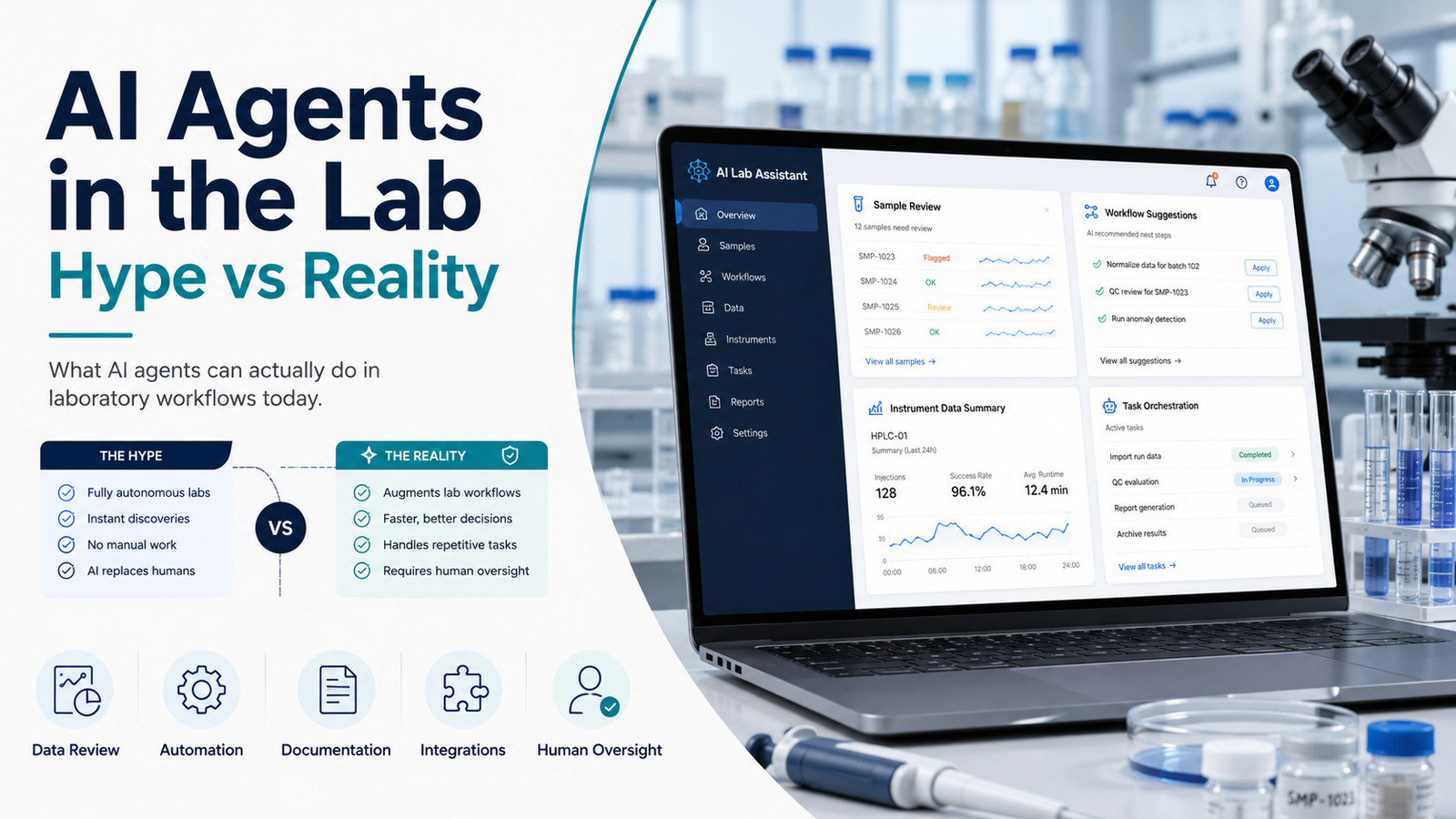
AI agents in laboratories are simultaneously more real and less transformative than the marketing suggests. Genuine autonomous systems have optimized real chemical reactions, run 17 days of unattended inorganic synthesis, and designed experimentally validated nanobodies — these are documented results, not demos. But the fully autonomous lab that picks its own questions and needs no scientists does not exist, and the enterprise track record is sobering: MIT’s Project NANDA found 95% of generative AI pilots deliver no measurable P&L impact, while Gartner projects over 40% of agentic AI projects will be cancelled by end of 2027. The gap between the two pictures isn’t model quality. It’s whether your data, workflows, and governance are ready for an agent to operate inside them. This guide separates what works from what’s being sold.
Defining terms, because the vocabulary is doing a lot of work
“AI agent” is used loosely enough that vendors and buyers frequently mean different things, and the ambiguity is commercially convenient.
An AI assistant answers questions or drafts text when asked. An AI agent takes actions autonomously against a goal — monitoring, deciding, and executing without a human triggering each step. Agentic orchestration places multiple agents inside a controlled process framework with audit trails, approval steps, and defined decision boundaries.
The distinction matters because most “agents” sold today are the first category wearing the second category’s name. Industry research is direct about this: 80% of IT leaders say most of their agents today are still limited to chatbots or assistants, and 48% operate in silos rather than inside end-to-end workflows. When a vendor demonstrates an “AI agent” for your lab, the first question is whether it acts or merely answers.
What genuinely works today
Set the scepticism aside for a moment, because the real results are substantial and worth knowing precisely.
Autonomous experimentation has produced peer-reviewed results. An LLM-driven agent (Coscientist) optimised real chemical reactions. Berkeley’s A-Lab ran autonomous inorganic synthesis for 17 consecutive days. In 2025, the Virtual Lab’s AI agents designed nanobodies that were subsequently experimentally validated. These are not vendor case studies; they are published science.
The common thread explains where autonomy succeeds: these work because the goal and the success signal are crisp. Where the objective is well-defined and the system can measure whether it succeeded, agents perform. That single condition is the most useful predictor of whether an agentic application will work in your lab.
Operational agents are deployed in labs now, in less glamorous but more immediately valuable roles. Agents connected to LIMS, instruments and inventory systems can continuously monitor incoming samples, test orders, instrument availability and queue depth — automatically routing STAT samples to the fastest available instrument, batching routine samples for efficiency, and reordering queues as priorities shift, in real time without human intervention. This is sample-routing optimization, not scientific discovery, and it is precisely the kind of bounded, measurable task where agents earn their keep.
Prediction and design loops are reducing wet-lab cost. A July 2026 paper (Hur & Lee, ICML AI-for-Science Workshop) targets what it calls the validation bottleneck with two mechanisms: a prior-aware experiment-design loop that proposes fewer but more informative next experiments, and a cost-aware surrogate that predicts expensive high-resolution measurements from cheap low-resolution ones, choosing between measurement types based on predicted uncertainty. The economic logic is compelling — spend fewer wet-lab rounds to reach the same answer.
What doesn’t work — and what’s being oversold
The autonomous lab that needs no scientists does not exist. What marketing often implies — a laboratory that picks its own questions — is not a current capability. Even the headline results were steered by humans, and in A-Lab’s case, the findings required correction after outside scrutiny. Autonomy still fails on open-ended judgment and ambiguous results, which is precisely where laboratory science spends most of its difficulty.
The enterprise failure rate is the number nobody quotes in a demo. MIT’s Project NANDA study — based on 150 leader interviews, a 350-employee survey, and analysis of 300 public AI deployments — found approximately 95% of generative AI pilots deliver no measurable P&L return, with only about 5% capturing value at scale. Supporting data compounds the picture: S&P Global found 42% of companies abandoned most of their AI initiatives in 2025, up from 17% the prior year, and Gartner projects over 40% of agentic AI projects cancelled by end of 2027, citing escalating costs, unclear business value and inadequate risk controls.
Critically, MIT traced the failure rate not to model quality but to a learning gap in how organizations put AI to work. The technology mostly isn’t the problem.
Most labs aren’t structurally ready. A global study found 85% of organizations lack the process maturity needed to deploy agentic orchestration at scale. For laboratories, that translates into a specific near-term priority: standardizing data, workflows and system connections before agents can operate safely inside them.
Business models are still shaking out. Strateos operated one of the earliest fully automated cloud labs and pivoted from the public “lab-as-a-service” model toward private on-premises deployments — a signal that remote-access shared robotic infrastructure faced commercial challenges at scale. The lesson isn’t that the infrastructure lacks value; it’s that labs want control over their physical infrastructure rather than a black-box service.
The regulatory ceiling nobody mentions in the demo
For any lab in a GMP environment, there is a hard constraint that overrides the entire capability discussion — and it is remarkably absent from vendor AI marketing.
The EU’s draft Annex 22, published alongside the Annex 11 revision in July 2025, limits AI in GMP-critical applications to static, deterministic models. Dynamic models, generative AI and large language models are excluded from critical use.
Read that against how laboratory software is currently marketed. A vendor’s generative AI feature may be genuinely useful for non-critical work — searching notebooks, drafting documentation, summarizing results — while being unusable for anything touching product quality or a release decision. When evaluating platforms, the question is not “does it have AI?” but “which AI features touch GMP-critical paths, and how do you demonstrate determinism?” Our guide to the EU Annex 11 revision covers the wider regulatory package, and our LIMS for pharmaceutical QC guide addresses regulated platform selection.
Even outside GMP, agents in regulated settings need infrastructure that most labs don’t yet have: real-time monitoring frameworks that detect performance drift or hallucination before data quality is affected, transparent automated audit trails translating digital actions into human-readable logs, and — when something goes wrong — a “flight recorder” capturing the event history, the specific inputs given to the AI, and the logic behind its conclusion. An error code is not sufficient documentation for an agent’s decision.
The interoperability problem
A practical obstacle sits between agents and instruments, and it’s worth understanding before believing any “plug-and-play” claim.
SiLA2 — a gRPC/Protocol Buffers standard — is the best-established laboratory instrument communication standard, supported by Tecan, Hamilton and others. But adoption remains slow: most instruments ship without SiLA2 support, and retrofitting older instruments requires custom driver development. MCP (Model Context Protocol) addresses a complementary need, providing the discovery and natural-language interface agents require, where SiLA2 provides structured, typed deterministic control.
The emerging architecture uses both: SiLA2 for the deterministic control layer, MCP wrapping it to expose capabilities to agents — letting existing LIMS and automation continue on SiLA2 while new AI workflows use MCP, with no migration required. The practical reality today, though, is that most labs building these capabilities are writing custom Python wrappers around vendor APIs. Budget accordingly.
One further safety practice worth adopting: before an AI decision engine sends commands to physical instruments, those commands should be validated in simulation.
What separates the 5% that work from the 95% that don’t
The failure research is unusually consistent about causes, and every one of them is addressable.
Define success before you start. 73% of failed AI projects had no agreed definition of success beforehand. Projects with quantified success metrics defined upfront achieve a 54% success rate versus 12% without — arguably the single highest-leverage discipline available.
Fix the data foundation first. Gartner predicts 60% of AI projects lacking AI-ready data will be abandoned through 2026, and companies with strong data integration report substantially higher ROI than those with poor data connectivity. For labs, this means a well-structured LIMS or ELN is not an obstacle to AI — it’s the prerequisite. If your data lives in spreadsheets, that’s the project to do first; see our spreadsheets vs LIMS guide.
Redesign the workflow before selecting the tool. Organizations reporting significant financial returns are twice as likely to have redesigned workflows before choosing AI tools.
Buy rather than build, in most cases. MIT found purchasing AI from specialized vendors succeeds roughly 67% of the time, while internal builds succeed about one-third as often. For a lab without a software engineering function, this is decisive.
Measure after launch. 61% of enterprise AI projects were approved on projected ROI that was never subsequently measured. The project ships and nobody checks.
Calibrate expectations. 57% of organizations experiencing AI failure attributed it to expecting too much, too fast.
How to evaluate an AI claim in a LIMS or ELN demo
Five questions cut through most of the noise:
Does it act, or does it answer? Ask for a workflow the software completes autonomously end to end, not a chat interface over search.
Was it built in, or bolted on? Features designed into a platform’s foundation tend to work more coherently across the system than retrofits onto legacy architecture.
What happens when it’s wrong? Ask to see the drift monitoring, the audit log of an AI action, and the record of inputs and reasoning behind a decision. If the answer is an error code, the feature isn’t ready for regulated work.
Which features touch GMP-critical paths? For regulated labs, this determines what you can actually use under Annex 22.
Show me a customer measuring it. Given that 61% of AI projects never measure post-launch ROI, a vendor who can point to a customer with quantified results is meaningfully differentiated.
Our how to choose a LIMS checklist covers the wider evaluation, and our best LIMS for biotech guide discusses AI as a tiebreaker rather than a primary criterion.
The honest bottom line
The consistent finding across the credible research is that agentic AI will not replace scientists or quality professionals, but will increasingly coordinate the work they already do. The labs likely to succeed in 2026 are those treating AI agents as operational infrastructure rather than experimental add-ons — and that means the readiness work matters more than the tool choice.
For most laboratories, the practical implication is almost anticlimactic: the highest-value AI preparation isn’t buying an AI product. It’s standardizing your data, structuring your workflows, and getting your systems talking to each other. Do that, and agents become useful when you adopt them. Skip it, and you join the 95%.
The hype is real, and so are the results. They’re just not the same results.
Where to go next
For regulated environments, start with our EU Annex 11 revision guide, which covers the Annex 22 AI restrictions, and our 21 CFR Part 11 explainer. For the data foundation that AI readiness depends on, see our LIMS software pillar and spreadsheets vs LIMS guide. For platform selection, our how to choose a LIMS checklist and best LIMS for biotech guide both address AI claims in context.
This guide reflects published research and reporting as of August 2026. AI capabilities and regulatory positions are changing rapidly; verify vendor claims independently and check current regulatory text before making compliance decisions. Several sources cited are vendors in the laboratory AI market; this guide flags that where relevant. LabSoftwareGuide is an independent editorial resource.
Sources
Scientific results and technical reality
- Robot on Rails — The self-driving lab in 2026: hype vs. reality (Coscientist, A-Lab, Virtual Lab, human steering): https://www.robotonrails.com/pages/guides/self-driving-lab-2026-hype-vs-reality.html
- QPillars — Self-Driving Labs in 2026: What Actually Works vs. What’s Still Hype (SiLA2/MCP architecture, Strateos): https://qpillars.com/blog/self-driving-labs-2026-what-works-vs-hype
- AICell Lab — Newsletter, 31 July 2026 (Hur & Lee, ICML 2026 validation bottleneck): https://aicell.io/post/newsletter-2026-07-31/
Lab deployment and industry context
- Lab Manager — How Agentic AI and AI Agents Are Reshaping Laboratory Workflows in 2026 (Camunda study, orchestration): https://www.labmanager.com/agentic-ai-moves-from-pilots-to-production-in-laboratory-workflows-34784
- LabLynx — AI Agents in Labs: From Analysis to Autonomous Action (vendor; sample-routing example): https://www.lablynx.com/resources/articles/ai-agents-laboratory-automation/
- LabVantage — Scaling Agentic AI in Regulated Labs (vendor; drift monitoring, “flight recorder” concept): https://www.labvantage.com/blog/the-discipline-of-innovation-scaling-agentic-ai-in-regulated-labs-2/
Failure and success data
- Fortune / MIT Project NANDA — The GenAI Divide: State of AI in Business 2025 (95% figure, methodology): https://finance.yahoo.com/news/mit-report-95-generative-ai-105412686.html
- Pertama Partners — AI Project Failure Statistics 2026 (RAND, MIT, S&P Global): https://www.pertamapartners.com/insights/ai-project-failure-statistics-2026
- Folio3 AI — AI Project Failure Rate in 2026 (success-metric and ROI-measurement data): https://www.folio3.ai/blog/ai-project-failure-rate-stats
- Talyx — Why 90% of Enterprise AI Implementations Fail (Gartner predictions, buy-vs-build, workflow-first): https://talyx.ai/insights/enterprise-ai-implementation-failure
- Coworker AI — Why Enterprise AI Fails: The Real Numbers: https://coworker.ai/blog/why-enterprise-ai-fails