
Open-Source ELN and LIMS: The Honest Guide for 2026
The promise of open-source laboratory software is compelling: no licence fees, full access to the source code, unlimited users, and the freedom to customise every workflow. In a market where enterprise LIMS and ELN contracts routinely run to six figures, it is no surprise that academic labs, startups, public health institutions, and budget-conscious industrial labs have invested seriously in open-source alternatives. But the reality is more nuanced than the marketing. Open-source does not mean free — it means the software is free. Infrastructure, implementation, validation, maintenance, and support are not. For some labs, that trade-off is excellent value. For others, it is a costly detour. This guide reviews the most capable open-source and free ELN and LIMS solutions available in 2026, and gives you a clear-eyed view of where they genuinely work — and where they fall short. The leading open-source ELN platforms eLabFTW is the most widely deployed open-source ELN in academic research. Published under the AGPLv3 licence and actively maintained by Deltablot, it covers experiment documentation, inventory management, team collaboration, audit trails, and multi-language support across 21 languages. Crucially, it supports the open .eln file format promoted by the ELN Consortium, protecting your data from lock-in. It requires a Linux server and comfort with Docker; institutions with IT support find it straightforward to deploy. Its FAIR data alignment and active global community make it a genuine first choice for academic and research labs. Solution Type License / model Best for eLabFTW ELN AGPLv3 — fully free, self-hosted Academic & research labs of all sizes Chemotion ELN was developed at the Karlsruhe Institute of Technology specifically for chemistry research. Published in the Journal of Cheminformatics, it features molecular structure handling, reaction planning, integration with PubChem and SciFinder, and a research data repository (Chemotion Repository) for FAIR-compliant data publication. If your lab works in organic chemistry or chemical sciences, it is one of the few open-source tools built for that domain rather than adapted from a generic notebook. Solution Type License / model Best for Chemotion ELN ELN EUPL — free, self-hosted Chemistry & chemical sciences labs SciNote occupies an interesting middle ground: its core is open source under Mozilla Public License, built in Ruby on Rails. Life science teams and academic groups can self-host the community edition at no cost. SciNote also offers a commercial SaaS tier with 21 CFR Part 11 compliance and GxP features — making it one of the few open-source-rooted tools that can scale into regulated environments with vendor support. Solution Type License / model Best for SciNote ELN Open core — free community / paid SaaS tier Life science researchers; regulated labs via paid tier The leading open-source LIMS platforms SENAITE is the most production-ready open-source LIMS available today. Originally forked from Bika LIMS — one of the earliest open LIMS, in active development since 2002 — SENAITE is a web-based system built on Plone/Python that targets testing and calibration laboratories. It supports ISO/IEC 17025 process controls, instrument connectivity with automatic result import, full audit trails with immutable snapshots, worksheets and workload planning, and a REST JSON API for BI integration. Deployed in diagnostic, environmental, and public health laboratories across multiple countries, it is a serious production system rather than a prototype. Solution Type License / model Best for SENAITE LIMS GPLv2 — free, self-hosted; commercial support available Testing, calibration, environmental & diagnostic labs Bika LIMS, the ancestor of SENAITE, continues as an independent project with a global community. It retains the same Plone/Python architecture and ISO 17025-compatible audit trail, with a focus on giving labs full ownership and zero licence fees. For labs that want to self-configure and self-support, Bika provides an established, well-documented codebase. Solution Type License / model Best for Bika LIMS LIMS GPLv2 — free, self-hosted Environmental, food & agricultural testing labs OpenELIS is a LIMS purpose-built for public health and clinical laboratory environments, particularly relevant for HIV/TB testing, diagnostics, and national health programmes. It is backed by a global foundation, actively maintained, and deployed across multiple countries in Africa, the Caribbean, and Asia. The 2025 release introduced flexible patient matching and real-time NPI registry integration. If your context is public health or clinical diagnostics, OpenELIS deserves attention over general-purpose alternatives. Solution Type License / model Best for OpenELIS LIMS Apache 2.0 — free, self-hosted; community-supported Public health, clinical & diagnostic labs openBIS from ETH Zurich is a combined ELN-LIMS designed for research data management in academic settings. It supports FAIR principles and is used by projects affiliated with the German National Research Data Infrastructure (NFDI). It is more complex to configure than eLabFTW, but offers powerful data modelling capabilities across biology, physics, chemistry, and materials science — and was specifically designed for multi-disciplinary research consortia. Solution Type License / model Best for openBIS ELN-LIMS Apache 2.0 — free, self-hosted Multi-disciplinary academic research, NFDI/FAIR initiatives Free tiers worth considering Beyond fully open-source tools, several commercial platforms offer genuinely useful free tiers that may suit smaller or early-stage labs without requiring a full open-source infrastructure commitment. Free tier Benchling offers a free plan for academic researchers with access to its ELN and molecular biology tools. Feature-gated (no enterprise compliance or advanced LIMS workflows), but widely used and well-regarded for ease of use in biotech and life sciences. Free tier LabArchives provides a free tier for individual researchers covering basic ELN functionality. Widely adopted in universities due to institutional agreements with many US and European institutions. Free tier SciNote offers a free plan for individual users and small teams with access to core experiment documentation, protocols, and basic inventory — sufficient for academic lab groups getting started with digital notebooks. The real advantages of open-source lab software The real disadvantages — what the brochures omit Licences and support models: what to check before you commit “Open source” covers very different arrangements. Two questions matter more than the label: what the licence obliges you to do, and who will help when something breaks. What the licence type means for a lab If
How to Choose an ELN: 10 Questions to Ask Before Buying
Selecting an Electronic Laboratory Notebook (ELN) is one of the most consequential software decisions a modern laboratory will make. Done right, it replaces fragmented paper notebooks and spreadsheets with a single, searchable, auditable system that accelerates research and satisfies regulators. Done poorly, it becomes an expensive burden that scientists work around rather than with. The ELN market now includes over 96 active platforms, according to a 2024 review published in Nature Protocols. The range of options — from lightweight research tools to enterprise-grade compliant systems — makes comparison genuinely difficult. This guide cuts through the noise with ten critical questions to ask any ELN vendor before signing a contract. These questions are designed for lab managers, quality directors, and IT teams working in pharma, biotech, CRO, academic, and industrial laboratory environments. 1. Does it meet your regulatory and compliance requirements? Compliance is not a feature — it is a prerequisite. Before evaluating anything else, establish which regulatory frameworks govern your laboratory, then verify that every candidate ELN can satisfy them with documented evidence. The most common compliance requirements for ELN selection include: Ask vendors for their validation documentation (IQ/OQ/PQ protocols), an audit trail demo, and references from similarly regulated customers. The FDA’s guidance on Part 11 scope and application is a useful starting point to understand what is actually required. Ask this Show me your audit trail in action. Who can modify or delete an entry, and what record is created when they do? 2. Cloud or on-premise — and what does that mean for your data? The deployment model shapes security, maintenance burden, cost structure, and accessibility. Both options are legitimate; the right choice depends on your organisation’s IT policy and data sensitivity. For cloud ELNs, ask specifically: Where is data stored geographically? What certifications does the vendor hold (ISO 27001, SOC 2 Type II)? What happens to your data if you cancel the contract? Ask this What is your data portability guarantee? In what format can we export everything if we choose to migrate? 3. How does it integrate with your existing instruments and software? An ELN that requires manual transcription of instrument data creates exactly the kind of human error it is supposed to eliminate. Strong integration capability is a non-negotiable requirement for most modern labs. Ask about: The SiLA 2 standard is worth referencing — it provides vendor-neutral instrument communication that reduces lock-in and simplifies future integration work. Ask this Can you connect directly to [name your top 3 instruments]? Show me a live data import from an instrument, not a screenshot. 4. How structured (or flexible) is the data entry model? ELNs sit on a spectrum from free-form (like a digital Word document) to highly structured (templated forms with enforced fields). Where a platform sits on this spectrum has profound implications for data quality, searchability, and the effort required during implementation. For pharma and biotech environments pursuing FAIR data principles (Findable, Accessible, Interoperable, Reusable), structured data entry is typically essential. Ask this How do you enforce data standards across a large team without blocking scientists from capturing unexpected observations? 5. What does implementation and onboarding actually involve? The total cost of an ELN is not the licence fee — it is the licence fee plus implementation time, data migration effort, training, and the productivity dip during the transition. Many labs dramatically underestimate this. Request specifics on: Ask this Give me a reference contact at a similar lab to ours who went live in the last 12 months. What was their actual timeline? 6. How does it handle collaboration across teams and sites? Modern R&D is distributed. CRO partnerships, multi-site organisations, remote working, and cross-functional teams require ELN collaboration features that go beyond simple shared access. Key questions: Ask this How would a CRO partner access only the data relevant to them, without seeing proprietary IP from other projects? 7. What is the real total cost of ownership over 3–5 years? ELN pricing is rarely as simple as a per-user subscription. Hidden costs are common and can significantly alter the business case. Typical cost components to map: Ask this Give us a fully itemised 5-year total cost estimate for our expected user count and data volume. Include everything. 8. How does the vendor handle updates — and what is their validation approach? In regulated environments, every software update is a potential validation event. A cloud ELN that pushes weekly updates without notice creates a compliance headache for labs that must document and approve system changes. Questions to ask: The GAMP 5 framework from ISPE provides useful guidance on computerised systems validation that applies directly to ELN selection and ongoing management. Ask this Do you provide a validation support package? What change control documentation do you supply with each update? 9. What search and data retrieval capabilities does it offer? An ELN is only as valuable as your ability to retrieve data from it. The promise of a searchable digital record fails completely if search is limited to keyword matching on titles. Evaluate: If your lab is building towards AI-assisted analysis or machine learning on experimental data, check whether the ELN’s data model and API support downstream analytics pipelines — this is an area where early architecture decisions become hard to undo. Ask this Show me how I would find every experiment in the last 2 years that used compound X and produced an IC50 below 10nM. 10. What does the vendor’s long-term roadmap and financial stability look like? An ELN is a 5–10 year commitment. The lab software market has seen consolidation, acquisitions, and product discontinuations. Choosing a vendor that is acquired or pivots their product strategy mid-contract is a painful and expensive disruption. Due diligence should include: Ask this If your company were acquired tomorrow, what would our contractual protections be? What would change for us? Quick Reference: 10 Questions at a Glance # Question area What to look for 1 Regulatory compliance 21 CFR Part 11, EU Annex 11, ISO 17025, ALCOA+ documentation
How to Choose a LIMS: 10 Questions to Ask Before Buying
A practical buyer’s guide for lab managers, quality directors, and IT teams evaluating Laboratory Information Management Systems. Selecting a Laboratory Information Management System (LIMS) is one of the most consequential technology decisions a lab can make. Get it right, and you gain a powerful platform that automates sample tracking, enforces compliance, and accelerates every workflow. Get it wrong, and you face years of expensive customization, frustrated staff, and regulatory risk. The challenge is that LIMS vendors are excellent at demonstrations. Every platform looks polished in a 30-minute sales call. The real differences only emerge when you probe beneath the surface — asking the uncomfortable questions before you sign a contract, not after. This guide gives you the 10 essential questions to ask any LIMS vendor. Whether you are evaluating your first system or replacing a legacy platform, these questions will help you cut through marketing noise and identify the solution that truly fits your laboratory’s needs. Why This MattersAccording to industry data, LIMS implementation failures are most often caused not by technology limitations, but by poor fit between the platform and the lab’s specific workflows, compliance requirements, and integration needs — all of which could have been identified during vendor evaluation. Question 1: Does It Support Your Specific Workflows — Not Just ‘Labs’ in General? The most common mistake in LIMS evaluation is accepting generic capability claims at face value. ‘We support laboratory workflows’ is not a meaningful answer. Your workflows are specific: you may need chain-of-custody tracking for environmental samples, GMP-compliant batch records for pharma manufacturing, or real-time PCR result capture for a genomics lab. Ask the vendor to demonstrate your actual workflows — not their canned demo. Request a sandbox environment with your sample types, your naming conventions, and your test methods configured. If they struggle to configure even a basic version of your process during evaluation, the full implementation will be far more painful. Key follow-up: “Can we run a proof of concept using our own data before signing?” A confident vendor will say yes. Question 2: What Are the True Total Costs Over 5 Years? LIMS pricing is notoriously opaque. The quoted license fee is rarely the full story. Implementation, training, validation, annual support, module add-ons, and user seat increases can multiply the initial cost by a factor of three to five over a five-year period. Request a Total Cost of Ownership (TCO) breakdown that includes all of the following: Red flag: Vendors who are unwilling to provide a multi-year TCO estimate are often hiding significant costs in year 2 onwards. Question 3: How Does It Handle Regulatory Compliance for Your Environment? Compliance requirements differ dramatically by industry. A pharmaceutical QC lab operating under FDA 21 CFR Part 11 and GMP regulations has very different needs from an environmental testing laboratory under ISO 17025, or an academic research lab with no formal regulatory mandate. Do not assume compliance — verify it. Ask specifically: For European labs, ask about GDPR data handling, and for ISO-accredited labs, ask specifically about method validation record management and proficiency testing documentation. Pro TipAsk the vendor for a list of current customers in your regulatory environment and contact at least two of them directly. A vendor’s relationship with regulated customers is the most reliable indicator of their compliance capability. Question 4: What Instruments and Systems Does It Currently Integrate With? A LIMS that cannot talk to your instruments is just an expensive spreadsheet. Integration capability — with both laboratory instruments and enterprise systems like ERP, QMS, or ELN — is one of the most critical and most frequently oversold capabilities in the LIMS market. Ask for a published list of certified integrations, not just ‘integration capability.’ There is a significant difference between a pre-built, tested connector for your mass spectrometer or HPLC system and a generic API that theoretically could be used to build one. Also ask about bidirectional data flow: can the LIMS send worklists to instruments as well as receive results? Can it trigger instrument runs automatically? These capabilities define whether you are getting automation or just data collection. Question 5: Cloud, On-Premise, or Hybrid — What Are the Real Implications? The deployment model you choose will affect security, cost structure, IT overhead, and performance for the entire lifetime of the system. Both cloud and on-premise have legitimate advantages depending on your organization’s situation. Cloud-based LIMS typically offers faster deployment, lower upfront cost, automatic updates, and easier remote access. On-premise deployments give you greater control over data sovereignty, network performance, and security — often critical for highly regulated environments or organizations with sensitive intellectual property. The right questions here are: Question 6: How Long Does Implementation Actually Take? LIMS vendors consistently underestimate implementation timelines during the sales process. A system that takes 18 months to fully implement instead of the promised 6 months creates enormous costs in parallel operations, staff time, and delayed ROI. Ask for references from customers with a similar scope of implementation — similar number of users, similar number of instruments, similar regulatory environment. Ask those customers directly: how long did implementation actually take, and what caused the delays? Important: Also ask who is responsible for what. Many vendors hand off large parts of implementation to third-party consultants. Understanding who your actual implementation team is — and their experience level — is as important as evaluating the software itself. Question 7: What Does Configuration vs. Customization Mean in Practice? Modern LIMS platforms market themselves as highly configurable — meaning lab teams can adapt workflows, fields, and reports without coding. This is a major advantage over older ‘customizable’ systems that required developer involvement for every change. However, the line between configuration and customization is frequently blurred in vendor communications. Ask for a live demonstration where the vendor — or better, where you — reconfigure a workflow in real time. If every change requires a support ticket or a professional services engagement, the system is not truly configurable. This distinction has significant long-term cost implications. Every hard-coded customization
LIMS Pricing Models Explained: How Vendors Charge and How to Negotiate
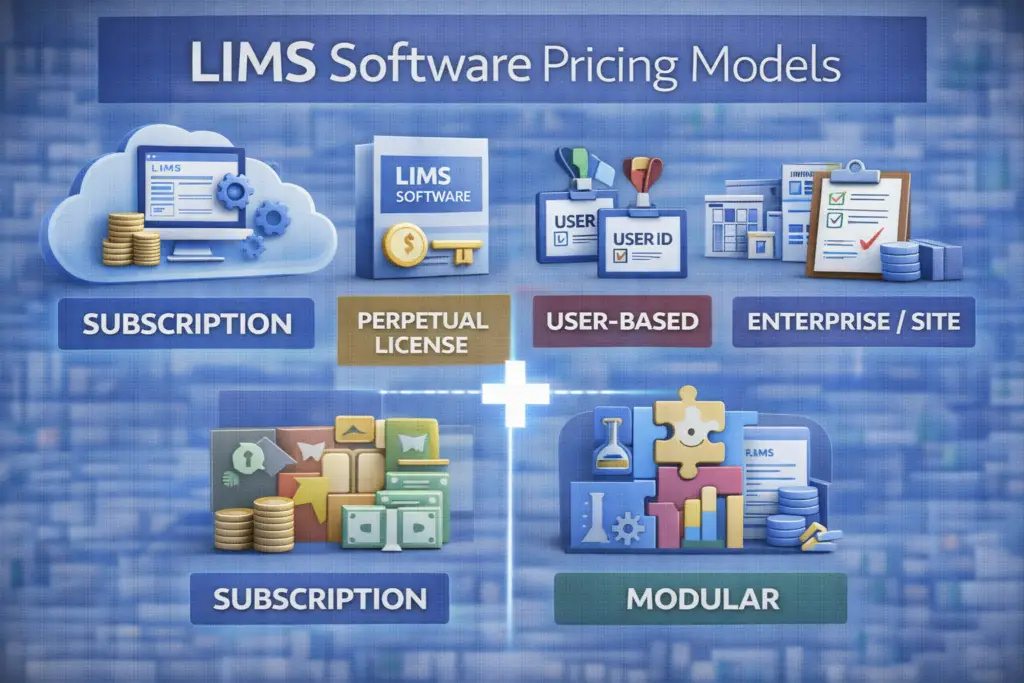
Quick verdict: Two LIMS quotes with similar headline prices can lead to very different five-year costs. The difference comes from the licensing model (subscription or perpetual), the unit being charged (named users, concurrent users, modules, sites), and everything priced outside the licence: implementation, integrations, data migration, validation, environments and support. Compare vendors on a five-year total cost of ownership built from the same line items, and negotiate the terms that drive cost after year one, such as renewal increases and tier thresholds, not only the entry price. For current price ranges, see our LIMS pricing benchmark; this guide explains the structures behind those numbers. Why LIMS quotes are hard to compare Most enterprise LIMS vendors do not publish prices. You receive a quote after a demo, built on assumptions the vendor chose: a number of users, a set of modules, a level of implementation support. A second vendor makes different assumptions. Placing the two totals side by side tells you little until both are broken into the same components. Three things make this harder than in most software categories: The main LIMS licensing models Model How you pay Usually suits What to watch SaaS subscription Recurring fee, usually per user per month or per year, billed annually; hosting, updates and standard support included Small and mid-sized labs, labs without internal IT for servers Renewal increases, tier caps, what “standard support” covers, data export at exit Perpetual licence + maintenance Large upfront licence, then an annual maintenance fee calculated as a percentage of the licence Large or multi-site labs with IT capacity, strict data residency needs Maintenance percentage, cost of major upgrades and reimplementation, hardware and IT staff Named-user pricing Each individual account is licensed Stable teams where most staff use the system daily Occasional users (reviewers, auditors, managers) inflating the count Concurrent-user pricing Licences cover the number of people logged in at the same time Shift work, many occasional users Peak-time lockouts, how concurrency is measured and audited Modular pricing Core platform plus paid modules (stability, instrument integration, inventory, reporting, portals) Labs that want to start small Modules you will need later priced at list rate; dependencies between modules Site or enterprise licence Flat fee for a site, a legal entity or unlimited users Large organizations rolling out across many labs Minimum commitment, definition of a “site”, renegotiation when scope changes Free or open-source No licence fee; you pay for hosting, support, configuration and validation Labs with technical staff and strong data sovereignty needs Total cost of running it; see open-source LIMS: pros and cons Many vendors combine these: a subscription priced per named user, with optional modules and a separate implementation fee, for example. Ask each vendor to state the unit, the tier boundaries and what triggers a change in price. What sits outside the licence A quote that covers only the licence is incomplete. Before comparing vendors, ask each one to price or explicitly exclude the following: Cloud vs on-premise: how the cost structure differs The choice is less about which is cheaper and more about when you pay and who carries which cost. Cloud subscription spreads cost over time as an operating expense. Hosting, infrastructure security, backups and upgrades are part of the fee. The costs that remain on your side are configuration, integrations, validation, and assessing each vendor release under change control. On-premise perpetual licensing front-loads cost as a capital expense, followed by annual maintenance. You also pay for servers, backup and disaster recovery, cybersecurity, IT staff time, and the projects that come with major upgrades, including revalidation in regulated environments. Over a long enough period the licence can cost less than a subscription, but only if these internal costs are included, and business cases often leave them out. A practical test: compare both options over the same five years, with the same number of users and modules, and include internal IT effort as a cost line. How to build a five-year total cost of ownership ELN buyers can use the same method; our ELN pricing guide applies it over three years. Negotiation levers that matter Discounts on the first-year licence are the most visible concession and often the least valuable. These terms usually have more effect on total cost: Term length is a trade-off: a multi-year commitment can lower the annual price, but it reduces your ability to leave if the system does not work for you. Accept longer terms only with renewal caps and exit terms in place. Red flags in a LIMS quote Our how to choose a LIMS checklist covers the non-financial questions to ask alongside these. Frequently asked questions Is a subscription LIMS cheaper than a perpetual licence?In the first years, usually yes, because there is no large upfront licence or server investment. Over a long period a perpetual licence can cost less, but only once maintenance, infrastructure, IT staff and upgrade projects are included in the comparison. What is the difference between named and concurrent users?Named-user licences are assigned to individual accounts. Concurrent licences limit how many people can be logged in at once, which can suit labs with shift work or many occasional users. Which cost is most often underestimated?Data migration, followed by validation in regulated labs. Both depend on the state of your existing data and processes, which is why vendors often leave them out of initial quotes. Should validation be included in the LIMS price?For regulated labs, ask for the vendor’s validation package and services to be itemized in the quote. Your own validation effort still needs budgeting separately. Where can I find actual LIMS prices?Our LIMS pricing benchmark collects published and reported prices, grades how reliable each figure is, and shows where sources disagree. The bottom line LIMS pricing is less opaque once you separate the model from the total. Identify how each vendor charges, make every quote itemize the same components, compare five-year costs rather than entry prices, and negotiate the terms that decide what you pay in year three. The vendor with the
Cloud vs On-Premise ELN: How to Choose Your Deployment Model
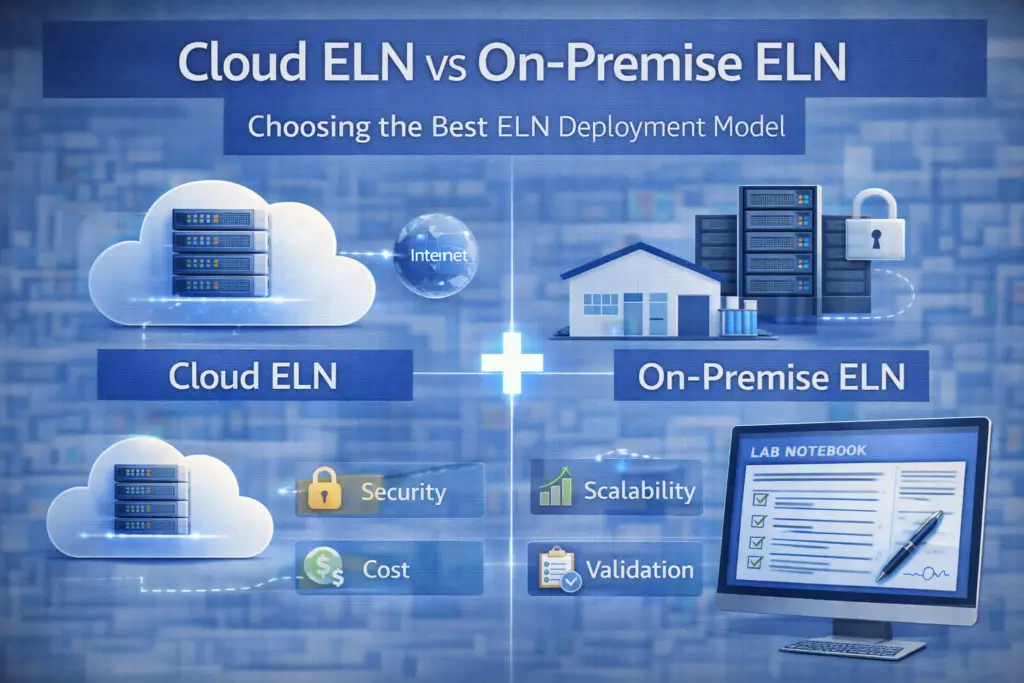
Quick verdict: For most labs, a cloud (SaaS) ELN is the practical default: faster to deploy, no servers to run, updates included, and accepted by regulators when the lab keeps proper oversight of the provider. On-premise still makes sense in specific cases: strict data residency or network isolation requirements, heavy integration with local instruments and systems, an IT team already running validated infrastructure, or a need to control exactly when the software changes. The decision should rest on those constraints and on a five-year cost comparison that includes internal IT effort, not on a general belief that one option is more secure. What the two models mean in practice Cloud ELN (SaaS). The vendor hosts the application, usually on a major cloud platform, and runs infrastructure, security patching, backups and upgrades. You access it through a browser and pay a subscription. Most instances are multi-tenant: your data is logically separated from other customers on shared infrastructure. Some vendors offer a single-tenant or private cloud option at a higher price. On-premise ELN. You install the software on servers you control, in your own data centre or in a cloud account managed by your IT team. You buy a licence (or a subscription for self-hosted software), and your team handles servers, databases, backups, security, and the timing of upgrades. Open-source ELNs such as eLabFTW are often self-hosted this way. The boundary is less sharp than the labels suggest. A “self-hosted” ELN running in your own cloud subscription gives you on-premise control with cloud infrastructure, and a vendor-managed single-tenant instance sits in between. Side-by-side comparison Cloud (SaaS) ELN On-premise ELN Deployment speed Fast: no infrastructure to build Slower: servers, database, network and security setup Who runs infrastructure Vendor Your IT team Upgrades Vendor schedule, frequent releases Your schedule, less frequent, often larger projects Cost profile Recurring subscription (operating expense) Upfront licence and hardware (capital expense), then maintenance and IT staff Remote access and collaboration Built in Requires VPN or exposed services, set up by IT Instrument and local system integration Needs connectors or gateways to reach the lab network Direct access on the local network Data location Vendor’s hosting regions; check contract Wherever you host it Validation focus Supplier assessment, release impact assessment Infrastructure qualification, upgrade revalidation Exit Depends on export terms in the contract Data already in your environment Security: where the real differences are A common assumption is that data is safer on servers inside the building. In practice, security depends on who runs the controls and how well. A reputable SaaS provider typically offers encryption in transit and at rest, a dedicated security team, continuous patching, and independent attestations such as ISO/IEC 27001 certification or SOC 2 reports. Many labs could not match that level internally. The risks move elsewhere: account security (strong authentication, single sign-on, removal of leavers), the provider’s own practices, and the terms that govern access to your data. On-premise gives you full control, which is an advantage only if your organization patches, monitors, backs up and tests recovery with the same discipline. A server that misses security updates for months, or a backup that has never been restored, is a larger risk than most cloud configurations. What to ask a cloud ELN vendor: current certifications or audit reports and their scope, hosting regions, encryption approach, backup frequency and tested recovery times, incident notification commitments, and support for single sign-on and multi-factor authentication. Compliance and validation Regulators do not require on-premise systems. What they require is that the lab stays in control of its regulated records, whatever the hosting model. The validation work shifts rather than disappears: Our ELN compliance and data integrity guide covers the controls in detail, and the LIMS validation guide describes the risk-based lifecycle that applies to both system types. Cost: compare five years, not year one Cloud ELN pricing is usually per user per month; our ELN pricing benchmark documents current published plans. On-premise pricing combines a licence or self-hosted subscription with costs that rarely appear in a vendor quote: servers or cloud infrastructure, database licences, backup and disaster recovery, security tooling, and IT staff time for maintenance and upgrades. A fair comparison uses the same scope for both options over five years: Our ELN pricing guide walks through the total cost of ownership calculation. Collaboration and integration Cloud ELNs make collaboration across sites, home working and external partners straightforward, because access only requires a browser and an account. On-premise systems can offer the same, but IT has to expose the application securely. Integration works the other way. Instruments, network drives and local systems sit on the lab network, which an on-premise ELN can reach directly. A cloud ELN needs an agent, gateway or middleware to collect instrument files and push them to the cloud. Before choosing cloud, list the instruments and systems you need to connect and ask each vendor how they are integrated today, in production, at a comparable lab. Which model fits your lab? Cloud is usually the better fit if: On-premise is usually the better fit if: Consider a middle option (self-hosted in your own cloud account, or a vendor-managed single-tenant instance) when you need control over data location or change timing without running physical servers. Frequently asked questions Can a cloud ELN be used for FDA-regulated or GLP work?Yes. The lab must assess the provider, define responsibilities in the contract, validate the system for its intended use, and retain the ability to retrieve complete records. Is on-premise more secure than cloud?Not by default. Security depends on the controls in place and how consistently they are operated. Many SaaS providers maintain controls that small internal IT teams cannot. Which option is cheaper?Cloud usually costs less in the first years. Over a longer period on-premise can compete, but only when infrastructure, IT staff and upgrade projects are counted. Can we move from on-premise to cloud later?Usually, but plan it as a data migration project: check export formats, metadata and audit trail transfer, and revalidation effort before committing. What