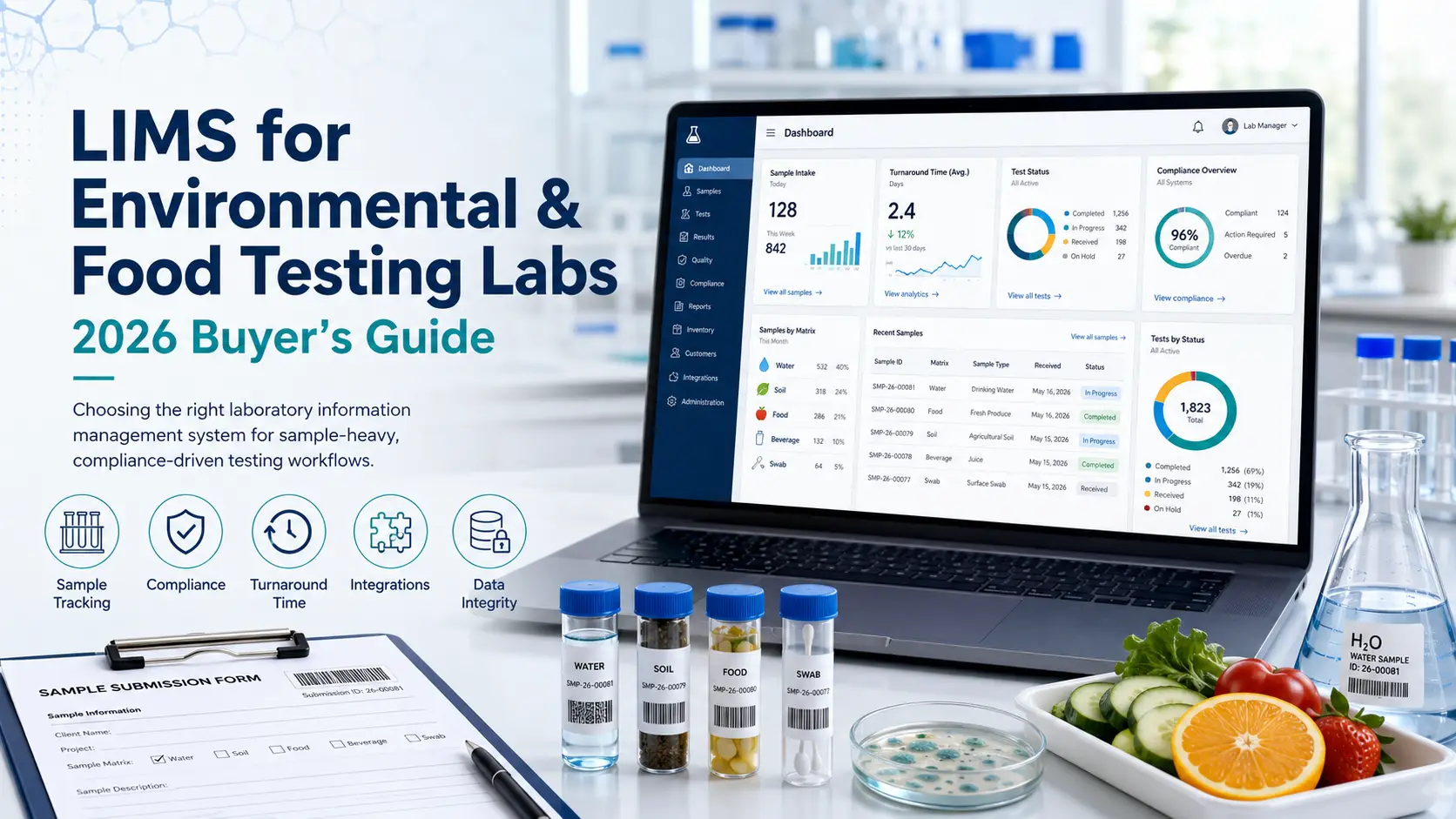
Environmental and food testing labs need capabilities that general-purpose LIMS platforms rarely deliver well: legally defensible chain of custody starting in the field, holding-time enforcement, multi-matrix sample handling, EPA and Standard Methods support, and automated electronic data deliverables in whatever format each client and regulator demands. These are production-style labs running fixed regulatory methods under accreditation pressure — closer to a manufacturing operation than a research bench. This guide covers what actually matters, which vendors specialize here, and why the biggest specialists in this niche are names most buyer guides never mention.
Why this segment is genuinely different
Environmental and food testing labs occupy an unusual position in the laboratory software market. They are neither research labs nor clinical labs, and the assumptions baked into most LIMS platforms — flexible experiment design, patient-centric records, discovery workflows — fit them poorly.
An environmental testing lab runs production-style sample throughput against fixed EPA, ASTM and Standard Methods procedures, and carries an accreditation burden that research labs rarely face. Volume is high, methods are prescribed rather than designed, and the output is a defensible number that will inform a consequential decision: whether a remediation site meets cleanup standards, whether a discharge permit is being met, whether a drinking water source is safe.
That last point is what really separates this segment. Environmental laboratory data may end up in regulatory proceedings, permit reviews, or litigation — which means the documentation trail must be legally defensible, not merely accurate. Food testing carries an analogous burden through FSMA, FDA and USDA oversight, plus customer-driven specification testing and lot traceability that can trigger a recall.
The practical consequence: when evaluating a LIMS for this segment, weight compliance mechanics and data-deliverable automation far above the feature breadth that dominates general LIMS comparisons. Our LIMS software pillar covers the category broadly; this guide is about what changes when your data has legal weight.
The regulatory stack you’re buying into
Environmental and food labs face an unusually layered compliance environment, and your LIMS has to serve all of it simultaneously.
Accreditation. ISO/IEC 17025 is the backbone — by 2024, over 114,600 laboratories worldwide had been accredited to it by ILAC MRA signatories, making it the global standard for demonstrating technical competence. In the US, environmental labs additionally pursue NELAP accreditation under TNI standards, assessed by recognized accreditation bodies through state programs. Our ISO 17025 guide details what software must support.
Methods. EPA standard methods (the 500, 600 and 8000 series), ASTM methods, and state-specific protocols govern how tests are run. Documented, auditable sample handling from receipt through disposal is required under NELAP and EPA method compliance — 40 CFR Part 136 for water, SW-846 for solid waste.
Programmatic regulations. Depending on your matrices and clients: RCRA, CERCLA, NPDES, UCMR, the Clean Water Act, and the Safe Drinking Water Act. Food labs layer on FSMA, FDA and USDA requirements, ISO 22000, and frequently 21 CFR Part 11 for electronic records.
The critical insight is that these requirements overlap rather than nest, and mapping them clearly before designing quality systems is one of the most common sources of costly audit findings when skipped. Bring that map to your vendor demos.
The capabilities that actually matter
Chain of custody that begins in the field
This is the defining requirement of environmental testing, and the one general-purpose LIMS handle worst. Chain of custody begins the moment a sampler’s gloves touch a collection vessel — before the lab has any involvement at all. If the documentation trail breaks anywhere between site and analytical report, the resulting data may be unusable in regulatory proceedings.
The capability to look for is electronic chain of custody (eCOC): a system that accepts custody transfers digitally at login, replacing handwritten forms with timestamped, user-authenticated records. This eliminates the manual transcription step that most commonly breaks the paper trail. When you demo a platform, ask specifically how field custody enters the system — not whether the LIMS “supports chain of custody” once samples are already logged.
Holding-time enforcement
Holding-time violations are the most frequent cause of sample rejection in environmental labs. A LIMS that triggers countdown timers at collection time and alerts analysts before deadlines are breached converts a recurring, expensive failure into a managed process. This is a small feature with outsized economic impact, and it is a genuine differentiator between specialist and generalist platforms.
Multi-matrix sample management
Environmental labs handle water, wastewater, soil, air, sediment, hazardous waste and sludge — each with its own preparation steps, analytical parameters and regulatory limits. Food labs face an analogous problem across product types, ingredients and finished goods, each with matrix-specific specification limits. A LIMS that treats “sample type” as a simple dropdown will fight you; one that models matrix-specific methods, detection limits and hold times natively will not.
Electronic data deliverables (EDD)
This is the capability buyers most often underestimate, and it directly determines turnaround time. Environmental clients and regulators demand data in prescribed formats — EQuIS, state-specific templates, custom client formats — and manual formatting is both slow and error-prone. Automated EDD generation from LIMS data reduces reporting burden and eliminates the formatting errors that delay client and regulator acceptance. Specialist platforms advertise generation across dozens of formats; ask for the specific list against your actual client base.
Instrument integration and QA/QC automation
Direct capture from ICP-MS, GC-MS, ion chromatography and similar instruments eliminates transcription entirely. On the quality side, look for control chart generation, management of QC samples (duplicates, spikes, blanks), automated calculation of complex results, and automatic flagging of out-of-spec values. For food and beverage QC specifically, lot genealogy and specification management per material, customer or standard are the equivalent requirements.
Certificates of analysis
A practical test worth borrowing from industry guidance: ask any vendor for a sample COA generated from their actual platform. If they can’t produce one, your COA design is likely to become a lengthy consulting engagement rather than a configuration task.
The vendors — including the specialists nobody lists
This is a segment where the best-known LIMS names are not necessarily the best fit, and where several long-established specialists rarely appear in general buyer guides. We group by profile.
Environmental specialists
Promium (Element LIMS) is a genuine environmental-first platform, designed with the environmental laboratory in mind rather than adapted to it. It serves labs testing water, soil, air, cannabis and food, and is used by commercial, private, federal, state and local government laboratories. Two capabilities stand out for this segment: DATATOOL, a large library of instrument interfaces that substantially reduces custom data-upload work, and reporting across more than four dozen file formats — directly addressing the EDD burden described above. Promium also holds trademarks including EnviroChain for custody tracking, reflecting a long-standing focus on the workflow. Reported productivity gains in the 30–50% range come from vendor-adjacent sources and should be treated as marketing rather than measurement, but the specialization itself is real. One caution from a user review worth noting: some report that complexity grew as more functionality was adopted.
Khemia Software (Omega LIMS) has served environmental labs since 1995 and targets commercial environmental laboratories managing high sample volumes and diverse client requirements. Its stated strengths map precisely to this segment’s pain points: EDD generation in EQuIS, GISKEY, state-specific and custom client formats; client management with per-client pricing and reporting formats; NELAC/TNI accreditation support; and direct GC/MS, ICP and IC integration. Customer testimonials cite relationships running since 2000 and 2010 — longevity that matters in a market where implementations are long-lived.
Confident LIMS positions itself across environmental, food and beverage, cannabis and nutraceuticals, emphasizing NELAP, EPA and state requirements with automated method management, dynamic detection limits per matrix, and built-in regulatory exports. Its published guidance on food and beverage QC selection is notably practical — the sample-COA test above comes from it — though as a vendor it naturally concludes in its own favor.
Broad platforms with environmental and food modules
LabLynx offers a modular suite spanning core LIMS, ELN and lab automation, with dedicated environmental and food/beverage configurations covering sample tracking, compliance reporting, chain of custody and FDA/USDA alignment. Its breadth suits labs wanting one vendor across multiple functions. See our LabLynx overview.
CloudLIMS is frequently recommended for environmental labs seeking cloud-native deployment without IT investment, with stated support for NELAC/TNI, ELAP, ISO 17025, EPA methods, CWA, NPDES and 21 CFR Part 11. Note the source caveat: the most detailed “best environmental LIMS” ranking currently circulating is published by CloudLIMS and concludes that CloudLIMS is the optimal choice. That doesn’t make the platform unsuitable — its compliance coverage is genuinely broad and its SaaS model genuinely reduces upfront cost — but the ranking should not be read as independent. Our CloudLIMS review offers a neutral assessment.
QBench brings modern cloud LIMS capability with configurable workflows, and is well regarded among small-to-mid-market testing labs across environmental, food and beverage sectors — a reasonable fit for labs prioritizing usability and fast setup over deep environmental specialization. See our QBench review.
Enterprise platforms
Thermo Fisher SampleManager, LabWare and Clinisys all serve environmental and food testing at scale, and appear on most sector rankings. They suit large, multi-site or high-complexity operations with the resources to absorb longer implementations — see our reviews of LabWare and our implementation timeline guide for what that commitment involves.
How to run this selection
Bring your regulatory map to the demo. List every accreditation, method series, and programmatic regulation binding your lab, plus every EDD format your clients require by name. Vendors who serve this segment seriously will answer specifically; generalists will answer in categories.
Test the custody chain end to end. Start the demo in the field, not at sample login. How does a field custody transfer enter the system? What happens when custody is disputed? Can you produce a defensible custody record for a sample from two years ago?
Demand a real COA and a real EDD. Ask for both generated from the vendor’s actual platform against a scenario resembling your work. This single request separates configuration from consulting engagement.
Check holding-time and QC automation behavior. Set up a hold-time scenario and an out-of-spec QC result in the sandbox. Watch what the system does unprompted.
Read vendor rankings for structure, not verdicts. Much of the published comparison content in this segment is authored by vendors ranking themselves first. The feature frameworks are often genuinely useful; the conclusions are not independent.
For the wider evaluation framework, our how to choose a LIMS checklist applies, and smaller operations should also see our best LIMS for small laboratories guide.
The mistake that costs these labs the most
The characteristic error in this segment is buying a capable general-purpose LIMS and assuming the environmental specifics can be configured in later. They usually can — at the cost of a long professional-services engagement to build custody workflows, hold-time logic, matrix-specific method management and EDD templates that a specialist platform ships with.
Audit findings in these labs rarely stem from technical incompetence; they stem from documentation gaps — missing signatures, undated entries, broken custody records, and manual transcription errors that create doubt about data integrity. A LIMS built for this work eliminates those failure modes structurally. One adapted to it eliminates them only as well as your configuration budget allows.
That is the real decision: whether your regulatory and reporting complexity justifies a specialist, or whether a modern generalist with strong configurability will carry you. Labs with heavy EDD obligations, multi-matrix workloads and NELAP accreditation should look hard at the specialists. Labs with simpler, more contained testing programs may find a well-configured cloud generalist entirely sufficient — and considerably easier to live with.
Where to go next
Start with our LIMS software pillar for the category overview, our ISO 17025 guide for accreditation specifics, and the how to choose a LIMS checklist to structure your evaluation. For budgeting, see our LIMS pricing benchmark and pricing models explainer; for planning, our implementation timeline guide.
This guide is updated as vendor offerings and regulations evolve. Accreditation support, method coverage, and EDD formats should always be confirmed directly with each vendor before purchase. Several widely cited environmental LIMS rankings are published by vendors that rank themselves first; this guide flags that bias where relevant. LabSoftwareGuide is an independent editorial resource and is not affiliated with the vendors listed above.
Sources
- Lab Manager — Environmental Lab LIMS: Chain of Custody Automation for Field Sample Compliance: https://www.labmanager.com/environmental-lab-lims-chain-of-custody-automation-for-field-sample-compliance-35513
- CloudLIMS — The 5 Best LIMS for Environmental Testing Labs in 2026 (vendor-authored ranking): https://cloudlims.com/the-5-best-lims-for-environmental-testing-labs-in-2026/
- CloudLIMS — Build a Robust QA Program with an Environmental LIMS (ISO 17025 accreditation data): https://cloudlims.com/build-a-robust-and-sustainable-quality-assurance-program-with-an-environmental-lims/
- OnePointe Solutions — How to Design an Environmental Testing Lab (TNI 2026, production-style throughput): https://www.onepointesolutions.com/blog/environmental-testing-lab-design/
- Confident LIMS — How to Choose a LIMS for Food and Beverage QC Labs: https://www.confidentlims.com/ai-content-feed/lims-food-beverage-qc-labs
- Confident LIMS — Environmental Solutions: https://www.confidentlims.com/solutions/environmental
- Umbrex — What is LIMS in food testing?: https://umbrex.com/resources/umbrex-explainers/agriculture-food-explainers/lims-in-food-testing/
- SelectScience — Element LIMS product listing and user reviews: https://www.selectscience.net/product/element-lims-r
- Khemia Software — Environmental Laboratory LIMS (Omega): https://khemia.com/environmental-laboratory-lims-2/
- LabLynx — Environmental LIMS: https://www.lablynx.com/industries/environmental-lims/
- LabLynx — Food & Beverage LIMS: https://www.lablynx.com/industries/food-beverage-lims/
- Justia Trademarks — Promium, L.L.C. (Element DataSystem, EnviroChain): https://trademarks.justia.com/owners/promium-l-l-c-1029455