
What Siemens Buying Dotmatics Actually Changes for LIMS and ELN Buyers
Siemens closed its $5.1B purchase of Dotmatics over a year ago. What actually changed for LIMS and ELN buyers, and what is still just a roadmap slide.
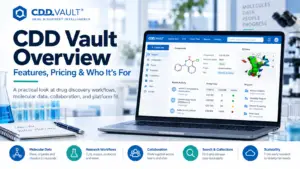
CDD Vault Overview: Features, Pricing & Who It’s For (2026)
CDD Vault is the pragmatist’s drug discovery platform — a hosted, modular informatics system covering chemical registration, bioassay data management, SAR analysis, ELN and inventory, built around being genuinely usable
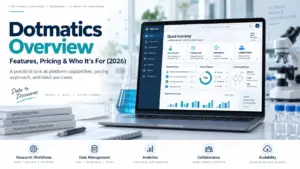
Dotmatics Overview: Features, Pricing & Who It’s For (2026)
Dotmatics is one of the most complete integrated discovery informatics platform on the market — an ELN, compound and biologics registration, assay data management, and analytics layer, wrapped around a
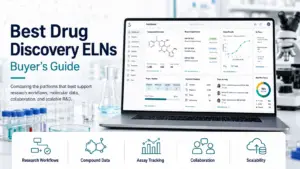
What Are the Best Drug Discovery ELNs? (Buyer’s Guide)
The decisive question in drug discovery ELN selection is not usability, price, or AI features ; it’s whether the platform is chemistry-native or biology-native. Small-molecule discovery lives on chemical structure
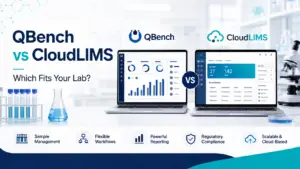
QBench vs CloudLIMS: Which Cloud LIMS Fits Your Lab?
This is the closest matchup in the small-to-mid-market cloud LIMS segment, and both platforms genuinely deserve their shortlist spots. QBench wins on day-to-day usability, support quality, no-code configurability, and API-driven
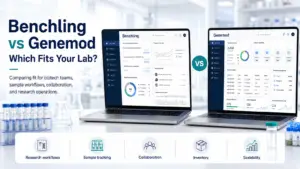
Benchling vs Genemod: Which Fits Your Lab?
These platforms are not competing for the same lab, and treating this as a winner-takes-all comparison is the fastest way to buy the wrong one. Benchling wins where molecular biology
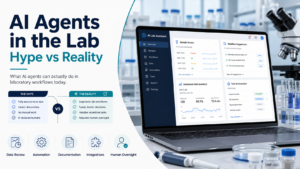
AI Agents in the Lab: Hype vs Reality (2026)
AI agents in laboratories are simultaneously more real and less transformative than the marketing suggests. Genuine autonomous systems have optimized real chemical reactions, run 17 days of unattended inorganic synthesis,
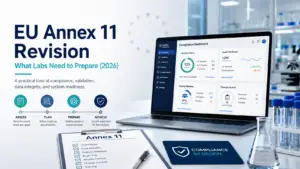
EU Annex 11 Revision: What Labs Need to Prepare (2026)
The draft revision published on 7 July 2025 is the most significant rewrite of Annex 11 since 2011 — expanding the guideline from 5 pages to 19, restructured into 17
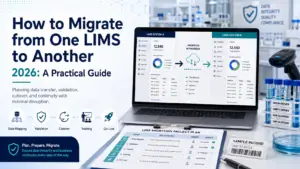
How to Migrate from One LIMS to Another (2026): A Practical Guide
A LIMS migration is not a software swap — it is a data project wearing a software project’s clothing. The technology rarely fails; the migration fails, usually because legacy data
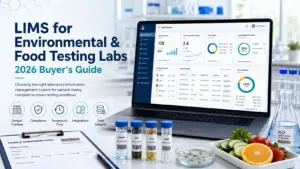
LIMS for Environmental & Food Testing Labs (2026): Buyer’s Guide
Environmental and food testing labs need capabilities that general-purpose LIMS platforms rarely deliver well: legally defensible chain of custody starting in the field, holding-time enforcement, multi-matrix sample handling, EPA and
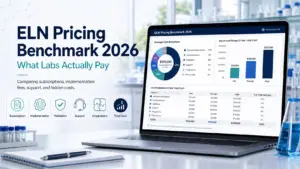
ELN Pricing Benchmark 2026: What Labs Actually Pay
Electronic Lab Notebooks are dramatically cheaper and more transparently priced than LIMS. Entry-level commercial ELN plans start around $12–30 per user per month, mid-market platforms land near $18–56, and open-source
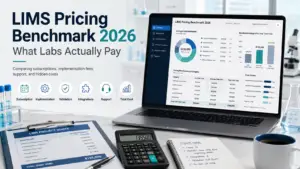
LIMS Pricing Benchmark 2026: What Labs Actually Pay
Cloud LIMS subscriptions in 2026 cluster between roughly $40 and $300 per user per month, with published vendor tiers concentrated in the $250–$425 range for mid-market testing platforms. Perpetual on-premise
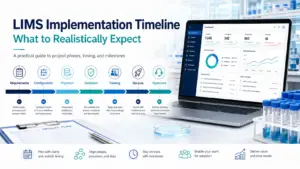
LIMS Implementation Timeline: What to Realistically Expect
A LIMS implementation takes anywhere from about 6 weeks to 12 months or more, and the range isn’t vagueness — it’s the single most important thing to understand before you
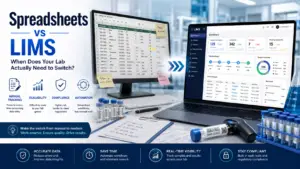
Spreadsheets vs LIMS: When Does Your Lab Actually Need to Switch?
Spreadsheets are not the enemy. They are accessible, flexible, free, and genuinely sufficient for many labs — which is precisely why almost every laboratory starts with them and many stay
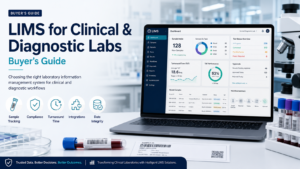
LIMS for Clinical & Diagnostic Labs : Buyer’s Guide
Quick verdict: Before you shortlist a single product, settle a prior question most buyer guides skip: does your lab need a LIMS, a LIS, or both? Clinical and diagnostic laboratories
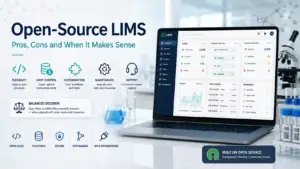
Open-Source LIMS: Pros, Cons and When It Makes Sense
Quick verdict: Open-source LIMS is free to license, not free to run. For labs with technical capability, data-sovereignty requirements, or an allergy to vendor lock-in, it can be an excellent
LIMS for Pharmaceutical QC: The Compliance-First Buyer’s Guide
Quick verdict: In a pharmaceutical quality control lab, a LIMS is not a productivity tool with compliance features bolted on — it is a compliance system that happens to manage
Best ELN for Academic and Research Laboratories
The best electronic lab notebook for an academic laboratory is not necessarily the platform with the most features. University laboratories, public research institutes and nonprofit research organizations face a distinctive