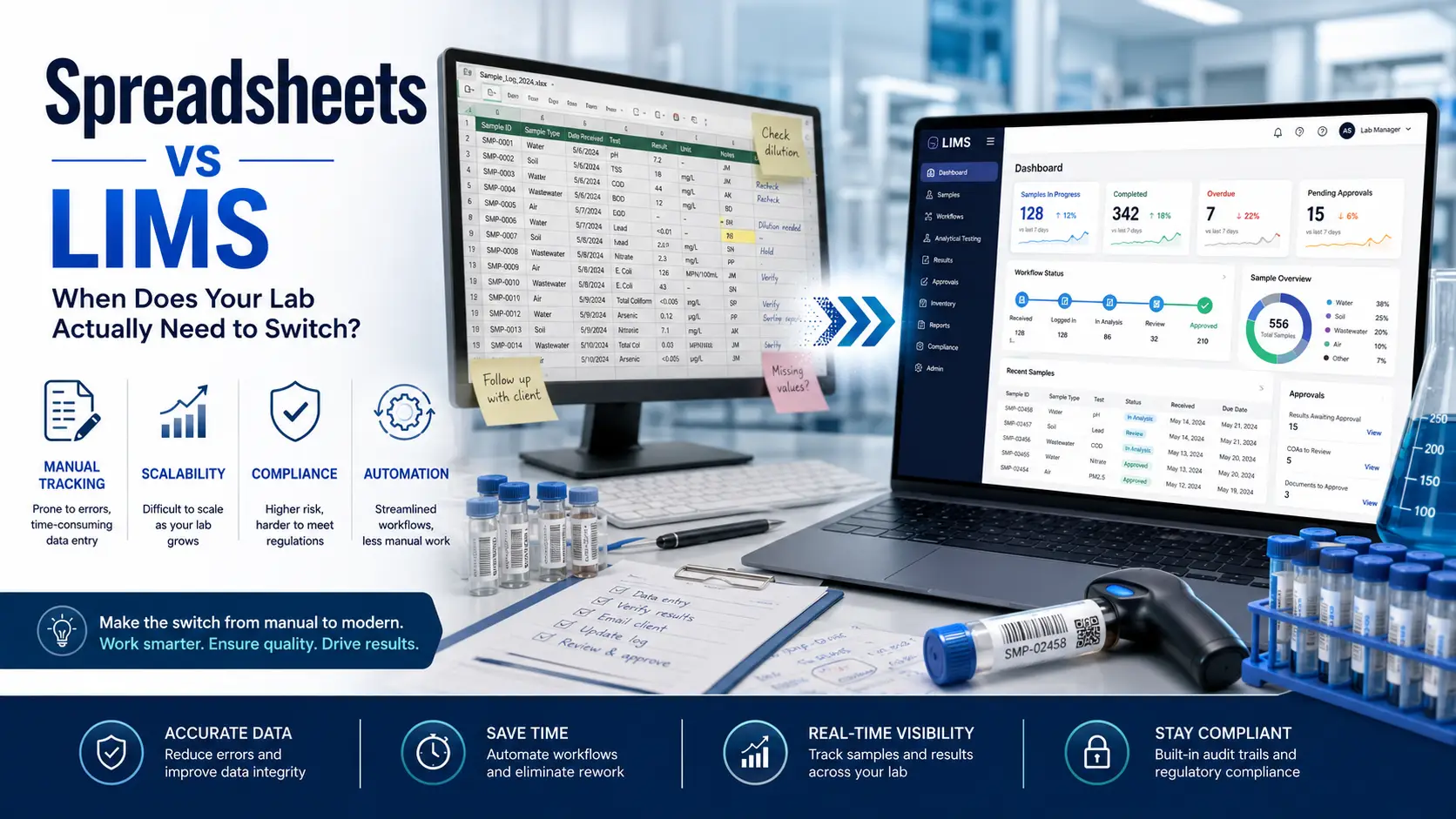
Spreadsheets are not the enemy. They are accessible, flexible, free, and genuinely sufficient for many labs — which is precisely why almost every laboratory starts with them and many stay too long. The switch to a LIMS is not an ideological upgrade from “old” to “modern”; it is a financial, regulatory, and operational decision that becomes justified at a specific inflection point. This guide identifies that point honestly: the signals that you’ve outgrown Excel, the signals that you haven’t, and how to tell the difference before a spreadsheet error costs you an audit finding or a client.
Why this decision is harder than the vendors admit
Search “spreadsheets vs LIMS” and you’ll find a wall of content arguing that Excel is a liability and you should switch immediately. Notice who publishes most of it: LIMS vendors. That doesn’t make them wrong — spreadsheets carry real, documented risks — but it does mean the framing is systematically skewed toward “switch now,” because that’s what sells software.
The honest version is more nuanced. Spreadsheets endure because they solve problems immediately: a lab manager can build a tracking template in an afternoon with no procurement cycle, no validation documentation, and no IT involvement, and formulas automate calculations for free. That is real value, not a mistake. The genuine question is not whether a LIMS is more sophisticated than Excel — of course it is — but at what point spreadsheet-based management crosses from asset to liability for your specific lab.
This article answers that question in both directions, because telling a five-person academic lab it urgently needs a $40,000 LIMS is as much a disservice as telling a GMP manufacturing lab that Excel is fine. Our broader LIMS software pillar frames the category; this guide is about the timing of the decision.
What spreadsheets genuinely do well
Let’s give Excel its due, because understanding its real strengths is what makes the limitations legible.
Spreadsheets are immediately accessible: everyone already knows how to use them, there’s no learning curve, and no budget approval required. They are infinitely flexible: you can restructure a sheet in seconds to match a workflow no vendor anticipated. They are free at the point of use, already sitting on every computer in the lab. And for genuinely simple needs — a single analyst logging a modest number of samples, a calculation-heavy workflow with few compliance demands, an early-stage lab still figuring out its processes — they are frequently the correct tool, not a compromise.
The failure mode isn’t using spreadsheets. It’s using them past the point where their structural limitations start generating costs that exceed the price of a proper system — and not noticing, because those costs are diffuse and hidden rather than itemized on an invoice.
The structural limitations that eventually bite
Spreadsheets weren’t designed for laboratory management, and four gaps become material as a lab grows.
No real audit trail
This is the single most consequential limitation. Excel cannot reliably record who changed what, when, and why. Tracking changes across a file that’s been edited many times is clunky at best and effectively impossible at scale — you cannot clearly reconstruct where changes were made, by whom, or when. For any lab under regulatory oversight, this is disqualifying: audit trails with attribution and timestamps are exactly what ISO 17025, FDA 21 CFR Part 11, and equivalent frameworks require. A LIMS is architected to log every change as a matter of course. Our guides to ALCOA+ data integrity and 21 CFR Part 11 cover what regulators actually expect.
Error-proneness at scale
The most cited statistic in this debate deserves scrutiny and mostly survives it: studies have repeatedly found that a large majority of spreadsheets contain errors — often quoted around 88%. Even if the precise figure varies by study, the direction is not in dispute, and the consequences in a lab are severe: a single transposed digit can produce a compliance violation, an incorrect client report, or a public-health risk. The canonical cautionary tale comes from outside the lab — JP Morgan’s 2012 “London Whale” losses were traced in part to a spreadsheet formula error — but the mechanism is identical. Manual transcription of instrument output into a spreadsheet is, as one environmental lab guide bluntly puts it, a guaranteed source of errors.
No enforced workflow or access control
In an accredited lab, a result should not travel from analyst to final report without technical review. In a spreadsheet world, that review is managed by email, a “pending review” folder, and verbal agreement — none of which is enforced by the tool. A LIMS makes the approval workflow structural: a result cannot be released until an authorized reviewer explicitly validates it. Spreadsheets similarly lack meaningful role-based access control, so the difference between someone who may view data and someone who may alter it is a matter of trust rather than permission.
Version chaos and fragility
The stories are remarkably consistent across labs: someone overwrites a formula and an entire inventory count is silently wrong; a critical dataset lives on a laptop that just crashed; two versions of the same file circulate with conflicting numbers and nobody knows which is authoritative. Concurrent editing multiplies the problem. These aren’t exotic failures — they are the ordinary, predictable behavior of a tool being used past its design intent.
The signals it’s time to switch
Rather than a vague “when you grow,” here are the concrete triggers that, individually or in combination, justify the transition. If several of these describe your lab, the economics have likely already tipped.
Regulatory or accreditation pressure. If you operate under FDA oversight, ISO 17025 or GLP/GMP, or face client audit requirements, structured audit trails and data integrity controls stop being optional. Preparing for an inspection with scattered spreadsheets is both inefficient and risky, and a single audit finding can cost more than a modest LIMS. Labs pursuing accreditation should read our ISO 17025 guide.
Throughput or complexity growth. As sample volume or test complexity rises, spreadsheet coordination strains. A useful quantitative signal appears in vendor case reports: labs frequently cite spending on the order of 3 hours every week — sometimes 10 or more — merely consolidating or reconciling spreadsheet data. When analysts spend significant time confirming data lineage rather than doing science, operational inefficiency is already present and measurable.
Recurring quality events tied to manual handling. If deviations keep tracing back to formula inconsistencies, transcription errors, or missing documentation, that’s a systemic vulnerability rather than bad luck. When quality investigations consume disproportionate effort, a structured system becomes economically justified.
Instrument integration needs. When a chromatograph or mass spectrometer generates hundreds of results per session, manual copying is both slow and a guaranteed error source. LIMS with instrument integration captures data directly, eliminating transcription entirely — a capability spreadsheets simply cannot offer.
Team and continuity risk. When knowledge lives in individual spreadsheets on individual machines, a departing team member can take institutional data with them, and a laptop failure can erase it. Multi-user, centralized systems eliminate this class of risk.
Client or turnaround pressure. If you’re losing clients to slow turnaround, or spending Friday afternoons manually assembling reports and certificates of analysis, automation pays back quickly.
The signals you should stay on spreadsheets (for now)
Equally important, and rarely said by vendors: sometimes the switch is premature. Hold off if most of the following are true.
Your lab is small and low-throughput, with a single analyst or a handful of people managing a modest sample load that spreadsheets handle comfortably. You face no meaningful regulatory burden — no accreditation, no FDA oversight, no client audits demanding formal data integrity controls. Your workflows are still in flux, so committing to a configured system now would mean validating and revalidating as you change your mind. Or your budget and IT capacity are genuinely constrained, and the total cost of a LIMS — including implementation, migration, and training — would exceed the cost of the inefficiency you’re trying to solve.
For labs in this position, the right move is often to improve spreadsheet discipline (version control, locked formula cells, a single source of truth, regular backups) rather than to buy software you’re not ready to exploit. If you’re a small lab feeling the first strain, our best LIMS for small laboratories guide covers the lightweight, fast-deploying options that fit that transitional moment better than an enterprise platform would.
A simple decision framework
Cut through the noise with three questions.
First, are you regulated or accredited — or about to be? If yes, the audit-trail and data-integrity gap makes the switch close to mandatory, and the only real question is which system and when, not whether. If no, proceed to the next question.
Second, what is the spreadsheet actually costing you? Estimate the hours per week lost to reconciliation and consolidation, the frequency and severity of data errors, and the risk exposure from version conflicts or lost files. Put a rough number on it. If that annual cost approaches or exceeds the total cost of a modest LIMS, the economics favor switching. Our LIMS pricing models explainer helps you estimate the other side of that equation.
Third, are your workflows stable enough to systematize? A LIMS encodes your process; if your process is still changing weekly, you’ll fight the system. If it’s settled, you’re ready to formalize it.
If you answer “regulated,” “it’s costing real money,” and “our workflows are stable,” you’ve outgrown spreadsheets. If you answer “unregulated,” “the cost is minor,” and “we’re still figuring things out,” stay put and revisit in six months.
Making the transition well, if you decide to switch
If the analysis points to a LIMS, two practices dramatically improve the odds of success.
Run in parallel before you cut over. A widely recommended approach is to operate the LIMS alongside your spreadsheets for a few weeks — commonly two to four — to validate that data flows correctly and nothing is lost in migration. This parallel-running period is your safety net; don’t skip it to save time.
Plan the data migration deliberately. Your historical spreadsheet data has value, and many vendors offer import or migration assistance to bring it across. Clarify before signing exactly how your legacy data will be transferred and verified, because a migration that silently drops or mangles records undermines the entire point of moving to a system built for data integrity. For the wider set of pitfalls, our LIMS implementation timeline and risks guide is worth reading before you begin, and our how to choose a LIMS checklist will structure the selection itself.
The honest bottom line
The spreadsheet-versus-LIMS question is not a morality tale about laggards clinging to Excel. It’s a timing decision, and both errors are costly: switching too early wastes money and effort on a system you can’t yet exploit, while switching too late exposes you to compliance findings, error-driven quality events, and the slow tax of manual reconciliation. Spreadsheets served your lab well precisely because they’re good tools for what they’re good at — and outgrowing them is a sign of success, not failure.
The labs that get this right are the ones that watched for the specific signals rather than the marketing pressure: regulation arriving, throughput climbing, errors recurring, hours leaking into reconciliation. When those signals appear, the switch pays for itself. Until they do, disciplined spreadsheets may genuinely be the right answer — and knowing which situation you’re in is the entire point.
Where to go next
Start with our LIMS software pillar for the category overview, or the how to choose a LIMS checklist when you’re ready to evaluate systems. Smaller labs at the transition point should see our best LIMS for small laboratories guide, regulated labs should review our ISO 17025 and 21 CFR Part 11 guides, and anyone still unsure whether they need a LIMS or an ELN should read our ELN vs LIMS explainer.
This guide is updated as the laboratory software landscape evolves. Costs, compliance capabilities, and vendor offerings should always be confirmed directly before purchase. Much of the published content on this topic originates from LIMS vendors; this guide deliberately presents both sides. LabSoftwareGuide is an independent editorial resource.
Sources
- QIA — Spreadsheets vs LIMS: when does the switch make sense?: https://www.qi-a.com/learning-center/spreadsheets-vs-lims-when-does-the-switch-make-sense/
- Zendolims — LIMS vs. Spreadsheets in environmental laboratories: https://www.zendolims.com/blog/lims-vs-spreadsheets.html
- Khemia / LIMS Software USA — LIMS vs Excel: Complete Comparison: https://khemia.com/lims-vs-excel/
- Third Wave Analytics — Excel vs. LIMS for Clinical Data Management: https://thirdwaveanalytics.com/blog/excel-for-lab-management/
- Genemod — Why Biotech Labs Are Replacing Spreadsheets in 2026: https://genemod.net/blog/why-biotech-labs-replacing-spreadsheets-2026
- LabHQ — Lab Efficiency: Why it’s Time to Ditch Paper & Excel for LIMS: https://www.thelabhq.com/resource-centre/transforming-lab-efficiency-why-its-time-to-ditch-paper-and-excel
- Aldoa — LIMS vs Spreadsheets: Why Construction Materials Testing Labs Are Making the Switch: https://www.aldoa.com/blog/lims-vs-spreadsheets-why-materials-testing-labs-are-making-the-switch
- LIMSmicro — Excel vs LIMS: Why Labs Switch: https://www.lims-micro.com/excel-vs-lims