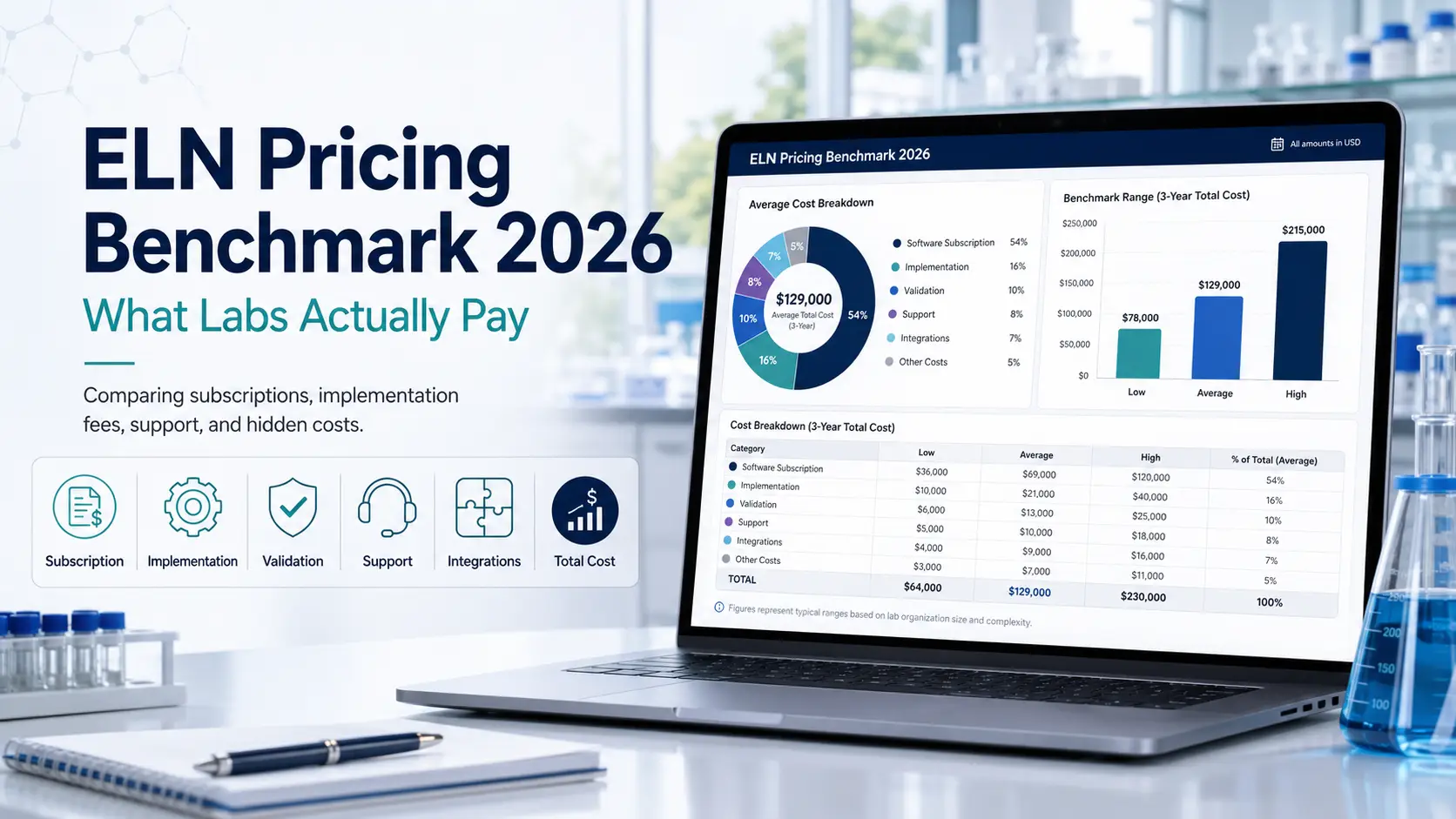
Electronic Lab Notebooks are dramatically cheaper and more transparently priced than LIMS. Entry-level commercial ELN plans start around $12–30 per user per month, mid-market platforms land near $18–56, and open-source options cost nothing to licence. The defining feature of ELN pricing is the academic/commercial split: the same product is frequently free or heavily discounted for universities and several times more expensive for companies — Labfolder is reported at roughly $18 per user monthly for academics versus $56 for commercial teams, and Benchling is free without limits for academia while commercial contracts are reported to start around $15,000 a year. This benchmark documents what is verifiable, flags where sources contradict each other, and says plainly what nobody can confirm.
Why ELN pricing is more knowable than LIMS pricing
Anyone who has priced a LIMS will find the ELN market a relief. Where enterprise LIMS vendors publish nothing and route every enquiry through a sales process, a meaningful share of ELN vendors publish tiers, offer free plans, or price low enough that individual researchers buy without procurement involvement.
Two structural reasons explain this. First, ELNs sell heavily into academia, where budgets are small, purchasing is decentralized, and a postdoc may choose the tool personally — a market that rewards transparent, self-serve pricing. Second, the ELN category has a credible free open-source option in eLabFTW, which anchors the low end and puts pressure on commercial pricing in a way that has no real equivalent in LIMS.
The result is that ELN benchmarks can be built on firmer ground. But “firmer” is not “firm,” and this guide applies the same evidence tiers we use in our LIMS pricing benchmark:
- Tier A — Vendor-published: stated publicly by the vendor on its own pricing page.
- Tier B — Aggregator-reported: published by review platforms (G2, Capterra) or independent reviewers, typically vendor-supplied or drawn from public materials.
- Tier C — Third-party estimated: figures from competitors, comparison sites, or undated community tables. Useful for orientation, unreliable for budgeting.
As with LIMS, be wary of pricing pages that disclose AI-assisted content or describe competitor figures as extrapolated. A modelled number presented as an observed one is worse than no number at all.
The academic/commercial split: the defining feature of ELN pricing
Before any table, understand the variable that moves ELN cost more than any other: who you are, not what you buy.
Multiple ELN vendors operate a two-tier model where identical functionality carries very different prices depending on whether the buyer is academic or commercial. Labfolder is the clearest documented example: academic institutions are reported to pay approximately $18 per user per month while commercial organizations pay around $56 per user per month for the same features — close to a threefold difference.
Benchling takes this further, offering a genuinely free, unlimited academic tier — which is why it is ubiquitous in university labs — while commercial pricing is opaque and reported to start around $15,000 per year for a small team, scaling sharply from there. LabArchives is widely deployed through institutional site licences, meaning many academic users pay nothing directly because their university already holds the contract.
Two practical consequences follow. If you are academic, check what your institution already licenses before buying anything — you may have free access to a platform you were about to purchase. If you are commercial, discount every headline ELN price you see online: much of it is academic pricing, and your quote will be materially higher.
Vendor-level pricing: what is documented
The table below covers ELN platforms with reported pricing. Where sources conflict, we show the conflict.
| Platform | Reported price | Tier | Source & notes |
|---|---|---|---|
| eLabFTW | Free — open source under AGPLv3; self-hosted. Paid cloud hosting available from the maintainers | A | Licence is verifiable fact. Self-hosting shifts cost to infrastructure and staff time, not licence. |
| SciNote | Free tier; premium reported from $12/user/month. Also reported at $50–300 per user annually and ~$250/user/year | B/C | Sources broadly consistent ($12/mo ≈ $144/yr). SciNote itself directs pricing enquiries to sales rather than publishing a full rate card. |
| Labfolder | Free plan (3 GB, 3-user limit); premium from $18/user/month academic, ~$56/user/month commercial | B/C | The $18 entry figure appears in two independent sources; the academic/commercial split is reported by a competitor (Scispot). |
| LabArchives | Reported $15–25/user/month; widely available free to researchers via institutional site licences | B/C | Institutional licensing is the dominant academic access route. |
| Benchling | Free, unlimited academic tier; commercial reported to start around $15,000/year for a small team | A (academic) / C (commercial) | Benchling publishes no commercial list price. See conflict note below. |
| Labguru (Cenevo) | Reported around $900 per user per year in a community comparison table | C | Undated third-party table maintained by a competing vendor. Treat as orientation only. |
| RSpace | Reported around $200 per user per year plus a $1,500 installation fee | C | Same undated community source. |
| LabCollector | Reported around $460 per user per year | C | Same source. |
The Benchling conflict deserves attention. One community comparison table lists Benchling at $2,400 per user per year (roughly $200/month), while an independent reviewer reports a commercial minimum around $15,000 per year for a five-person lab. These are not reconcilable as like-for-like. The likeliest explanation is that the lower figure reflects an older or nominal per-seat rate, while the higher reflects a real-world minimum contract value — the floor a commercial buyer actually encounters regardless of headcount. For budgeting, assume the minimum-contract reality rather than the per-seat arithmetic, and confirm directly. Our Benchling overview covers the platform in depth.
A note on the community table. Several figures above (Labguru, RSpace, LabCollector, and the disputed Benchling number) come from a GitHub comparison maintained by Labii, itself an ELN vendor. It is a genuinely useful compilation and we cite it transparently, but it is undated, unaudited, and authored by a market participant. That is precisely why it sits in Tier C.
Where ELN pricing sits relative to LIMS
The contrast is stark and worth stating, because labs frequently conflate the two categories when budgeting.
A mid-market LIMS costs roughly $25,000–50,000 per year, with cloud subscriptions commonly $40–300 per user per month and enterprise contracts above $50,000. A mid-market ELN costs a small fraction of that: commercial per-user pricing clusters in the $12–56 per user per month band, with free tiers genuinely usable for small or academic teams.
That gap reflects a real difference in scope. A LIMS manages samples, workflows, instruments, batches and compliance across an operation; an ELN documents experiments. When an ELN approaches LIMS pricing — as Benchling’s commercial tier does — it is generally because the product has expanded into sample management, registration and inventory, becoming a platform rather than a notebook. If you are unsure which category you actually need, our ELN vs LIMS explainer resolves it, and the how to choose an ELN checklist structures the evaluation.
The costs that don’t appear in the per-user price
ELN total cost is closer to the sticker price than LIMS total cost, but four line items still surprise buyers.
Storage limits and overages. ELN plans are frequently gated on storage rather than features, and labs generating imaging or instrument data hit ceilings quickly. Labfolder’s free plan caps at 3 GB; community data suggests storage add-ons priced per 100 GB. If your work is image-heavy, model storage as a recurring cost, not a footnote.
Installation and onboarding fees. Mostly absent at the low end, but real for institutional deployments — RSpace is reported to carry a $1,500 installation fee, and enterprise ELN deployments (Hivebench is reported at around $20,000 plus licensing) shift the economics entirely.
The self-hosting trade. eLabFTW’s licence is free, but self-hosting converts a subscription into staff time: servers, backups, upgrades, security patching, and — for regulated labs — validation documentation you must write yourself. Our eLabFTW overview and open-source LIMS decision guide explain when free genuinely wins.
Compliance tiers. If you need 21 CFR Part 11 support — e-signatures, audit trails, validation — expect it to sit in a higher tier or require a regulated edition. Budget for the compliant version, not the entry plan. See our 21 CFR Part 11 explainer.
Data portability. Not a line item but a financial risk: independent reviewers flag limited export capability on some widely used platforms, which makes migration costly and turns a cheap subscription into an expensive dependency. Confirm the export path before you commit.
How to use this benchmark
Check institutional access first if you are academic. The cheapest ELN is often the one your university already pays for. This single step saves more money than any negotiation.
Assume the academic price you see online is not your price if you are commercial. Given documented gaps of roughly 3x, budget accordingly and ask specifically for commercial pricing.
Ask for the minimum contract value, not the per-seat rate. The Benchling discrepancy shows that per-user arithmetic can understate reality by an order of magnitude when a vendor enforces a contract floor.
Model storage, not just seats. For imaging and instrument-heavy labs, storage is frequently the variable that determines which tier you land in.
Weight transparency. Vendors who publish tiers reduce your negotiation asymmetry. Opacity is not proof of expense, but it does transfer risk to you.
Methodology and limitations
This benchmark compiles publicly available ELN pricing as of July 2026. We have not received vendor quotes, conducted a buyer survey, or verified any figure against a signed contract — and we say so plainly.
Specific limitations. Several figures come from undated third-party compilations, including one maintained by a competing vendor, and are labelled Tier C accordingly. Vendors including SciNote and Benchling route pricing through sales rather than publishing complete rate cards, so their entries are partial. Academic pricing dominates published figures, which systematically understates commercial cost. Reported prices are entry tiers; real quotes vary with storage, compliance requirements, integrations and negotiation. And where a cited source is a competitor of the vendor being priced, we say so in the table.
If you have a dated written ELN quote and are willing to share the figures, we would welcome the contribution — verified buyer-side data is what this market most lacks.
The honest bottom line
ELN pricing is one of the more navigable corners of laboratory software. The broad picture is consistent across sources: free and open-source at the bottom, $12–30 per user per month for entry commercial plans, roughly $18–56 for mid-market platforms with a sharp academic/commercial split, and five-figure annual contracts once a notebook becomes a full research platform.
The two decisions that move your cost most are not which vendor you pick but whether your institution already licenses something and whether you are buying as an academic or a company. Settle those first, and the rest of the ELN market is refreshingly easy to price — a sentence that can almost never be written about LIMS.
Prices compiled July 2026 from publicly available sources and subject to change. Figures should be confirmed directly with vendors before any purchasing decision; nothing here constitutes a quote. Several cited sources are competitors of the vendors they price, and this is flagged where relevant. LabSoftwareGuide is an independent editorial resource and is not affiliated with the vendors listed.
Sources
Vendor and licence facts (Tier A)
- eLabFTW — open-source ELN, AGPLv3: https://www.elabftw.net/
- SciNote — pricing enquiry routing: https://www.capterra.com/p/156310/sciNote-Electronic-Lab-Notebook/
Independent and aggregator-reported (Tier B)
- Scientist in Progress — Benchling Review 2026 (commercial minimum, SciNote annual range, lock-in): https://scientistinprogress.com/blog/benchling-review/
- 37degrees — Electronic Lab Notebooks in 2026: The Modern Scientist’s Guide: https://www.37degrees.io/resources/eln-landscape-2026/
- App Deal Hunt — Best Electronic Lab Notebooks for Biotech Startups 2026 (LabArchives, SciNote, Benchling entry figures): https://appdealhunt.com/featured/best-electronic-lab-notebooks-eln-for-biotech-startups-2026-2/
- Alternatives.co — Labfolder Pricing and Packages: https://alternatives.co/software/labfolder/pricing/
Third-party estimated (Tier C)
- Labii — Comparison of Best Electronic Lab Notebook (GitHub, undated, maintained by a competing ELN vendor): https://github.com/Labii/comparison-of-best-electronic-lab-notebook
- Scispot — Labfolder Pricing Guide (competitor analysis, academic vs commercial split): https://www.scispot.com/blog/labfolder-pricing-guide-full-breakdown-of-plans-costs-and-better-options
- Scispot — LabArchives Pricing Guide (competitor analysis): https://www.scispot.com/blog/labarchives-pricing-guide-plans-costs-features-explained